

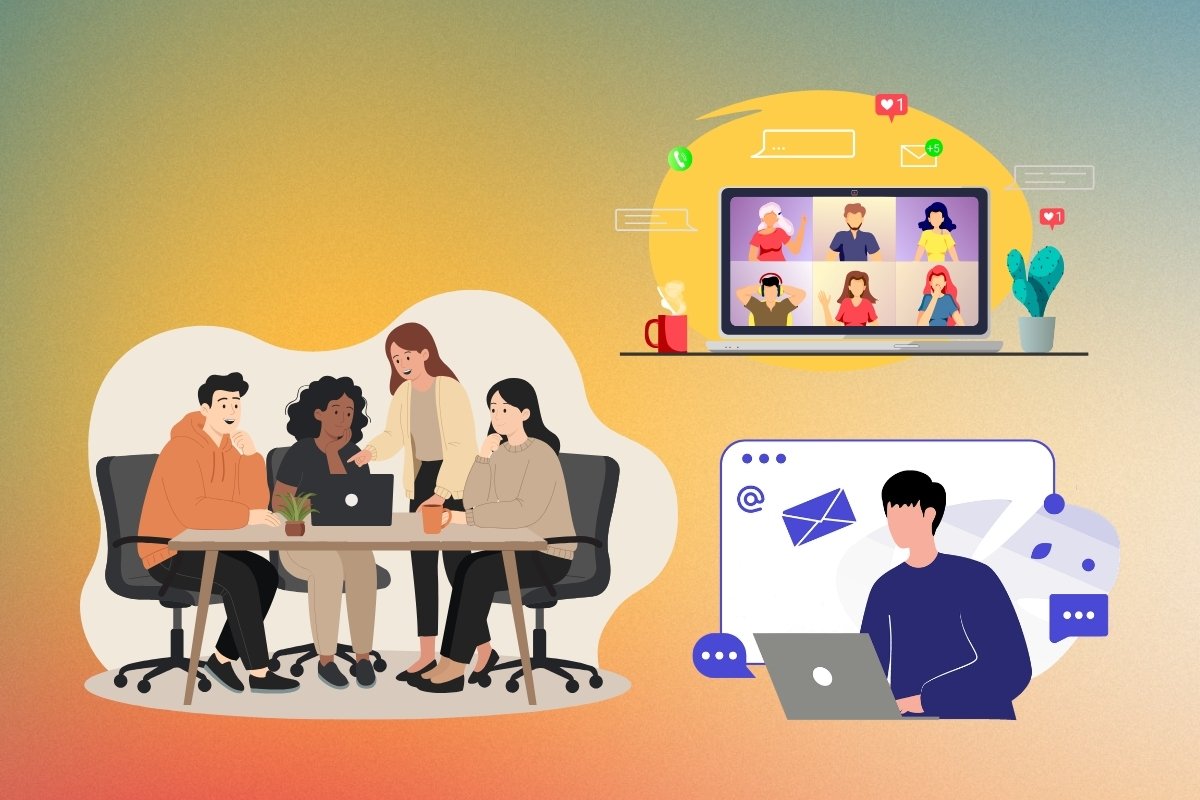
Workplace communication plays a direct role in how employees understand priorities, coordinate tasks, make decisions and respond to change. Organizations are managing more communication channels than ever, from email and instant messaging to video meetings, collaboration platforms and AI-supported tools. These systems can improve speed and access to information, but they can also create overload, fragmented attention and confusion when messages are unclear or poorly organized.
The effects are visible across different work environments. Hybrid teams need clear communication rules to stay aligned across locations, managers need to translate company strategy into practical expectations and employees increasingly depend on digital tools to retrieve information quickly. At the same time, communication quality can influence productivity, engagement, trust, retention and collaboration. The statistics in this article show how workplace communication is changing and where organizations can improve the way information moves across teams.
Editor’s Choice: Key Workplace Communication Statistics
- Only 1 in 6 employees in 2026 feels entirely aligned with organizational goals, despite alignment remaining central to execution and performance.
- 75% of leaders say their communications are clear and engaging in 2026, while only 61% of employees share that assessment. The 14-point gap shows that communication quality depends heavily on the recipient’s experience.
- Poor communication can consume 10% to 30% of an employee’s working year, turning communication quality into a measurable labor-cost issue.
- Employees earning more than $200,000 lose more than 60 working days annually to poor communication, an increase of 17 days from the prior year.
- In 2026, 54% of high-performing organizations prioritize organization-wide communication from different leadership levels multiple times each week.
- Organizations with highly engaged employees record 18% higher productivity and 23% higher profitability than comparison groups in the underlying engagement research.
- In 2025, 20% of employees worldwide were engaged at work, marking a second consecutive annual decline after engagement reached 23% in 2023.
- Weekly meaningful manager feedback has a major connection with engagement: about 7 in 10 employees who strongly agree they received meaningful feedback are highly engaged, versus roughly 1 in 4 among those who do not strongly agree.
- In 2025, 30% of employees said improving workplace communication would make them more likely to remain with their employer.
- Among organizations that increased internal communication investment, 68% reported improved employee retention, compared with 32% among organizations where investment stayed flat or decreased.
Recent Developments
- Employee perceptions of clear and engaging communication reached 61% in 2026, while 75% of leaders rated their communication that way.
- Employee alignment improved from 9% in 2025 to 16% in 2026, although fewer than one-fifth of employees still describe themselves as entirely aligned with organizational goals.
- Leaders became slightly less optimistic about alignment: the share saying employees were entirely aligned fell from 27% in 2025 to 25% in 2026.
- Despite the improvement in employee-reported alignment, communication-related missed deadlines nearly doubled from 2025 to 2026.
- In 2026, 61% of leaders think employees regularly use AI or qualify as AI power users, but only 40% of employees agree.
- Another 29% of employees say they rarely use AI at work, highlighting a sizable gap between management assumptions and day-to-day adoption.
- Only 26% of employees say their organization has clear and enforced policies for AI use. This leaves roughly three-quarters without the level of guidance captured by that measure.
- Among communication leaders surveyed in 2026, 96% use AI at least weekly, showing much faster adoption within communication functions than among employees overall.
- Furthermore, 93% of communication leaders using AI report performance gains, while 42% have already created at least one AI assistant, agent or automated workflow.
- Among high-performing organizations, 55% significantly increased investment in both AI tools and employee training designed to help workers use those tools effectively.
The Cost of Poor Workplace Communication
- In 2026, poor communication accounts for an estimated 10% to 30% of the working year across organizational levels.
- For employees earning more than $200,000, communication problems can consume more than 60 working days per year.
- That annual loss for $200,000-plus employees increased by 17 working days year over year, indicating that the time cost has risen rather than disappeared as communication technology has expanded.
- In the 2025 findings, an employee earning $50,000 to $100,000 could lose more than 35 working days annually because of ineffective communication.
- For that $50,000-to-$100,000 employee group, the estimated salary value of lost time reached $10,140 per employee per year.
- Employees in the 2025 research reported spending only 63% of their workday executing core responsibilities.
- At the same time, 34% of the workday went toward distractions and avoidable meetings, illustrating how communication and coordination demands can compete with focused work.
- Among leaders surveyed in 2025, 33% had to set aside their own work to deal with immediate problems caused by ineffective communication.
- Another 30% of leaders said communication problems pulled them further into projects than their roles should require.
- Meanwhile, 27% of leaders reported spending excessive time clarifying or reinforcing objectives, organizational goals or company policies.

How Poor Communication Affects Productivity
- In 2025, 73% of leaders believed employees could easily retrieve previously shared goals, strategies and directives, but only 49% of employees agreed.
- This means 51% of employees did not agree that critical organizational information was easy to find when they needed it.
- Only 12% to 16% of employees described the critical leadership updates they needed for their jobs as “very effective.”
- When employees clearly understand organizational goals and feel engaged, 63% report increased productivity, making goal clarity one of the strongest communication-linked performance measures in the 2025 research.
- Clear goals and engagement also correspond with a 59% improvement in motivation, which can affect how consistently employees sustain effort.
- Employees reported a 45% improvement in collaboration when they clearly understood organizational goals and were engaged.
- Problem-solving improved by 44% under the same conditions, linking communication clarity with employees’ ability to address operational issues.
- Employees also reported a 35% improvement in their ability to meet project timelines when they understood organizational goals and felt engaged.
- Among leaders with strongly aligned teams, 62% reported that employees operated efficiently, while 53% connected strong alignment with increased revenue and profits.
- In 2026, the number of missed deadlines associated with poor communication reached almost twice the 2025 level, suggesting that communication breakdowns continue to create measurable execution problems.
Communication’s Impact on Employee Engagement and Retention
- Global employee engagement declined from 21% in 2024 to 20% in 2025, its lowest level since 2020.
- Manager engagement fell even faster, dropping from 27% in 2024 to 22% in 2025. By comparison, nonmanager engagement edged up from 18% to 19%.
- The previous year’s fall in global engagement carried an estimated $438 billion productivity cost to the world economy in 2024.
- In 2025, 79% of employees said leadership communication quality affects how well they understand organizational goals.
- Another 72% of employees said their understanding of organizational goals affects how engaged they are at work.
- 30% of employees said better workplace communication would make them more likely to remain with their employer, making communication a measurable retention factor alongside pay, benefits and career development.
- Among organizations that increased communication investment, 68% reported improved engagement, compared with 32% among organizations that maintained or reduced investment.
- Likewise, 68% of organizations that increased communication investment reported improved employee retention, compared with 32% among organizations with flat or reduced investment.
- Employees who strongly agree that they received meaningful manager feedback recently show engagement rates of about 70%, while only about 25% are engaged when they do not strongly agree they received such feedback.
- Finally, roughly 3 in 10 preventable turnover factors identified by former employees related to manager relationships: 21% involved a need for more positive interactions, including listening and communication, while 8% involved reducing negative manager interactions.
Workplace Communication Channel Preferences
- In 2025, 65% of employees relied on email for workplace communication, making it the most widely used channel in the survey.
- One-to-one conversations with line managers ranked second, with 35% of employees relying on them for workplace information.
- Company newsletters and team meetings each reached 34%, showing that structured written updates and group discussions remain important alongside instant communication.
- More than half of employees, 53%, preferred receiving information about organizational plans and priorities in writing. This supports the continued role of searchable, asynchronous communication.
- Another international study found 47% of employees preferred email or management memos for company news and information, ahead of immediate supervisors at 44%.
- Immediate supervisors carried particularly strong credibility: 57% of employees said they trusted information from their supervisor “a great deal.”
- For critical organizational updates, 22% of employees preferred newsletters or recurring updates, while the same percentage preferred text messages.
- Instant messaging or online chat appealed to 18% of employees for critical updates, compared with 16% for employee apps and 16% for phone calls.
- Only 11% preferred video messages for critical updates, while podcasts attracted just 4%, suggesting that newer formats do not automatically outperform concise written communication.
- From the communication professional’s perspective, intranets and email also remain prominent: 67% identified intranets and 58% identified email as effective internal communication channels.

Remote and Hybrid Work Communication Statistics
- As of May 2026, 52% of U.S. employees with remote-capable jobs worked hybrid schedules, while 26% worked exclusively remotely and 22% worked fully on-site.
- The hybrid share has remained remarkably stable: it stood at 52% in May 2025 and remained at 52% in May 2026.
- In Q2 2025, 47.4% of remote-capable employees said most members of their teams worked across different locations, up from 42.3% in Q2 2024.
- By comparison, only 36.8% of employees in Q2 2025 said most team members worked from the same physical location, down from 40.6% one year earlier.
- Communication remains one of the biggest hybrid-work problems: 48% of leaders and managers identify communication as a top hybrid challenge, while 44% identify collaboration.
- Nearly 48% of hybrid employees say their team has not discussed a formal or informal plan for collaborating effectively in a hybrid environment.
- Employees on teams with an agreed hybrid collaboration plan are 66% more likely to be engaged than employees without such a plan.
- Employees with a hybrid collaboration plan are also 29% less likely to experience burnout, linking communication norms with employee well-being.
- These employees are 2.2 times as likely to say their organization’s hybrid policy has an extremely positive effect on team collaboration.
- Hybrid scheduling also became slightly more structured in 2025: 34% of hybrid employees determined their own schedules, 35% followed manager or team decisions, and 31% followed schedules set by organizational leadership.
Internal Communication Challenges and Barriers
- In a 2025 global survey of internal communication professionals, 60% struggled to engage frontline employees, making frontline reach the most commonly reported communication challenge.
- Low engagement with company intranets affected 53% of communication leaders, despite intranets remaining a major channel for distributing company information.
- Another 47% reported outdated information on communication channels, which can create confusion when employees encounter conflicting policies or instructions.
- 40% struggled to track the impact of email campaigns, limiting their ability to determine whether important communications actually reached or influenced employees.
- Information overload ranked among the largest underlying barriers, with 64% citing it as a cause of communication challenges.
- Heavy workloads created an equally large problem: 64% said employees were too busy to check workplace communications effectively.
- Limited digital access affected 31%, a particularly important issue for frontline workers who may not spend their shifts at computers.
- A geographically distributed workforce created communication difficulties for 22% of respondents, while outdated intranets also registered at 22%.
- Employee information needs also remain uneven. In 2025, 36% said they did not receive enough information about pay and benefits, while 31% wanted more career-development information.
- Organization size affects communication experience: 83% of employees at organizations with 500 to 999 workers said they received the right amount of information, compared with 67% at organizations with 10,000 or more employees.
How Employees Are Using AI for Workplace Communication
- Drafting and replying to emails is the most common communication task delegated to AI, with 35% of employees using AI for this purpose.
- 33% of employees use AI to summarize meeting notes and transcripts, making it the second-most common application.
- Automating routine team updates is handled with AI by 30% of employees, highlighting its growing role in repetitive workplace communication.
- Around 28% of employees rely on AI for adjusting tone and polishing written text, helping improve clarity and consistency.
- Generating presentation outlines and reports ranks fifth, with 25% of employees using AI to support these content-heavy tasks.
- The gap between the highest and lowest reported uses is only 10 percentage points, indicating that AI adoption is relatively distributed across multiple communication activities.

Communication Skills Employers Value Most
- In 2025 hiring research, 77.1% of employers said they looked for written communication skills on candidates’ resumes.
- Verbal communication also ranked highly, with 69.3% of employers seeking this ability from job candidates.
- Communication connects closely with teamwork: 81% of employers wanted candidates who could work effectively as part of a team.
- Interpersonal skills mattered to 63.1% of employers, reinforcing the value of communicating effectively with colleagues rather than relying only on technical expertise.
- Problem-solving topped the overall resume attribute list at 88.3%, a skill that often requires employees to explain problems, exchange information and communicate solutions.
- Employer assessments put communication’s importance even higher when measured as a career-readiness competency: 96.1% rated communication as very or extremely important.
- However, only 53.5% of employers rated recent graduates as very or extremely proficient in communication, creating a 42.6-percentage-point gap between importance and perceived proficiency.
- Students viewed their own skills differently: 78.1% of new graduates rated themselves highly proficient in communication, a 24.6-point difference from the employer assessment.
- Teamwork showed a much narrower skills gap: 93.9% of employers considered teamwork highly important and 81.5% rated recent graduates highly proficient in it.
- The 2026 hiring update continues the pattern: more than 40% of employers said new graduates’ overall skills aligned very closely with hiring needs, while 56% described them as partially aligned. Employers nevertheless continued to identify communication among the most important areas for improvement.
Statistics on Meeting and Email Overload
- Employees in the heaviest communication group receive about 275 meeting, email or chat interruptions per day, which works out to roughly one interruption every two minutes during core working hours.
- In 2025, 60% of meetings among employees with the highest meeting volume were unscheduled or ad hoc, reducing workers’ ability to plan uninterrupted focus time.
- Employees received an average of 117 emails per day in 2025, illustrating how inbox management can become a substantial daily workload by itself.
- Workers also received an average of 153 workplace chat messages per day, adding another high-frequency stream of information alongside email.
- About 50% of meetings took place during the two periods researchers identified as the most productive parts of the day: 9-11 a.m. and 1-3 p.m.
- After-hours communication rose as well. Workplace chats outside the traditional 9-to-5 schedule increased 15% year over year, with employees receiving an average of 58 messages before or after normal hours.
- Meetings beginning after 8 p.m. increased 16% year over year, reflecting the communication demands created by global and cross-time-zone teams.
- Around 30% of meetings now involve multiple time zones, up 8 percentage points compared with 2021.
- Late preparation creates another source of pressure: presentation edits increased 122% during the final 10 minutes before meetings compared with three hours beforehand.
- Overall, 48% of employees and 52% of leaders described their work as chaotic and fragmented, showing how constant communication can undermine employees’ sense of control over their workday.
Generational Differences in Workplace Communication Preferences
- Gen Z leads in instant messaging adoption, with 78.9% preferring channels such as Slack, Microsoft Teams and text messaging for internal workplace communication.
- Millennials favor a hybrid communication approach, with approximately 65.0% preferring a combination of instant messaging and email.
- Baby Boomers show a stronger preference for traditional communication, with around 60.0% favoring face-to-face meetings and phone calls.
- Gen X employees lean toward direct communication, with approximately 55.0% preferring concise emails and phone conversations.
- The data highlights a clear generational divide in workplace communication, as younger employees gravitate toward digital, real-time channels, while older generations retain stronger preferences for email, phone and in-person interaction.

How Effective Communication Builds Trust
- In May 2026, just 20% of U.S. employees strongly agreed that they trusted the leadership of their organization. That figure stood at 19% in August 2025.
- Trust has declined over the longer term. 24% of U.S. employees strongly agreed that they trusted organizational leadership in 2019, compared with 20% in May 2026.
- Globally, 58% of workers in 2025 said they trusted their direct manager and felt able to speak openly with that person.
- Employees with the highest trust in their direct manager were 72% more motivated than workers reporting the lowest manager trust.
- Similarly, employees with the highest trust in top management were 63% more motivated than employees with the lowest level of leadership trust.
- Communication remains one of the clearest sources of dissatisfaction: 29% of employees in recent U.S. engagement research said their workplace lacked clear, honest or consistent leadership communication.
- In 2025, only 32% of U.S. employees strongly agreed that their organization provided a trusting and open working environment, although that represented a slight increase from 31% in 2024.
- Immediate supervisors hold strong communication credibility. 57% of employees across an international study said they trusted information from their supervisor “a great deal.”
- By comparison, 51% highly trusted information from an intranet, while 50% placed that level of trust in emails or management memos. Human communication therefore retained an advantage over major digital channels.
- High-performing teams also show a strong trust advantage: 65% of people on high-performing teams said team members trust one another, compared with 28% of respondents on teams that did not report high performance.
Manager and Leadership Communication Statistics
- 56% of internal communication professionals named manager communication as their top communication trend for 2026.
- Despite that priority, only 4% of communicators said managers were very effective at cascading organizational communication to employees.
- Another 17% said managers were only somewhat effective at cascading information, illustrating the scale of the manager communication gap.
- In August 2025, only 27% of U.S. employees strongly agreed that their direct manager communicated effectively. The same percentage was recorded in August 2024.
- Only 29% of U.S. employees strongly agreed in 2025 that their manager actively supported team members during organizational change.
- Communication professionals also recognize the leadership problem. In 2025, 1 in 3 identified leadership communication coaching as a major priority.
- Meanwhile, 45% of communication professionals rated leadership communication coaching as a highly important professional skill.
- Communication teams are already trying to influence leadership behavior: 87% said they proactively approached leaders with advice about how to communicate.
- However, only 70% said leaders implemented their communication advice, leaving a 17-point gap between recommendations offered and recommendations acted upon.
- A 2025 global study of more than 1,300 professionals found that 59% of managers believed their own engagement had increased during the previous year, while 80% of employees said their managers’ engagement had either remained flat or declined.
Workplace Collaboration and Team Communication Statistics
- In 2025 research, 68% of respondents identified themselves as members of high-performing teams, providing a benchmark for comparing the behaviors that separate stronger teams from weaker ones.
- Among high-performing teams, 72% said team members respected one another, compared with just 31% among employees who did not report belonging to a high-performing team.
- 68% of high-performing team members said colleagues made everyone feel included and part of the team, compared with 50% on lower-performing teams.
- A strong sense of support and encouragement appeared among 63% of high-performing teams, versus only 25% of teams that did not report high performance.
- Hybrid-team research shows that employees with a formal collaboration plan are 66% more likely to be engaged than hybrid employees whose teams have not created such a plan.
- Employees working under an agreed hybrid collaboration plan are also 29% less likely to experience burnout, showing that coordination practices can influence well-being as well as output.
- These employees are 2.2 times as likely to say their organization’s hybrid policy has an extremely positive effect on collaboration.
- Structured meeting communication can improve results. In one workplace experiment, 85% of page-led meetings achieved their objectives, compared with 69% of standard meetings.
- Participants in meetings supported by a clear written briefing reported 29% more energy and were 23% less likely to feel frustrated than participants in conventional meetings.
- Access to information remains a collaboration problem: more than half of HR and people leaders said at least 75% of employee requests concern information that employees can technically already access through an intranet or knowledge base.

Communication Technology and Automation Trends
- In 2026, 42% of internal communication professionals reported using AI every day as part of their workflows.
- Another 31% use AI several times per week, meaning almost three-quarters of communicators use the technology at least multiple times during a typical week.
- Automation has become the leading desired AI application: 68% of communication professionals said automating repetitive tasks was their top AI priority for 2026.
- AI adoption does not mean established communication channels have disappeared. 95% of internal communication teams still use email, making it the most widely used channel in the 2026 research.
- Email also remains effective: 81% of communication teams identified it as their most effective channel.
- AI use has spread far enough that only 22% of surveyed communication professionals said in 2026 that they were not using AI in the workplace.
- However, the business case remains uneven. In late-2025 research, 96% of surveyed executives said AI had not yet produced meaningful return on investment at the organizational level.
- Knowledge workers nevertheless reported sizable individual benefits, saying AI made them 33% more productive and saved an average of 1.3 hours each day.
- Only 4% of executives reported dramatic AI-driven improvements in organizational efficiency, innovation or work quality, highlighting the gap between individual productivity and companywide impact.
- Companies that emphasized AI experimentation rather than waiting for a perfect implementation strategy were twice as likely to report significant innovation gains.
The Future of Workplace Communication
- In early 2026 research covering more than 12,000 global knowledge workers, only 14% of teams had reached the highest-performing category for generating measurable returns from AI-supported ways of working.
- Teams in that leading group were up to 9.4 times more likely to say AI increased collaboration, indicating that the technology creates more value when integrated into team workflows rather than used only for individual tasks.
- Those teams were also up to 5.6 times more likely to say AI helped them plan and prioritize work more effectively.
- High-performing AI teams were 2.3 times more likely to fully trust AI to identify and contextualize relevant workplace information.
- Looking further ahead, executives surveyed in 2025 predicted that by 2030 only about one-third of work will be completed entirely by humans, underscoring expectations for deeper human-AI collaboration.
- In 2025, 82% of business leaders expected to use digital labor to increase workforce capacity during the following 12 to 18 months.
- However, human capacity remains constrained: 80% of employees and leaders said they lacked enough time or energy to complete their work, while 53% of leaders said productivity still needed to increase.
- Internal communicators are also looking beyond traditional top-down messaging. 41% said they wanted to explore employee influencers in 2026 to help translate organizational messages into more relatable workplace communication.
- Communication teams increasingly want better information flow themselves: 67% said obtaining content from other teams was their biggest obstacle in 2026.
- At the same time, 72% of communicators identified employee engagement as their No. 1 goal, showing that future communication strategies will still need to prioritize human understanding rather than message volume alone.
Frequently Asked Questions (FAQs)
Employees in the highest communication-volume group receive about 275 meeting, email and chat interruptions per day, equal to roughly one interruption every two minutes during core work hours.
In 2025, the average employee received about 117 emails and 153 workplace chat messages per weekday.
About 48% of leaders and managers identify communication as one of their biggest challenges in a hybrid work environment, while 44% cite collaboration.
Hybrid employees whose teams establish a collaboration plan are 66% more likely to be engaged and 29% less likely to experience burnout.
About 48% of employees say their work feels chaotic and fragmented, compared with 52% of leaders.
Conclusion
Workplace communication statistics show that better technology does not automatically create better communication. Employees now have access to more channels, more information and more AI-supported tools, yet many organizations still struggle with communication overload, weak manager communication, fragmented information and low levels of trust. The data also shows that poor communication can reduce productivity, make collaboration harder and influence whether employees remain engaged with their work.
The most effective approach combines clear priorities, accessible information, strong manager communication and selective use of automation. Organizations also need communication practices that fit hybrid work, different employee preferences and increasingly AI-supported workflows. When employers reduce unnecessary communication, improve message clarity and make important information easier to find, they can strengthen productivity, collaboration, engagement and trust across the workplace.