


Wireless gaming mice have evolved from convenience-focused peripherals into high-performance hardware used by casual PC gamers, competitive players, and esports professionals. Improvements in low-latency 2.4 GHz connectivity, sensor accuracy, battery efficiency, and lightweight construction have reduced many of the performance compromises traditionally associated with wireless devices. Current flagship models can deliver 8,000 Hz wireless polling, weigh less than 50 grams, and provide more than 100 hours of battery life under certain operating conditions.
These advances have also changed how gamers choose peripherals. Competitive players can prioritize low weight and rapid response without relying on a wired connection, while everyday PC gamers gain cleaner desk setups and greater freedom of movement. At the same time, growing wireless adoption, premium product launches, and expanding regional demand are influencing market revenue and pricing. The following wireless gaming mouse statistics examine market size, growth, adoption, sales, esports usage, sensor performance, latency, weight, and battery life.
Editor’s Choice
- The broader global gaming mouse market reached an estimated $1.92 billion in 2025 and $2.08 billion in 2026 under one market model.
- Wireless accounted for an estimated 60% of PC gaming mouse revenue in 2025 in one connectivity analysis.
- The same analysis values the 2025 wireless PC gaming mouse segment at approximately $2.1 billion, compared with $1.4 billion for wired products.
- A dedicated wireless gaming mouse forecast estimates the category at $1.92 billion in 2025 and projects $3.45 billion by 2032.
- That dedicated forecast translates to an expected 8.7% CAGR through 2032.
- U.S. online sales among the top 50 tracked wireless gaming mouse listings reached 101,750 units in July 2026, generating about $5.98 million.
- December 2025 was the strongest month in that trailing online dataset, reaching approximately 135,300 units and $6.7 million in sales.
- Wireless performance now extends to 8,000 Hz polling on current esports-focused products, removing much of the historical performance distinction between wired and wireless designs.
- One 2026 model reports average wireless click latency as low as 0.204 milliseconds and motion latency of 0.36 milliseconds.
- Battery efficiency continues to improve alongside speed: one current 57-gram esports model provides up to 150 hours at 1,000 Hz, although that figure drops to 22 hours at 8,000 Hz.
Recent Developments
- New competitive models now support a true 8,000 Hz polling rate over wireless connections, meaning the mouse can theoretically report its position to the PC up to 8,000 times per second.
- One latest-generation wireless implementation claims 37% lower latency than its previous generation under standard test conditions.
- The same wireless architecture claims to operate with more than 63% greater efficiency, addressing the power demands created by higher polling rates.
- Sensor specifications have also increased. One 2026 esports-oriented model combines 45,000 DPI, 900 IPS tracking, and acceleration support of 85 G.
- That sensor carries a claimed 99.8% resolution accuracy, illustrating how manufacturers now compete on tracking consistency as well as headline DPI.
- Lightweight engineering remains another focus. A current ergonomic wireless esports model weighs 57 grams, despite containing its own battery and wireless hardware.
- High polling rates create a clear battery trade-off. The same device offers up to 150 hours at 1,000 Hz but only 22 hours at 8,000 Hz, a difference of roughly 85%.
- U.S. online demand remained substantial in mid-2026: the top 50 tracked wireless gaming mouse listings sold approximately 108,500 units in June and 101,750 in July.
- July 2026 sales were 15.9% higher than August 2025 in that tracked U.S. online dataset, despite falling 6.2% from June.
- The wider peripherals business also remained active. One major gaming hardware company’s gamer and creator peripherals revenue reached $492.1 million in 2025, up about 4% from $472.7 million in 2024.
Wireless Gaming Mouse Market Size
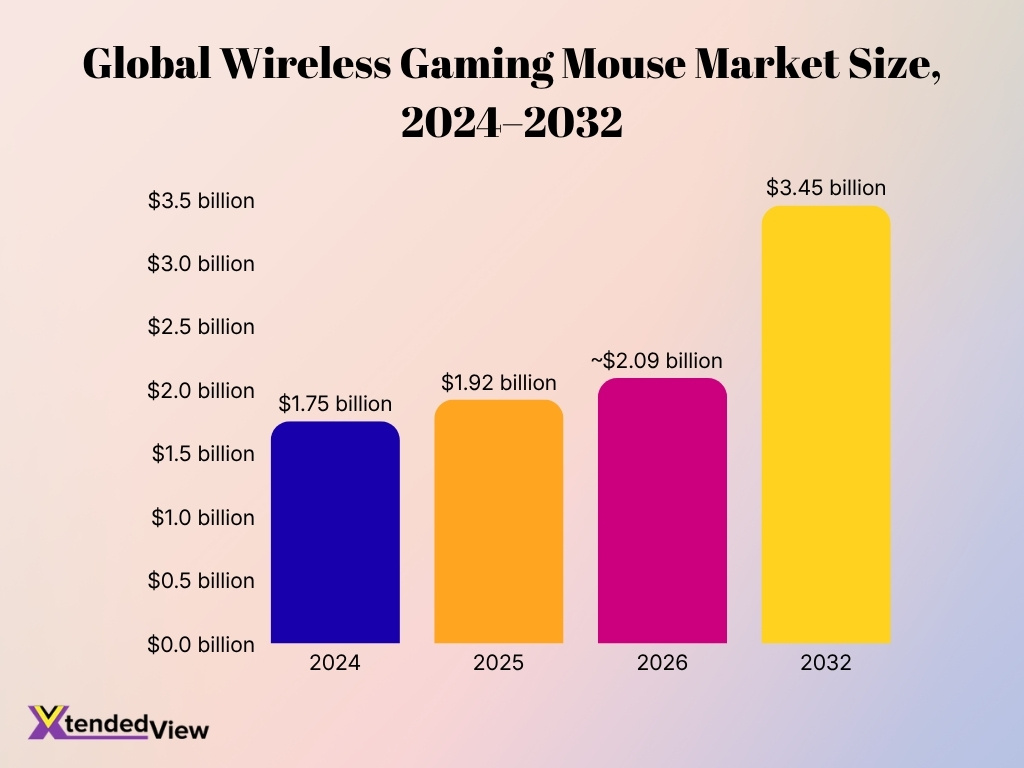
- The global wireless gaming mouse market was valued at $1.75 billion in 2024.
- Market size increased to $1.92 billion in 2025, reflecting continued demand for wireless gaming peripherals.
- In 2026, the market is estimated to reach approximately $2.09 billion.
- By 2032, the global wireless gaming mouse market is projected to reach $3.45 billion.
- Between 2024 and 2032, the market is expected to expand by about $1.70 billion, representing nearly 97% overall growth.
- The figures indicate a sustained long-term growth trend as gamers increasingly adopt wireless, low-latency gaming mice.
Wireless Gaming Mouse Market Growth
- A dedicated wireless gaming mouse forecast expects the market to expand at a CAGR of 8.7% through 2032.
- That forecast takes the category from $1.92 billion in 2025 to $3.45 billion by 2032, an absolute increase of $1.53 billion.
- The projected 2032 value would be roughly 80% higher than 2025 if that forecast materializes.
- The wider gaming mouse market is forecast to grow at 8.09% annually from 2026 through 2031 in another current estimate.
- Under that model, global gaming mouse revenue rises from $2.08 billion in 2026 to $3.06 billion in 2031, adding roughly $980 million.
- A separate PC gaming mouse forecast is considerably more bullish, projecting 15.1% CAGR from 2026 to 2030.
- That forecast puts the PC gaming mouse category at $3.24 billion in 2026 and $5.69 billion in 2030.
- Another PC gaming mouse model projects slower but steadier 6.5% CAGR growth between 2025 and 2032, reaching approximately $5.44 billion.
- The broader wireless mouse market provides additional context: one 2026 forecast expects revenue to increase from $3.31 billion in 2025 to $5.18 billion in 2030, equivalent to a 9.3% CAGR.
- Corporate results also indicate continued demand for gaming hardware: one major peripheral manufacturer’s gaming-category sales increased 6% in fiscal 2026, reaching $1.414 billion versus $1.338 billion in fiscal 2025.
Wireless Gaming Mouse Market Share
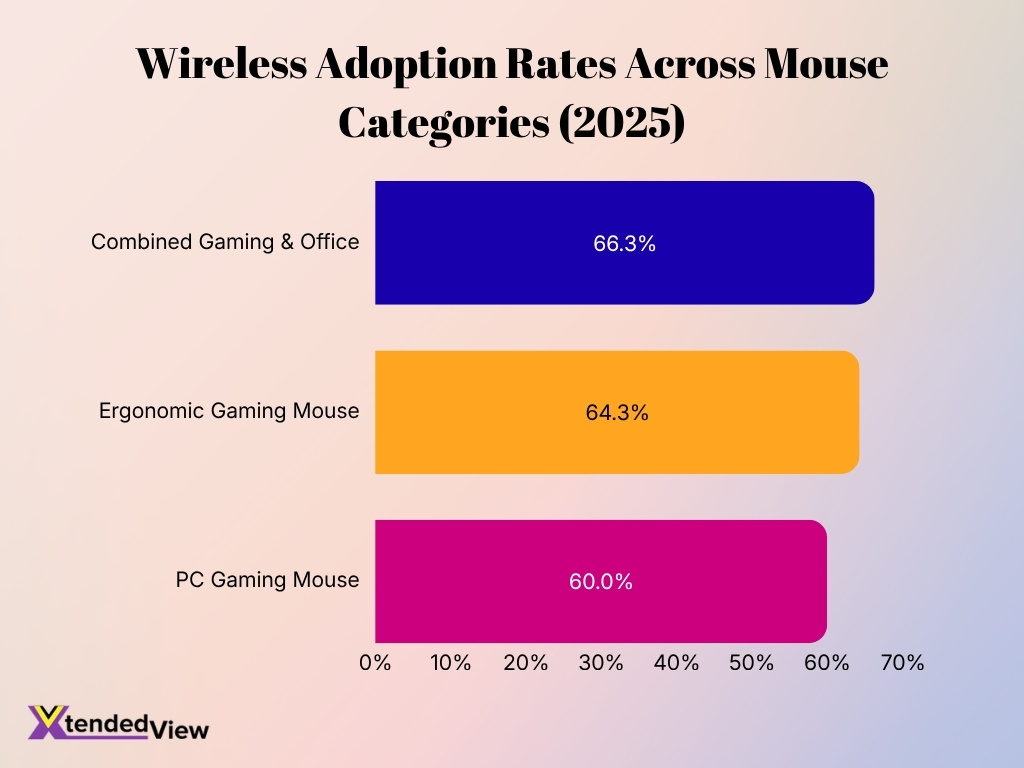
- Wireless products captured an estimated 60% of PC gaming mouse revenue in 2025, according to one connectivity-based market model.
- In dollar terms, that model assigns approximately $2.1 billion to wireless gaming mice and $1.4 billion to wired models in 2025.
- Another worldwide gaming mouse analysis arrives at a nearly identical result, estimating wireless at 59.96% of 2025 revenue.
- That dataset estimates wireless gaming mouse revenue at $3.142 billion, compared with about $2.098 billion for wired products.
- A different gaming mouse dataset places the 2025 wireless share at 54.3%, still making wireless the largest product-type segment in its model.
- Within ergonomic gaming mice specifically, wireless connectivity represented an estimated 64.3% of the 2025 market, indicating particularly strong adoption in comfort-focused products.
- Wireless also accounted for 66.3% of a broader 2025 market that combines gaming and office mice, showing that cable-free peripherals have gained traction beyond gaming alone.
- In July 2026 U.S. online data, the top 10 wireless gaming mouse listings captured 73.7% of unit sales among the top 50 tracked listings.
- Those top 10 listings also generated 70.6% of tracked revenue, suggesting strong sales concentration among a relatively small number of products.
- The leading individual listing in that July 2026 dataset sold 10,000 units, representing 9.8% of tracked top-50 unit volume for the month.
Wireless Gaming Mouse Market Forecast
- A dedicated forecast expects the wireless gaming mouse market to rise from $1.92 billion in 2025 to $3.45 billion in 2032.
- That trajectory implies an 8.7% CAGR across the forecast period.
- A separate 2026 market estimate places the wireless gaming mouse category at $4.2 billion in 2025 and forecasts $7.1 billion by 2033, demonstrating the wide variation created by different market definitions.
- That second forecast expects a 9.8% CAGR from 2026 through 2033.
- For the total gaming mouse category, another current model forecasts growth from $2.08 billion in 2026 to $3.06 billion in 2031.
- A broader PC gaming mouse forecast expects the market to reach $5.69 billion by 2030, compared with $3.24 billion in 2026.
- A second PC gaming mouse model extends its outlook to 2032 and projects $5.44 billion, up from $3.5 billion in 2025.
- The broader wireless mouse industry is forecast to reach $5.75 billion by 2034, compared with $3.63 billion in 2026.
- Asia-Pacific is identified as the fastest-growing region in one current wireless mouse forecast, while North America held the largest regional position in 2025.
- Taken together, current forecasts consistently point toward higher wireless mouse revenue through the next decade, but differences in category scope mean readers should compare growth rates and definitions, rather than treating every published market value as directly interchangeable.
Wireless vs. Wired Gaming Mouse Adoption
- Wireless models generated an estimated 60% of global PC gaming mouse revenue in 2025, equal to about $2.1 billion. Wired models represented the remaining 40%, or roughly $1.4 billion.
- A separate market estimate places the 2025 wireless share at 54.3%, compared with 45.7% for wired gaming mice. The difference reflects variations in market definitions and data collection.
- Under that forecast, wireless gaming mice are expected to grow at an 8.3% CAGR from 2026 through 2034, versus 5.8% for wired models.
- Wireless products also led the combined gaming mouse and keyboard category in 2025, capturing approximately 54.7% of revenue in one global analysis.
- Current 2.4 GHz gaming connections can deliver latency close enough to wired products that reviewers report no perceptible difference under normal gaming conditions. Bluetooth remains slower and primarily serves as a secondary connection.
- Wireless adoption extends deep into professional gaming. The five most-used mouse models in one September 2026 database, totaling 1,211 professional users, are all wireless models.
- The Logitech G Pro X Superlight 2 alone accounts for 12.27% of 2,428 tracked professional players, or 298 users, in current esports gear data.
- At the end of 2025, the Razer Viper V3 Pro reached a 21% share among 2,072 analyzed professional players, gaining about 3 percentage points from the prior year.
- Wireless technology has also reached 8,000 Hz polling in commercially available esports mice, narrowing the technical distinction between premium wired and wireless products even further.
Wireless Gaming Mouse Sales by Region
- North America held the largest position in one global PC gaming mouse study in 2025, confirming the region as a major market for performance-oriented gaming peripherals.
- Another 2025 analysis estimates North America at 31.12% of the global PC gaming mouse market, with regional revenue of approximately $1.30 billion under that study’s broader market definition.
- The United States alone represented an estimated 26% of the global PC gaming mouse market in that model, making it the largest contributor within North America.
- Canada represented approximately 4.17% of global PC gaming mouse revenue in the same 2025 dataset, while Mexico accounted for about 0.95%.
- U.S. online demand for wireless gaming mice remained substantial in 2026: the top 50 tracked listings generated 101,750 unit sales in July 2026 and nearly $6 million in monthly revenue.
- Over the 12 months ending July 2026, those U.S. listings generated approximately 1.2 million unit sales and $61.5 million in revenue, averaging almost 100,000 units per month.
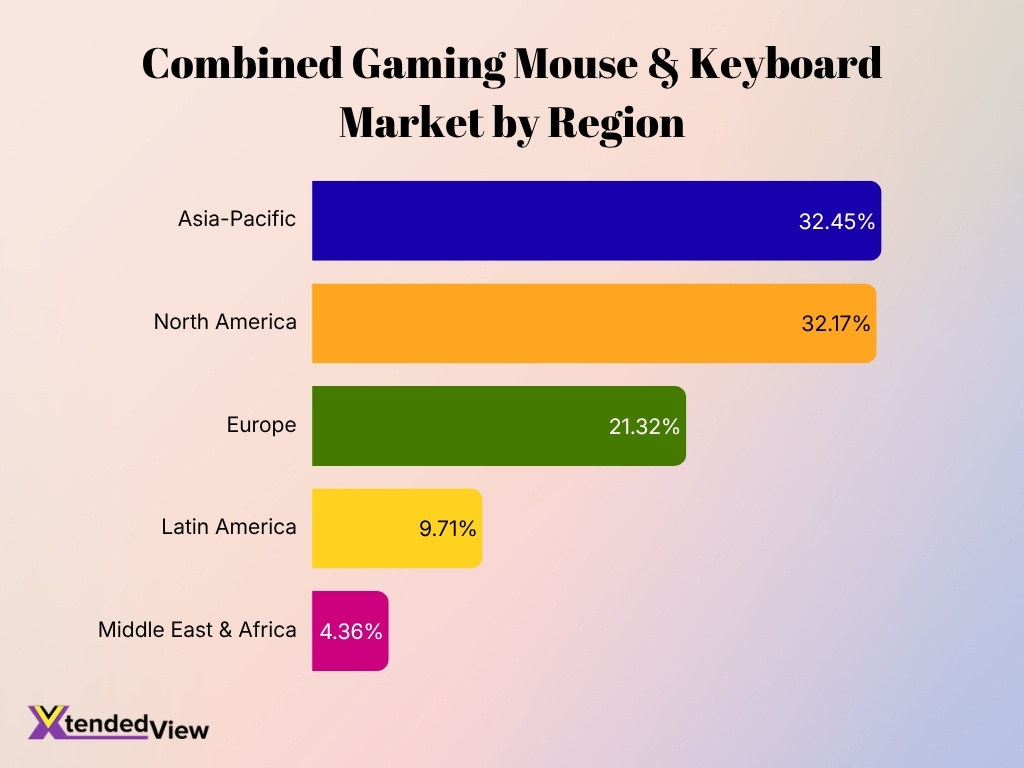
- Asia-Pacific slightly exceeded North America in a 2025 combined gaming mouse and keyboard dataset, with a 32.45% regional share, compared with 32.17% for North America.
- Europe represented 21.32% of that same combined gaming mouse and keyboard market, while Latin America accounted for 9.71% and the Middle East and Africa for 4.36%.
- A narrower ergonomic gaming mouse study shows a similar three-region concentration: North America held 31.41%, Asia-Pacific 30.35%, and Europe 28.11% of 2025 revenue.
- Regional pricing also differs. In Asia-Pacific, mainstream $60-$99 gaming mice generate roughly 30%-35% of market value, while $100-plus enthusiast and flagship models contribute an estimated 20%-25% despite much lower unit volume.
Wireless Gaming Mouse Market by Connectivity Type
- Dedicated 2.4 GHz wireless receivers remain the preferred connection for gaming because Bluetooth generally introduces more latency.
- Current 2.4 GHz gaming connections can perform with no perceptible latency difference from standard wired connections under normal gaming conditions.
- Bluetooth remains useful for casual gaming and everyday computing, but current testing guidance recommends a dedicated USB wireless receiver when minimum latency matters.
- In the broader 2.4 GHz wireless mouse market, midrange products accounted for 46.39% of 2025 revenue, equivalent to approximately $858.2 million.
- Budget products represented another 34.51% of 2.4 GHz wireless mouse revenue, while premium models accounted for 19.10%.
- Online retail generated 50.54% of global 2.4 GHz wireless mouse revenue in 2025, narrowly exceeding offline retail’s 49.46%.
- Multi-mode Bluetooth-plus-2.4 GHz products represented 54.5% of revenue in one adjacent LED wireless mouse category in 2025, compared with 45.5% for Bluetooth-only products.
- Another wireless mouse segment shows a different mix: Bluetooth captured 54.9% of 2025 revenue, 2.4 GHz RF held 35.1%, and dual-mode models represented about 10%. This illustrates how connectivity preferences change sharply by use case.
- For gaming specifically, Bluetooth’s value centers on versatility rather than peak responsiveness. Some wireless gaming mice combine a high-speed USB receiver for play with Bluetooth for browsing or casual use, extending battery life when maximum polling performance is unnecessary.
Wireless Gaming Mouse Revenue by Product Type
- Wireless PC gaming mice generated approximately $2.1 billion in 2025, representing 60% of revenue in one global market model.
- Wired gaming mice generated approximately $1.4 billion, or 40% of that same market, leaving wireless ahead by about $700 million.
- Optical-sensor gaming mice produced an estimated $2.8 billion in 2025 revenue, representing 80% of the PC gaming mouse market measured by that study.
- Laser-sensor products generated about $700 million, giving them a 20% share and putting optical revenue at four times the laser total.
- Another market model estimates optical gaming mice at 68.7% of 2025 revenue, compared with 31.3% for laser products. Although lower than the previous estimate, optical still leads by a wide margin.
- Ergonomic wireless gaming mice represented 64.3% of 2025 revenue within the ergonomic gaming mouse category, showing that wireless adoption extends beyond symmetrical FPS-focused designs.
- Premium gaming mice priced above $100 represented an estimated 34.6% of 2025 market value in one pricing analysis, despite accounting for only 12.1% of unit sales.
- The same premium category is projected to expand at approximately 9.7% annually, supported partly by lightweight wireless designs and higher-specification sensors.
- In Asia-Pacific, gaming mice priced at $100 or more represent only 5%-10% of units but 20%-25% of market value, illustrating the revenue impact of premium wireless and enthusiast hardware.
Wireless Gaming Mouse Brand Market Share
- Logitech held an estimated 22%-24% of global gaming mouse revenue in 2025 in one market analysis, giving it the largest individual brand share.
- Razer followed with an estimated 18%-20% share of global gaming mouse revenue in the same dataset.
- Corsair, SteelSeries, and ZOWIE collectively represented an estimated 18%-22% of global revenue, leaving the rest distributed among smaller and regional competitors.
- In professional esports, the Logitech G Pro X Superlight 2 is currently used by 298 of 2,428 tracked players, equivalent to 12.27%.
- The Razer Viper V3 Pro has 268 tracked professional users, while the newer Razer Viper V4 Pro has already reached 236 users in current data.
- The original Logitech G Pro X Superlight remains in use among 224 tracked professionals, despite newer generations being available.
- In a separate database, the Logitech G Pro X Superlight 2 is used by 31% of tracked esports professionals, while the Razer Viper V3 Pro appears in 19% of tracked setups.
- Among 698 tracked Counter-Strike 2 professionals, 161 players, or 23%, use the Logitech G Pro X Superlight 2. The Razer DeathAdder V4 Pro ranks second with 83 users.
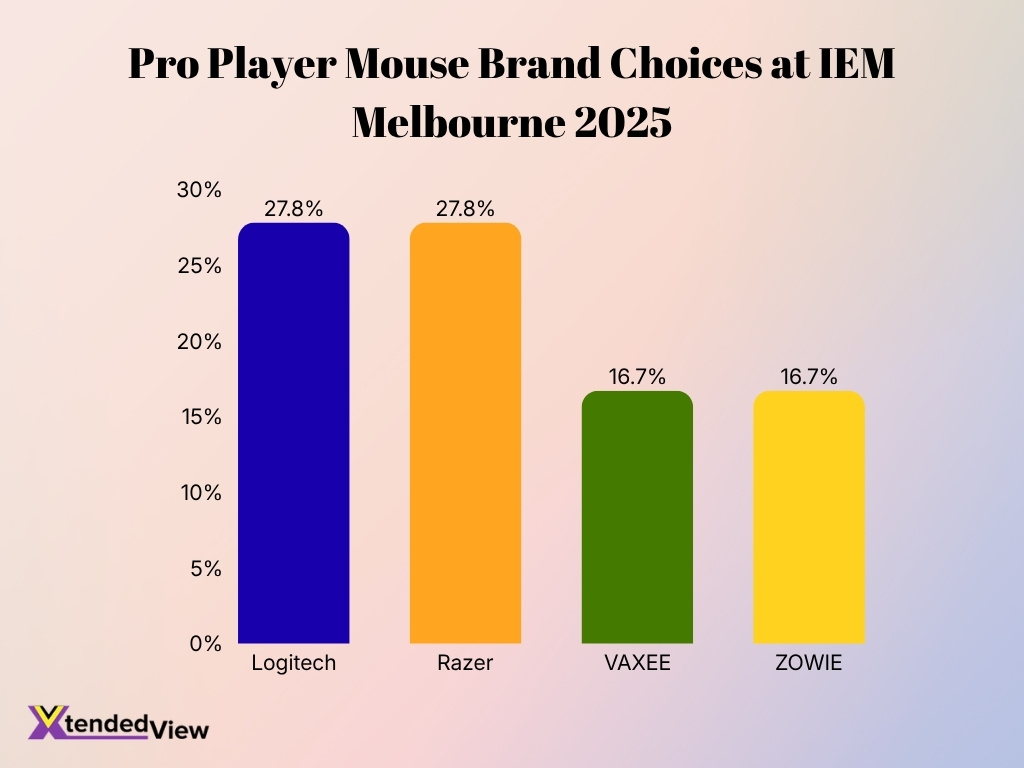
- At the 2025 IEM Melbourne playoffs, Logitech and Razer each captured 27.8% of player mouse choices, while VAXEE and ZOWIE each held 16.7%.
- A broader 2026 gaming-peripheral survey of more than 5,000 consumers found 28.3% owned a Logitech accessory. The figure covers gaming peripherals rather than mice alone, so it serves as supporting brand-awareness context rather than direct mouse market share.
Wireless Gaming Mouse Price Statistics
- Among the 50 leading U.S. online wireless gaming mouse listings, the typical product price was $58.36 in July 2026.
- Those 50 listings generated nearly $5.98 million from 101,750 units during July 2026, which works out to about $58.73 in revenue per unit across the tracked set.
- Over the 12 months ending July 2026, the same listings generated $61.48 million from 1.20 million units, equivalent to roughly $51.24 per unit across the period.
- In the broader gaming mouse market, products priced from $51 to $100 captured more than 60.58% of 2025 market share in one current estimate.
- Products above $150 represent a smaller base but form the fastest-growing price bracket in that market analysis, supported by premium materials and limited-edition releases.
- Another pricing dataset puts $100-plus gaming mice at 34.6% of market value but just 12.1% of units, highlighting the revenue premium attached to high-end products.
- Premium gaming mice in that dataset commonly sell between $150 and $250, with advanced wireless capability and lightweight construction among the features used to justify higher prices.
- Asia-Pacific’s performance-core segment generally falls between $60 and $99 and contributes an estimated 30%-35% of gaming mouse market value in the region.
- At the lower end, $30-$59 models account for roughly 35%-40% of unit sales in developing Asia-Pacific gaming markets, while products below $30 contribute 25%-30% of units but less than 10% of value.
- A 2026 survey of more than 5,000 gamers found the most popular mouse spending range was ₹1,000 to ₹3,000, while only about 6% were willing to spend more than ₹6,000. The survey reflects a price-sensitive Asian market rather than U.S. purchasing behavior.
Wireless Gaming Mouse Usage Among PC Gamers
- Wireless accounted for 60% of PC gaming mouse revenue in 2025 in one market analysis, indicating that cable-free models now represent the majority of spending in the category.
- Another independent market estimate puts wireless gaming mice at 54.3% of 2025 revenue, again placing them ahead of wired models.
- Wireless is also expected to grow at 8.3% annually through 2034, compared with 5.8% for wired gaming mice under that forecast.
- A 2026 gaming-peripheral survey collected responses from more than 5,000 participants, providing a large recent snapshot of how gamers evaluate and buy PC accessories.
- In that survey, the monitor and mouse together represented 60% of gamers’ most-valued peripheral choices, placing the mouse among the most important components of the PC gaming setup.
- Nearly 50% of surveyed gamers bought peripherals through major online marketplaces, while 13.5% used dedicated peripheral retailers and 9.7% bought directly from brand websites.
- Current laboratory guidance for wireless gaming recommends a dedicated USB receiver instead of Bluetooth when responsiveness matters, reflecting the dominant usage pattern for performance-focused PC play.
- More than 400 mouse models have been tested in one current laboratory review program, and its 2026 wireless recommendations span flagship, upper-midrange, midrange, lower-midrange, budget, and cheap categories. That breadth shows how wireless options now cover most consumer price tiers.
- Current 2.4 GHz wireless gaming technology can perform without a perceptible latency difference from wired connections in normal use, while Bluetooth remains less suitable for latency-sensitive gaming.
- U.S. online purchasing provides another adoption signal: the top 50 wireless gaming mouse listings sold nearly 1.2 million units during the 12 months ending July 2026, including 135,300 units during the December 2025 peak.
Wireless Gaming Mouse Usage Among Esports and Competitive Gamers
- Among 2,428 tracked professional players, the Logitech G Pro X Superlight 2 ranks first with 298 users, or 12.27% of the database.
- The Razer Viper V3 Pro follows with 268 professional users, while the newer Viper V4 Pro has already reached 236 users in current tracking.
- The original Logitech G Pro X Superlight remains fourth with 224 users, while the Logitech G Pro X2 SUPERSTRIKE has reached 188 professional users. All five leading models are wireless.
- In June 2026, Razer held 36% of professional mouse usage in a 2,196-player sample, narrowly ahead of Logitech G at 35%. ZOWIE ranked third at 8%.
- The Razer Viper V3 Pro held 14% of professional mouse usage in that June sample, followed by the Logitech G Pro X Superlight 2 at 13% and the original Superlight at 10%.
- Among 699 tracked VALORANT professionals, the wireless Razer Viper V4 Pro reached 17.45% adoption, equivalent to 122 players, by September 2026.
- The previous-generation Viper V3 Pro remained in use by another 92 VALORANT professionals, showing that established wireless models retain substantial competitive use after successors arrive.
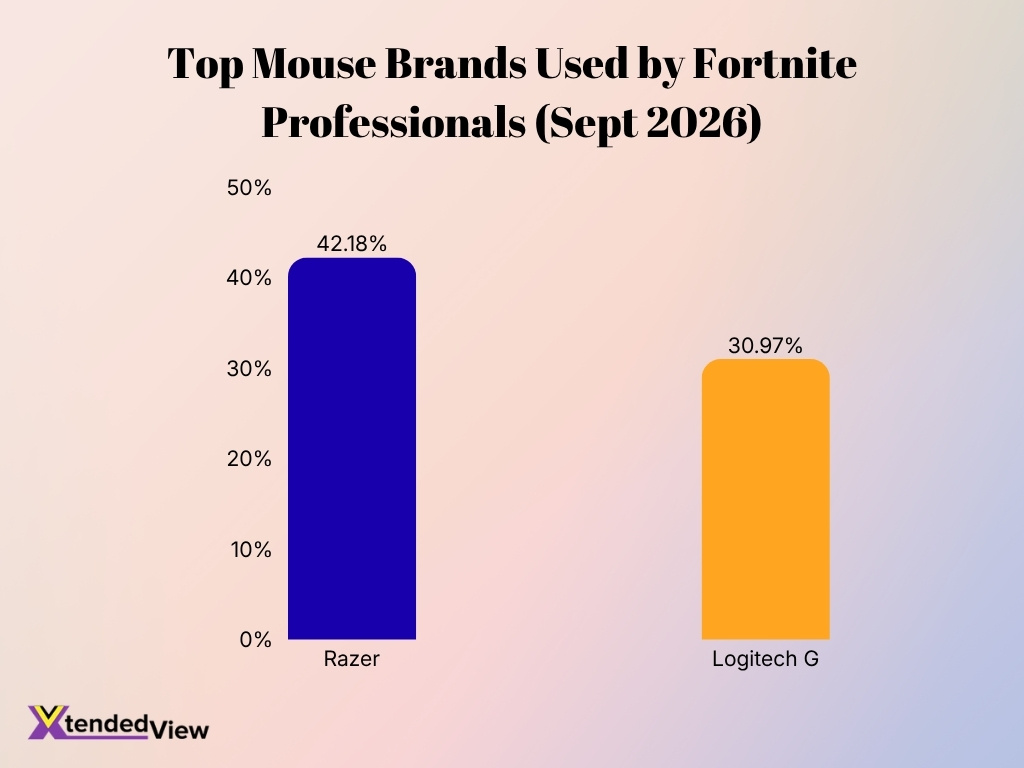
- Fortnite shows similar wireless adoption. Among 339 professionals tracked in September 2026, Razer represented 42.18% of mouse choices, while Logitech G accounted for 30.97%.
- League of Legends data shows the Logitech G Pro X Superlight 2 used by 24 of 167 professionals, equal to 14.37% of the tracked player base.
- These adoption figures indicate that battery-powered wireless technology no longer prevents widespread tournament use. Instead, current professional preferences concentrate around wireless models with low weight and high polling rates.
Wireless Gaming Mouse Sensor, DPI, and Accuracy Statistics
- The Razer Viper V4 Pro’s Focus Pro Gen-3 sensor reaches 50,000 DPI, 930 IPS maximum tracking speed, and 90 G maximum acceleration.
- The Logitech G Pro X Superlight 2 reaches 44,000 DPI, more than 888 IPS, and 88 G through its HERO 2 sensor.
- The Logitech G Pro X Superlight 2 supports DPI adjustment from 100 to 44,000 DPI, despite competitive users typically selecting much lower values.
- The Corsair SABRE v2 PRO uses a 33,000 DPI sensor capable of 750 IPS tracking and 50 G acceleration.
- That 33,000 DPI sensor carries a claimed 99.7% resolution accuracy, illustrating why modern sensor comparisons increasingly extend beyond maximum sensitivity.
- Among 131 verified Counter-Strike 2 professionals analyzed in May 2026, 48.9% used 800 DPI and 43.5% used 400 DPI. Only 4.6% used 1,600 DPI.
- The median DPI in that Counter-Strike 2 sample was 800, while the mean was 678 DPI and observed settings ranged from 400 to 3,200 DPI.
- A September 2026 analysis of 435 VALORANT professionals found 53% at 800 DPI, 28% at 400 DPI, and 16% at 1,600 DPI. Median effective DPI was 240.
- In Apex Legends, another current professional dataset places 61% of tracked players at 800 DPI, followed by 16% at 1,600 DPI and 11% at 400 DPI.
- The gap between hardware capability and real-world settings is therefore substantial: a 50,000-DPI flagship sensor offers 62.5 times the resolution setting of the common 800-DPI configuration used by many esports players.
Wireless Gaming Mouse Polling Rate, Response Time, and Latency Statistics
- A 1,000 Hz polling rate corresponds to one report every 1 millisecond, while 8,000 Hz can reduce the theoretical report interval to 0.125 milliseconds.
- The Corsair SABRE v2 PRO supports 8,000 Hz in both wired and wireless modes, delivering up to eight times as many reports per second as a 1,000 Hz device.
- The Logitech G Pro X Superlight 2 also supports a maximum 8,000 Hz wireless report rate, compared with 1,000 Hz on earlier generations of many mainstream wireless gaming mice.
- The Razer Viper V4 Pro reaches 8,000 Hz wirelessly and wired, meaning high polling no longer requires a cable on current flagship hardware.
- Under manufacturer testing, the Viper V4 Pro recorded an average wireless click latency of 0.204 milliseconds at 8,000 Hz.
- Its measured average motion latency under the same manufacturer’s testing reached 0.36 milliseconds.
- The DeathAdder V4 Pro recorded 0.291-millisecond average click latency in the manufacturer’s comparison, versus 0.807 milliseconds for the unnamed comparison wireless 8,000 Hz device.
- Motion latency in the same comparison measured 0.57 milliseconds for the DeathAdder V4 Pro and 0.92 milliseconds for the comparison product.
- High polling rates are already present in esports-proven hardware. The Viper V3 Pro, used by 268 tracked professionals in September 2026, supports an 8,000 Hz wireless polling rate.
- The practical difference becomes progressively smaller as latency falls. For context, an independent 2026 review noted that even high-level competitive players have reaction times above 100 milliseconds, far longer than sub-millisecond mouse latency.
Wireless Gaming Mouse Weight and Lightweight Design Statistics
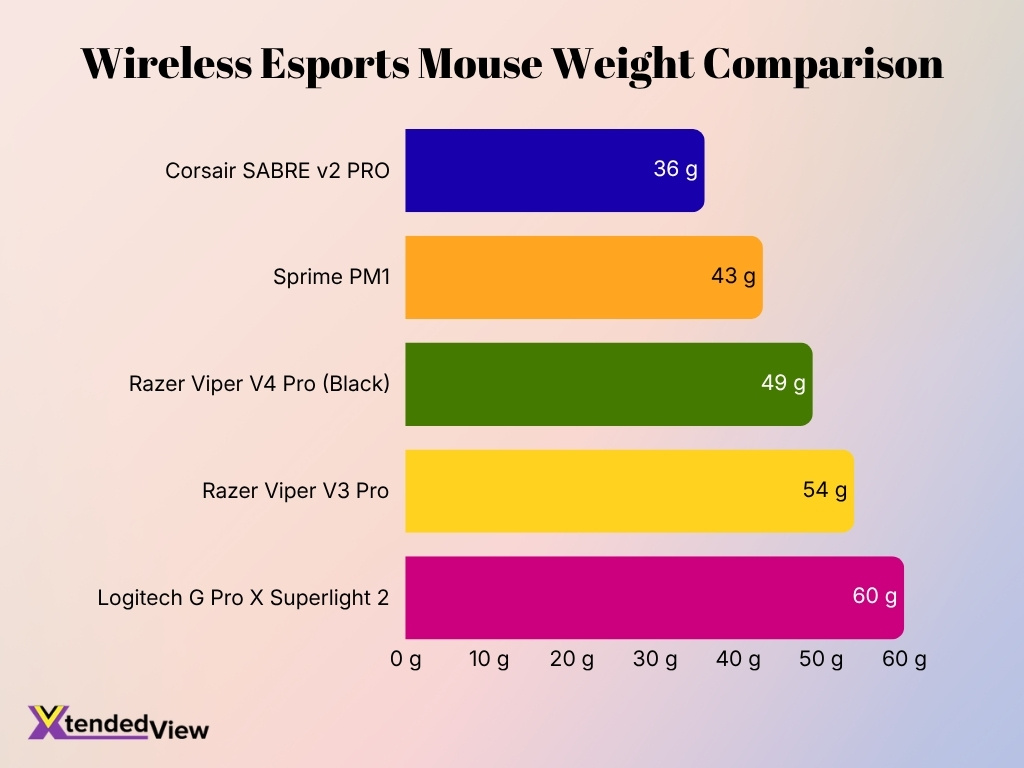
- The 2026 Razer Viper V4 Pro weighs 49 grams in black and 50 grams in white, excluding its cable and dongle.
- Its predecessor, the Razer Viper V3 Pro, weighs 54 grams, making the black V4 Pro roughly 9% lighter.
- The Corsair SABRE v2 PRO weighs just 36 grams, making it 18 grams lighter than the 54-gram Viper V3 Pro.
- At 36 grams, the SABRE v2 PRO weighs 40% less than a 60-gram mouse, despite including its wireless electronics and internal rechargeable battery.
- The Logitech G Pro X Superlight 2 weighs approximately 60 grams while supporting an 8,000 Hz report rate and a 44,000 DPI sensor.
- The ergonomic Logitech G Pro X Superlight 2 DEX also weighs 60 grams, indicating that ergonomic shells can remain near the ultralight threshold.
- The Sprime PM1 weighs 43 grams while offering an 8,000 Hz wireless polling rate, demonstrating that sub-50-gram designs extend beyond the largest peripheral manufacturers.
- The current Viper V4 Pro combines 49 grams, 50,000 DPI, and 8,000 Hz polling, compared with the Viper V3 Pro’s 54 grams, 35,000 DPI, and the same maximum polling rate.
- Among current esports favorites, the Logitech G Pro X Superlight 2 weighs 60 grams and the Razer Viper V3 Pro weighs 54 grams; together, these models account for 566 tracked professional users.
- Competitive design has therefore moved beyond simply reaching the 60-gram mark. Current wireless products now span roughly 36 to 60 grams across several prominent performance-focused models.
Wireless Gaming Mouse Battery Life and Charging Statistics
- The Razer Viper V4 Pro offers up to 180 hours of battery life at 1,000 Hz, one of the highest figures among current performance-focused rechargeable wireless mice.
- Running that mouse at 8,000 Hz reduces rated battery life to 45 hours, a 75% decrease from its maximum 1,000 Hz figure.
- The Razer DeathAdder V4 Pro offers up to 150 hours of battery life, supporting extended gaming sessions without daily charging.
- The Logitech G Pro X Superlight 2 provides up to 95 hours of constant-motion battery life while retaining support for an 8,000 Hz maximum report rate.
- The Logitech G Pro X Superlight 2 DEX similarly carries a 95-hour constant-motion battery rating.
- The Corsair SABRE v2 PRO delivers up to 70 hours of 2.4 GHz wireless use at 1,000 Hz, despite weighing only 36 grams.
- The Razer DeathAdder V3 HyperSpeed reaches 100 hours of battery life and can support true 8,000 Hz wireless polling with an optional compatible receiver.
- The Logitech G Pro X Superlight 2 DEX SE is rated for 88 hours in its standard configuration and up to 95 hours at 1,000 Hz with an upgraded receiver.
- Comparing current flagship ratings, the Viper V4 Pro’s 180-hour figure is 20% higher than the DeathAdder V4 Pro’s 150 hours and roughly 89% higher than the Superlight 2’s 95 hours.
- The figures also show why adaptive polling matters: moving from 1,000 Hz to 8,000 Hz increases report frequency eightfold, but current products can lose substantial battery runtime when users keep maximum polling enabled continuously.
Frequently Asked Questions (FAQs)
Wireless gaming mice accounted for approximately 60% of PC gaming mouse market revenue in 2025, according to a 2026 market analysis.
The top 50 tracked U.S. listings generated approximately 1.2 million unit sales during the 12 months ending July 2026, including 101,750 units in July alone.
The top 50 tracked listings generated approximately $61.5 million during the 12 months ending July 2026, with about $6 million recorded in July.
The Logitech G Pro X Superlight 2 is currently used by 12% of tracked professional players, representing 298 players in one live esports equipment database.
A current flagship model supports 8,000 Hz wireless polling and provides up to 180 hours of battery life at 1,000 Hz, falling to 45 hours at 8,000 Hz.
Conclusion
Wireless gaming mouse statistics show how rapidly the category has progressed from a convenience-focused alternative to a major part of the performance gaming market. Wireless models now appear extensively in professional esports setups, while manufacturers continue to compete through lower weight, faster polling, improved sensor accuracy, and longer battery life. Current flagship hardware can deliver 8,000 Hz polling, sub-50-gram designs, sensors rated as high as 50,000 DPI, and battery life reaching 180 hours at standard polling settings.
The data also shows that raw specifications tell only part of the story. Professional players commonly use DPI settings far below the maximum capabilities of modern sensors, while operating a mouse at its highest polling rate can substantially reduce battery life. Market estimates vary because research firms define gaming mice and wireless segments differently, but several datasets indicate that wireless products now account for a substantial share of gaming mouse spending. Overall, the 2025 and 2026 figures point to wireless technology becoming an established format across mainstream PC gaming and competitive esports, with future development increasingly focused on efficiency, responsiveness, lower weight, and consistent performance.