

Supercomputers have become critical infrastructure for scientific research, artificial intelligence, weather and climate modeling, engineering, energy exploration, health research, and national security. The fastest machines operate at the exascale level, completing more than a quintillion floating-point operations per second and allowing researchers to tackle calculations that would overwhelm conventional computing systems.
Their impact reaches well beyond research laboratories. Scientists use supercomputers to model climate systems, analyze molecular behavior, and accelerate drug discovery, while automotive and aerospace companies rely on high-performance computing to simulate vehicles, aircraft, materials, and complex engineering designs before physical production. At the same time, the growth of generative AI has increased demand for GPUs, specialized accelerators, high-bandwidth memory, and energy-efficient computing infrastructure.
The industry is also changing economically. Cloud-based HPC gives more organizations access to large-scale computing without requiring them to build dedicated facilities, while rising electricity requirements are making performance per watt an increasingly important measure of progress. The statistics below examine the performance, market size, regional distribution, architecture, energy use, AI adoption, and future direction of supercomputing.
What Is a Supercomputer?
A supercomputer combines very large numbers of processing elements, high-speed memory, storage, and specialized interconnects to solve computational problems that conventional computers cannot handle efficiently. Modern systems increasingly combine CPUs with accelerators such as GPUs, allowing them to divide massive workloads across thousands or millions of computing cores.
- The June 2026 list tracks 500 of the world’s highest-performing systems using standardized HPL results, providing a common basis for comparing large-scale computing performance.
- The minimum HPL performance required to enter the June 2026 ranking reached 2.66 petaflops.
- Entry into the top 100 required at least 21.85 petaflops in June 2026.
- The average ranked machine contained 305,404 computing cores in June 2026, up about 12.9% from 270,522 six months earlier.
- Accelerator or coprocessor technology appeared in 276 of the 500 systems, or 55.2%, in June 2026. Six months earlier, 255 systems used accelerators.
- Among accelerated systems, 107 used NVIDIA Hopper chips, while 62 used NVIDIA Ampere technology and 32 used AMD Instinct accelerators.
- Intel processors powered 53.2% of ranked systems in June 2026, down from 57% six months earlier.
- AMD processors appeared in 192 systems, or 38.4%, compared with 35.6% six months earlier.
Editor’s Choice
The following statistics capture the most important changes in supercomputing between 2025 and 2026.
- 2.198 exaflops: The fastest supercomputer in June 2026 achieved 2,198.4 petaflops on HPL, becoming the first ranked machine to exceed two exaflops of sustained double-precision performance.
- 13,789,440 cores: The June 2026 No. 1 system used nearly 13.8 million cores to deliver its benchmark result.
- Five exascale systems: By June 2026, five machines had crossed the one-exaflop HPL threshold, compared with four in November 2025.
- 18.73 exaflops: The combined HPL performance of all 500 ranked systems increased from 14.99 exaflops six months earlier. That represents an increase of roughly 25%.
- 161 systems: The United States hosted 161 machines on the June 2026 list, equal to 32.2% of the total.
- 55.2% accelerated: A total of 276 machines used accelerator or coprocessor technology, underscoring the growing importance of GPUs and other specialized processors.
- 73.28 gigaflops per watt: The leading June 2026 energy-efficiency result reached 73.282 GFlops/W while drawing 46 kW during the benchmark measurement.
- $61 billion: One 2026 market estimate places the global HPC market at approximately $61 billion, up from $56.7 billion in 2025.
- 8% CAGR: The same forecast expects the broader HPC market to reach $104.7 billion by 2033, representing an 8% compound annual growth rate from 2026 through 2033.
- 52.4% cloud share: Cloud deployments accounted for 52.4% of HPC revenue in 2025 in that market assessment, highlighting how high-performance computing is expanding beyond traditional on-premises installations.
Recent Developments
- In November 2025, the top system delivered 1.809 exaflops on HPL and remained ahead of machines recording 1.353 and 1.012 exaflops.
- A European system reached 1.000 exaflops in the November 2025 ranking, becoming the first exascale system outside the United States.
- By June 2026, a new system had reached 2.198 exaflops, moving the previous 1.809-exaflop leader into second place.
- The new leader produced roughly 80% of its 2.736-exaflop theoretical peak during its HPL run, a high utilization rate for a system of its scale.
- Its HPCG result reached 22.00 petaflops, exceeding the 17.41-petaflop result of the previous HPCG leader.
- The June 2026 ranking placed five exascale machines in the top five positions, with HPL results of 2.198, 1.809, 1.353, 1.012, and 1.000 exaflops.
- Italy’s HPC7 reached 571.5 petaflops, taking sixth place globally and recording an HPCG result of about 5.95 petaflops.
- Accelerator-equipped machines increased from 255 to 276 between the November 2025 and June 2026 lists, an increase of about 8.2%.
- The leading Green500 result reached 73.282 GFlops/W in June 2026, while the top three energy-efficient systems all used the same Grace Hopper-based architecture.
- The June 2026 No. 5 machine remained at 1.000 exaflop while consuming 15,794 kW during its reported HPL measurement, making it notably less power-intensive than the other systems in the exascale top five.
How Supercomputers Are Measured (FLOPS, Rmax, Rpeak)
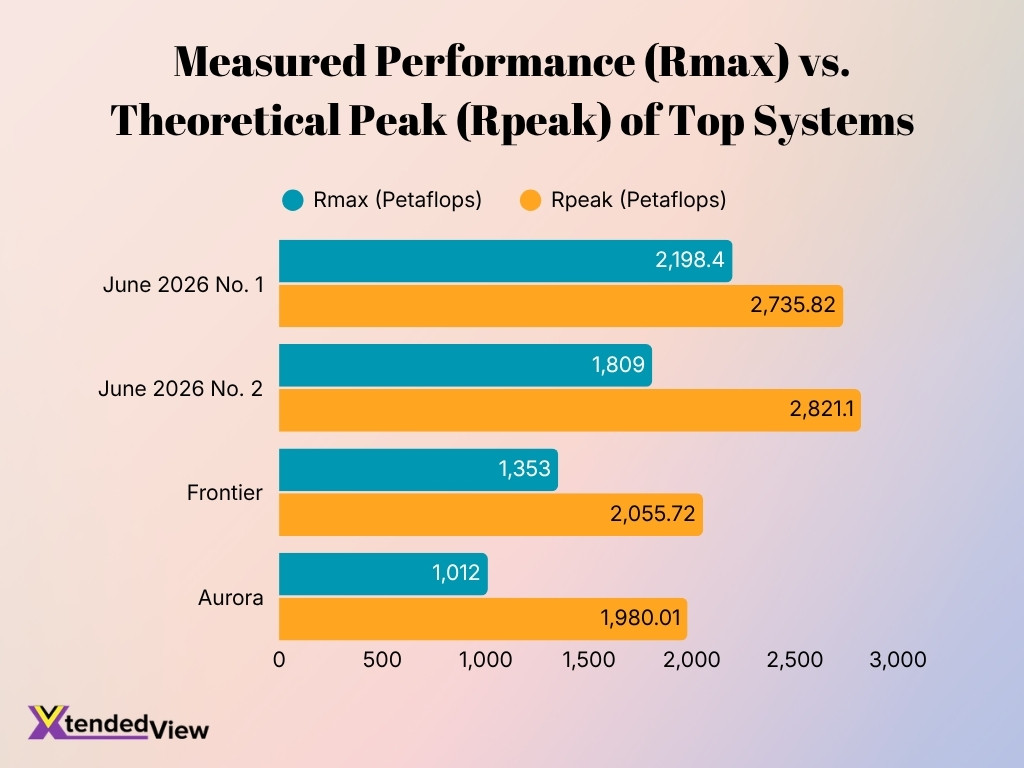
- Rmax represents the highest measured performance achieved on the HPL benchmark and provides the primary metric used to order the major global ranking.
- Rpeak represents theoretical peak performance based on the system’s processors and advertised clock rates rather than its measured HPL output.
- The June 2026 No. 1 machine recorded an Rmax of 2,198.4 petaflops against an Rpeak of 2,735.82 petaflops.
- That result corresponds to roughly 80.4% of theoretical peak performance, showing how much of the system’s nominal capability HPL could capture.
- The No. 2 machine posted 1,809 petaflops Rmax against 2,821.10 petaflops Rpeak, or roughly 64% of theoretical peak.
- Frontier produced 1,353 petaflops Rmax from 2,055.72 petaflops Rpeak, equivalent to about 65.8% of peak capability.
- Aurora reached 1,012 petaflops Rmax against a theoretical 1,980.01 petaflops, putting its HPL result at about 51.1% of Rpeak.
- HPCG provides another view of system performance. In June 2026, the leading HPCG score was 22.005 petaflops, while the next three results were 17.406, 16.005, and 14.054 petaflops.
- Mixed-precision HPL-MxP can produce much higher figures for AI-oriented workloads. One leading system reached 16.7 exaflops on HPL-MxP, compared with approximately 1.742 exaflops in the corresponding HPL test configuration.
- Energy efficiency adds another dimension to performance measurement. The June 2026 Green500 leader delivered 73.282 billion floating-point operations per second per watt during its qualifying measurement.
Global Supercomputer Market Size and Growth
- One dedicated supercomputer market estimate valued the sector at $9.13 billion in 2023 and projects it to reach $16.81 billion by 2030.
- That dedicated-market forecast implies a 9.4% CAGR from 2024 through 2030.
- A separate 2026 supercomputer forecast expects the market to add $29.8 billion in revenue between 2025 and 2030, with a 20.3% CAGR over the period.
- In the broader HPC category, global market revenue reached an estimated $56.7 billion in 2025.
- The same HPC forecast puts the market at approximately $61 billion in 2026, representing an increase of about 7.6% from the 2025 estimate.
- Global HPC revenue could reach $104.7 billion by 2033, according to that forecast, nearly 1.7 times the projected 2026 market size.
- Another 2026 estimate places the HPC market at $61.5 billion, compared with $55.88 billion in 2025.
- That second forecast expects global HPC revenue to reach $91.38 billion by 2030, representing a 10.4% CAGR during its forecast period.
- A third 2026 market assessment values HPC at $64.67 billion in 2026, up from $59.33 billion in 2025, and projects $128.84 billion by 2034.
- Across these forecasts, the common growth drivers include AI and machine learning, scientific simulation, cloud HPC, digital twins, genomics, engineering workloads, and rising demand for large-scale data processing.
Supercomputer Market by End-User Industry
- Government and defense represented 26.5% of global HPC revenue in 2025, making it the largest end-use segment in one current market assessment.
- Another 2026 market assessment placed the government and defense segment at 24.16% of 2025 HPC revenue, while identifying life sciences as the fastest-growing application through 2031.
- Life sciences HPC demand is forecast to expand at a 9.54% CAGR through 2031, supported by genomics, molecular simulation, drug discovery, and increasingly computational biomedical research.
- Aerospace and defense accounted for 22.21% of the cloud HPC market in 2025, making it the largest industrial application in that specific market segment.
- Media and entertainment represents the fastest-growing industrial application in the cloud HPC forecast, with an expected 8.62% CAGR through 2031. Rendering, simulation, and AI-generated media contribute to computing demand.
- Government national laboratories accounted for an estimated $8.32 billion of the academic and government HPC market in 2025, compared with $6.29 billion for academic research institutions.
- Defense and intelligence organizations generated an estimated $4.83 billion within the academic and government HPC segment in 2025.
- Industries including aerospace, automotive, pharmaceuticals, and climate science increasingly rely on HPC for complex simulations and large-scale data analysis, helping push the overall HPC market from $56.7 billion in 2025 to an estimated $61 billion in 2026.
- Large enterprises generated 64.15% of cloud HPC revenue in 2025, while small and midsize enterprises are forecast to grow at a 6.98% CAGR from 2026 through 2031.
Supercomputer Market by Region
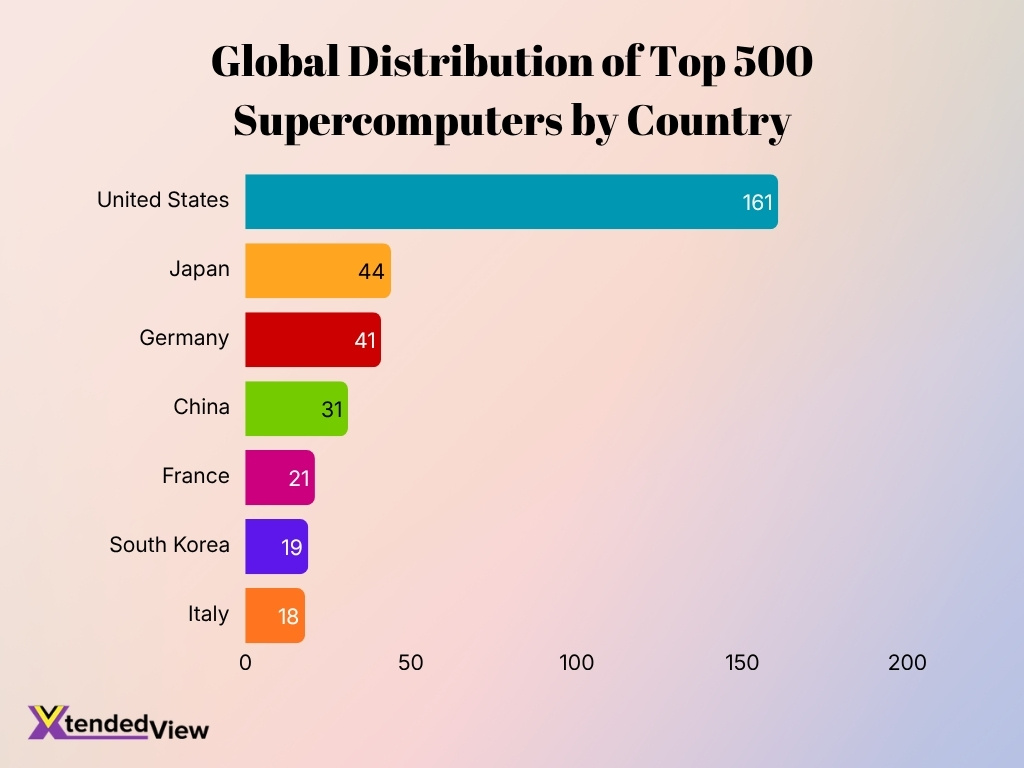
- The United States hosted 161 of the 500 ranked systems in June 2026, giving it a 32.2% share by system count.
- U.S. machines collectively delivered approximately 7.03 exaflops of Rmax performance, the largest national total in the June 2026 ranking.
- Japan ranked second by installation count with 44 systems, representing 8.8% of the global list and about 1.52 exaflops of combined Rmax.
- Germany followed with 41 systems, or 8.2% of the list, delivering approximately 1.40 exaflops of combined Rmax.
- China had 31 ranked systems, representing 6.2% of installations, but those machines produced approximately 2.38 exaflops of combined Rmax.
- Italy had 18 systems yet delivered about 1.45 exaflops of combined Rmax, reflecting the presence of several high-ranking machines, including the 571.5-petaflop HPC7.
- South Korea operated 19 ranked systems, accounting for 3.8% of the list and approximately 605.5 petaflops of combined Rmax.
- France accounted for 21 systems, or 4.2% of the total, and also hosted the top two machines in the June 2026 Green500 energy-efficiency ranking.
- North America represented 41.6% of global HPC revenue in 2025, while the U.S. generated the largest country-level revenue share within that market assessment.
- Asia Pacific ranked as the fastest-growing HPC region in the 2026-2033 market outlook, while a dedicated supercomputer assessment identified Asia Pacific as the largest supercomputer revenue market in its 2023 base year.
Supercomputer Market by Component and Deployment Mode
- Servers generated the largest individual component share in one global HPC assessment, accounting for 33.1% of 2025 revenue.
- A separate market assessment found hardware represented 51.54% of HPC revenue in 2025, showing how processors, accelerators, storage, and networking still account for a large portion of spending.
- HPC services are forecast to expand at a 9.42% CAGR through 2031, the fastest component growth rate in that forecast, as organizations seek implementation, optimization, and managed-computing expertise.
- Cloud deployment represented 52.43% of global HPC revenue in 2025 in one market assessment, putting it slightly ahead of traditional on-premises deployment.
- Another assessment measured cloud installations at 48.88% of the HPC market in 2025, while forecasting hybrid HPC architectures to grow at an 8.22% CAGR through 2031.
- Within cloud HPC specifically, hardware generated 44.12% of 2025 revenue, while software is forecast to record an 8.42% CAGR through 2031.
- Public cloud represented 67.95% of cloud HPC revenue in 2025, while private cloud is projected to expand at a 7.52% CAGR through 2031.
- Infrastructure as a Service accounted for 53.85% of cloud HPC spending in 2025, while Platform as a Service is forecast to grow at 7.05% annually through 2031.
- The commercial HPC market generated about 43% of its 2025 revenue from servers, while storage represented roughly 18%, networking 14%, and software and services approximately 25% in another industry estimate.
- On-premises deployment remains particularly relevant for workloads involving defense, government, pharmaceuticals, and financial services, where security, data sovereignty, and infrastructure control can outweigh the flexibility of public cloud computing.
Supercomputer Market by System Type and Architecture
- 276 of the 500 systems, or 55.2%, used accelerator or coprocessor technology in June 2026, up from 255 systems six months earlier.
- NVIDIA Hopper technology appeared in 107 accelerated systems in June 2026, while 62 systems used NVIDIA Ampere technology and 32 used AMD Instinct accelerators.
- Intel processors powered 53.2% of the 500 ranked systems in June 2026, down from 57% in November 2025.
- AMD processors powered 192 systems, or 38.4%, in June 2026, increasing from 35.6% six months earlier.
- Intel Sapphire Rapids was the single most common processor architecture, appearing in 84 systems, or 16.8% of the June 2026 list.
- AMD Zen 3, or Milan, appeared in 66 systems, while Zen 4, or Genoa, appeared in 51 and the newer Zen 5, or Turin, architecture appeared in 20.
- InfiniBand connected 292 systems, or 58.4%, making it the most common interconnect category in the June 2026 ranking.
- Gigabit Ethernet accounted for 165 systems, or 33%, while Omni-Path appeared in 26 systems and proprietary or custom interconnects appeared in 13.
- GPU-based systems captured 59.22% of 2025 HPC market revenue by chip type in one industry assessment, while ASICs and specialized AI accelerators are forecast to grow at an 8.86% CAGR through 2031.
- The world’s No. 1 machine in June 2026 stands out from the accelerator-heavy trend: its 13,789,440-core architecture uses custom 304-core CPUs and achieved 2.198 exaflops without relying on the GPU configuration found in many other leading systems.
World’s Most Powerful Supercomputers by Computing Performance
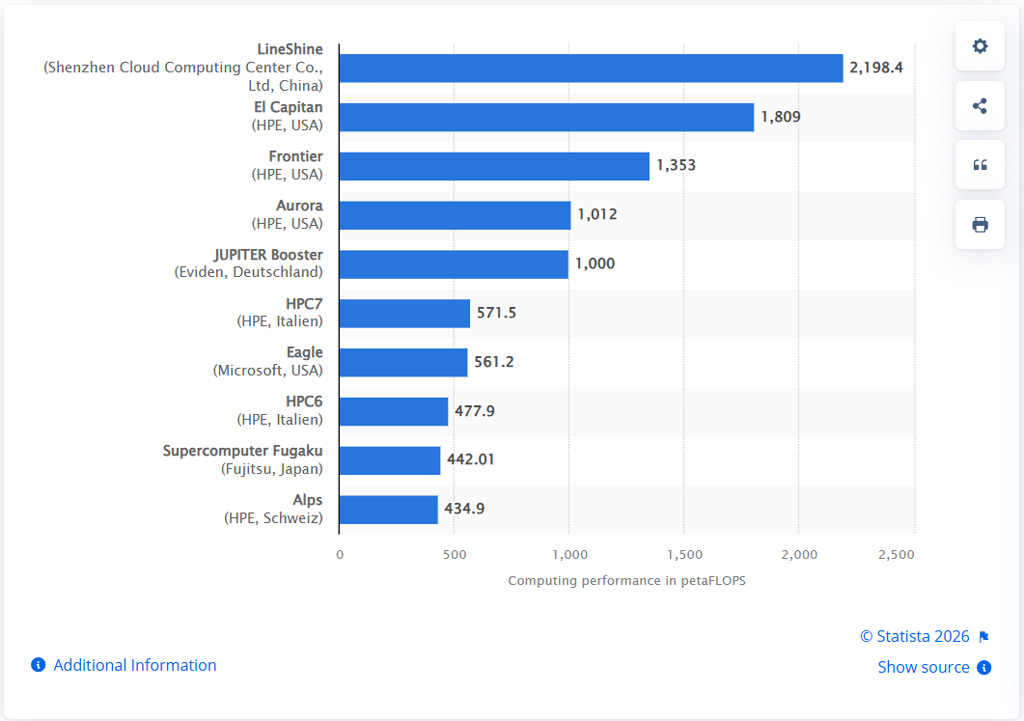
- LineShine ranked as the world’s most powerful supercomputer in July 2026, delivering 2,198.4 PetaFLOPS of computing performance.
- El Capitan placed second with 1,809 PetaFLOPS, around 389.4 PetaFLOPS below LineShine.
- Frontier ranked third at 1,353 PetaFLOPS, making it the third system in the list to exceed 1,300 PetaFLOPS.
- Aurora recorded 1,012 PetaFLOPS, while Germany’s JUPITER Booster reached exactly 1,000 PetaFLOPS.
- The top five systems all achieved at least 1,000 PetaFLOPS, highlighting the growing presence of exascale-class computing.
- HPC7 in Italy delivered 571.5 PetaFLOPS, followed closely by Microsoft’s Eagle at 561.2 PetaFLOPS.
- Italy’s HPC6 posted 477.9 PetaFLOPS, placing it eighth among the world’s leading systems.
- Japan’s Supercomputer Fugaku delivered 442.01 PetaFLOPS, while Switzerland’s Alps reached 434.9 PetaFLOPS.
- HPE was associated with six of the 10 systems in the ranking, including El Capitan, Frontier, Aurora, HPC7, HPC6, and Alps.
- The United States had four systems in the top 10, more than any other country represented in the chart.
Exascale, Petascale, and Pre-Exascale Supercomputers
- The June 2026 ranking contained five verified exascale systems, compared with four in November 2025.
- The fastest machine reached 2.198 exaflops in June 2026, making it the first ranked system to exceed two exaflops of sustained HPL performance.
- The second-ranked system delivered 1.809 exaflops, supported by 11.34 million cores and AMD Instinct MI300A accelerators.
- Frontier remained above the threshold with 1.353 exaflops, while Aurora delivered 1.012 exaflops.
- Europe’s first verified exascale system recorded exactly 1.000 exaflop and used 4,801,344 cores in June 2026.
- In November 2025, only four systems had verified HPL performance of at least one exaflop, meaning the global count increased by 25% by June 2026.
- HPC7 sits immediately below the exascale group at 571.5 petaflops, making it one of the most powerful pre-exascale systems operating in 2026.
- Eagle follows closely with 561.2 petaflops, demonstrating that cloud infrastructure can now reach performance levels that once belonged almost exclusively to government research centers.
- The minimum performance required simply to enter the global ranking reached 2.66 petaflops in June 2026, while entering the top 100 required at least 21.85 petaflops.
- All 500 systems together delivered 18.73 exaflops of HPL performance in June 2026, up approximately 25% from 14.99 exaflops in November 2025.
Most Powerful Supercomputers by Country
- China: LineShine leads the world at 2.198 exaflops and 13,789,440 cores. It became the first China-based machine to hold the No. 1 position since 2017.
- United States: El Capitan ranks second globally with 1.809 exaflops, while the country also hosts Frontier at 1.353 exaflops and Aurora at 1.012 exaflops.
- Germany: JUPITER Booster delivers 1.000 exaflops, making it Europe’s first verified exascale machine and Germany’s most powerful system.
- Italy: HPC7 delivers 571.5 petaflops, while HPC6 adds another 477.9 petaflops, giving Italy two machines within the global top eight.
- Japan: Fugaku remains the country’s highest-ranked system with 442.01 petaflops and 7,630,848 cores. It also delivers 16.00 petaflops on HPCG.
- Switzerland: Alps reaches 434.9 petaflops and ranks No. 10 globally, using NVIDIA Grace CPUs and GH200 Superchips.
- Finland: LUMI records 379.7 petaflops and ranks No. 11, while its HPCG performance reaches approximately 4.59 petaflops.
- South Korea: Leonardo, listed at a Samsung Electronics installation in the June 2026 ranking, delivers 106.2 petaflops in that configuration.
- France: CEA-HE reaches 90.79 petaflops, using NVIDIA GH200 Superchips and 548,352 cores.
- Greece: DAEDALUS reaches 85.69 petaflops with 411,264 cores, placing another European national research system among the world’s highest-performing machines.
AI Supercomputer Market Growth Statistics
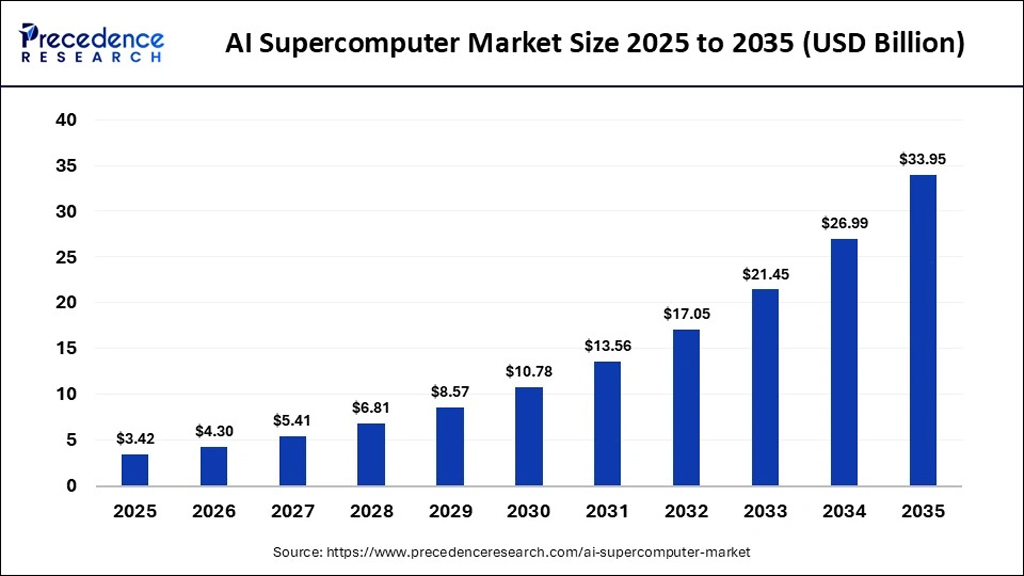
- The global AI supercomputer market is projected to rise from $3.42 billion in 2025 to $33.95 billion by 2035.
- This represents an increase of nearly 10 times over the 10-year forecast period.
- The market is expected to surpass $10 billion in 2030, reaching approximately $10.78 billion.
- By 2032, the AI supercomputer market is projected to reach $17.05 billion, up from $13.56 billion in 2031.
- Market size is forecast to exceed $20 billion in 2033, reaching around $21.45 billion.
- The strongest absolute annual gains occur toward the end of the forecast period, with the market increasing from $26.99 billion in 2034 to $33.95 billion in 2035.
- Between 2025 and 2030, the market is projected to grow by about $7.36 billion, from $3.42 billion to $10.78 billion.
- Between 2030 and 2035, the market is expected to add another $23.17 billion, highlighting accelerating demand for AI-focused high-performance computing infrastructure.
Supercomputer Adoption in Key Industries
- Government and defense generated 26.5% of global HPC revenue in 2025, making the sector the largest end-use category in one current market assessment.
- Aerospace, automotive, pharmaceutical, and climate-science organizations rank among the major users of HPC because they need to simulate complex processes and analyze large datasets.
- Aerospace and defense represented 22.21% of cloud HPC revenue in 2025, the largest industrial application share in that market.
- El Capitan can process about 3,000 standard-resolution 3D problems in one day or approximately 170 high-resolution problems, demonstrating the scale that exascale computing brings to complex modeling.
- El Capitan gives researchers roughly a 20-fold improvement in the ability to model high-fidelity weapons performance and safety compared with the previous generation of computing resources described for the program.
- The system also supports research into inertial confinement fusion and the behavior of materials under extreme conditions, alongside AI, machine learning, and other national-security workloads.
- Cloud HPC adoption has broadened access to computational resources: cloud deployment accounted for 52.43% of overall HPC revenue in 2025 in one market estimate.
- Large enterprises represented 64.15% of cloud HPC revenue in 2025, but small and midsize organizations are forecast to expand at a 6.98% CAGR from 2026 through 2031.
- Media and entertainment is forecast to become one of the faster-growing cloud HPC applications, with an 8.62% CAGR through 2031, driven in part by compute-intensive rendering and digital-content workloads.
- Commercial adoption extends beyond technical simulation. High-performance business computing supports workloads such as fraud detection, gaming, logistics, and financial services, widening the addressable market beyond traditional scientific HPC.
Supercomputer Processor and Accelerator Trends
- 276 of 500 systems, or 55.2%, used accelerator or coprocessor technology in June 2026. Six months earlier, only 255 did.
- NVIDIA Hopper chips appeared in 107 systems, making Hopper the largest accelerator group identified in the June 2026 statistics.
- Another 62 systems used NVIDIA Ampere accelerators, while 32 relied on AMD Instinct technology.
- Intel CPUs powered 53.2% of systems in June 2026, down from 57% six months earlier.
- AMD CPUs appeared in 192 systems, or 38.4%, compared with 35.6% in the previous ranking, indicating a continued gain in installation share.
- El Capitan combines fourth-generation AMD EPYC processors with AMD Instinct MI300A accelerators and reaches 1.809 exaflops on HPL.
- Frontier combines third-generation AMD EPYC processors with MI250X accelerators across more than 9.06 million cores, sustaining 1.353 exaflops.
- Aurora takes a different approach, combining Intel Xeon CPU Max processors with Intel Data Center GPU Max accelerators across more than 9.26 million cores.
- JUPITER Booster uses NVIDIA Grace CPUs and GH200 Superchips, while Alps uses a similar Grace/GH200 architecture and reaches 434.9 petaflops on HPL.
- Accelerator-heavy systems show especially large gains on mixed-precision workloads. El Capitan reached 16.7 exaflops on HPL-MxP, Aurora 11.6 exaflops, and Frontier 11.4 exaflops.
Supercomputer Power Consumption and Energy Efficiency
- The world’s fastest system in June 2026 reported power consumption of 42,220 kW, or 42.22 MW, while producing 2.198 exaflops on HPL.
- El Capitan consumed 29,685 kW during its reported measurement while delivering 1.809 exaflops. Its reported energy efficiency reached 60.94 GFlops/W.
- Frontier required 24,607 kW to deliver 1.353 exaflops, meaning its benchmark power demand was roughly 24.6 MW.
- Aurora reported the highest power figure among the five exascale systems at 38,698 kW, while producing 1.012 exaflops.
- JUPITER Booster achieved 1.000 exaflops using 15,794 kW, substantially less reported benchmark power than the other four exascale systems.
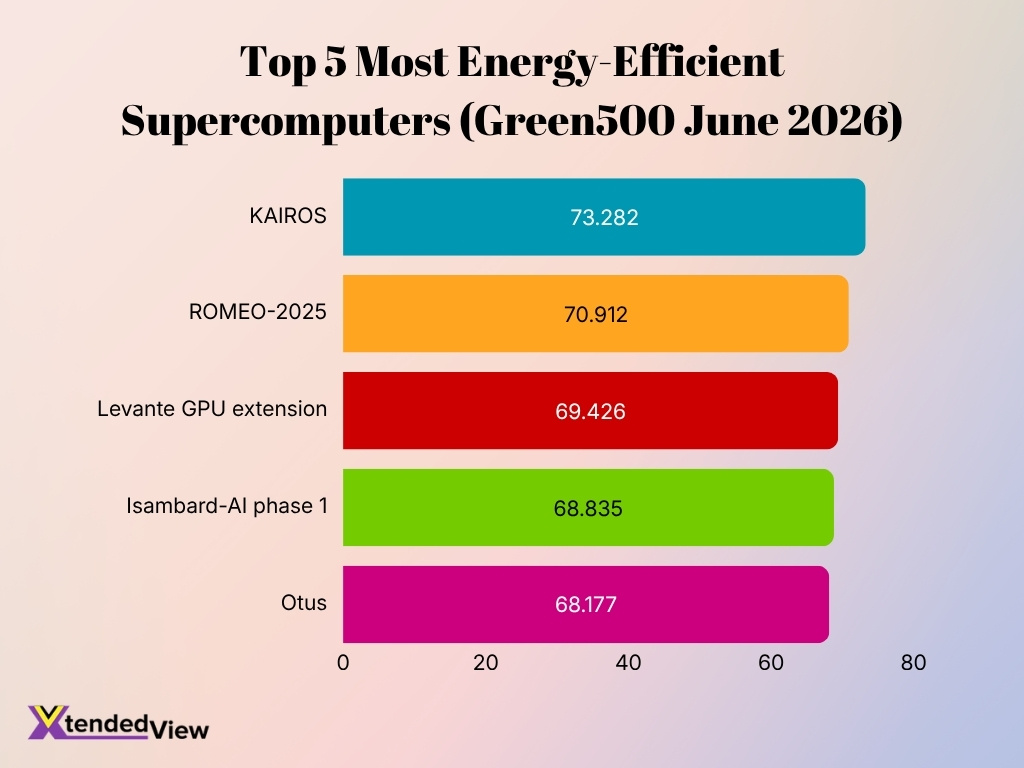
- KAIROS led the June 2026 energy-efficiency ranking at 73.282 GFlops/W, delivering 3.05 petaflops while drawing only 46 kW during its qualifying measurement.
- ROMEO-2025 ranked second for efficiency at 70.912 GFlops/W, with 9.86 petaflops of HPL performance and 160 kW of measured power.
- The Levante GPU extension ranked third at 69.426 GFlops/W, generating 6.75 petaflops while using 110 kW.
- Isambard-AI phase 1 achieved 68.835 GFlops/W, while the fifth-ranked Otus GPU configuration reached 68.177 GFlops/W.
- The top three energy-efficient systems in June 2026 shared the same basic architecture: Grace Hopper CPUs, NVIDIA GH200 Superchips, and high-speed NDR200 InfiniBand networking.
Cloud-Based Supercomputing and HPC-as-a-Service
- Cloud deployments accounted for 52.43% of global HPC revenue in 2025, giving cloud a slight majority in one current market assessment.
- Within the dedicated cloud HPC market, public cloud captured 67.95% of 2025 revenue, making it the dominant deployment model.
- Private cloud is forecast to expand at a 7.52% CAGR through 2031, supported by demand for data control, security, and predictable performance.
- Infrastructure as a Service represented 53.85% of cloud HPC spending in 2025, reflecting demand for flexible access to computing, networking, and storage infrastructure.
- Platform as a Service is forecast to grow at a 7.05% CAGR through 2031, as organizations increasingly use managed environments rather than assembling complete HPC software stacks themselves.
- Hardware accounted for 44.12% of cloud HPC revenue in 2025, while cloud HPC software is forecast to grow at an 8.42% CAGR through 2031.
- Large enterprises generated 64.15% of cloud HPC revenue in 2025, although small and midsize businesses are forecast to grow at 6.98% annually through 2031.
- North America held 39.94% of cloud HPC revenue in 2025, while Asia Pacific is forecast to grow at 8.77% annually through 2031.
- Cloud infrastructure has already reached the upper tiers of global supercomputing: Eagle ranked No. 7 worldwide in June 2026 with 561.2 petaflops of HPL performance.
- Public-cloud HPC particularly supports burst workloads such as computer-aided engineering, media rendering, and life-sciences searches, where organizations may need large amounts of computing capacity for limited periods.
Future Outlook: Supercomputer Trends to 2030-2035
- The global HPC market is forecast to rise from $61 billion in 2026 to $104.7 billion in 2033, representing an 8% CAGR.
- That forecast implies the market could add approximately $43.7 billion in annual revenue between 2026 and 2033.
- Another 2026 forecast estimates the broader HPC market could reach $106.3 billion by 2032, up from $57.6 billion in 2025.
- Hardware in that forecast is expected to grow at an 11% CAGR and reach $52.4 billion by 2032, reflecting continued spending on compute-intensive infrastructure.
- China’s HPC market is forecast to reach $18.6 billion by 2032, expanding at an 8.6% CAGR under the same market projection.
- Asia Pacific is expected to become the fastest-growing region in the broader HPC market between 2026 and 2033, while North America entered the period with 41.6% of 2025 revenue.
- Cloud HPC software is forecast to expand at an 8.42% CAGR through 2031, reflecting demand for schedulers, performance-management software, and workflows spanning cloud and hybrid infrastructure.
- Small and midsize organizations are projected to increase cloud HPC spending at a 6.98% CAGR through 2031, suggesting that high-performance computing will continue moving beyond organizations capable of financing their own supercomputers.
- Accelerator adoption already increased from 255 machines in late 2025 to 276 machines in June 2026, suggesting that heterogeneous CPU-accelerator architectures will remain central as AI and scientific computing converge.
- The five leading machines in June 2026 already deliver a combined 7.37 exaflops of HPL performance, illustrating how quickly aggregate exascale capacity is increasing as the industry moves toward the next performance era.
Frequently Asked Questions (FAQs)
LineShine ranks No. 1 as of June 2026, delivering 2.198 exaflops on the HPL benchmark with 13,789,440 cores, making it the first ranked system to exceed two exaflops of sustained double-precision performance.
There are five verified exascale systems in the June 2026 ranking: LineShine, El Capitan, Frontier, Aurora, and JUPITER Booster.
The 500 ranked systems deliver a combined 18.73 exaflops as of June 2026, up about 25% from 14.99 exaflops six months earlier.
The global HPC market is estimated at $61.0 billion in 2026 and is projected to reach $104.7 billion by 2033, representing an 8.0% CAGR from 2026 to 2033.
The global AI supercomputer market is projected at $3.05 billion in 2026, up from $2.56 billion in 2025, and is forecast to reach $8.96 billion by 2032 at a 19.6% CAGR.
Conclusion
Supercomputing entered the year with five exascale systems, rising accelerator adoption, and an increasingly close relationship between traditional scientific HPC and artificial intelligence. The fastest machine now delivers 2.198 exaflops, while the combined performance of the world’s 500 leading systems has reached 18.73 exaflops. These gains show how quickly large-scale computing capacity continues to advance.
However, raw processing speed represents only one part of the industry’s development. GPUs and specialized accelerators now play a central role in many leading systems, while energy consumption has made performance per watt a major design consideration. At the same time, cloud HPC and HPC-as-a-Service are widening access to advanced computing resources for organizations that cannot justify building and operating dedicated supercomputing facilities.
These changes are expanding the role of supercomputers across AI, climate science, engineering, pharmaceuticals, energy, manufacturing, national security, and academic research. Looking toward 2030-2035, the next generation of systems will increasingly compete on AI throughput, energy efficiency, memory bandwidth, networking performance, specialized processor design, and flexible access to computing capacity. Supercomputing is therefore evolving from a race for higher FLOPS into a broader computing ecosystem designed to solve increasingly complex scientific, industrial, and AI workloads.