


Smartwatches have evolved from simple notification devices into everyday health, fitness, and productivity companions. Hospitals now use smartwatch data to support remote patient monitoring, while employers and insurers increasingly encourage wearable-based wellness programs. As AI-powered health tracking and connected ecosystems continue to expand, smartwatch adoption continues to reshape consumer technology worldwide. Explore the statistics below to understand the latest market trends, growth patterns, and industry developments.
Editor’s Choice
- Global smartwatch shipments rebounded by 4% year over year in 2025, reversing the decline recorded during 2024 as demand improved across major markets.
- The worldwide smartwatch market recorded its first-ever annual shipment decline of 7% in 2024, mainly due to slower replacement cycles and weaker entry-level demand.
- IDC forecasts 159.7 million smartwatch shipments in 2026, although supply constraints may temporarily soften demand.
- Apple remained the leading smartwatch brand globally entering 2026, while Huawei and Xiaomi continued gaining market share.
- Cellular-enabled smartwatch shipments increased 6% year over year during 2025, reflecting stronger consumer demand for standalone connectivity.
- China became the fastest-growing smartwatch market in 2025, driven by strong domestic brands and government incentives.
- IDC expects the smartwatch category to return to sustained growth from 2027 onward as supply conditions improve and AI-driven health features mature.
Recent Developments
- During Q1 2026, global smartwatch shipments increased 4% year over year, supported by refreshed flagship product launches.
- Apple captured 23% of global smartwatch shipments in Q1 2026, maintaining the leading position worldwide.
- Huawei secured approximately 17% shipment share in Q1 2026, continuing its rapid international expansion.
- Apple’s smartwatch shipments grew 21% year over year in Q1 2026, the strongest increase among leading brands.
- North America recorded approximately 14% shipment growth during Q1 2026.
- China posted roughly 15% shipment growth in Q1 2026, making it the fastest-growing regional market.
- Throughout 2025, consumers increasingly favored premium smartwatches with advanced health monitoring instead of budget models.
- AI-powered features, biometric sensing, and software upgrades became major purchase drivers across premium smartwatch launches during 2025.
Smartwatch Market Overview
- Smartwatches remain one of the largest categories within the global wearable technology industry.
- IDC projects 159.7 million smartwatch shipments worldwide during 2026.
- Global smartwatch demand recovered in 2025 after contracting during 2024.
- Health monitoring continues to rank among the strongest factors influencing smartwatch purchases worldwide.
- Premium smartwatch models gained share as consumers upgraded for ECG, advanced sleep tracking, and AI-powered wellness tools.
- China has become a major growth engine for the smartwatch industry because of rising domestic consumption and competitive local manufacturers.
- Apple, Huawei, Samsung, Garmin, and Xiaomi continue to dominate the premium smartwatch landscape globally.
- Analysts expect AI integration, health diagnostics, and cross-device connectivity to shape the next phase of smartwatch growth.
Smartwatch Revenue Growth
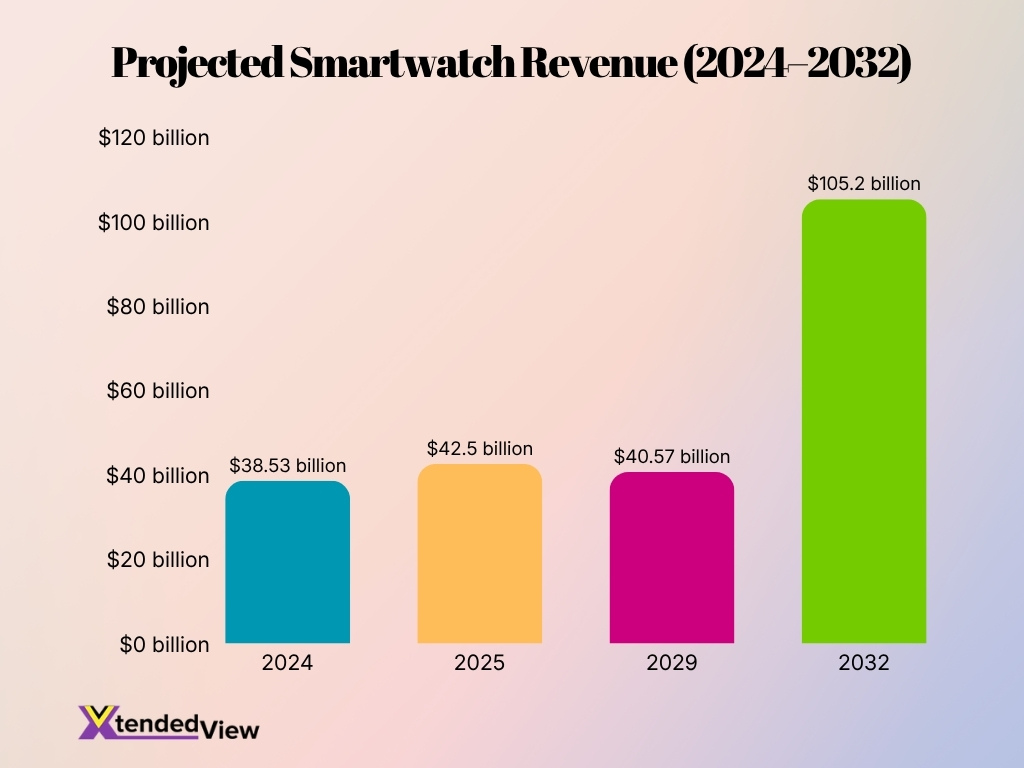
- Global smartwatch revenue stood at $38.53 billion in 2024, reflecting the market’s already significant size and strong consumer demand for wearable devices.
- The market is projected to reach $42.50 billion in 2025, representing an annual increase of approximately 10.3% from the previous year.
- Revenue is shown at $40.57 billion in 2029, indicating a temporary decline of around 4.5% compared with the 2025 revenue level.
- By 2032, global smartwatch revenue is expected to surge to $105.20 billion, more than doubling from the value recorded in 2029.
- Between 2024 and 2032, the market is projected to add approximately $66.67 billion in revenue, highlighting substantial long-term expansion potential.
- Overall smartwatch revenue is forecast to increase by nearly 173% during the period, rising from $38.53 billion to $105.20 billion.
- The sharp growth expected by 2032 suggests that increasing adoption of health monitoring, fitness tracking, connectivity, and smart features will continue to support market demand.
Smartwatch Market Size
- IDC forecasts the global smartwatch market will ship 159.7 million units in 2026.
- Global smartwatch shipments expanded 4% during 2025 after a difficult 2024.
- The market experienced a 7% shipment decline in 2024, marking its first annual contraction.
- Wearables overall shipped 145.7 million units in Q1 2026, demonstrating continued consumer demand across connected devices.
- Smartwatches continue representing one of the largest value segments within consumer wearable technology.
- Higher average selling prices in 2026 reflect memory-related supply constraints affecting production costs.
- Premium smartwatch adoption continues rising faster than entry-level models in developed markets.
- Industry forecasts suggest renewed expansion beginning in 2027 as supply chains normalize.
Smartwatch Shipments
- IDC expects 159.7 million smartwatch shipments globally in 2026.
- Global smartwatch shipments increased 4% year over year in 2025.
- Worldwide smartwatch shipments fell 7% during 2024, marking the industry’s first annual decline.
- Q1 2026 shipments grew 4% year over year, signaling continued market recovery.
- Apple accounted for 23% of smartwatch shipments in Q1 2026.
- Huawei followed with a 17% global shipment share during Q1 2026.
- North America recorded double-digit shipment growth during Q1 2026, supported by strong Apple demand.
- China’s smartwatch shipments expanded by approximately 15% year over year in Q1 2026, making it the fastest-growing major region.
Smartwatch User Growth Trends Worldwide
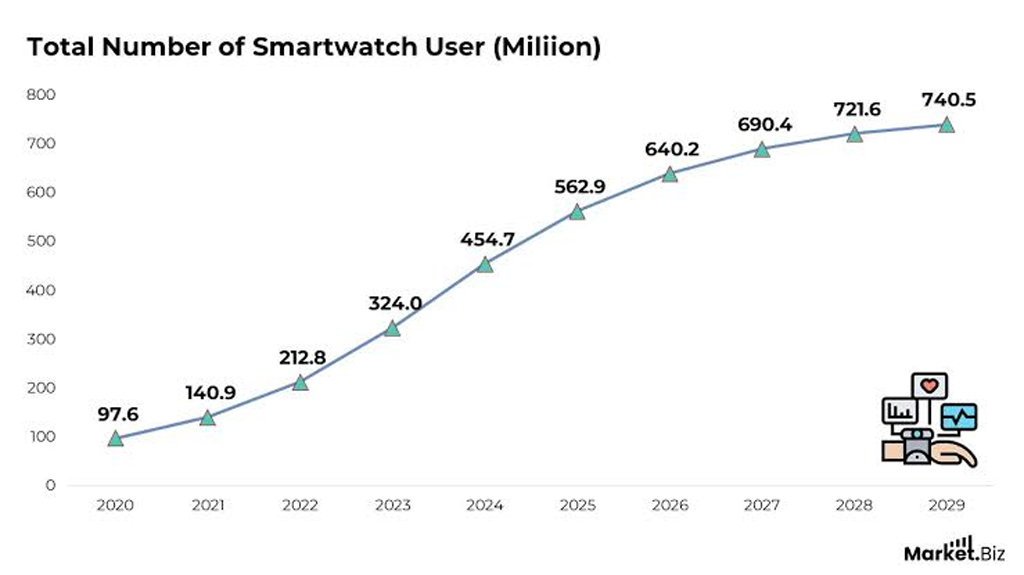
- Global smartwatch users increased from 97.6 million in 2020 to 740.5 million in 2029.
- The user base is projected to grow by nearly 7.6 times during the forecast period.
- Smartwatch users crossed the 200 million mark in 2022, reaching 212.8 million.
- Adoption accelerated sharply to 324 million users in 2023, an annual increase of 111.2 million.
- The market added its largest yearly gain between 2023 and 2024, rising by 130.7 million users.
- Global users surpassed 450 million in 2024 and reached 562.9 million in 2025.
- Smartwatch adoption is expected to exceed 600 million users in 2026, reaching 640.2 million.
- Growth continues at a slower pace after 2027, as the market approaches greater maturity.
- The user base is forecast to reach 721.6 million in 2028 and 740.5 million in 2029.
- Overall, the data highlights strong long-term adoption, despite gradually declining annual growth toward 2029.
Smartwatch Adoption Rate
- Global smartwatch users reached 562.86 million in 2025, representing a 23.7% increase from the previous year.
- The worldwide user base is projected to hit 640.15 million in 2026 and expand to 740.53 million by 2029.
- Approximately 27.8% of adults globally own a smartwatch, showcasing a robust adoption rate across consumer markets.
- Smartwatch adoption peaks within the 18 to 34 age group, with roughly 40% owning a wearable device.
- The standalone smartwatch segment is anticipated to capture over 45% of the global revenue share in 2026.
- A remarkable 92% of smartwatch users rely on their devices primarily for health and fitness tracking.
- The demographic breakdown of current ownership reveals a global user ratio of 60% male to 40% female.
- Global smartwatch shipments are predicted to surpass 400 million units by the end of 2026.
- The global smartwatch market size is forecasted to grow from $35.88 billion in 2026 to $100.13 billion by 2035.
Smartwatch Regional Market Share
- China recorded the fastest smartwatch shipment growth at 15% year-over-year during Q1 2026.
- North America followed closely with approximately 14% shipment growth during the same Q1 2026 period.
- Europe posted a solid 9% shipment growth during the first quarter of 2026.
- North America accounted for over 50% of Apple’s total smartwatch shipment volumes globally.
- Huawei dominated China’s market expansion by capturing a massive 40% shipment share.
- The Asia-Pacific region continues to lead overall global demand with nearly 39% of the unit volume.
- Premium smartwatch upgrades in mature markets drove average selling prices up by 6% year-over-year.
- Developing economies like the Middle East are expanding rapidly with a projected 10.5% growth rate.
Global Smartwatch Shipment Trends by Brand
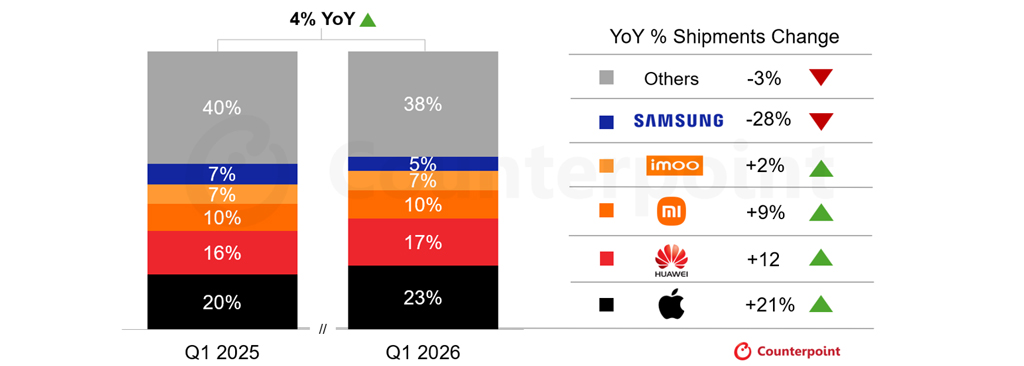
- Global smartwatch shipments increased by 4% year over year in Q1 2026.
- Apple strengthened its market leadership, increasing its share from 20% to 23% as shipments rose by 21%.
- Huawei remained the second-largest brand, with market share climbing from 16% to 17% and shipments growing by 12%.
- Xiaomi maintained a stable 10% market share, while recording 9% YoY shipment growth.
- imoo retained a 7% market share in both periods, supported by a modest 2% shipment increase.
- Samsung experienced the sharpest decline, with shipments falling by 28% and market share dropping from 7% to 5%.
- The combined share of other smartwatch brands declined from 40% to 38%, alongside a 3% YoY shipment decrease.
- Apple and Huawei together controlled 40% of the market in Q1 2026, up from 36% in Q1 2025.
Smartwatch Country-Wise Usage
- The United States is projected to generate $10.90 billion in smartwatch revenue during 2026, the largest national market worldwide.
- Approximately 37% of U.S. adults currently own a smartwatch.
- Croatia has one of the world’s highest smartwatch ownership rates, with nearly 40% of online adults owning one.
- The United Arab Emirates reports smartwatch ownership above 38% among online adults.
- Norway also exceeds 38% smartwatch ownership among internet users.
- Japan records comparatively low smartwatch ownership at 11.6% of internet users.
- Kenya reports smartwatch ownership below 10% among online adults.
- China continues posting some of the world’s fastest smartwatch shipment growth due to rising domestic demand.
Smartwatch Demographics
- Around 27.8% of the global adult population currently owns at least one smartwatch.
- The user base leans male, with ownership split roughly 60% male to 40% female globally.
- Adoption peaks among the 18 to 34 age demographic, where approximately 40% own a device.
- The 25 to 34 age bracket forms the largest consumer segment, accounting for 38% of total sales.
- Women aged 18 to 34 are slightly more likely to own a smartwatch than men of the same age.
- India holds the highest household wearable ownership at 57%, followed by Mainland China at 53%.
- The number of global smartwatch users hit 562.86 million in 2025, a 23.7% increase from 2024.
- North America leads the global smartwatch industry with a dominant 38.81% market share in 2025.
Smartwatch Operating System Market Share Insights
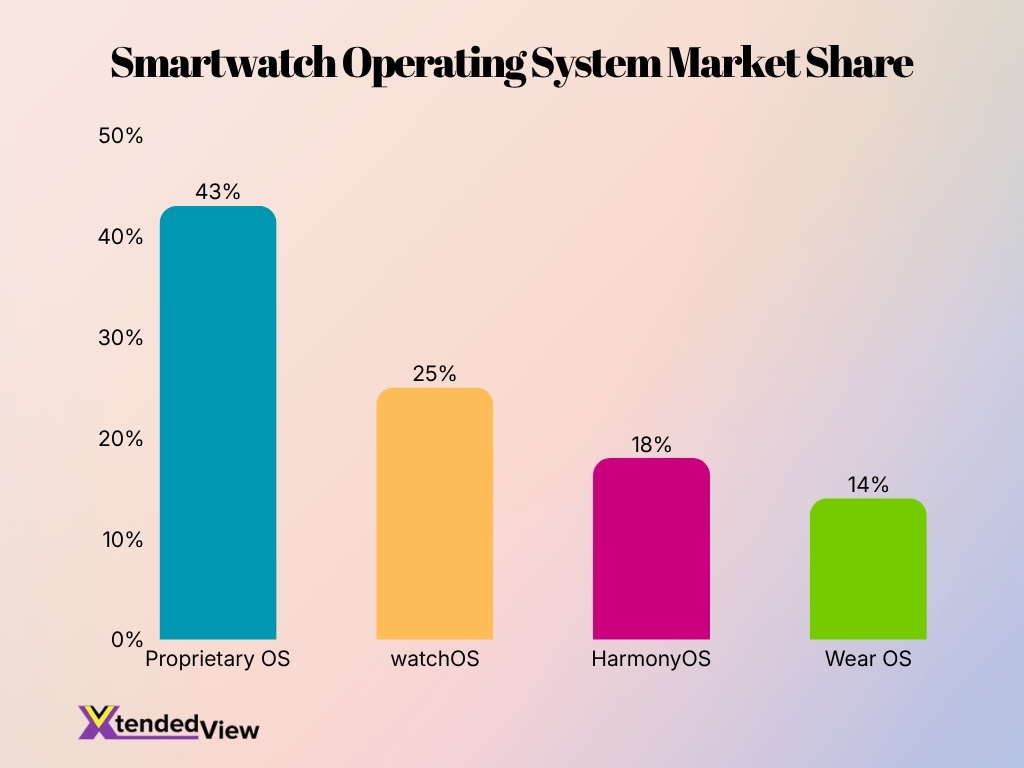
- Proprietary operating systems lead the smartwatch market with a 43% share, showing that brand-specific platforms remain highly influential.
- Apple’s watchOS holds the second-largest position at 25%, accounting for one-quarter of the overall smartwatch OS market.
- HarmonyOS captures an 18% market share, reflecting its growing presence across Huawei’s smartwatch ecosystem.
- Wear OS represents 14% of the market, making it the smallest major platform among the four operating system categories.
- Together, watchOS, HarmonyOS, and Wear OS account for 57% of the market, slightly exceeding the combined share of proprietary platforms.
- The 29-percentage-point gap between Proprietary OS and Wear OS highlights the strong fragmentation and competition within the smartwatch software market.
Smartwatch Health and Fitness Usage
- 67% of wearable users primarily use their devices to track health and fitness activities.
- 69% of wearable owners report wearing their devices every day, highlighting strong long-term engagement.
- 60% of consumers agree that health-focused wearable technology helps improve their overall health and wellness.
- Modern smartwatches increasingly support advanced health monitoring, including ECG, blood oxygen, sleep tracking, and heart rhythm analysis.
- Wearables generated $16.8 billion in global sales during 2025, growing 13% year over year, driven largely by health-focused devices.
- More than half of U.S. wearable owners have discussed data collected from their devices with a healthcare provider.
- Smartwatch users increasingly rely on continuous monitoring for sleep quality, exercise recovery, stress management, and cardiovascular health.
- Researchers continue to find that smartwatch health features improve user engagement, health expectations, and long-term device usage.
Smartwatch Features and Usage Trends
- Global smartwatch shipments increased 4% year over year in Q1 2026.
- Smartwatch average selling prices increased 6% in Q1 2026 alongside advanced AI features.
- Over 92% of users rely on their smartwatches primarily for tracking health and fitness.
- The total worldwide number of smartwatch users officially reached 562.86 million in 2025.
- The premium smartwatch segment held a massive 45.6% of the global market share in 2025.
- Apple successfully secured the highest market leadership with a 23% shipment share in Q1 2026.
- Cellular-enabled smartwatch shipments grew by exactly 6% year over year during 2025.
- Standalone and classic smartwatches dominated consumer preferences by holding a 61.40% share in 2025.
- The OLED display segment captured exactly 68.30% of total global smartwatch shipments in 2025.
Smartwatch Consumer Preferences
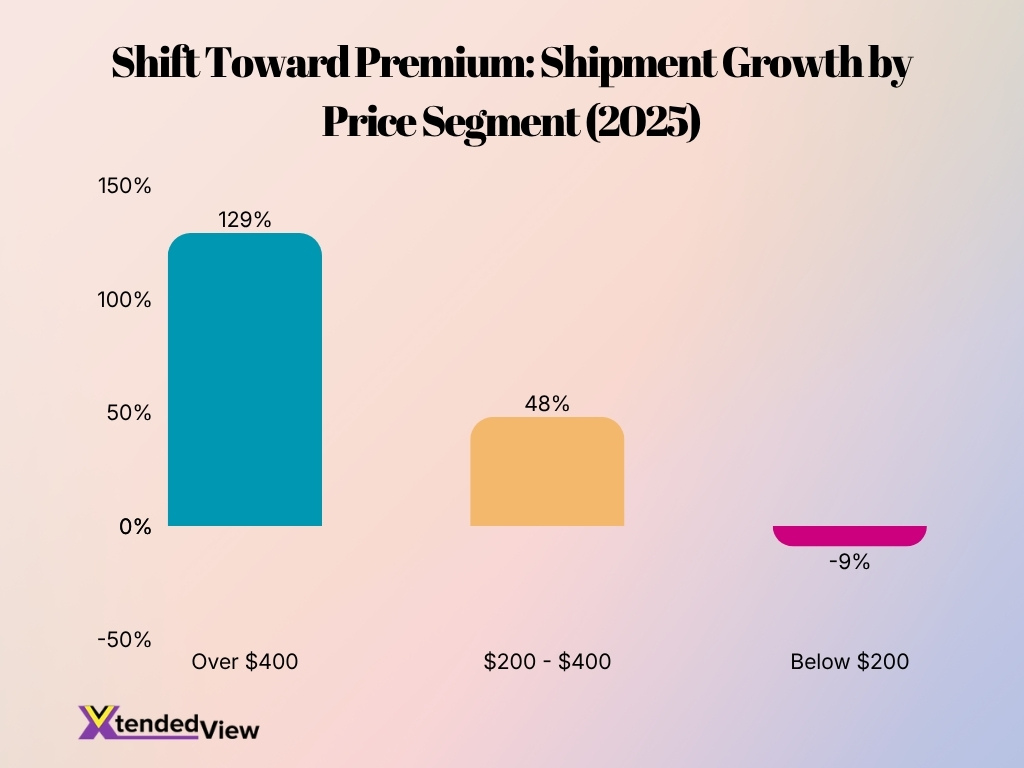
- High-end smartwatches priced over $400 witnessed a 129% year-on-year shipment increase, reflecting premium preferences.
- Smartwatches priced below $200 experienced a 9% overall shipment decline during 2025.
- The $200-$400 price segment recorded a 48% year-over-year shipment increase globally in 2025.
- Approximately 92% of smartwatch wearers utilize their devices primarily for health and fitness monitoring.
- Nearly 90% of adult users are highly willing to integrate their smartwatch data with external healthcare ecosystems.
- Exactly 74% of wearable users express significant concerns regarding data privacy when selecting wearable technology.
- The average selling price of health-focused devices rose by 8.4% as consumers upgraded for better sensor accuracy and battery performance.
- AI-driven personalized health recommendations are projected to capture over 35% of incremental smartwatch market revenue by 2034.
Smartwatch Pricing Trends
- Global average selling prices rose 5% during 2025 due to feature upgrades.
- Smartwatch prices saw an additional 6% year-over-year increase in Q1 2026.
- Global smartwatch prices escalated in 2026 due to severe memory supply constraints.
- Entry-level pricing surged by 34% alongside the introduction of new AI functions.
- Premium smartwatch demand sustained continuous growth despite facing higher retail prices.
- India’s average selling price jumped 16% year-over-year during Q4 2025.
- Premium models became more accessible through expanded financing and trade-in programs.
- Pricing is projected to remain firm through 2026 before reaching component-driven stabilization.
Key Reasons People Use Smartwatches
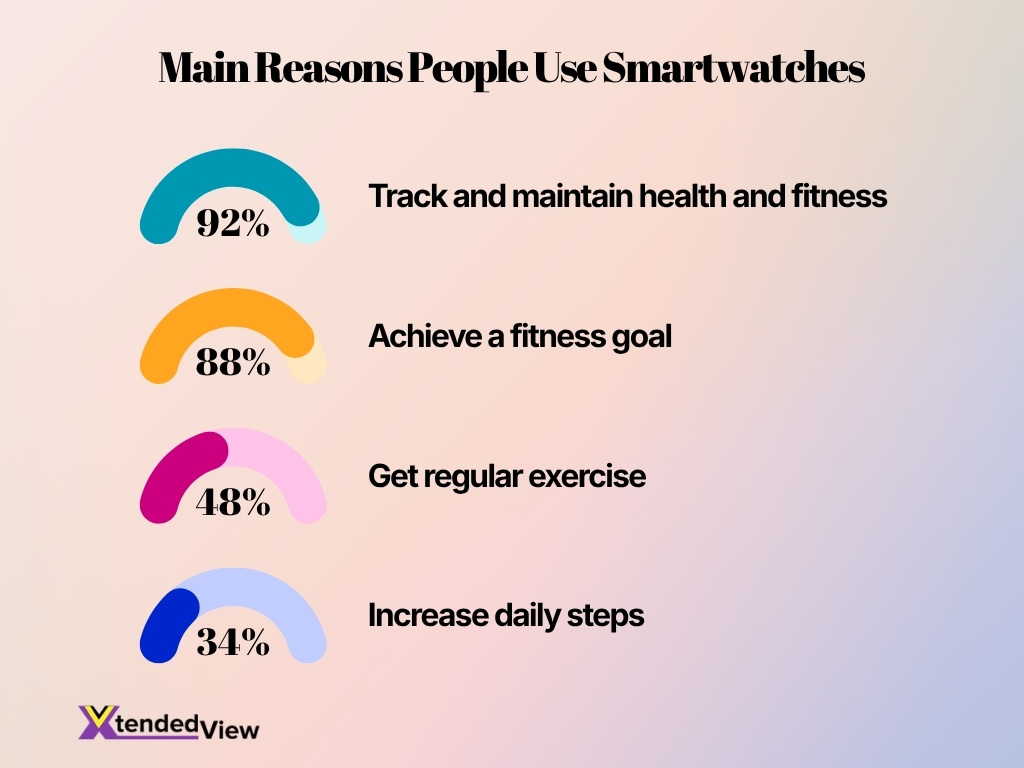
- Health and fitness tracking is the leading reason for smartwatch use, cited by 92% of people.
- Achieving a fitness goal ranks second, with 88% of users relying on smartwatches for motivation and progress tracking.
- Nearly half of users, or 48%, use smartwatches to help them exercise regularly.
- Increasing daily step counts is a key objective for 34% of people, showing the importance of everyday activity monitoring.
- Overall, the data shows that smartwatch usage is strongly driven by health management, fitness goals, and active lifestyle habits.
Smartwatch Forecast
- Worldwide smartwatch revenue is projected to reach $34.91 billion in 2026.
- The global smartwatch market is expected to grow at a 4.67% CAGR between 2026 and 2030.
- Global smartwatch revenue is forecast to reach $41.91 billion by 2030.
- User penetration is expected to increase from 8.13% in 2026 to 9.22% by 2030.
- The smartwatch market is projected to grow at approximately 3% CAGR through 2030 based on shipment forecasts.
- Industry analysts expect smartwatch shipments to recover to sustained long-term growth beginning in 2027 as supply constraints ease.
- AI-enabled health monitoring, chronic disease management, and connected healthcare ecosystems will remain major growth drivers.
- Premium smartwatches are expected to capture an increasing share of total market value over the next five years.
Frequently Asked Questions (FAQs)
Global smartwatch shipments are forecast to reach 159.7 million units in 2026.
The worldwide smartwatch market is projected to generate US$34.91 billion in revenue in 2026.
Apple led the global smartwatch market with a 23% shipment share in Q1 2026.
The global smartwatch market is expected to grow at a 4.67% CAGR between 2026 and 2030.
Global smartwatch shipments increased by 4% year over year in Q1 2026.
Conclusion
The smartwatch industry entered the year on a stronger footing after recovering from its first annual shipment decline in 2024. Growth is increasingly shifting from low-cost devices to premium models that deliver AI-powered health insights, more accurate sensors, cellular connectivity, and tighter ecosystem integration. Consumers are also using smartwatches beyond fitness, with healthcare providers incorporating wearable data into clinical conversations and preventive care.
Looking ahead, industry forecasts point to steady revenue growth, rising global user penetration, and continued innovation in digital health. As manufacturers invest in advanced wellness capabilities and connected services, smartwatches are expected to play an even greater role in personal healthcare, productivity, and everyday digital experiences across the United States and worldwide.
