

Gaming keyboards have evolved from niche PC accessories into a major part of the broader gaming hardware market. Competitive players increasingly rely on features such as adjustable actuation, rapid-trigger switches, and high polling rates to improve responsiveness, while streamers and hybrid users value programmable keys, wireless connectivity, and customizable layouts for both gaming and productivity. With 212.3 million Americans playing video games at least one hour per week and the global PC player population reaching approximately 936 million in 2025, manufacturers have a large and diverse audience to serve.
The market is also becoming more segmented. Mechanical keyboards continue to dominate performance-focused gaming, but Hall Effect and magnetic switch technologies are gaining momentum as players look for faster actuation and greater control. At the same time, compact layouts, RGB lighting, and low-latency wireless connections are influencing how consumers choose and upgrade their keyboards. The following statistics examine how market growth, regional demand, player preferences, spending patterns, and esports adoption are shaping gaming keyboard trends.
Editor’s Choice
- One 2026 market model puts the global gaming keyboard market at $3.16 billion in 2026, up from $2.81 billion in 2025, equivalent to 12.5% annual growth.
- A separate 2026 forecast values the sector at $4.17 billion, compared with $3.81 billion in 2025, and projects a 10.57% CAGR through 2032. Differences reflect varying definitions of the gaming keyboard category.
- Another narrower market model estimates gaming keyboard revenue at $1.3 billion in 2026, with the market reaching about $1.9 billion in 2030.
- Asia Pacific generated approximately 43.05% of worldwide gaming keyboard revenue in 2025 under one current market model, making it the largest regional market.
- Mechanical gaming keyboards captured an estimated 75.2% of gaming keyboard revenue in 2025 in one global segmentation model, compared with 17.8% for membrane products.
- Approximately 69% of PC gamers were estimated to prefer mechanical keyboards over membrane models in a 2026 gaming-peripherals analysis.
- Among tracked professional gamers at the end of 2025, the two most-used individual keyboard models each accounted for 15% of observed setups, while the third-ranked model represented 14%.
Recent Developments
- In July 2026, a new Hall Effect gaming keyboard family launched with 8,000Hz polling, adjustable magnetic switches, and competitive-focused input controls. The lineup includes tenkeyless and 65% configurations.
- The same 2026 keyboard line uses a true 8KHz polling rate, meaning the device can report input to a connected PC up to 8,000 times per second under supported conditions.
- The 2026 tenkeyless version entered the U.S. market at approximately $140, while the smaller 65% edition started at roughly $120, bringing magnetic switch technology below the $150 level.
- A 2026 magnetic 65% gaming keyboard tested with adjustable actuation as low as 0.1 mm, highlighting how switch travel has become a tunable performance specification rather than a fixed hardware property.
- That same 2026 model combined 8,000Hz polling with a 16,000Hz internal scan rate, showing how manufacturers now market both host polling and switch-scanning speed separately.
- Its reported input latency reached approximately 0.125 milliseconds under its performance configuration, illustrating how premium gaming keyboards increasingly compete around sub-millisecond response claims.
- At Computex 2026, 8,000Hz polling and magnetic switch technology appeared across multiple new keyboard introductions, suggesting that specifications once confined to enthusiast models are moving toward broader high-performance lineups.
- Low-latency wireless development also accelerated in 2026, with new products promising 8K wireless operation over 2.4GHz connections, narrowing the performance distinction between wired and wireless keyboards.
- A 2025-2026 gamer survey covering roughly 14,000 respondents found that established gaming brands still led keyboard usage, while smaller specialist brands gained visibility in satisfaction and recommendation rankings.
Global Gaming Keyboard Market Size and Growth
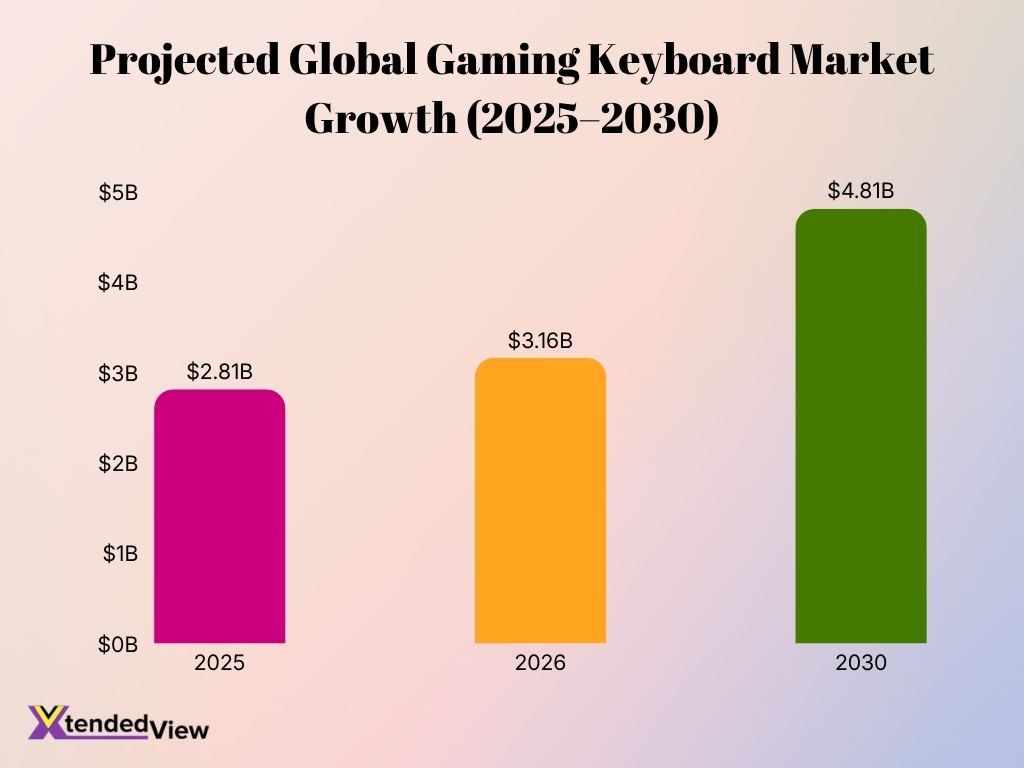
- One July 2026 market forecast estimates global gaming keyboard revenue at $3.16 billion in 2026, compared with $2.81 billion in 2025.
- That estimate translates to 12.5% year-over-year growth from 2025 to 2026, making gaming keyboards a relatively fast-growing peripheral segment under that methodology.
- The same model projects market revenue of $4.81 billion by 2030, equivalent to an approximately 11% compound annual growth rate over its longer forecast period.
- A second 2026 study estimates the market at $2.52 billion in 2026, up from $2.30 billion in 2025.
- Under that forecast, gaming keyboard revenue could reach $3.96 billion by 2031, representing a 9.5% CAGR between 2026 and 2031.
- Another current model places the market at $3.81 billion in 2025 and $4.17 billion in 2026, followed by $7.71 billion in 2032.
- That $3.81 billion-to-$7.71 billion forecast corresponds to a 10.57% CAGR, indicating that several market models expect high-single-digit or low-double-digit long-term growth despite different market definitions.
- A narrower product definition produces a substantially smaller estimate, $1.1 billion in 2024 and about $1.3 billion in 2026, with revenue forecast to reach $1.9 billion in 2030.
- Under the narrower model, the sector is forecast to expand at a 9.3% CAGR from 2025 through 2030, supporting the broader conclusion that gaming keyboard spending continues to rise even though absolute market-size estimates differ.
Gaming Keyboard Market Share by Region
- Asia Pacific captured 43.05% of global gaming keyboard revenue in 2025 in one recently updated market model, making it the leading region.
- The same analysis expects the Asia Pacific market to expand at a 9.09% CAGR through its forecast period, supported by gaming adoption across China, Japan, India, and Southeast Asia.
- A separate 2025 segmentation valued Asia Pacific gaming keyboard revenue at approximately $720.1 million, again placing the region first worldwide.
- Under that same model, North America generated about $465.4 million in gaming keyboard revenue during 2025.
- Europe contributed approximately $386 million in 2025 under the same methodology, ranking behind Asia Pacific and North America.
- Latin America represented about $106.4 million in 2025 gaming keyboard revenue, showing a smaller but measurable regional market for gaming-specific keyboards.
- The Middle East and Africa contributed approximately $52.4 million under that 2025 segmentation.
- Looking specifically at mechanical gaming keyboards, Asia Pacific accounted for approximately 37.5% of 2025 revenue, compared with 31.0% for North America and 23.5% for Europe.
- The U.S. gaming keyboard market generated $125.5 million in 2024 under another narrower market definition and is forecast to reach $217.2 million by 2030, representing a 9.6% CAGR.
Gaming Keyboard Adoption Among Gamers
- The addressable U.S. gaming population reached 212.3 million weekly players in 2026, creating a large consumer base for keyboards and other gaming accessories.
- The U.S. added approximately 7.2 million weekly gamers between 2025 and 2026, increasing the potential customer pool for dedicated gaming peripherals.
- More than 80% of Gen Alpha and Gen Z Americans reported playing video games weekly in 2026, placing younger consumers among the most concentrated audiences for gaming hardware.
- Weekly gaming participation also reached 71% among U.S. millennials in 2026, showing that gaming keyboard demand extends well beyond teenagers and college-age players.
- Among Gen X consumers, 56% played video games weekly in 2026, while 50% of boomers did so. This broader age mix expands the market for keyboards that combine gaming and productivity functions.
- Globally, there were approximately 936 million PC players in 2025, up 3.1% from the previous year. PC remains the platform most directly tied to standalone keyboard demand.
- PC players represented about 26% of the worldwide gaming population in 2025, giving keyboard manufacturers access to nearly one-quarter of all gamers through a keyboard-native platform.
- One 2026 gaming-peripherals analysis estimates that gaming keyboards generate roughly 33% of gaming peripheral market revenue, reflecting the keyboard’s central role in PC setups.
- Another 2026 analysis places mechanical keyboard preference among PC gamers at approximately 69%, indicating that specialized switch technology has moved well beyond a small enthusiast niche.
Mechanical vs Membrane Gaming Keyboard Preferences
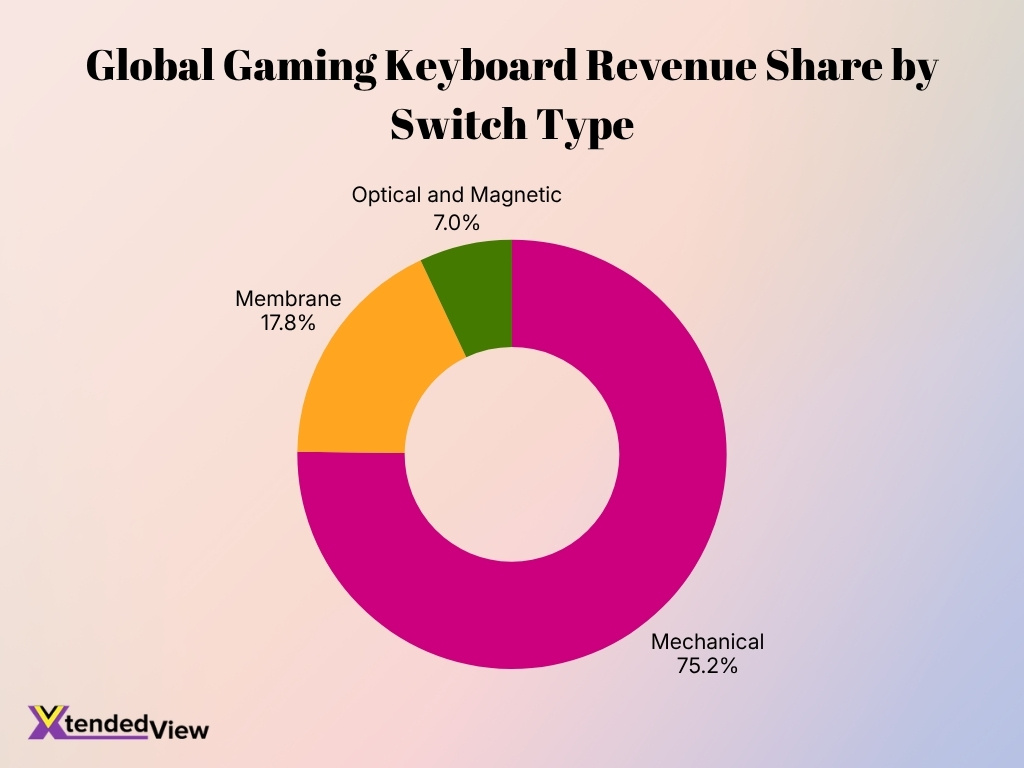
- Mechanical gaming keyboards generated an estimated 75.2% of worldwide gaming keyboard revenue in 2025 under one switch-based market segmentation.
- Membrane gaming keyboards accounted for approximately 17.8% of 2025 revenue under the same methodology, leaving optical and magnetic models with roughly 7%.
- Mechanical models in that dataset generated about $1.30 billion during 2025, versus approximately $308.3 million for membrane gaming keyboards.
- Optical and magnetic gaming keyboards generated approximately $120.5 million in 2025, indicating that newer switch technologies remained smaller than mechanical and membrane products but had established a measurable commercial segment.
- Another market dataset found mechanical gaming keyboards held 65.6% of product revenue in 2023, showing that mechanical designs already led the market before the recent expansion of magnetic switches.
- The membrane gaming keyboard segment generated approximately $249.8 million in 2024 under that same market framework and is forecast to reach $442.7 million by 2030.
- Membrane gaming keyboards are forecast to post roughly a 10% CAGR from 2025 to 2030, meaning mechanical dominance does not translate into declining membrane demand. Lower prices continue to support the category.
- One broader 2026 peripheral analysis estimates that 69% of PC gamers prefer mechanical keyboards over membrane alternatives, citing faster actuation and tactile response as major factors.
- In the wireless gaming keyboard segment specifically, mechanical switches accounted for approximately 81% of 2025 revenue, while membrane switches represented roughly 13.7%, suggesting that buyers willing to pay for wireless gaming performance also tend to favor mechanical designs.
Wireless vs Wired Gaming Keyboard Usage Statistics
- Wired models accounted for 61.4% of global gaming mechanical keyboard revenue in 2025, compared with 38.6% for wireless models. Wired keyboards remain common among competitive players because they remove battery management and wireless interference concerns.
- Wireless gaming mechanical keyboards represented 38.6% of 2025 revenue, making them smaller than wired models but the faster-growing connectivity segment.
- Wireless gaming mechanical keyboard revenue is forecast to grow at an 11.2% CAGR through 2034, compared with 6.8% for wired models. That gap points to continued share gains for cable-free keyboards.
- Wireless mechanical gaming keyboards typically command a 25% to 40% price premium over comparable wired products because manufacturers add batteries, wireless controllers, and multiple connectivity modes.
- In the broader gaming mouse-and-keyboard category, wireless products reached 54.2% of worldwide revenue in 2025, up from about 34% in 2019. The combined data indicates how quickly low-latency wireless technology has moved into mainstream gaming setups.
- The broader wired gaming mouse-and-keyboard category represented 45.8% of 2025 revenue and is projected to decline to around 37.2% by 2034 as wireless adoption increases.
- Hall Effect gaming keyboards show a similar but less advanced transition; wired products held 62.4% of Hall Effect keyboard revenue in 2025, while wireless products accounted for 37.6%.
- Wireless Hall Effect gaming keyboards are projected to grow at a 14.2% CAGR from 2026 to 2034, versus 9.2% for wired Hall Effect models. This makes wireless one of the strongest growth opportunities within performance-focused keyboards.
Gaming Keyboard Switch Type Preferences
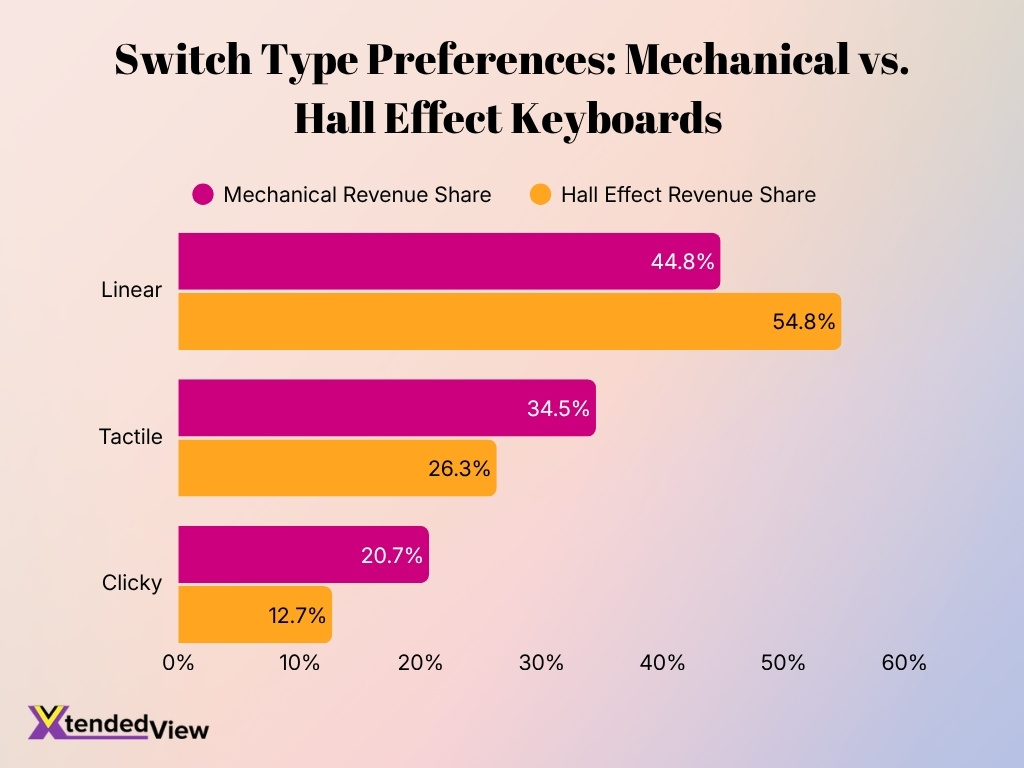
- Linear switches captured 44.8% of gaming mechanical keyboard revenue in 2025, making them the leading switch category in one current global market analysis.
- Tactile switches accounted for 34.5% of gaming mechanical keyboard revenue in 2025, placing them second behind linear switches. Their physical feedback also makes them suitable for gamers who use the same keyboard for work.
- Clicky switches represented the remaining 20.7% of 2025 gaming mechanical keyboard revenue under the same segmentation. Their louder sound profile limits their appeal in shared workspaces and streaming environments.
- Typical linear gaming switches require approximately 35 to 45 grams of actuation force, compared with around 45 to 60 grams for tactile switches.
- Clicky gaming switches typically fall around 50 to 60 grams of actuation force, creating stronger tactile and audible feedback than most linear options.
- Within the newer Hall Effect category, linear switches commanded approximately 54.8% of 2025 revenue, substantially ahead of other magnetic switch types.
- Tactile Hall Effect switches represented about 26.3% of 2025 Hall Effect keyboard revenue, while clicky models accounted for roughly 12.7%.
- A 2025 consumer study of Hall Effect keyboard owners found that about 71% preferred linear switches for gaming, while 22% selected tactile configurations. That result reinforces the connection between smooth switch travel and performance-oriented gaming.
Gaming Keyboard Layout and Size Preferences
- A conventional full-size keyboard generally contains 104 keys, including a dedicated number pad, function row, arrows, and navigation cluster. Full-size designs remain useful for gamers who also perform spreadsheet, productivity, or data-entry work.
- Tenkeyless, or TKL, keyboards typically use 87 keys, removing the number pad while retaining the function row, arrows, and navigation controls. This design creates additional mouse space without removing most frequently used gaming controls.
- A typical 75% keyboard uses approximately 84 keys, compressing the navigation cluster into a smaller footprint while retaining the function row and dedicated arrows.
- A 65% keyboard generally contains about 68 keys. It removes the number pad and function row but usually retains dedicated arrow keys, which distinguishes it from most 60% models.
- A standard 60% keyboard uses roughly 61 keys, eliminating the number pad, function row, dedicated navigation cluster, and usually the standalone arrow-key block.
- Compact layouts have become especially visible in premium gaming because Hall Effect manufacturers now routinely offer products spanning 60%, 65%, TKL, and full-size formats rather than limiting magnetic switches to one keyboard size.
- Individual consumers generated 61.8% of Hall Effect gaming keyboard revenue in 2025, and manufacturers increasingly address that large consumer segment with multiple layout options instead of standardized full-size designs.
- TKL layouts continue to feature heavily in gaming-focused product testing because removing the number pad lets players position their mouse closer to the keyboard and creates more horizontal space for low-sensitivity mouse movement. One 2026 evaluation of 10 gaming keyboards included several TKL models alongside 75%, 60%, and full-size options.
RGB Lighting Adoption in Gaming Keyboards
- Approximately 76% of gaming keyboard purchases in 2025 included integrated RGB lighting in one current market analysis, showing how lighting has shifted from an enthusiast option to a mainstream gaming feature.
- Among gaming mechanical keyboards priced above $80, more than 73% included full RGB backlighting in 2025.
- In comparison, only around 38% of gaming mechanical keyboards above that price threshold featured full RGB in 2019, illustrating a substantial expansion in adoption over six years.
- The share of RGB-equipped gaming mechanical keyboards above $80 therefore increased by approximately 35 percentage points between 2019 and 2025.
- The premium gaming keyboard segment linked to greater customization expanded by approximately 31% during 2025, with programmable lighting, switches, and software ecosystems contributing to demand.
- In the U.S. market, keyboards with configurable RGB zones appeared in more than one-third of new 2026 model launches examined in one market assessment, particularly among products aimed at gamers, streamers, and content creators.
- Per-key RGB has become especially common in the $100 to $200 mainstream-premium range, where manufacturers increasingly combine lighting with wireless connectivity, hot-swappable switches and software-based customization.
- RGB adoption also extends into Hall Effect products. The largest Hall Effect price tier in 2025, covering keyboards priced from $80 to $160, commonly included programmable per-key RGB alongside rapid trigger and adjustable actuation.
Average Spending on Gaming Keyboards
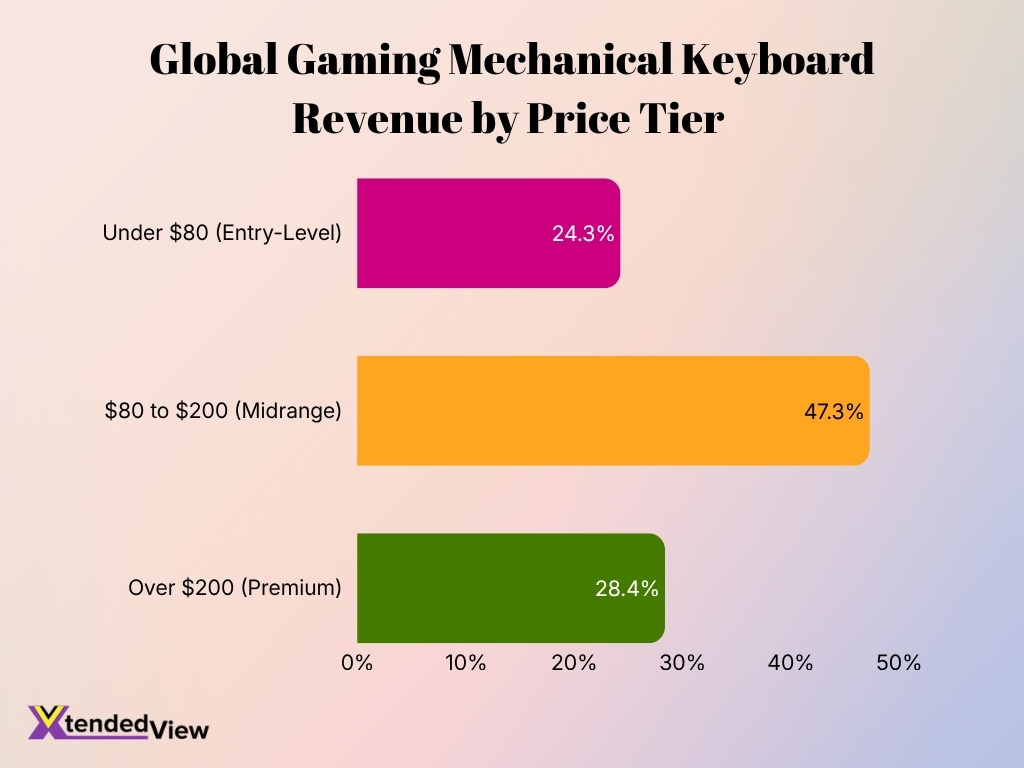
- The $80 to $200 price tier captured 47.3% of global gaming mechanical keyboard revenue in 2025, making midrange products the largest spending segment.
- Entry-level gaming mechanical keyboards priced below $80 accounted for 24.3% of 2025 market revenue. This tier remains important for first-time mechanical keyboard buyers and price-sensitive gamers.
- Premium keyboards priced above $200 represented 28.4% of gaming mechanical keyboard revenue in 2025, indicating that more than one-quarter of category spending came from high-end products.
- Combining the medium and high tiers shows that keyboards priced at $80 or more generated 75.7% of 2025 gaming mechanical keyboard revenue under this segmentation.
- Professional gaming buyers spent an average of about $145 per keyboard in the broader gaming mouse-and-keyboard category during 2025.
- Casual gamers spent an average of approximately $67 per gaming keyboard in the same 2025 analysis, less than half the professional-gaming average.
- The difference between the reported professional and casual average selling prices was approximately $78 per keyboard, meaning the professional average was roughly 116% higher.
- Hall Effect gaming keyboards carried an estimated 25% to 60% premium over comparable traditional mechanical models in 2025, although entry-level magnetic keyboards increasingly appeared in the $40 to $80 range.
- The largest Hall Effect revenue tier in 2025 covered products priced $80 to $160 and accounted for about 43.2% of worldwide Hall Effect gaming keyboard revenue.
Gaming Keyboard Polling Rate Trends
- Traditional gaming keyboards commonly operate at 1,000Hz polling, which means the device can report its state to a PC up to 1,000 times per second, or once every millisecond.
- High-end gaming keyboards increasingly support 8,000Hz polling, theoretically reducing the polling interval from 1 millisecond at 1,000Hz to 0.125 milliseconds.
- At 8,000Hz, a keyboard can theoretically transmit input data eight times as frequently as a conventional 1,000Hz gaming keyboard.
- Several current full-size performance keyboards now advertise 8,000Hz polling, showing that high report rates no longer belong exclusively to experimental or compact products. One recently tested full-size model combined 8K polling with high-speed mechanical switches.
- Magnetic gaming keyboards have pushed polling rates further into the mainstream. New 2026 Hall Effect launches increasingly combine 8K polling with adjustable actuation and rapid-trigger controls, targeting competitive FPS players.
- Some 2026 gaming keyboards now pair an 8,000Hz USB polling rate with a 16,000Hz internal scan rate. The distinction matters because internal scanning determines how frequently the keyboard checks switch positions before transmitting data to the PC.
- The theoretical polling interval at 4,000Hz is 0.25 milliseconds, exactly half the interval of a 2,000Hz device and four times faster than a conventional 1,000Hz interval.
- The move from 1,000Hz to 8,000Hz represents a theoretical maximum interval reduction of 0.875 milliseconds. In practice, total input latency also depends on switch scanning, firmware, USB processing, the game engine, and display refresh rate.
Gaming Keyboard Purchase Factors and Priorities
- Approximately 67% of keyboard buyers in one 2025 market assessment considered the ability to evaluate switch feel an important purchase factor. That preference helps physical retailers remain relevant despite online sales growth.
- Online stores nevertheless captured 65.8% of gaming mechanical keyboard revenue in 2025, indicating that buyers increasingly research specifications, reviews, and switch options digitally before purchasing.
- Offline retailers retained 34.2% of 2025 gaming mechanical keyboard revenue, supported partly by consumers who want to test key feel, sound, and build quality before committing to a model.
- Price remains a major purchase constraint; the $80 to $200 segment represented 47.3% of 2025 revenue, making it the industry’s largest spending tier and showing where many buyers balance performance against cost.
- Connectivity increasingly shapes purchasing decisions. Wireless mechanical keyboards held 38.6% of 2025 gaming mechanical keyboard revenue and are forecast to grow faster than wired products through 2034.
- Switch feel remains another core priority. Linear, tactile and clicky models accounted for 44.8%, 34.5% and 20.7%, respectively, of 2025 gaming mechanical keyboard revenue, demonstrating that no single switch profile meets every user’s needs.
- RGB has become a baseline feature for many purchasers; 76% of gaming keyboard purchases in 2025 reportedly included RGB lighting, while more than 73% of mechanical gaming keyboards priced above $80 offered full RGB.
- Low latency has become particularly important in the fast-growing Hall Effect segment. Professional gaming represented 41.2% of Hall Effect keyboard revenue in 2025, where adjustable actuation, rapid trigger, and low input latency serve as major product differentiators.
- Durability also affects purchase decisions. Hall Effect switches commonly carry expected lifespans of 100 million or more keystrokes, compared with about 50 million for many conventional mechanical switches, which strengthens their appeal to heavy users and gaming cafés.
- Customization increasingly influences premium purchases. More than 60% of Hall Effect gaming keyboards launched in 2025 included some form of rapid-trigger implementation, showing how adjustable performance settings have become a competitive feature rather than a niche add-on.
Esports Professional Gaming Keyboard Usage
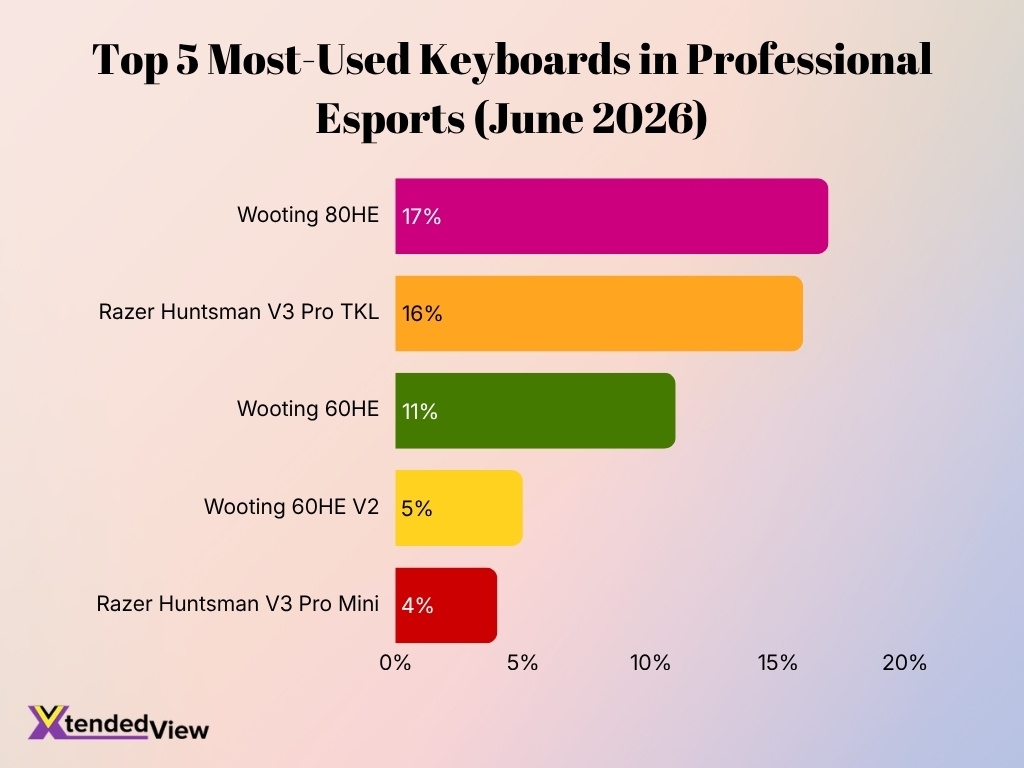
- As of June 2026, the Wooting 80HE ranked as the most-used keyboard among tracked professional esports players, accounting for 17% of player setups.
- The Razer Huntsman V3 Pro TKL ranked second in June 2026, with 16% of tracked professionals using the model. The difference between the top two keyboards was only 1 percentage point.
- The Wooting 60HE ranked third among professional players in June 2026 with an 11% usage share, giving compact analog keyboards a substantial presence in competitive setups.
- The newer Wooting 60HE V2 had already reached 5% of professional setups by June 2026, despite competing with its established predecessor.
- The Razer Huntsman V3 Pro Mini represented another 4% of tracked professional keyboard use in June 2026. Together, the five leading models accounted for 53% of observed setups.
- The market changed substantially from July 2025, when the Wooting 60HE led individual models with 16% usage, followed by the Razer Huntsman V3 Pro TKL at 14% and Wooting 80HE at 10%.
- By December 2025, the Razer Huntsman V3 Pro TKL and Wooting 60HE were tied at 15% each, while the Wooting 80HE had climbed to 14%. This shift preceded the 80HE’s move into first place in 2026.
- A separate 2026 database covering 1,011 professional Counter-Strike 2 players found 104 players, or 10.3%, using the black Wooting 80HE alone. Another 86 players, or 8.5%, used its Frost version.
- That Counter-Strike 2 dataset tracked 136 different keyboard models, showing that professional players use a broad range of equipment even though a handful of magnetic keyboards command large shares.
Gaming Keyboard Replacement and Upgrade Frequency
- Mechanical keyboards can remain functional for much longer than many other PC peripherals, but consumers typically refresh their keyboards approximately every four to five years rather than waiting for complete hardware failure.
- A 2026 regional market assessment estimates a shorter two-to-three-year replacement cycle for gaming enthusiasts, reflecting demand for new switch technologies, wireless connectivity, and updated lighting systems.
- The same analysis puts casual gaming-keyboard replacement at approximately three to four years, about one year longer than the typical enthusiast cycle.
- Across Asia Pacific, active gamers’ estimated replacement cycle has shortened from roughly four to five years to two to three years, with magnetic switches, wireless upgrades and changing design preferences contributing to faster replacement.
- Replacement purchases may generate approximately 40% to 50% of annual gaming-keyboard unit sales in mature Asian markets such as South Korea and Japan.
- Another market analysis takes a more conservative view, estimating that many consumers retain gaming keyboards for five to seven years. The difference illustrates how replacement behavior varies considerably between enthusiasts and mainstream buyers.
- Conventional mechanical switches commonly carry durability ratings of roughly 30 million to 100 million keystrokes, which helps explain why functional lifespan can exceed the consumer’s preferred upgrade cycle.
- Hall Effect switches often carry ratings of approximately 100 million to 150 million keystrokes, potentially reducing switch-wear-related replacement while simultaneously encouraging upgrades for adjustable actuation and rapid-trigger features.
- Some 2026 magnetic switches now advertise 150 million actuations, compared with 100 million for other magnetic models in the same generation. This suggests that durability improvements continue even as enthusiasts replace keyboards for performance rather than outright failure.
Gaming Keyboard Features Most Valued by Consumers
- Switch durability remains a measurable purchasing consideration. Conventional mechanical switches typically carry ratings between 30 million and 100 million keystrokes, while Hall Effect alternatives often reach 100 million to 150 million.
- Adjustable actuation has become a defining performance feature in 2026. New Hall Effect gaming keyboards allow users to set actuation anywhere from 0.1 mm to 4.0 mm, letting players choose between highly sensitive gaming inputs and deeper everyday keystrokes.
- Rapid Trigger removes the need for a conventional fixed reset point. Combined with magnetic sensing, current keyboards can reset according to key movement, a feature aimed particularly at games that demand repeated directional inputs.
- 8,000Hz polling has become a headline specification on current performance keyboards. At that rate, a keyboard can theoretically report its state every 0.125 milliseconds rather than every 1 millisecond at 1,000Hz.
- One current Hall Effect implementation measured an average latency of 0.60 milliseconds at 0.1 mm actuation and 8,000Hz polling in manufacturer testing, an 8% advantage over the nearest competing magnetic model included in that test.
- Compact size also matters in performance designs. One prominent 2026 magnetic model uses a 65% layout while providing 8,000Hz polling and a 16,000Hz internal scan rate, illustrating how manufacturers combine desk-space savings with high-performance electronics.
- The same 2026 keyboard supports actuation down to 0.1 mm and rapid-trigger reset at 0.01 mm, highlighting the increasingly granular customization available to performance-focused buyers.
- Repairability can extend a keyboard’s useful life. Hot-swappable designs let owners replace an individual failed switch rather than replacing the entire keyboard, making switch sockets a practical consideration alongside gaming performance.
- Wireless performance has become another important competitive feature. Current market forecasts expect wireless gaming keyboards to grow at a 10.3% CAGR through 2030, reflecting demand for cable-free desks without giving up gaming-oriented responsiveness.
Gaming Keyboard Brand Market Share
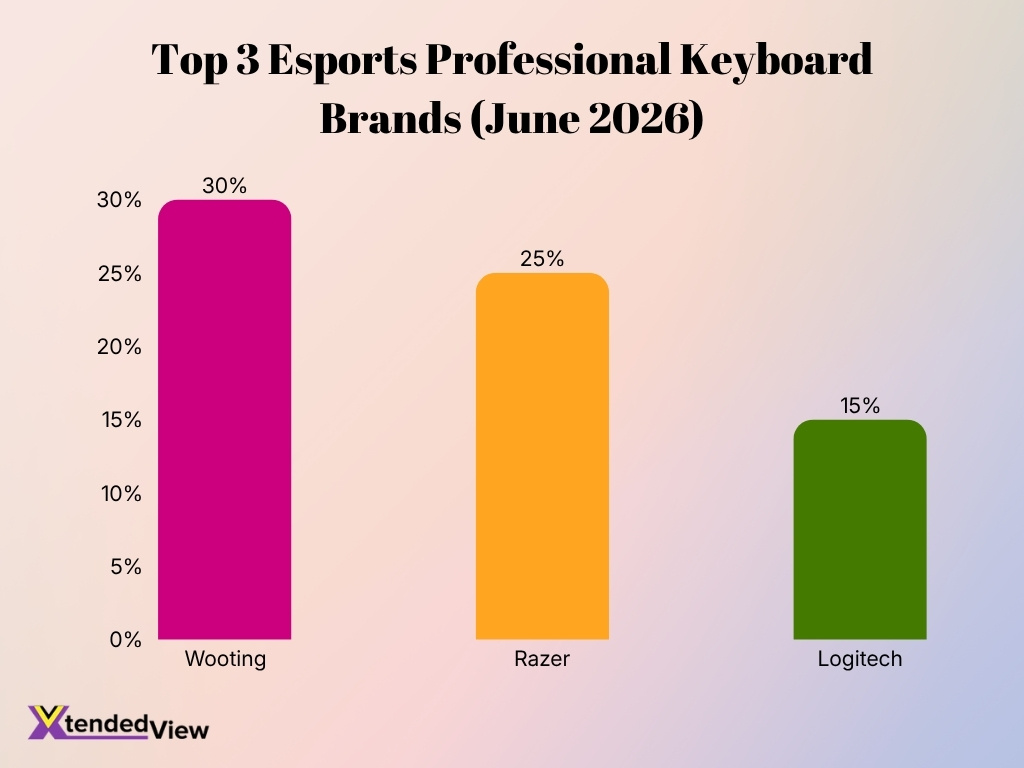
- Wooting led tracked professional keyboard usage with a 30% share in June 2026, moving ahead of the industry’s larger established peripheral brands.
- Razer ranked second with 25% of professional keyboard setups in June 2026. Combined, Wooting and Razer supplied keyboards to 55% of the tracked professional players.
- Logitech ranked third with a 15% professional usage share in June 2026. The top three brands therefore accounted for 70% of tracked esports keyboard setups.
- Wooting increased its professional usage share by 9 percentage points during 2025, enough to finish that year as the most-used keyboard brand in the tracked dataset.
- Razer gained approximately 2 percentage points during 2025, while Logitech lost 4 percentage points over the same period. The figures illustrate how quickly professional preferences shifted toward analog and magnetic designs.
- At the midpoint of 2025, Razer still held more than 25% of professional keyboard usage, while Wooting had gained 6 percentage points from the beginning of the year.
- SteelSeries held approximately 8% of professional keyboard usage in July 2025, placing it behind Logitech but still among the more widely represented gaming-keyboard brands.
- By June 2026, the 5-percentage-point gap between Wooting and Razer showed how magnetic-switch specialization had altered the competitive landscape. Wooting had moved from challenger status to the leading brand among tracked professionals.
- Individual-model data reinforces that concentration, the Wooting 80HE and Razer Huntsman V3 Pro TKL together represented 33% of professional setups in June 2026.
Future Gaming Keyboard Market Projections
- Under one current market definition, worldwide gaming keyboard revenue is forecast to rise from $3.16 billion in 2026 to $4.81 billion in 2030, representing an 11% CAGR.
- That forecast implies approximately $1.65 billion in additional annual market revenue between 2026 and 2030, equivalent to an increase of roughly 52%.
- A second research model projects the market from $4.17 billion in 2026 to $7.71 billion in 2032, corresponding to a 10.57% CAGR. Differences in absolute values reflect different definitions and segmentation methods.
- A longer-range forecast values the market at $6.5 billion by 2035, compared with $2.6 billion in 2025, representing a projected CAGR of 9.6% from 2026 through 2035.
- Another model projects gaming keyboard revenue to reach $5.12 billion by 2034, compared with $2.21 billion in 2024, at an 8.7% CAGR.
- A narrower market definition estimates $1.3 billion in 2026 and $1.9 billion by 2030, corresponding to a 9.3% CAGR from 2025 through 2030. Despite the lower absolute value, its growth direction closely matches broader forecasts.
- The U.S. market alone is forecast to reach approximately $217.2 million by 2030 under the narrower methodology, up from $125.5 million in 2024 and representing a 9.6% CAGR from 2025 through 2030.
- Online gaming-keyboard sales represent another high-growth channel. Global online-segment revenue is projected to increase from $109.6 million in 2024 to $202 million in 2030, a 10.7% CAGR.
- Looking further ahead, another 2026 forecast projects the gaming-keyboard market to rise from $1.45 billion in 2026 to $2.77 billion by 2035, producing a 7.4% CAGR. Taken together, current forecasts consistently point toward expansion even though their definitions produce different market totals.
Frequently Asked Questions (FAQs)
One current estimate values the global market at $1.3 billion in 2026, with revenue projected to reach $1.9 billion by 2030.
One current forecast projects a 9.3% CAGR from 2025 to 2030, although estimates vary depending on market definitions.
Asia Pacific held 43.05% of the global market in 2025 under one recent market estimate.
The top-ranked keyboard is used by 16.63% of 2,418 tracked professional players, or 402 players.
Mechanical gaming keyboards represented approximately 75.2% of global revenue in 2025 in one switch-type market analysis.
Conclusion
Gaming keyboard statistics point to a market that is continuing to expand while becoming more specialized and performance-driven. Current forecasts generally indicate 7% to 11% annualized growth across different research methodologies, while rising PC gaming participation and continued spending on peripherals support long-term demand. Mechanical keyboards remain dominant, but magnetic and Hall Effect technologies are gaining visibility because they offer adjustable actuation, rapid-trigger functionality, and increasingly low input latency.
Professional esports usage also shows how quickly new technologies can influence the wider market. Wooting reached 30% of tracked professional keyboard usage in June 2026, while 8,000Hz polling and sub-millimeter actuation settings have become increasingly common among high-performance models. At the same time, wireless connectivity, compact layouts, RGB customization, and longer switch lifespans continue to shape mainstream purchasing decisions.
Although published market-size estimates vary because different research firms define the gaming keyboard category differently, the overall direction remains consistent. Gaming keyboards are becoming more customizable, responsive, and technically advanced, giving both competitive players and everyday gamers more options across price points, layouts, and switch technologies.