

Wireless keyboards have become a core part of modern workspaces, gaming setups, and mobile computing environments. Businesses now rely on wireless peripherals to support hybrid work, while gamers and creators prefer low-latency keyboards that reduce desk clutter and improve flexibility. The market also benefits from growing demand for Bluetooth-enabled tablets, smart TVs, and multi-device productivity tools.
Manufacturers continue to improve battery life, connectivity stability, and ergonomic design, which has pushed wireless keyboards into both premium and mainstream consumer segments. As remote work and portable computing expand worldwide, the wireless keyboard market keeps evolving across consumer, enterprise, and gaming categories. Explore the latest wireless keyboard statistics, growth trends, and market forecasts shaping.
Editor’s Choice
- The global wireless keyboard market is expected to reach $1.5 billion in 2026, with forecasts projecting growth to $2.4 billion by 2033.
- Wireless keyboard market growth between 2026 and 2033 is projected at a 6.8% CAGR, largely fueled by hybrid work adoption and portable device usage.
- Another industry estimate valued the wireless keyboard market at $3.8 billion in 2025, with revenue expected to hit $6.7 billion by 2034.
- Bluetooth-enabled wireless keyboards accounted for approximately 54.7% of total market revenue in 2025.
- Asia-Pacific represented the largest regional wireless keyboard market in 2025, contributing 36.4% of global revenue share.
- The gaming mouse and keyboard market is projected to grow from $5.29 billion in 2025 to $9.10 billion by 2033.
- Premium wireless gaming keyboards in 2026 now offer battery life exceeding 660 hours on advanced wireless firmware platforms.
- The Bluetooth computer keyboard market is forecast to expand at a 9.2% CAGR between 2026 and 2033.
- Standard wireless keyboards held the largest product category share at 38.2% in 2025.
Recent Developments
- Keychron introduced its Q Ultra wireless keyboard lineup at CES 2026 with support for 8K polling rates and battery life reaching 660 hours.
- Hall effect keyboard technology moved into mainstream gaming markets during 2025, with brands such as Asus, Corsair, Logitech, and Keychron expanding wireless offerings.
- Wireless gaming keyboards increasingly use 2.4 GHz wireless connectivity instead of Bluetooth to reduce input latency for esports players.
- Asus ROG Azoth emerged as one of the most recognized premium wireless gaming keyboards in 2025 and 2026 because of its long battery life and customizable switches.
- Manufacturers accelerated the adoption of hot-swappable switches in wireless keyboards during 2025, targeting both gamers and office professionals.
- Mechanical wireless keyboard sales continued rising as e-commerce growth increased direct-to-consumer peripheral purchases globally.
- Low-latency Bluetooth 5.2 technology became a major trend in Bluetooth keyboard development across the enterprise and gaming segments.
- Rechargeable and solar-powered wireless peripherals gained traction among environmentally conscious consumers in 2025 and 2026.
- Wireless keyboard makers are increasingly focused on compact 65%, 75%, and tenkeyless layouts to support mobile workstations and smaller desk setups.
Wireless Keyboards Market Size
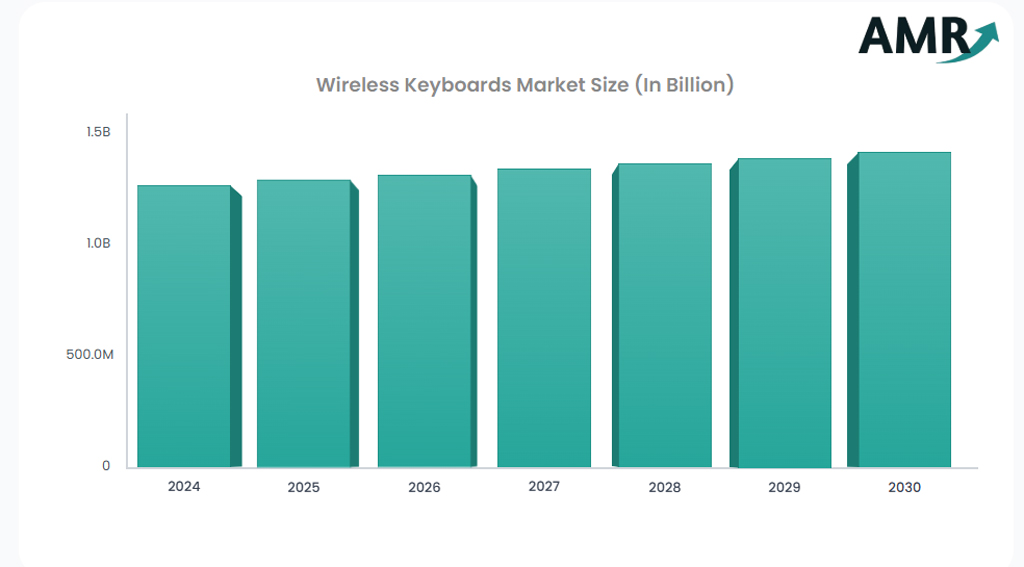
- The wireless keyboards market is expected to grow steadily from $1.266 billion in 2024 to $1.418 billion by 2030.
- Between 2024 and 2030, the market is projected to add around $152 million in value.
- The market size is estimated at $1.290 billion in 2025, showing continued demand for wireless keyboard products.
- By 2026, the wireless keyboards market is forecast to reach $1.315 billion, crossing the $1.3 billion mark.
- The market is expected to rise further to $1.340 billion in 2027, supported by the growing use of wireless peripherals in work, gaming, and home office setups.
- In 2028, the market is projected to reach $1.365 billion, maintaining a stable upward trend.
- By 2029, the wireless keyboards market is forecast to hit $1.391 billion, moving closer to the $1.4 billion level.
- The highest value in the chart appears in 2030, when the market is expected to reach $1.418 billion.
- Overall, the data shows a consistent year-over-year increase, indicating that wireless keyboards remain a growing segment within the computer accessories market.
- The gradual rise suggests demand is being driven by remote work, portable devices, gaming setups, ergonomic accessories, and Bluetooth-enabled connectivity.
Wireless Keyboard Market Growth Statistics
- The wireless keyboard market is projected to expand at a 6.8% CAGR from 2026 to 2033.
- Market Research Future forecasts wireless keyboard growth at 7.48% CAGR through 2035.
- Bluetooth computer keyboards are expected to grow faster than the overall category at 9.2% CAGR.
- The gaming keyboard and mouse segment is forecast to grow at approximately 7.3% CAGR through 2032.
- Mechanical keyboard demand is projected to increase by $362.6 million between 2026 and 2030.
- Wireless mouse and keyboard products are expected to grow at 6.4% CAGR through 2035.
- Historical wireless keyboard market growth between 2020 and 2025 averaged around 6.1% annually.
- Gaming peripherals are forecast to add nearly $3.8 billion in new revenue by 2033.
- Growth in hybrid work and remote office setups remains one of the largest demand drivers for wireless keyboard manufacturers globally.
Wireless Keyboard Market Forecast Statistics
- The wireless keyboard market could surpass $2.4 billion by 2033 under current growth forecasts.
- Dataintelo forecasts the market will reach approximately $6.7 billion by 2034.
- Market Research Future predicts the wireless keyboard market may hit $10.85 billion by 2035.
- The Bluetooth keyboard segment alone could grow to $4.8 billion by 2033.
- Gaming mouse and keyboard products are projected to reach $2.34 billion by 2032.
- The broader computer keyboard industry is forecast to achieve $9.5 billion by 2035.
- Wireless mouse and keyboard devices are expected to generate $12.08 billion globally by 2035.
- Mechanical keyboard revenue is expected to continue expanding through 2030 due to rising online sales and gaming demand.
- Analysts expect North America to maintain a leading share of Bluetooth keyboard revenue through 2030 because of enterprise and gaming demand.
Wireless Keyboard Regional Market Share Statistics
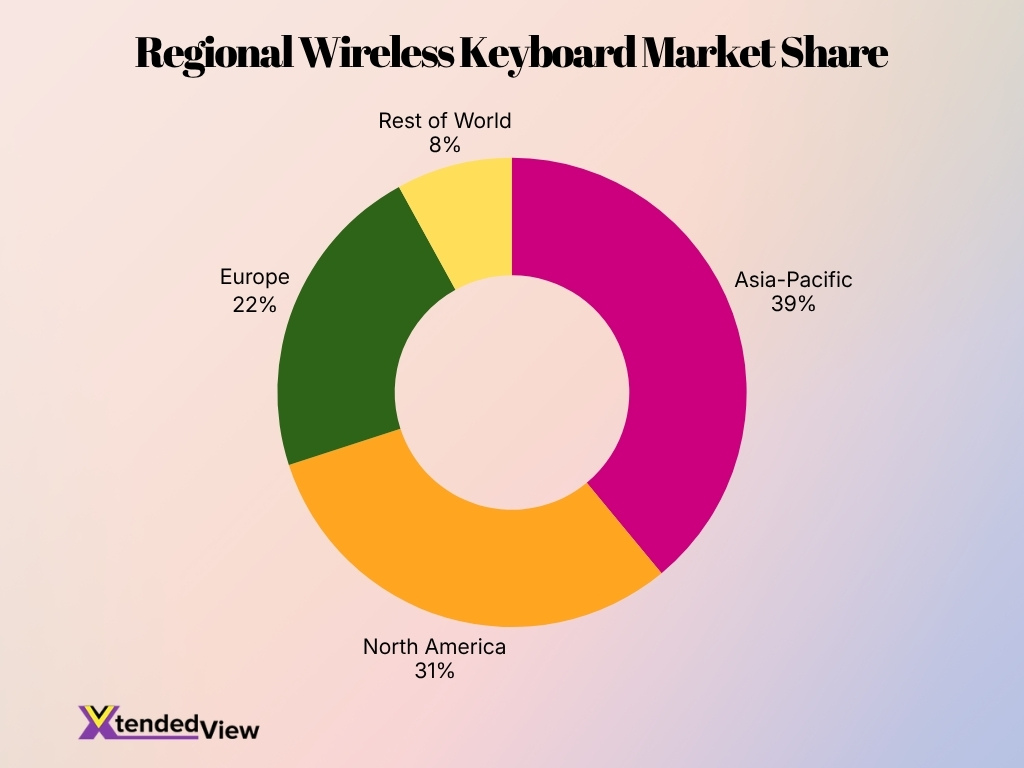
- Asia-Pacific holds the largest share of the wireless keyboard market, accounting for 39% of the total regional market share.
- North America ranks second with a 31% share, showing strong demand for wireless keyboards across consumers, offices, and gaming users.
- Europe represents 22% of the market, supported by the growing adoption of wireless peripherals in workplaces and home setups.
- The Rest of World segment contributes 8%, indicating a smaller but developing market presence.
- Together, Asia-Pacific and North America account for 70% of the wireless keyboard market share.
- Asia-Pacific leads North America by 8 percentage points, making it the dominant regional market.
- Europe’s 22% share shows that the region remains an important market, though it trails Asia-Pacific by 17 percentage points.
- The data suggests that wireless keyboard demand is highly concentrated in the top three regions, which together make up 92% of the market.
- The lower 8% share for the Rest of World highlights potential growth opportunities in emerging markets.
- Overall, the chart shows that Asia-Pacific, North America, and Europe are the key regions driving global wireless keyboard market demand.
Wireless Keyboard Market Share Statistics
- Bluetooth wireless keyboards controlled roughly 54.7% of market revenue in 2025.
- Standard wireless keyboards accounted for approximately 38.2% of total product share in 2025.
- Asia-Pacific led the global wireless keyboard market with 36.4% share in 2025.
- North America represented around 28.1% of global wireless keyboard revenue in 2025.
- Europe captured an estimated 21.3% market share in the wireless keyboard segment during 2025.
- The consumer electronics segment remains the largest end-user category for Bluetooth keyboard sales globally.
- Individual consumers accounted for around 42.6% share of the broader keyboard market in 2025.
- Gaming and esports continue gaining market share within premium wireless mechanical keyboard categories.
- Compact wireless keyboards, including 65% and 75% layouts, increased market share in 2025 as desk space optimization became a higher priority for remote workers.
Wireless Keyboard Connectivity Trends Statistics
- Bluetooth remained the dominant wireless keyboard connectivity technology with 54.7% market share in 2025.
- Bluetooth 5.2 adoption accelerated in 2025 because manufacturers focused on lower latency and improved power efficiency.
- Gaming keyboards increasingly relied on 2.4 GHz wireless connectivity rather than standard Bluetooth to reduce response lag.
- Multi-device wireless keyboards that support switching between laptops, tablets, and smartphones became one of the fastest-growing product categories in 2025.
- USB-C rechargeable wireless keyboards gained popularity as manufacturers phased out disposable battery designs.
- Wireless keyboards with dual connectivity modes represented a growing share of premium office and gaming products in 2025.
- Low-energy wireless chipsets helped extend keyboard battery life beyond 300 hours on several flagship devices.
- Secure wireless connectivity features became more important in enterprise environments because of rising concerns about peripheral-based cyberattacks.
- Wireless keyboards compatible with smart TVs and streaming devices continued gaining traction in the home entertainment market.
Wireless Keyboard Usage Is Led by Office and Productivity Needs
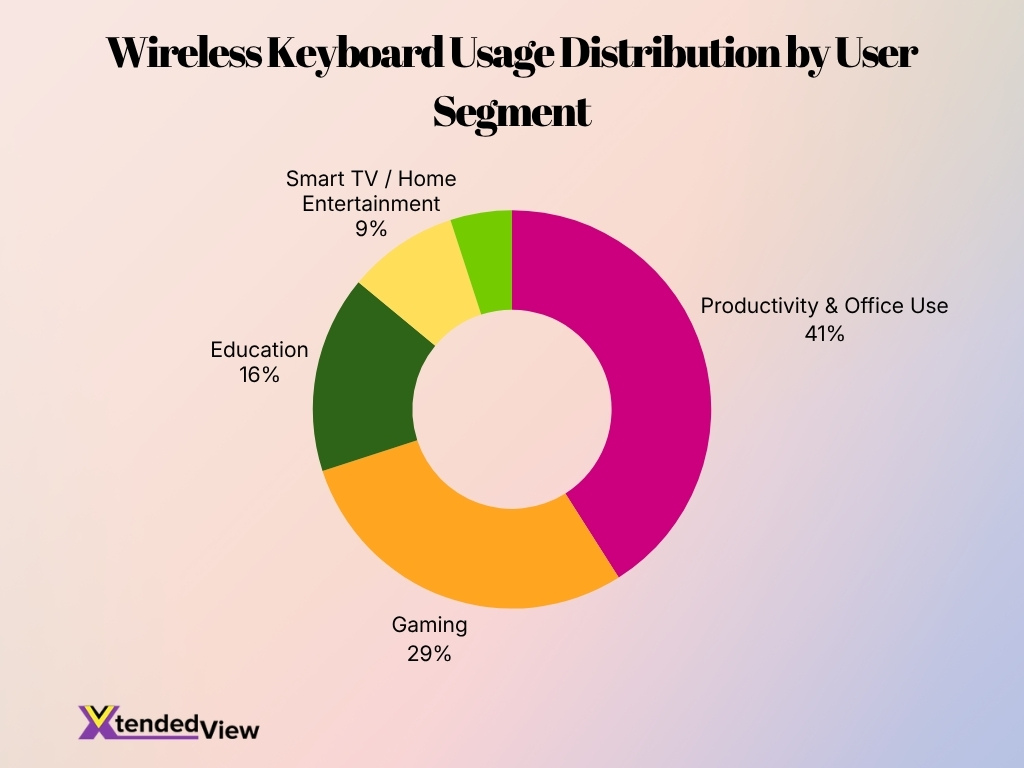
- Productivity & office use is the largest segment, accounting for 41% of wireless keyboard usage.
- Gaming ranks second with a 29% share, showing strong demand from gamers who prefer clutter-free setups.
- Education represents 16% of usage, supported by remote learning, digital classrooms, and student device adoption.
- Smart TV and home entertainment usage holds a 9% share, reflecting the role of wireless keyboards in media navigation and living-room setups.
- Other use cases account for the remaining 5%, including casual browsing, travel setups, and multi-device control.
- Together, productivity and gaming make up 70% of total wireless keyboard usage, highlighting their dominance in the market.
- The data shows that wireless keyboards are no longer limited to office environments, with gaming, education, and home entertainment creating wider adoption opportunities.
Bluetooth Wireless Keyboard Statistics
- Bluetooth keyboards held 70% of the wireless keyboards market share in 2025.
- The global wireless keyboards market reached $1.5 billion in 2026, up from prior growth.
- The Bluetooth computer keyboard market is valued at $2.4 billion in 2025.
- Bluetooth Low Energy reduced power consumption by up to 50% in wireless keyboards.
- North America commanded 35% share of the global wireless keyboards market.
- Asia Pacific wireless keyboards market grows at 9% CAGR.
- Online distribution captured 60% of wireless keyboard revenue.
- Commercial end-users accounted for 40% of wireless keyboard demand.
- Over 5 billion Bluetooth-enabled devices are shipped annually, boosting keyboard adoption.
- The wireless keyboard market is projected to hit $2.4 billion by 2033 at 6.8% CAGR.
Wireless Keyboard Consumer Preferences Statistics
- Compact 65% and 75% layouts now represent the fastest-growing segment of the mechanical keyboard market in 2026, saving ~40% desk space vs full-size.
- Mechanical switches are driven by 68% rising preference, with 54% gaming adoption and 47% demand for durability as top purchase drivers.
- Flagship wireless keyboards deliver 300+ hours of battery life with RGB off, while RGB-on usage provides 40–80 hours of typical gaming use.
- RGB lighting customization is a significant trend driven by 59.75% gaming/esports revenue share in 2025, especially in North America and Asia-Pacific.
- Linear quiet switches held 44.55% of the mechanical keyboard market in 2025, favored by office workers in frequent video meetings.
- Bluetooth keyboards held 54.7% market share in 2025, making multi-device compatibility a leading requirement for wireless buyers.
- USB-C charging is now the standard on modern wireless keyboards, with 15-minute quick charge delivering 20+ hours of usage.
- The ergonomic split keyboard market is growing at 10.6% CAGR (2025–2032), attracting professionals with wrist strain from repetitive typing.
Wireless Keyboard Feature Adoption Trends
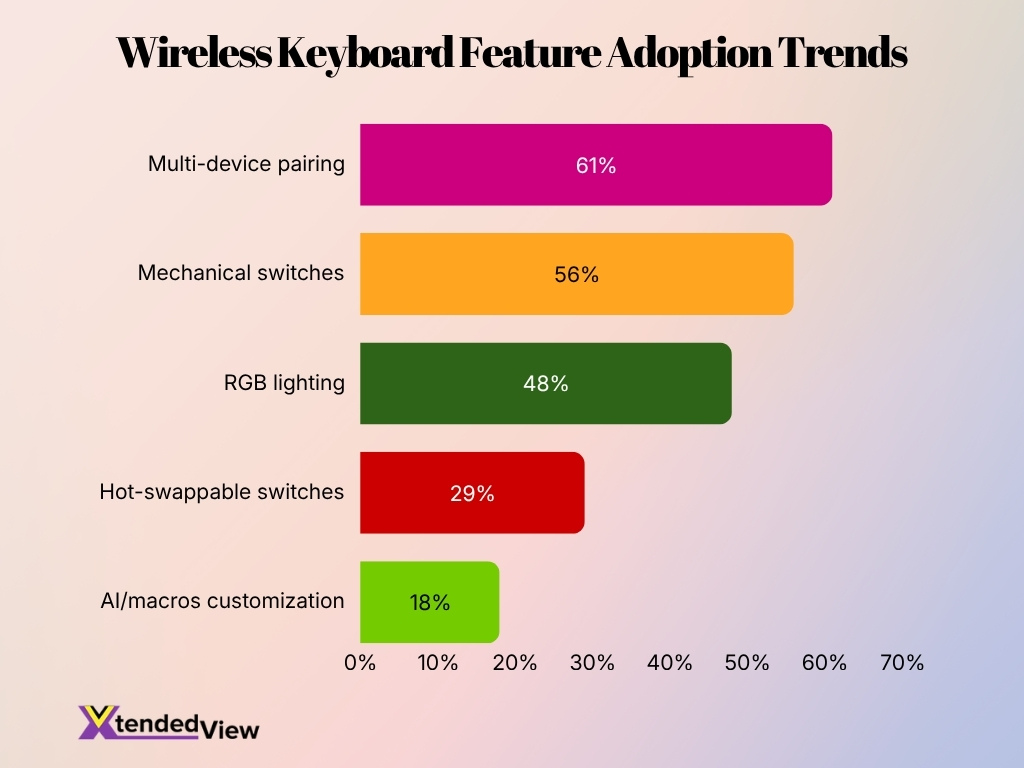
- Multi-device pairing is the most adopted wireless keyboard feature, with 61% adoption, showing strong demand for switching between laptops, tablets, and smartphones.
- Mechanical switches rank second at 56%, highlighting users’ preference for better typing feel, durability, and performance.
- RGB lighting is used by 48% of wireless keyboard users, making it a popular feature, especially among gamers and style-focused buyers.
- Hot-swappable switches have a lower adoption rate of 29%, suggesting that advanced customization is still more common among keyboard enthusiasts.
- AI/macros customization has the lowest adoption at 18%, indicating that smart automation features are still emerging in the wireless keyboard market.
- The gap between the top feature, multi-device pairing at 61%, and the lowest feature, AI/macros customization at 18%, shows a difference of 43 percentage points.
- Practical features like multi-device pairing and mechanical switches are currently more widely adopted than niche customization features.
- The data suggests that buyers prioritize convenience, typing comfort, and device flexibility when choosing wireless keyboards.
Wireless Keyboard Adoption Trends Statistics
- Hybrid work and remote setups are still the main drivers, with the wireless keyboard market projected to grow at 7.48% CAGR from 2025 to 2035.
- The global wireless keyboard market is estimated at $5.272 billion in 2025 and could reach $10.85 billion by 2035.
- The broader wireless mouse and keyboard market was valued at $6.1 billion in 2024 and is forecast to hit $12.08 billion by 2035.
- Wireless gaming keyboards are growing fast, with one forecast placing the market at $1.2 billion in 2024 and $2.5 billion by 2033.
- The gaming keyboard market is expected to rise from $2.81 billion in 2025 to $3.16 billion in 2026, showing 12.5% CAGR growth.
- Tablet keyboard demand is also rising, with the tablet keyboard market valued at $8.01 billion in 2025.
- More than 1.3 billion devices currently run Windows, helping wireless keyboards stay widely compatible across offices and schools.
- In India, fewer than 10% of households own a laptop or computer, but over 20% of adults can operate a computer, showing room for wireless peripheral growth in developing markets.
- Up to 78 million batteries could be discarded daily by 2025, strengthening the case for rechargeable wireless keyboards.
- Search interest for wireless keyboard peaked at 100 in August 2025, while compact and gaming keyboard queries also surged in August and November 2025.
Wireless Keyboard Battery Life Statistics
- Keychron Q6 Ultra 8K delivers up to 660 hours of battery life on a single charge.
- Mainstream Bluetooth keyboards last 3–36 months, depending on usage and LEDs off.
- Bluetooth Low Energy slashes idle power draw to 0.02–0.05 mW, far below classic Bluetooth.
- RGB lighting drains 65–80% of the battery in backlit wireless keyboards.
- Full RGB at max brightness reduces the gaming keyboard’s life to under 24 hours from months.
- Wireless solar keyboard market hits $150 million in 2026 with 8.5% CAGR.
- Lenovo combos offer a 3-month battery with standard USB-C charging in 2 hours.
- Budget models like Logitech K650 achieve 36 months on two AA batteries.
- Gaming keyboards with RGB off reach 200 hours, dropping to 13 hours on full lights.
- 70% of 2026 users prefer wireless keyboards for enhanced flexibility and convenience.
Wireless Keyboard Brand Statistics
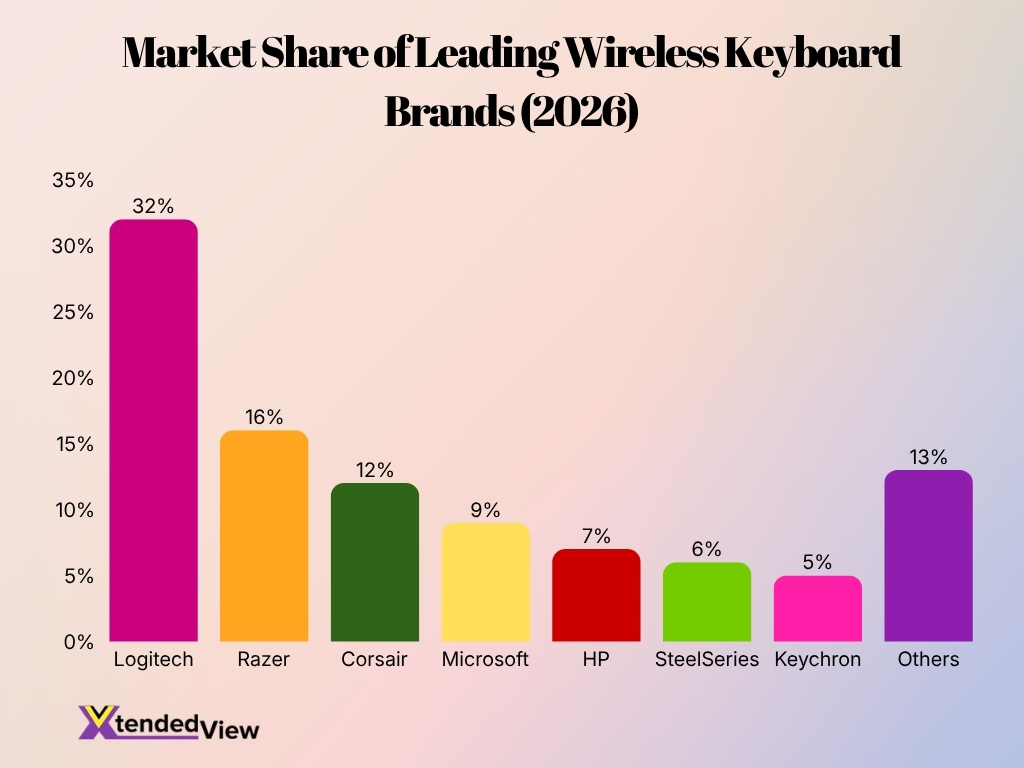
- Logitech leads the wireless keyboard market with the highest estimated share of 32%, making it the dominant brand in 2026.
- Razer holds the second-largest share at 16%, showing strong demand among gaming and performance-focused keyboard users.
- Corsair accounts for 12% of the market, supported by its popularity in gaming and premium keyboard segments.
- Microsoft captures 9% market share, reflecting steady demand for productivity and office-focused wireless keyboards.
- HP represents 7% of the market, mainly driven by its presence in PC accessories and enterprise hardware ecosystems.
- SteelSeries holds a 6% share, indicating a solid position in the gaming keyboard category.
- Keychron accounts for 5% of the market, showing growing interest in compact, mechanical, and enthusiast wireless keyboards.
- Other Brands together make up 13%, suggesting that smaller and regional players still have a noticeable presence in the wireless keyboard market.
- The top three brands, Logitech, Razer, and Corsair, collectively control 60% of the market, highlighting a highly concentrated competitive landscape.
- Logitech’s 32% share is twice as high as Razer’s 16%, showing a clear leadership gap in the wireless keyboard industry.
Wireless Keyboard Typing Performance Statistics
- Modern wireless gaming keyboards achieve average end-to-end latency under 1ms in 2026, down from 15ms in 2015.
- Hall effect switches captured 38.56% market share in Hall effect sensors in 2025.
- Mechanical keyboards enable 3-5 WPM higher typing speeds than membrane keyboards for advanced typists.
- 8K polling rate (8000Hz) wireless keyboards launched at CES 2026 by Keychron.
- Low-profile keyboards reduce key height to 7-11mm vs 18-22mm standard, cutting finger fatigue.
- The multi-device wireless keyboards market is expected to grow from $1.2B in 2024 to $2.5B by 2033.
- Gaming keyboard market valued at $227.39M in 2025, with 7.47% CAGR to 2034.
- 9/10 ergonomic keyboard users never return to standard layouts due to reduced fatigue.
- The wireless keyboards market is projected at $1.5B in 2026, growing 6.8% CAGR to 2033.
Wireless Keyboard Gaming Usage Statistics
- The wireless gaming keyboard market reached $1.2 billion in 2024, growing at 9.2% CAGR to $2.5 billion by 2033.
- Global gaming keyboard market valued at $227.39 million in 2025, projected to reach $430.33 million by 2034 at 7.47% CAGR.
- The wireless segment in gaming keyboards is expected to grow at 10.3% CAGR from 2024 to 2030 due to low-latency tech.
- The esports audience surpassed 318 million enthusiasts in 2025, boosting wireless peripherals demand.
- The RGB lighting keyboards market hit $850 million in 2025, reaching $1.5 billion by 2033 at 12% CAGR.
- Hall effect keyboard market valued at $4.7 billion in 2025, with explosive growth in gaming adoption.
- Gaming keyboards led by Asus, Logitech, Corsair, and Razer are dominating sales in premium segments.
- 60% and 75% layouts surged in popularity among esports pros for larger mouse space in 2025.
- League of Legends Worlds 2025 peaked at 6.7 million viewers, driving wireless gaming demand.
Key Challenges Limiting Wireless Keyboard Adoption
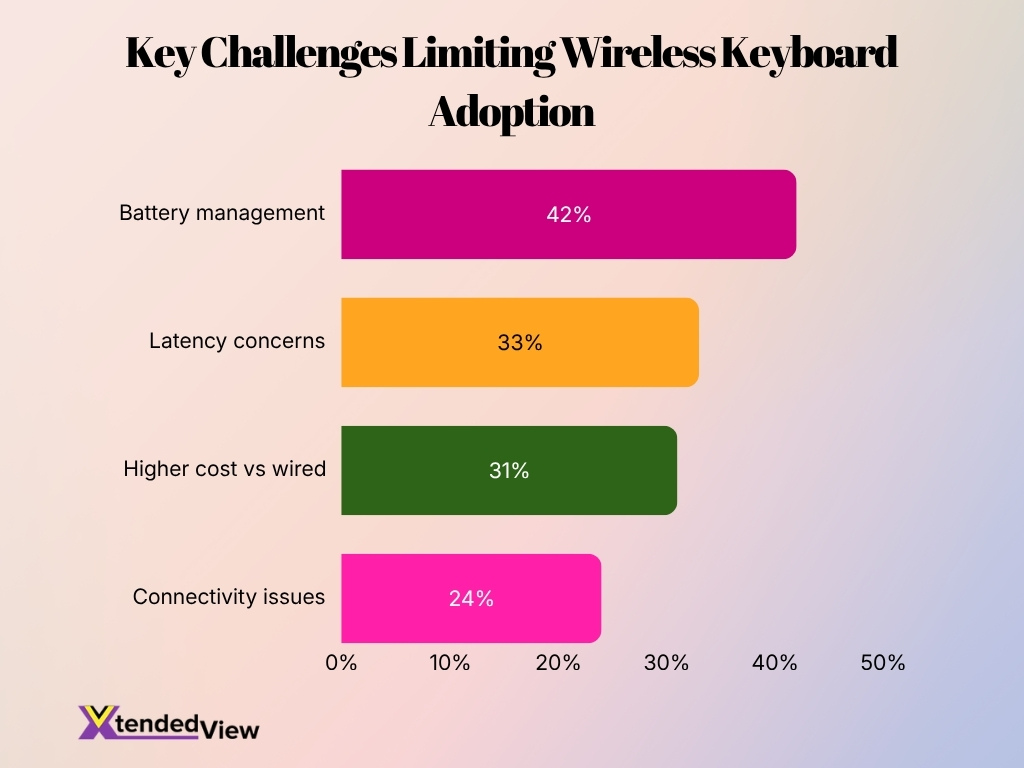
- Battery management is the biggest challenge, affecting 42% of users, showing that charging, battery replacement, and power reliability remain major concerns.
- Latency concerns are reported by 33% of users, making response speed an important factor, especially for gaming, work, and fast typing.
- Higher cost vs wired keyboards is a challenge for 31% of users, suggesting that price sensitivity still impacts wireless keyboard adoption.
- Connectivity issues affect 24% of users, including problems such as Bluetooth pairing, signal drops, or unstable wireless connections.
- The data shows that power reliability is a stronger concern than connectivity, with battery management ranking 18 percentage points higher than connectivity issues.
- Performance-related concerns remain important, as latency concerns rank second at 33%.
- Cost remains a key purchase barrier, with nearly 1 in 3 users citing wireless keyboards as more expensive than wired alternatives.
- Overall, the findings suggest that brands can improve adoption by focusing on longer battery life, lower latency, stable connectivity, and better value pricing.
Wireless Keyboard Productivity Usage Statistics
- Hybrid workers drive 70% of wireless keyboard demand amid 6.8% market CAGR to $2.4B by 2033.
- 52% of U.S. remote-capable employees use hybrid models, boosting wireless productivity keyboards.
- Bluetooth holds 70% share in wireless keyboards for tablet/smartphone compatibility.
- Multi-device keyboards command over 65% revenue with 12.5% annual growth.
- Quiet mechanical switches adoption rises 25% yearly in video conferencing offices.
- Wireless ergonomic keyboards capture 47% market, growing at 8.8% CAGR.
- Rechargeable models cut battery costs by avoiding disposables, extending life to 5 months.
- Compact wireless keyboards, popular as MX Keys S, suit small home offices.
- Programmable macro keyboards enhance AI productivity via automation in remote workflows.
Wireless Keyboard Ergonomics Statistics
- The wireless ergonomic keyboard market reached $6.48 billion in 2025, projected to grow at 8.85% CAGR to $12.78 billion by 2033.
- Global ergonomic keyboard market valued at $1.2 billion in 2023, expected to reach $2.8 billion by 2032 at 9.6% CAGR.
- Wireless ergonomic keyboards held 47.3% of market revenue in 2025, up from 36% in 2021.
- Ergonomic keyboard market to grow from $1.24 billion in 2025 to $1.82 billion by 2030 at 8% CAGR.
- 90% of users switching to ergonomic keyboards never return to conventional models.
- Split ergonomic keyboards significantly lower the incidence of new musculoskeletal symptoms vs. standard keyboards.
- 60% of IT professionals working >8 hours/day on computers likely suffer RSI symptoms.
- North America holds ~35% share of the wireless ergonomic keyboard market.
- Ergonomic keyboards reduce wrist ulnar deviation and forearm muscle activity during typing.
Frequently Asked Questions (FAQs)
The global wireless keyboard market is projected to reach US$1.5 billion in 2026.
The wireless keyboard market is forecast to grow at a 6.8% CAGR between 2026 and 2033.
Bluetooth wireless keyboards account for approximately 70% of the global market share.
The Bluetooth computer keyboard market is expected to reach US$4.8 billion by 2033.
Some premium wireless keyboards launched in 2026 offer up to 660 hours of battery life.
Conclusion
Wireless keyboards continue evolving from simple desktop accessories into essential tools for hybrid work, gaming, education, and mobile productivity. The market benefits from rising demand for Bluetooth connectivity, compact layouts, ergonomic designs, and low-latency gaming performance. At the same time, manufacturers are improving battery efficiency, multi-device compatibility, and customizable features to meet changing consumer expectations.
Market forecasts indicate steady long-term growth through 2033 and beyond, supported by the expansion of remote work, esports adoption, and rising peripheral demand across emerging economies. Premium mechanical and ergonomic keyboards are also gaining traction as consumers prioritize comfort, portability, and productivity. As connectivity technology advances further, wireless keyboards will likely remain central to modern computing experiences across both consumer and enterprise markets.