

Gaming earbuds have evolved from simple mobile accessories into a distinct segment of the gaming-audio market. Players now use compact in-ear devices across smartphones, handheld consoles, PCs, and competitive esports environments, while manufacturers increasingly combine low-latency 2.4 GHz connections, Bluetooth, active noise cancellation, and spatial audio in the same product. This shift reflects broader changes in gaming behavior, especially the growth of mobile gaming, cross-platform play, and demand for lighter alternatives to traditional headsets.
As wireless performance improves and prices spread from budget to premium tiers, gaming earbuds are becoming relevant to both casual players and performance-focused users. The following statistics examine the market’s size, adoption, sales trends, features, regional demand, and long-term outlook.
Editor’s Choice
- One 2026 industry forecast expects the overall gaming earbuds market to grow at 8.34% annually from 2026 through 2031, increasing from $2.51 billion in 2025 to $4.06 billion in 2031.
- Another market model projects 8.6% annual growth through 2032 and a final market value of about $4.79 billion, reinforcing the expectation of sustained category expansion.
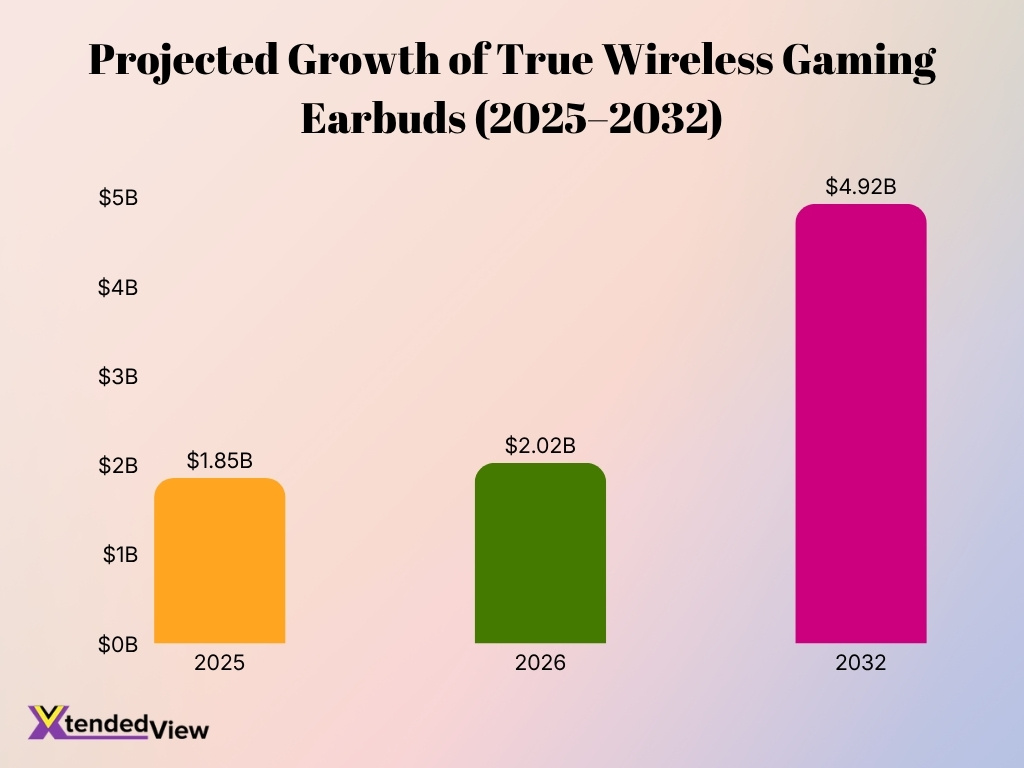
- A narrower true wireless gaming-earbud assessment projects a much faster 15.52% CAGR from 2025 to 2032, taking the category from $1.85 billion to $4.92 billion.
- Asia-Pacific generated an estimated $681.1 million in true wireless gaming-earbud revenue in 2025, compared with $558.3 million in North America and $427.9 million in Europe.
- In another gaming-earbud dataset, TWS models accounted for 78.85% of 2025 revenue, or about $981.7 million, while wired earbuds accounted for 21.15%.
- Online retail represented 68.3% of worldwide gaming-earbud revenue in that same 2025 dataset, indicating that digital purchasing channels now drive more than two-thirds of category sales.
- The wider TWS market also favors in-ear designs: sealed in-ear products represented 66.45% of TWS market share in 2025, supporting the form factor on which most gaming earbuds rely.
- Performance continues to improve in 2026. Newly announced open-ear gaming earbuds have reached sub-30-millisecond latency, showing how dedicated wireless connections are narrowing a traditional performance advantage of wired gaming audio.
Recent Developments
- In April 2026, Hammerhead V3 HyperSpeed earbuds launched with both 2.4 GHz wireless and Bluetooth 6.0, targeting users who switch among mobile, PC, and handheld gaming devices.
- The same 2026 model added active noise cancellation and THX Spatial Audio on PC, illustrating how manufacturers increasingly combine competitive-gaming connectivity with features previously associated with premium entertainment earbuds.
- In September 2026, ARC 5 Gaming earbuds were announced with sub-30ms latency through an included USB-C dongle.
- The ARC 5 Gaming also offers as much as 60 hours of total battery life, an IPX7 rating and an AMOLED touchscreen charging case, showing how gaming models increasingly compete on features outside pure audio performance.
- The ARC 5 Gaming launch also brought THX Spatial Audio with head tracking to an open-ear true wireless gaming design, adding another form factor to the gaming-earbud category.
- In June 2025, the wired Hammerhead V3 launched with an 11 mm dynamic driver and support for both 3.5 mm and USB-C connections, showing that wired products continue to receive investment despite wireless growth.
- Gaming-oriented TWS products have also moved rapidly down the price curve. By late 2025, multiple models targeting gamers in India sold for under ₹2,000, with some advertising gaming latency around 40ms.
- At the premium end, gaming earbuds available in 2026 span roughly $160 to $200 for several prominent wireless models, while entry-level wired gaming options can cost around $30. This wide price range allows the category to address both casual and enthusiast buyers.
Gaming Earbuds Market Size and Growth
- One global estimate values the gaming earbuds market at $2.51 billion in 2025 and forecasts $4.06 billion by 2031.
- That projection translates into an 8.34% CAGR from 2026 to 2031, supported by mobile gaming, esports, and demand for portable audio peripherals.
- A second estimate values the market at $2.69 billion in 2025 and forecasts revenue of nearly $4.79 billion by 2032.
- Under that forecast, gaming-earbud revenue would expand at an 8.6% CAGR over the 2026-2032 period.
- Another industry model valued the worldwide gaming-earbud category at $1.25 billion in 2025 and projects $3.02 billion by 2032, representing a 13.52% CAGR. The lower starting figure indicates a narrower category definition.
- Within true wireless gaming earbuds specifically, one 2026 report estimates a $1.85 billion market in 2025.
- That true wireless estimate rises to approximately $2.02 billion in 2026, an increase of about 9.1% from its stated 2025 level.
- The same forecast puts true wireless gaming earbuds at $4.92 billion by 2032, about 2.7 times their estimated 2025 value.
- For context, the entire TWS earbuds market reached an estimated $39.3 billion in 2025. Gaming therefore operates within a much larger wireless-audio ecosystem that can supply components, manufacturing capacity, and consumer familiarity with in-ear devices.
Gaming Earbuds Market Share Statistics
- TWS products generated an estimated 78.85% of worldwide gaming-earbud revenue in 2025 under one category-specific market analysis.
- On that basis, TWS gaming earbuds produced approximately $981.7 million in 2025 revenue.
- Wired gaming earbuds retained 21.15% of the same measured market, worth approximately $263.3 million.
- Online retail accounted for 68.3% of worldwide gaming-earbud revenue in 2025, compared with 31.7% for offline specialty stores in the same dataset.
- Within true wireless gaming earbuds, online retail held an even larger 70.5% share in 2025.
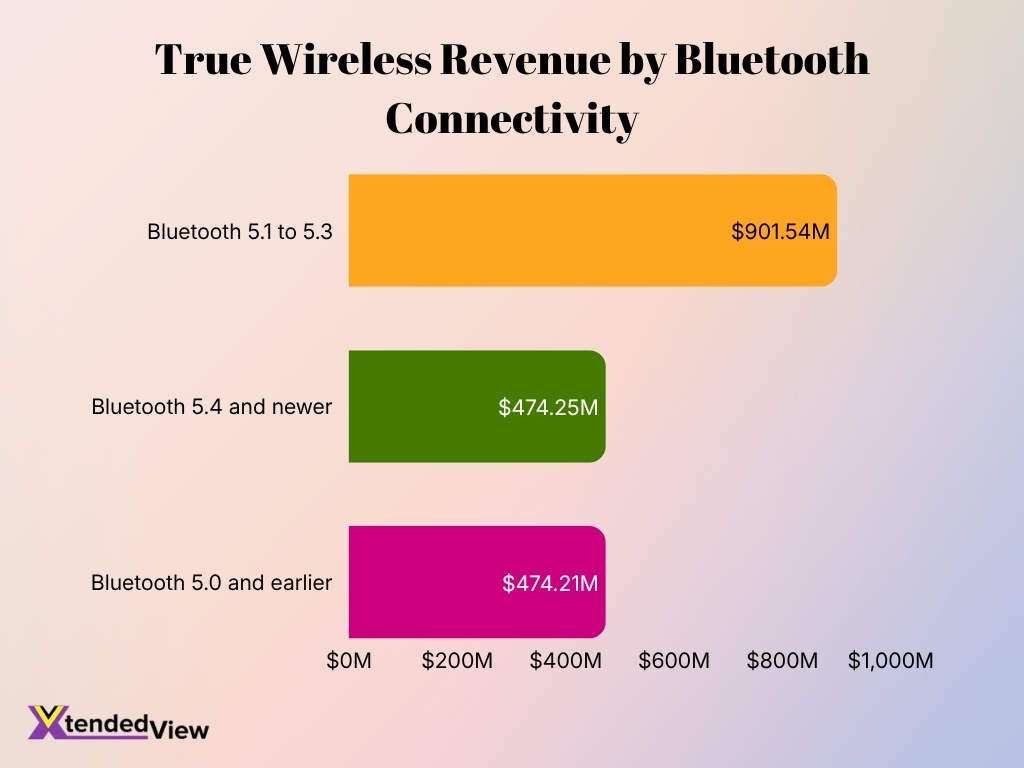
- Bluetooth 5.1-to-5.3 devices accounted for 48.73% of true wireless gaming-earbud revenue in 2025, making them the largest connectivity group.
- Bluetooth 5.4-and-newer models represented 25.64% of 2025 true wireless gaming-earbud revenue, almost level with the 25.63% share held by Bluetooth 5.0-and-earlier products.
- Asia-Pacific represented roughly 36.8% of the $1.85 billion true wireless gaming-earbud market in 2025 when calculated from reported regional revenue of $681.1 million. North America represented about 30.2%.
- In the broader TWS market, Asia-Pacific held 30.70% of 2025 market share, while gaming and esports are forecast to expand at a 12.55% CAGR through 2031.
Gaming Earbuds vs Headphones Preference Statistics
- Wireless gaming earbuds accounted for more than 60% of the gaming-earbud market in 2024 in one industry assessment, reflecting a strong move toward portable, cable-free gaming audio.
- By 2025, a separate dataset placed TWS products at 78.85% of gaming-earbud revenue, suggesting that the preference shift within the earbud category continued.
- Wired earbuds still captured 21.15% of that 2025 market, showing that a meaningful group of gamers continues to prioritize direct connections, simple compatibility, and freedom from battery management.
- The broader gaming earphones and headphones category generated $13.55 billion in 2023, far above gaming-earbud-only estimates. Traditional headphones and headsets therefore continue to represent a major share of gaming-audio spending.
- Portability gives earbuds a practical advantage in mobile gaming. Current testing guidance notes that traditional gaming headsets can prove too bulky for phone gaming, while earbuds better fit portable use cases.
- Latency remains one of the key reasons competitive gamers may favor dedicated headsets or wired earbuds over ordinary Bluetooth earbuds. Bluetooth connections can introduce noticeable audio-video delay, while modern gaming earbuds increasingly counter this through 2.4 GHz wireless dongles.
- Premium gaming earbuds now compete directly with headsets on endurance. INZONE Buds, for example, provide up to 12 hours of continuous battery life and use a 2.4 GHz USB-C connection alongside Bluetooth LE Audio.
- Gaming earbuds have moved further into traditional headset territory with 2.4 GHz wireless, Bluetooth 5.3, ANC, spatial audio, and 100-plus game-specific audio presets on some current platforms.
- Price still separates many purchasing decisions. Current 2026 recommendations span from roughly $30 wired gaming earbuds to $200 premium wireless models, allowing earbuds to compete with headsets across entry-level and premium budgets rather than occupying a single price tier.
- Consequently, the available statistics support a use-case split rather than a universal winner: earbuds gain ground where portability, mobile play and cross-device use matter, while headsets retain advantages in established desktop and console gaming setups. The 12.55% projected CAGR for gaming and esports within the wider TWS market indicates that in-ear gaming adoption should continue expanding through 2031.
Gaming Earbuds Revenue and Sales Statistics
- Worldwide gaming-earbud revenue reached an estimated $1.25 billion in 2025 under one narrowly defined market model.
- Within that estimate, TWS gaming earbuds generated approximately $981.7 million, making wireless models the category’s principal revenue source.
- Wired gaming earbuds generated about $263.3 million in 2025, leaving them with roughly one-fifth of measured category revenue.
- Online retailers generated approximately $850.2 million from gaming earbuds in 2025 under the same market model.
- Offline specialty stores generated approximately $394.8 million, less than half the revenue attributed to online channels.
- A broader true wireless gaming-earbud estimate puts 2025 category revenue at $1.85 billion, including approximately $1.30 billion through online retail.
- Bluetooth 5.1-to-5.3 gaming earbuds generated an estimated $901.54 million in that 2025 true wireless market.
- Bluetooth 5.4-and-newer products generated about $474.25 million, virtually matching the $474.21 million attributed to Bluetooth 5.0-and-earlier models.
- For a unit-volume benchmark, another industry assessment estimated global true wireless gaming-earbud production at 16.5 million units in 2024, with an average selling price of about $77.02.
- Beyond gaming-specific products, the wider TWS category shipped 78 million pairs during Q1 2025 alone, representing 18% year-over-year growth and highlighting the scale of consumer demand available to gaming-focused manufacturers.
Mobile Gaming Earbuds Adoption Rates
- Mobile gaming reached 3 billion players in 2025, representing about 83% of the world’s 3.58 billion video game players. PC reached 936 million players, while consoles reached 645 million.
- Mobile games generated $113.3 billion in global revenue in 2025, up 10.7% year over year. Mobile therefore produced about 56% of the $201.6 billion global games market.
- In the U.S., 82% of players age 8 and older used mobile devices to play games in 2025, making mobile the country’s dominant gaming platform.
- Mobile’s U.S. gaming reach rose from 78% in 2024 to 82% in 2025 among players age 8 and older, continuing a long-term shift toward smartphone and tablet gaming.
- For comparison, only 44% of U.S. players used mobile devices for gaming 10 years earlier, showing how much the addressable market for mobile gaming audio has expanded.
- Approximately 31% of U.S. players exclusively played on mobile in 2024, creating a substantial consumer group whose gaming-audio needs differ from traditional PC and console users.
- U.S. consumer spending on mobile gaming reached $26.7 billion in 2025, while overall U.S. video game spending reached a revised $60.8 billion.
- More than half of U.S. players now use multiple gaming devices during a typical week. That behavior favors gaming earbuds that can move between smartphones, PCs, consoles and handheld systems without requiring a separate audio product for each platform.
- Mobile’s influence extends beyond the U.S. China had about 723 million players in 2025, while the U.S. had 224.8 million, giving manufacturers large addressable markets for mobile-first gaming accessories.
- Although direct surveys measuring the percentage of mobile gamers who own dedicated gaming earbuds remain scarce, the combination of 3 billion mobile players and rising gaming-specific TWS sales makes smartphones one of the strongest adoption channels for the category.
Wireless Gaming Earbuds Market Share
- TWS models accounted for approximately 78.85% of worldwide gaming-earbud revenue in 2025 under one dedicated gaming-earbud market estimate.
- That share left wired gaming earbuds with roughly 21.15% of category revenue, meaning wireless products generated nearly four times as much revenue as wired alternatives in that dataset.
- In the broader TWS market, sealed in-ear models controlled 66.45% of revenue in 2025, strengthening the underlying form factor used by most wireless gaming earbuds.
- Gaming and esports represent one of the faster-growing applications within TWS, with revenue forecast to expand at a 12.55% CAGR through 2031.
- TWS shipments reached 78 million pairs in Q1 2025, an 18% increase from the same quarter a year earlier. The growing installed base lowers the behavioral barrier to adopting gaming-focused wireless models.
- Bluetooth-only products represented 68.55% of Asia-Pacific wireless-audio revenue in 2025, although gaming models increasingly supplement Bluetooth with dedicated low-latency wireless connections.
- Asia-Pacific TWS earbuds accounted for 45.62% of regional wireless-audio revenue in 2025, showing how central the earbud form factor has become in the world’s largest gaming region.
- Active noise cancellation appeared in products representing 54.85% of worldwide TWS market value in 2025, making ANC increasingly mainstream rather than exclusive to premium lifestyle earbuds.
- The three largest vendors in the broader TWS market collectively accounted for 34.5% of global shipments in 2025, leaving substantial room for specialist gaming-audio manufacturers to compete outside the largest consumer ecosystems.
Gaming Earbuds Sales by Price Range in India
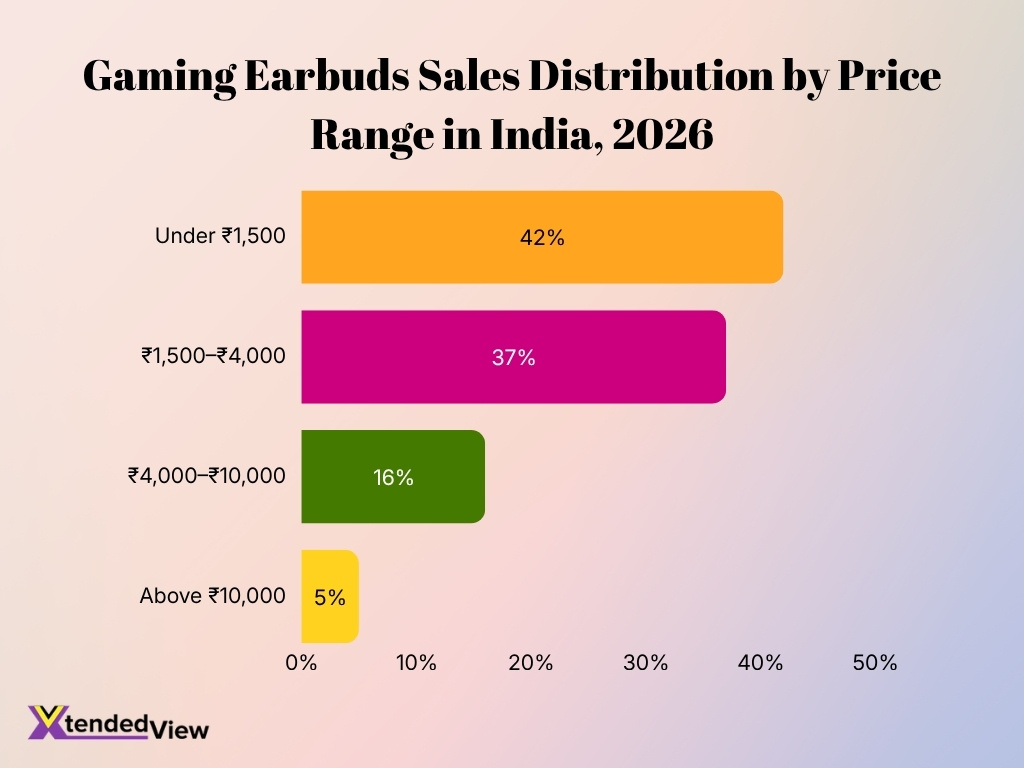
- Budget gaming earbuds under ₹1,500 dominate the Indian market, accounting for an estimated 42% of total sales, making this the largest price segment in 2026.
- The ₹1,500–₹4,000 price range captures another 37% of sales, highlighting strong consumer demand for affordable earbuds with better gaming features and performance.
- Combined, gaming earbuds priced below ₹4,000 represent 79% of estimated sales, showing that the Indian market is heavily concentrated in budget and mid-range products.
- The ₹4,000–₹10,000 segment accounts for 16% of sales, indicating a smaller but meaningful market for consumers willing to pay more for premium gaming features.
- High-end gaming earbuds priced above ₹10,000 contribute just 5% of sales, making premium models the smallest segment of the Indian gaming earbuds market.
Latency and Performance Statistics for Gaming Earbuds
- A 2026 gaming-earbud launch demonstrated sub-30-millisecond wireless latency, showing how dedicated gaming connections can approach response times suitable for competitive play.
- Ordinary Bluetooth gaming audio can approach 100ms of delay in some configurations, enough to make gunfire, footsteps or other game events arrive perceptibly after the corresponding visual action.
- Therefore, many current gaming earbuds use 2.4 GHz USB-C dongles rather than relying exclusively on Bluetooth when low-latency performance matters.
- Wired earbuds continue to provide the most predictable latency because audio travels through a direct physical connection rather than a wireless codec and radio link.
- Bluetooth SBC and AAC connections can introduce enough latency to affect gaming, while dedicated gaming modes and lower-latency codecs reduce that delay.
- One current gaming TWS platform combines Bluetooth 5.3 with 2.4 GHz wireless, allowing users to choose Bluetooth for convenience and a dedicated receiver for latency-sensitive gaming.
- Premium gaming earbuds can now deliver approximately 12 hours of continuous battery life, reducing the chance that competitive sessions end because the earbuds need charging.
- Another leading gaming-earbud platform reaches around 40 hours of total battery life with its charging case, demonstrating that portability no longer requires extremely short operating time.
- Laboratory testing of one current gaming model found active noise cancellation could reduce perceived external sound by roughly 78%, illustrating the increasing performance overlap between gaming earbuds and premium consumer ANC products.
Gaming Earbuds Features Most Valued by Gamers
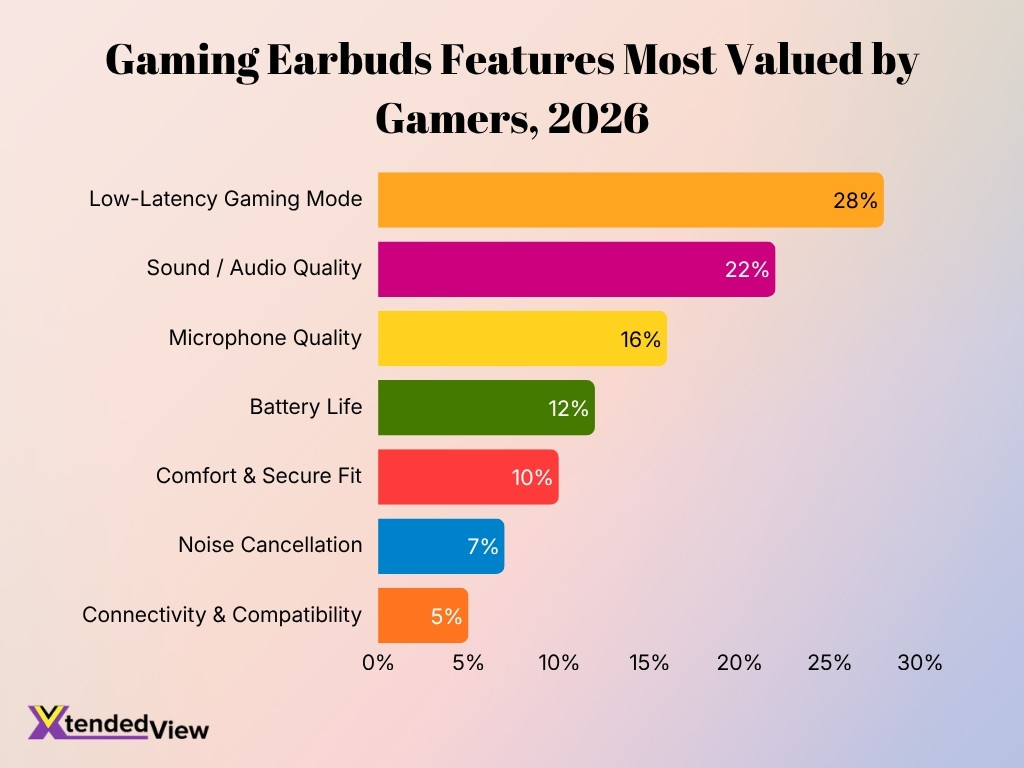
- Low-latency gaming mode ranks as the most valued gaming earbud feature in 2026, accounting for 28% of gamer preferences.
- Sound and audio quality follows closely at 22%, highlighting the importance of clear, immersive audio for gaming experiences.
- Microphone quality represents 16% of preferences, showing that reliable voice communication remains an important consideration for gamers.
- Battery life accounts for 12% of gamer preferences, reflecting demand for earbuds that can support longer gaming sessions without frequent charging.
- Comfort and secure fit attracts 10% of preferences, indicating that ergonomics remain important for gamers who wear earbuds for extended periods.
- Noise cancellation makes up 7% of preferences, while connectivity and compatibility ranks lowest at 5% among the features measured.
Gaming Earbuds Usage Among Professional Gamers
- A 2025 international study collected 488 responses from gamers and esports participants; 13.9%, or 68 respondents, said they actively participated in esports events.
- Among esports participants in that study, 41.2% rated sound as extremely important, demonstrating how heavily competitive players can depend on audio information.
- The average reported listening-volume setting among esports participants reached 55.7%, compared with 45.6% among esports viewers.
- About 37.1% of esports players reported high or very high volume settings, a substantially higher rate than the 18.3% recorded among esports viewers.
- Only 35.8% of surveyed esports players reported taking a sound break every hour, highlighting the long-session listening conditions gaming audio must support.
- At a major 2025 battle royale world championship, tournament rules explicitly specified headphones/in-ear buds for in-game sound, while organizers broadcast standardized white noise to players’ headphones.
- In 2026, one major tactical-shooter league described a double-isolation setup in which professional players wear IEMs for team communications while over-ear headsets play white noise to block arena sound.
- That 2026 system routes team communications through the IEMs, showing that in-ear devices can form the primary competitive audio channel even when players also wear large headsets onstage.
- Official 2025 and 2026 football-esports rules allow in-ear monitors for music but require players to cover them with tournament-provided headsets, illustrating how competition integrity can dictate professional audio configurations.
- Current Counter-Strike tournament rules similarly recommend that finalists bring their preferred in-ear devices for game audio underneath ANC headsets, while the outer headset handles communication and stage-noise control.
Regional Gaming Earbuds Market Statistics
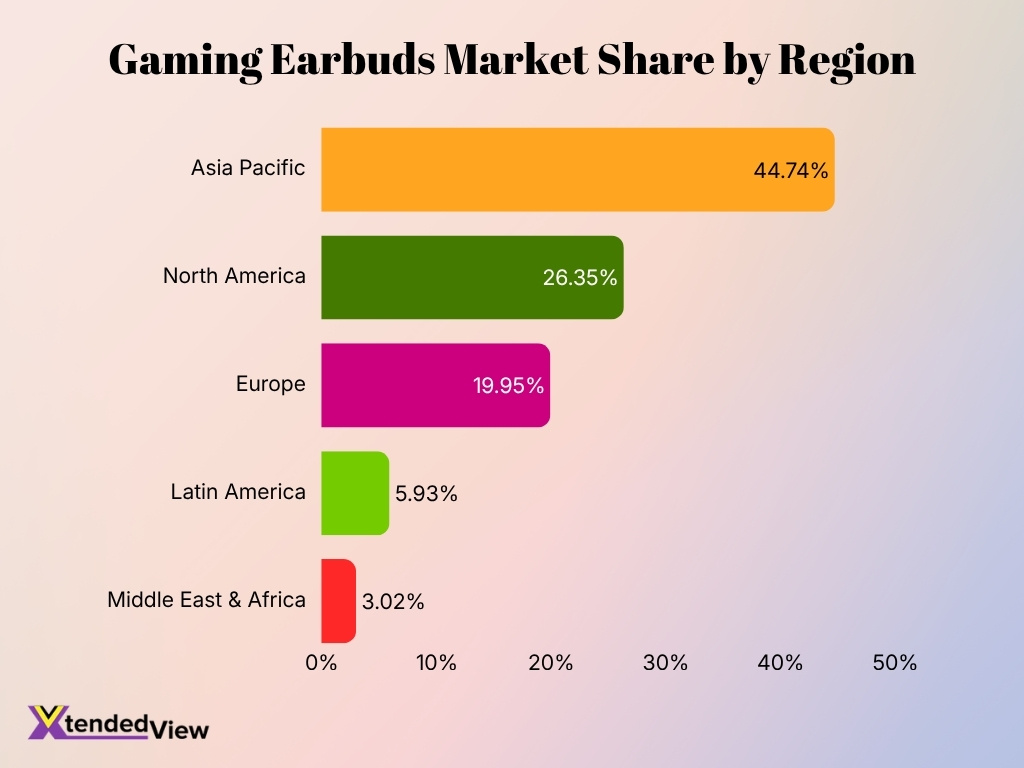
- Asia Pacific dominates the gaming earbuds market with a 44.74% share, accounting for nearly half of the global market in 2025.
- North America ranks second with a 26.35% market share, trailing Asia Pacific by 18.39 percentage points.
- Europe holds 19.95% of the gaming earbuds market, making it the third-largest regional market globally.
- Together, Asia Pacific, North America and Europe account for 91.04% of the market, showing that gaming earbuds demand is heavily concentrated in these three regions.
- Latin America represents 5.93% of the global market, while the Middle East & Africa holds 3.02%, the smallest regional share in the dataset.
- Asia Pacific’s 44.74% share is larger than the combined 35.90% share of Europe, Latin America, and the Middle East & Africa, highlighting its strong market leadership.
Wired vs Wireless Gaming Earbuds Sales Trends
- True wireless models generated about $981.7 million in gaming-earbud revenue in 2025, compared with $263.3 million for wired earbuds. Wireless revenue was therefore roughly 3.7 times higher.
- TWS gaming earbuds held 78.85% of category revenue in 2025, while wired models accounted for 21.15%.
- The worldwide gaming-earbud market increased from $1.14 billion in 2024 to approximately $1.25 billion in 2025, representing 9.5% annual growth as wireless products dominated sales.
- The market is projected to reach approximately $1.38 billion in 2026, an 11.11% increase over its 2025 level.
- The dedicated true wireless gaming-earbud market reached an estimated $1.85 billion in 2025 under a broader TWS-specific definition and is projected to increase to $2.02 billion in 2026.
- That broader true wireless category grew 11.31% in 2025 after jumping 29.75% in 2024, showing that wireless gaming audio continued expanding even after an unusually strong prior year.
- Conventional TWS demand also supports gaming products: worldwide TWS shipments reached about 78.3 million units in Q1 2025, up 18% year over year.
- Wireless does not completely eliminate wired demand. Japanese retail rankings in late 2025 placed a wired gaming-earbud model eighth among gaming headsets and earbuds during one measured week, alongside several wireless products.
- A second October 2025 retail period again placed a wired gaming-earbud model ninth in its broader gaming-headset sales ranking, indicating continuing retail demand for direct-connect products.
- Consequently, 2026 sales data point toward a two-tier market: TWS drives category growth and revenue, while wired earbuds retain buyers who prioritize lower cost, direct connectivity, and zero charging requirements.
Demographics of Gaming Earbuds Users
- Approximately 212.3 million Americans ages 5 to 90 played video games for at least one hour per week in 2026, up 7.2 million from 2025.
- That equals 67% of Americans in the measured age range, illustrating how gaming accessories now address a mainstream consumer base rather than a narrow enthusiast audience.
- The average U.S. player reached 37 years old in 2026, one year older than the 36-year average recorded in 2025.
- The U.S. gaming population remains close to gender-balanced: 53% of players are male, and 46% are female in 2026.
- More than 80% of Gen Alpha and Gen Z Americans played video games weekly in 2026, creating a particularly large young audience for mobile and wireless gaming audio.
- Gaming also reaches 71% of Millennials, making adults ages roughly 30 to 45 an important potential customer group for premium gaming peripherals.
- Among older U.S. consumers, 56% of Gen X and 50% of Boomers played weekly in 2026, widening the potential market beyond younger buyers.
- Adult U.S. players in 2026 identified as 68% White, 22% Hispanic and 15% Black, with respondents allowed to identify with more than one ethnicity.
- Globally, a 2025 study of 24,216 players across 21 countries found a similarly balanced gamer population, with 51% identifying as men and 48% as women.
- Gaming-earbud manufacturers therefore serve a broad demographic rather than a teenage-only segment. However, these figures represent gamers overall, not confirmed gaming-earbud owners, so they should not be interpreted as direct ownership percentages.
Gaming Headset Brand Market Share Among Pro Gamers
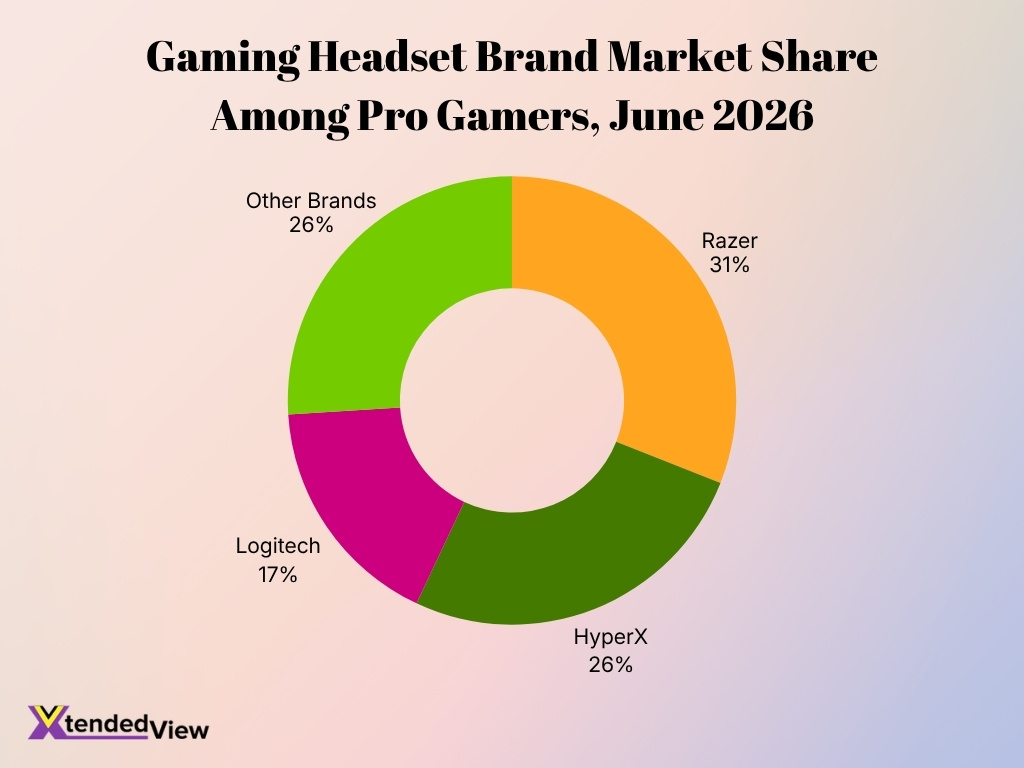
- Razer leads the professional gaming headset market with a 31% share, giving it the strongest individual brand presence among pro gamers in June 2026.
- HyperX ranks second with a 26% market share, trailing Razer by only 5 percentage points and highlighting strong competition between the two leading brands.
- Logitech accounts for 17% of the market, placing it third among the named gaming headset brands and 14 percentage points behind Razer.
- Other brands collectively hold 26% of the market, matching HyperX’s share and showing that more than one-quarter of pro gamers use headsets from alternative brands.
- Razer, HyperX and Logitech together control 74% of the market, indicating that professional gaming headset preferences are heavily concentrated among these three major brands.
Gaming Earbuds Impact on Gaming Experience Statistics
- A controlled spatial-audio study involving 68 participants found that enhanced localized audio significantly improved perceived sound quality, immersion, sound localization, and emotional involvement during VR experiences.
- Earlier controlled research with 40 participants found that training with three-dimensional game audio increased real-world sound-localization hit rates by approximately 20%.
- Participants in that experiment trained for 30 minutes per day across seven sessions, after which both horizontal and vertical localization errors fell significantly.
- The localization gains in that study persisted for more than one month, suggesting that repeated interaction with spatial game audio can produce measurable auditory-learning effects.
- Research comparing experienced first-person shooter players with nonplayers found gamers had an audiovisual temporal-integration window of about 87ms versus 105ms among nonplayers.
- In the same study, gamers produced correct perceptual reports approximately 68% of the time, compared with about 59% for nonplayers, suggesting greater audiovisual temporal precision among experienced players.
- A 2026 audio-motor training study found sound-localization accuracy improved by 12.4%, while distance-estimation error declined by 20.1% following training.
- Audio benefits must be balanced against listening risk. A systematic review covering 14 peer-reviewed studies found that measured gaming sound levels often approached or exceeded permissible exposure limits.
- Of five studies in that review that directly examined gaming in relation to hearing loss or tinnitus, four reported significant associations or correlations.
- A later international gamer survey found 24.8% of gamers used high or very high volume settings, while only 34.3% reported taking an audio break every hour.
Gaming Earbuds Market Forecast and Projections
- One 2026 forecast places the overall gaming-earbud market at approximately $1.38 billion in 2026, rising from $1.25 billion in 2025.
- That forecast expects revenue to reach about $1.65 billion in 2027, equivalent to 19.17% projected year-over-year growth.
- Market value is forecast to increase to approximately $1.78 billion in 2028 before approaching $2.00 billion in 2029.
- The same model projects gaming-earbud revenue of $2.32 billion in 2030 and $2.63 billion in 2031.
- By 2032, that market definition reaches approximately $3.02 billion, representing a 13.52% CAGR from its 2025 baseline.
- A broader true wireless gaming-earbud model forecasts $2.51 billion in 2027, up sharply from $2.02 billion in 2026.
- True wireless gaming-earbud revenue under that forecast rises to approximately $3.26 billion in 2029 and $3.89 billion in 2030.
- By 2031, the TWS-specific category could exceed $4.31 billion, before reaching approximately $4.92 billion in 2032.
- The TWS gaming-earbud forecast implies a 15.52% CAGR through 2032, faster than the 13.52% forecast for the narrower overall gaming-earbud dataset.
- These forecasts imply that wireless products should capture most incremental category growth as low-latency connectivity, mobile gaming, online retail and longer battery life become available at more price points.
Frequently Asked Questions (FAQs)
The global gaming earbuds market is estimated at $1.38 billion in 2026, up from $1.25 billion in 2025 under one dedicated market model.
True wireless stereo gaming earbuds accounted for approximately 78.9% of global gaming-earbud revenue in 2025, generating about $981.7 million.
The global gaming earbuds market is projected to expand at a 13.52% CAGR from 2025 to 2032, reaching approximately $3.02 billion by 2032.
Asia-Pacific ranked No. 1 in 2025, accounting for about 36.8% of true wireless gaming-earbud sales, equivalent to approximately $681.1 million.
The true wireless gaming earbuds segment is projected to grow at a 15.52% CAGR from 2025 to 2032, increasing from $1.85 billion to approximately $4.92 billion.
Conclusion
Gaming earbuds enter the year with a broader user base, stronger wireless performance, and significantly more product variety than in earlier years. TWS models now account for most category revenue, while mobile gaming, professional esports, cross-platform play and demand for low-latency audio continue to support adoption. Improvements in battery life, active noise cancellation, spatial audio and dedicated 2.4 GHz connections are also reducing many of the traditional performance gaps between earbuds and gaming headsets.
The market outlook remains positive through 2032, with several forecasts pointing to sustained double-digit growth in wireless gaming-earbud segments. However, published market totals vary because research providers use different definitions for gaming earbuds, TWS gaming products, and broader gaming-audio categories. Overall, the available data suggest that gaming earbuds are shifting from a niche accessory into a more established part of the global gaming-peripherals market, supported by changing player habits and continued advances in wireless audio technology.