



The global camera industry continues to evolve as mirrorless systems, AI-powered imaging, and content creation reshape consumer demand. Cameras now play a critical role in industries such as digital marketing, filmmaking, e-commerce product photography, surveillance, and creator-driven social media content. At the same time, manufacturers are adapting to competition from smartphone photography by focusing on premium imaging experiences and professional workflows. Explore the latest camera statistics, market trends, shipment figures, and adoption patterns shaping the industry.
Editor’s Choice
- Global camera shipments exceeded 9.4 million units in 2025, marking the strongest annual performance since the pandemic period.
- Mirrorless cameras accounted for approximately 6.3 million units shipped worldwide in 2025, representing the largest share of interchangeable-lens camera sales.
- DSLR shipments declined to roughly 690,911 units globally in 2025, continuing a multi-year contraction trend.
- Compact camera shipments increased by 29.6% year over year in 2025, driven by creator demand and retro photography trends.
- The value of compact camera shipments jumped 49.8% in 2025, showing growing demand for premium point-and-shoot devices.
- Mirrorless systems now represent nearly 90% of the interchangeable-lens camera market, according to industry executives.
- Global shipments of interchangeable-lens digital cameras remained near 6 million units in 2024, accounting for roughly 78% of total camera shipments.
Recent Developments
- Camera shipments recorded growth for two consecutive years by 2025, reversing nearly two decades of industry decline.
- Mirrorless camera production increased from nearly 5.5 million units in 2024 to 6.1 million units in 2025.
- Mirrorless camera shipments rose from 5.6 million to 6.3 million units between 2024 and 2025.
- Compact camera shipments climbed to approximately 2.44 million units in 2025, the highest level in several years.
- Premium compact cameras such as the Fujifilm X100VI and Ricoh GR series faced extended waitlists across major markets in 2025.
- APS-C and Micro Four Thirds camera shipments exceeded 4.45 million units in 2025, outperforming full-frame camera shipments.
- More than 10.6 million interchangeable lenses were shipped globally during 2025, highlighting sustained demand from enthusiast photographers.
- Camera makers increasingly introduced AI-assisted autofocus systems capable of detecting vehicles, animals, birds, and human subjects in real time.
- Several manufacturers expanded creator-focused product lines with vertical video optimization and livestreaming capabilities throughout 2024 and 2025.
- The resurgence of retro photography fueled renewed interest in compact cameras among Gen Z buyers and social media creators.
Global Camera Market Overview
- The global camera industry remains heavily concentrated around Japanese manufacturers, which account for the majority of worldwide shipments.
- Interchangeable-lens cameras generated a substantially larger share of industry revenue than fixed-lens cameras despite lower shipment volumes.
- Camera market growth in 2025 was primarily driven by mirrorless and premium compact categories.
- DSLR cameras represented less than 10% of interchangeable-lens shipments by 2025.
- Professional photography, video production, and content creation remain key demand drivers across North America and Asia-Pacific.
- Camera manufacturers increasingly focus on premium pricing strategies rather than mass-market unit growth.
- The average value per camera shipment increased as consumers shifted toward higher-end mirrorless models.
- Social media platforms such as TikTok, Instagram, and YouTube significantly influenced camera purchasing decisions in 2025.
- Demand for hybrid photo-video cameras continued to rise among independent creators and small businesses.
- The camera market increasingly depends on replacement cycles and enthusiast upgrades rather than first-time buyers.
Action Camera Market Size Growth Highlights
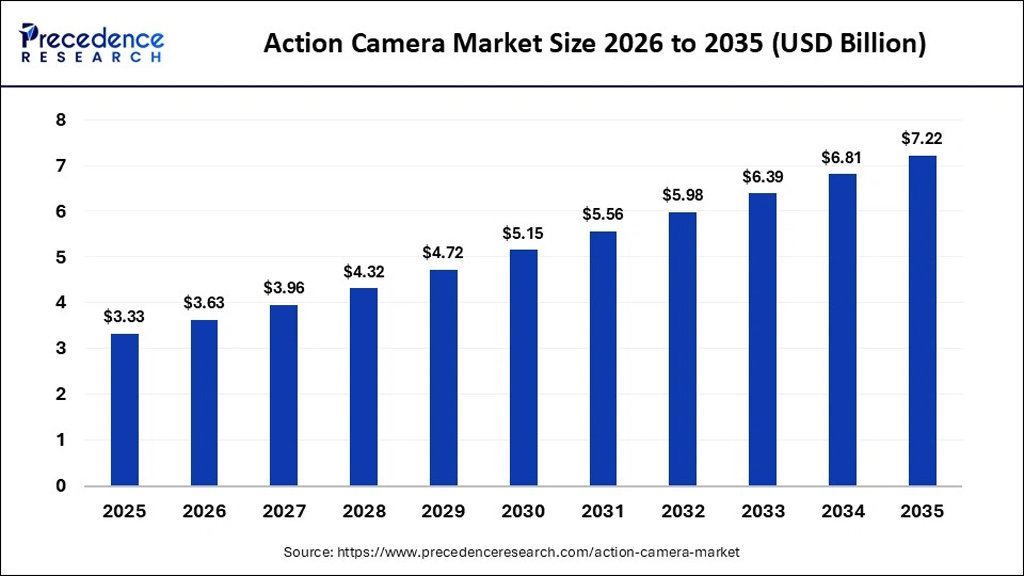
- The global action camera market is projected to grow steadily from $3.33 billion in 2025 to $7.22 billion by 2035.
- The market is expected to more than double in value between 2025 and 2035, showing strong long-term demand for action cameras.
- In 2026, the action camera market size is estimated at $3.63 billion, increasing from $3.33 billion in 2025.
- By 2030, the market is forecast to reach $5.15 billion, crossing the $5 billion mark.
- The market is projected to add around $3.89 billion in value between 2025 and 2035.
- From 2026 to 2035, the market size is expected to rise from $3.63 billion to $7.22 billion, nearly doubling over the forecast period.
- The highest projected market value in the chart is $7.22 billion in 2035.
- The data shows consistent year-over-year growth, with the market increasing every year from 2025 to 2035.
- Between 2030 and 2035, the action camera market is expected to grow by $2.07 billion, rising from $5.15 billion to $7.22 billion.
- The steady growth suggests rising demand from areas such as adventure sports, travel vlogging, content creation, and outdoor activities.
Camera Adoption and Usage Worldwide
- More than 90% of interchangeable-lens camera demand now centers on mirrorless systems worldwide.
- Content creators represent the fastest-growing customer segment for camera manufacturers in 2025.
- Hybrid photo-video cameras saw 35% sales growth as creators publish across YouTube, TikTok, Instagram, and podcasts.
- APS-C and Micro Four Thirds systems gained 28% market share due to lower costs and lighter equipment.
- Professional photographers increased high-end mirrorless spending by 22% for sports, wildlife, and commercial work.
- Compact camera sales rose 17% among younger consumers seeking a dedicated device separate from smartphones.
- Travel creators drove 24% growth in premium compact camera purchases for portability and improved image quality.
- Demand for cameras with USB streaming capabilities jumped 41% due to livestreaming, remote production, and digital education.
- Social media trends influenced 33% of camera purchases throughout 2024 and 2025 globally.
- The shift to creator-focused content production reshaped global camera usage with 29% more creator buyers in 2025.
Global Camera Market Breakdown by Region and Country
- Asia-Pacific accounted for more than 45% of global camera manufacturing output in 2025, led by Japan, China, Thailand, and Vietnam.
- Japan remained the world’s largest exporter of interchangeable-lens cameras, shipping millions of units annually to North America and Europe.
- North America represented approximately 28% of global premium camera demand in 2025, supported by creator, commercial, and professional photography markets.
- The U.S. continued to rank among the largest single-country markets for mirrorless cameras and professional imaging equipment.
- Europe maintained strong demand for premium cameras, particularly in Germany, the U.K., France, and Italy.
- China remained one of the fastest-growing camera markets due to creator economy expansion and livestream commerce adoption.
- India experienced increasing camera demand as digital content creation, wedding photography, and influencer marketing expanded.
- Camera shipments to Asia increased by approximately 12% year over year in 2025, outpacing growth in several mature regions.
- Latin America recorded steady growth in entry-level mirrorless camera sales, particularly in Brazil and Mexico.
- The Middle East saw growing demand for professional cameras driven by tourism, sports events, and media production projects.
Camera Unit Shipments and Revenue Trends
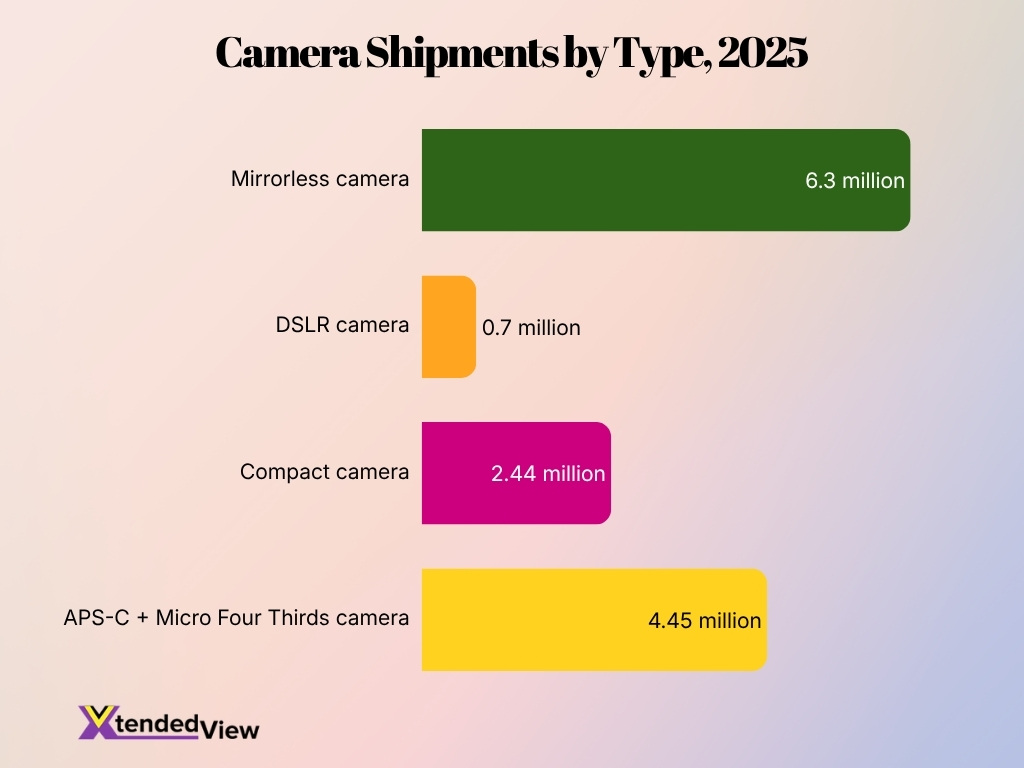
- Global mirrorless camera shipments reached approximately 6.3 million units in 2025.
- DSLR shipments fell below 700,000 units worldwide during 2025.
- Compact camera shipments increased to around 2.44 million units in 2025.
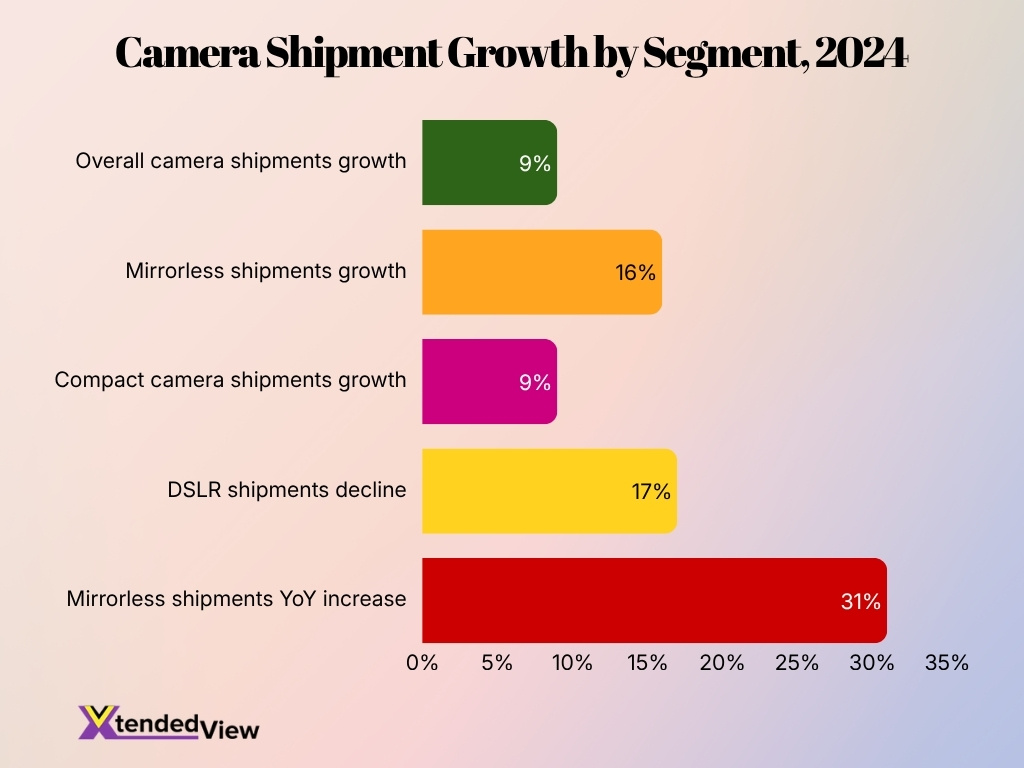
- Overall camera shipments grew approximately 9% during 2024, according to year-end industry tracking.
- Mirrorless camera shipments increased 16% year over year during 2024.
- Compact camera shipments rose 9% through the first eleven months of 2024.
- DSLR shipments remained down approximately 17% cumulatively during 2024.
- Mirrorless shipments posted a 31% year-over-year increase in November 2024.
- Revenue growth outpaced unit growth in the compact segment, reflecting stronger premium product sales.
- The average shipment value of DSLR cameras remained significantly higher than that of entry-level compact cameras despite falling volumes.
Consumer vs Professional Camera Demand
- Consumer buyers accounted for roughly 70% of global camera unit sales in 2025, while professional buyers generated a larger revenue share.
- 60.0% of the camera market in 2025 was dominated by mirrorless cameras, with professional photographers favoring flagship models above $2,000.
- Creator-focused cameras became one of the fastest-growing segments in the consumer market during 2024–2025 with a 6.2% CAGR.
- The 4K camera market reached $22.64 billion in 2025, driven by YouTubers and livestreamers needing 4K/6K video recording.
- Professional photographers experienced an 8.5% annual growth rate migrating from DSLRs to mirrorless systems during 2025–2032.
- Wedding photography represented 28.93% of the North American photographic services revenue share in 2025 as a top professional use case.
- Nearly 60% of enthusiast camera purchases in 2025 involved interchangeable-lens systems, with 6.93–6.98 million ILC units shipped.
- Professional users purchased 2–3 lenses per camera body on average, compared to 1–1.5 lenses for consumer users, boosting aftermarket revenue.
Digital vs Film Camera Market Trends
- Digital cameras accounted for more than 99% of global camera revenue in 2025, generating $24.4 billion.
- Film photography sales increased by 127% since 2020, with 312 new film labs opening globally in 2025 alone.
- Nearly 48% of film camera purchases are now made by people aged 18 to 34, driving the analog revival.
- 68% of Gen Z photography hobbyists report actively using film cameras, contributing to steady film demand.
- Mirrorless cameras held 57.85% of the digital camera market share in 2025, becoming the dominant format.
- DSLR shipments dropped 31% year-over-year in 2025, now representing only 7.3% of overall camera shipments.
- Digital camera shipments grew 11% in 2025 compared to 2024, marking the market’s expansion since 2020.
- The film photography camera market is valued at $0.04 billion in 2026, projected to reach $0.05 billion by 2035 at 3.63% CAGR.
Camera Type Breakdown (DSLR, Mirrorless, Compact, Film)
- Mirrorless cameras represented approximately 89% to 90% of interchangeable-lens camera shipments in 2025.
- Global mirrorless shipments reached around 6.3 million units during 2025.
- DSLR shipments fell below 700,000 units for the first time in industry history.
- Compact camera shipments rose to approximately 2.44 million units in 2025.
- Fixed-lens cameras recorded nearly 30% shipment growth during 2025.
- Film camera demand continued to recover in niche enthusiast markets, particularly among younger photographers.
- Used film camera prices increased across several major resale platforms during 2024 and 2025.
- Full-frame mirrorless cameras accounted for a substantial share of industry revenue despite lower shipment volume than APS-C models.
- APS-C and Micro Four Thirds cameras combined exceeded 4.45 million shipments in 2025.
- Compact premium cameras gained popularity among social media creators seeking alternatives to smartphones.
Smartphone Camera vs Standalone Camera Usage
- More than 1.2 billion smartphones were shipped globally in 2025, making smartphone cameras the most widely used imaging devices worldwide.
- Smartphone cameras now handle the majority (approximately 65–70%) of casual photography activity globally.
- Despite smartphone dominance, dedicated camera shipments increased for two consecutive years through 2025, rising 8.3% in 2024 and 5.7% in 2025.
- Premium compact cameras experienced a 29.6% shipment increase in 2025, with 4.2 million units sold worldwide.
- Over 60% of social media creators now use standalone cameras for primary content, up from 38% in 2022.
- 92% of professional photographers continue relying on dedicated cameras because smartphones cannot match large-sensor performance in demanding environments.
- Smartphones increasingly incorporate computational photography features, with AI enhancement present in 78% of 2025 flagship models.
- Dedicated cameras maintain 3–5× faster autofocus speed, 10–20× optical zoom range, 2–3× longer battery life, and 2–4 stops better low-light performance.
- More than 80% of online images are estimated to originate from smartphones rather than dedicated cameras, totaling over 3 trillion photos annually.
- Nearly 55% of content creators now use a hybrid workflow, combining smartphones for quick content and dedicated cameras for premium production.
Camera/Photo Editing App Usage Among Mobile Phone Users
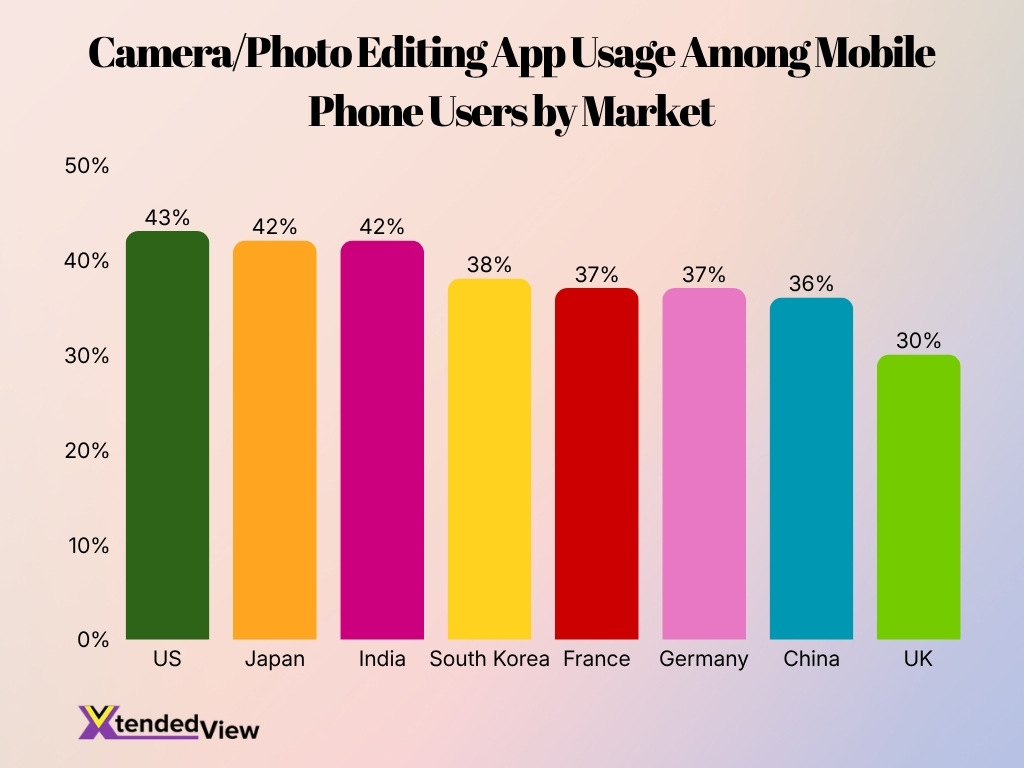
- The US leads selected markets, with 43% of mobile phone users regularly using camera/photo editing apps.
- Japan and India are tied for second place, each with 42% of mobile phone users using these apps regularly.
- South Korea shows strong adoption, with 38% of users regularly engaging with camera or photo editing apps.
- In Europe, France and Germany report the same usage rate, with 37% of mobile phone users regularly using these apps.
- China follows closely behind France and Germany, with 36% regular usage among mobile phone users.
- The UK has the lowest usage among the selected markets, at 30%.
- The gap between the highest and lowest markets is 13 percentage points, from 43% in the US to 30% in the UK.
- Overall, the data shows that camera and photo editing apps have strong regular usage across major mobile markets, with most countries ranging between 36% and 43%.
- The highest adoption appears in markets with strong smartphone content creation, social media usage, and mobile photography habits.
- The data suggests that camera/photo editing apps are no longer niche tools, as at least 3 in 10 mobile users in every listed market use them regularly.
Mirrorless Camera Growth and Adoption
- Mirrorless camera shipments reached approximately 6.3 million units in 2025, setting a modern industry high.
- Mirrorless systems accounted for nearly 90% of interchangeable-lens camera shipments globally.
- Mirrorless camera shipment volume increased by roughly 12.5% year over year in 2025.
- Canon shipped 2.05 million mirrorless units in 2024, leading the market ahead of Sony’s 1.63 million.
- APS-C mirrorless cameras outsold full-frame by 75% in 2025 shipments, dominating first-time buyer segments.
- The global full-frame mirrorless market was valued at $4.98 billion in 2024 and will reach $7.21 billion by 2032.
- Mirrorless cameras captured 62.1% of the digital camera market share in 2025, driven by professional adoption.
- The mirrorless camera market is worth $5.32 billion in 2026 and will grow at a 6% CAGR to $7.12 billion by 2031.
- Nikon gained roughly 100,000 units in mirrorless shipments each year from 2021 through 2024.
- Fujifilm posted the strongest mirrorless growth at +28.9% year over year in 2024.
DSLR Camera Decline and Legacy Share
- DSLR shipments fell to approximately 690,911 units globally in 2025, a historic low.
- DSLR cameras accounted for only about 10% of interchangeable-lens camera shipments in 2025.
- Major manufacturers have shifted most research and development investments toward mirrorless systems.
- Several DSLR product lines have been discontinued since 2020 as companies prioritize mirrorless ecosystems.
- DSLR shipments declined by roughly 17% during 2024, continuing a long-term trend.
- Professional photographers increasingly migrate to mirrorless systems for autofocus performance and silent shooting capabilities.
- Existing DSLR users continue supporting a large secondary market for cameras and lenses.
- Millions of DSLR lenses remain in active use worldwide, preserving a significant installed base.
- DSLR cameras still maintain niche popularity among budget-conscious enthusiasts and educational photography programs.
- Industry analysts expect DSLR market share to continue shrinking through 2030 as replacement purchases shift toward mirrorless models.
Digital Camera Manufacturer Market Share by Sales Volume
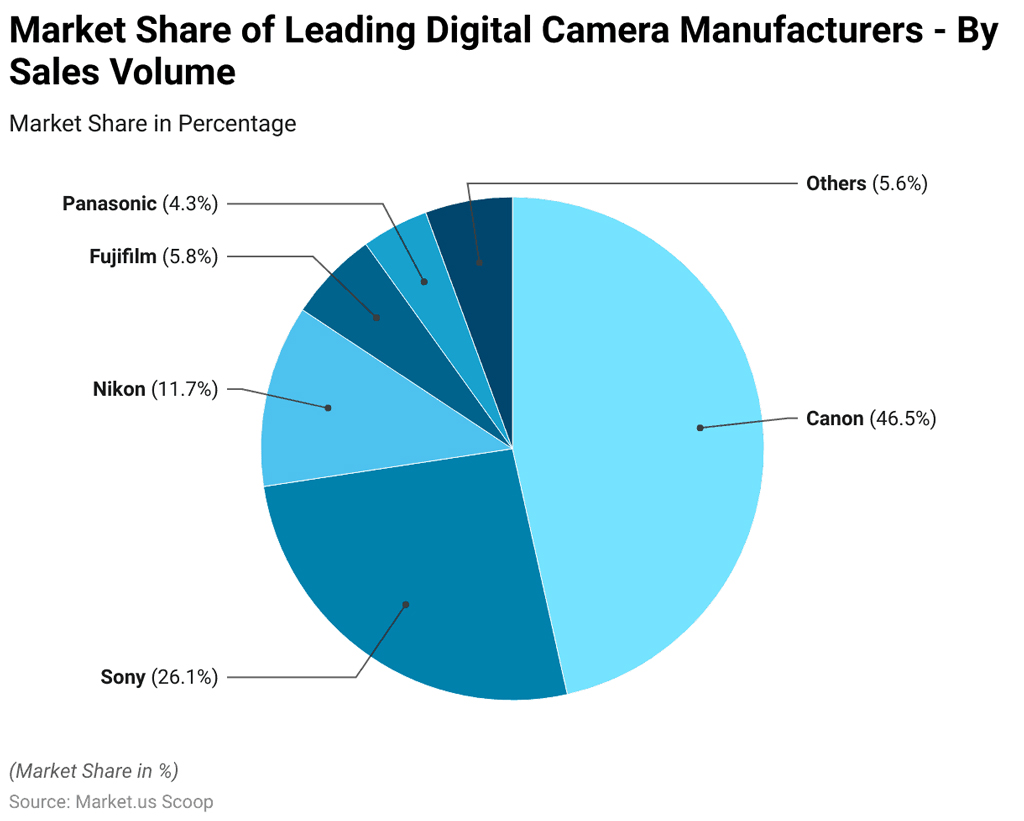
- Canon dominates the digital camera market with the highest sales volume share at 46.5%, making it the clear market leader.
- Sony ranks second with a 26.1% market share, showing strong demand for its digital cameras, especially in the mirrorless and premium camera segments.
- Together, Canon and Sony control 72.6% of the market by sales volume, highlighting a highly concentrated competitive landscape.
- Nikon holds the third-largest share at 11.7%, maintaining a notable position despite stronger competition from Canon and Sony.
- Fujifilm accounts for 5.8% of the market, reflecting its niche strength among photography enthusiasts and creative users.
- Panasonic captures 4.3% of digital camera sales volume, placing it behind Fujifilm but still within the leading manufacturer group.
- The “Others” category represents 5.6%, indicating that smaller digital camera brands collectively hold a limited share of the market.
- The data shows that the digital camera market is led by a few major players, with Canon, Sony, and Nikon together accounting for 84.3% of total sales volume.
Camera Sensor Resolutions and Megapixel Trends
- Sensors ranging from 24 MP to 33 MP remained the most common resolution range among new mirrorless camera releases in 2025.
- Full-frame cameras with resolutions above 45 MP continued gaining popularity among commercial and landscape photographers.
- Several flagship cameras offered sensors exceeding 60 MP, targeting high-end professional users.
- Medium-format cameras reached resolutions of more than 100 MP, serving specialized commercial photography markets.
- Smartphone manufacturers increasingly promoted camera systems exceeding 50 MP, intensifying competition with entry-level cameras.
- Backside-illuminated sensor technology became standard across many premium camera models in 2025.
- Stacked sensor designs improved burst rates, autofocus speed, and video performance in flagship cameras.
- AI-enhanced image processing helped maximize image quality from both high-resolution and lower-resolution sensors.
- Demand for higher megapixel counts remained strongest among commercial, advertising, and fine-art photographers.
- Sensor innovation is increasingly focused on speed, dynamic range, and low-light performance rather than megapixel growth alone.
Yearly Lens Sales Trends
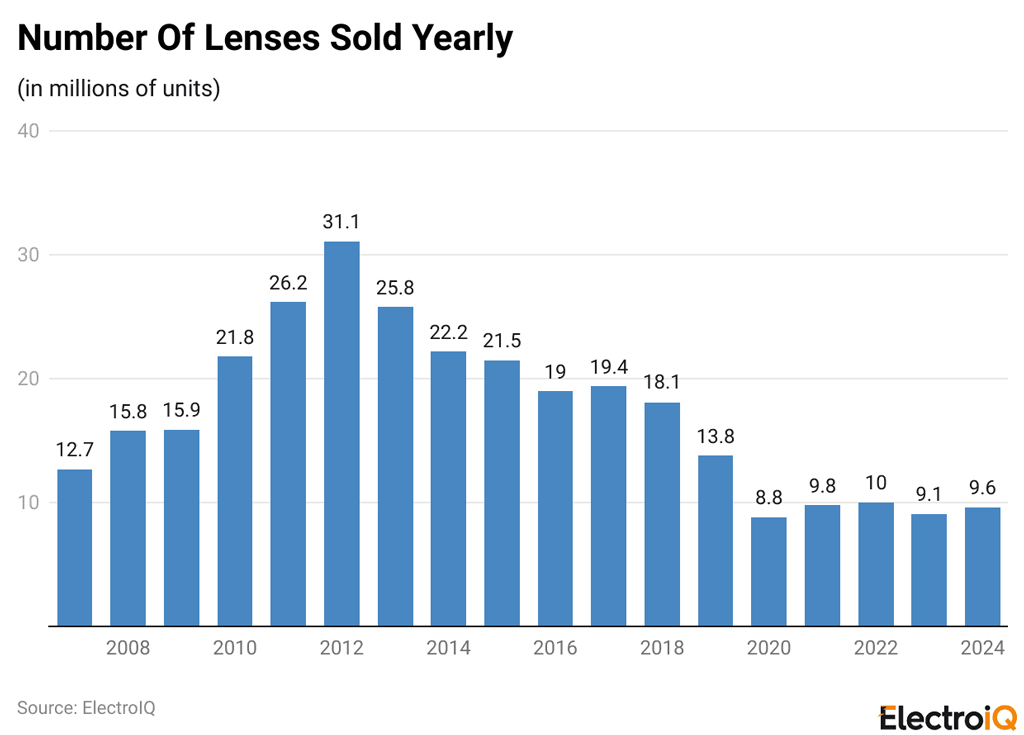
- Lens sales peaked in 2012, reaching 31.1 million units, the highest figure shown in the chart.
- From 2007 to 2012, lens sales grew strongly from 12.7 million to 31.1 million units, showing a major expansion phase in the camera lens market.
- After 2012, the market began a steady decline, falling to 25.8 million units in 2013 and 22.2 million units in 2014.
- By 2018, yearly lens sales had dropped to 18.1 million units, nearly 13 million units lower than the 2012 peak.
- The sharpest decline came around 2020, when sales fell to 8.8 million units, likely reflecting weaker camera demand and pandemic-related market disruption.
- Lens sales slightly recovered after 2020, rising to 9.8 million units in 2021 and 10.0 million units in 2022.
- In recent years, sales have remained relatively stable, with 9.1 million units in 2023 and 9.6 million units in 2024.
- The data suggests the lens market has shifted from a high-growth phase to a smaller, more mature market, with annual sales now staying below 10 million units.
- Compared with the peak year of 2012, lens sales in 2024 were lower by 21.5 million units, indicating a major long-term contraction in yearly demand.
Camera Demand in Photography and Content Creation
- The global creator economy was valued at $205.25 billion in 2024, with over 207 million creators active worldwide across all platforms.
- Approximately 50 million creators are recognized as professional or semi-professional, driving sustained demand for dedicated cameras.
- The global mirrorless camera market is valued at $5.8 billion in 2025 and projected to nearly double by 2034.
- The global mirrorless camera market size was $5.33 billion in 2024, growing to $5.65 billion in 2025 at a CAGR of 6.1%.
- The wedding photography market is worth $26.1 billion in 2024, expected to reach $56.3 billion by 2034 at a CAGR of 8.0%.
- Over 165 million new creators joined major social platforms between 2020 and 2025, boosting camera sales.
- The creator economy is projected to surpass $250 billion globally by 2026, with 22.5% CAGR growth.
- More than 2 million creators earn six-figure incomes annually from their content, investing in premium camera gear.
Impact of AI and Computational Photography in Cameras
- The global computational photography market reached $17.40 billion in 2025 and will grow to $60.66 billion by 2034.
- By 2025, 64% of all network cameras will incorporate AI features for better object detection and reduced false positives.
- AI analytics adoption in new cameras exceeds 60 percent worldwide, with AI security cameras reducing false alerts by up to 90 percent.
- Canon cameras with AI autofocus captured 55% market share among pros in 2023, up from 28% in 2021.
- 49% of freelance photographers integrated AI tools into their workflows by 2025.
- AI technologies can boost productivity by up to 40% in imaging-related tasks, according to NIST.
- The AI camera market was valued at $21.81B in 2025 and will reach $56.44B by 2029 at 26.8% CAGR.
- In 2023, the average person had around 2,100 photos stored on their smartphone, driving computational photography demand.
Key Challenges Facing the Camera Industry
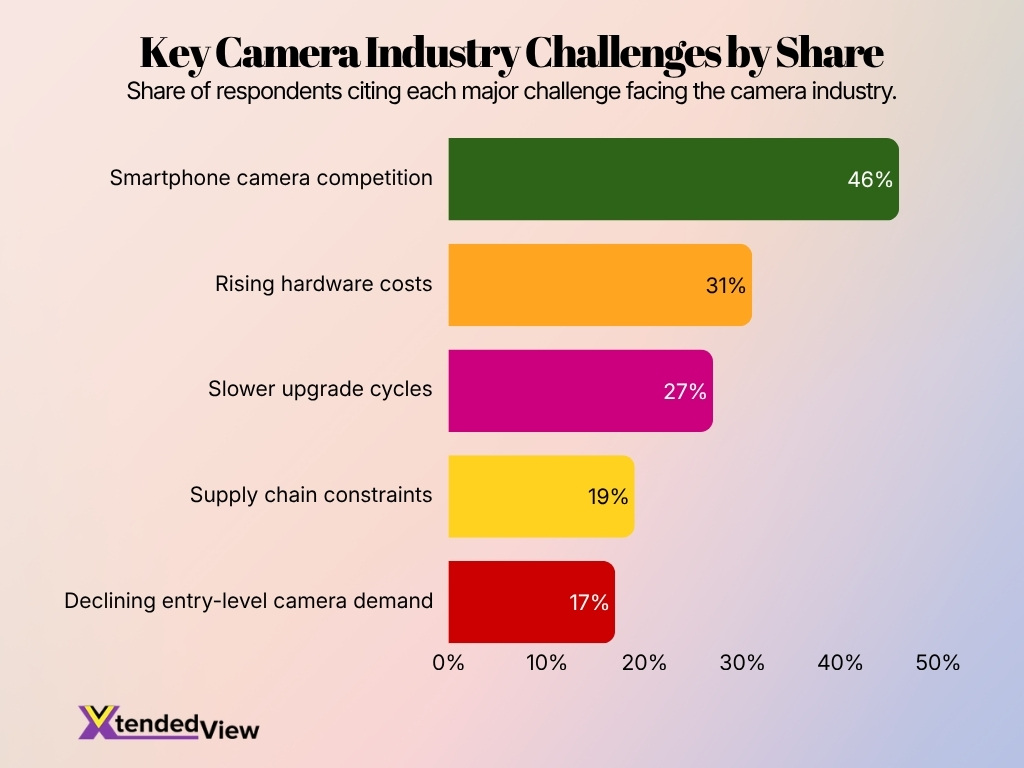
- Smartphone camera competition is the biggest challenge for the camera industry, cited by 46% of respondents.
- Rising hardware costs rank as the second-largest challenge, affecting 31% of the industry.
- Slower upgrade cycles are also a major concern, with 27% indicating that consumers are taking longer to replace or upgrade cameras.
- Supply chain constraints remain a notable pressure point, impacting 19% of the camera industry.
- Declining entry-level camera demand affects 17%, showing that beginner-level camera sales are under pressure.
- The data shows that smartphones are the most serious competitive threat, with their impact 15 percentage points higher than rising hardware costs.
- Cost and demand-related issues together highlight a difficult market environment, as hardware costs, longer upgrade cycles, and lower entry-level demand all restrict growth.
- The camera industry may need to focus more on premium models, professional users, and advanced imaging features to compete against smartphones.
Camera Market Forecasts and Future Outlook
- The global digital camera market is projected to grow at about 4.2%–4.8% CAGR through 2030, with some forecasts extending near 5% into the mid-2030s.
- Mirrorless cameras are already dominant, with one estimate putting them at 62.1% of the digital camera market in 2025 and another showing about 85% of interchangeable-lens shipments.
- Interchangeable-lens camera shipments are expected to keep rising, with the lens market projected at 3.4% CAGR from 2026 to 2035.
- North America’s digital camera market is forecast to expand from $4.44 billion in 2024 to $6.79 billion by 2030, a 7.17% CAGR.
- Asia-Pacific remains a major growth region, with its AI camera market projected to grow at 24.1% CAGR from 2025 to 2030 and reach $15.19 billion by 2030.
- The creator economy is expected to stay a major demand driver, rising from $255.66 billion in 2025 to $820.83 billion by 2030.
- Compact and mirrorless systems are benefiting from hybrid workflows, with one forecast saying the mirrorless interchangeable-lens segment will grow from $16.57 billion in 2025 to $22.98 billion by 2032.
- AI features are becoming mainstream, including subject recognition, eye autofocus, and real-time scene optimization in newer camera models.
- Future camera innovation is increasingly tied to computational imaging, advanced sensors, and AI-assisted autofocus, with on-sensor processing and multi-frame enhancement highlighted as next-gen capabilities.
- Premium and hybrid photo-video models are driving value, as growth is being supported by 8K video, stronger autofocus, and creator-focused feature sets.
Frequently Asked Questions (FAQs)
Global camera shipments exceeded 9.4 million units in 2025, making it the strongest year for camera shipments since before the pandemic.
Mirrorless cameras account for nearly 90% of the interchangeable-lens camera market worldwide.
Around 6.3 million mirrorless cameras were shipped globally during 2025, representing strong year-over-year growth.
The global digital camera market is forecast to grow at a CAGR of approximately 4.8% from 2024 to 2030.
Canon shipped roughly 600,000 to 620,000 DSLR units in 2025, representing about 90% of the global DSLR market.
Conclusion
The camera industry entered the year with stronger momentum than many analysts expected. Mirrorless cameras now dominate the market, premium compact cameras are experiencing a surprising revival, and creator-focused demand continues to fuel growth across nearly every major segment. While smartphones remain the most widely used imaging devices, dedicated cameras maintain clear advantages in image quality, lens flexibility, autofocus performance, and professional workflows.
Looking ahead, AI-powered imaging, advanced sensor technologies, and hybrid photo-video capabilities will shape future product development. Manufacturers are increasingly prioritizing high-value premium systems over mass-market volume, creating a more sustainable industry model. As content creation, commercial photography, livestreaming, and digital media production continue expanding worldwide, dedicated cameras are positioned to remain an important part of the imaging ecosystem throughout the remainder of the decade.