


Modern vehicles now rely on software, cloud platforms, sensors, mobile apps, and wireless connectivity to deliver safer and smarter driving experiences. As a result, cybersecurity has become a core priority for automakers, suppliers, fleet operators, and regulators. It now influences everything from over-the-air (OTA) software updates to electric vehicle charging networks and autonomous driving systems. The growing number of cyber incidents shows why automotive cybersecurity has become a critical business and safety issue worldwide. Explore the statistics below to understand how the threat landscape continues to evolve.
Editor’s Choice
- 494 publicly reported automotive and smart mobility cybersecurity incidents were analyzed worldwide during 2025, highlighting another active year for the industry.
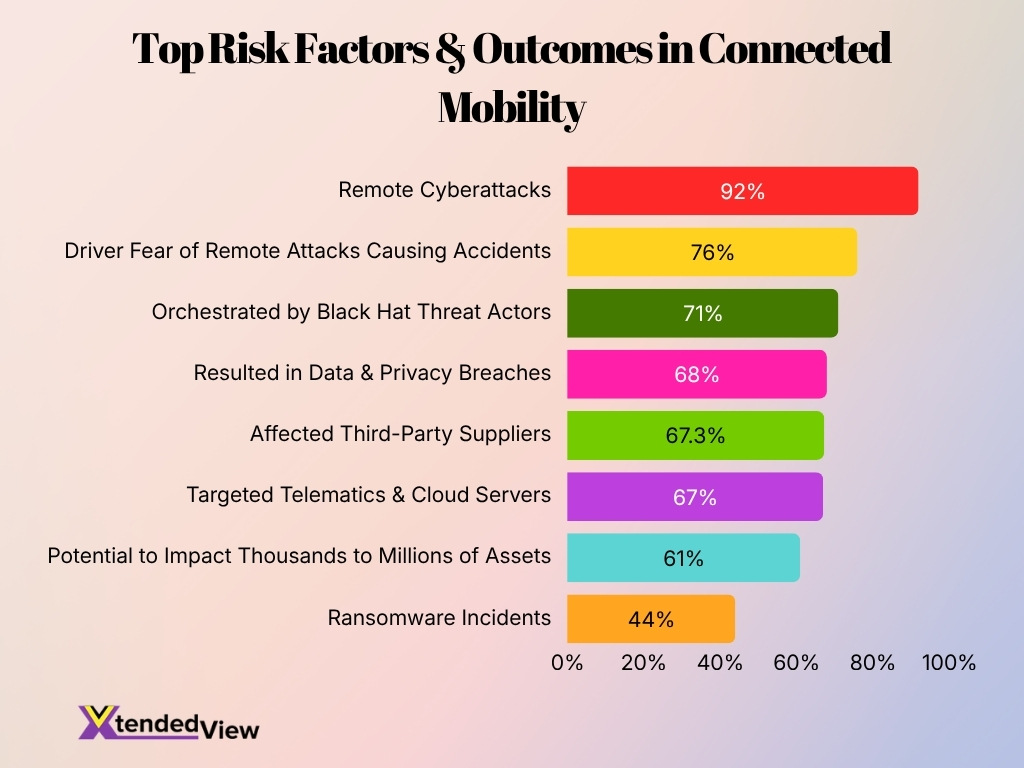
- 71% of reported automotive cyber incidents in 2025 were attributed to malicious black-hat threat actors, up from 65% in 2024.
- 67% of 2025 incidents involved telematics and cloud systems, making them the leading attack targets across connected vehicle ecosystems.
- 68% of automotive cyber incidents in 2025 resulted in data or privacy exposure, demonstrating the growing value of vehicle-generated data to attackers.
- 44% of all reported automotive cyber incidents in 2025 were ransomware-related, more than doubling from the previous year.
- 61% of incidents had the potential to impact thousands to millions of mobility assets, while 20% reached massive-scale classification.
- 92% of automotive cyberattacks in 2025 were executed remotely, and 86% required no physical access to the targeted vehicle or infrastructure.
- UN Regulations R155 and R156 now serve as key cybersecurity and software update requirements across 50+ countries, making cybersecurity compliance a global market requirement.
Recent Developments
- Automotive cybersecurity research shifted strongly toward AI-enabled attack techniques during 2025 as connected vehicle software became increasingly AI-driven.
- Researchers observed ransomware campaigns expanding beyond enterprise IT into vehicle remote-control functions, including door locks and ignition systems.
- Telematics and application server attacks increased from 43% in 2023 to 66% in 2024, reflecting the industry’s growing cloud dependency.
- Publicly reported automotive cybersecurity incidents increased from 295 in 2023 to 409 in 2024.
- The cumulative number of documented automotive cybersecurity incidents reached 1,877 since 2010 by the end of 2024.
- Automotive cybersecurity maturity increasingly depends on securing the entire software lifecycle, according to a 2025 industry survey involving 174 experts worldwide.
- Security automation and Generative AI ranked among the fastest-growing cybersecurity investments reported by automotive organizations in 2025.
- Governments continue expanding compliance requirements around cybersecurity management systems and secure software updates, making cybersecurity part of vehicle homologation in many markets.
Automotive Cybersecurity Market Growth Highlights
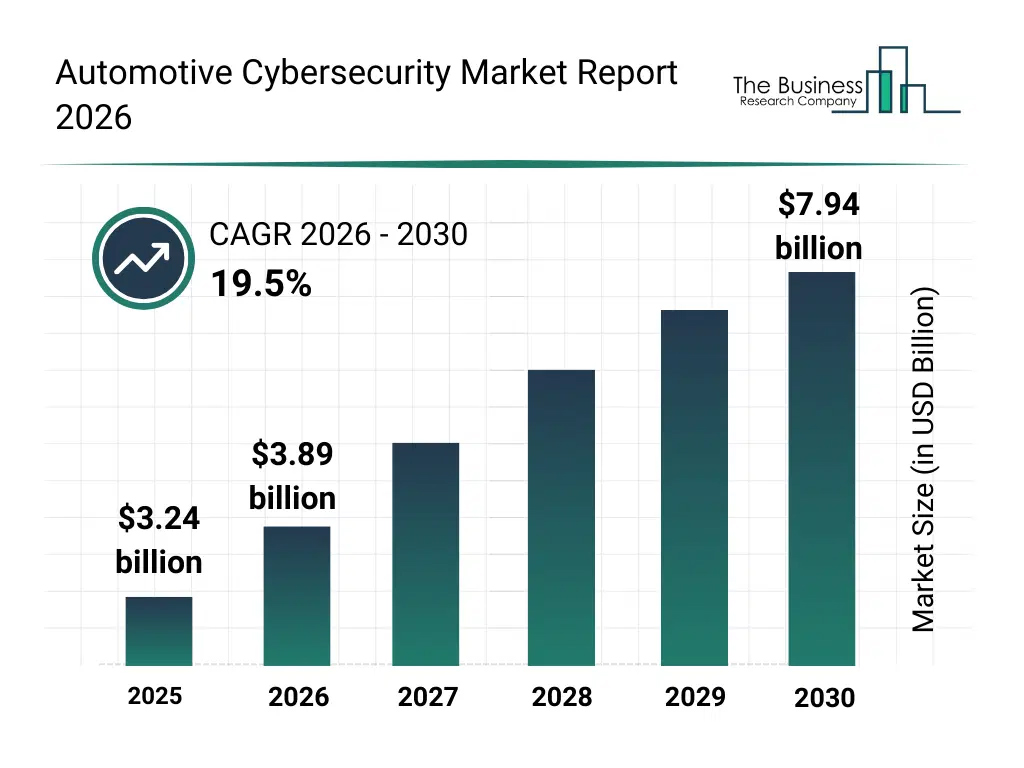
- The global automotive cybersecurity market was valued at $3.24 billion in 2025.
- The market is projected to reach $3.89 billion in 2026, representing an annual increase of approximately 20.1%.
- Automotive cybersecurity revenue is expected to rise to nearly $4.65 billion in 2027.
- By 2028, the market could exceed $5.56 billion, driven by increasing connected vehicle security requirements.
- The industry is forecast to reach approximately $6.64 billion in 2029.
- By 2030, the automotive cybersecurity market is projected to hit $7.94 billion.
- The market is expected to expand at a strong 19.5% CAGR from 2026 to 2030.
- Between 2025 and 2030, the market is projected to grow by $4.70 billion, more than doubling in size.
- The 2030 market value is expected to be around 2.45 times larger than the 2025 market value.
- This rapid growth reflects rising investment in protecting connected cars, electric vehicles, vehicle software, and digital automotive infrastructure.
Growth In Automotive Cyber Threats
- Automotive cyber incidents increased from 295 in 2023 to 409 in 2024, representing a substantial year-over-year rise.
- Researchers documented 494 publicly reported incidents during 2025, indicating continued high attack activity across the automotive ecosystem.
- Ransomware incidents accounted for 44% of all reported automotive cybersecurity events in 2025.
- 71% of 2025 attacks originated from organized malicious actors compared with 65% the year before.
- Massive-scale attacks capable of affecting millions of connected assets continued to increase during both 2024 and 2025.
- 92% of reported automotive attacks in 2025 occurred remotely, demonstrating how attackers increasingly exploit internet-connected systems instead of requiring physical access.
- Deep and dark web activity targeting automotive systems continued expanding, enabling organized groups to coordinate attacks more efficiently.
- Researchers increasingly observed attacks targeting APIs, cloud platforms, and mobility applications instead of traditional vehicle hardware alone.
Types Of Automotive Cyber Attacks
- Ransomware represented 44% of automotive cybersecurity incidents during 2025.
- Data and privacy breaches occurred in 68% of reported automotive incidents during 2025.
- Business disruption affected 34% of reported incidents, interrupting production, dealership operations, or connected mobility services.
- Telematics and cloud attacks accounted for 67% of attack vectors in 2025.
- Remote attacks made up 92% of all reported incidents, emphasizing the dominance of wireless exploitation techniques.
- APIs increasingly became high-value attack targets because they connect vehicles, cloud platforms, and mobile applications.
- Credential theft and unauthorized access to cloud-based mobility platforms remain common methods used by organized cybercriminal groups.
- Supply chain attacks continue affecting OEMs, software vendors, dealerships, and third-party service providers simultaneously due to the industry’s interconnected digital infrastructure.
Connected And Autonomous Vehicle Cyber Risks
- Ransomware incidents accounted for 44% of all automotive cyberattacks in 2025.
- Remote cyberattacks constituted 92% of total reported incidents in the connected vehicle sector.
- Approximately 61% of reported cyber incidents had the potential to impact thousands to millions of mobility assets.
- Nearly 67.3% of automotive cybersecurity incidents directly affected third-party suppliers rather than manufacturers.
- Attacks targeting telematics and cloud servers were responsible for 67% of all recorded connected car vulnerabilities.
- Data and privacy breaches were the direct outcome of 68% of connected vehicle cyber incidents.
- The global automotive cybersecurity market is projected to reach USD 22.2 billion by the year 2032.
- Around 76% of connected car drivers fear that remote cyberattacks could cause accidents or endanger lives.
- Malicious activities orchestrated by black hat threat actors were responsible for 71% of automotive incidents.
Attack Vectors in Automotive Ecosystems
- Telematics, cloud platforms and application servers appeared in 67% of publicly reported automotive cyber incidents in 2025, making remotely accessible infrastructure the sector’s largest attack surface.
- In 2024, telematics and application-server attacks accounted for 66% of incidents, up from 43% in 2023.
- API-related attacks increased by nearly 30% in 2024 and represented 17% of reported incidents that year.
- Researchers classified 92% of automotive cyberattacks in 2025 as remote, showing that attackers rarely need to touch the targeted vehicle or system.
- Moreover, 86% of 2025 attacks required no physical proximity, allowing criminals to target vehicles, fleets and service platforms across national borders.
- Researchers identified 1,663 automotive software vulnerabilities disclosed between 2018 and September 2024 across embedded systems, mobile apps, cloud services, infotainment platforms and simulation software.
- Software vulnerabilities contributed to an estimated 49.5% of automotive cyberattacks examined in an earlier industry dataset, demonstrating the persistent value of unpatched weaknesses.
- Supply-chain concentration increases systemic exposure because one vulnerable software package, cloud service, or hardware platform can appear across millions of vehicles.
- Modern connected cars can contain more than 100 million lines of code, giving security teams a far larger review and maintenance burden than traditional mechanical vehicles.
In-Vehicle System Vulnerabilities
- A modern vehicle can contain more than 100 electronic control units, each of which may communicate with safety, comfort, infotainment, or powertrain systems.
- Earlier technical research identified about 70 electronic control units in a typical vehicle, illustrating how quickly in-vehicle computing complexity has expanded.
- The traditional Controller Area Network supports communication rates of up to 1 megabit per second, but its original design lacks native message authentication.
- Because CAN nodes often trust messages by default, a compromised unit can inject fabricated instructions that appear legitimate to other connected components.
- Automotive networks can combine at least four major bus technologies, CAN, LIN, MOST and FlexRay, alongside newer Automotive Ethernet implementations.
- At the 2025 automotive hacking competition, researchers disclosed 16 unique zero-day vulnerabilities on the first day alone.
- Those first-day demonstrations generated $382,750 in awards, reflecting the technical value and potential impact of exploitable vehicle and charging-system weaknesses.
- By the second day of the 2025 event, researchers had demonstrated 23 zero-day vulnerabilities across EV chargers and in-vehicle infotainment products.
- The 2026 competition produced 76 unique vulnerabilities and awarded researchers $1.047 million, indicating that exploitable flaws remain common in current automotive products.
Automotive Cybersecurity Market Share by Application
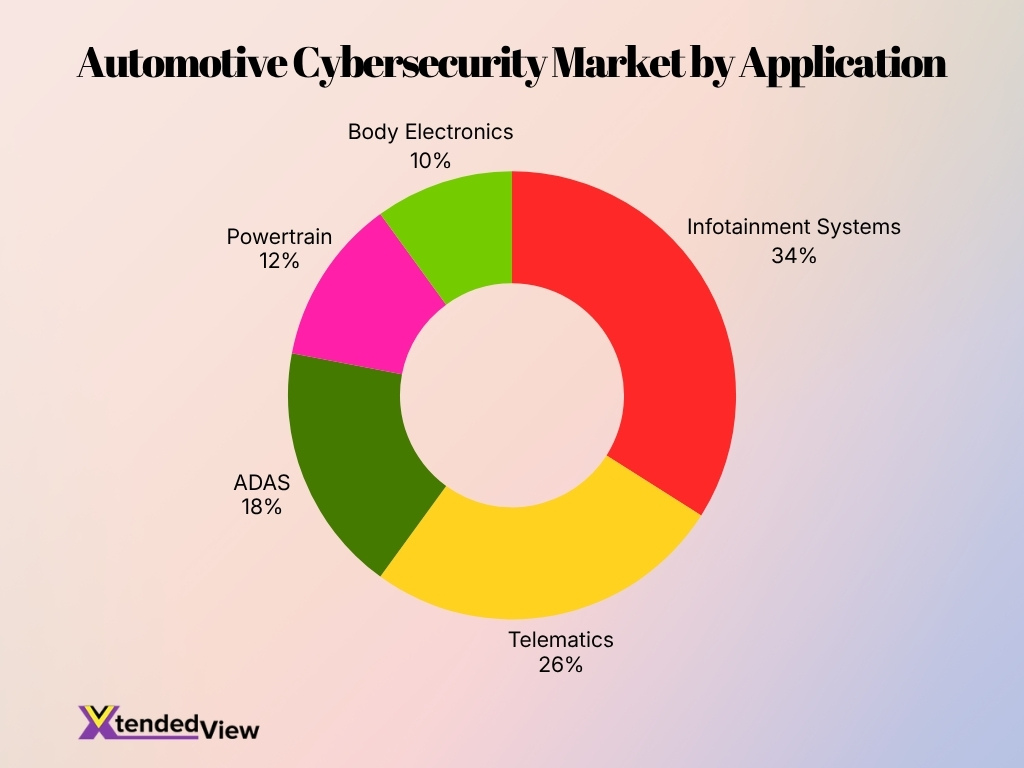
- Infotainment systems lead the automotive cybersecurity market with a 34% share, reflecting growing security needs across connected displays, media platforms, and in-car applications.
- Telematics accounts for 26% of the market, driven by the need to protect vehicle tracking, remote diagnostics, navigation, and wireless communication systems.
- ADAS represents 18% of automotive cybersecurity demand as advanced driver assistance technologies rely heavily on secure sensors, cameras, software, and data processing.
- Powertrain systems hold a 12% market share, highlighting the importance of protecting engine, transmission, and electric vehicle control functions from cyber threats.
- Body electronics contributes the remaining 10%, covering security for connected components such as door locks, lighting, climate controls, and access systems.
- Together, infotainment systems and telematics account for 60% of the market, showing that connected and communication-based vehicle technologies face the strongest cybersecurity demand.
- The top three applications, including infotainment, telematics, and ADAS, collectively represent 78% of the automotive cybersecurity market.
Vehicle-To-Everything (V2X) Communication Vulnerabilities
- The global V2X cybersecurity market generated an estimated $43 million in 2023, reflecting the relatively early stage of commercial protection for connected road communications.
- Forecasts project that market to reach $778 million by 2030, as automakers and infrastructure operators add protections to V2V, V2I and V2N communications.
- That projection represents a 51.3% compound annual growth rate, one of the fastest expansion rates within automotive cybersecurity.
- V2X environments connect vehicles with at least four endpoint groups: other vehicles, roadside infrastructure, pedestrians’ devices and wider communications networks.
- Attackers can exploit false V2X messages to report nonexistent collisions, traffic congestion or hazardous road conditions, potentially altering vehicle behavior and route decisions.
- A successful Sybil attack can make one malicious device appear as multiple road users, distorting traffic information and overwhelming trust-based safety systems.
- Certificate and identity management must operate at fleet scale because V2X messages require rapid authentication without exposing a driver’s permanent identity.
- Location data creates an additional privacy risk because repeated V2X transmissions can reveal travel patterns even when individual messages use temporary identifiers.
- Meanwhile, compromised roadside equipment can distribute deceptive information to many vehicles simultaneously, turning a local infrastructure breach into a fleet-level safety risk.
Electric Vehicle And Charging Infrastructure Vulnerabilities
- A November 2024 cyberattack exposed 116,000 sensitive records from multiple global charging operators.
- Hackers uncovered 16 unique zero-day vulnerabilities during the first day of the 2025 automotive hacking competition.
- Researchers identified 23 zero-day flaws across charging and infotainment products by the event’s second day.
- A single 2025 charging-system exploit manipulating the Open Charge Point Protocol earned researchers $57,500.
- A security research team earned $91,750 for successfully compromising two separate EV charging products.
- The 2026 security competition recorded 66 zero-days against Level 2 and Level 3 chargers by day two.
- The full 2026 competition produced 76 unique vulnerabilities confirming risks in charger firmware.
- Security researchers were awarded $1,047,000 in total bounties during the 2026 automotive hacking contest.
- During the 2024 automotive contest, hackers collected $1,323,750 after demonstrating 49 zero-day bugs.
Impact of Cybercrime on Automotive Companies
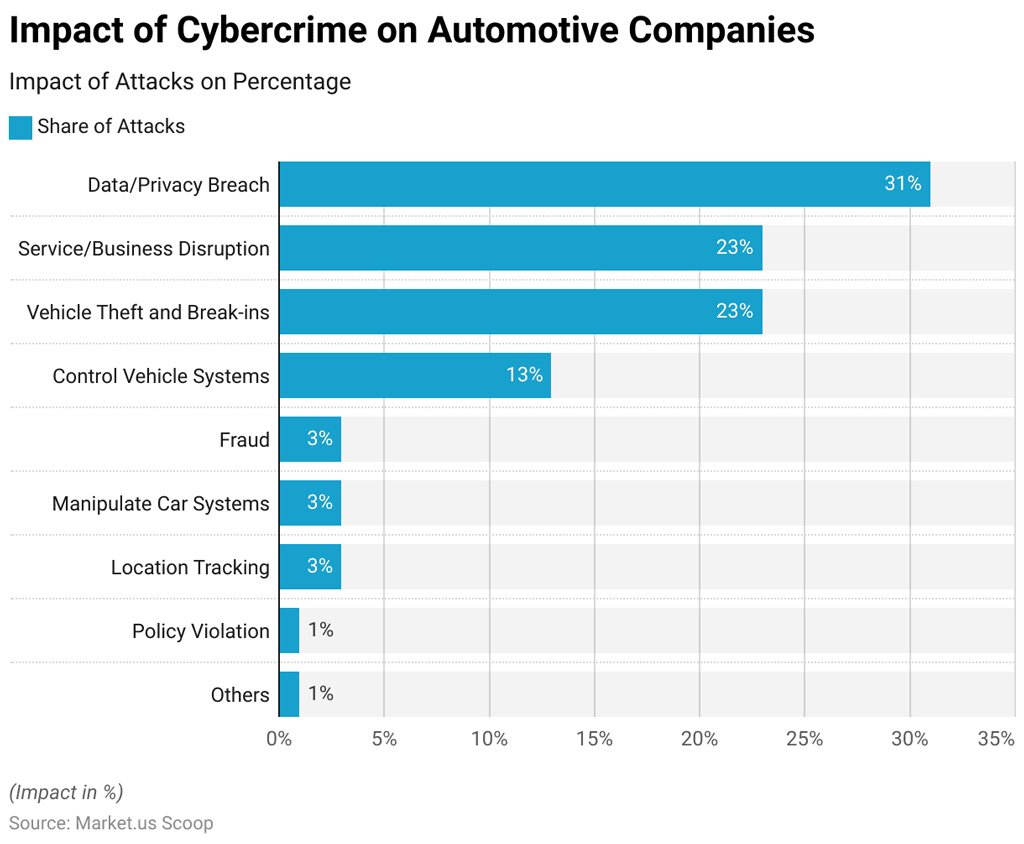
- Data and privacy breaches are the most common impact, accounting for 31% of automotive cyberattacks.
- Service and business disruption represents 23% of attacks, highlighting the operational risks faced by automotive companies.
- Vehicle theft and break-ins also account for 23%, making physical security a major consequence of automotive cybercrime.
- Attacks aimed at controlling vehicle systems make up 13%, showing the growing threat to connected and software-enabled vehicles.
- Fraud, car system manipulation, and location tracking each represent 3% of reported attacks.
- Policy violations account for only 1%, suggesting they are less frequently reported than direct security breaches.
- Other unspecified cybercrime impacts also represent 1% of attacks.
- The top three categories together account for 77% of all reported automotive cyberattack impacts.
- Overall, the data shows that automotive cybercrime primarily threatens customer data, business continuity, and vehicle security.
Telematics And Cloud Security Incidents
- Telematics, APIs and cloud systems served as primary attack vectors in 67% of automotive incidents reported in 2025.
- The comparable share stood at 66% in 2024, up sharply from 43% in 2023.
- API attacks increased by almost 30% during 2024, as vehicle apps and digital services exposed more remote commands and customer records.
- In 2025, 92% of attacks occurred remotely, largely because telematics units, web interfaces and cloud accounts remain accessible beyond the vehicle.
- Furthermore, 86% required no physical proximity, allowing one attacker to probe services supporting vehicles in several regions.
- Cloud compromises can scale quickly because one backend platform may support thousands or millions of vehicles rather than one physical unit.
- Connected platforms can hold personally identifiable information, vehicle locations, driving behavior, payment data, and commercially sensitive intellectual property.
- Weak API authorization can let attackers use a valid vehicle identifier to request data or activate functions belonging to another customer.
- As automakers move features into software subscriptions, a cloud outage or account takeover can interrupt remote locking, charging controls, navigation and fleet-management services at the same time.
Ransomware Incidents In The Automotive Industry
- Ransom-related activity accounted for 44% of publicly reported automotive cyber incidents in 2025.
- The number of automotive ransomware incidents more than doubled between 2024 and 2025, marking one of the sector’s clearest year-over-year threat increases.
- Researchers analyzed 494 publicly reported automotive and smart-mobility incidents in 2025 when calculating the ransomware share.
- Based on that dataset, the 44% share equates to roughly 217 ransom-related incidents, although the published percentage may include rounding.
- Manufacturing attracted 36% of recorded cyberattacks in 2024 in one threat-intelligence dataset; that category includes automakers and many component suppliers.
- Early 2025 ransomware cases affected automotive organizations in at least three regions: Japan, Italy and Australia, showing the threat’s geographic reach.
- Ransomware can halt production, dealership sales, parts ordering, diagnostic access and financing operations even when attackers never compromise a vehicle directly.
- Suppliers create a high-impact entry point because one breach can delay several automakers that depend on the same parts, logistics or software provider.
- Double-extortion groups increase pressure by encrypting operational systems and threatening to publish stolen employee, customer, or engineering data.
Data Breaches And Privacy Violations In Vehicles
- Connected vehicles can collect at least five major data classes: identity information, precise location, driving behavior, biometric data, and payment details.
- Regulators have specifically identified telematics, geolocation, video and biometric information as sensitive categories that automakers may collect.
- One charging-network breach exposed 116,000 records in November 2024, illustrating that privacy risk extends beyond the vehicle to supporting infrastructure.
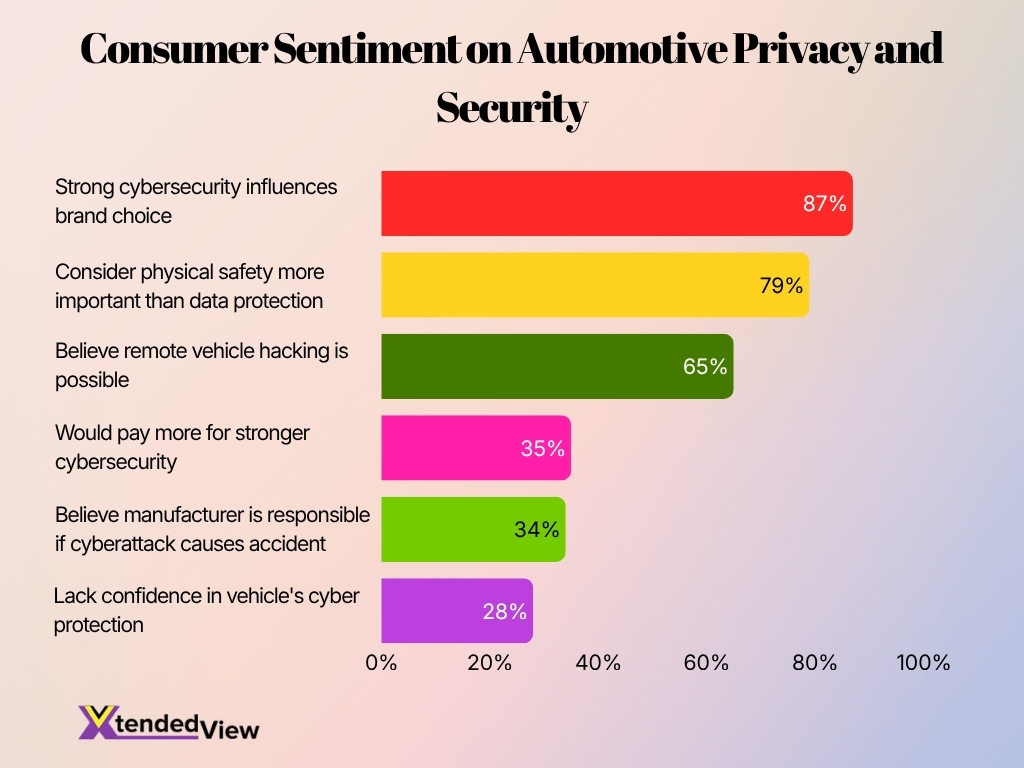
- A 2025 consumer study found that 65% of respondents believed remote vehicle hacking was possible.
- In the same study, 28% lacked confidence that their vehicle had adequate protection against hackers.
- 87% of respondents said strong cybersecurity and privacy protections would influence their choice of automotive brand.
- Additionally, 35% said they would pay more for a vehicle from a brand that offered stronger cybersecurity and privacy safeguards.
- 79% considered physical safety more important than personal-data protection, although a single vehicle compromise can threaten both outcomes.
- Finally, 34% believed the manufacturer should bear responsibility when a vehicle cyberattack causes an accident, linking privacy and security controls directly to brand accountability.
Financial Losses From Automotive Cyber Attacks
- Automotive cyberattacks recorded between 2022 and 2024 caused an estimated tens of billions of dollars in combined ransomware, data-breach and operational-disruption losses.
- A major 2025 automaker cyberattack generated an estimated $2.55 billion in economic damage after disrupting production and the wider supply chain.
- The same incident halted operations for nearly six weeks, demonstrating how recovery time can magnify losses beyond the initial security event.
- The disruption affected more than 5,000 organizations, including manufacturers, suppliers, and service businesses tied to the automaker’s operations.
- Three affected factories normally produced about 1,000 vehicles per day, so each day of downtime removed substantial manufacturing output.
- Government support included a $2 billion-equivalent loan guarantee to help stabilize suppliers after the 2025 incident disrupted cash flow across the production network.
- Business and operational disruption occurred in 34% of publicly reported automotive cyber incidents in 2025, creating costs through downtime, delayed deliveries and lost sales.
- Furthermore, 61% of 2025 incidents could have affected thousands to millions of mobility assets, increasing the potential financial impact of each successful attack.
- Ransom-related events represented 44% of automotive incidents in 2025 and more than doubled from 2024, raising expenses for investigation, restoration, legal support and business continuity.
Threat Actors Targeting The Automotive Sector
- Black-hat actors caused 71% of reported automotive cyber incidents in 2025, up from 65% in 2024.
- The 6-percentage-point increase reflected stronger activity from organized criminal groups capable of targeting several companies or systems in one campaign.
- Ransomware operators accounted for 44% of sector incidents in 2025, making financially motivated extortion one of the industry’s most visible threats.
- Ransom-related automotive incidents more than doubled between 2024 and 2025, indicating that criminal groups increasingly view manufacturers and suppliers as profitable targets.
- Remote attackers conducted 92% of automotive cyberattacks in 2025, allowing individuals and organized groups to operate across borders.
- 86% of attacks required no physical proximity, reducing the cost and practical risk for attackers targeting cloud services, APIs and remote-access systems.
- Nation-state groups increasingly pursue autonomous-vehicle technology, intellectual property, and commercial data to provide strategic or economic advantages to their home countries.
- Social-engineering-focused groups demonstrated that young, loosely organized actors can disrupt major automotive operations without relying only on advanced technical exploits.
- Insiders, contractors, and compromised third-party accounts also present risks because automotive organizations share sensitive software, production, and customer data across extensive supplier networks.
Regional Distribution Of Automotive Cyber Incidents
- North America recorded the highest overall number of reported automotive cyber incidents globally in 2024.
- One 2026 estimate projected that Asia-Pacific will account for 39% of the global automotive cybersecurity revenue.
- Europe was assigned a 25.1% share in 2026 and identified as the fastest-growing regional market.
- A separate 2025 estimate placed the Asia-Pacific market share at 35.8%.
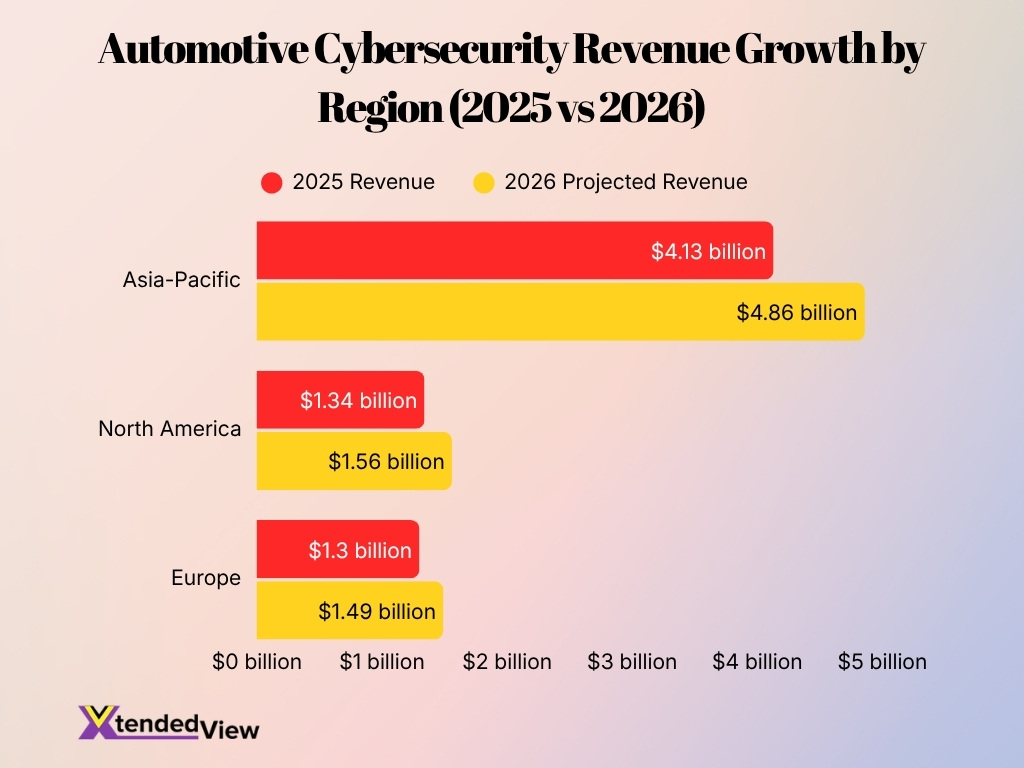
- Asia-Pacific automotive cybersecurity revenue was valued at $4.13 billion in 2025 and projected to hit $4.86 billion in 2026.
- North American cybersecurity revenue reached an estimated $1.34 billion in 2025 and could increase to $1.56 billion in 2026.
- European automotive cybersecurity revenue totaled $1.30 billion in 2025 with a projected rise to $1.49 billion in 2026.
- Mexico alone experienced 31 billion attempted cyberthreats during the first half of 2024 across targeted industries.
Regulatory And Compliance Landscape For Automotive Cybersecurity
- The global automotive cybersecurity market is projected to reach $17.35 billion by 2034 with a 9.60% CAGR.
- Automakers globally allocated an estimated $4.2 billion toward cybersecurity R&D in 2024 alone.
- Asia Pacific dominated the global regulatory landscape by securing a 57.97% market share in 2025.
- Over 54 countries currently mandate UN Regulation No. 155, enforcing strict cybersecurity management systems.
- Approximately 92% of all observed automotive cyberattacks were executed remotely according to industry tracking.
- Europe commands roughly 38% of the 2025 market revenue driven by stringent vehicle type-approval deadlines.
- The embedded in-vehicle security segment is forecast to capture 73.29% of the market share by 2026.
- Total ransomware costs in the automotive sector reached $209.6 million in the first half of 2023.
- Original Equipment Manufacturers (OEMs) accounted for 52.0% of the overall automotive cybersecurity market size in 2024.
- Consumer surveys reveal that 76% of people fear that remote vehicle hacking could physically endanger their lives.
Future Outlook For Automotive Cybersecurity Statistics
- One current forecast values the global automotive cybersecurity market at $7.7 billion in 2025 and $8.8 billion in 2026.
- Under that projection, the market could reach $24.8 billion by 2033, representing a compound annual growth rate of 15.9% from 2026.
- Another forecast estimates that the market will rise from $3.9 billion in 2025 to $11.7 billion by 2035, a compound annual growth rate of 11.6%.
- These differing valuations show that forecasts depend on whether researchers include embedded software, cloud platforms, consulting, managed services and industrial security.
- The AI-focused automotive cybersecurity market reached an estimated $1.5 billion in 2025 and could grow to $1.8 billion in 2026.
- AI-based automotive security revenue could reach $5.4 billion by 2035, supported by a projected 12.8% compound annual growth rate.
- Cloud-based products represented an estimated 58% of the AI automotive cybersecurity market in 2025, reflecting demand for fleetwide detection and remote analysis.
- The V2X cybersecurity market could grow from $43 million in 2023 to $778 million by 2030, equal to a projected compound annual growth rate of 51.3%.
- Automotive vulnerability management will remain a long-term priority because researchers documented 1,663 software vulnerabilities between 2018 and September 2024.
- Future investment will increasingly focus on vehicle security operations centers, continuous monitoring, and over-the-air remediation as manufacturers manage software across millions of connected vehicles.
Frequently Asked Questions (FAQs)
Researchers analyzed 494 publicly reported automotive and smart mobility cybersecurity incidents worldwide during 2025.
44% of all publicly reported automotive cybersecurity incidents in 2025 were ransomware-related, more than double the level recorded in 2024.
67% of reported automotive cyber incidents in 2025 involved telematics and cloud systems as the primary attack vectors.
The global automotive cybersecurity market is estimated to reach $8.8 billion in 2026, up from $7.7 billion in 2025.
The global automotive cybersecurity market is projected to grow at a 15.9% CAGR from 2026 to 2033.
Conclusion
Modern vehicles are evolving into software-defined platforms, making cybersecurity as essential as mechanical reliability and functional safety. The latest statistics show that remote attacks, ransomware, cloud compromises and data breaches continue to grow alongside vehicle connectivity. At the same time, governments are expanding cybersecurity regulations, while automakers are investing more heavily in secure software development, AI-driven threat detection and continuous monitoring.
Looking ahead, automotive cybersecurity will remain a critical factor for manufacturers, suppliers, fleet operators and technology providers. Organizations that prioritize secure design, proactive vulnerability management and rapid incident response will be better positioned to reduce operational risk and protect connected mobility ecosystems. As connected, electric and autonomous vehicles become more common, cybersecurity will continue to shape the future of the global automotive industry.
