


AI toolkits now shape how businesses write code, automate customer support, generate marketing assets, and analyze enterprise data. In healthcare, AI-powered workflow platforms help clinicians summarize patient records faster, while software teams use AI coding assistants to reduce debugging time and accelerate releases.
As spending on generative AI infrastructure and business automation rises across the US and global markets, organizations continue to expand their AI stacks at record speed. Explore the latest AI toolkit statistics, adoption trends, market growth figures, and platform data shaping.
Editor’s Choice
- The global AI market is expected to reach $900 billion in 2026, up from $757.58 billion in 2025.
- Worldwide AI spending is forecast to total $2.52 trillion in 2026, marking a 44% year-over-year increase.
- Generative AI reached 53% population-level adoption within three years, faster than both the internet and personal computers.
- Around 88% of organizations now use AI in at least one business function as of 2025,2026.
- The global generative AI market is projected to grow from $22.21 billion in 2025 to $324.68 billion by 2033.
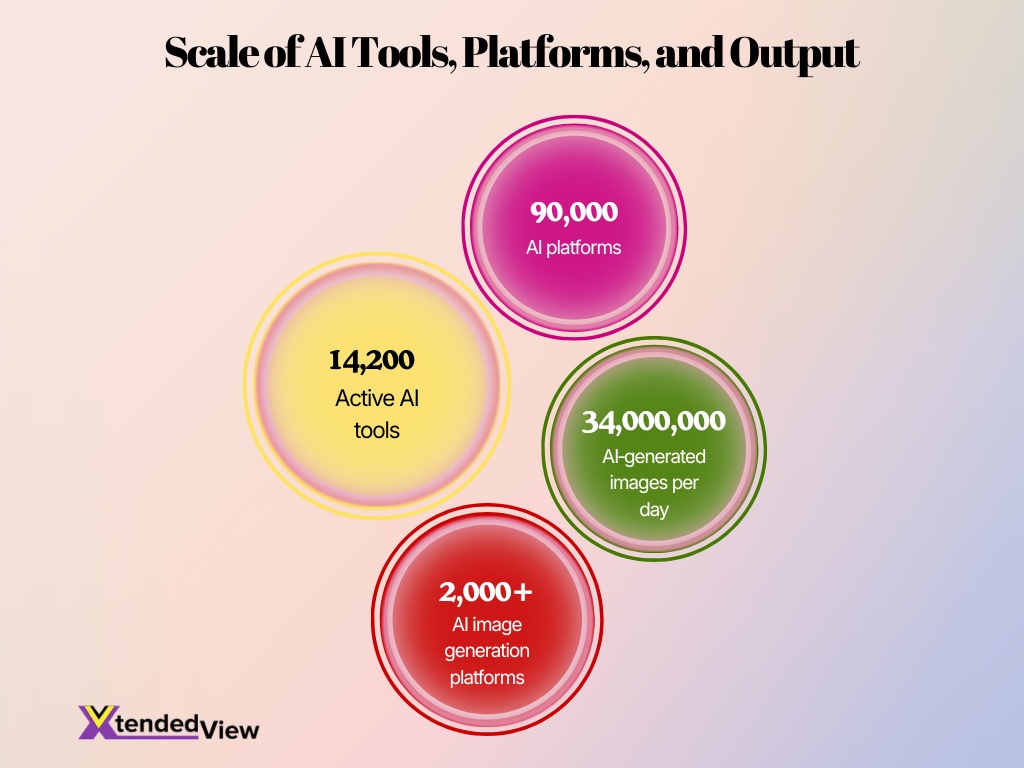
- More than 14,200 active AI tools are available globally in 2026, representing a 68% increase from 2025.
- US consumers now derive an estimated $172 billion in annual value from generative AI tools.
- The AI market is projected to grow at a 30.6% CAGR between 2026 and 2033.
- Generative AI software spending is expected to reach $52.2 billion by 2028, compared to $5.1 billion in 2023.
Recent Developments
- In May 2026, Goldman Sachs projected that hyperscalers may become the next major AI investment winners after semiconductor firms dominated early AI growth.
- Big Tech companies are expected to invest nearly $700 billion in AI-related capital expenditures in 2026.
- US electricity demand is forecast to hit record highs in 2026 and 2027 due to AI data center expansion.
- Goldman Sachs estimated hyperscaler AI capex could surge 83% year over year to $755 billion in 2026.
- Microsoft-backed workplace research found that 65% of AI users feel pressure to adopt AI to stay competitive at work.
- Only 20% of employees report having sufficient support and systems to implement AI effectively in the workplace.
- Monaco, an AI sales automation startup, surpassed $1 million in monthly recurring revenue within three months of launch in 2026.
- EU statistics showed 32.7% of people aged 16–74 used generative AI tools in 2025.
- Private global investment in generative AI reached $33.9 billion in 2024, up 18.7% from 2023.
AI Toolkit Market Growth Highlights
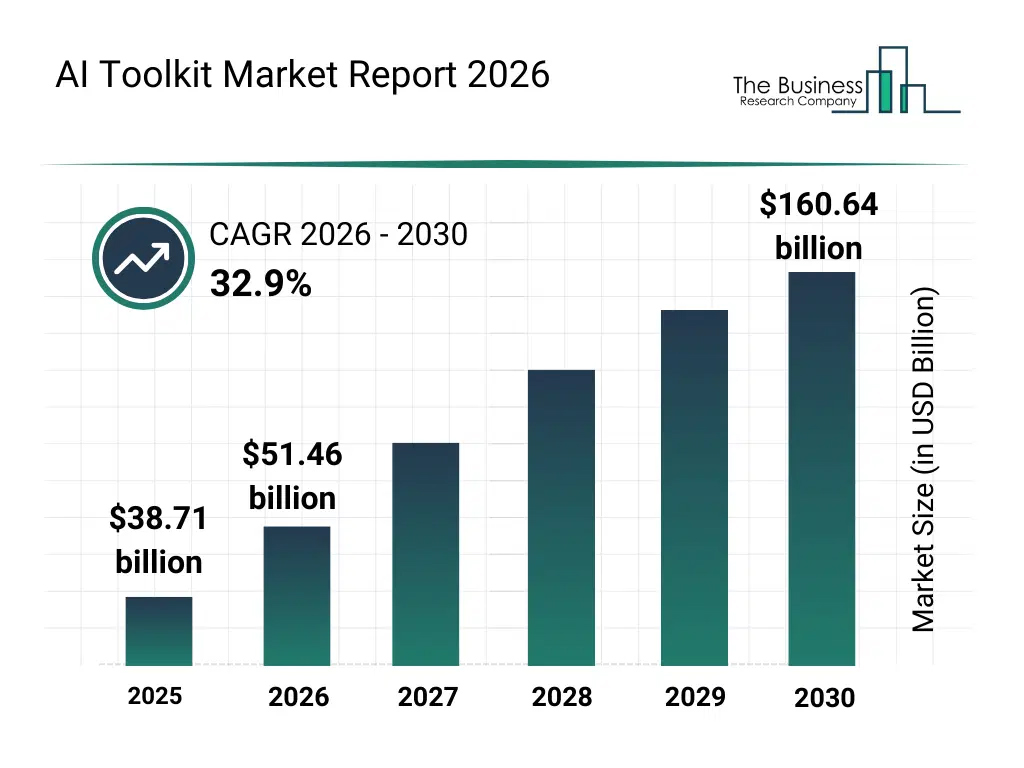
- The global AI toolkit market is projected to grow sharply from $38.71 billion in 2025 to $160.64 billion by 2030.
- In 2026, the market size is expected to reach $51.46 billion, showing strong early-stage expansion.
- The market is forecast to grow at a powerful 32.9% CAGR from 2026 to 2030.
- Between 2025 and 2030, the AI toolkit market is expected to increase by nearly $121.93 billion.
- The data shows that AI toolkits are moving from niche adoption to broader use across businesses, developers, and enterprise workflows.
- The steep growth curve suggests rising demand for AI development platforms, automation tools, machine learning frameworks, and enterprise AI solutions.
- By 2030, the market is expected to be more than 4 times larger than its 2025 value.
- The forecast highlights how AI toolkits are becoming a key part of digital transformation, software development, analytics, and business automation strategies.
Global AI Toolkit Adoption Statistics
- Around 78% of organizations reported using AI in 2024, compared to 55% in 2023.
- By 2026, approximately 67% of businesses globally will actively use AI technologies.
- Generative AI adoption among global consumers reached 53% within three years.
- Singapore reported a 61% generative AI adoption rate, one of the highest globally in 2026.
- The United Arab Emirates recorded a 54% population adoption rate for generative AI tools in 2026.
- The United States ranked 24th globally with a 28.3% adoption rate for generative AI tools.
- In Saudi Arabia, 93% of surveyed participants reported active use of generative AI tools.
- Across 35 European countries, workplace generative AI adoption averaged 12% in 2024,2025.
- AI search exposure expanded from 7 countries in 2024 to 229 countries in 2025.
- Research showed that more than 66% of COVID-related search queries received AI-generated answers in 2025, compared to only 1% in 2024.
AI Toolkit User Base and Demographics
- More than 1.8 billion people globally are expected to use AI-powered tools in some capacity by the end of 2026.
- Around 71% of Gen Z users actively use generative AI tools weekly in 2026, compared to 48% of Millennials.
- In the US, nearly 61% of white-collar professionals now rely on at least one AI toolkit during their workday.
- Surveys show that 54% of AI users are male, while 46% are female globally.
- Users aged 25 to 34 represent the largest AI toolkit demographic, accounting for roughly 34% of total users.
- More than 400 million people actively used conversational AI platforms monthly by early 2026.
- In higher education, about 86% of students reported using AI tools for research, writing, or study support in 2025,2026.
- Around 49% of remote workers say AI productivity tools save them at least five hours weekly.
- In the US, approximately 32% of consumers use AI-powered search or assistant tools daily in 2026.
Number of AI Tools and Platforms Available
- More than 14,200 AI tools were active globally in 2026.
- Estimates suggest there are around 90,000 AI platforms available worldwide in 2026.
- Analysts describe the AI ecosystem as containing millions of open-source models and repositories alongside thousands of commercial tools.
- AI tool growth accelerated by 68% between 2025 and 2026.
- AI SEO tools became one of the fastest-growing SaaS categories in 2025,2026.
- AI-powered productivity platforms expanded rapidly across content generation, coding, analytics, and customer service sectors in 2026.
- The AI tooling market is increasingly shifting toward agentic AI systems capable of autonomous execution rather than basic chatbot interaction.
- Businesses increasingly consolidated AI stacks into integrated ecosystems rather than using standalone tools in 2026.
- Major AI vendors continued expanding multimodal capabilities that combine text, image, video, and voice generation in a single platform.
AI Toolkit Adoption by Business Size
- Around 97% of large enterprises with more than 5,000 employees use AI tools in at least one department.
- Small businesses increased AI adoption by 27% year over year between 2025 and 2026.
- Approximately 58% of SMBs now use AI for marketing automation and customer communication.
- Mid-sized businesses reported an average 21% operational efficiency gain after AI toolkit implementation.
- Around 44% of startups launched in 2025 integrated AI into their core products from day one.
- Businesses with fewer than 50 employees most commonly use AI for content creation, scheduling, and analytics tasks.
- Enterprise AI budgets grew by 32% on average in 2026 compared to the previous year.
- Around 69% of SMB leaders believe AI gives smaller companies a stronger ability to compete with larger enterprises.
- Businesses using AI-driven workflow automation tools reduced repetitive task time by up to 40%.
AI Toolkit Adoption by Region and Country
- North America accounted for nearly 38% of global AI software spending in 2026.
- China’s AI market is expected to surpass $220 billion by 2026.
- The United States leads the world in private AI investment with over $109 billion invested in 2024.
- Europe recorded a 32.7% consumer adoption rate for generative AI tools in 2025.
- India ranked among the fastest-growing AI adoption markets, with over 80% enterprise AI adoption in 2026.
- Singapore reported one of the world’s highest AI workforce readiness scores in 2026.
- The Middle East AI market is projected to grow at a 35% CAGR through 2030.
- Japan increased AI investment in manufacturing and robotics by 29% in 2025.
- Latin America’s AI software market is forecast to exceed $17 billion by 2027.
Generative AI Tool Usage Frequency at Work
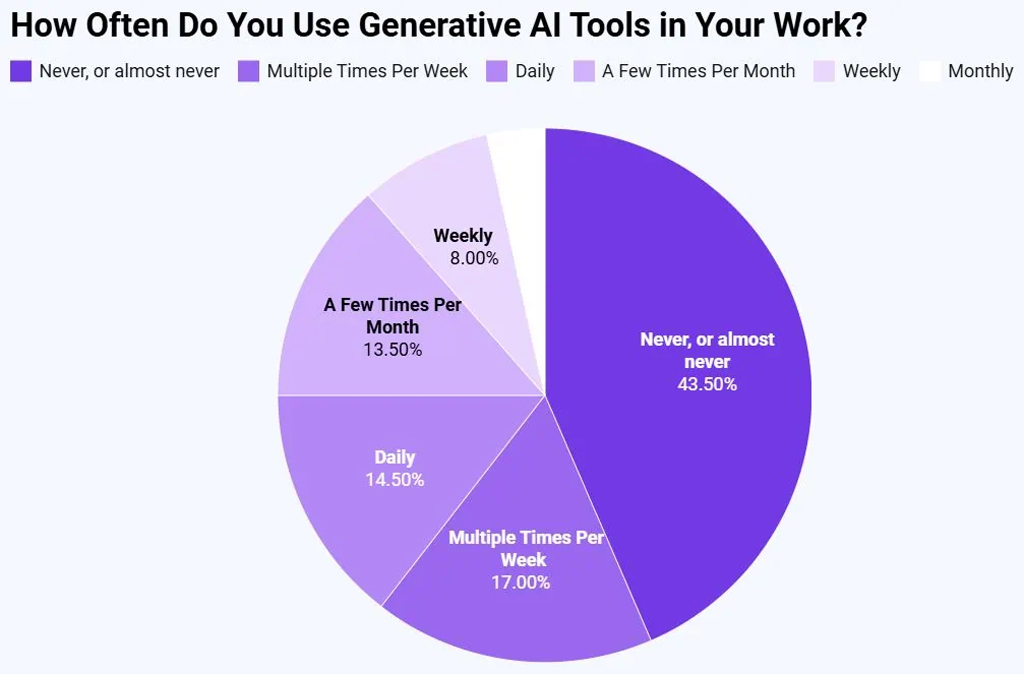
- The largest share of respondents, 43.50%, said they never or almost never use generative AI tools in their work.
- This shows that despite growing interest in AI, a significant portion of workers have not yet integrated generative AI into their regular workflows.
- Around 17.00% of respondents use generative AI tools multiple times per week, making it the most common active usage pattern.
- Daily users account for 14.50%, indicating that a smaller but meaningful group relies on generative AI as part of their everyday work routine.
- About 13.50% use generative AI tools a few times per month, suggesting occasional use for specific tasks rather than constant adoption.
- Only 8.00% of respondents reported using generative AI tools weekly.
- The lowest usage frequency is monthly, reported by just 3.50% of respondents.
- Combined, 56.50% of respondents use generative AI tools at least sometimes, while 43.50% rarely or never use them.
- The data suggests that generative AI adoption at work is still uneven, with many professionals either using it regularly or not using it at all.
- Frequent users, including daily and multiple-times-per-week users, represent 31.50% of respondents, showing a solid base of active workplace adoption.
Enterprise vs Individual AI Toolkit Usage
- Around 84% of enterprises globally now deploy AI-powered productivity or analytics tools internally.
- Individual consumer AI app usage grew by 54% between 2024 and 2026.
- Enterprise AI deployments generated an average ROI of 3.5x in 2026.
- Nearly 45% of individual AI users rely on free AI tools rather than premium subscriptions.
- Large enterprises spend an average of $20 million annually on AI infrastructure and software ecosystems.
- Approximately 72% of consumers use AI assistants for search, writing, or recommendations at least once weekly.
- Enterprise cybersecurity teams using AI threat detection tools reduced incident response times by up to 40%.
- About 39% of individual AI users primarily access AI tools through smartphones in 2026.
- Enterprises are nearly three times more likely than individuals to use multimodal AI platforms combining text, image, and analytics functions.
AI Toolkit Usage in Software Development and DevOps
- Around 76% of developers used or planned to use AI coding assistants in 2026.
- AI-assisted coding tools helped developers complete tasks up to 55% faster during controlled productivity studies.
- More than 61% of DevOps teams now use AI for monitoring, anomaly detection, or incident management.
- Organizations using AI testing tools reduced software QA cycles by 35% on average.
- AI-driven code review platforms reduced production bugs by up to 30% in enterprise environments.
- Around 48% of engineering leaders say AI tools accelerated software release cycles in 2026.
- AI-powered infrastructure optimization tools helped cloud teams reduce operational costs by 22%.
- Approximately 44% of cybersecurity teams integrated AI threat intelligence systems into DevSecOps pipelines.
- AI-generated documentation tools reduced internal documentation workloads by 40% in software organizations.
AI Toolkit Adoption by Industry
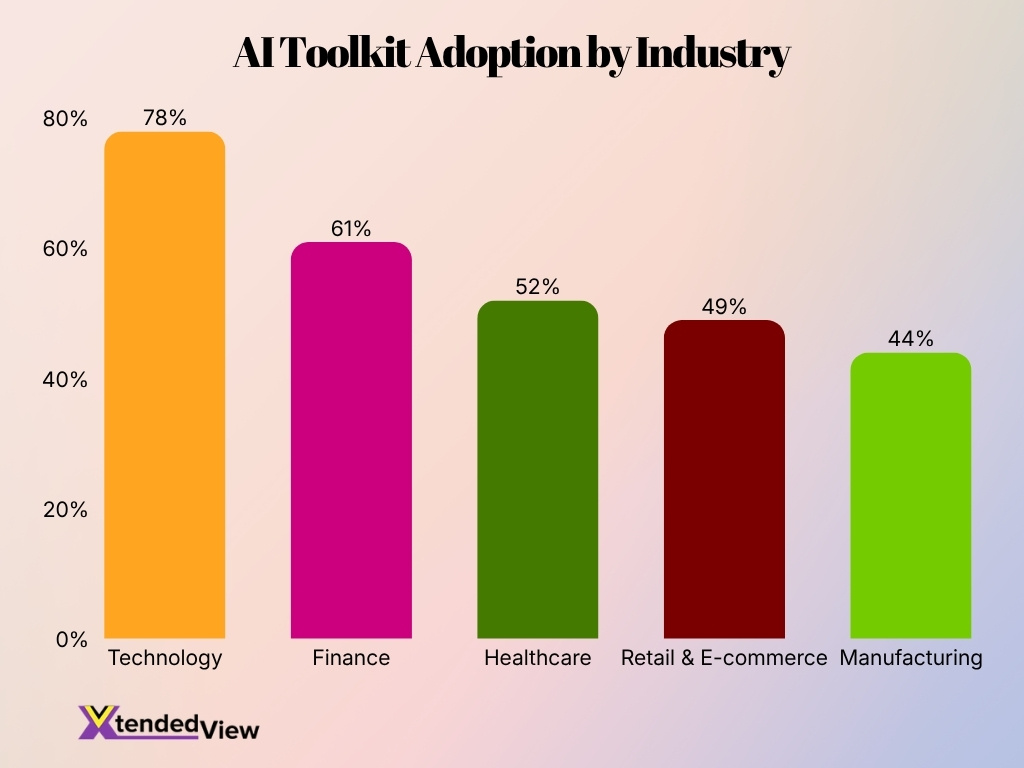
- Technology leads AI toolkit adoption with 78%, making it the most advanced industry in the dataset.
- Finance follows with 61% adoption, showing strong uptake of AI tools for automation, analytics, risk assessment, and customer service.
- Healthcare records 52% adoption, reflecting growing use of AI in areas such as diagnostics, patient management, research, and operational efficiency.
- Retail & E-commerce has an adoption rate of 49%, indicating steady integration of AI for personalization, inventory management, customer support, and sales forecasting.
- Manufacturing shows the lowest adoption among the listed industries at 44%, though this still suggests meaningful use of AI for process automation, quality control, and predictive maintenance.
- The data shows a clear adoption gap between Technology at 78% and Manufacturing at 44%, a difference of 34 percentage points.
- Overall, AI toolkit adoption is strongest in digitally mature sectors, while industries with more physical operations appear to be adopting AI at a slower but still significant pace.
AI Toolkit Usage in Marketing and Sales
- Around 80% of marketers globally use AI tools for content creation or campaign optimization in 2026.
- Businesses using AI-driven personalization reported up to 40% higher revenue growth than peers.
- AI-powered email optimization tools increased open rates by an average of 18% in 2025,2026.
- Around 62% of sales teams use AI for lead scoring and pipeline forecasting.
- Generative AI reduced average marketing content production time by more than 50%.
- AI chatbot adoption in ecommerce increased conversion rates by 20% to 30% on average.
- Around 47% of consumers say AI-generated product recommendations influence their purchase decisions.
- Companies using AI-powered ad targeting reduced customer acquisition costs by up to 28%.
- More than 53% of B2B marketers now use generative AI for SEO and search optimization tasks.
AI Toolkit Usage in Customer Support and Service
- Around 79% of customer service leaders invested in AI or automation tools during 2025,2026.
- AI chatbots now handle nearly 68% of routine customer support interactions without human escalation.
- Businesses deploying conversational AI reduced customer support costs by up to 30%.
- AI-powered ticket routing systems improved first-response times by 35% in enterprise support centers.
- Around 64% of consumers say 24/7 AI support availability improves their brand experience.
- Voice AI systems reduced call center wait times by up to 45% in high-volume industries.
- AI-driven customer sentiment analysis tools improved customer retention metrics by 18% on average.
- Around 58% of support agents say AI tools reduce burnout and repetitive workloads.
- Companies using AI self-service systems reported 22% higher customer satisfaction scores compared to traditional-only support channels.
AI Toolkit Usage Across Business Functions
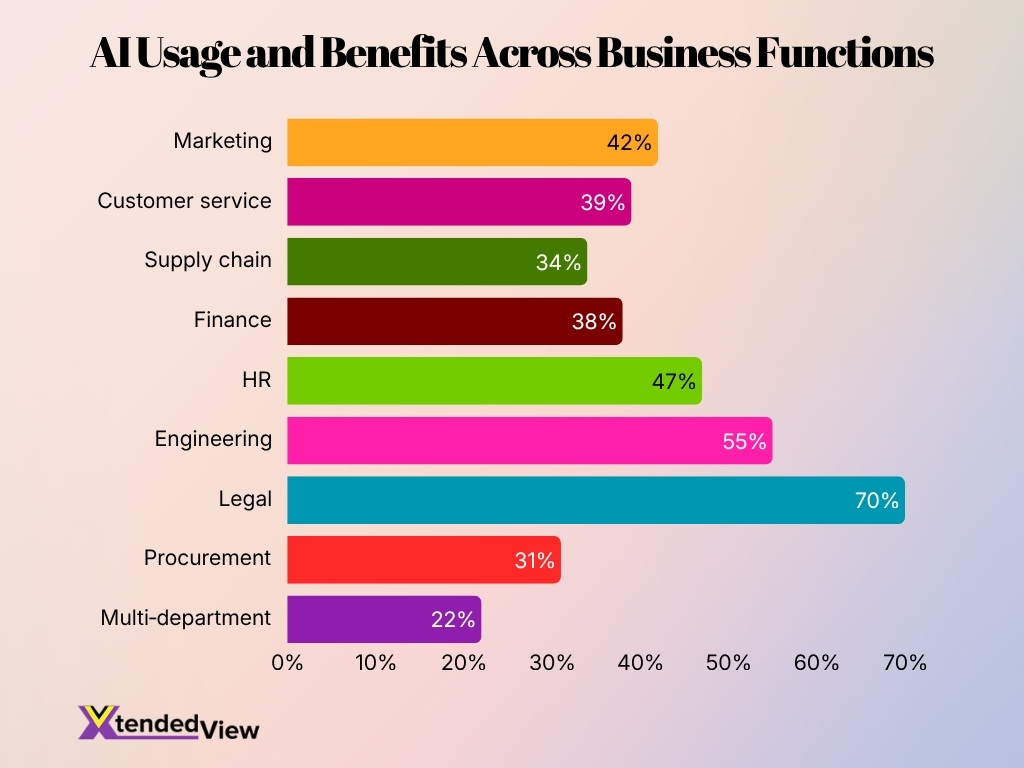
- Marketing remains the leading business function for AI deployment, with 42% of companies using AI for campaigns and content generation.
- Around 39% of organizations use AI tools in customer service operations.
- AI adoption in supply chain management increased by 34% year over year in 2026.
- Finance departments using AI forecasting tools improved budgeting accuracy by up to 38%.
- Around 47% of HR teams now use AI for onboarding, recruitment, or workforce analytics.
- AI-assisted coding and DevOps tools helped engineering teams reduce debugging time by up to 55%.
- Legal teams using AI contract analysis platforms processed documents 70% faster than manual review workflows.
- Around 31% of procurement departments use AI tools for vendor risk analysis and sourcing optimization.
- Organizations implementing AI across multiple departments reported an average 22% increase in operational efficiency.
Market Share of Leading AI Tools
- OpenAI-powered platforms drove about 39% of global generative AI traffic in 2026, making them the clearest traffic leader.
- AI search assistants captured nearly 12% of informational search activity worldwide in 2026, showing fast adoption beyond traditional search.
- Microsoft Copilot reached 20 million paid enterprise seats by April 2026, while broader Copilot usage was reported at 33 million active users across Windows, apps, and web.
- Google’s Gemini held about 9% of the worldwide AI chatbot market share in April 2026 and was gaining ground in enterprise deployment.
- Anthropic’s Claude Code subscriptions quadrupled since the start of 2026, with enterprise use rising to over half of Claude Code revenue.
- AI image generation was producing around 34 million AI-generated images per day across more than 2,000 platforms in 2026.
- AI coding assistants were being used by millions of developers, with some 2026 market analyses projecting rapid growth above 25% CAGR through the next five years.
- Generative AI production use was expected to reach over 80% of enterprises by 2026, supporting strong demand for integrated AI suites.
- Business AI productivity tools centered on unified access to multiple models, automation, and knowledge workflows, reflecting a shift toward integrated ecosystems rather than standalone apps.
Revenue Generated by AI Tool Providers
- The generative AI software market is projected to generate more than $52 billion in annual revenue by 2028.
- OpenAI reportedly surpassed $3.4 billion in annualized revenue in 2026.
- AI SaaS providers collectively generated over $110 billion in global revenue during 2025.
- Enterprise AI subscriptions represented the largest revenue segment, accounting for nearly 58% of provider earnings.
- AI cloud infrastructure spending exceeded $180 billion globally in 2026.
- AI cybersecurity vendors recorded annual revenue growth rates above 25% in 2025,2026.
- Subscription-based AI productivity platforms achieved some of the highest SaaS retention rates in 2026.
- AI image and video generation startups collectively raised billions in venture funding during 2025,2026.
- Enterprise AI consulting and integration services became a rapidly expanding revenue category as businesses scaled AI deployments.
Most Popular AI Tool Categories
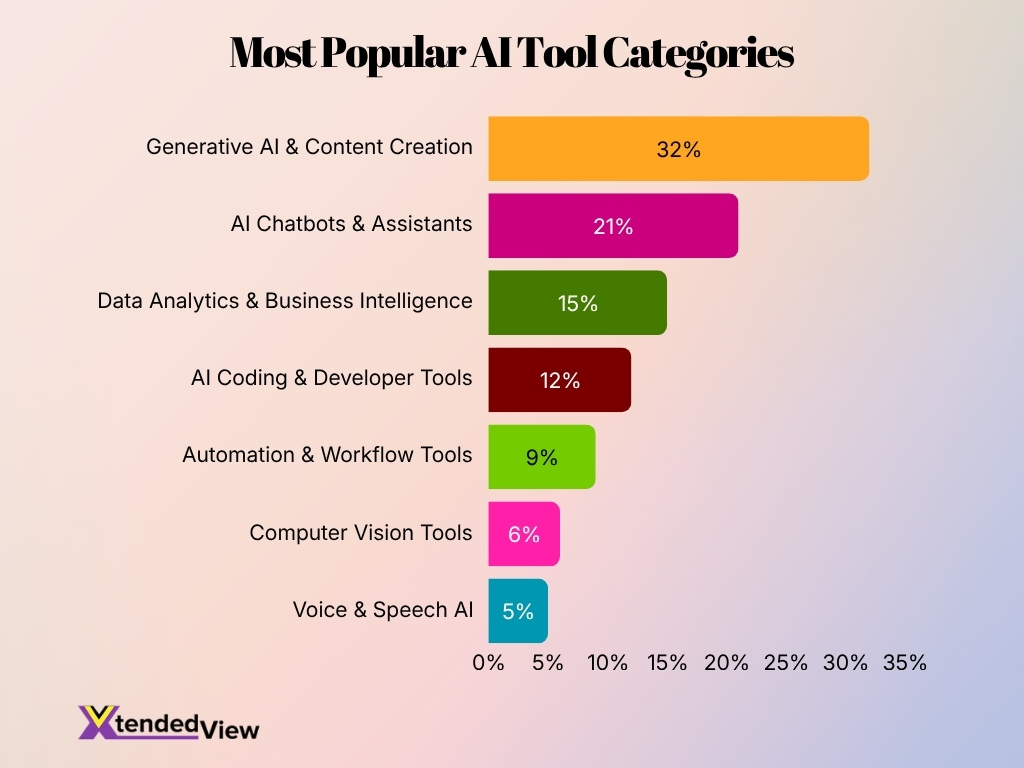
- Generative AI & Content Creation is the most popular AI tool category, accounting for 32% of the overall share.
- AI Chatbots & Assistants rank second with 21%, showing strong demand for conversational AI tools across personal and business use cases.
- Together, Generative AI & Content Creation and AI Chatbots & Assistants make up 53% of the market, indicating that user-facing AI tools dominate adoption.
- Data Analytics & Business Intelligence tools hold a 15% share, reflecting the growing role of AI in decision-making, reporting, and business insights.
- AI Coding & Developer Tools represent 12%, highlighting the increasing use of AI for software development, debugging, code generation, and developer productivity.
- Automation & Workflow Tools account for 9%, showing steady adoption of AI for streamlining repetitive tasks and improving operational efficiency.
- Computer Vision Tools hold a smaller but meaningful share of 6%, suggesting specialized use in areas such as image recognition, quality control, security, and healthcare.
- Voice & Speech AI has the lowest share at 5%, but it remains relevant for applications such as transcription, voice assistants, accessibility, and customer service.
- The data suggests that content generation, conversation, and productivity-focused AI tools are leading adoption in 2026.
- Overall, the chart shows that AI usage is concentrated in categories that help users create, communicate, analyze, code, and automate more efficiently.
Productivity Improvements from AI Toolkit Adoption
- Employees using AI assistants completed writing tasks up to 40% faster in productivity studies.
- Generative AI could contribute between $2.6 trillion and $4.4 trillion annually to the global economy.
- AI-enabled customer support teams improved case resolution speed by up to 52%.
- Software developers using AI coding assistants completed programming tasks 55% faster on average.
- Businesses implementing AI workflow automation reduced operational costs by 20% to 30%.
- AI-powered analytics tools improved decision-making speed by up to 38% in enterprise environments.
- Around 49% of workers say AI tools reduce repetitive tasks and administrative burdens significantly.
- AI-powered meeting summarization and scheduling tools saved professionals an average of 4.5 hours weekly in 2026.
- Organizations with advanced AI adoption were 2.3 times more likely to outperform peers financially.
Frequently Asked Questions (FAQs)
The global AI toolkit market is projected to reach $230.41 billion by 2034, growing at a 24.54% CAGR from 2026 to 2034.
The AI toolkit market is forecast to grow at a 32.9% CAGR, rising from $51.46 billion in 2026 to $160.64 billion by 2030.
The global artificial intelligence market is expected to reach $3.49 trillion by 2033, expanding at a 30.6% CAGR from 2026 onward.
Citigroup forecasts enterprise AI alone could generate nearly $1.9 trillion within a broader $4.2 trillion global AI market by 2030.
Some industry forecasts estimate the AI toolkit market could grow at a 36.4% CAGR from 2026 to 2035, reaching approximately $809.5 billion by 2035.
Conclusion
AI toolkit adoption accelerated sharply across enterprises, startups, and individual users. Businesses now use AI platforms to automate workflows, improve customer support, optimize software development, and scale marketing operations with fewer manual processes. At the same time, consumers increasingly rely on AI-powered assistants, search tools, and productivity applications in daily life.
The data also shows that AI investment continues to rise across cloud infrastructure, generative AI software, cybersecurity, analytics, and multimodal platforms. Organizations that integrate AI across multiple business functions consistently report faster decision-making, stronger operational efficiency, and measurable productivity gains.
As AI ecosystems continue evolving, the market will likely shift toward more integrated and autonomous platforms capable of handling complex business tasks with minimal human intervention. Companies that invest early in scalable AI infrastructure, workforce training, and responsible deployment strategies may gain a significant competitive advantage over the next decade.
