



Ambient intelligence (AmI) blends artificial intelligence, sensors, and connected devices to create environments that react to people automatically. The technology already powers smart homes that adjust lighting and temperature and supports hospitals that monitor patients in real time without constant human input. As enterprises invest in AI and IoT infrastructure, ambient intelligence is moving from research labs into daily life. The statistics below show how quickly this market is expanding and where the biggest opportunities lie.
Editor’s Choice
- The global ambient intelligence market is projected to reach $45.2 billion in 2026, up from $36.29 billion in 2025.
- The market could expand to $233.38 billion by 2034, representing a 22.8% CAGR.
- Another industry forecast expects the market to hit $99.43 billion by 2030, growing at a 24.4% CAGR from 2023 to 2030.
- North America accounted for approximately 35% of global market revenue in 2025, making it the leading regional market.
- Smart homes represent the largest growth opportunity and hold an estimated 38% share of the ambient intelligence market.
- The Asia-Pacific ambient intelligence market is expected to exceed $11.5 billion in 2026 as smart city projects accelerate.
- The broader AI market is forecast to grow from $539.5 billion in 2026 to $3.5 trillion by 2033, creating a strong foundation for ambient intelligence adoption.
Recent Developments
- In 2026, enterprises increased investments in edge AI and sensor-driven computing, accelerating real-time ambient intelligence applications.
- Governments continue to fund smart city initiatives that rely on ambient intelligence for transportation, energy management, and public safety.
- Hospitals increasingly deploy ambient monitoring systems for remote patient observation and predictive care workflows.
- Large cloud providers now offer AI services that simplify deployment of intelligent environments across homes and workplaces.
- The use of low-power sensors and processors has lowered deployment costs for ambient intelligence systems.
- AI-powered surveillance and smart lighting systems have gained traction across Middle Eastern smart city projects.
- European hospitals continue to adopt RFID and BLE technologies to improve equipment tracking and patient management.
- Several countries in Asia have integrated ambient intelligence into urban infrastructure to improve traffic flow and environmental monitoring.
- Smart building projects increasingly combine IoT, AI, and predictive analytics to reduce energy consumption and improve user comfort.
Ambient Intelligence Market Size by Year
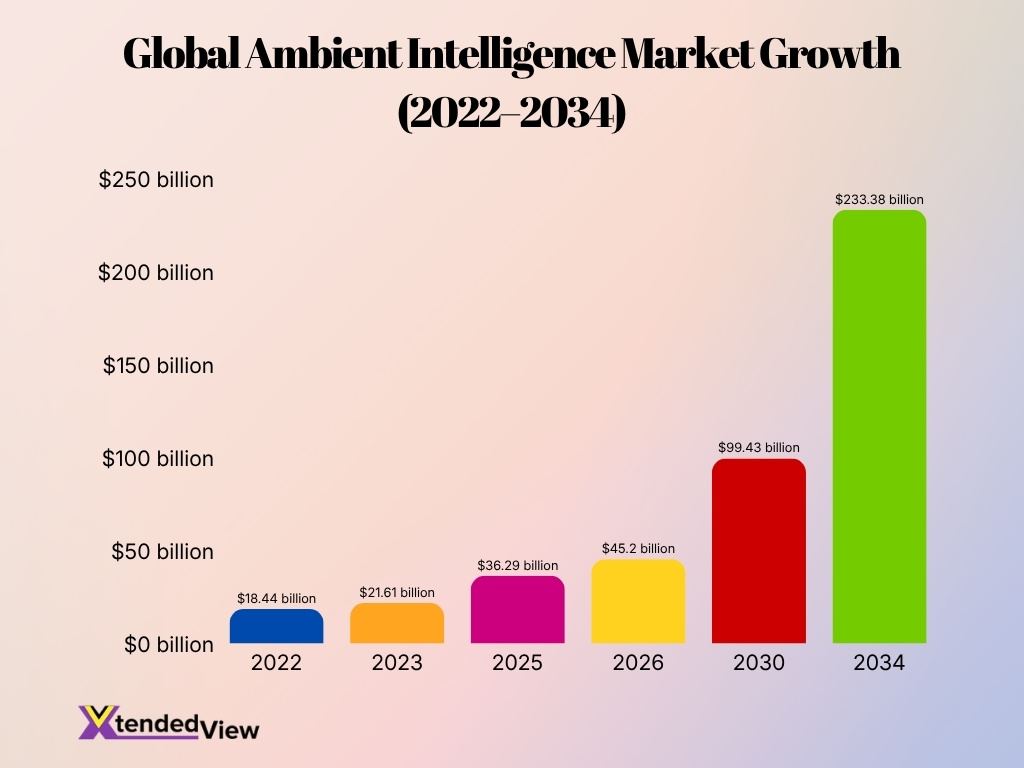
- 2022: The market was estimated at $18.44 billion according to Grand View Research.
- 2023: The market reached approximately $21.61 billion.
- 2025: Market value climbed to $36.29 billion.
- 2026: The market is projected to hit $45.2 billion.
- 2029: One forecast estimates a market size of $4.22 billion, reflecting a narrower market definition and methodology.
- 2030: Global market value could reach $99.43 billion.
- 2033: The market may expand to $25.11 billion under conservative forecasting assumptions.
- 2034: The most aggressive forecast places the market at $233.38 billion.
- Across all forecasts, analysts agree that ambient intelligence will maintain double-digit annual growth throughout the next decade.
Global Ambient Intelligence Market Overview
- The global ambient intelligence market was valued at $36.29 billion in 2025.
- The market is expected to reach $45.2 billion in 2026.
- Forecasts suggest the market could surpass $233 billion by 2034.
- Another widely cited estimate places the market at $25.11 billion by 2033 from a $9.73 billion base in 2026.
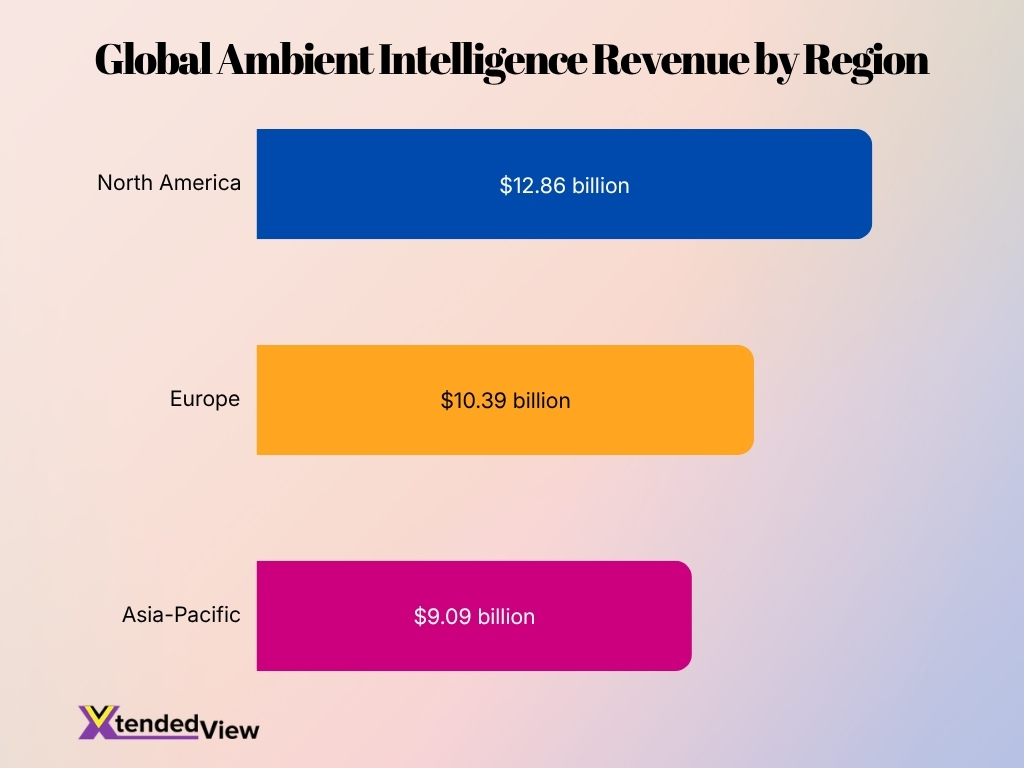
- North America generated approximately $12.86 billion in ambient intelligence revenue during 2025.
- Europe contributed nearly $10.39 billion in 2025 market revenue.
- Asia-Pacific accounted for around $9.09 billion in market value in 2025.
- The residential segment remains the dominant end-user category due to rising demand for connected living environments.
- Growth continues to be fueled by IoT expansion, AI adoption, and increasing investment in smart infrastructure.
Ambient Intelligence Market Growth Rate
- The global ambient intelligence market is projected to grow at a 22.8% CAGR from 2026 to 2034.
- The market is expected to register a 24.4% CAGR between 2023 and 2030, reflecting strong long-term adoption.
- Industry forecasts estimate the ambient intelligence market will expand at a 14.5% CAGR from 2026 to 2033.
- Another market projection indicates a 13.5% CAGR through 2033.
- The services segment is expected to grow at an annual rate of approximately 25.5%, outpacing hardware deployments.
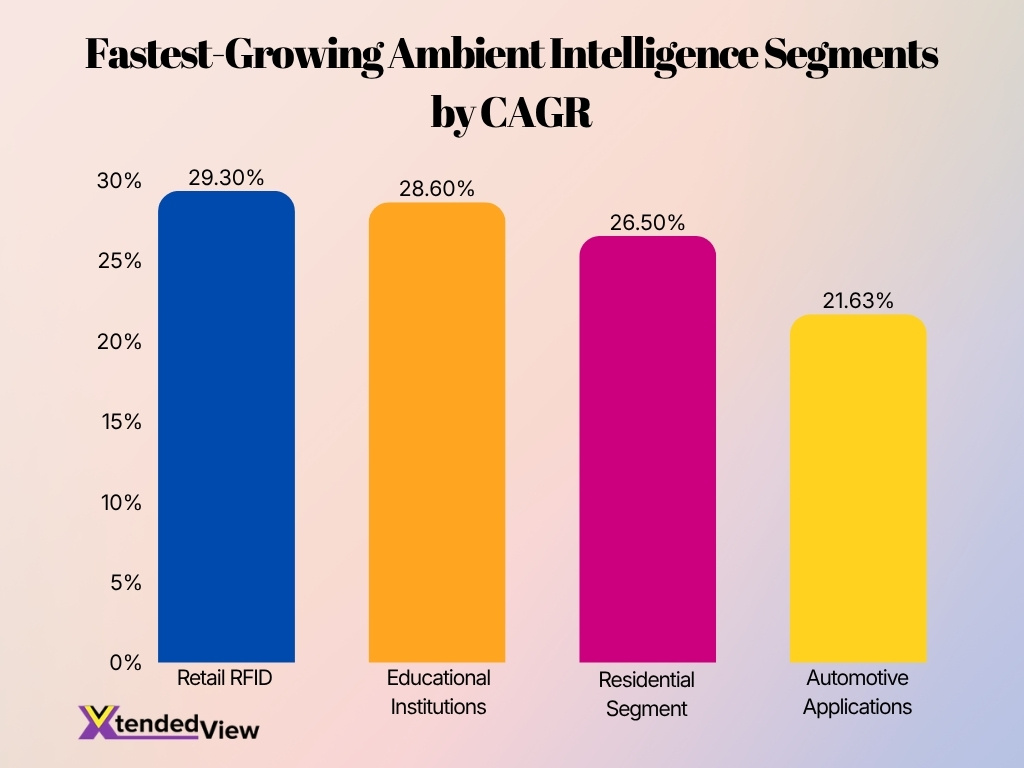
- The education sector is forecast to record a 28.6% CAGR, making it one of the fastest-growing application segments.
- Asia-Pacific is expected to remain the fastest-growing regional market, driven by rapid urbanization and smart city investments.
- Growing demand for energy-efficient buildings and connected healthcare systems continues to accelerate the adoption of ambient intelligence worldwide.
- Increasing deployment of edge AI and billions of connected devices are expected to support double-digit market growth throughout the next decade.
Ambient Intelligence Revenue by Region
- North America held around 35% of the global ambient intelligence market in 2025, making it the largest regional market.
- North America’s ambient intelligence revenue reached an estimated $12.7 billion to $12.9 billion in 2025, based on global market valuation estimates.
- Europe generated roughly $10.4 billion in market revenue in 2025, supported by smart building and healthcare investments.
- Asia-Pacific accounted for approximately $9.1 billion in 2025 revenue and remains the fastest-growing region.
- The Asia-Pacific market is expected to expand at a higher-than-global CAGR through 2034 due to large-scale smart city initiatives in China, India, Japan, and South Korea.
- The Middle East and Africa region continues to gain momentum through investments in smart infrastructure and intelligent public services.
- South America remains a smaller market but is witnessing increased adoption of connected healthcare and smart transportation systems.
- Several forecasts expect Asia-Pacific to narrow the gap with North America by the early 2030s because of rapid urbanization and IoT adoption.
- Regional revenue growth increasingly comes from software and managed services rather than hardware deployments alone.
Smart Home Ambient Intelligence Statistics
- U.S. households with smart home devices reached 63.43 million in 2023, representing a 10.2% annual increase.
- The smart home segment represents approximately 38% of the ambient intelligence market, making it the largest application category.
- The number of connected devices in homes worldwide is expected to continue rising as consumers adopt voice assistants and automated appliances.
- Smart thermostats and lighting systems remain among the most widely adopted ambient intelligence applications in residential environments.
- Security systems equipped with AI-powered sensors are increasingly becoming a standard feature in newly built homes.
- Smart home platforms increasingly rely on edge AI to process data locally and improve response times.
- Location-based ambient intelligence forecasts suggest the smart home segment could reach $350 billion by 2035.
- Rising energy costs are encouraging homeowners to adopt intelligent energy management systems that automatically optimize consumption.
- Demand for ambient intelligence in homes is also increasing among older adults seeking aging-in-place technologies and health monitoring solutions.
Healthcare Ambient Intelligence Statistics
- The global ambient clinical intelligence market is projected to reach $11.58 billion by 2033.
- Ambient clinical intelligence is expected to experience a rapid CAGR of 22.85% between 2026 and 2035.
- More than 50% of healthcare organizations are currently piloting or actively implementing generative AI solutions.
- The healthcare sector captured a significant 24.45% market share of the overall ambient intelligence industry in 2026.
- Physicians currently spend approximately 49% of their clinical workday on EHR and desk-related tasks.
- North America dominated the ambient clinical intelligence space by accounting for 45% of the global share in 2025.
- The implementation of ambient intelligence for patient monitoring systems witnessed a 26% increase between 2023 and 2026.
- Integrating AI tools into public health initiatives has contributed to a 27% reduction in adverse outcomes.
Ambient Intelligence Adoption by Industry
- The residential segment is projected to grow at a 26.5% CAGR driven by increasing smart home installations.
- Healthcare captured a leading 24.45% market share in 2026 due to growing remote monitoring solutions.
- The retail RFID segment is expected to surge at a 29.3% CAGR to highly personalize customer experiences.
- Over 61% of deployed devices feature edge computing for predictive maintenance and manufacturing safety.
- Smart building applications held a 27.34% revenue share in 2025 to optimize occupancy and energy costs.
- Automotive applications are forecast to record a rapid 21.63% CAGR for intelligent in-cabin experiences.
- Educational institutions are expected to witness a massive 28.6% CAGR in adoption through the next decade.
- Global investments in smart city initiatives and intelligent infrastructure are projected to exceed $500 billion.
- Over 45% of deployments now utilize decentralized edge frameworks to support real-time decision-making.
Automotive and Transportation Ambient Intelligence Statistics
- The ambient intelligence market size is projected to reach $292.2 billion by 2032, with automotive as a key driver.
- The global driver monitoring system market is valued at $3.51 billion in 2025 and will reach $9.60 billion by 2035.
- Hardware components like in-cabin sensors dominate the ambient intelligence sector with over 57% of the overall market share.
- The global smart transportation market is projected to grow from $154.9 billion in 2025 to $393.0 billion by 2033.
- Worldwide urbanization is driving the development of more than 26 major smart cities by 2025 to address transportation challenges.
- The fleet management application segment for monitoring solutions is expected to record a rapid 12.38% CAGR through 2035.
- The automotive AI market size is expected to hit $38.45 billion by 2030 with an impressive 15.3% CAGR.
- The traffic management segment accounted for the largest revenue share in smart mobility at over 33.5% in 2025.
- Over 61% of deployed ambient intelligence devices incorporate edge computing modules to ensure latency-sensitive processing.
Retail and Customer Experience Ambient Intelligence Statistics
- The retail segment accounts for over 40% of the end-use market share in advanced ambient intelligence solutions.
- The global location-based ambient intelligence market is projected to surpass $2.26 trillion by 2035.
- Over 80% of modern retailers plan to significantly increase their AI and automation spending by 2025.
- Integrating edge AI cameras and ambient sensors can reduce average customer checkout times by 30%.
- The global self-checkout systems market is rapidly expanding and is expected to reach $18.6 billion by 2032.
- Computer vision-enabled smart carts are projected to capture 48% of the smart cart market share in 2026.
- The global smart retail market is forecast to reach $164.79 billion by 2031 with a 21.15% CAGR.
- Hardware components like IoT sensors currently contribute to over 50% of total smart retail market revenue.
- Foot-traffic monitoring applications hold a 22.1% market share for optimizing staffing and analyzing customer behavior.
Ambient Intelligence Market Share by Component Statistics (2026)
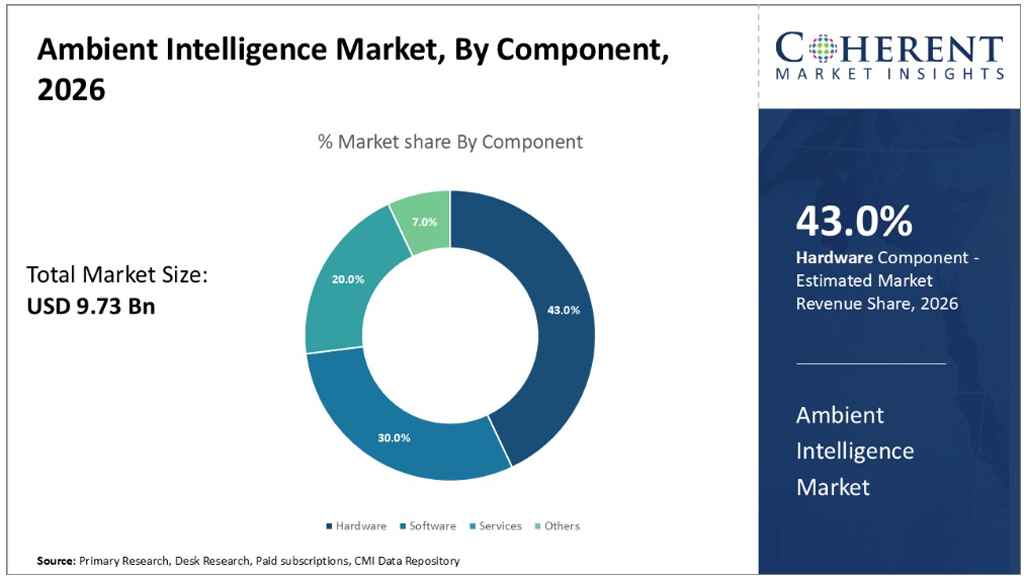
- Hardware accounted for the largest market share at 43.0%, making it the leading component in the Ambient Intelligence market.
- Software represented 30.0% of the global Ambient Intelligence market, ranking as the second-largest segment.
- Services contributed 20.0% of the total market revenue, reflecting strong demand for deployment and support.
- The Others category held a 7.0% market share, making it the smallest component segment.
- Hardware and Software combined captured 73.0% of the total Ambient Intelligence market revenue in 2026.
- Services and Others together accounted for the remaining 27.0% of the market share.
- The global Ambient Intelligence market was valued at USD 9.73 billion in 2026.
- Hardware’s 43.0% share highlights the growing importance of sensors, smart devices, and connected infrastructure in Ambient Intelligence solutions.
- Software’s 30.0% contribution underscores the increasing role of AI platforms, analytics, and intelligent automation in the market.
- The market’s component distribution indicates that hardware remains the primary revenue driver, while software and services continue to expand their share as adoption grows.
Industrial and Manufacturing Ambient Intelligence Statistics
- The global predictive maintenance market is projected to reach $70.73 billion by 2032, growing at a CAGR of 26.5%.
- Global IoT spending in industrial sectors is expected to surpass $1.8 trillion by 2028, driven by 5G and AI integration.
- The smart manufacturing market is anticipated to reach $384.38 billion by 2034, expanding at a 9.60% CAGR.
- The industrial IoT segment is projected to command a 42.31% market share by 2026 within smart factory deployments.
- The discrete industry sector leads ambient technology adoption, accounting for 58.71% of smart factory investments by 2026.
- Cloud-based ambient intelligence systems are anticipated to capture a 65.75% market share by 2026 for scalable industrial operations.
- Integrating AI agents and automation architectures into industrial workflows aims to increase manufacturing productivity by up to 50%.
- Application enablement accounts for over 40% of all IoT-based sales worldwide, supporting intelligent factory data systems.
- Asia Pacific leads the global adoption of smart factory ambient technologies, holding a 33% revenue share in 2025.
Ambient Intelligence in IoT Devices Statistics
- The number of connected IoT devices worldwide is expected to reach more than 19 billion in 2025.
- Forecasts suggest the global IoT device count could exceed 40 billion by 2030.
- Ambient intelligence systems increasingly rely on IoT sensors that capture environmental, behavioral, and location-based data.
- Smart homes account for one of the largest concentrations of ambient intelligence-enabled IoT devices.
- More than 50% of enterprises worldwide now use IoT technologies in at least one business function.
- Edge AI chips embedded in IoT devices are becoming a critical component of ambient intelligence ecosystems.
- The average connected home now contains more than a dozen smart devices, including sensors, speakers, and appliances.
- Industrial IoT devices continue to drive demand for real-time analytics and contextual computing solutions.
- Growth in low-power wide-area networks and 5G connectivity is accelerating ambient intelligence adoption across IoT ecosystems.
Ambient Intelligence Market by Technology
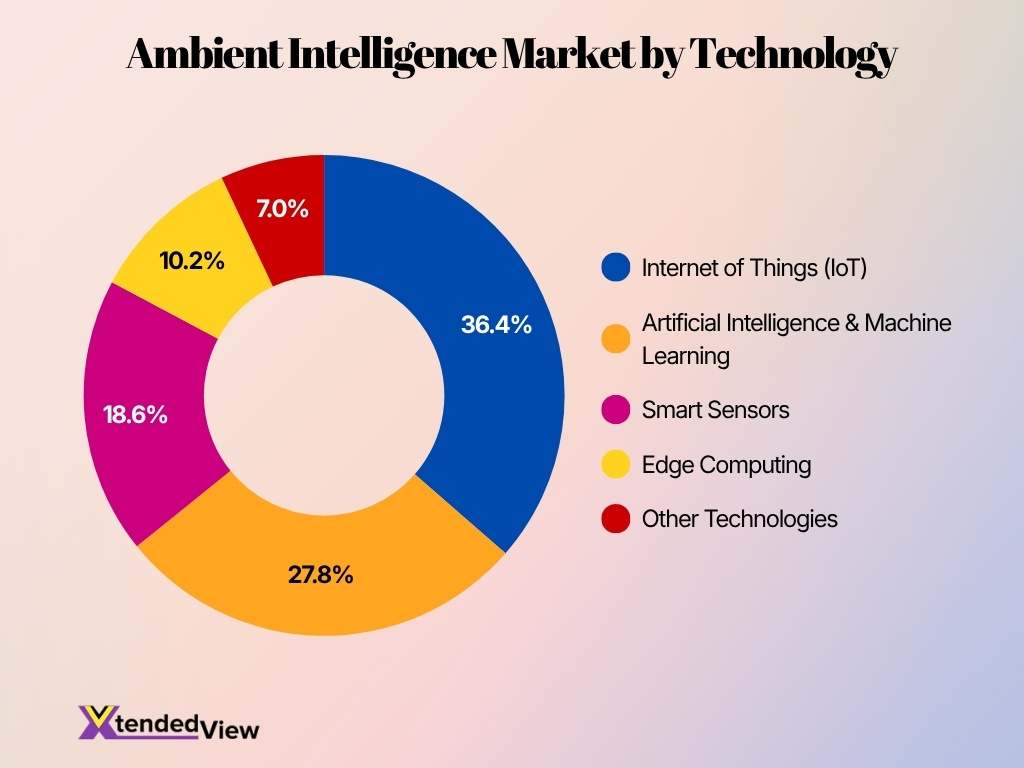
- Internet of Things (IoT) leads the Ambient Intelligence market with a 36.4% share, making it the largest enabling technology.
- Artificial Intelligence & Machine Learning accounts for 27.8%, highlighting its critical role in intelligent decision-making.
- Smart Sensors contribute 18.6% of the market, supporting real-time data collection and environmental awareness.
- Edge Computing holds a 10.2% market share, enabling faster data processing closer to connected devices.
- Other Technologies collectively represent 7.0% of the market, reflecting the contribution of emerging and niche innovations.
- The combined share of IoT and Artificial Intelligence & Machine Learning reaches 64.2%, demonstrating their dominance in Ambient Intelligence.
- IoT exceeds Smart Sensors by 17.8 percentage points, emphasizing its stronger market adoption.
- The top three technologies, IoT, AI & Machine Learning, and Smart Sensors, together account for 82.8% of the total market.
- Edge Computing and Other Technologies together represent 17.2%, indicating growing opportunities for supporting technologies.
- The data shows that connected devices, intelligent algorithms, and sensor technologies are the core pillars driving the Ambient Intelligence market.
User Penetration of Ambient Intelligence Assistants Statistics
- Global voice-enabled devices are projected to reach 8.4 billion installations by 2025.
- The United States is forecasted to exceed 154.3 million voice assistant users in 2025.
- Approximately 32% of consumers worldwide actively use a voice assistant every week.
- By 2025, it is estimated that 75% of households will own smart speaker devices.
- Over 62% of adults in the U.S. regularly engage with a voice assistant on any device.
- Nearly 65% of individuals aged 25 to 49 interact with voice-enabled devices daily.
- The global voice commerce market is expected to hit $80 billion by the year 2026.
- Around 50% of the total U.S. population conducts some form of voice search every day.
- The global ambient intelligence market is projected to grow to $292.2 billion by 2032.
Ambient Intelligence Investment and Funding Statistics
- The global ambient intelligence market is projected to reach $323.13 billion by 2035 with a CAGR of 24.98%.
- The U.S. ambient computing market is expected to grow to $96.11 billion by 2033 at an 18.8% CAGR.
- Global edge AI market size is forecast to surge from $35.60 billion in 2025 to $445.75 billion by 2034.
- The global smart home market is anticipated to attract massive funding, reaching $848.47 billion by 2034.
- Investments in the ambient IoT market are predicted to drive global revenue to $35.78 billion by 2035.
- The healthcare sector captured 24.45% of the ambient intelligence market share in 2026 for remote monitoring.
- North America dominated global ambient intelligence investments, holding a 35% revenue share in 2025.
- Funding for edge cloud infrastructure is anticipated to grow at an industry-leading CAGR of 35.2%.
- The European Commission mobilized $210 billion for AI investments in 2025 to boost ambient ecosystems.
Ambient Intelligence Consumer Attitudes and Trust Statistics
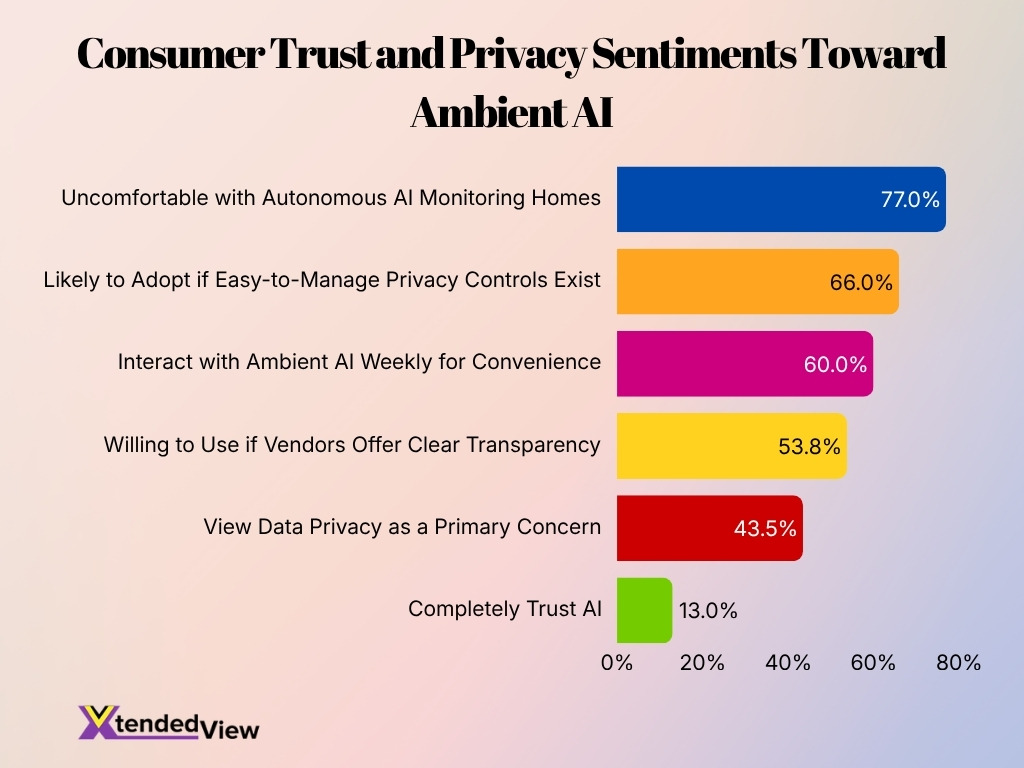
- Over 60% of global consumers interact with ambient AI weekly for enhanced convenience and personalization.
- Data privacy remains a primary concern for 43.5% of users when adopting AI-powered smart home applications.
- Only 13% of consumers report that they completely trust AI, highlighting a major barrier to intelligent environments.
- Approximately 66% of consumers are more likely to adopt connected technologies if they offer easy-to-manage privacy controls.
- Home healthcare applications are projected to grow by over 32% as older adults seek AI support for independent living.
- Smart security and access control devices currently account for over 31% of all smart home market purchases.
- Nearly 77% of individuals remain highly uncomfortable with autonomous AI systems acting and monitoring inside their homes.
- Over 53.8% of consumers express greater willingness to use ambient intelligence if vendors offer clear transparency around data.
- Energy management systems hold the highest growth rate at 77% as demand for efficient and privacy-preserving AI increases.
Ambient Intelligence Startups and Company Landscape Statistics
- The global ambient intelligence market is projected to reach $233.38 billion by 2034.
- North America dominated the ambient intelligence landscape with a 35% market share in 2025.
- AI startup funding represented nearly 33% of global venture capital investment in 2024.
- The hardware segment captured over 57% of the ambient intelligence market share in 2022.
- The healthcare sector generated 24.79% of all ambient intelligence spending in 2025.
- The market size for ambient intelligence services is projected to grow at a 20.17% CAGR through 2031.
- The Asia-Pacific region is expected to achieve a 20.44% CAGR in the ambient intelligence market from 2026 to 2031.
- Bluetooth Low Energy technology held a 24.43% market share in the ambient intelligence ecosystem in 2025.
- Over 61% of deployed ambient intelligence devices incorporated edge computing modules in 2025.
- The solutions segment dominated the platform landscape by accounting for 61.5% of total revenue in 2025.
Privacy and Security Incidents in Ambient Intelligence Systems
- Over 80% of IoT breaches start at the device level rather than the core network.
- A 2025 cloud misconfiguration exposed 2.7 billion IoT device records, including telemetry and credentials.
- The average cost of a targeted IoT security incident has reached $330,000 per event.
- Ransomware attacks leveraging compromised ambient systems as entry points surged by 46% in 2025.
- Connected IoT devices face a staggering average of 820,000 hacking attempts every single day.
- Smart homes experienced 29 daily attack attempts in 2025, representing a threefold increase from 2024.
- About 10% of smart home applications secretly collect sensitive user data for unauthorized tracking purposes.
- Global connected IoT devices reached 21.1 billion in 2025, exponentially expanding the ambient attack surface.
- A record-breaking 15.72 Tbps DDoS attack in 2026 was launched entirely by a botnet of compromised ambient devices.
Frequently Asked Questions (FAQs)
The global ambient intelligence market is projected to reach $45.2 billion in 2026, up from $36.29 billion in 2025.
The market is expected to grow at a 22.8% CAGR between 2026 and 2034, although some analysts estimate growth rates ranging from 19.67% to 24.4% depending on market scope and methodology.
North America accounted for 35% of global ambient intelligence revenue in 2025, making it the largest regional market worldwide.
Industry forecasts estimate the market could reach $99.43 billion by 2030, while broader studies project values exceeding $112.8 billion by the same year.
The U.S. ambient intelligence market is forecast to grow from $9.51 billion in 2025 to $69.16 billion by 2035, representing a 22.2% CAGR.
Conclusion
Ambient intelligence is evolving from a niche technology into a foundational layer of digital life. The market could exceed $45 billion, driven by rapid growth in smart homes, healthcare, industrial automation, and connected transportation. At the same time, billions of IoT devices and the rise of AI assistants are creating new opportunities for context-aware services.
However, growth also brings challenges. Privacy concerns, cybersecurity risks, and consumer trust issues continue to shape adoption patterns. Companies that invest in secure, transparent, and user-centric ambient intelligence solutions will likely capture the greatest opportunities as the market matures over the next decade.
