


The Internet of Things (IoT) continues to reshape how businesses, governments, and consumers interact with connected technology. From predictive maintenance in manufacturing plants to smart thermostats that reduce household energy use, IoT devices now support critical operations across nearly every industry. As organizations invest in automation, real-time monitoring, and data-driven decision-making, the number of connected devices keeps rising worldwide. This article explores the latest IoT device statistics, highlighting market growth, adoption trends, and emerging opportunities across major sectors.
Editor’s Choice
- The number of connected IoT devices worldwide is expected to reach 21.1 billion in 2025, representing approximately 14% annual growth.
- Global IoT device connections stood at roughly 18.8 billion at the end of 2024, demonstrating sustained expansion across enterprise and consumer deployments.
- Worldwide IoT market revenue is projected to reach $1.18 trillion in 2026.
- The global IoT market is forecast to grow from $547.1 billion in 2025 to $865.2 billion by 2030.
- Cellular IoT connections are expected to total 4.5 billion by the end of 2025.
- IoT devices are forecast to generate 79.4 zettabytes of data in 2025, reflecting the increasing importance of edge and cloud analytics.
- The smart home market is expected to reach approximately $180.1 billion in 2026, fueled by growing demand for connected security, energy management, and automation systems.
Recent Developments
- In late 2025, analysts revised global IoT connection forecasts slightly downward due to weaker-than-expected infrastructure spending in some regions.
- Connected IoT devices still maintained a projected 14% annual growth rate despite macroeconomic uncertainty.
- Enterprise deployments increasingly focus on autonomous operations powered by connected sensors and AI-driven analytics.
- Less than 1% of global IoT connections currently include dedicated edge AI accelerators, highlighting a large future growth opportunity.
- Semiconductor demand linked to AI, IoT, and autonomous technologies helped drive industry revenue to $791.7 billion in 2025.
- Global semiconductor sales are projected to approach $1 trillion in 2026, supporting further IoT hardware expansion.
- Cellular IoT recorded its slowest growth rate since 2020 during 2025, although total connections continued rising.
- Organizations increasingly combine IoT deployments with edge computing to reduce latency and improve real-time decision-making.
- Smart city initiatives across the Asia-Pacific continue accelerating IoT adoption through public infrastructure modernization projects.
Global IoT Device Growth Statistics
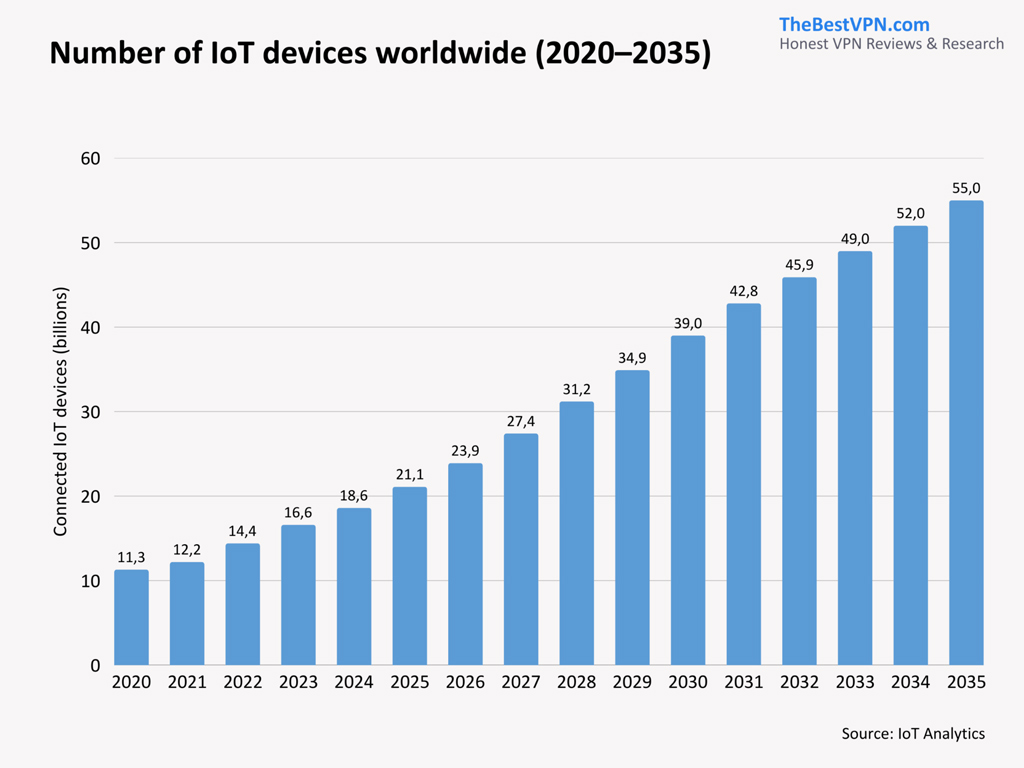
- The number of connected IoT devices worldwide increased from 11.3 billion in 2020 to 18.6 billion in 2024, representing a growth of 64.6% in just four years.
- Global IoT connections are projected to surpass 21.1 billion devices in 2025, highlighting the rapid expansion of connected technologies across industries.
- By 2030, the worldwide IoT device count is expected to reach 39 billion, more than double the 2024 total.
- The IoT ecosystem is forecast to grow to 55 billion connected devices by 2035, nearly 4.9 times higher than the 2020 level.
- Between 2020 and 2035, the market is expected to add approximately 43.7 billion new IoT devices globally.
- The largest annual increase during the forecast period occurs between 2029 and 2030, when connected devices rise from 34.9 billion to 39 billion, adding 4.1 billion devices in a single year.
- IoT device adoption is projected to accelerate significantly after 2025, with global connections increasing by more than 33.9 billion devices over the following decade.
- Worldwide IoT deployments are expected to cross the 30 billion device milestone in 2028, reaching approximately 31.2 billion connected devices.
- The period from 2030 to 2035 is forecast to add another 16 billion devices, demonstrating sustained long-term demand for IoT technologies.
- By 2033, the global installed base of IoT devices is projected to approach 49 billion, reflecting widespread adoption across consumer, enterprise, industrial, healthcare, and smart city applications.
- The number of connected IoT devices is expected to exceed 50 billion for the first time in 2034, reaching approximately 52 billion devices worldwide.
- The data indicates a consistent upward trajectory, with annual IoT device counts increasing every year from 2020 through 2035 without any projected decline.
Worldwide IoT Market Size and Revenue
- The worldwide IoT market is expected to generate $1.18 trillion in revenue during 2026.
- The global IoT market value is projected at $547.06 billion in 2025.
- Revenue is forecast to climb to $865.20 billion by 2030.
- The forecast growth rate between 2025 and 2030 is approximately 9.6% CAGR.
- The IoT devices market alone is expected to reach $273.63 billion in 2026.
- IoT device market revenue is projected to exceed $534.71 billion by 2031.
- Analysts estimate continued spending growth as organizations digitize assets and operational workflows.
- Demand for device management, connectivity platforms, and analytics services remains a major revenue driver.
- Industrial and enterprise applications account for a significant share of global IoT spending.
Industrial Internet of Things (IIoT) Statistics
- The industrial IoT market was valued at approximately $119.4 billion in 2024.
- The market is projected to grow to $198.2 billion in 2025.
- Forecasts place IIoT revenue at roughly $286.3 billion by 2029.
- Another industry assessment values the industrial IoT market at $325.7 billion in 2025.
- IIoT revenue could reach $944.8 billion by 2034 under current forecasts.
- Predictive maintenance remains one of the most common industrial IoT applications because it reduces equipment downtime and maintenance costs.
- Manufacturing facilities increasingly deploy connected sensors for machine monitoring and production optimization.
- Real-time operational visibility and automation remain the primary drivers of IIoT investment.
- Industrial IoT continues to represent one of the largest revenue-generating segments within the broader IoT ecosystem.
IoT Connectivity Technologies Market Share
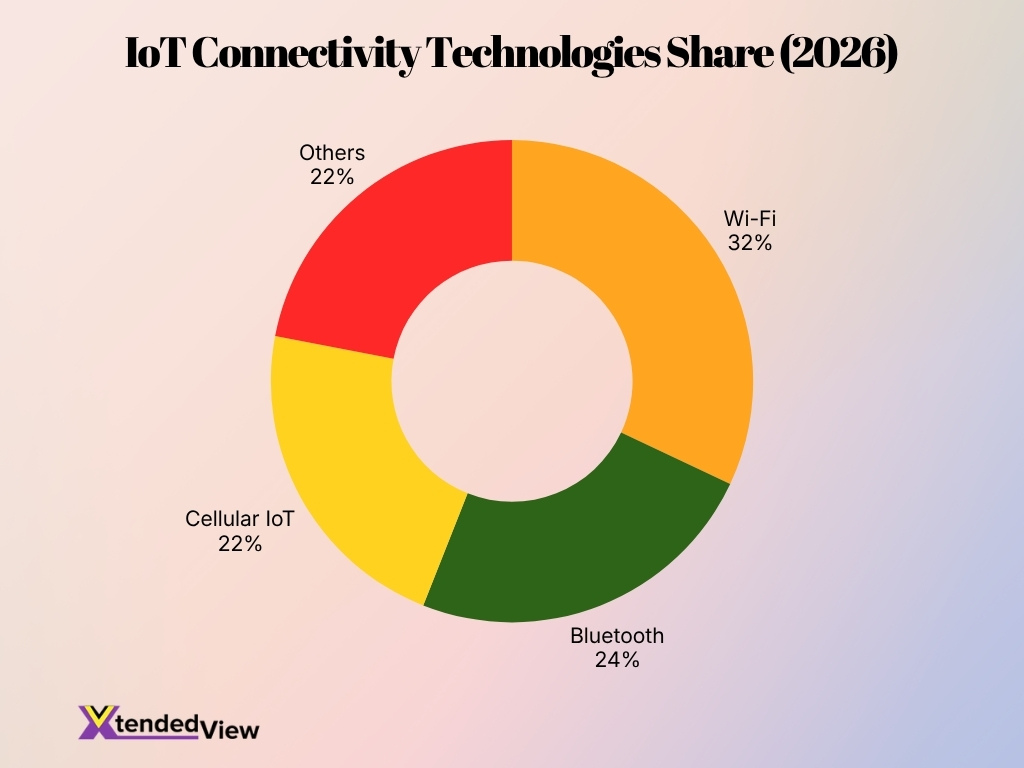
- Wi-Fi is the leading IoT connectivity technology, accounting for 32% of all connections, highlighting its dominant role in smart homes, consumer electronics, and enterprise networks.
- Bluetooth holds a 24% share, making it the second most widely used connectivity option for wearables, smart devices, and short-range IoT applications.
- Cellular IoT represents 22% of the market, demonstrating strong demand for connected vehicles, asset tracking, industrial monitoring, and remote infrastructure management.
- The Others category also captures 22%, indicating the continued relevance of alternative technologies such as LPWAN, Zigbee, Z-Wave, LoRaWAN, satellite IoT, and proprietary wireless protocols.
- Together, Wi-Fi and Bluetooth account for 56% of all IoT connectivity technologies, showing that short-range wireless solutions remain the backbone of the IoT ecosystem.
- Wireless technologies dominate the market, with 100% of reported IoT connections relying on wireless communication methods across consumer, commercial, and industrial applications.
- The relatively close shares of Bluetooth (24%), Cellular IoT (22%), and Others (22%) suggest a diversified connectivity landscape where different technologies serve specialized use cases.
- Cellular IoT’s 22% share reflects the growing importance of wide-area connectivity for applications requiring mobility, real-time monitoring, and nationwide coverage.
- The gap between Wi-Fi (32%) and Cellular IoT (22%) is 10 percentage points, emphasizing Wi-Fi’s cost advantages and widespread infrastructure availability.
- The data shows that no single technology controls more than one-third of the market, highlighting the need for multiple connectivity standards to support diverse IoT deployment requirements.
Consumer IoT and Smart Home Statistics
- The global smart home market reached $147.52 billion in 2025.
- Smart home revenue is projected to increase to $180.12 billion in 2026.
- The market could expand to $848.47 billion by 2034.
- North America accounted for 31.7% of the global smart home market in 2025.
- Wireless technologies represented the largest smart home communication segment during 2025.
- Wireless connectivity held approximately 64% market share in 2025.
- The consumer IoT market was valued at $193.97 billion in 2025.
- Consumer IoT revenue is expected to reach $218.50 billion in 2026.
- Smart HVAC systems are forecast to be among the fastest-growing smart home device categories through 2030.
Healthcare IoT (IoMT) Statistics
- The global IoMT market is projected to reach $286.2 billion in 2026, up from $222 billion in 2025.
- IoMT market revenue is forecast to surpass $1.1 trillion by 2034, reflecting strong adoption across healthcare.
- North America accounted for more than 38% of IoMT revenue in 2025, supported by advanced connected care.
- The hardware component segment is projected to account for 56.3% of the market share in 2026.
- More than 70 million Americans are expected to use remote patient monitoring solutions by 2027.
- The cloud-based deployment model is expected to hold the largest market share with 68.5% in 2026.
- Over 70% of healthcare entities are actively planning to increase their IoT investments in the near future.
- The healthcare IoT market is expected to maintain a CAGR exceeding 18% through the early 2030s.
- The average hospital now operates more than 350,000 connected medical devices to enable continuous monitoring.
- IoMT deployments are estimated to have a global economic impact of $1.6 trillion across the healthcare industry.
Smart City and Public Infrastructure IoT Statistics
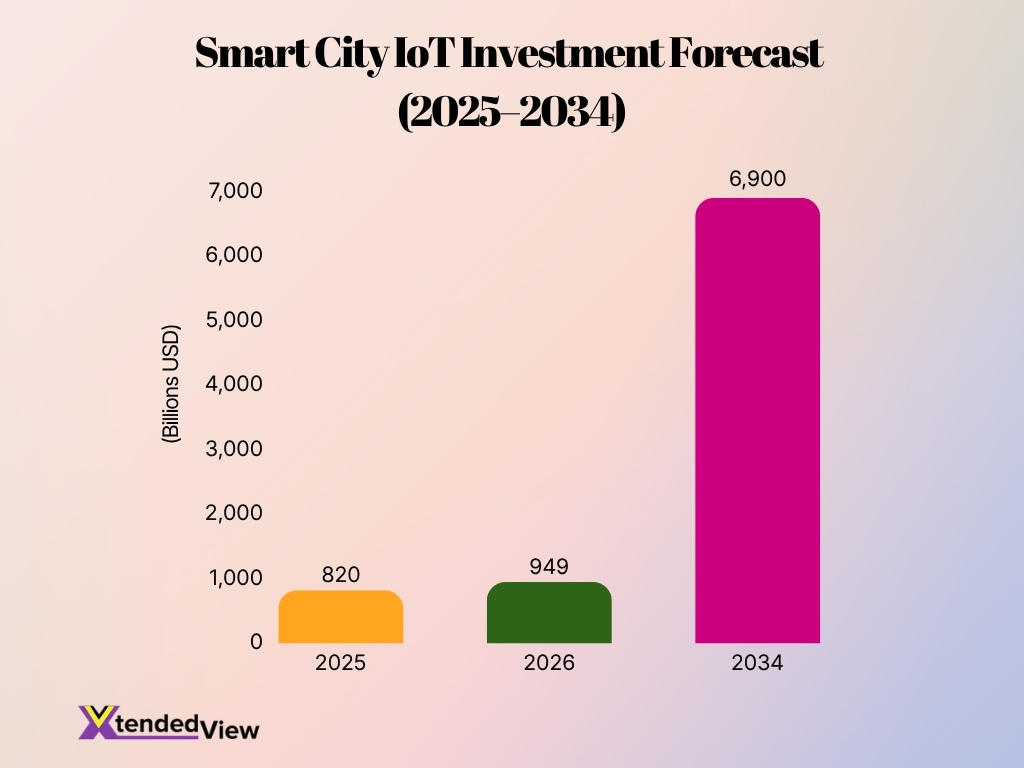
- The global smart cities market is expected to reach approximately $949 billion in 2026.
- Smart city spending worldwide exceeded $820 billion in 2025.
- The market is forecast to surpass $6.9 trillion by 2034.
- More than 1,000 smart city projects are currently active across major global metropolitan areas.
- Intelligent transportation systems remain among the largest public-sector IoT investment categories.
- Connected street lighting can reduce municipal energy consumption by 50% to 70% compared with conventional lighting systems.
- Smart water management systems help utilities reduce water loss by up to 30% in some deployments.
- Cities increasingly use IoT sensors for air quality monitoring, traffic optimization, and waste management.
- Asia-Pacific continues to lead global smart city infrastructure deployment due to rapid urbanization and government investment.
- Public safety applications, including connected surveillance and emergency response systems, represent a growing IoT use case for municipalities.
Business Adoption and ROI for IoT Devices
- Approximately 83% of organizations have at least one active IoT project or deployment.
- Nearly 57% of enterprises report that IoT initiatives have exceeded their expected ROI targets.
- Organizations implementing IoT-based predictive maintenance often reduce maintenance costs by 10% to 40%.
- IoT-enabled operational monitoring can lower equipment downtime by up to 50%.
- More than 70% of manufacturers report measurable productivity improvements after deploying connected systems.
- Real-time asset tracking remains one of the highest-return IoT applications in logistics and transportation.
- Approximately 60% of enterprise IoT projects now incorporate AI or advanced analytics capabilities.
- Businesses increasingly prioritize IoT investments that improve efficiency rather than purely experimental innovation projects.
- Supply chain visibility continues to rank among the top enterprise IoT deployment objectives.
- Energy management systems frequently deliver ROI within two to three years for large organizations.
Cellular IoT and Connectivity Protocols
- Global cellular IoT connections are projected to reach 6.5 billion by 2030, driven heavily by 5G adoption.
- Total cellular IoT connectivity revenue is forecast to reach $31 billion globally by the end of 2030.
- China dominates the global market, currently accounting for nearly 70% of total worldwide cellular IoT connections.
- The NB-IoT and LTE-M cellular market size is projected to reach $48 billion to $55 billion by 2036.
- The global 5G IoT market size was estimated at $11.83 billion in 2025 and will reach $479.47 billion by 2034.
- 5G Non-Standalone Architecture accounts for nearly 54% market share in the current 5G IoT connectivity landscape.
- The hardware segment represents a massive 44.3% revenue share of the overall 5G Internet of Things market.
- Worldwide LoRaWAN-connected devices have officially surpassed 125 million units globally.
- The global LoRaWAN market was valued at $3.7 billion in 2024 and is growing at a 41.1% CAGR.
- Analysts project that LoRaWAN technology will help drive total LPWAN connections beyond 3.5 billion by 2030.
IoT Device Security and Risk Exposure Statistics
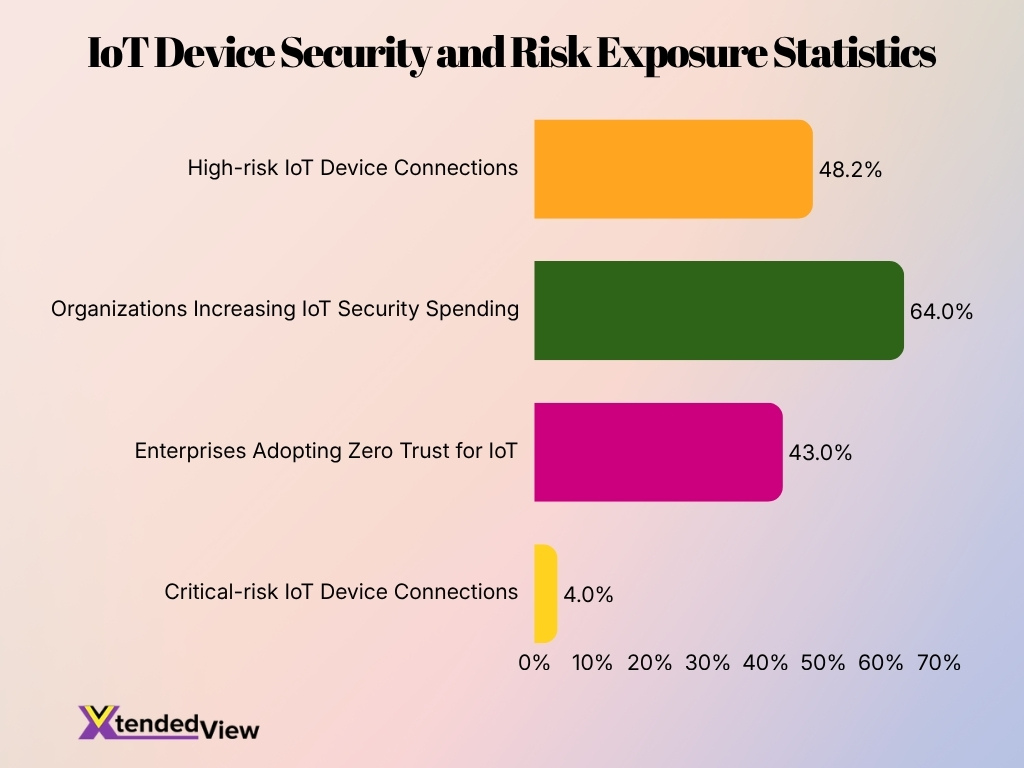
- 64% of organizations are increasing their IoT security spending, highlighting the growing priority of protecting connected devices from cyber threats.
- Nearly half of all IoT device connections (48.2%) are classified as high-risk, indicating widespread exposure to potential security vulnerabilities.
- 43% of enterprises have adopted Zero Trust security frameworks for IoT environments, reflecting a shift toward stronger access controls and continuous verification.
- Although smaller in share, 4% of IoT device connections are categorized as critical-risk, representing devices that may pose severe security and operational threats.
- The gap between high-risk (48.2%) and critical-risk (4%) connections suggests that many organizations still face significant security challenges before risks escalate to critical levels.
- The combination of higher security investments (64%) and Zero Trust adoption (43%) demonstrates that enterprises are actively strengthening defenses as IoT deployments expand.
- With more than one in every two organizations increasing cybersecurity budgets, IoT security remains a major focus area for digital transformation initiatives.
- The presence of 52.2% combined high-risk and critical-risk IoT connections underscores the need for continuous monitoring, device authentication, and threat detection measures.
- Enterprises implementing Zero Trust architectures are better positioned to mitigate risks associated with the growing number of connected IoT devices.
- These figures highlight that while IoT adoption continues to accelerate, security remains one of the industry’s most pressing challenges and investment priorities.
Edge Computing and IoT Data Generation Statistics
- IoT devices generated approximately 79.4 zettabytes of data globally in 2025.
- Global IoT spending is expected to surpass $1 trillion in 2026.
- The global edge computing market is forecast to reach $263.8 billion by 2035.
- Connected IoT devices are projected to scale to 40.6 billion units globally by 2034.
- The manufacturing sector accounts for 34% of total IoT device deployments worldwide.
- Approximately 5.7 billion IoT devices are actively connected to cellular networks in 2026.
- Over 50% of enterprise-generated data is being processed outside centralized data centers in 2026.
- Global spending on edge computing solutions is projected to hit $380 billion by 2028.
- The Industrial IoT market size is expected to grow to $1.69 trillion by 2030.
- Healthcare IoT devices exceeded 540 million units to support remote patient monitoring systems.
Manufacturing IoT Device Statistics
- More than 70% of manufacturers have implemented IoT technologies in at least one operational area.
- Predictive maintenance solutions powered by IoT can reduce machine downtime by 30% to 50%.
- Connected manufacturing systems can lower maintenance costs by 10% to 40%.
- The global IoT in manufacturing market is projected to grow from $172.65 billion in 2026 to over $1.1 trillion by 2034.
- Industrial manufacturers lose $50 billion annually to unplanned downtime, which IoT predictive analytics cuts by 20% to 30%.
- Implementing IoT predictive analytics delivers operational benefits like a 15% to 20% production increase and 25% to 56% energy savings.
- Around 40% of the value from IoT in manufacturing comes directly from preventing unplanned downtime.
- The Asia Pacific region is the fastest-growing market for IoT analytics with a projected 24.6% CAGR.
Active IoT Devices by Region (2023–2030)
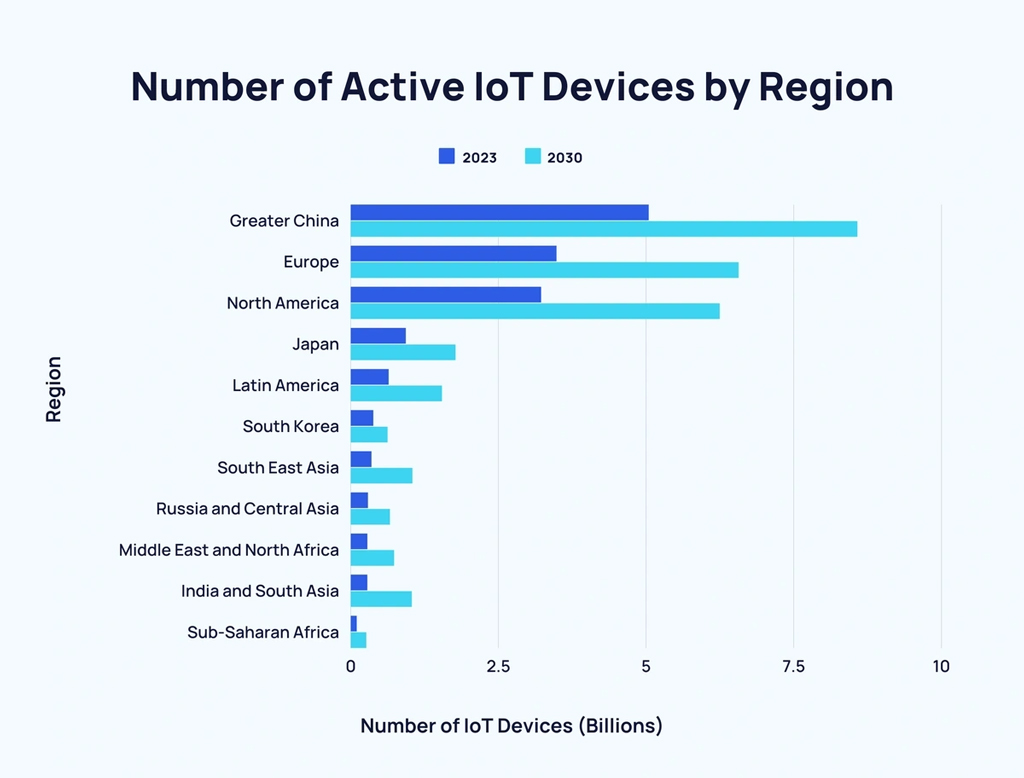
- Greater China remains the world’s largest IoT market, with active IoT devices projected to grow from 5.04 billion in 2023 to 8.57 billion by 2030, adding more than 3.5 billion devices.
- Europe is expected to maintain its position as the second-largest IoT region, increasing from 3.48 billion to 6.56 billion devices by 2030.
- North America will see substantial growth, with active IoT devices rising from 3.22 billion in 2023 to 6.24 billion in 2030, nearly doubling over the period.
- The combined total of Greater China, Europe, and North America is projected to exceed 21 billion active IoT devices by 2030, highlighting their dominance in global IoT adoption.
- Japan’s IoT ecosystem is forecast to expand from 0.93 billion to 1.77 billion devices, representing an increase of approximately 90%.
- Latin America is expected to grow from 0.64 billion active IoT devices in 2023 to 1.54 billion by 2030, adding nearly 900 million devices.
- South East Asia is among the fastest-growing IoT regions, with device counts projected to rise from 0.35 billion to 1.04 billion, nearly tripling by 2030.
- India and South Asia are forecast to experience strong IoT expansion, growing from 0.28 billion devices in 2023 to 1.03 billion in 2030.
- The Middle East and North Africa (MENA) region is expected to increase its active IoT device base from 0.28 billion to 0.73 billion, reflecting accelerating digital infrastructure investments.
- Russia and Central Asia are projected to more than double their IoT device count, from 0.29 billion in 2023 to 0.66 billion by 2030.
- South Korea will grow from 0.38 billion to 0.62 billion active IoT devices, supported by continued advancements in smart manufacturing and connectivity.
- Although starting from a smaller base, Sub-Saharan Africa is expected to see IoT devices increase from 0.10 billion to 0.26 billion, representing growth of over 160%.
- Every region in the study is projected to record significant IoT device growth between 2023 and 2030, underscoring the global expansion of connected technologies.
- Emerging markets such as India and South Asia, South East Asia, and Latin America are expected to contribute a growing share of future IoT device deployments.
- By 2030, several regions, including South East Asia, India, and South Asia, are projected to surpass the 1 billion active IoT device milestone.
IoT Energy and Sustainability Statistics
- Smart energy management systems powered by IoT can reduce commercial building energy consumption by 10% to 30%.
- Connected smart grids are projected to help utilities reduce transmission and distribution losses by up to 15% in certain deployments.
- More than 1.3 billion smart electricity meters are expected to be deployed globally by 2026.
- Smart lighting systems can lower electricity consumption by 50% to 70% compared with traditional systems.
- IoT-enabled building automation systems can reduce HVAC energy usage by approximately 20% to 25%.
- Utilities increasingly use connected sensors to detect leaks, monitor grid performance, and optimize renewable energy integration.
- Precision agriculture solutions powered by IoT can reduce water consumption by up to 30% while maintaining crop yields.
- Smart waste management systems have helped municipalities reduce collection costs by 20% to 40% in selected projects.
- IoT-driven sustainability initiatives remain among the fastest-growing enterprise investment categories entering 2026.
- Organizations increasingly combine IoT, AI, and sustainability reporting tools to monitor carbon emissions in real time.
IoT Device Growth Rate Statistics
- Global IoT connections are expected to grow from 18.8 billion in 2024 to 21.1 billion in 2025, representing approximately 14% annual growth.
- Worldwide IoT device connections are projected to exceed 40 billion by 2030, nearly doubling within the decade.
- Cellular IoT connections are forecast to increase from roughly 4.0 billion in 2024 to 4.5 billion in 2025.
- Smart home device adoption continues to expand at a CAGR exceeding 17% through the early 2030s.
- Industrial IoT deployments are expected to maintain double-digit annual growth rates through 2030.
- IoMT adoption is projected to grow at more than 20% CAGR during the forecast period.
- Smart city IoT infrastructure spending is increasing faster than overall public-sector technology spending in many regions.
- Edge computing adoption continues to accelerate as organizations seek faster processing and reduced cloud dependency.
- Enterprise IoT deployments increasingly focus on scalability and AI integration rather than pilot projects.
- Analysts expect IoT growth to remain resilient despite economic uncertainty because connected devices support operational efficiency and automation.
Enterprise IoT Adoption Across Industries
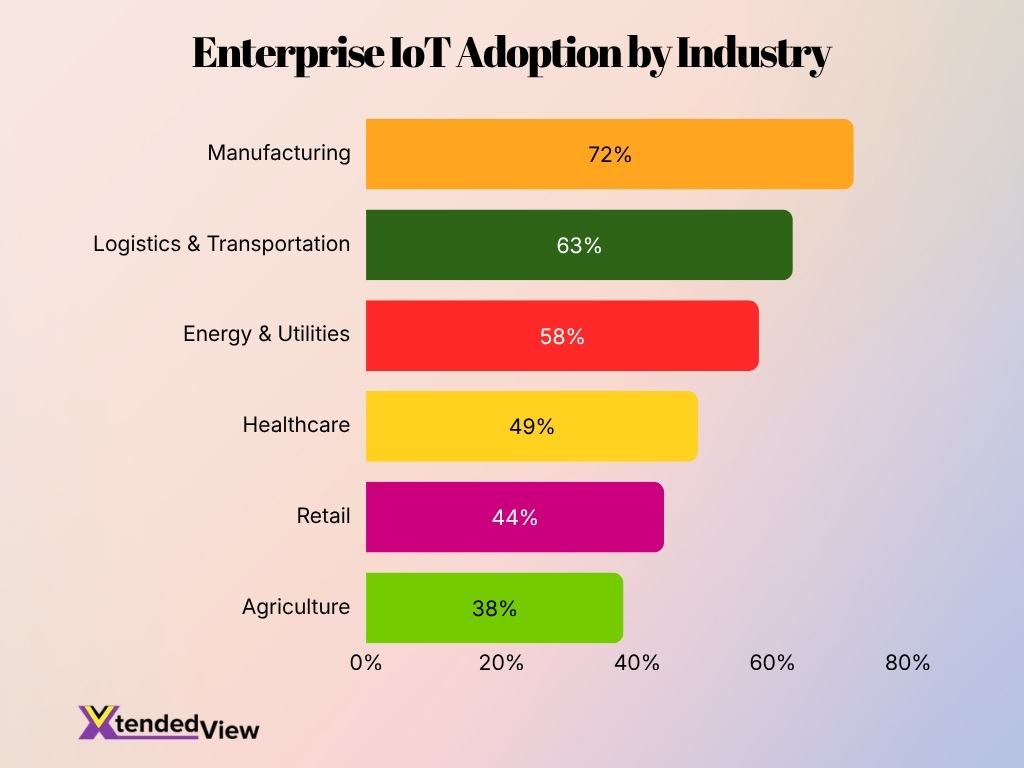
- Manufacturing leads enterprise IoT adoption with 72%, highlighting its strong reliance on connected devices for automation, predictive maintenance, and operational efficiency.
- Logistics & Transportation ranks second at 63%, reflecting widespread use of IoT for fleet tracking, supply chain visibility, and real-time asset monitoring.
- The Energy & Utilities sector reports an adoption rate of 58%, driven by smart grid management, remote equipment monitoring, and energy optimization initiatives.
- Nearly half of healthcare organizations (49%) have implemented IoT solutions to improve patient monitoring, asset tracking, and connected medical device management.
- Retail shows an IoT adoption rate of 44%, with businesses leveraging connected technologies for inventory management, customer analytics, and smart store operations.
- Agriculture records the lowest adoption among the listed industries at 38%, though IoT is increasingly being used for precision farming, irrigation control, and livestock monitoring.
- The adoption gap between Manufacturing (72%) and Agriculture (38%) is 34 percentage points, demonstrating significant differences in digital transformation maturity across sectors.
- Four industries, Manufacturing, Logistics & Transportation, Energy & Utilities, and Healthcare, have achieved adoption levels of 49% or higher, indicating that IoT is becoming a mainstream enterprise technology.
- The average IoT adoption rate across the six industries stands at approximately 54%, showing that more than half of organizations in these sectors are utilizing IoT solutions.
- The data highlights that industries with extensive physical assets and operational infrastructure, such as Manufacturing and Logistics, are leading the shift toward connected enterprise ecosystems.
Edge AI and Intelligent IoT Device Statistics
- The global Edge AI market is projected to reach approximately $24.4 billion in 2026.
- Edge AI revenue is consistently forecast to exceed $143 billion globally by 2034.
- Less than 1% of current IoT endpoints include dedicated AI accelerators for edge computing.
- Global connected IoT devices are reliably estimated to reach 40 billion units by 2030.
- The Edge AI processor market is expected to reach $14.7 billion by 2033 at a 19.6% CAGR.
- North America successfully dominated the Edge AI market with a 34.8% revenue share in 2025.
- The hardware segment currently leads the Edge AI industry, accounting for over 51% of the total revenue.
- The global IoT Analytics market is projected to grow heavily to $136.0 billion by the year 2033.
Future Outlook for IoT Devices
- Global IoT connections are projected to reach 38.7 billion devices by 2030.
- Worldwide IoT market revenue is forecast to reach $2.72 trillion annually by 2030.
- Enterprise IoT connections are expected to double and account for 63% of all connections by 2030.
- Edge computing and devices are projected to grow at a 17% CAGR to enable real-time analytics.
- Manufacturing deployments will remain a major driver by holding a 29.5% revenue share.
- Connected smart agriculture technologies are projected to expand at a rapid 19.2% CAGR through 2030.
- Environmental monitoring systems driven by sustainability will advance at a 20.1% CAGR.
- Cellular-connected IoT devices, heavily relying on 5G, will grow to 5 billion units by 2030.
- IoT services and security investments are expected to dominate by capturing a 34% market share.
- Asset tracking applications powered by AI and IoT will account for 22% of the total market size.
Frequently Asked Questions (FAQs)
The number of connected IoT devices worldwide is expected to reach 21.1 billion in 2025, representing approximately 14% year-over-year growth.
The global Internet of Things market is forecast to generate approximately $1.18 trillion in revenue in 2026.
Industry forecasts estimate that global IoT connections will reach around 39 billion to 40.6 billion devices by 2030.
The global IoT market is projected to grow from $1.35 trillion in 2025 to $2.72 trillion by 2030, at a 15.04% CAGR.
More than 50% of enterprise-generated data is expected to be processed at the edge rather than in centralized data centers by 2026.
Conclusion
The IoT ecosystem continues to expand at a remarkable pace, with connected devices supporting everything from industrial automation and healthcare monitoring to smart homes and urban infrastructure. Global device connections have moved beyond 20 billion, while IoT-related spending now exceeds the trillion-dollar mark. At the same time, organizations are increasingly combining IoT with artificial intelligence, edge computing, and advanced analytics to unlock greater operational value.
Looking ahead, growth will likely come from intelligent IoT devices, smart city deployments, industrial automation, and sustainability-focused initiatives. However, security, interoperability, and data governance will remain critical challenges as billions of new devices come online. For businesses, governments, and consumers alike, IoT is evolving from a connected-device strategy into a foundational layer of the digital economy.
