



Remote work has evolved from a temporary response into a long-term workforce strategy that now shapes how organizations hire, operate, and grow. Companies increasingly rely on distributed teams to reduce overhead costs, access global talent pools, and maintain business continuity across regions. At the same time, employees benefit from flexible work environments that reduce commuting time, improve focus, and allow better control over daily schedules.
Industries such as technology, customer support, finance, and digital marketing have already embedded remote work into their core operations, enabling teams to collaborate seamlessly across time zones using cloud-based tools and real-time communication platforms. This shift has also influenced urban planning, commercial real estate demand, and workforce expectations at scale. As businesses and workers continue to adapt, understanding the latest data becomes essential for making informed decisions. Let’s explore the most up-to-date remote work statistics and what they reveal about the future of work.
Editor’s Choice
- 22.8% of U.S. employees work remotely at least part-time, representing over 36 million workers (BLS, 2025).
- Around 32.6 million Americans (≈22% of the workforce) are remote workers in 2025.
- Globally, remote work participation has reached 52% of the workforce in 2026, nearly doubling since pre-pandemic levels.
- 83% of workers worldwide prefer a hybrid work model over fully remote or on-site setups.
- Hybrid work dominates, with 52% of remote-capable employees working in hybrid environments.
- A 1% increase in remote work adoption correlates with a 0.08% productivity gain.
- Nearly 98% of employees want remote work options for at least part of their careers.
Recent Developments
- Remote job postings now account for 15%+ of new U.S. job listings, up from just 4% pre-2020.
- In Q4 2025, 24% of job postings were hybrid and 11% fully remote.
- Global average work-from-home days stabilized at 1.27 days per week in 2025.
- About 37% of remote workers would work from another country if allowed.
- There are over 40 million digital nomads globally, with 18.1 million from the U.S.
- Only 30% of companies plan to eliminate remote work by 2026, signaling long-term adoption.
- Office attendance rose just 1–3% despite increased mandates, showing resistance to full return.
- Nearly 78% of CEOs consider remote collaboration a long-term strategy.
Key Remote Work Statistics Overview
- About 21%–23% of the U.S. workforce worked remotely in 2025.
- Roughly 34.3 million Americans worked remotely in April 2025.
- Remote work has stabilized after a decline from pandemic peaks but remains significantly higher than pre-2020.
- Before 2020, fewer than 5% of workers worked remotely regularly.
- Now, 56% of U.S. jobs are remote-compatible, even if not fully remote.
- Over 300–400 million workers globally are affected by remote or hybrid work options.
- Remote-capable roles show 80% participation in hybrid or remote setups.
- Remote work share has stabilized between 17.9% and 23.8% in recent years.
Why Workers Prefer Remote Work
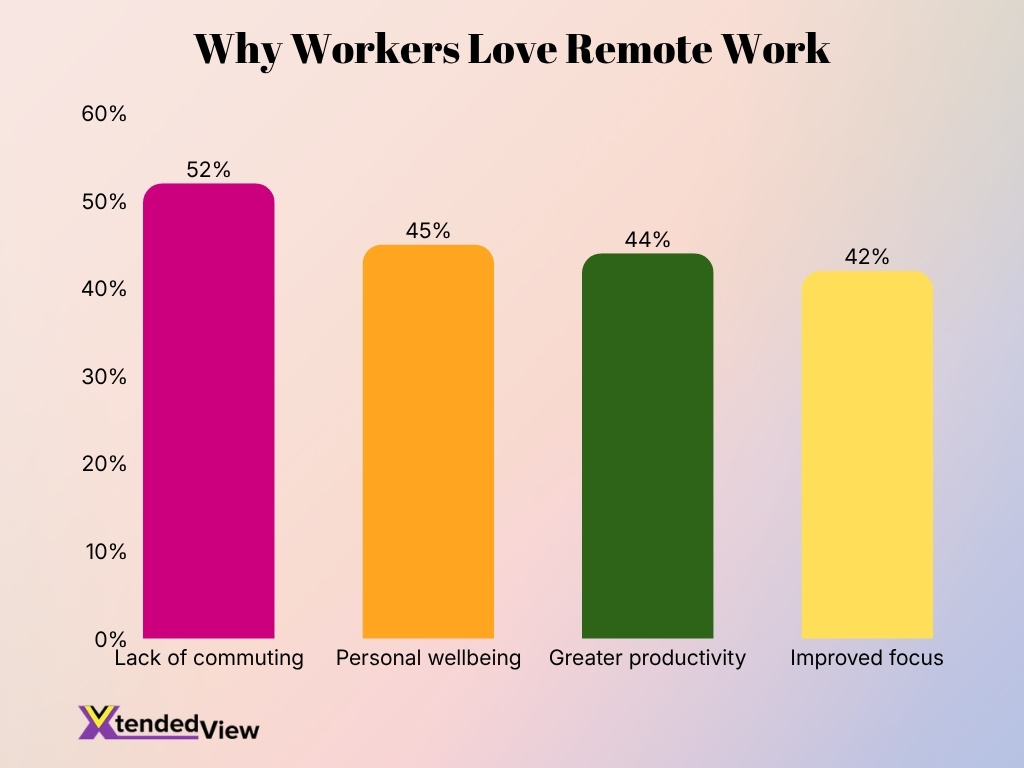
- Lack of commuting dominates as the top reason, with 52% of workers valuing the elimination of daily travel time and costs.
- Personal well-being ranks second, with 45% of employees reporting improved mental and physical health when working remotely.
- 44% of workers feel more productive, indicating that remote environments can enhance efficiency and output.
- Improved focus is a major benefit for 42% of employees, likely due to fewer office distractions and better control over work settings.
- The data highlights a strong trend: flexibility and autonomy are key drivers behind remote work satisfaction.
- Overall, more than 4 in 10 workers associate remote work with better performance and wellbeing, reinforcing its long-term appeal.
Remote Work by Country and Region
- In the U.S., 32.6 million workers will be remote in 2025.
- The U.S. telework rate fluctuates between 17.9% and 23.8%.
- India reports 12.7% fully remote workers and 28.2% hybrid workers.
- The UK sees around 40% of workers in hybrid or remote roles.
- EU countries average 22% remote workforce participation.
- North America leads in remote flexibility compared to Asia.
- Over 18.1 million U.S. workers identify as digital nomads.
- Remote work opportunities remain limited in developing regions due to infrastructure gaps.
Hybrid vs Fully Remote vs On-Site Work
- 52% of employees prefer hybrid work arrangements.
- About 27% of workers are fully remote.
- Less than 10% prefer fully on-site work.
- In tech, 47% work fully remote and 45% hybrid, leaving just 9% on-site.
- 60% of employees prefer hybrid, while over one-third want fully remote.
- Only 5% of companies are fully remote-first, while most offer flexible hybrid options.
- Around 80% of remote-capable workers operate in hybrid or remote setups.
- Remote work frequency averages 1–2 days per week globally in hybrid models.
Remote Work Demographics by Age Group
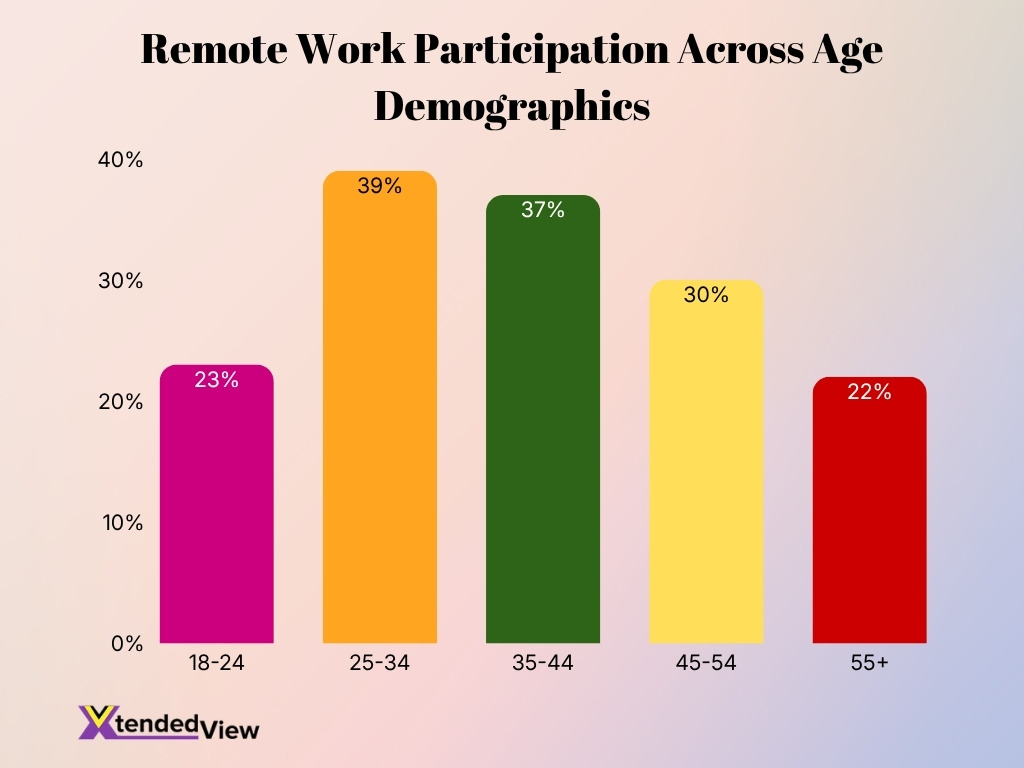
- Workers aged 25–34 have the highest remote participation at 39%.
- Employees aged 35–44 follow closely at 37% remote adoption.
- Younger workers (18–24) show lower adoption at 23%, often due to entry-level roles.
- Workers aged 45–54 report 30% remote participation, reflecting mid-career flexibility.
- Employees over 55 show 22% remote work rates, often tied to semi-retirement roles.
- Millennials make up over 50% of remote workers globally.
- Gen Z workers prefer hybrid setups, with 74% favoring flexibility.
- Remote work adoption among parents is 15% higher than among non-parents.
- Early-career professionals are twice as likely to seek hybrid roles as fully on-site jobs.
Remote Work Demographics by Gender
- Women are slightly more likely to work remotely, with 24% participation vs 21% for men.
- Mothers with children under 18 are 35% more likely to choose remote work.
- Men dominate fully remote tech roles, accounting for 60% of remote tech workers.
- Women report a higher preference for hybrid work at 68% vs 55% for men.
- Remote work has increased female labor force participation by 2–3 percentage points.
- Gender pay gaps narrow slightly in remote roles, with up to 10% reduction.
- Women in leadership roles report higher remote productivity gains (≈12%).
- LGBTQ+ workers show a higher preference (75%) for remote work due to inclusivity benefits.
- Female freelancers represent over 45% of the global remote freelance workforce.
Employee Preferences for Remote and Hybrid Work
- About 98% of workers want remote work options at least part-time.
- 65% of employees prefer fully remote work over hybrid or on-site.
- Meanwhile, 83% favor hybrid models as the ideal long-term setup.
- Employees rank flexibility as the top job priority (72%), ahead of salary in some surveys.
- Around 57% would look for a new job if remote options were removed.
- Workers save an average of 72 minutes daily by avoiding commutes.
- Nearly 80% report improved job satisfaction with remote flexibility.
- 68% of employees say remote work improves focus and reduces distractions.
- Over 50% of workers would accept a pay cut for remote flexibility.
Remote Work Preference by Industry
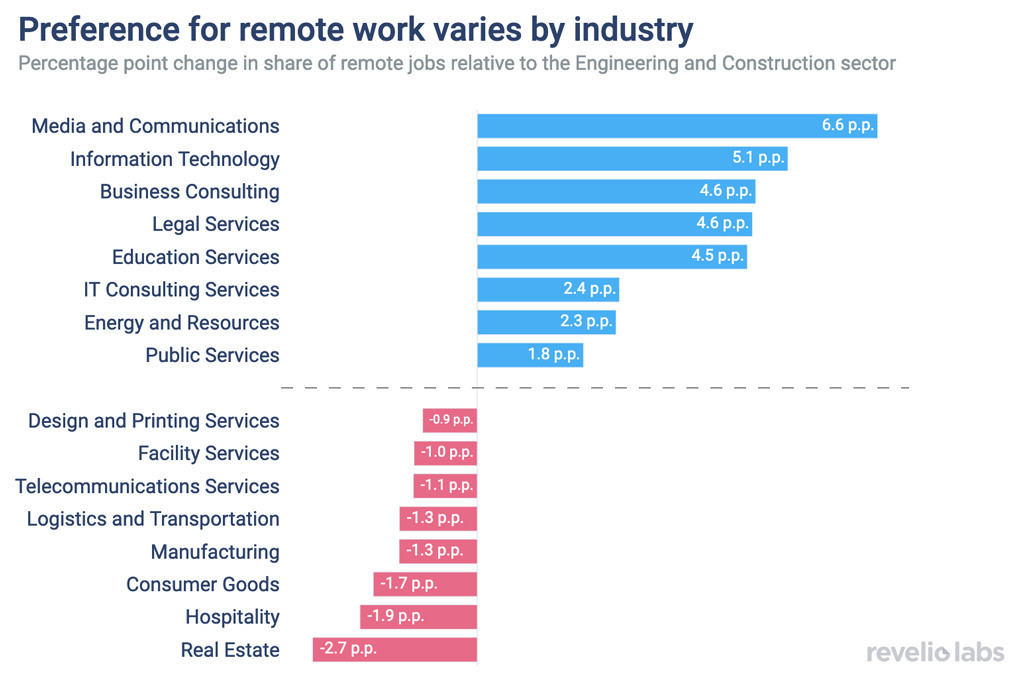
- Media and Communications leads with the highest increase at +6.6 percentage points, showing the strongest shift toward remote work.
- Information Technology follows closely with +5.1 p.p., reinforcing its position as a highly remote-friendly sector.
- Business Consulting and Legal Services both record +4.6 p.p., indicating strong adoption of remote work in professional services.
- Education Services also shows a notable rise at +4.5 p.p., highlighting the growing digital transformation in education.
- Mid-tier industries like IT Consulting (+2.4 p.p.), Energy and Resources (+2.3 p.p.), and Public Services (+1.8 p.p.) show moderate but positive growth in remote work adoption.
- Several industries fall below the baseline, indicating reduced remote work preference compared to Engineering & Construction.
- Real Estate experiences the steepest decline at -2.7 p.p., making it the least remote-friendly sector in the dataset.
- Hospitality (-1.9 p.p.) and Consumer Goods (-1.7 p.p.) also show significant drops, reflecting the need for physical presence in these industries.
- Manufacturing and Logistics (-1.3 p.p. each) highlight the operational limitations of remote work in production and supply chain roles.
- Telecommunications (-1.1 p.p.), Facility Services (-1.0 p.p.), and Design & Printing (-0.9 p.p.) show slight declines, suggesting partial but limited remote adaptability.
- Overall, knowledge-based and digital industries dominate remote work growth, while hands-on, location-dependent sectors lag behind.
Employee Attitudes Toward Return-to-Office Policies
- About 64% of employees oppose mandatory full-time office returns.
- Nearly 40% would quit if forced back to the office full-time.
- 76% of workers expect flexible policies to remain permanent.
- Companies enforcing strict return policies see higher attrition rates (up to 20%).
- Only 12% of employees prefer full-time office work.
- Hybrid mandates result in higher employee satisfaction (by 15–20%).
- Around 58% of managers struggle to enforce return-to-office compliance.
- Employees value autonomy, with 70% citing flexibility as key to retention.
- Office attendance rates remain below 60% of pre-pandemic levels.
Remote Work and Productivity and Performance
- Remote workers report 13% higher productivity compared to office workers.
- Hybrid workers show 5%–9% productivity gains due to flexible schedules.
- Around 77% of employees say they are more productive working remotely.
- Companies report 20% cost savings linked to productivity improvements.
- Remote work reduces absenteeism by up to 41%.
- Employees work an average of 48.5 minutes longer per day remotely.
- About 60% of managers report equal or improved performance in remote teams.
- Remote work increases task completion rates by up to 10%.
- Digital collaboration tools improve team efficiency by 30%+.
Home Internet Cost Coverage in Remote Work
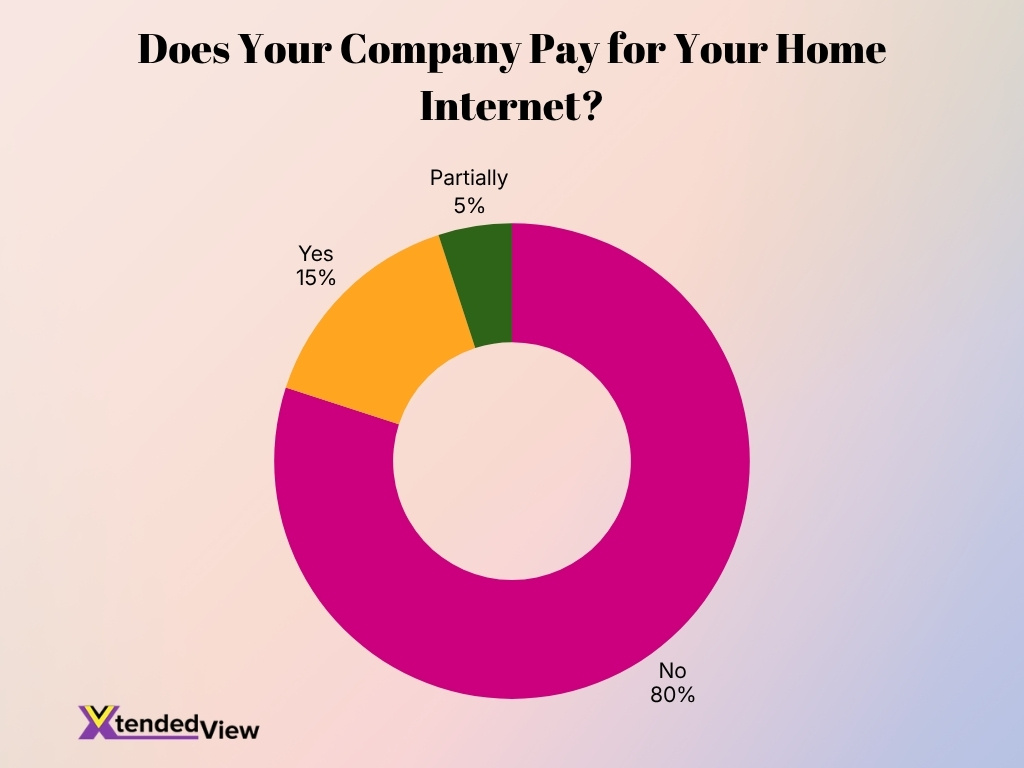
- A significant 80% of employees report that their company does not pay for home internet, highlighting a major shift in cost burden to workers.
- Only 15% of companies fully cover home internet expenses, indicating limited employer support in remote setups.
- Just 5% of respondents receive partial reimbursement, showing that hybrid support models are rare.
- The data suggests that 85% of employees (No + Partially) are either fully or partially responsible for their internet costs.
- This trend reflects how remote work often comes with hidden personal expenses, despite increased adoption globally.
- Employers may need to reassess policies as internet connectivity remains a critical infrastructure for remote productivity.
Remote Work and Work–Life Balance
- 71% of employees say remote work improves work–life balance.
- Workers save an average of $4,000 annually by working remotely.
- About 68% report reduced stress levels when working remotely.
- Remote workers spend more time with family (by 30% on average).
- Flexible schedules allow 40% of workers to pursue personal interests or side projects.
- However, 27% struggle to unplug after work hours.
- Remote work reduces commuting-related stress by over 50%.
- Employees report higher sleep quality (by 20%) due to flexible schedules.
- Around 45% of remote workers say they exercise more frequently.
How Remote Work Saves Money and Time
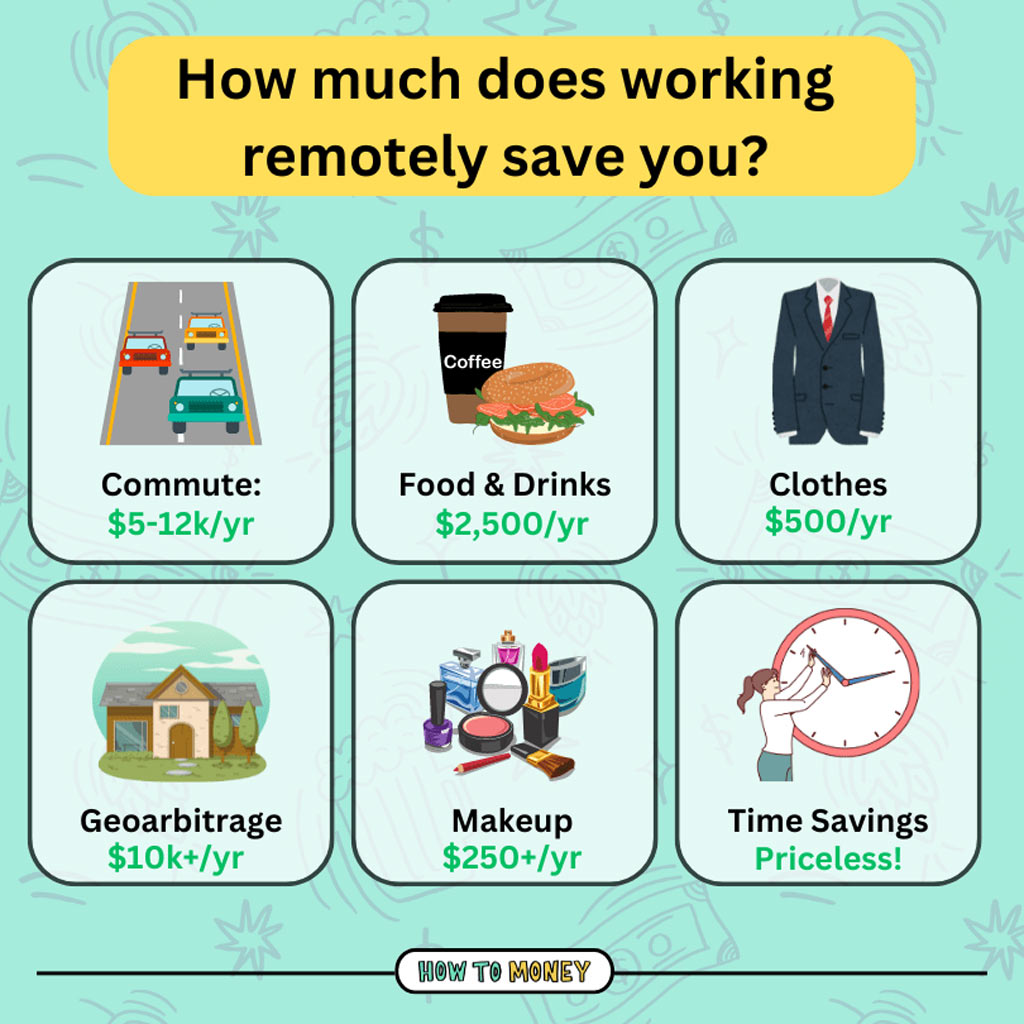
- Commuting costs drop significantly, saving workers between $5,000 and $12,000 per year, making it one of the biggest financial benefits of remote work.
- Daily spending on food and drinks decreases, with an average saving of around $2,500 annually, as employees avoid expensive lunches and coffee runs.
- Work-related clothing expenses are reduced, cutting costs by approximately $500 per year, especially for formal office wear.
- Geoarbitrage creates major financial gains, allowing individuals to save $10,000+ annually by living in lower-cost locations while earning the same income.
- Personal grooming and makeup expenses decline, leading to savings of $250+ per year, especially for professionals who previously maintained daily office-ready appearances.
- Time savings are invaluable (“Priceless”), as remote workers eliminate commuting time, resulting in better work-life balance, increased productivity, and improved well-being.
Remote Work and Mental Health and Wellbeing
- About 74% of remote workers report improved mental well-being compared to office settings.
- However, 25% of remote employees say loneliness is their biggest challenge.
- Remote workers experience 32% less workplace stress due to flexible schedules.
- Nearly 70% of employees say remote work reduces burnout when managed properly.
- On the flip side, 41% report increased screen fatigue from prolonged virtual meetings.
- Around 60% of remote workers feel more in control of their mental health routines.
- Employees working remotely full-time are 20% more likely to report emotional exhaustion without clear boundaries.
- Companies offering mental health support see 23% higher employee satisfaction in remote teams.
- Remote workers with flexible schedules report 19% better overall well-being scores.
Remote Work and Employee Retention and Turnover
- Companies offering remote work see 25% lower employee turnover.
- About 57% of employees would leave their jobs if remote flexibility were removed.
- Remote roles receive 2x more applications than on-site positions.
- Organizations with hybrid policies report higher retention rates (up to 20%).
- Employees with remote options are 35% more likely to stay long-term.
- Around 76% of workers consider flexibility a key factor in job loyalty.
- Companies that enforce strict office returns see attrition spikes of 15%–20%.
- Remote work reduces hiring costs by up to 50% due to lower turnover.
- Flexible work policies improve employer branding, increasing offer acceptance rates by 30%.
What Incentives Drive Employees Back to the Office
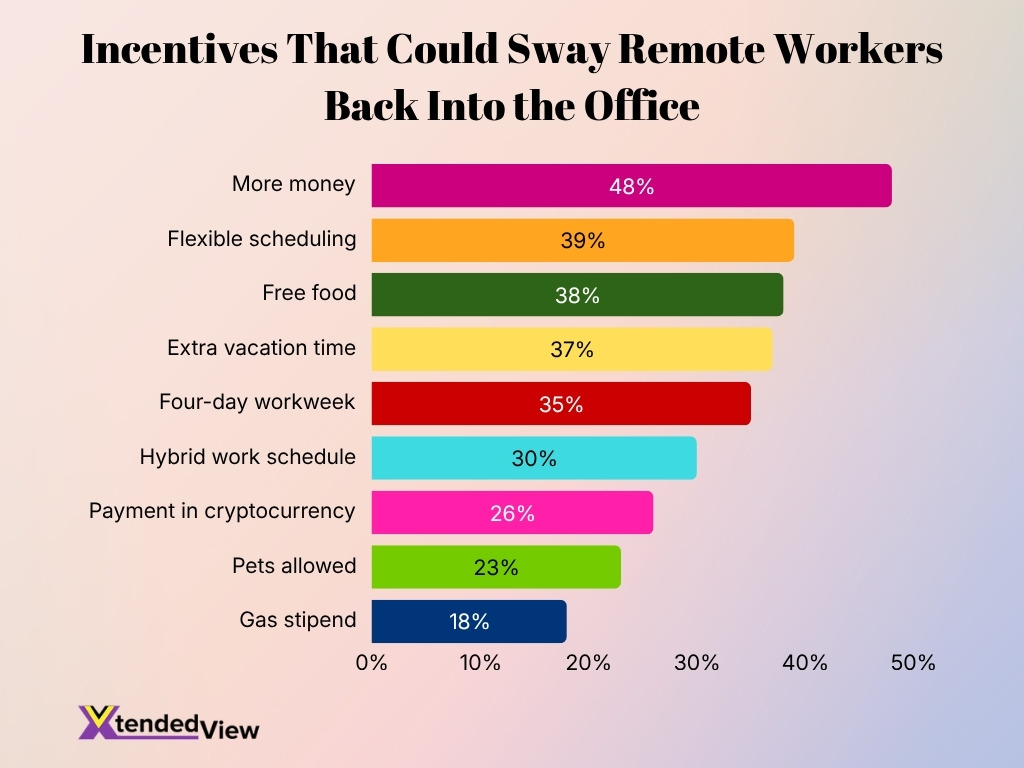
- The most compelling incentive is higher pay, with 48% of remote workers saying more money would motivate them to return, clearly making financial benefits the top driver.
- Flexible scheduling (39%) ranks as the second most influential factor, highlighting that workers still value control over their time even in office settings.
- Surprisingly, free food (38%) and extra vacation time (37%) are nearly tied, showing that both immediate perks and long-term benefits strongly influence employee decisions.
- A four-day workweek (35%) remains a highly attractive option, indicating growing demand for reduced work hours without sacrificing productivity.
- Only 30% of workers are swayed by a hybrid work schedule, suggesting that while hybrid models help, they are not as powerful as financial or flexibility-based incentives.
- Payment in cryptocurrency (26%) appeals to a niche but notable segment, reflecting emerging interest in alternative compensation models.
- Allowing pets in the workplace (23%) has moderate appeal, indicating that lifestyle perks matter but are less critical than core benefits.
- The least motivating factor is a gas stipend (18%), suggesting that commuting cost support alone is insufficient to bring most workers back.
- Overall, the data shows a clear trend: financial rewards, flexibility, and work-life balance benefits significantly outweigh smaller perks when influencing return-to-office decisions.
Remote Work Technology, Tools, and Infrastructure
- Over 80% of remote teams rely on collaboration tools like Slack and Microsoft Teams.
- Video conferencing usage increased by 300%+ since 2020, remaining high in 2026.
- About 67% of companies invest in cloud infrastructure to support remote work.
- AI-powered productivity tools are used by 45% of remote teams.
- Remote employees use an average of 5–7 digital tools daily.
- VPN usage increased by 70% globally to secure remote connections.
- Companies spend $3,000–$5,000 per employee on remote tech setup.
- Workflow automation tools improve efficiency by 20%–30% in remote teams.
- Over 90% of organizations plan to increase investment in digital collaboration tools.
Cybersecurity and Data Protection in Remote Work
- Remote work has increased cyberattack risks by 238% since 2020.
- About 68% of organizations report higher security incidents in remote environments.
- Human error accounts for 82% of data breaches in remote setups.
- Companies investing in cybersecurity reduce breach costs by up to 50%.
- Multi-factor authentication adoption increased to 78% among remote-first companies.
- Around 60% of employees use personal devices for work, increasing the risk.
- Phishing attacks increased by over 60% with the expansion of remote work.
- Organizations spend 10%–15% more on cybersecurity budgets post-remote transition.
- Secure access service edge adoption is growing, with 40% of enterprises implementing it.
Key Remote Work Challenges Statistics
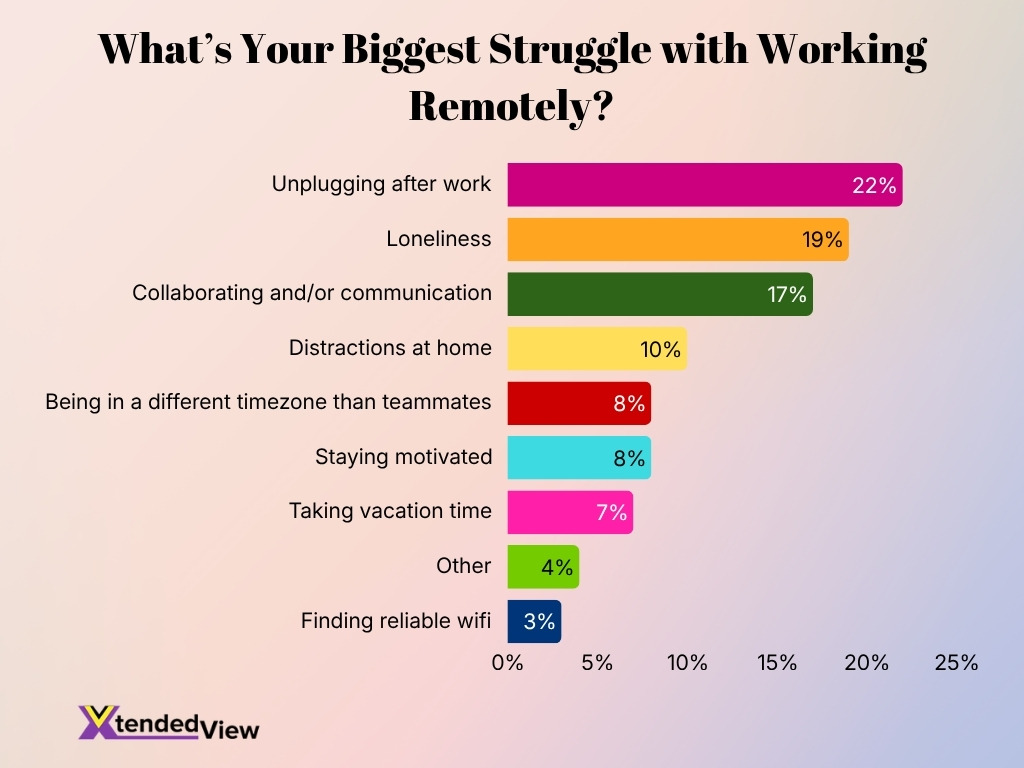
- The top struggle faced by remote workers is unplugging after work (22%), highlighting issues with work-life boundaries.
- Loneliness (19%) ranks as the second biggest challenge, showing the impact of social isolation in remote environments.
- 17% of workers report difficulties with collaboration and communication, indicating gaps in remote teamwork and tools.
- Distractions at home (10%) remain a significant productivity barrier for remote employees.
- Timezone differences (8%) affect coordination, especially in global or distributed teams.
- An equal 8% struggle with staying motivated, reflecting challenges in self-discipline and engagement.
- 7% of remote workers find it difficult to take vacation time, suggesting issues with burnout and overwork culture.
- A smaller segment (4%) reported other challenges, indicating diverse but less common issues.
- Only 3% struggle with reliable Wi-Fi, showing that connectivity is no longer a major barrier for most remote workers.
Future of Remote Work: Predictions and Trends
- By 2028, 73% of teams are expected to include remote workers.
- Hybrid work will dominate, with over 60% of companies adopting flexible models.
- Remote job postings are projected to grow by 25% annually.
- AI integration in remote workflows will increase productivity by 30%+.
- Digital nomad populations could exceed 60 million globally by 2030.
- Companies will reduce office footprints by up to 50% in the next decade.
- Cross-border hiring is expected to rise by 35%, expanding global talent access.
- Remote work policies will become standard in over 70% of large enterprises.
- Four-day workweeks combined with remote setups are being tested by 20% of companies.
Frequently Asked Questions (FAQs)
About 22.8% of U.S. employees, representing over 36 million workers, work remotely at least part-time.
Remote work participation has reached approximately 52% of the global workforce in 2026.
Around 52% of employees work hybrid, while 27% work fully remote worldwide.
Approximately 46% of remote-capable workers say they would leave their job if remote work flexibility were taken away.
Remote workers are about 13% more productive than their in-office counterparts.
Conclusion
Remote work reflects a sustained transformation rather than a short-term adjustment. Organizations have moved beyond experimentation and now actively refine hybrid and remote-first models to balance productivity, collaboration, and employee satisfaction. At the same time, workers increasingly expect flexibility as a standard benefit, not a perk, influencing how companies attract and retain talent in a competitive market.
The data shows that remote work delivers measurable advantages, including improved productivity, lower turnover, and significant cost savings for employers. However, it also introduces new challenges such as maintaining team cohesion, managing mental well-being, and strengthening cybersecurity frameworks. Companies that invest in the right technology, set clear expectations, and support employee well-being will gain a competitive edge.
Looking ahead, remote work will continue to evolve alongside advancements in AI, automation, and global hiring practices. Businesses that embrace flexible work structures while maintaining accountability and culture will be better positioned to scale efficiently and adapt to future workforce demands.
