



Remote work remains a major part of the U.S. labor market, but the way companies use it has changed significantly since the peak pandemic years. Instead of choosing between fully remote and fully office-based work, many organizations now rely on hybrid schedules that combine home-based work with regular office attendance. This shift is especially visible in technology, finance, professional services and other knowledge-based industries, where employees can perform a large share of their work digitally.
Employers are also using flexible work to expand hiring pools, improve retention, reduce unnecessary office dependence and support geographically distributed teams. At the same time, return-to-office policies have become more common, creating a labor market where remote, hybrid and on-site models operate side by side. The statistics below examine how remote work is evolving across adoption rates, industries, demographics, productivity, employee preferences, compensation, cybersecurity, real estate, AI use and hiring trends.
Editor’s Choice
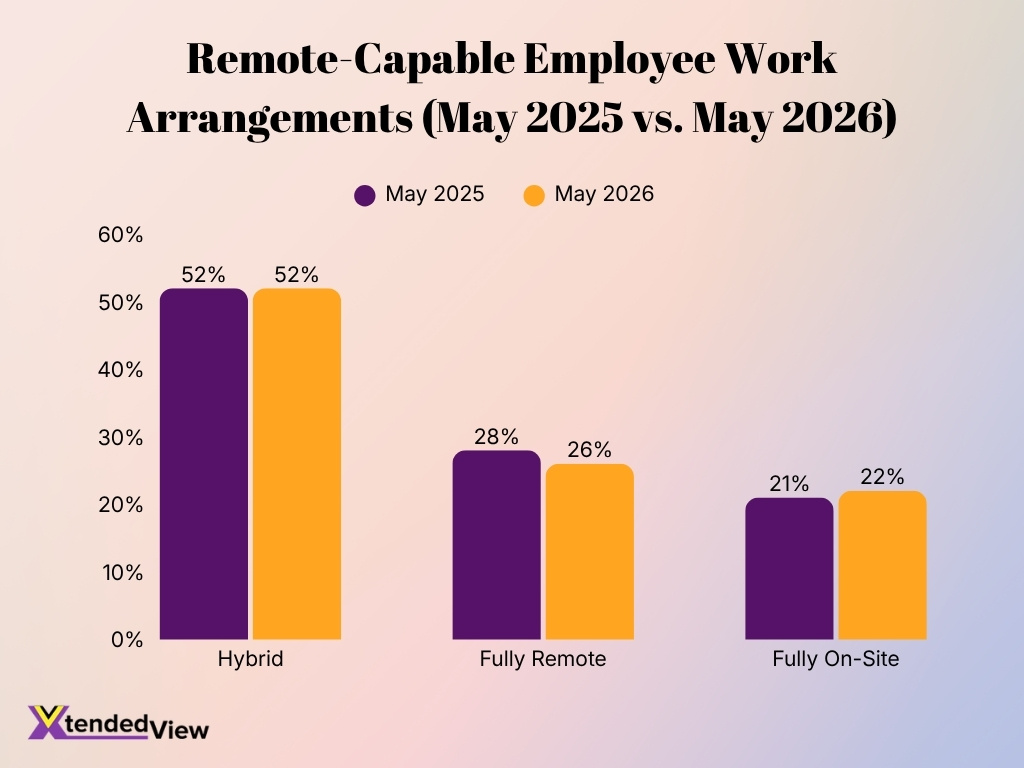
- 52% of remote-capable U.S. employees worked hybrid schedules in May 2026, making hybrid work the most common arrangement among people whose jobs can support remote work.
- Fully remote employees accounted for 26% of remote-capable U.S. workers in May 2026, compared with 28% in May 2025.
- Across the broader U.S. workforce, 22.4% of people at work teleworked during 2025, including employees who worked remotely for either some or all of their weekly hours.
- Remote work varies sharply by occupation: 65.4% of workers in computer and mathematical occupations teleworked in 2025, compared with just 3.4% of workers in construction and extraction occupations.
- Finance and insurance had one of the country’s highest industry telework rates in 2025, with 58.9% of workers performing at least some work remotely.
- Women recorded a higher overall telework rate than men in 2025: 25% of women at work teleworked, compared with 20.2% of men.
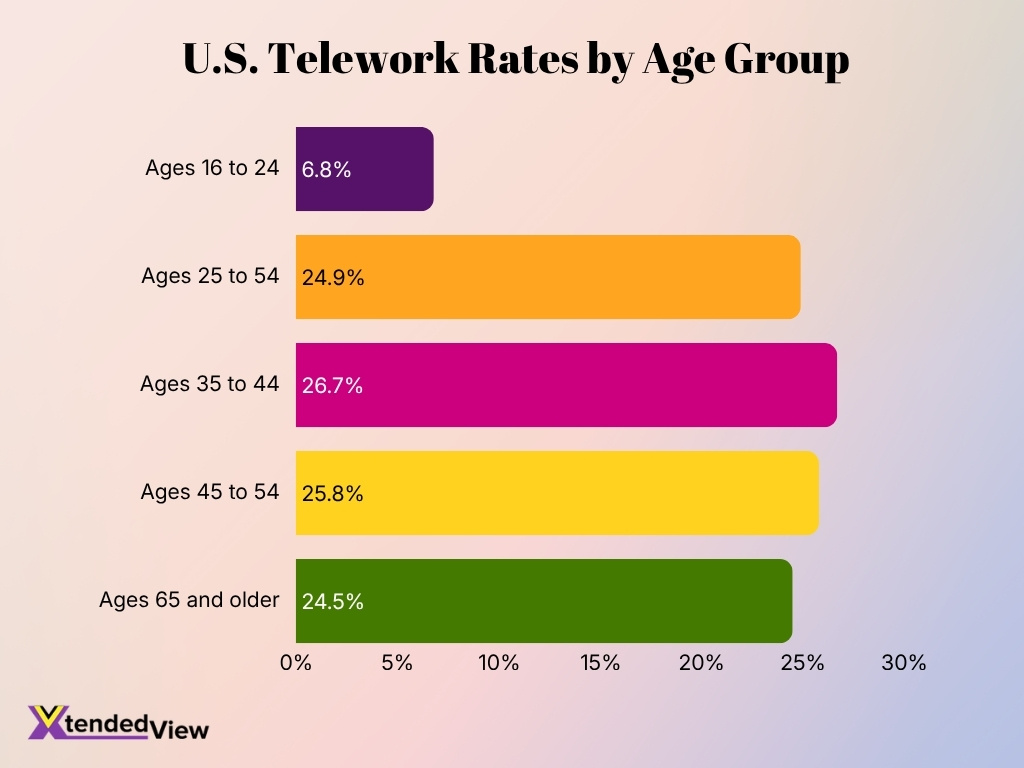
- Among workers aged 35 to 44, 26.7% teleworked in 2025, the highest rate among the main working-age groups reported in the national data.
- Despite prominent return-to-office announcements, only 12% of executives overseeing hybrid or fully remote workers said in early 2025 that they planned to introduce some form of return-to-office requirement during the following year.
Recent Developments
- The share of remote-capable U.S. employees working fully remotely stood at 26% in May 2026, unchanged from February 2026. Hybrid work also stayed unchanged at 52%.
- Compared with May 2025, the fully remote share of remote-capable jobs fell from 28% to 26% by May 2026, while hybrid work remained at 52%.
- Fully on-site work among remote-capable employees rose only slightly, from 21% in May 2025 to 22% in May 2026, despite highly visible corporate return-to-office policies.
- A survey of more than 1,000 executives conducted in February 2025 found that only 12% of businesses with hybrid or fully remote employees expected to introduce a return-to-office mandate during the next 12 months.
- Research covering more than 150,000 U.S. businesses found that employers expected employees to continue working from home about one day per week even five years into the future.
- The same business research found that 70% of firms did not track whether employees met office-attendance requirements, while 75% did not monitor how much employees worked from home.
- Federal remote work changed much more sharply. Full-time telework and remote-work hours across the federal workforce fell 75.2% between January and October 2025 following government-wide return-to-office directives.
- Before that change, about 10% of federal civilian employees were fully remote, while approximately 40% teleworked at least part time, according to figures published in January 2026.
- Employers also increased office-attendance expectations during 2026. A commercial real-estate survey found that 89% of surveyed employers required at least three office days in 2026, up from 78% in 2025, although actual average attendance increased only from 2.8 to 2.9 days.
Current Remote Work Adoption Rates
- Across all U.S. workers who worked during the relevant survey periods, 22.4% teleworked during 2025. That represented roughly 35.4 million workers.
- About 11.9% of all U.S. workers teleworked for only part of their weekly hours in 2025, while 10.5% worked remotely for all of their hours.
- Full-time employees were more likely to telework than part-time workers. In 2025, 23.8% of full-time workers teleworked, compared with 15.6% of part-time workers.
- Among remote-capable employees specifically, 78% worked either hybrid or fully remotely in May 2026. The remaining 22% worked exclusively on-site.
- Hybrid arrangements alone represented 52% of remote-capable jobs in May 2026, double the 26% share working fully remotely.
- A separate household survey found that 39% of workers had worked from home at least some of the time in 2025, with 17% working entirely from home and 23% working some of the time remotely.
- Among employees who teleworked during 2025, 53.1% worked remotely for some of their hours, while 46.9% worked remotely for all hours.
- Employees who teleworked averaged 26.5 remote hours per week and 39.9 total work hours, meaning roughly two-thirds of their hours occurred remotely.
- Among workers who split time between home and another workplace, remote work averaged 17.3 hours per week. Employees who worked remotely for all reported hours averaged 37 hours of home-based work.
Remote Work Trends by Industry
- Finance and insurance recorded a 58.9% telework rate in 2025, one of the highest rates among major U.S. industries. Of all workers in the sector, 30.2% worked remotely for all their hours.
- Professional and technical services followed closely, with 58.4% of workers teleworking during 2025. About 32.6% of workers in the sector performed all of their work remotely.
- The information industry recorded a 48.4% telework rate, including 25.3% who worked remotely for all hours and 23.1% who worked remotely for part of their hours.
- Across professional and business services more broadly, 44.9% of workers teleworked in 2025, equal to roughly 9.6 million people.
- Real estate, rental and leasing recorded a 39.4% telework rate in 2025, while 15.6% of workers in the industry worked remotely for all their hours.
- Manufacturing remained much more workplace-dependent: 19.7% of manufacturing workers teleworked, leaving 80.3% without remote work during the survey reference period.
- Health care and social assistance recorded a 17.8% telework rate. Hospitals had an even lower rate of 15%, reflecting the high share of clinical and operational work that requires physical presence.
- Retail trade had a telework rate of 10.9%, while transportation and warehousing stood at 8%.
- Accommodation and food services remained among the least remote-compatible sectors, with only 4% of workers teleworking in 2025. By comparison, nearly 59% of finance and insurance workers teleworked.
- Firm-level research found a similarly wide gap: workers averaged about 2.8 work-from-home days per week in information-related businesses, compared with only about 0.1 day in accommodation and food services.
Remote Work Demographics and Workforce Breakdown
- Women were more likely than men to telework in 2025. 25% of women at work teleworked, compared with 20.2% of men.
- Among women aged 35 to 44, the telework rate reached 30.3%, compared with 23.7% among men in the same age group.
- Workers aged 35 to 44 had the highest telework rate among major age groups at 26.7%, followed by workers aged 45 to 54 at 25.8%.
- Younger employees were far less likely to work remotely. Only 6.8% of workers ages 16 to 24 teleworked during 2025, compared with 24.9% of workers ages 25 to 54.
- Remote work did not disappear among older workers. 24.5% of workers ages 65 and older teleworked in 2025, and 14% worked remotely for all their hours.
- Education creates another major divide. In a 2025 U.S. household survey, 23% of workers with at least a bachelor’s degree worked entirely from home, compared with 10% of workers whose education ended at high school or earlier.
- Self-employed workers had especially high flexibility: 36.4% of self-employed workers teleworked in 2025, compared with 20.9% of wage and salary employees outside incorporated self-employment.
- Among incorporated self-employed workers, the telework rate reached 40.8%, while 33.3% of unincorporated self-employed workers teleworked.
- International research involving more than 16,000 college-educated workers across 40 countries found similar average work-from-home levels for men and women, but employees with children were more likely to use hybrid schedules than workers without children.
Hybrid Work Model Statistics
- In May 2026, 52% of remote-capable U.S. employees worked hybrid schedules, compared with 26% working fully remotely and 22% entirely on-site.
- Hybrid employment has remained unusually stable. The share stood at 52% in February 2025, May 2025, August 2025, November 2025, February 2026 and May 2026.
- The hybrid share has grown substantially from the early pandemic period. In May 2020, only 18% of remote-capable employees were hybrid, compared with 52% in May 2026.
- Fully remote work moved in the opposite direction. It fell from 70% of remote-capable employees in May 2020 to 26% in May 2026, while hybrid work absorbed much of the shift.
- Employee preference closely matches the prevalence of hybrid work: about six in 10 remote-capable workers say they want a hybrid arrangement, while roughly one-third prefer fully remote work and fewer than 10% prefer full-time on-site work.
- Hybrid employees have gradually increased office attendance. Recent tracking found that hybrid workers spent about 46% of their workweek in the office, equal to approximately 2.3 days per week, compared with 42% in 2022.
- A 2025 household survey found that 13% of all workers worked from home one or two days per week. That represented 59% of employees who reported working from home only some of the time.
- Parents show a particularly strong connection to hybrid work. Global research found that employees with children were more likely to split their week between home and an employer location, while employees without children were more likely to work either fully remote or fully on-site.
- Hybrid work remains widespread even as office mandates tighten. In a 2026 study of organizational workplace policies, 84% of the companies examined allowed some form of hybrid work, while three office days per week represented the most common attendance policy.
- The tech sector remains an exception to the broader hybrid majority. Among remote-capable tech employees, 47% worked fully remotely and 45% worked hybrid, while only 9% worked entirely on-site in the latest available analysis.
Remote Work Productivity Statistics
- In a 2025 U.S. worker survey, 60% of employees who worked from home at least sometimes said their arrangement helped them get work done and meet deadlines. Only 7% said it hurt their productivity, while 33% reported no effect.
- A randomized trial involving 1,612 professional employees found no significant decline in performance when employees worked from home two days per week instead of spending all five days in the office.
- The same experiment found no statistically significant difference in performance reviews between hybrid and fully office-based workers over two years of follow-up data.
- Researchers also found no significant difference in promotion rates between employees assigned to hybrid work and those assigned to full-time office work during the two-year evaluation period.
- Among software engineers in the experiment, hybrid work produced no measurable decline in lines of code written, providing a direct output-based measure alongside performance reviews.
- Managers initially expected hybrid work to reduce productivity by 2.6%. After experiencing the six-month hybrid experiment, their estimate shifted to a positive 1% effect.
- Non-managerial employees initially expected hybrid work to improve productivity by about 0.7%, showing a substantial gap between employee and manager perceptions before the trial began.
- U.S. employees who teleworked in 2025 averaged 39.9 total work hours per week, compared with an overall average of 38.3 hours among all people at work.
- Full-time teleworkers averaged 42.6 hours of work per week in 2025, including 28 hours worked remotely. Remote hours therefore represented 65.8% of their total working time.
- Among hybrid workers, employees who worked remotely for only part of their week averaged 17.3 hours of remote work, compared with 37 hours among workers who teleworked for all reported hours.
Employee Sentiments on Remote Work vs. Compensation
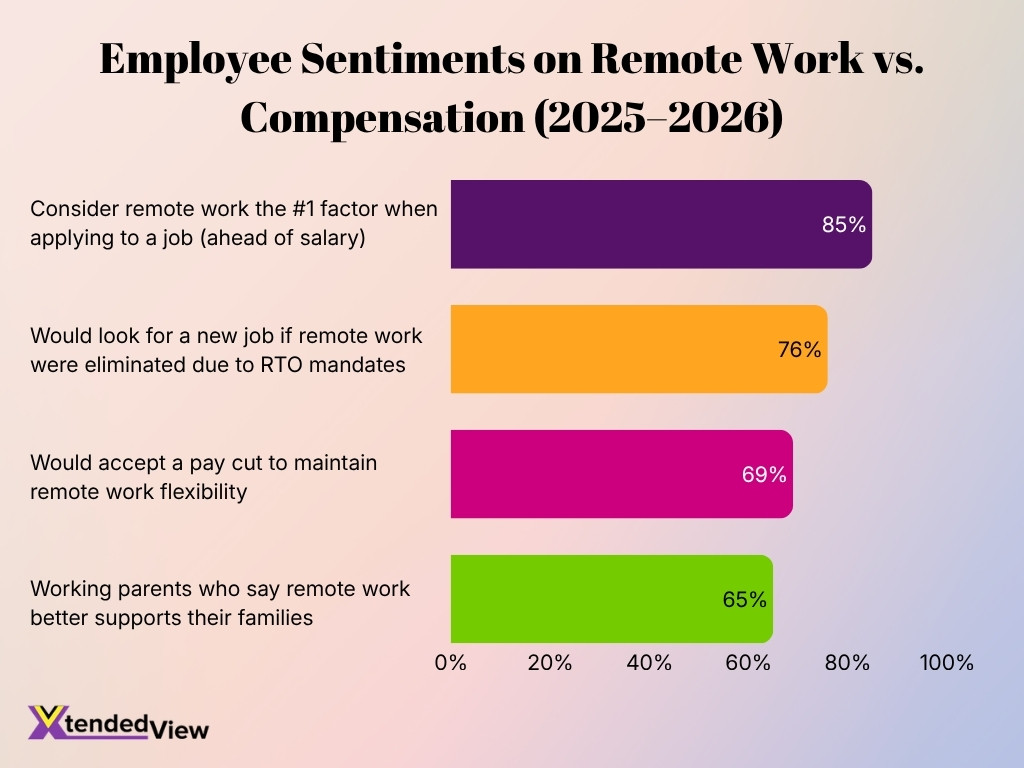
- 85% of workers consider remote work the No. 1 factor when applying for a job, ranking it ahead of salary.
- 76% of employees would consider looking for a new job if their employer eliminated remote work through return-to-office mandates.
- 69% of workers would be willing to accept a pay cut to preserve remote work flexibility.
- Among working parents, 65% say remote work better supports their families, highlighting its importance for balancing professional and family responsibilities.
- Overall, the figures suggest that remote work flexibility has become a major employment priority, with workers willing to change jobs or even sacrifice compensation to retain it.
Employer Attitudes Toward Remote Work
- In February 2025, only 12% of executives whose organizations had remote or hybrid employees said they planned to introduce a return-to-office mandate during the following 12 months.
- More than 1,000 U.S. executives participated in that survey, covering businesses of different sizes, industries and geographic regions.
- Executives reported that approximately one-third of their employees worked remotely at least one day per week in early 2025.
- Employers estimated that work from home accounted for 21.2% of all paid working days before planned return-to-office changes.
- Planned return-to-office policies were expected to lower that figure to only 20.8% of paid workdays, a decline of just 0.4 percentage points.
- More than one-quarter of companies planning a return-to-office policy still expected employees to work on-site only one to four days per week, rather than eliminating remote work completely.
- In 2026, 89% of surveyed employers required at least three office days per week, up sharply from 78% in 2025.
- Despite those requirements, employees actually averaged 2.9 office days per week in 2026, only slightly above 2.8 days in 2025 and below employers’ average expectation of 3.2 days.
- The share of employers expecting only one or two office days dropped from 23% in 2025 to 11% in 2026, showing a shift toward stronger in-person attendance requirements without eliminating hybrid work.
- Another workplace survey found that 69% of organizations expected no change to their workplace policy over the following year, while 42% expected no policy change over the next three years.
Remote Work and Employee Retention
- Nearly 46% of U.S. employees who currently work from home at least sometimes said they would be unlikely to stay with their employer if remote work were eliminated.
- Within that group, 26% said they would be very unlikely to remain at their current job if their employer stopped allowing them to work from home.
- Only 36% of remote or hybrid employees said they would be likely to remain with their employer after losing work-from-home flexibility.
- Women showed greater sensitivity to losing remote work: 49% said they would be unlikely to stay, compared with 43% of men.
- Among workers ages 18 to 49, 50% said they would be unlikely to stay if remote work disappeared, compared with 35% of employees age 50 and older.
- A randomized hybrid-work experiment found that offering two work-from-home days per week reduced employee attrition by 33% compared with five-day office work.
- Employee turnover in the control group reached 7.2%, compared with 4.8% among hybrid employees during the six-month experiment.
- Among non-managerial workers, hybrid work reduced attrition from 8.59% to 5.33%, equivalent to roughly a 40% decline.
- The retention effect was especially pronounced among women. Their attrition rate fell from 9.19% to 4.18% under the hybrid arrangement.
- Workers with longer commutes also experienced a notable retention benefit: attrition fell from 6% among office-based employees to 2.89% among hybrid workers with above-median commute times.
Remote Work Salary and Compensation Statistics
- A 2025 study of U.S. technology workers found that employees were willing to accept an average 25% pay reduction in exchange for partly or fully remote employment opportunities.
- Despite this willingness to trade pay for flexibility, researchers found no evidence that comparable remote technology jobs actually paid systematically less than in-person roles.
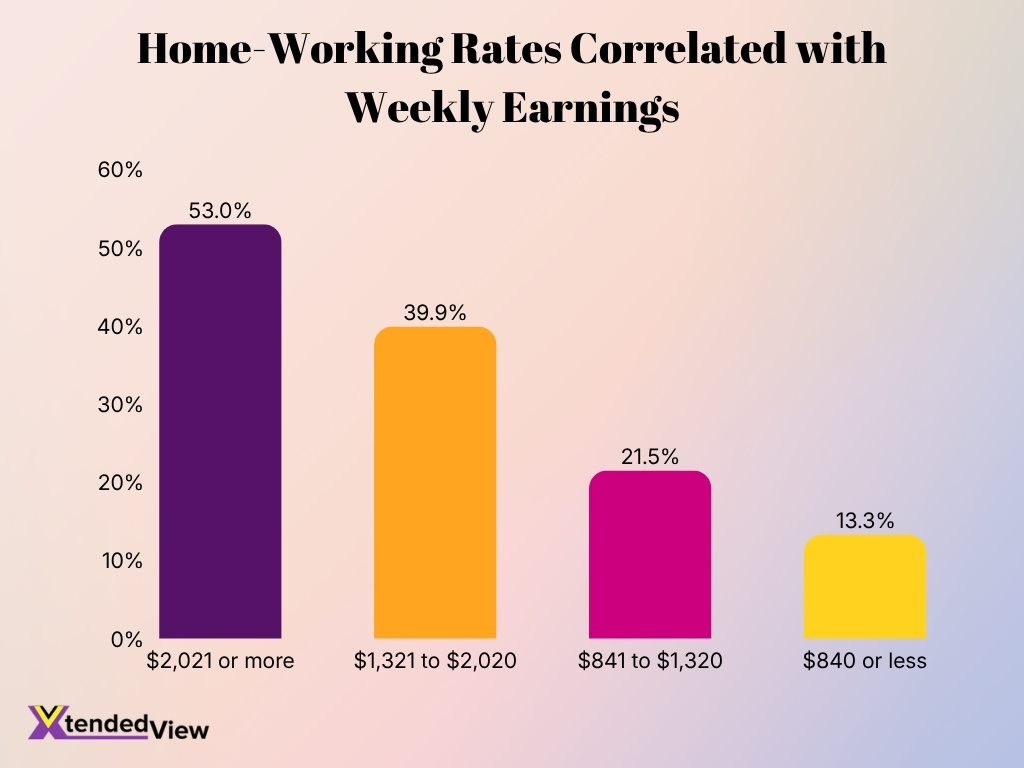
- In 2025, 53% of workers earning at least $2,021 per week worked from home on an average working day.
- Among workers earning $1,321 to $2,020 per week, 39.9% worked from home on an average day.
- The home-working rate fell to 21.5% for employees earning $841 to $1,320 per week, showing a clear relationship between earnings and access to remote-compatible jobs.
- Among workers earning $840 per week or less, just 13.3% worked from home on an average day in 2025.
- Therefore, workers in the highest earnings group were almost four times as likely to work from home on an average day as workers in the lowest earnings group.
- High earners who worked at home spent an average of 5.89 hours working there per day, compared with 4.57 hours among employees earning $840 or less.
- A large hybrid-work experiment found employees valued two work-from-home days per week at an amount comparable to roughly a 10% pay increase, illustrating the monetary value many professionals assign to flexibility.
- Work-from-home access also aligns strongly with occupational pay patterns. In 2025, 37.2% of management, professional and related workers teleworked, substantially above the 22.4% rate across the total U.S. workforce.
Remote Work and Work-Life Balance Statistics
- In the latest U.S. survey, 73% of people who worked from home at least sometimes said their arrangement improved their ability to balance work and personal life.
- Only 9% said remote or hybrid work hurt their work-life balance, while 17% said it made no meaningful difference.
- Controlled research found that employees offered two remote days per week reported significantly higher work-life balance scores than employees required to spend five days in the office.
- Hybrid employees in that experiment also reported higher overall work satisfaction, increasing from an average score of 7.84 to 8.19 out of 10.
- Employees cited reduced commuting time and commuting expenses as major benefits of hybrid work, alongside greater flexibility for handling personal responsibilities during the day.
- Remote work also creates social trade-offs. 49% of people working from home at least sometimes said their arrangement made it harder to feel connected with coworkers.
- Only 11% said remote work improved coworker connection, while 39% reported no meaningful effect on their connection with colleagues.
- Mentorship presents another challenge: 34% of remote and hybrid workers said their arrangement reduced their opportunities for mentorship at work.
- By comparison, only 13% said working remotely improved mentorship opportunities, while 53% said it had neither helped nor hurt them.
- U.S. teleworkers averaged 26.5 remote hours each week in 2025, highlighting why boundary-setting and scheduling remain important for employees whose homes function as regular workplaces.
Remote Work Cybersecurity Statistics
- Credential abuse accounted for 22% of known initial access vectors in analyzed breaches in the 2025 data, making stolen or compromised login details one of the most common ways attackers gained entry.
- Exploitation of vulnerabilities accounted for 20% of known initial access vectors, putting software and infrastructure weaknesses close behind credential compromise.
- Phishing represented another 16% of known initial access vectors, reinforcing the need for remote employees to verify emails, login pages, and unexpected requests.
- Vulnerability exploitation as an initial breach vector increased 34% year over year in the 2025 breach dataset.
- Edge devices and VPNs accounted for 22% of vulnerability-exploitation targets, up from only 3% in the previous report, an almost eightfold increase. This matters directly to organizations that rely on remote network access.
- Organizations fully remediated only about 54% of identified edge-device vulnerabilities during the period studied. The median time to complete remediation was 32 days.
- Ransomware appeared in 44% of analyzed breaches in the 2025 dataset, up from 32% the previous year.
- Ransomware involvement rose 37% year over year, even though the median ransomware payment declined from $150,000 to $115,000.
- 64% of ransomware victims did not pay the attackers, compared with 50% two years earlier, indicating a growing willingness to rely on recovery and incident-response strategies rather than payment.
- Third-party involvement in breaches doubled in the 2025 findings, increasing the importance of controlling vendor accounts, cloud platforms and external connections used by distributed teams.
Remote Team Collaboration Tool Adoption
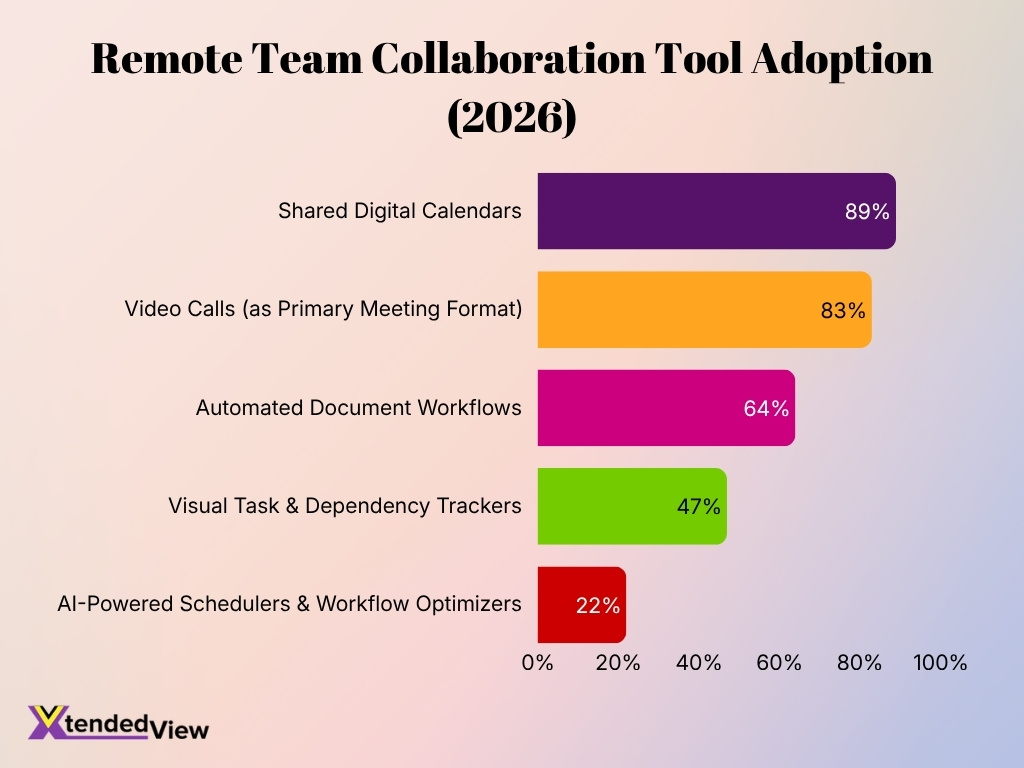
- Shared digital calendars lead remote collaboration tool adoption at 89%, showing that centralized scheduling has become a core part of distributed workforce coordination.
- Video calls are the primary meeting format for 83% of the workforce, reinforcing their critical role in maintaining real-time communication across remote teams.
- Automated document workflows have reached 64% adoption, indicating that nearly two-thirds of workers rely on automation to streamline document-related processes.
- Visual task and dependency trackers are used by 47% of the workforce, suggesting that almost half of remote teams depend on visual tools to organize projects and monitor progress.
- AI-powered schedulers and workflow optimizers have a 22% adoption rate, making them the least-used category but highlighting the emerging role of AI in remote work management.
- The 67-percentage-point gap between digital calendars (89%) and AI-powered workflow tools (22%) shows that established collaboration technologies remain far more widely adopted than newer AI-driven solutions.
Remote Work Real Estate and Cost Savings Statistics
- In 2026, 89% of surveyed employers required at least three office days per week, compared with 78% in 2025. However, actual attendance averaged just 2.9 days per week.
- Employers expected workers to average 3.2 office days per week, creating a gap of roughly 0.3 days between policy and actual attendance.
- Two-thirds of surveyed organizations, or 66%, planned either to maintain or expand their office portfolios over the following three years in 2026.
- About 38% expected their office footprint to grow, while 28% expected it to remain broadly unchanged. Another 34% anticipated contraction.
- Among companies with at least 10,000 employees, 46% planned to reduce office space in 2026, down significantly from 60% in 2025.
- Hybrid work became a less common reason for large-company downsizing. 47% of large organizations cited hybrid work as a contraction driver in 2026, compared with 67% in 2025.
- Technology companies moved in the opposite direction: 64% planned to expand their office footprint, up from 41% in 2025.
- Technology businesses accounted for 21% of major U.S. office leasing activity in the first half of 2026, reaching their highest share since 2019.
- Only 16% of organizations said they had no flexible-space strategy in 2026, down from 24% in 2025. Flexible offices increasingly help employers manage uncertain headcount and market expansion.
- U.S. office vacancy was forecast to finish 2026 at approximately 18%, while annual net absorption was projected at about 37 million square feet as office demand gradually recovered.
Remote Work Mental Health and Wellbeing Statistics
- A 2025 U.S. workforce survey found that 69% of employees worked in their preferred environment, whether that meant in-person, hybrid, or fully remote work.
- That represented an improvement from 67% in 2024, although nearly one-third of employees still worked somewhere other than their preferred location.
- In 2025, 31% of employees were not working in their preferred environment, a mismatch associated with weaker satisfaction and psychological outcomes.
- Workers’ preferences differed considerably from their actual arrangements. While 61% worked entirely in person, only 40% said an all-in-person arrangement was their preferred option.
- Hybrid work showed the opposite imbalance: 25% actually worked hybrid schedules, while 37% said hybrid work was their preferred arrangement.
- Fully remote work accounted for 14% of actual arrangements in the same survey, while 22% of workers preferred fully remote jobs.
- Interest in fully remote work nevertheless declined. The share preferring it dropped 6 percentage points, from 28% in 2024 to 22% in 2025.
- Workplace stress extended beyond location flexibility. 54% of U.S. workers said job insecurity had a significant effect on their stress levels in 2025.
- Approximately 65% of employed adults said their organization had been affected by recent government policy changes, while 20% described those effects as significant or drastic. Workers at affected organizations reported more stress and uncertainty.
- Earlier workforce data also found that 67% of employees experienced at least one burnout-related outcome during the previous month, including low energy, reduced motivation or feelings of isolation, demonstrating why remote-work wellbeing depends on workload and management as much as location.
Remote Work and AI Adoption Statistics
- In March 2026, approximately 55% of U.S. workers reported using AI for at least one work task, including writing, research, idea generation, administrative work and technical assistance.
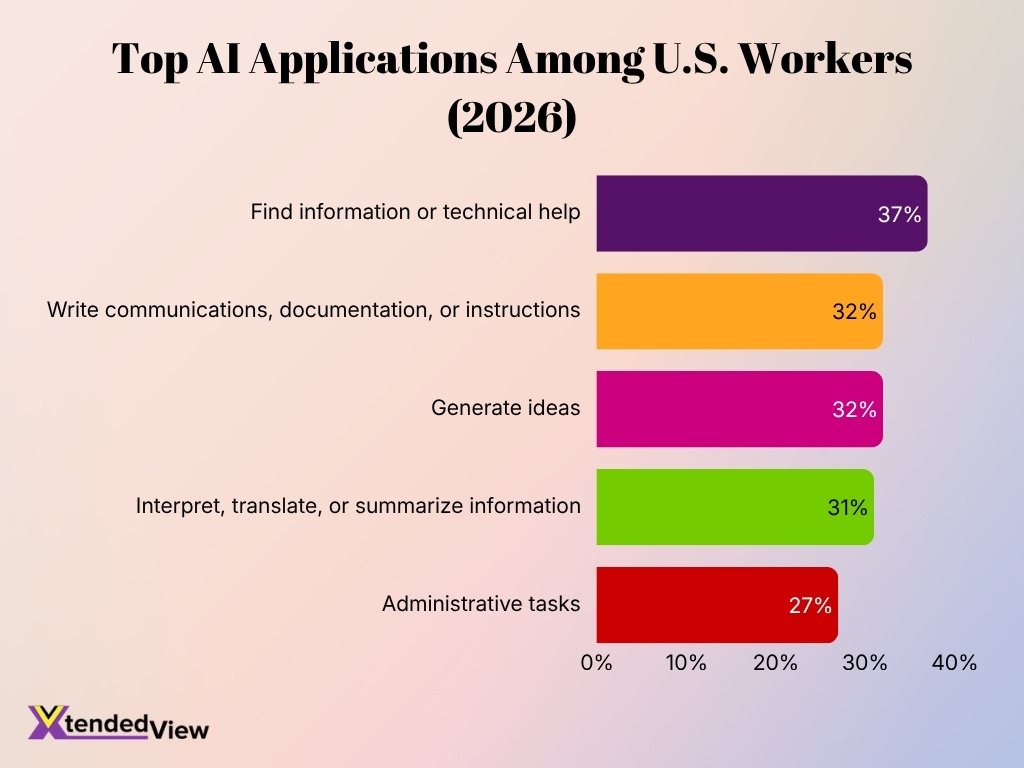
- Information and technical research represented the most common workplace AI application, with 37% of workers reporting that they had used AI to find information or technical help.
- About 32% used AI to write communications, documentation, or instructions, while another 32% used it to generate ideas.
- Approximately 31% used AI to interpret, translate, or summarize information, while 27% reported AI use for administrative tasks.
- Among employees who used AI for work, 24% used it every day during the surveyed week, while another 46% used it on at least one day but not daily.
- Among recent workplace AI users, 31% estimated that AI saved them one to two hours of work, while 25% said it saved less than one hour.
- AI use is substantially higher in jobs that can support remote work. By late 2025, 66% of employees in remote-capable roles used AI, compared with 32% of employees in jobs that could not reasonably be performed remotely.
- Frequent AI use among remote-capable workers reached 40% in late 2025, up from 13% in the second quarter of 2023. Daily AI use reached 19% within this group.
- Longitudinal 2026 research initially found that fully remote workers were 6.8 percentage points more likely to report frequent AI use than comparable on-site workers, while hybrid employees were 6.1 points more likely. However, those gaps largely disappeared after researchers accounted for differences between individual workers over time.
- AI also influences future workplace planning. 23% of organizations said AI already affected their office-space decisions in 2026, while another 30% expected meaningful effects during the next two years.
Remote Work Job Market and Hiring Trends
- During the second quarter of 2026, 87% of analyzed U.S. job postings were fully on-site, compared with 65% in the fourth quarter of 2025.
- Hybrid positions represented approximately 10% of analyzed job advertisements in the second quarter of 2026.
- Fully remote openings represented only 3% of analyzed job postings during the same quarter, indicating intense competition for location-independent vacancies.
- In addition, 36% of surveyed employers said they had increased required on-site days during the previous year.
- Despite weaker remote job advertising, 34.1 million U.S. workers teleworked in July 2026, representing 22.2% of all people at work that month.
- Roughly 17.1 million employees worked remotely for only part of their hours in July 2026, while approximately 16.9 million worked remotely for all their hours.
- Among full-time employees, 23.5% teleworked in July 2026, compared with 16% of part-time workers.
- Management, professional and related occupations remained highly compatible with remote work: 37.6% of workers in those occupations teleworked in July 2026.
- Management, business and financial occupations had an even higher telework rate of 42.5%, including 21.9% who worked remotely part of the time and 20.6% who worked remotely for all their hours.
- The wider U.S. hiring market also slowed during 2026. Job openings stood at approximately 7.27 million in July, while hires declined to about 5.05 million, making competition for attractive remote positions part of a broader environment of cautious employer hiring.
Frequently Asked Questions (FAQs)
22.2% of U.S. workers teleworked or worked from home for pay in July 2026, representing about 34.1 million people.
52% of U.S. employees in remote-capable jobs worked hybrid as of May 2026, compared with 26% fully remote and 22% on-site.
Only 3% of analyzed U.S. job postings in Q2 2026 were fully remote, while 10% were hybrid and 87% were fully on-site.
U.S. teleworkers averaged 26.6 hours per week working remotely in July 2026, equal to 67.5% of their total working hours.
By late 2025, 66% of employees in remote-capable roles used AI at work, including 40% who used it frequently and 19% who used it daily.
Conclusion
Remote work has settled into a more structured and permanent role in the labor market rather than disappearing. Hybrid schedules now dominate many remote-capable jobs, while fully remote positions remain highly desirable but increasingly competitive. Employers continue to raise office-attendance expectations, yet millions of workers still perform at least part of their jobs from home each week.
The broader trend also extends beyond workplace location. AI adoption, digital collaboration tools, flexible real estate strategies, employee preferences and retention pressures are all influencing how organizations design work. The data suggests that the future of remote work will not follow a single model. Instead, companies are building different combinations of remote, hybrid and on-site work based on job requirements, workforce needs and business priorities. For employees and employers alike, flexibility has become an established part of modern work rather than a temporary response to disruption.