


Smartphone battery performance has become increasingly important as larger displays, 5G connectivity, mobile gaming, video streaming, navigation, and AI-powered features place greater demands on devices throughout the day. By the end of 2025, 4.8 billion people were using mobile internet worldwide, while average smartphone battery capacity had moved beyond the traditional 5,000 mAh benchmark. Manufacturers are responding with larger batteries, silicon-carbon technology, faster charging, and software designed to manage power more efficiently.
These changes have practical consequences for everyday users. Commuters may simultaneously rely on GPS, 5G, and high-brightness displays, while professionals can spend hours using messaging apps, video calls, and cloud-based services. Gamers and video viewers create another demanding use case because the display, processor, graphics hardware, and network connection can remain active for extended periods. The following Mobile Battery Usage Statistics examine these behaviors alongside charging habits, battery degradation, app consumption and emerging battery technologies.
Editor’s Choice
- The global average battery capacity of smartphones shipped exceeded 5,000 mAh for the first time in 2025, after increasing 11% year over year.
- By January 2026, average smartphone battery capacity worldwide had reached approximately 5,291 mAh, illustrating how quickly manufacturers have moved toward larger batteries.
- The global average smartphone battery capacity could exceed 5,500 mAh in 2026 as manufacturers increase the use of higher-density battery technologies.
- Around 6% of smartphones shipped in 2025 used silicon-carbon batteries. The share could exceed 10% during 2026 as manufacturers expand the technology across more product lines.
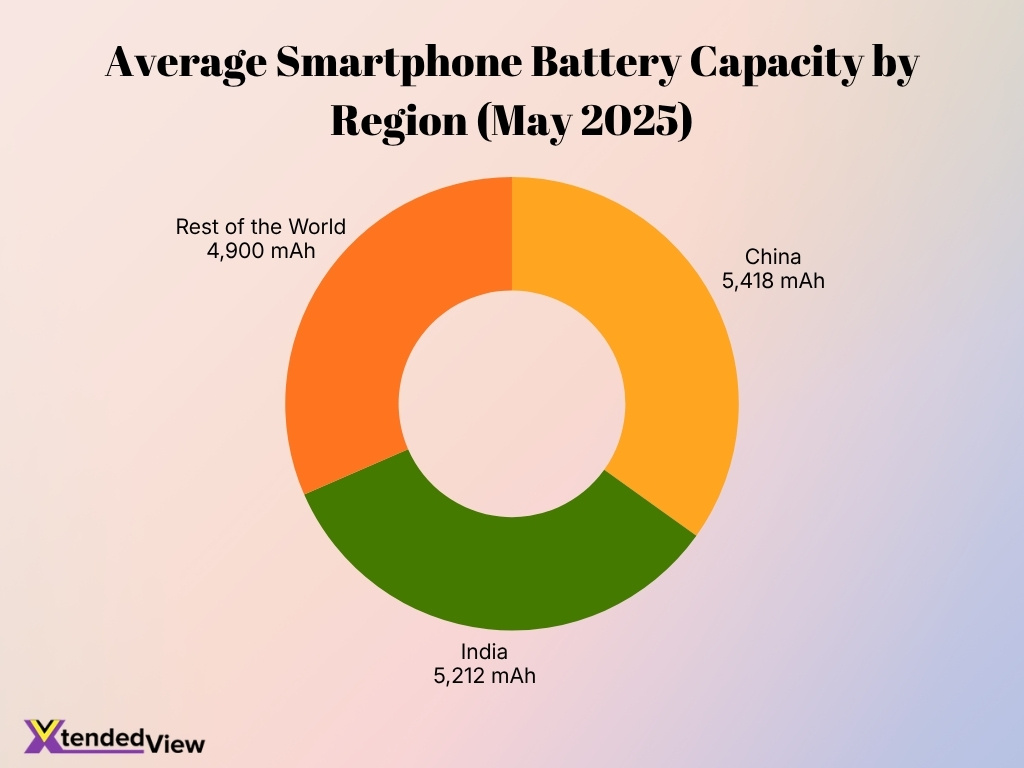
- China reached an average smartphone battery capacity of 5,418 mAh in May 2025, 518 mAh higher than the average across the rest of the world.
- Mobile users spent a combined 4.2 trillion hours in apps during the year covered by the 2025 mobile-market report, illustrating the scale of activity that ultimately depends on mobile-device power.
- Display settings can produce substantial differences in power demand. Research on OLED smartphones found that switching from light to dark mode at typical indoor brightness saved about 3% to 9% of total phone power, while savings reached 39% to 47% at 100% brightness.
Recent Developments
- Smartphone batteries passed an important milestone in 2025: average capacity across shipments grew 11% year over year and exceeded 5,000 mAh for the first full year.
- The transition accelerated late in the year. Q3 2025 became the first quarter when average shipped smartphone battery capacity moved above 5,000 mAh, and Q4 maintained the level.
- Silicon-carbon technology has helped manufacturers increase capacity without making phones proportionally thicker. Roughly 6% of smartphones shipped in 2025 incorporated silicon-carbon batteries.
- The technology could spread much further in 2026, with silicon-carbon-equipped smartphones projected to represent more than 10% of global shipments.
- Chinese smartphone manufacturers have moved particularly quickly. In May 2025, phones with batteries of 6,000 mAh or more represented 35% of China’s market, compared with just 9% a year earlier.
- Average battery capacity in China reached 5,418 mAh in May 2025, an 11% year-over-year increase. Meanwhile, average capacity across the rest of the world grew 3% during the same period.
- Software is also taking a more active role in power management. On supported iPhones, Adaptive Power can reduce brightness, limit background activity, and activate Low Power Mode at 20% battery when the system predicts heavier-than-normal usage.
- Network optimization remains another battery-management tool. Current iPhones can use 5G Auto to switch to LTE when 5G does not provide a noticeable performance benefit, reducing unnecessary power use.
- The need for these improvements continues to expand with mobile connectivity. By the end of 2025, 4.8 billion people, or 59% of the global population, used mobile internet on their own devices.
Global Smartphone Battery Usage Overview
- Average smartphone battery capacity worldwide surpassed 5,000 mAh in 2025, establishing a higher baseline for the industry entering 2026.
- Battery capacity increased 11% year over year across smartphones shipped during 2025, showing that manufacturers increasingly use capacity as a way to support demanding displays, connectivity, and apps.
- China stood well above the international average in May 2025. Its smartphones averaged 5,418 mAh, compared with roughly 4,900 mAh across the rest of the world.
- The difference between China and the rest of the world reached 518 mAh in May 2025, reflecting faster adoption of high-capacity silicon-carbon designs among Chinese manufacturers.
- India also moved beyond the traditional 5,000 mAh benchmark. Average smartphone battery capacity in the country stood at 5,212 mAh in 2025.
- At the brand level, vivo, including iQOO, increased its average shipped battery capacity by 18% in 2025, taking the figure above 6,000 mAh.
- HONOR also averaged more than 6,000 mAh in 2025, representing a 12% year-over-year increase in average battery size.
- OPPO, including OnePlus, recorded average battery capacity in the 5,500-6,000 mAh range in 2025, following approximately 17% annual growth.
- The scale of battery-dependent mobile activity continues to increase. The mobile ecosystem supported 5.8 billion unique subscribers in 2026, representing roughly 70% of the world’s population.
- At the end of 2025, global 5G connections exceeded 2.7 billion, adding another dimension to power management as smartphones balance network speed, radio activity, and battery endurance.
Average Daily Battery Consumption Patterns
- Daily battery drain depends heavily on how long the display remains active, which apps run, and whether the device relies on Wi-Fi or cellular connectivity. Current iPhone battery reporting therefore compares each day’s consumption with the user’s previous seven days of activity.
- Smartphone energy consumption continues even when users are not actively looking at the screen. A large-scale Android study covering more than 80,000 smartphones found substantial standby consumption because apps and system processes remain active in the background.
- In that large-scale dataset, chat and internet applications represented more than 70% of total app usage time, showing why communication and browsing behavior can shape daily battery patterns.
- Internet applications and games together accounted for 67% of application energy consumption in the same research, considerably more than traditional phone functions.
- Voice calls represented only 6% of usage time and 5% of energy consumption in the study, illustrating how smartphones have shifted from voice-first devices toward app-driven computing platforms.
- Network conditions can change daily and drain even when usage remains similar. Strong Wi-Fi or cellular signals require less energy, while weak coverage makes the phone work harder to maintain connectivity.
- Screen brightness can materially alter consumption during active use. Current battery guidance identifies high display brightness as a high-energy setting and recommends reducing brightness when longer runtime matters.
- Notifications add another source of repeated daily consumption because incoming alerts can wake the device. Reducing unnecessary notification activity can therefore cut the number of battery-consuming wake events.
- Heavy-use days increasingly trigger software-based intervention. Adaptive Power can limit background activity and slightly reduce display brightness after learning a user’s charging and usage patterns for at least seven days.
Battery Usage by App Category
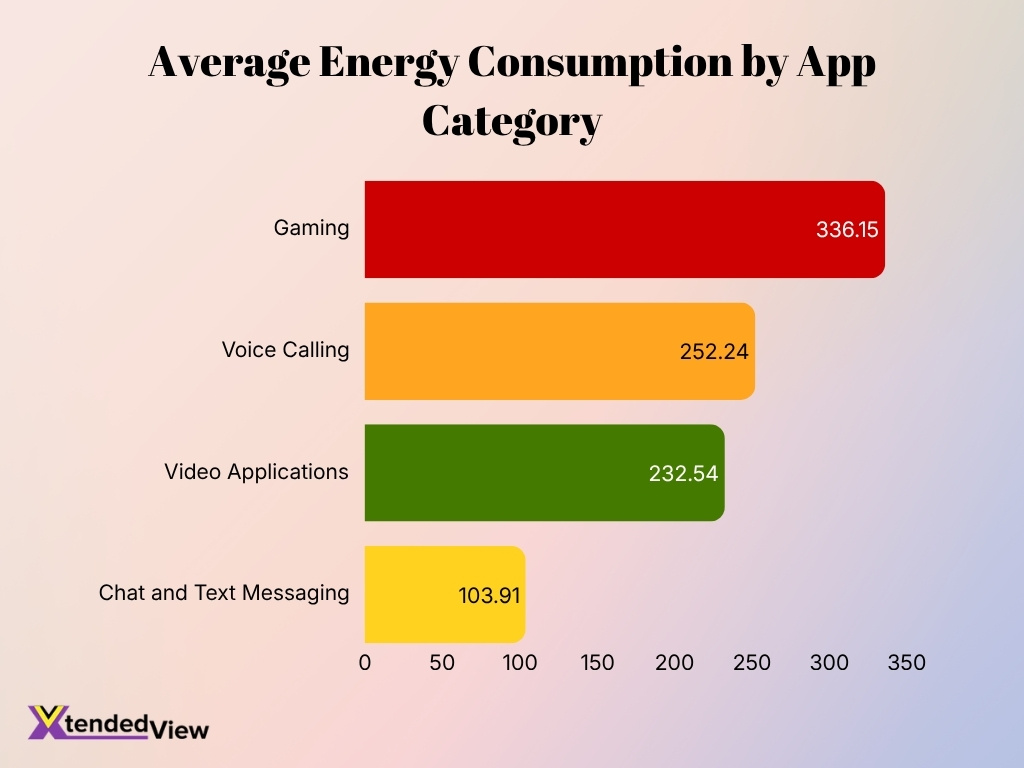
- Games rank among the most energy-intensive smartphone applications. One large-scale Android study measured an average energy consumption rate of 336.15 mA for gaming, the highest rate among the categories examined.
- Voice calling produced an average consumption rate of approximately 252.24 mA in the same research, making sustained calls another comparatively demanding activity.
- Video applications averaged approximately 232.54 mA, reflecting the combined energy requirements of the screen, processor, network connection, and video decoding.
- Chat tools and text messaging averaged 103.91 mA, substantially below gaming, video, and voice calling in the study.
- The difference between the lowest- and highest-consuming app categories reached roughly three to four times, demonstrating why two people with similar screen time can finish a day with very different battery levels.
- Another real-world energy study found that games and personalization applications consumed roughly 2.1 times as much daily energy as social media and news apps.
- Games also placed unusually high demands on graphics hardware: GPU activity represented an average of 12.9% of gaming-app energy consumption in that study.
- Background consumption varies sharply between categories. Background activity represented 76.9% of weather-app energy use, compared with 32.5% for health apps, 39% for productivity apps, and only 5.3% for education apps in the same dataset.
- App-category differences matter even more because games remain the world’s largest download category. Games generated 34.54 billion downloads in 2025, representing 30.82% of global app downloads in one market analysis.
- Entertainment applications recorded another 10.04 billion downloads in 2025, indicating the scale at which video and other media-heavy workloads can influence aggregate smartphone energy demand.
Screen Time and Display Battery Drain
- The display remains one of the most important sources of smartphone power consumption. Component-level research has estimated that the display accounts for around 27.4% of smartphone energy use on average.
- Screen energy does not contribute equally across app categories. A real-world study found that the screen accounted for as much as 73.6% of energy consumption in medical apps and 68.3% in education apps.
- Media applications showed a different profile, with screen energy representing about 22.3% of total consumption, as networking, processing and other components took a larger share.
- A 2025 experimental comparison found that Dynamic AMOLED technology delivered energy reductions of up to 72.49% compared with PLS TFT LCD under the study’s test conditions.
- Dark mode produces relatively modest savings under typical indoor conditions. Tests across four OLED smartphones found average total-phone power savings of 3% to 9% when switching from light mode to dark mode under normal auto-brightness settings.
- However, the same tests found much larger benefits at maximum brightness. Dark mode reduced power consumption by approximately 39% to 47% at 100% brightness, making display theme more relevant during outdoor use.
- Brightness itself can have an even larger effect. Researchers found that reducing OLED brightness from 100% to 50% cut display power draw by roughly 10 times under their test conditions.
- Refresh rate can also influence endurance. In a controlled browsing test on a 4,510 mAh smartphone, enabling 120 Hz instead of 60 Hz reduced battery life by about 10%.
- On another 5,000 mAh flagship tested under browsing and scrolling workloads, battery life fell from 12 hours, 23 minutes at 60 Hz to 10 hours, 2 minutes at 120 Hz, a decline of nearly 20%.
- Power-saving modes increasingly target the display for this reason. Low Power Mode on compatible devices reduces screen brightness and limits ProMotion displays to 60 Hz, while Adaptive Power can make smaller brightness adjustments automatically during high-consumption days.
Mobile Gaming Battery Consumption
- Mobile gaming remained one of the heaviest smartphone workloads entering 2026. In 2025, users downloaded mobile games about 95,000 times per minute, while mobile game revenue reached $82 billion. Longer gaming sessions keep the display, CPU, GPU and network active simultaneously, increasing battery demand.
- Global users spent about 3.5 trillion hours playing mobile games in 2024, up 8% year over year. The number of gaming sessions also increased 12%, expanding the amount of time smartphones spend under sustained graphics workloads.
- The pattern shifted somewhat in 2025. Worldwide mobile gaming still accounted for roughly 444.6 billion hours during the year, even as games faced growing competition from social, short-form video and AI apps for users’ attention.
- Mobile game downloads reached roughly 50 billion in 2025, despite falling about 7% from the previous year. This volume confirms that gaming remains one of the largest recurring battery-intensive activities across smartphones.
- Experimental smartphone research has measured gaming at approximately 336 mA, higher than the consumption rates reported for video, voice calling and chat in the same study. Graphics processing represents an important part of this demand because games continuously render interactive content.
- Gaming demand varies considerably by user. A 2025 survey of 1,550 smartphone users found that 32% spent four to six hours per week gaming, while 74% of surveyed Gen Z users spent at least six hours per week.
- Modern operating systems explicitly classify graphics-heavy and highly interactive games among activities that can shorten battery life. Consequently, reducing gaming time provides more potential power savings than closing lightweight apps that spend most of the day idle.
- Battery requirements continue to rise alongside gaming performance. The 2025 generation of smartphone processors introduced substantially stronger GPUs; for example, one major 2025 handset’s GPU delivered more than 2 times the performance of its 2021 counterpart while relying on hardware and software efficiency improvements to maintain endurance.
Social Media and Messaging App Battery Impact
- Social and messaging apps matter to battery life because users open them repeatedly throughout the day. In a 2025 U.S. survey, 84% of adults used YouTube, 71% used Facebook, 50% used Instagram, 37% used TikTok and 32% used WhatsApp.
- About 37% of U.S. adults opened Facebook several times per day in 2025, while 33% said the same about YouTube. Frequent sessions repeatedly activate the display, processor and network connection rather than concentrating energy consumption into one continuous session.
- TikTok had particularly high engagement among younger users: roughly half of U.S. adults ages 18 to 29 used the service daily in 2025, compared with 5% of adults ages 65 and older.
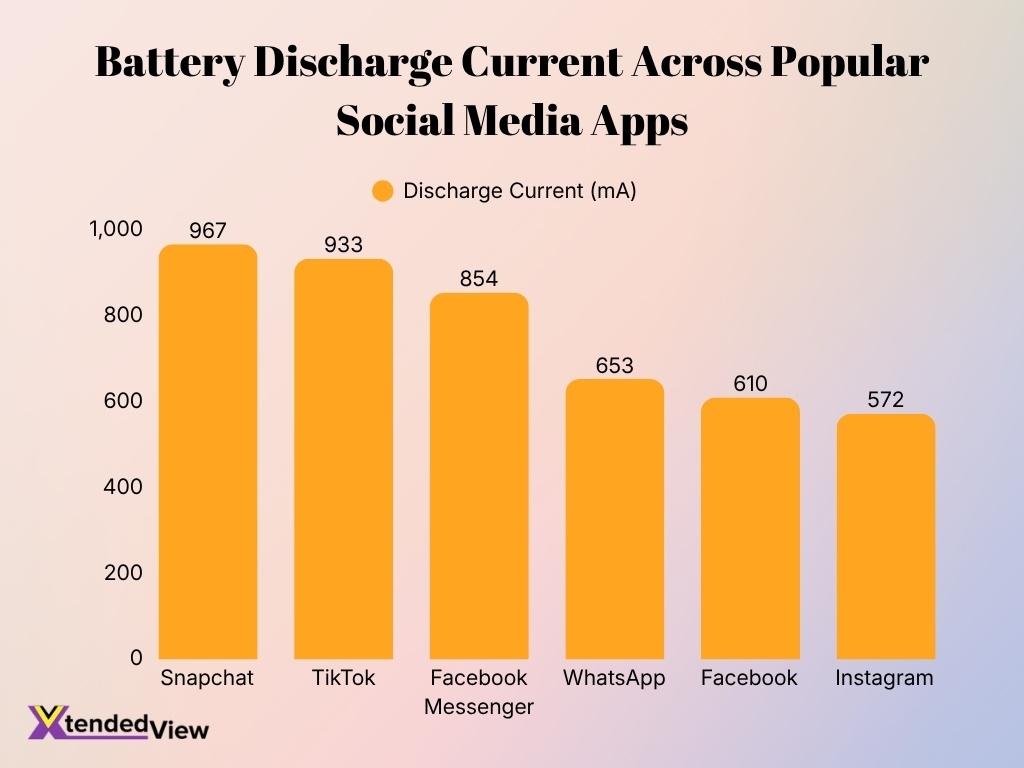
- Controlled tests of six social apps found large differences in power demand. On one Motorola test phone, mean discharge current reached 967 mA for Snapchat, 933 mA for TikTok, 854 mA for Facebook Messenger, 653 mA for WhatsApp, 610 mA for Facebook and 572 mA for Instagram.
- Snapchat also pushed the test handset’s battery temperature to approximately 45 degrees Celsius during about 20 minutes of use. Researchers identified Snapchat as the most energy- and temperature-intensive of the six tested apps on that particular handset.
- Messaging frequency also affects power demand. A controlled WhatsApp and Telegram experiment tested 0, 10, 25 and 50 incoming messages per minute and found that device energy consumption generally increased with the number of messages received.
- Video calling creates a much larger load than text messaging because it runs the camera, display, audio hardware and network together. On one tested Motorola device, Facebook Messenger video calling averaged 814 mA, compared with 934 mA for WhatsApp and 1,087 mA for Zoom.
- App design can produce meaningful battery differences even when users perform the same task. In the same video-calling experiment, the least efficient codec combinations required up to 35% more energy than apps using H.264 video with Opus audio.
- Background behavior adds another layer of consumption. Current Android battery-management guidance recommends keeping per-app optimization enabled because unrestricted apps can run more frequently while users are not actively using them, consuming additional battery power.
4G vs. 5G Network Battery Usage
- Large-scale measurements have found that smartphones connected to 5G can experience 6% to 11% more battery drain than devices operating over 4G LTE, although the difference varies by chipset, network configuration, signal strength, and user activity.
- One flagship chipset recorded 31% battery drain on 5G versus 25% on 4G LTE during the measurement period, a 6-percentage-point gap.
- Another chipset recorded 34% drain on 5G and 27% on 4G, producing a 7-percentage-point difference under the same analysis.
- A Samsung flagship chipset showed 38% battery drain on 5G versus 31% on LTE, again creating a 7-point difference. These results illustrate why the processor and modem matter alongside the network generation itself.
- The first-generation Tensor platform produced one of the larger gaps measured: approximately 40% drain over 5G versus 29% over 4G, an 11-percentage-point difference.
- Newer silicon reduced some of this penalty. The later Tensor G2 recorded roughly 38% drain on 5G and 28% on LTE, while newer flagship processors from several manufacturers also improved 5G efficiency compared with their predecessors.
- Network architecture helps explain the difference. On networks where a smartphone maintains LTE alongside a 5G data connection, multiple network connections can remain active simultaneously, which increases energy consumption and can raise device temperature.
- Signal conditions also influence the result, so 5G does not carry a fixed battery penalty. Weak cellular coverage can force a smartphone radio to work harder, while newer modems, 5G Standalone networks, and efficient power-management systems can narrow the gap.
- The underlying evidence also requires context: one widely cited 4G-versus-5G dataset compared battery levels across parts of the day rather than controlling every variable such as screen-on time, brightness, and app activity. Therefore, the 6%-11% range works best as a real-world observational benchmark, not a universal laboratory result.
Location Services and GPS Battery Consumption
- GPS remains one of the most power-intensive smartphone sensors because the receiver must acquire satellite signals and repeatedly calculate location. A recent standardized sensor study again identified high-accuracy GPS as the highest-power sensor among the smartphone sensors referenced in its comparison.
- One classic controlled experiment found that a smartphone running GPS dropped from full charge to 79% after one hour, while the same phone with GPS disabled retained 94%. The 15-percentage-point difference illustrates the potential cost of continuous high-accuracy positioning.
- During that experiment, a typical GPS invocation drew approximately 400 mW while obtaining a location lock and about 600 mW during the sensing and reporting period.
- The same measurements found that the GPS locking period lasted around 4 to 5 seconds, followed by approximately 10 to 12 seconds of sensing and reporting. Frequent location requests can repeatedly trigger this energy-intensive sequence.
- An adaptive location-detection experiment reduced GPS-related energy consumption by an average of 49.5% by selecting between GPS and cell-based localization according to application requirements, user movement, and remaining battery.
- Selectively tracking satellites can also reduce demand. Experimental GPS receiver research achieved energy savings of approximately 20.9% to 23.1% while maintaining positioning accuracy of around 12 meters in its test environment.
- Higher positioning capability can carry an energy cost. Tests of dual-frequency GNSS found approximately 37% higher power consumption outdoors than a single-frequency implementation.
- Indoors, the same dual-frequency GNSS study measured approximately 28% higher power consumption than the single-frequency comparison device.
- Long navigation sessions remain a practical battery concern in 2026. Current Android guidance specifically identifies extended navigation and prolonged GPS use as activities users should reduce when they need to preserve battery life.
Background App Activity and Battery Drain
- Background apps can consume power even when their interfaces are not visible. Current Android battery controls therefore allow users to identify individual apps with high background usage and restrict or optimize those applications.
- Battery Saver directly addresses this issue by limiting or turning off background activity. The trade-off is that some apps, visual effects, network connections, and notifications can respond more slowly.
- Background networking represents another measurable drain. Android’s technical-quality monitoring flags apps when users experience more than 50 MB of background mobile-network traffic per day during qualifying battery sessions.
- Wi-Fi scanning can create a similar problem. The platform tracks battery sessions in which an app performs more than four background Wi-Fi scans per hour, providing developers with a metric for identifying excessive scanning.
- Research into smartphone communication has estimated that network activity can represent 40% or more of an app’s non-idle energy consumption in some workloads. Frequent background connections can therefore matter even when individual transfers appear small.
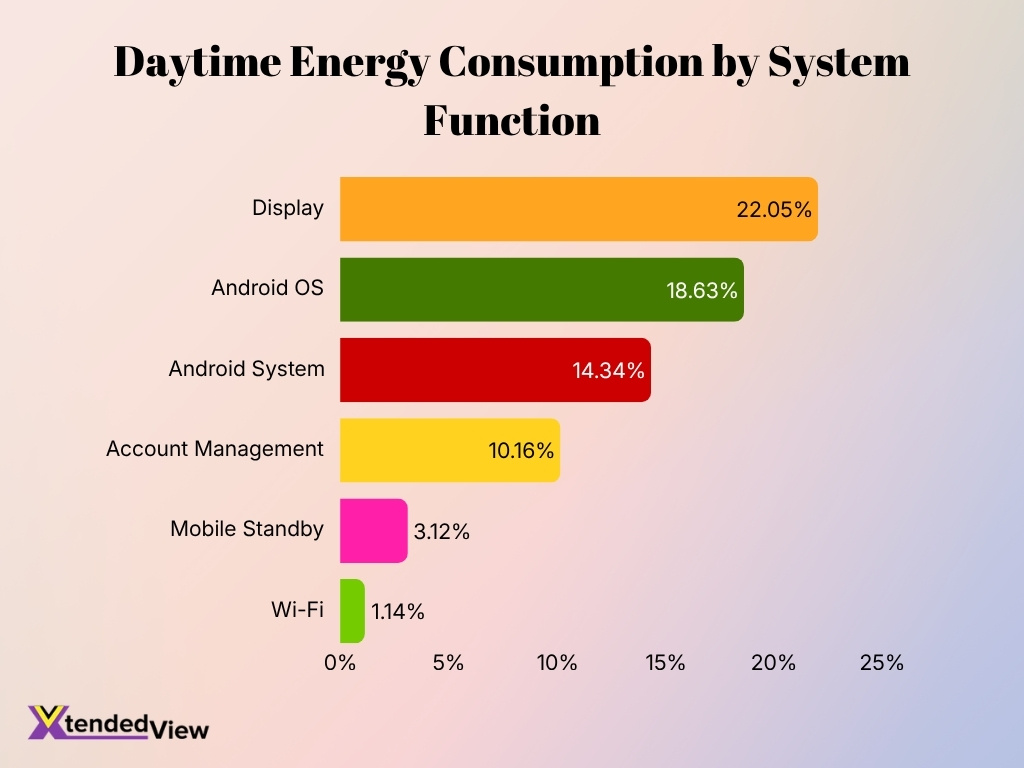
- A real-world smartphone energy experiment attributed 18.63% of daytime energy consumption to the Android OS, 14.34% to the Android System, and 10.16% to account-management processes in its test configuration. The results show that visible foreground apps do not account for every percentage point of battery drain.
- In the same experiment, the display represented 22.05% of daytime energy consumption, while mobile standby accounted for 3.12% and Wi-Fi for 1.14%. Actual shares vary substantially with device, network, and user behavior.
- Adaptive battery management reduces unnecessary activity by learning how users interact with applications. The system can delay notifications or reduce background performance for less frequently used apps to extend runtime.
- Users can now inspect battery consumption at a granular level. Current Pixel software, for example, separates battery usage by app and system function, helping users distinguish background software drain from display, connectivity and other system-level consumption.
Video Streaming and Multimedia Battery Usage
- Video streaming combines several battery-intensive components: the display, wireless radio, CPU or dedicated video decoder, and audio hardware. Current Android battery guidance specifically identifies streaming video or music and prolonged video viewing as activities that can reduce battery life.
- Controlled multimedia research measured approximately 1.22 W during YouTube video playback over Wi-Fi on one Android test device. CPU utilization during the workload reached about 62%.
- The same experiment recorded roughly 60% CPU utilization when YouTube video ran over the mobile network, showing that video playback can maintain substantial processor activity regardless of the connection type.
- Network choice can alter streaming energy demand. Research examining more than 500 smartphone streaming sessions across YouTube, Vimeo, Dailymotion and Netflix measured energy use over Wi-Fi, HSPA and LTE, finding that both playback behavior and the wireless interface contribute to total consumption.
- Current 2026 hardware demonstrates how efficiency improvements translate into longer media endurance. One flagship launched for 2026 pairs a 5,000 mAh battery with up to 31 hours of video playback under the manufacturer’s test conditions.
- A major 2025 flagship offers up to 30 hours of local video playback and 27 hours of streamed playback, showing a three-hour difference between the two manufacturer-rated workloads.
- Its larger Pro Max counterpart reaches up to 37 hours of video playback and 33 hours of streamed playback, illustrating the endurance available from current premium smartphones.
- Generational efficiency gains have also been substantial. The standard 2025 model increased its rated video endurance to 30 hours, eight hours more than its previous generation, despite also introducing a high-refresh-rate display.
- Video calling can consume considerably more power than passive playback because it adds continuous camera capture and two-way communication. In one experiment, mean discharge current during video calls ranged from 814 mA to 1,330 mA across eight tested apps on a Motorola handset.
Charging Habits and Battery Health Statistics
- Charging behavior increasingly centers on battery longevity rather than simply reaching 100%. Current devices can cap charging at 80%, reducing the time lithium-ion batteries spend at a high state of charge.
- On current Pixel phones, Adaptive Charging needs about 14 days to learn a user’s routine. During long or overnight charging sessions, the system can delay the final stage so the battery reaches 100% closer to the time the user normally disconnects it.
- iPhone charging optimization also requires at least 14 days of learning and at least nine charging sessions lasting five hours or longer in a given location before the feature can activate reliably.
- iPhone 15 and later models allow users to choose a charge ceiling between 80% and 100% in 5-percentage-point increments. The phone can also recommend a limit, such as 95%, based on individual charging behavior.
- Pixel’s 80% charging option periodically allows a complete charge for calibration. The device needs to reach 100% every 10th cycle and remain connected for at least 30 minutes afterward to maintain accurate capacity estimates.
- Automatic battery protection can become more aggressive under stressful conditions. Supported Pixel devices can restrict charging to roughly 70%-80% after prolonged charging at high temperatures or when they remain plugged in continuously for several days.
- A U.S. consumer survey found that 69% of respondents charged their smartphones at least twice per day, highlighting how frequent top-ups have become part of normal phone use.
- Overnight charging was the most common routine in the same U.S. survey, reported by 64% of respondents. Meanwhile, more than one-third worried that frequent or overnight charging could damage their battery.
- Wired charging remained the dominant method at 88%, while 28% of respondents regularly used wireless charging and 19% used power banks. In addition, 46% reported charging in a vehicle.
- Charging location reflects how central smartphones have become to daily routines: 93% charged at home, 45% in a car or on public transportation, 32% at work, and 8% during flights.
Battery Life by Smartphone Brand and Model
- The iPhone 17 Pro Max is rated for up to 37 hours of video playback and 33 hours of streamed video playback, placing it above the standard model in manufacturer-rated media endurance.
- The standard iPhone 17 provides up to 30 hours of video playback and 27 hours of streamed playback. Its rated video endurance increased eight hours compared with the preceding standard generation.
- The 2026 Galaxy S26 Ultra retains a 5,000 mAh typical battery and carries a manufacturer rating of up to 31 hours of video playback.
- Its 2025 predecessor, the Galaxy S25 Ultra, also used a 5,000 mAh battery with a rating of up to 31 hours of video playback. The unchanged headline figures show that year-over-year battery improvements do not always come from increasing capacity.
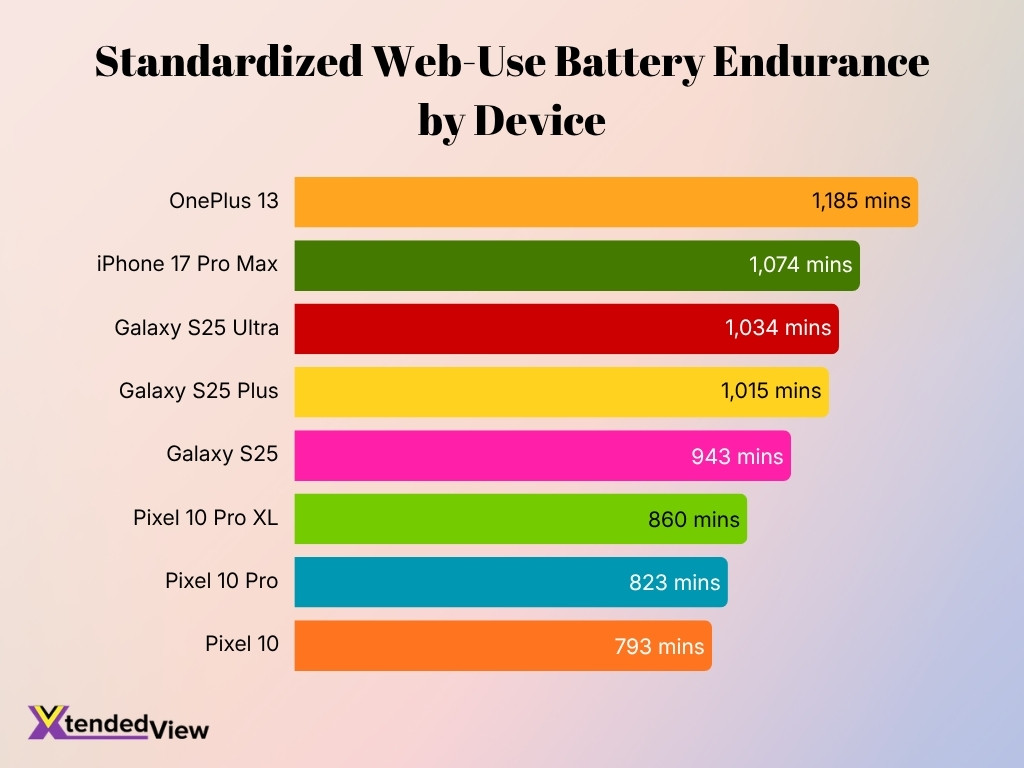
- Independent standardized web-use testing measured the iPhone 17 Pro Max at 17 hours, 54 minutes, compared with 17 hours, 17 minutes for the iPhone 16 Pro Max.
- In the same test methodology, the Galaxy S25 Ultra reached 17 hours, 14 minutes, while the Galaxy S25 Plus reached 16 hours, 55 minutes and the standard Galaxy S25 reached 15 hours, 43 minutes.
- The OnePlus 13 reached 19 hours, 45 minutes in that test with its 6,000 mAh battery, demonstrating how higher-capacity silicon-carbon-era designs can translate into longer real-world endurance.
- Google’s Pixel 10 family produced results ranging from 13 hours, 13 minutes to 14 hours, 20 minutes: 13:13 for Pixel 10, 13:43 for Pixel 10 Pro and 14:20 for Pixel 10 Pro XL.
- Battery capacity alone does not predict runtime. In the same independent test, a 5,088 mAh iPhone 17 Pro Max reached 17:54, a 5,000 mAh Galaxy S25 Ultra reached 17:14, and the 6,000 mAh OnePlus 13 reached 19:45. Processor efficiency, modem behavior, display characteristics and software power management all contribute to the final result.
Battery Degradation Over Time
- Lithium-ion batteries lose usable capacity as charge cycles accumulate. For iPhone 15 and later models, the battery design target is 80% of original capacity after 1,000 complete cycles under ideal conditions.
- The comparable target for iPhone 14 and earlier models is 80% after 500 complete cycles. The newer design target therefore doubles the specified cycle count before reaching the same 80% benchmark.
- Pixel 8a and later batteries also carry a target of retaining up to 80% capacity for about 1,000 cycles, after which battery replacement is recommended.
- Older Pixel generations have a lower specified cycle benchmark. Pixel 3 through Pixel 8 Pro and Pixel Fold batteries should retain up to 80% capacity for approximately 800 cycles when charged as recommended.
- A charge cycle does not necessarily mean charging from zero to 100% in one session. Using 50% of the battery, recharging it and later consuming another 50% adds up to one complete cycle.
- Temperature remains an important variable in long-term degradation. Current Pixel battery guidance recommends charging in a cool environment of about 25°C, or 78°F, using a compatible charger.
- Keeping a lithium-ion battery fully charged for extended periods can also increase long-term strain. This is why adaptive charging systems delay reaching 100% until shortly before users typically disconnect their phones.
- Battery degradation affects more than runtime. As lithium-ion cells chemically age, their ability to deliver peak power can decline, which may eventually affect device performance as well as the time available between charges.
- One current silicon-carbon smartphone provides a useful benchmark for emerging technology: its manufacturer says the 7,300 mAh battery should retain more than 80% health after four years of use.
Fast Charging Adoption and Usage Trends
- Fast charging continues to shorten the time users need to remain connected to a wall outlet. The iPhone 17 can reach 50% in about 20 minutes with a compatible 40W-or-higher wired adapter.
- Wireless charging is closing part of that gap. The same phone can reach approximately 50% in 30 minutes with a compatible 30W-or-higher adapter and MagSafe charging equipment.
- Short top-ups now provide hours of practical use. A 10-minute charge on the iPhone 17 can provide up to eight hours of manufacturer-rated video playback under specified conditions.
- The Galaxy S26 Ultra increased wired charging power from 45W to 60W and can reach approximately 75% charge in 30 minutes. Its predecessor reached about 69% during the same period.
- Fast charging is even more aggressive among silicon-carbon Android phones. The OnePlus 15 combines a 7,300 mAh battery with 80W wired charging in the U.S. and Canada and up to 120W in international markets.
- Wireless fast charging is expanding through standardized hardware. Qi2 25W launched in July 2025, increasing maximum charging power by nearly 70% compared with the original 15W Qi2 specification.
- Qi2 25W can take a compatible smartphone from zero to 50% in about 30 minutes, putting standardized wireless charging closer to the speeds of many wired charging systems.
- Qi2 adoption expanded quickly before the 25W update. By January 2025, more than 1,100 Qi2 products had received certification in roughly one year, a sixfold faster adoption rate than the previous Qi generation.
- The broader Qi ecosystem now includes more than 13,000 certified products, giving fast wireless charging a substantial installed accessory base as manufacturers expand Qi2 support.
- The underlying USB charging standard already supports far more power than phones typically consume. USB Power Delivery can provide up to 240W, compared with a previous ceiling of 100W, leaving room for future devices to negotiate higher power levels when appropriate.
Battery Anxiety and Low Battery Behavior
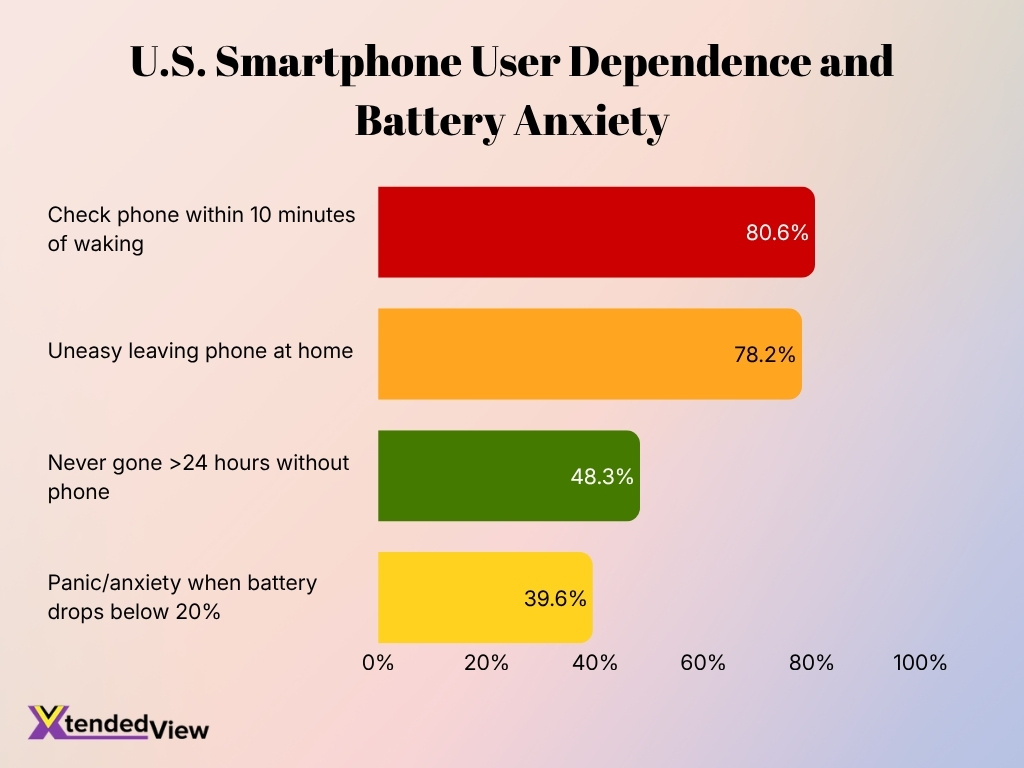
- Low-battery anxiety remains measurable among U.S. smartphone users. A 2025 survey found that 39.6% of Americans felt panic or anxiety when their phone battery dropped below 20%.
- The same research found that 78.2% of Americans felt uneasy about leaving their phone at home, indicating that battery concerns sit within a broader dependence on constant smartphone access.
- Around 80.6% checked their phone within 10 minutes of waking, which helps explain why having sufficient battery power at the beginning of the day matters to many users.
- About 48.3% said they had never gone longer than 24 hours without their phone, further illustrating why losing access because of an empty battery can create practical and emotional discomfort.
- Low-battery anxiety also appears outside the U.S. In a consumer study in India, 72% of respondents experienced anxiety at 20% battery or below.
- Overall, 65% of surveyed Indian smartphone users reported some form of emotional discomfort because of battery drain. The most common individual response was feeling worried or anxious, selected by 28%.
- Battery concerns can begin before a phone approaches zero. The same study reported that 9 in 10 users experienced a higher degree of low-battery anxiety when their battery was between 30% and 50% compared with the 0%-30% range.
- Users frequently continue using their phones during charging: 87% of respondents in that study reported doing so, while about half said they charged their phones twice each day.
- Battery performance can influence replacement decisions. About 60% of respondents said they were likely to replace their smartphones to obtain better battery performance.
- Battery life also influences new-device purchasing. A 2025 survey of more than 1,000 smartphone buyers found battery life had become the top specification priority in the sub-INR 20,000 segment, while average smartphone capacity in that market reached 5,212 mAh.
Future Trends in Smartphone Battery Technology
- Larger batteries are moving rapidly into mainstream smartphones. Devices with batteries of 6,000 mAh or more represented 29% of global smartphone sales in January 2026, compared with 10% in January 2025.
- That means the 6,000 mAh-plus segment nearly tripled its global sales share in one year, providing one of the clearest signs that battery capacity has become a competitive smartphone specification.
- Silicon-carbon chemistry sits at the center of this shift. Among the 10 leading smartphones with at least 6,000 mAh batteries in January 2026, six used silicon-carbon cells.
- Chinese manufacturers currently lead high-capacity battery deployment. All of the top 10 smartphones in the 6,000 mAh-plus segment in January 2026 came from Chinese brands, and six of those models were sold only in China.
- Silicon-rich battery designs are already moving beyond 6,000 mAh. One internationally available flagship launched with a 7,300 mAh silicon-based battery containing 15% silicon, alongside fast wired and wireless charging.
- The technology is also pushing smartphone capacity toward five-digit figures. By 2026, commercially announced silicon-carbon phones ranged from around 6,000 mAh to 10,000 mAh, showing how manufacturers can increase energy storage without relying solely on thicker conventional graphite cells.
- Battery demand remains closely tied to purchase decisions. In a 2025 consumer survey, 13% of respondents identified battery life as the feature for which they were willing to pay more, behind processor speed at 16% but ahead of several other specifications.
- Consumers also want large batteries without oversized devices. In a 2025 survey of more than 2,000 young smartphone buyers, more than half said they were unwilling to compromise on battery life and processor performance when considering a compact smartphone.
- Charging technology will develop alongside battery chemistry. Qi2 25W increased standardized wireless power by nearly 70%, while USB Power Delivery supports up to 240W at the specification level. Future smartphone charging will therefore depend on balancing speed, heat management, and long-term cell health rather than simply increasing wattage.
- Software will play a larger role as batteries become denser and devices run more AI workloads. Adaptive charging, 80% limits, and predictive power management already use learned behavior to reduce battery stress, pointing toward more automated battery management in future smartphones.
Frequently Asked Questions (FAQs)
The global average reached approximately 5,291 mAh, about 400 mAh higher than a year earlier.
Smartphones with batteries of at least 6,000 mAh accounted for 29% of global smartphone sales in January 2026, up from 10% in January 2025.
6 of the top 10 best-selling smartphones with batteries of at least 6,000 mAh used silicon-carbon technology in January 2026.
Qi2 25W can charge a compatible smartphone from 0% to 50% in about 30 minutes, while providing nearly 70% more charging power than the original 15W Qi2 specification.
A 2025 U.S. survey found that 39.6% of Americans felt panic or anxiety when their smartphone battery fell below 20%.
Conclusion
Mobile battery statistics point to a clear transition toward larger-capacity batteries, higher-density cells, faster charging and smarter power management. Smartphones with batteries of 6,000 mAh or more represented 29% of global sales in January 2026, while silicon-carbon technology continued expanding across high-capacity devices. At the same time, manufacturers are using adaptive charging, charge limits, and software-based optimization to address battery longevity as well as daily runtime.
The data also shows why capacity alone does not determine battery life. Display brightness and refresh rate, 5G connectivity, gaming, video streaming, GPS, background activity, and individual charging habits can all change how quickly a smartphone consumes energy. Battery health also declines gradually with charge cycles, making temperature control and optimized charging increasingly relevant for consumers who keep their phones for several years.
Looking ahead, smartphone battery development will increasingly combine energy density, charging speed, hardware efficiency, and intelligent software rather than focusing on a single specification. As silicon-carbon cells spread and power-management systems become more adaptive, users can expect manufacturers to pursue longer practical runtime while keeping devices relatively thin and protecting long-term battery health.