



Tablets continue to play a central role in digital life, bridging the gap between smartphones and laptops. Consumers use tablets for streaming, gaming, reading, and online shopping, while businesses rely on them for field operations, retail point-of-sale systems, and mobile productivity. Recent device upgrades, education initiatives, and growing demand for portable computing have helped the tablet market recover after several years of slower growth. Explore the statistics below to understand how the global tablet industry is evolving.
Editor’s Choice
- Global tablet shipments reached approximately 162 million units in 2025, representing a 9.8% year-over-year increase.
- Worldwide tablet shipments totaled 147.6 million units in 2024, up 9.2% from 2023 levels.
- Apple shipped 17.1 million iPads in Q4 2025, capturing 41.9% market share during the quarter.
- Global tablet shipments increased 13.1% year over year in Q2 2025, reaching 38.3 million units.
- Apple sold roughly 56.9 million tablets in 2024, remaining the world’s largest tablet vendor.
- Samsung shipped approximately 27.8 million tablets in 2024, ranking second globally.
- IDC forecasts tablet shipments will decline 7.6% in 2026 after the strong rebound experienced in 2024 and 2025.
- Q4 2025 tablet shipments reached 44 million units globally, making it the strongest quarter of the year.
- Xiaomi recorded one of the fastest growth rates in 2024, with tablet shipments rising 73% year over year.
Recent Developments
- The tablet market recorded its second consecutive year of recovery in 2025, with shipments rising nearly 10% globally.
- Product refreshes from major manufacturers helped drive a 13.1% increase in Q2 2025 shipments.
- Government-backed education projects contributed significantly to tablet demand during 2025.
- China’s subsidy programs supported tablet purchases and accelerated replacement cycles throughout 2025.
- Apple’s entry-level iPads accounted for nearly 52% of the company’s quarterly tablet sales in Q4 2025.
- Samsung’s tablet shipments declined 7.5% year over year in Q4 2025 despite maintaining the second position globally.
- Q3 2025 marked the seventh consecutive quarter of tablet market expansion, signaling sustained demand recovery.
- Lenovo achieved approximately 23% annual growth in tablet shipments during Q3 2025.
- IDC reported that consumer demand remained stronger than commercial demand across several tablet markets in late 2025.
Tablets Market Growth Outlook
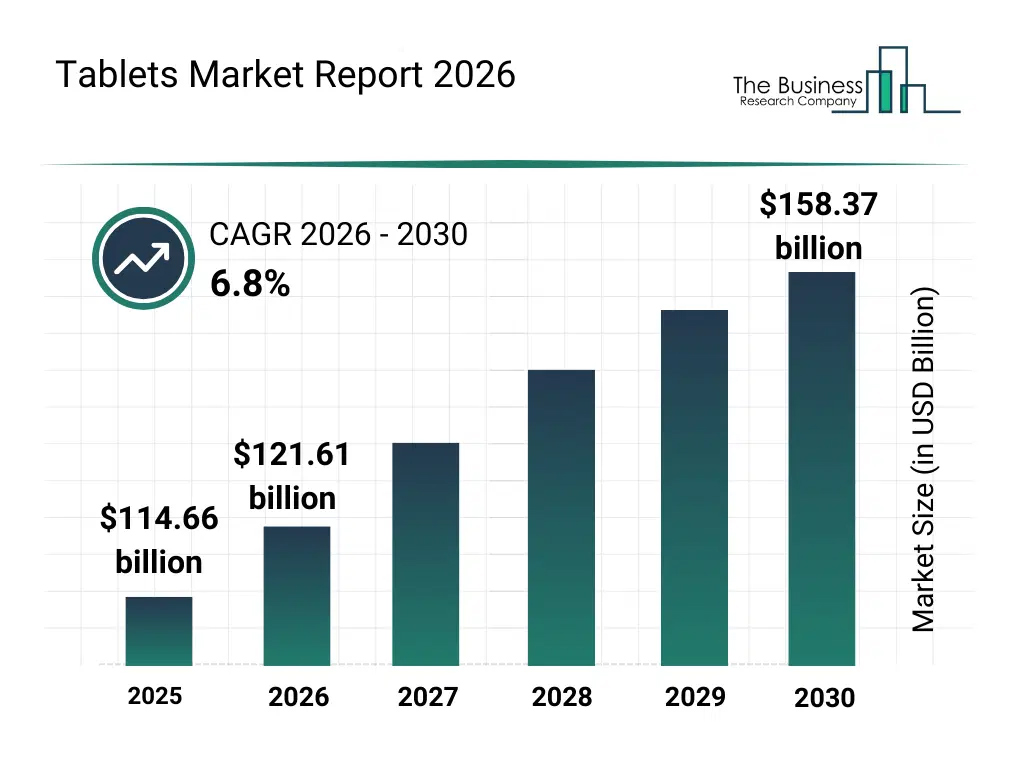
- The global tablets market is projected to grow from $114.66 billion in 2025 to $158.37 billion by 2030.
- The market is expected to add nearly $43.71 billion in value between 2025 and 2030.
- In 2026, the tablet market is forecast to reach $121.61 billion, showing steady year-over-year growth.
- The market is projected to grow at a 6.8% CAGR from 2026 to 2030.
- Tablet demand is expected to rise consistently across the forecast period, with market value increasing every year from 2025 to 2030.
- By 2030, the tablet market is expected to be around 38% larger than its 2025 value.
- The strongest long-term growth indicator is the projected jump from $121.61 billion in 2026 to $158.37 billion in 2030.
- The data suggests tablets will remain a major device category despite competition from smartphones, laptops, and hybrid devices.
- Growth may be supported by rising use of tablets in education, remote work, healthcare, digital media, and enterprise productivity.
- The projected 6.8% CAGR signals a healthy growth phase for tablet manufacturers, software providers, and accessory brands.
Global Tablet Shipment Statistics
- Global tablet shipments totaled 147.6 million units in 2024.
- Shipments increased to roughly 162 million units in 2025.
- Q4 2025 shipments reached 44 million units, up 9.8% year over year.
- Q4 2024 shipments reached 39.9 million units worldwide.
- Q2 2025 shipments totaled 38.3 million units, rising 13.1% annually.
- Q2 2024 shipments reached 34.4 million units, representing 22.1% annual growth.
- Apple shipped approximately 16.9 million tablets in Q4 2024.
- Samsung shipped roughly 7.1 million tablets in Q4 2024.
- Apple shipped 17.1 million units in Q4 2025, extending its market leadership.
- Samsung shipped 6.4 million tablets in Q4 2025.
Tablet Revenue and Sales Statistics
- The global tablet market is valued at approximately $59.9 billion in 2026.
- Market value is projected to reach $79.3 billion by 2033.
- The tablet market is forecast to grow at a 4.1% CAGR between 2026 and 2033.
- Apple sold nearly 56.9 million tablets during 2024, generating the largest share of industry revenue.
- Apple’s tablet shipments increased 8% year over year in Q4 2025.
- iPad shipments rose 16.5% year over year during Q4 2025, according to Omdia data.
- Premium tablet models contributed a growing share of revenue as consumers upgraded to higher-performance devices.
- Entry-level tablets remained strong volume drivers, accounting for more than half of Apple’s quarterly tablet sales mix.
- Increased education procurement and consumer replacement cycles boosted tablet sales volumes throughout 2025.
Tablet Market Share by Brand
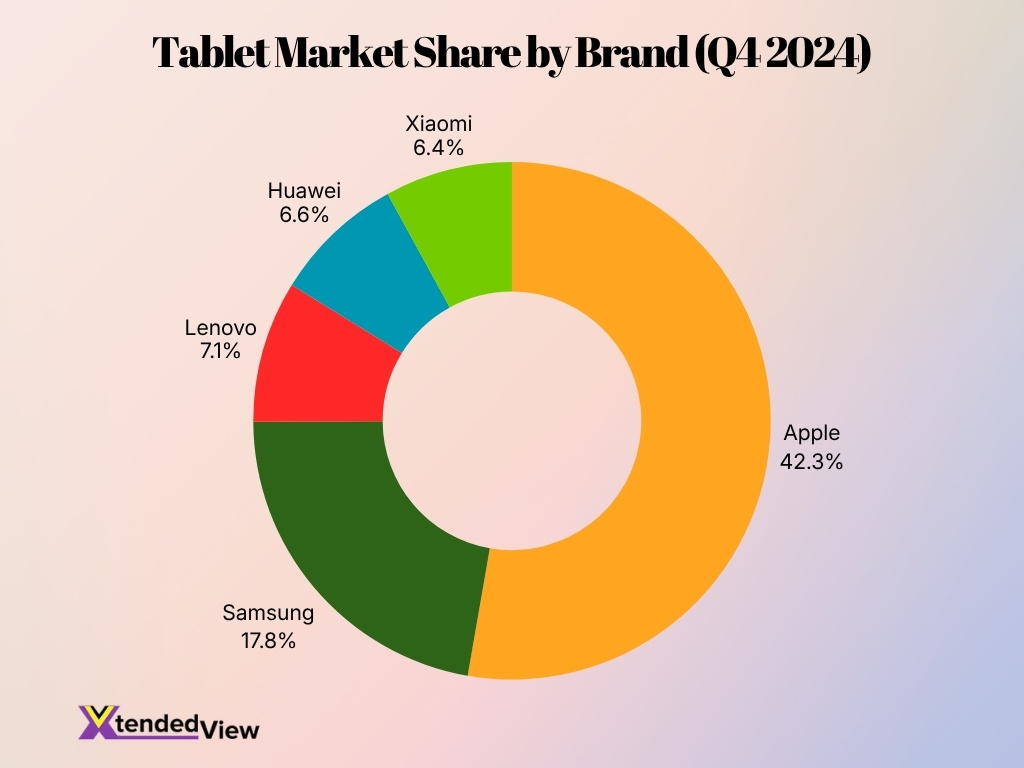
- Apple held 42.3% market share in Q4 2024.
- Samsung accounted for 17.8% market share in Q4 2024.
- Lenovo captured 7.1% market share during Q4 2024.
- Huawei represented 6.6% of global shipments in Q4 2024.
- Xiaomi achieved 6.4% market share in Q4 2024 after rapid expansion.
- Apple’s share increased to 41.9% in Q4 2025, maintaining a dominant lead.
- Samsung remained the second-largest vendor with 6.4 million shipments in Q4 2025.
- Apple shipped about 56.92 million units globally in 2024, nearly double Samsung’s volume.
- Xiaomi recorded the fastest annual growth among leading tablet brands in 2024, expanding shipments by 73%.
- Apple’s share of the global tablet market approached 45% by early 2026, according to industry estimates.
Tablet Market Share by Operating System
- Android remained the leading tablet operating system globally in 2025, accounting for approximately 56% to 58% of active tablet devices worldwide.
- iPadOS represented roughly 42% to 44% of the global tablet installed base during 2025.
- Android powered more than 90 million tablet shipments worldwide in 2025, supported by Samsung, Lenovo, Xiaomi, Huawei, and other vendors.
- Apple shipped approximately 56.9 million iPads in 2024, strengthening iPadOS adoption globally.
- Android tablets dominated emerging markets due to the wider availability of devices priced below $300.
- iPadOS continued to lead the premium tablet segment, particularly devices priced above $600.
- Educational institutions in North America reported stronger adoption of iPadOS compared with most other operating systems.
- Android maintained leadership in government procurement programs across Asia-Pacific and Latin America.
- The gap between Android and iPadOS narrowed slightly in premium productivity use cases because of growing demand for Apple Silicon-powered iPads.
- Industry analysts expect Android to retain shipment leadership through 2026, while iPadOS continues generating a larger share of tablet revenue.
Tablet Market Share by Region
- Asia-Pacific held the largest market share with 38% of global tablet shipments in 2025.
- North America accounted for approximately 25% of worldwide tablet shipments during 2025.
- Europe contributed nearly 22% of the overall global tablet demand in 2025.
- China experienced a 12% YoY increase in tablet shipments driven by digital learning in 2025.
- India saw a 40% rise in educational tablet adoption under state-backed programs in 2025.
- The United States led single-country revenue with over $25 billion in tablet sales in 2025.
- Latin America achieved an 8% growth rate as affordable Android tablets gained popularity in 2025.
- Middle East and Africa saw a 5% shipment increase fueled by government mobility projects in 2025.
- Educational deployments accounted for 28% of total tablet shipments across Asia-Pacific in 2025.
- North American buyers had the highest average selling price at over $580 per device in 2025.
Tablet Ownership By Age In The United States
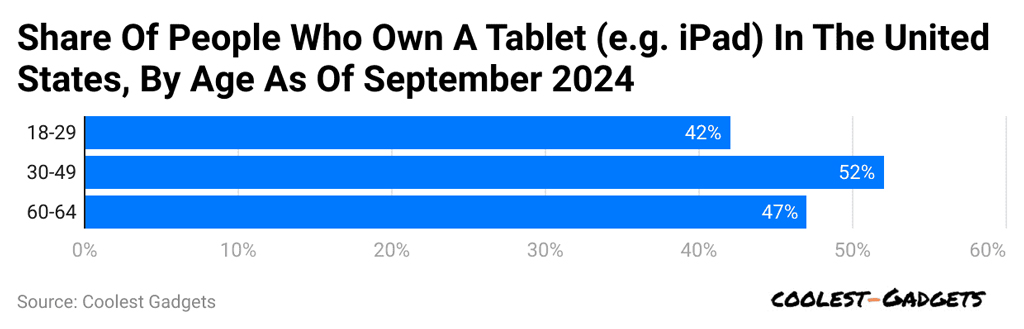
- Tablet ownership is highest among Americans aged 30 to 49, with 52% owning a tablet as of September 2024.
- The 60 to 64 age group also shows strong tablet adoption, with 47% reporting tablet ownership.
- Younger adults aged 18 to 29 have the lowest tablet ownership rate among the listed groups, at 42%.
- The data shows that middle-aged adults are more likely to own tablets than younger adults.
- Tablet ownership among people aged 30 to 49 is 10 percentage points higher than among those aged 18 to 29.
- The gap between the 30 to 49 group and the 60 to 64 group is relatively small, at 5 percentage points.
- The findings suggest tablets remain useful for work, entertainment, reading, video streaming, and family use among adults.
- Overall, tablet ownership is fairly strong across all age groups shown, ranging from 42% to 52%.
Tablet Usage Statistics by Generation
- Gen Z users dedicate 74% of their tablet time to streaming video and casual gaming.
- Millennials represent the largest demographic, comprising 45% of all tablet users globally.
- Over 70% of Millennial tablet owners engage with entertainment apps on a weekly basis.
- Generation X users complete 58% of their online shopping on tablets due to convenience.
- Nearly 65% of Baby Boomers prefer tablets over smartphones for their larger screen sizes.
- Gen Z users consume 40% more tablet video content daily compared to previous generations.
- Millennials drive 60% of premium tablet purchases, strongly favoring higher-end models.
- Approximately 48% of Generation X owners use their tablets primarily for work-related activities.
- Over 72% of older generations utilize tablets frequently for news consumption and video calling.
- Educational applications see a 37% higher usage rate among Gen Z and younger demographics.
Tablet Usage Statistics
- Video streaming is the leading global activity, with over 70% of tablet users engaging regularly.
- Web browsing consistently ranks among the top 3 most popular tablet activities worldwide.
- More than 50% of tablet owners utilize their devices for reading digital books and magazines.
- Tablet gaming continues its rapid growth, capturing 16% of app sessions among users aged 18 to 34.
- Roughly 40% of remote workers increasingly rely on tablets as secondary productivity devices.
- Health and fitness applications experienced a 15% increase in tablet user engagement during 2025.
- Tablet users spend an estimated average of 4 to 5 hours weekly browsing social media platforms.
- Exactly 88% of consumers use their tablets as companion screens while watching television.
- Productivity and note-taking apps saw a 20% usage growth driven by hybrid work environments.
Weekly Tablet Usage Shows Moderate Engagement Among Users
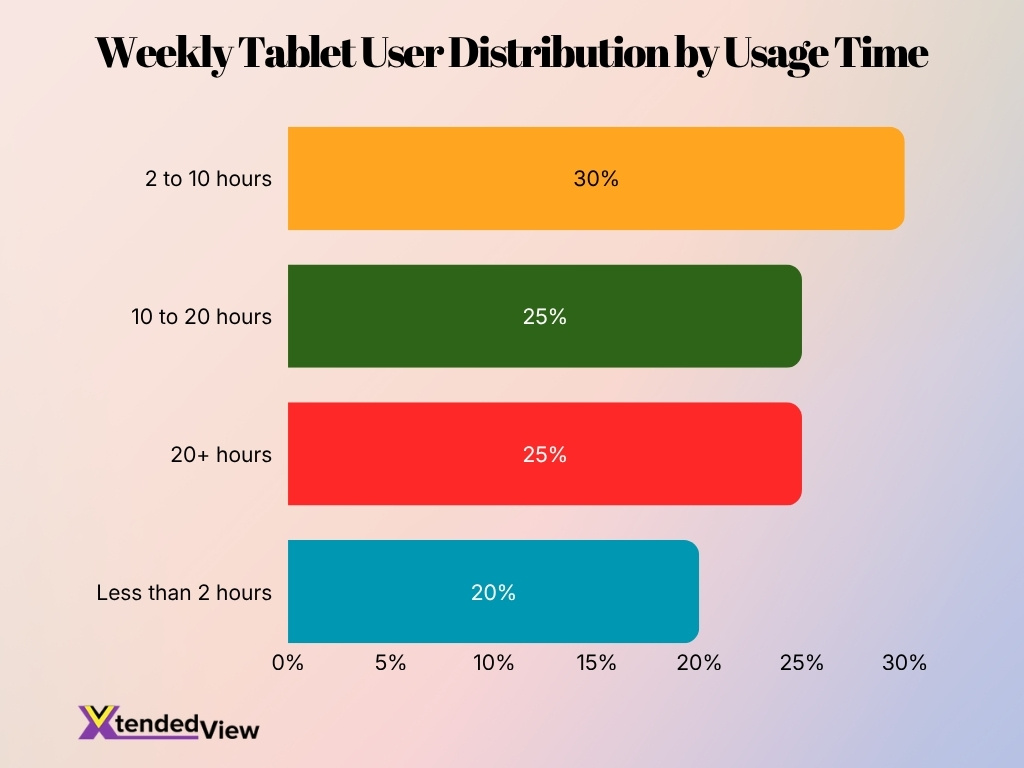
- 30% of tablet users spend 2 to 10 hours per week on tablets, making it the largest usage group.
- 25% of users spend 10 to 20 hours weekly, showing that one in four tablet users have regular mid-level engagement.
- Another 25% of users spend 20+ hours per week, indicating a strong base of heavy tablet users.
- Combined, 50% of users spend 10 hours or more per week on tablets.
- Only 20% of users use tablets for less than 2 hours weekly, making light users the smallest group.
- The data suggests that tablets remain useful for entertainment, browsing, reading, work, and learning activities.
- Since 80% of users spend at least 2 hours per week on tablets, the device still holds a meaningful role in digital behavior.
- The equal share of 10 to 20 hours and 20+ hours users shows balanced demand between moderate and heavy tablet usage.
- Overall, weekly tablet usage is concentrated among active users, with most users spending several hours on the device each week.
Tablet E-commerce and Shopping Statistics
- More than 40% of tablet owners completed an online purchase within the past 30 days.
- Tablet shoppers generate an average order value that is roughly 20% higher than smartphone users.
- Retail conversion rates for tablet traffic hit 3.3%, easily beating out standard mobile phone averages.
- Tablets currently drive nearly 15% of total holiday-season e-commerce sales across the United States.
- Over 60% of all tablet purchases fall into the fashion, electronics, and home goods categories.
- Roughly 55% of shoppers use their tablets extensively for product research before buying.
- Tablet users view an average of 4.5 product pages per visit before making a purchase decision.
- Global tablet commerce revenue is expected to exceed $64 billion in total sales by 2026.
Tablet App and Technical Usage Statistics
- Entertainment apps maintained market dominance with top platforms reaching 415.6 million global downloads in 2025.
- The demand for productivity applications surged, pushing performance-oriented tablets to account for 81% of total quarterly shipments.
- The reliance on cloud-based collaboration tools contributed heavily to the global tablet market reaching a $78.4 billion valuation in 2025.
- AI-powered productivity features became standard in premium models, utilizing neural engines capable of 38 trillion operations per second.
- Premium tablet devices offering built-in stylus functionality grew exponentially, capturing nearly 80% of total shipments in key markets.
- Driven by enterprise usage, the detachable tablet and keyboard accessory segment is expanding at an 8.55% compound annual growth rate.
- As mobile networks improved globally, 5G-enabled tablet shipments recorded a robust 21% year-over-year growth throughout 2025.
- Upgraded configurations accommodating heavier storage and 12GB RAM saw a massive 1,359% year-over-year expansion.
- Seamless multitasking capabilities drove the popularity of premium displays, capturing up to 85% of large-screen tablet shipments.
- Enterprise users heavily scaled their managed mobile hardware, highlighted by single institutional deployments of over 350,000 connected tablets.
Tablet Screen Resolution Stats Worldwide
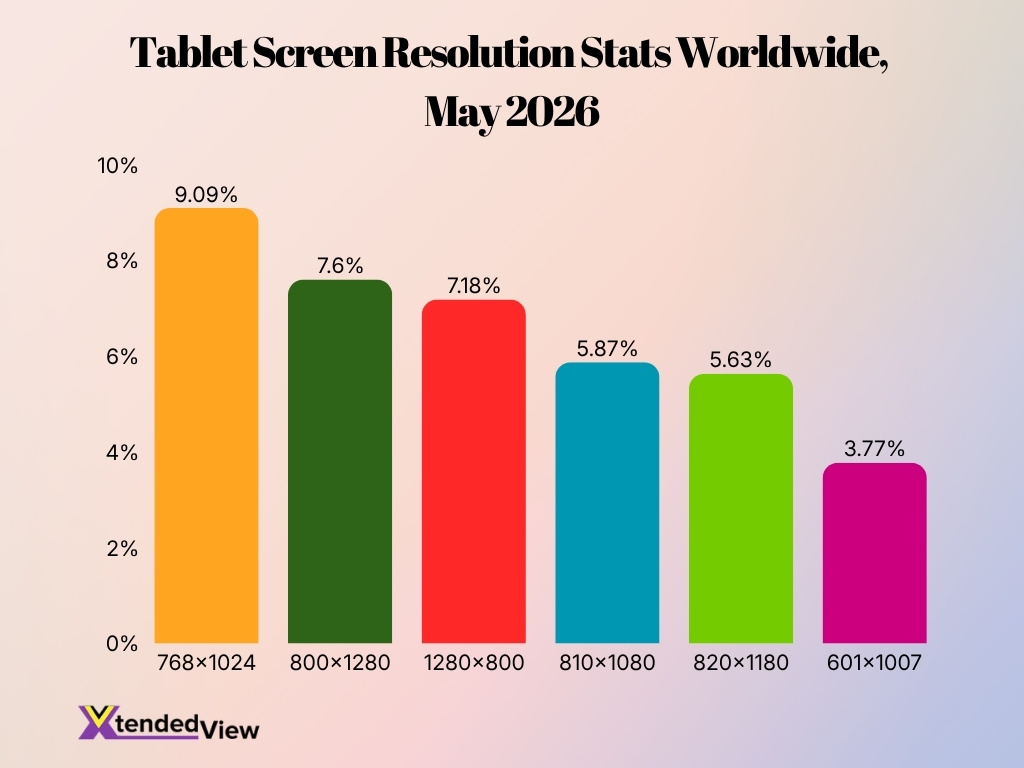
- 768×1024 is the leading tablet screen resolution worldwide, accounting for 9.09% of usage share in May 2026.
- 800×1280 ranks second with a 7.6% global share, showing strong adoption among tablet users.
- 1280×800 holds the third position with 7.18%, making it another widely used tablet resolution.
- The top three resolutions, 768×1024, 800×1280, and 1280×800, together represent 23.87% of worldwide tablet screen resolution usage.
- 810×1080 captures 5.87% of the global tablet resolution share, placing it in the mid-range usage category.
- 820×1180 follows closely with 5.63%, showing a small gap of only 0.24 percentage points compared with 810×1080.
- 601×1007 records the lowest share among the listed resolutions, with 3.77% worldwide usage.
- The data shows that tablet screen resolution usage is highly fragmented, with no single resolution crossing the 10% share mark.
- Resolutions near 768×1024 and 800×1280 remain important for tablet website optimization and responsive design planning.
- Publishers, developers, and advertisers should optimize tablet layouts for multiple screen sizes, as the top six resolutions range from 3.77% to 9.09%.
iPad Statistics
- Apple shipped approximately 56.9 million iPads in 2024, maintaining its position as the world’s largest tablet vendor.
- iPad shipments reached 17.1 million units in Q4 2025, representing a 41.9% global tablet market share.
- Apple recorded roughly 16.5% year-over-year shipment growth during Q4 2025.
- Entry-level iPads accounted for nearly 52% of Apple’s tablet shipments in Q4 2025.
- Apple held approximately 38.6% of global tablet shipments throughout 2024.
- The iPad remained the leading tablet brand in North America, Western Europe, Japan, and Australia during 2025.
- Premium iPad models powered by Apple Silicon continued gaining traction among creative professionals and business users.
- iPad Pro and iPad Air models generated a significant share of industry tablet revenue despite lower shipment volumes than entry-level models.
- Analysts estimate that active iPad devices worldwide surpassed 300 million units in 2025.
- Apple’s tablet ecosystem continues to benefit from integration with Mac, iPhone, Apple Watch, and cloud services.
Android Tablet Statistics
- Android tablets accounted for approximately 56% to 58% of global tablet shipments during 2025.
- Samsung remained the largest Android tablet vendor, shipping about 27.8 million units in 2024.
- Samsung shipped approximately 6.4 million tablets in Q4 2025, retaining second place globally.
- Lenovo recorded annual tablet shipment growth exceeding 20% during several quarters of 2025.
- Xiaomi achieved approximately 73% year-over-year shipment growth in 2024, making it one of the fastest-growing tablet brands.
- Huawei remained among the world’s top five tablet manufacturers despite international market restrictions.
- Android tablets dominated shipments in India, Southeast Asia, Latin America, and parts of Africa.
- Affordable Android tablets priced below $300 accounted for a substantial portion of global volume shipments.
- Android tablets increasingly support productivity features such as desktop modes, stylus compatibility, and multitasking tools.
- AI-enhanced Android tablet experiences became more common in premium devices released during 2025.
Education Sector Tablet Statistics
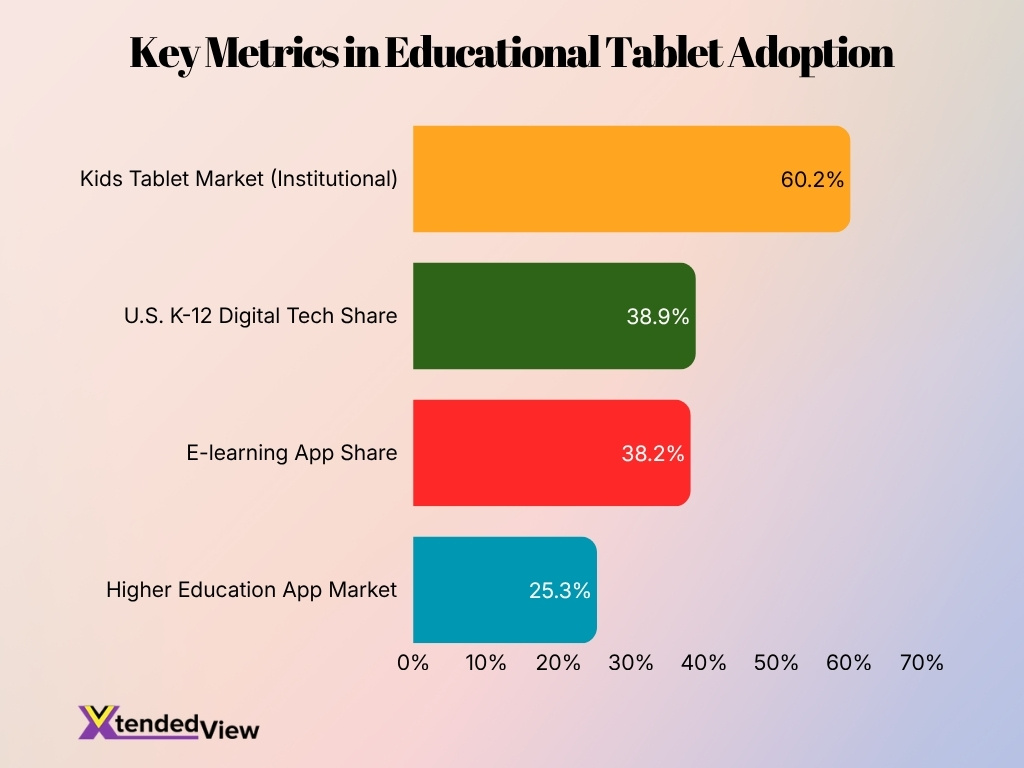
- Educational institutions captured a massive 60.20% revenue share in the global kids tablet market.
- The Asia-Pacific region’s educational tablet sector is projected to grow at a rapid 14.30% CAGR due to government investments.
- Over 55% of K-12 schools globally have successfully integrated tablets into their classroom instruction and digital learning ecosystems.
- The U.S. K-12 education segment led the digital technology market with a dominant 38.9% revenue share in 2025.
- Global tablet shipments increased by 9.8% to reach 162 million units in 2025, largely supported by institutional procurement.
- The global education apps market reached $12.4 billion in 2025, with e-learning apps capturing a 38.2% share.
- Stylus-enabled hybrid tablets for education are projected to grow at a fast 15.11% CAGR to support creative coursework.
- Higher education institutions accounted for 25.3% of the global education apps market in 2025 for hybrid classrooms.
- Education deployments helped stabilize overall device demand, contributing to a 5% annual shipment increase to 151.9 million units globally.
- Industry experts project the global educational interactive tablet market to reach an impressive $15.8 billion by the year 2035.
Enterprise and Business Tablet Statistics
- The global tablet market is projected to reach $87.08 billion by 2032 as organizations continue expanding hybrid work deployments.
- Approximately 72% of retail businesses now utilize tablet POS systems for secure payment processing and inventory management.
- Mobile point-of-sale terminal applications in healthcare are projected to grow at the fastest CAGR from 2026 to 2033.
- Over 58% of industrial users now prefer rugged tablets for reliable logistics routing and workforce management.
- The detachable tablet segment is growing at an 8.55% CAGR as professionals demand premium devices with keyboards and styluses.
- Cloud-based tablet POS systems account for 63% of new installations, standardizing enterprise mobility and administration.
- Driven by business demand, shipments of premium AI-powered tablets experienced a massive 22% year-over-year growth in 2024.
- To optimize digital documentation and onboarding, businesses favor larger screens, with 10-inch-plus tablets capturing 64% of global sales.
Future Tablet Market Projections
- Global tablet shipments are expected to decline approximately 7.6% in 2026.
- The market previously experienced strong growth throughout 2024 and 2025.
- Long-term tablet demand is projected to remain stable through 2030.
- The global tablet market is forecast to reach $79.3 billion by 2033.
- Industry forecasts project a compound annual growth rate of 4.1% between 2026 and 2033.
- The growing adoption of 5G connectivity will likely support future tablet upgrades.
- Educational institutions represent the largest institutional tablet buyers globally.
- Pandemic-era device replacement demand will support the market through the late 2020s.
Frequently Asked Questions (FAQs)
Global tablet shipments reached approximately 162 million units in 2025, representing a 9.8% year-over-year increase and the highest annual volume since the pandemic-era boom.
Apple captured 41.9% of the global tablet market in Q4 2025, shipping 17.1 million iPads during the quarter.
The global tablet market is projected to reach $79.33 billion by 2033, up from $59.88 billion in 2026.
The tablet market is expected to grow at a 4.1% compound annual growth rate (CAGR) between 2026 and 2033.
India’s tablet market is projected to grow from 4.43 million units in 2025 to 8.40 million units by 2034, reflecting a 7.01% CAGR.
Conclusion
The global tablet market has entered a renewed growth phase after several years of uneven performance. Shipments increased significantly in both 2024 and 2025, driven by device refresh cycles, education-sector investments, enterprise mobility initiatives, and stronger consumer demand. Apple continues to dominate the premium segment, while Android tablets maintain shipment leadership through broader vendor participation and affordability.
Looking ahead, the market may experience short-term shipment moderation, but long-term fundamentals remain positive. Expanding AI capabilities, 5G adoption, digital learning programs, and hybrid work environments continue to strengthen the role of tablets across consumer, education, and business settings. As these trends evolve, tablets are expected to remain an important category within the global personal computing ecosystem.
