


Microsoft Windows continues to power the backbone of global computing, from enterprise IT systems to personal laptops used for remote work and gaming. Businesses rely on Windows environments for productivity tools like Microsoft 365, while developers and gamers depend on its ecosystem for software compatibility and performance. As Windows 11 adoption accelerates and Windows 10 nears its end of support, the platform is undergoing one of its biggest transitions in years, making now the perfect time to explore the latest data and trends shaping its future.
Editor’s Choice
- Windows 11 reached 72.57% market share of desktop Windows versions by early 2026, up sharply from ~50% in late 2025.
- Windows 10 declined to 26.45% share in 2026, down from over 80% at its peak usage.
- Windows 11 crossed 1 billion users faster than Windows 10, highlighting accelerated adoption cycles.
- The OS jumped from 50.73% (Dec 2025) to 72.78% (Feb 2026), a rapid 22-point increase.
- Over 500 million PCs capable of upgrading to Windows 11 remained on Windows 10 in 2025.
- Windows 11 adoption initially lagged, taking 4 years to surpass Windows 10 market share.
- Older systems like Windows 7 now hold less than 1% market share, showing a near-complete phase-out.
Recent Developments
- Windows 11 saw record growth in early 2026, rising over 10 percentage points in a single month.
- The OS surged from 62.41% in January 2026 to 72.57% in February 2026, marking rapid adoption.
- Windows 10 officially reached end-of-life in October 2025, accelerating upgrades.
- Early 2026 growth followed a temporary decline in late 2025, where Windows 11 dropped to ~50.73%.
- Microsoft increased its focus on user feedback-driven updates in 2026, aiming to improve reliability.
- Enterprises drove much of the upgrade cycle, especially post-2025 support deadlines.
- Alternative OS platforms gained attention, with Linux distributions reporting millions of downloads.
- Hardware upgrades, not just preference, drove adoption as many devices were incompatible with Windows 11.
Global Windows Overview
- Windows remains the dominant desktop OS globally, with the majority share across PCs.
- The platform crossed over 1 billion active users with Windows 11 alone.
- Windows 11 adoption increased by over 45% during 2025, reflecting strong upgrade momentum.
- Windows continues to serve as the primary OS for enterprise IT environments worldwide.
- Desktop OS usage still heavily favors Windows over competitors like macOS and Linux.
- Growth in Windows 11 correlates with hardware refresh cycles and enterprise migrations.
- Despite dominance, Linux reached ~5% desktop share, signaling gradual diversification.
- The Windows ecosystem integrates with services like Microsoft Edge, Teams, and Xbox, expanding usage beyond PCs.
Windows Share of Desktop OS Market
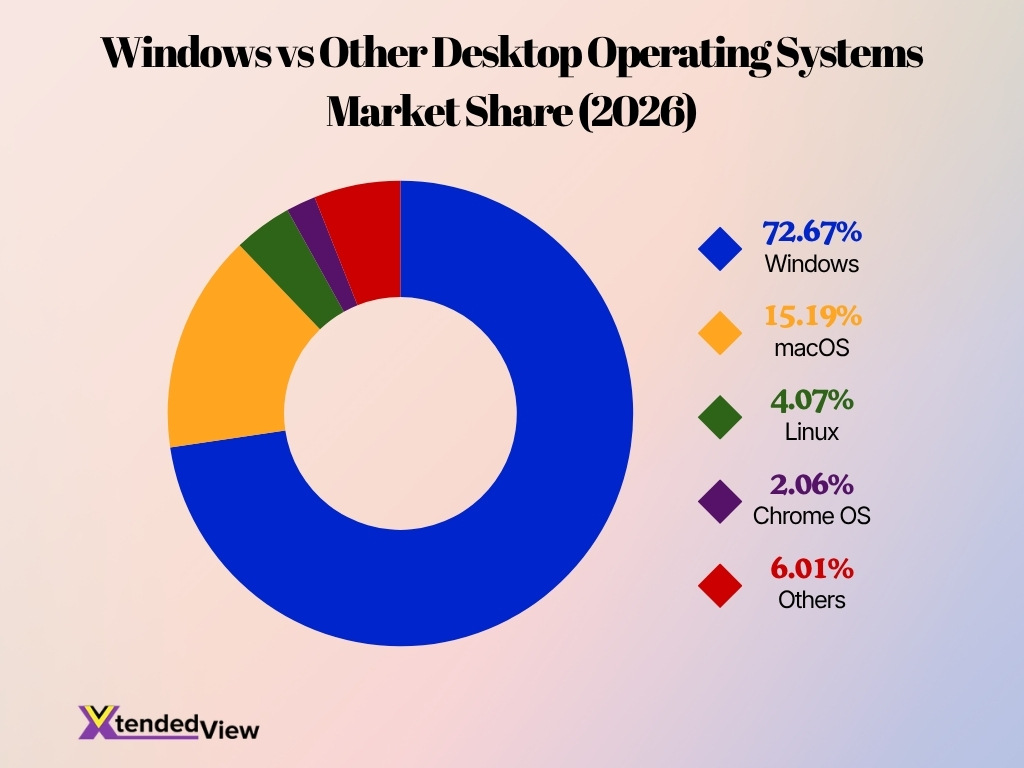
- Windows dominates the market with a massive 72.67% share, reinforcing its position as the leading desktop operating system globally.
- macOS holds the second position with 15.19%, showing strong adoption among premium and professional users.
- Linux accounts for 4.07%, indicating a steady presence driven by developers, enterprises, and open-source enthusiasts.
- Chrome OS captures 2.06%, reflecting its niche popularity, especially in education and budget devices.
- The “Others” category stands at 6.01%, representing smaller or less common operating systems in the market.
- There is a significant gap of over 57 percentage points between Windows (72.67%) and macOS (15.19%), highlighting Windows’ clear dominance.
- Combined, non-Windows operating systems make up 27.33% of the market, showing that while alternatives exist, they remain fragmented.
- The data indicates a highly consolidated market, with the top two OS (Windows + macOS) controlling 87.86% of the total share.
- Emerging and niche OS platforms struggle to gain traction against established ecosystems.
- Overall, the desktop OS landscape in 2026 remains heavily skewed toward Windows, with limited disruption from competitors.
Total Number of Windows Users
- Windows 11 surpassed 1 billion users globally by early 2026.
- The combined Windows ecosystem, all versions, supports well over 1.5 billion active devices globally.
- Around 500 million upgrade-ready PCs remained on Windows 10 in 2025.
- Another 500 million devices cannot be upgraded due to hardware limitations.
- Windows 11 reached the 1B milestone in 1,576 days, faster than Windows 10’s adoption cycle.
- Windows 10 still retained hundreds of millions of users entering 2026, despite a decline.
- Enterprise environments account for a significant portion of the Windows user base, especially in the US.
- Adoption remains uneven due to hardware compatibility barriers and upgrade costs.
Windows Share Across All Devices
- Across all device categories, Windows accounts for roughly 25–30% of total OS usage globally.
- Mobile platforms like Android dominate with over 40% share globally.
- iOS holds around 15–18% of global OS share, primarily in mobile ecosystems.
- Windows share is significantly lower across all devices due to smartphone dominance.
- Desktop usage still contributes heavily to Windows’ enterprise and productivity relevance.
- Windows remains the top OS for productivity software and enterprise applications.
- Hybrid work trends continue to sustain PC demand and Windows usage globally.
- Growth in tablets and mobile devices continues to reduce Windows’ share in total device usage.
Windows Version Market Share Insights (Apr 2026)
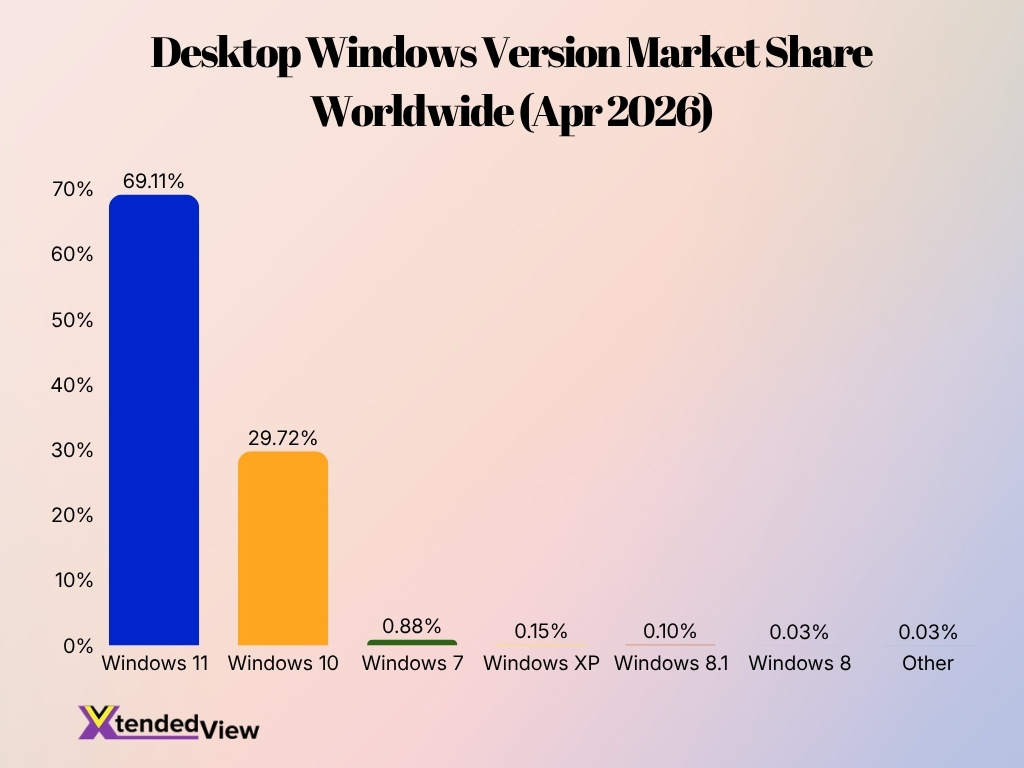
- Windows 11 dominates the market with a massive 69.11% share, making it the clear leader among all desktop Windows versions.
- Windows 10 still holds a strong position at 29.72%, but it is significantly behind Windows 11, indicating ongoing user migration.
- The combined share of Windows 11 and Windows 10 exceeds 98%, showing near-total dominance of modern Windows versions.
- Legacy systems have almost disappeared, with Windows 7 at just 0.88%, reflecting rapid phase-out after end-of-support.
- Windows XP usage is nearly extinct, accounting for only 0.15%, highlighting minimal presence in current environments.
- Windows 8.1 (0.10%) and Windows 8 (0.03%) together contribute a negligible share, confirming low adoption historically and continued decline.
- The “Other” category stands at just 0.03%, indicating very limited usage of niche or unidentified Windows versions.
- The data clearly reflects a strong transition toward Windows 11, driven by hardware upgrades, security requirements, and Microsoft’s ecosystem push.
- The steep gap between Windows 11 (69.11%) and Windows 10 (29.72%) signals an accelerated upgrade cycle compared to previous Windows transitions.
Windows 11 Adoption Statistics
- Windows 11 surpassed 1 billion active users by 2026, reaching the milestone faster than Windows 10.
- Adoption jumped from ~50% in late 2025 to over 72% in early 2026, driven by upgrade deadlines.
- The OS grew by more than 10 percentage points in a single month (Jan–Feb 2026).
- Over 500 million eligible PCs remained on Windows 10 in 2025, representing untapped upgrade potential.
- Hardware requirements, TPM 2.0, and newer CPUs slowed early adoption but later boosted device refresh cycles.
- Windows 11 adoption in enterprises increased significantly post-2025 due to compliance and security mandates.
- The OS saw higher adoption in developed markets like the US, UK, and Germany compared to emerging regions.
- Gaming performance improvements and DirectX 12 Ultimate support contributed to strong adoption among gamers.
- OEM pre-installation on new PCs ensured that most new devices ship with Windows 11 by default.
Windows 10 Usage and Decline
- Windows 10 usage dropped to ~26% by early 2026, down from over 80% in 2020.
- Microsoft ended mainstream support for Windows 10 in October 2025, accelerating migration.
- Despite the decline, Windows 10 still supports hundreds of millions of devices globally.
- Around 500 million PCs capable of upgrading remained on Windows 10 entering 2025.
- Many organizations delayed upgrades due to application compatibility concerns and costs.
- Extended Security Updates (ESU) programs allowed enterprises to continue using Windows 10 beyond 2025.
- Consumer adoption dropped faster than enterprise adoption due to automatic upgrade prompts and new PC purchases.
- Windows 10 remains popular in regions with older hardware and slower upgrade cycles.
- Decline accelerated in 2026 as Windows 11 surpassed 70% share, marking a tipping point.
Windows Market Share by Region
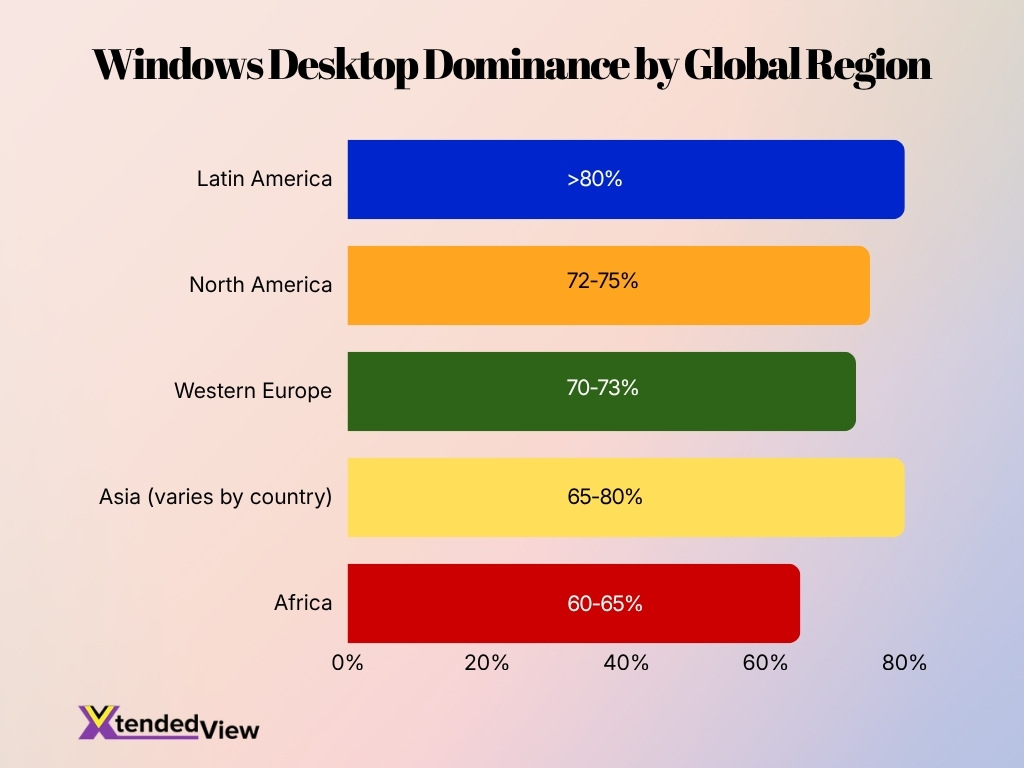
- Windows holds roughly 72–75% of the desktop OS share in North America, making it the dominant platform in the region.
- In Western Europe, Windows accounts for about 70–73% of desktop usage, slightly below that of North America but still dominant.
- Across Asia, Windows share ranges from 65% to 80% by country, with higher penetration in more developed markets and lower in some mobile‑heavy economies.
- In Eastern Europe, Linux adoption reaches around 6–8% of desktop usage, one of the highest regional shares globally.
- In Latin America, Windows commands over 80% of the desktop market, reflecting strong reliance on affordable Windows‑based hardware.
- In Africa, Windows accounts for roughly 60–65% of desktop usage, with Android‑based devices dominating the broader OS landscape.
- In the United States, macOS holds about 20–30% of the desktop and laptop OS market, giving it a significantly stronger presence than in most other regions.
- In enterprise environments, Windows maintains over 85–90% share across North America, Europe, and Asia‑Pacific, driven by standardized IT policies.
- In developed economies, Windows 11 adoption has surpassed 50–55% of all Windows desktops, while in emerging markets, it remains below 30% due to slower hardware refreshes.
- Globally, Windows holds around 70–72% of the total desktop OS market share, with macOS at roughly 13–15%, Linux near 4–5%, and ChromeOS below 2%.
Legacy Windows Versions Statistics
- Windows 7 holds less than 1% global share, despite ending support in 2020.
- Windows 8/8.1 combined usage is below 0.5%, reflecting minimal relevance.
- Windows XP usage is now statistically negligible (<0.1%), mostly in isolated systems.
- Some government and industrial systems still rely on legacy versions due to specialized software dependencies.
- Unsupported systems pose higher cybersecurity risks, contributing to a disproportionate share of vulnerabilities.
- Migration programs and compliance requirements reduced legacy usage by over 90% in the last decade.
- Legacy OS usage is more common in developing markets with limited access to newer hardware.
- Businesses increasingly phase out legacy systems to meet regulatory and security standards.
Windows Revenue and Licensing Statistics
- Microsoft’s “More Personal Computing” segment, which includes Windows, generated $62 billion in revenue in FY2025.
- Windows OEM revenue declined by ~3% year-over-year in 2024, reflecting slower PC shipments.
- Commercial Windows licensing revenue grew by over 10% YoY in 2025, driven by enterprise demand.
- Windows Enterprise subscriptions saw increased adoption through Microsoft 365 bundles.
- OEM licensing, pre-installed Windows on PCs, accounts for a significant portion of Windows revenue globally.
- Cloud-connected Windows services contributed to revenue growth via Azure and hybrid integrations.
- Enterprise agreements and volume licensing remain a core revenue stream for large organizations.
- Windows Pro and Enterprise editions generate higher margins compared to consumer Home editions.
Windows Usage by Industry and Enterprise
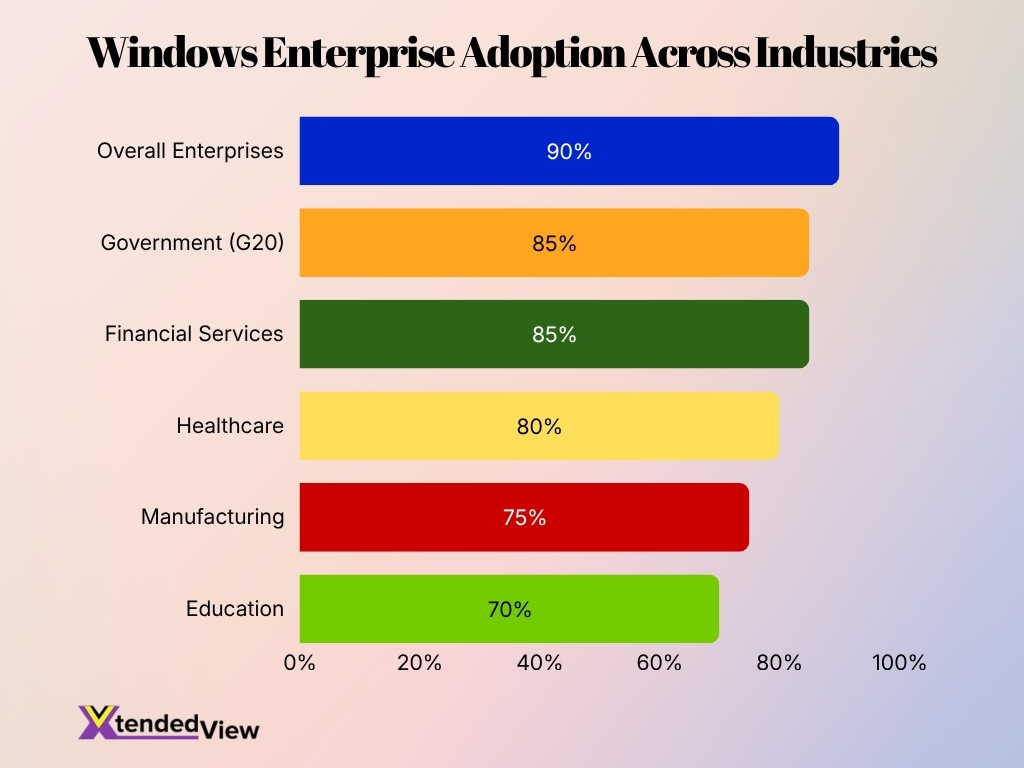
- Over 90% of enterprises globally run Windows‑based environments for core IT operations, according to recent enterprise adoption surveys.
- In the financial services sector, near‑universal Windows usage persists, with over 85% of banks relying on Windows for legacy core banking and compliance systems.
- Healthcare organizations deploy Windows on more than 80% of clinical endpoints that run electronic medical records and diagnostic imaging software.
- The manufacturing industry uses Windows on roughly 75% of industrial control and automation systems supporting PLCs and SCADA interfaces.
- Educational institutions install Windows on over 70% of school PCs, leveraging its cost‑effective volume licensing and broad compatibility with learning software.
- Government agencies in the G20 economies run Windows on an estimated 85% of administrative desktops, trusted for secure communications and side‑by‑side legacy systems.
- Through Azure integration, more than 60% of enterprises now operate hybrid Windows environments, extending on‑prem workloads into the cloud.
- Windows‑based VDI and virtual desktops serve over 100 million remote users globally, with peak spikes during large‑scale remote‑work periods.
Windows OEM and PC Shipment Statistics
- Global PC shipments reached approximately 250–260 million units in 2025, stabilizing after pandemic declines.
- Windows devices account for over 85% of global PC shipments, dominating OEM distribution.
- PC shipments grew slightly in 2026 due to Windows 11 upgrade cycles and enterprise refresh programs.
- Laptop shipments represent over 60% of total PC shipments, driven by remote work trends.
- Leading OEMs like Dell, HP, and Lenovo ship the majority of Windows-based devices globally.
- ARM-based Windows devices are gaining traction, though they still account for less than 10% of shipments.
- Refurbished PC markets are growing, contributing to millions of additional Windows device activations annually.
- Enterprise bulk purchases drive large shipment volumes during upgrade cycles tied to OS transitions.
Windows Upgrade and Migration Trends
- Over 500 million eligible PCs remained on Windows 10 in 2025, indicating a massive upgrade pipeline.
- Windows 11 adoption surged by over 20 percentage points in early 2026 due to migration deadlines.
- Enterprises delayed migration initially but accelerated upgrades after Windows 10 end-of-life in 2025.
- Hardware incompatibility affected hundreds of millions of devices, slowing migration speed.
- Many organizations adopted phased rollouts, upgrading 10–30% of devices annually.
- Cloud-based deployment tools simplified migration for enterprises using Azure and Intune.
- Consumer upgrades increased through automatic update prompts and new PC purchases.
- Migration strategies often included replacing outdated hardware to meet Windows 11 system requirements.
Windows Usage by Device Type
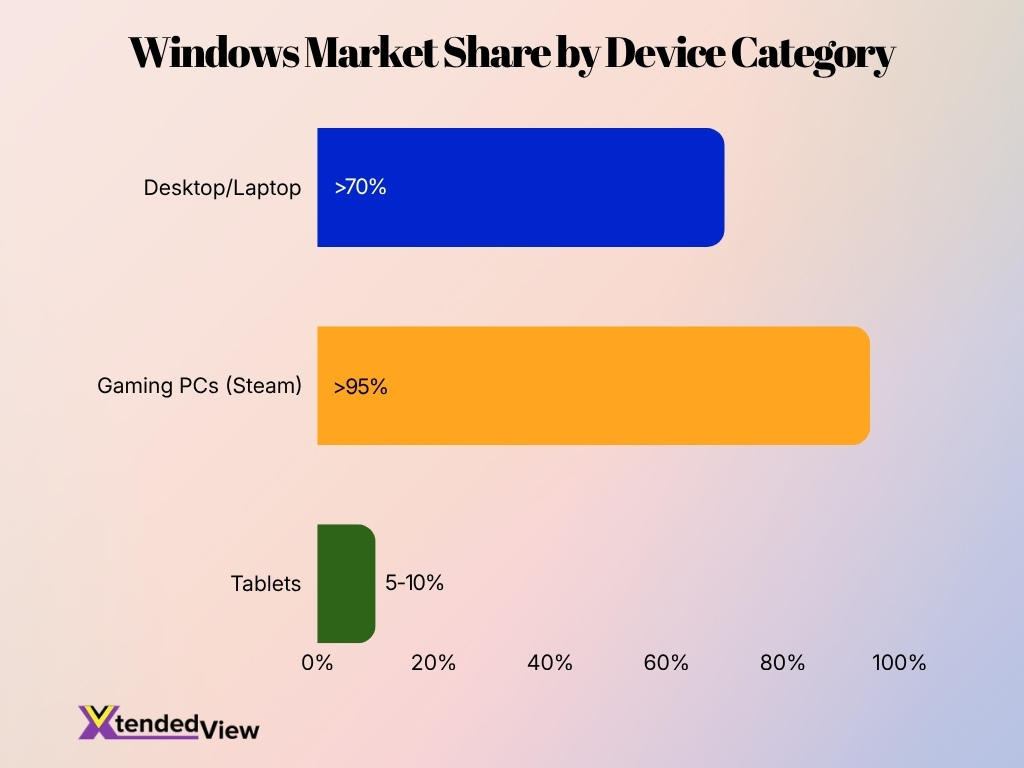
- Windows dominates desktop and laptop devices with over 70% share globally.
- On tablets, Windows holds a smaller share of around 5–10%, competing with iPadOS and Android.
- Windows-powered 2-in-1 devices, like the Surface, contribute to the growing use of hybrid devices.
- Mobile usage of Windows is negligible after the discontinuation of Windows Phone.
- Enterprise desktops account for a significant portion of Windows device distribution globally.
- Gaming PCs overwhelmingly run Windows, with over 95% of Steam users on Windows systems.
- Remote work trends increased demand for Windows laptops and enterprise devices post-2020.
- Windows also powers specialized devices like POS systems, kiosks, and industrial machines.
Windows Security and Vulnerability Statistics
- Microsoft patched over 1,200 vulnerabilities in 2025, reflecting ongoing security challenges.
- Windows remains the most targeted OS due to its large global user base.
- Over 60% of enterprise cyberattacks target Windows environments.
- Windows Defender protects hundreds of millions of devices globally with real-time threat detection.
- Unsupported Windows versions account for a disproportionate share of malware infections.
- Windows 11 introduced enhanced security features like TPM 2.0 and Secure Boot enforcement.
- Phishing and ransomware remain the top threats targeting Windows systems.
- Security updates are released monthly via Patch Tuesday, covering critical vulnerabilities.
Windows Gaming and DirectX Statistics
- 95.6% of PC gamers on Steam used a Windows-based system in June 2025, confirming Windows as the dominant gaming OS.
- Steam’s June 2025 survey showed 59.8% of PC gamers were on Windows 11, the largest single Windows gaming share.
- Windows 11 gaming got a major boost in 2025, with Microsoft saying DirectX advances improved ray-tracing performance by up to 2.3x on supported hardware.
- The PC gaming hardware market reached $44.5 billion in 2025, up 35% year over year, driven largely by Windows 11 upgrade demand.
- One report said Windows still held about 80% of the PC gaming landscape in 2024, showing its long-running lead.
- Xbox Game Pass reached 34 million subscribers by February 2024, reinforcing its massive reach in Windows and PC gaming.
- A 2025 report said DirectX 12 Ultimate had support across 30+ released or announced DirectX Raytracing games.
- DirectX 12 was described by Microsoft as the fastest-adopted Direct3D API since Direct3D 9, underscoring its strong gaming traction.
- PC gaming hardware growth in 2025 was estimated at 35%, with Windows 11 hardware requirements cited as a key catalyst.
- Windows 11’s gaming-focused features like Auto HDR and DirectStorage were highlighted as core upgrades that improve visuals and loading times.
Forecasts and Predictions for Future Windows Adoption
- Windows 11 is projected to exceed 80% share of Windows devices by late 2026.
- Windows 10 usage is expected to fall below 15% by 2027 as support phases out.
- PC shipments are forecast to grow modestly, reaching 270+ million units annually by 2027.
- Enterprise adoption of cloud-connected Windows environments will continue to rise through hybrid IT models.
- AI integration into Windows, Copilot features, is expected to drive new upgrade cycles.
- ARM-based Windows devices may grow to 15–20% of shipments by 2028.
- Security-driven upgrades will remain a key factor as organizations prioritize zero-trust architectures.
- Competition from macOS and Linux will increase slightly, but Windows is expected to retain its dominant desktop share.
Frequently Asked Questions (FAQs)
Windows holds about 66.6% of the global desktop OS market share in 2026.
Windows accounts for roughly 26.33% of total global operating system usage across all devices.
Windows 11 holds approximately 72.57% to 72.78% of the Windows OS market share in 2026.
Windows 11 market share increased by about 22 percentage points between December 2025 and February 2026.
Windows 11 has surpassed 1 billion global users by 2026.
Conclusion
Windows continues to dominate the global desktop operating system market while evolving rapidly through Windows 11 adoption, enterprise migration, and AI-driven innovation. The data shows a clear transition phase, with Windows 10 declining and new hardware cycles accelerating adoption. At the same time, security, cloud integration, and gaming ecosystems reinforce Windows’ relevance across industries. As businesses and consumers upgrade systems and adopt new features, Windows remains central to productivity, development, and digital infrastructure worldwide.
