



Opera remains a sizable alternative in a browser market dominated by a small group of major platforms. Its product lineup now spans traditional desktop and mobile browsing, gaming, built-in AI, privacy tools, ad blocking, VPN services, and data-saving technologies. These features make Opera relevant to several user groups, from professionals managing multiple tabs and AI-assisted research to gamers using Opera GX and mobile users relying on Opera Mini in markets where data costs remain a concern.
The browser’s statistics also show a business focused on improving monetization while expanding in selected regions, devices, and niche segments. Growth in Opera GX, Western mobile markets, and AI-enabled products highlights how the company is competing through specialization rather than overall market dominance. The figures below provide a detailed view of Opera’s users, market share, financial performance, regional reach, device usage, and product development.
Editor’s Choice
- Opera averaged 288 million monthly active users across its products and services in Q2 2026.
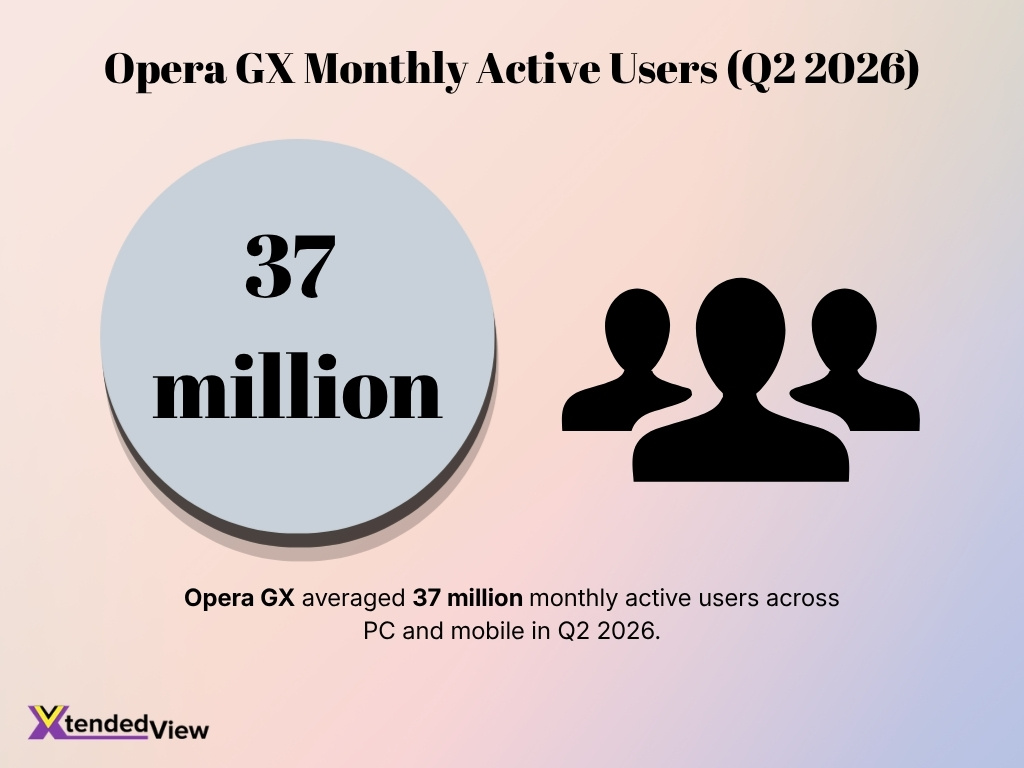
- Opera GX averaged 37 million monthly active users across PC and mobile in Q2 2026.
- Opera held 1.94% of the worldwide browser market across all platforms in August 2026.
- Opera’s worldwide desktop browser share reached 1.99% in August 2026.
- Its worldwide mobile browser share stood at 1.92% in August 2026.
- Opera captured a much higher 3.93% browser share in India in August 2026, illustrating the browser’s stronger position in some regional markets.
- Opera’s combined Android and iOS monthly active audience grew 40% year over year in the U.S. during Q2 2026.
Recent Developments
- Opera One R3 began rolling out on Jan. 15, 2026, bringing a major update to Opera’s flagship desktop browser.
- The R3 release expanded Split Screen support to as many as four simultaneous page views, targeting users who work across multiple pages.
- Opera added 4 million monthly active users during Q1 2026, with PC browsers contributing strongly after the R3 launch.
- Opera GX added 2 million monthly active users sequentially between Q1 and Q2 2026.
- Opera’s combined Android and iOS monthly active audience grew 66% year over year in the U.K. during Q2 2026.
- Opera added an MCP Connector to Opera Neon on March 31, 2026, allowing compatible third-party AI clients to interact with an active browser session.
- Browser Connector followed on April 16, 2026, expanding MCP-based browser context access to Opera One and Opera GX.
- MiniPay reached 15 million cumulative activated wallets by March 2026, up 123% from a year earlier and extending Opera’s product ecosystem beyond conventional browsing.
Opera Browser Monthly Active Users
- Opera’s Q2 2025 audience of 289 million represented one of the company’s higher recent quarterly MAU readings before its strategy continued shifting toward users in higher-monetization markets.
- Between Q2 and Q4 2025, reported average MAUs decreased by approximately 5 million, even as revenue per user and Western-market penetration increased.
- Opera’s Western-market audience gained 2 million MAUs during Q4 2025 alone, taking that segment to 60 million.
- Total average MAUs increased by approximately 4 million from Q4 2025 to Q1 2026, reversing the late-2025 decline.
- Opera GX gained 1 million average MAUs sequentially in Q1 2026, moving above its Q4 2025 level.
- The gaming browser then posted another sequential gain of 2 million users in Q2 2026, a larger increase than in the preceding quarter.
- From Q4 2025 through Q2 2026, Opera GX increased its quarterly average audience by roughly 3 million MAUs.
- Despite shifts within its product mix, Opera’s total quarterly MAU base remained within a relatively narrow 284 million to 289 million range across the Q2 2025-to-Q2 2026 figures examined here.
Opera Browser User Statistics
- Opera averaged 289 million monthly active users in Q2 2025, providing a useful baseline for evaluating its 2026 audience.
- The company reported 284 million average monthly active users in Q4 2025.
- Opera finished Q4 2025 with 60 million monthly active users in Western markets after adding 2 million during the quarter.
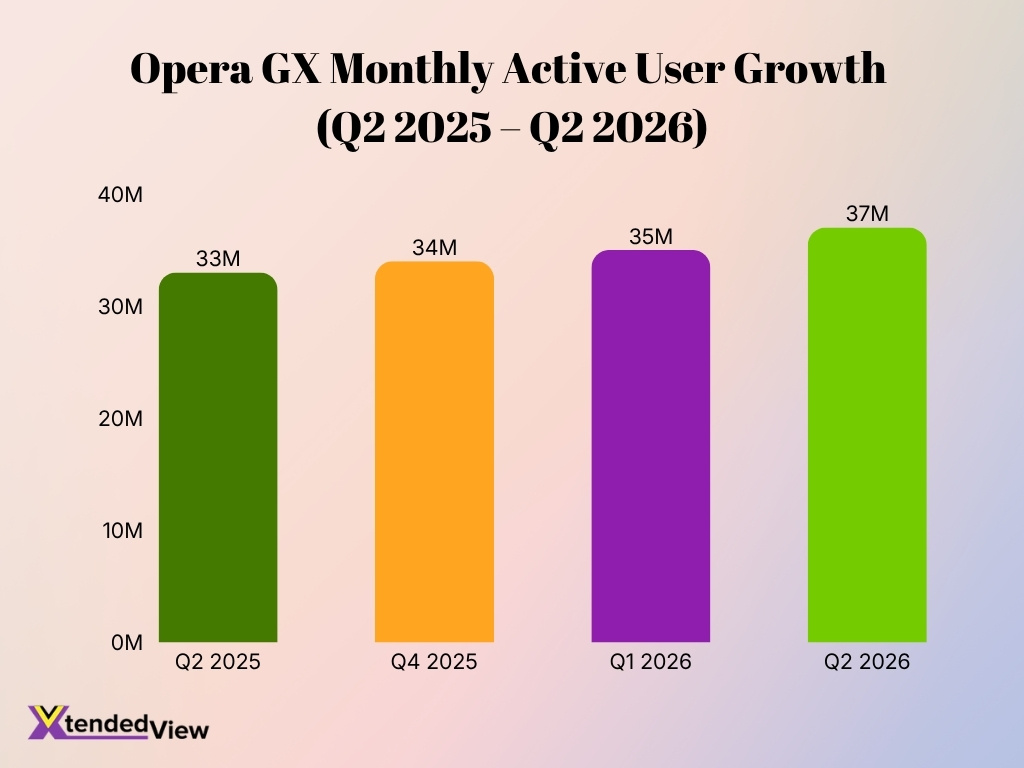
- Opera GX reached 33 million average monthly active users in Q2 2025, up 11% from the same quarter in 2024.
- Opera GX then increased to 34 million average monthly active users in Q4 2025 across PC and mobile.
- By Q1 2026, Opera GX had risen again to 35 million average monthly active users.
- Opera’s Q2 2026 mobile growth was particularly strong in two high-value markets: combined Android and iOS users increased by an average of roughly 48% across the U.S. and U.K. when the two reported growth rates are viewed together. This is a simple average of the reported 40% and 66% rates, not a company-reported combined growth rate.
- Opera GX added about 4 million average monthly users between Q2 2025 and Q2 2026, moving from 33 million to 37 million.
Opera Browser Market Share Statistics
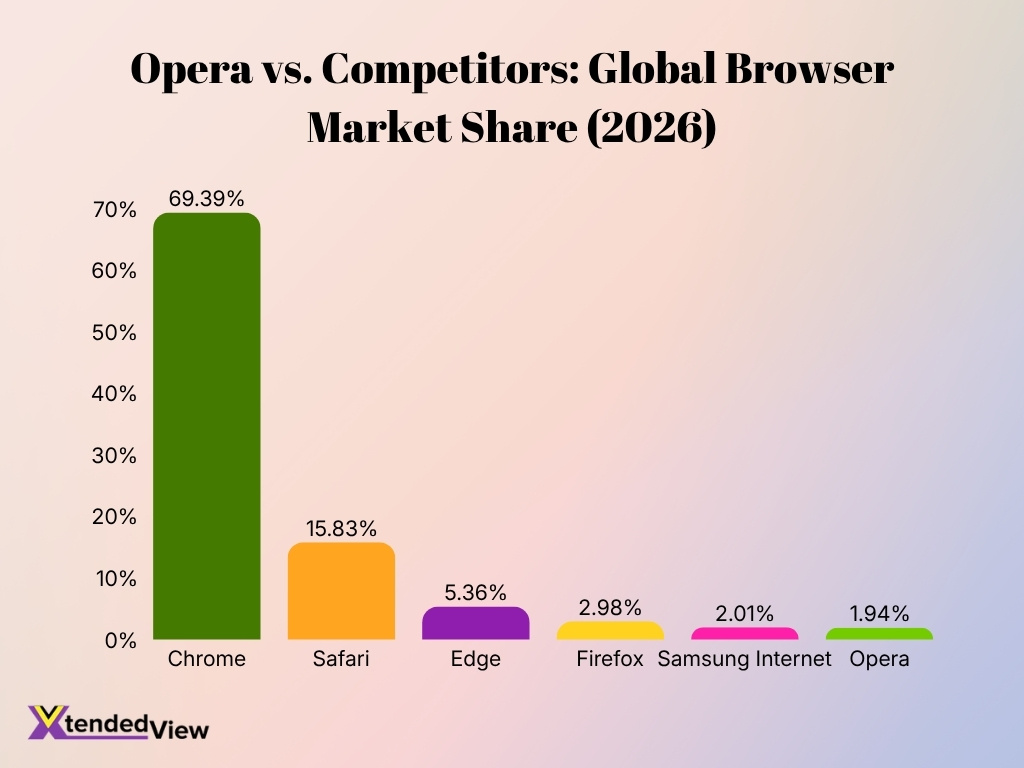
- Opera ranked sixth worldwide among measured browsers across all platforms in August 2026, behind Chrome, Safari, Edge, Firefox and Samsung Internet.
- Chrome controlled 69.39% of the worldwide browser market in August 2026, leaving every alternative browser with a substantially smaller share.
- Safari ranked second globally with 15.83%, more than eight times Opera’s share.
- Edge accounted for 5.36% of worldwide browser usage, or about 2.8 times Opera’s measured share.
- Firefox held 2.98% globally, placing it about one percentage point ahead of Opera.
- Samsung Internet held 2.01%, leaving a gap of only 0.07 percentage points between it and Opera in August 2026.
- Opera’s 3.93% share in India was more than twice its worldwide share, showing how national market positions can differ sharply from global averages.
- In India, Opera ranked second overall in August 2026, ahead of Safari, Edge, UC Browser and Firefox in measured browser usage.
Opera Browser Market Share by Device
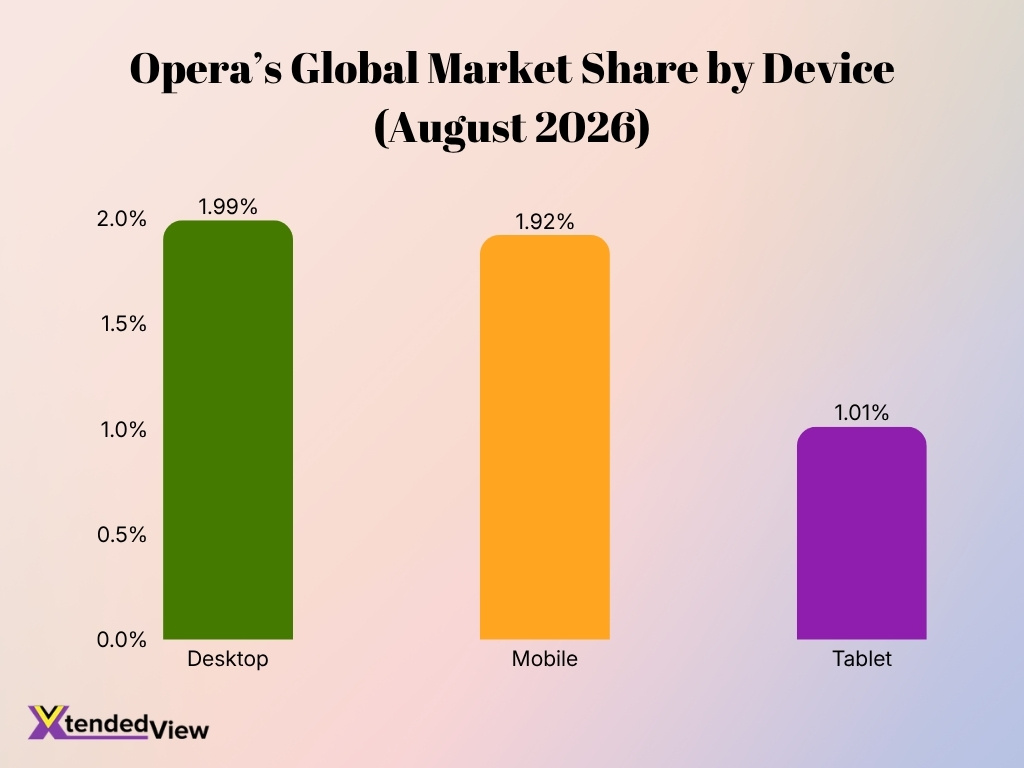
- On desktop computers worldwide, Opera held 1.99% of browser usage in August 2026.
- Worldwide mobile usage placed Opera at 1.92%, only 0.07 percentage points below its desktop share.
- Opera’s worldwide tablet browser share was lower at 1.01% in August 2026.
- Across mobile and tablet devices combined, Opera accounted for 1.90% of worldwide browser usage.
- Across desktop and tablet devices combined, Opera captured 1.96% globally.
- In the U.S., Opera held 2.40% of desktop browser usage in August 2026, giving it a stronger position on PCs than its global desktop average.
- Opera’s U.S. mobile browser share was substantially smaller at 0.56%, despite the strong year-over-year growth in its U.S. mobile monthly active audience.
- India showed the reverse pattern: Opera captured 4.88% of mobile browser usage versus 2.18% on desktop in August 2026, making mobile a much stronger channel for the browser in that market.
Opera Browser Mobile and Desktop Statistics
- Opera’s browser portfolio averaged approximately 258 million browser MAUs in Q4 2025, excluding users counted only through other services.
- Average smartphone MAUs reached 167 million in Q4 2025, illustrating how heavily Opera’s overall audience remains weighted toward mobile devices.
- About 141 million smartphone users in Q4 2025 specifically used Opera’s browser products, while roughly 25 million used its news app.
- Smartphone browser users therefore represented about 55% of Opera’s 258 million browser MAUs in Q4 2025. This percentage is calculated from the disclosed audience totals.
- Opera Mini alone had more than 100 million users worldwide in April 2025, making the Android-focused product a major part of Opera’s mobile footprint.
- In Brazil, Opera had a 2.04% desktop browser share in August 2026, compared with a much smaller share across mobile-focused devices.
- In Indonesia, Opera’s mobile, tablet and console share reached 1.37% in August 2026, compared with 0.83% on desktop.
- India showed one of Opera’s strongest device-specific positions, with 2.18% of desktop browser usage belonging to Opera in August 2026.
- Opera GX spanned both PC and mobile and reached 37 million MAUs in Q2 2026, reinforcing Opera’s strategy of extending specialized browser products across device categories.
Opera Browser Usage and Growth Statistics
- Opera’s total average monthly active audience increased from 284 million in Q4 2025 to 288 million in Q1 2026, a sequential gain of 4 million users.
- The company maintained 288 million average MAUs in Q2 2026, keeping its overall audience stable after the first-quarter increase.
- Opera GX reached 37 million MAUs in Q2 2026, up 10% from a year earlier.
- GX gained 2 million users in a single quarter, rising from 35 million MAUs in Q1 to 37 million in Q2 2026.
- Opera’s Western-market audience reached 60 million MAUs in Q4 2025 after adding approximately 2 million users during the quarter.
- Opera Mini’s monthly average user base in Kenya increased 13% following the return of a free-data program in 2025.
- Weekly Opera Mini default-browser usage among surveyed Kenyan users increased 40% from the start of 2025, with 47% using Opera Mini as their default browser on a weekly basis by November.
- Among users on the participating Kenyan mobile network, Opera Mini recorded a 93% increase in daily active users after the campaign relaunched.
- Pages loaded by those users increased 55%, showing that user growth also translated into higher browsing activity rather than installations alone.
- In Nigeria, users who had kept Opera Mini for at least three years were more than 1.5 times as likely to open it on a given day as newly acquired users, pointing to stronger engagement among long-tenure users.
Opera Browser Market Share by Country
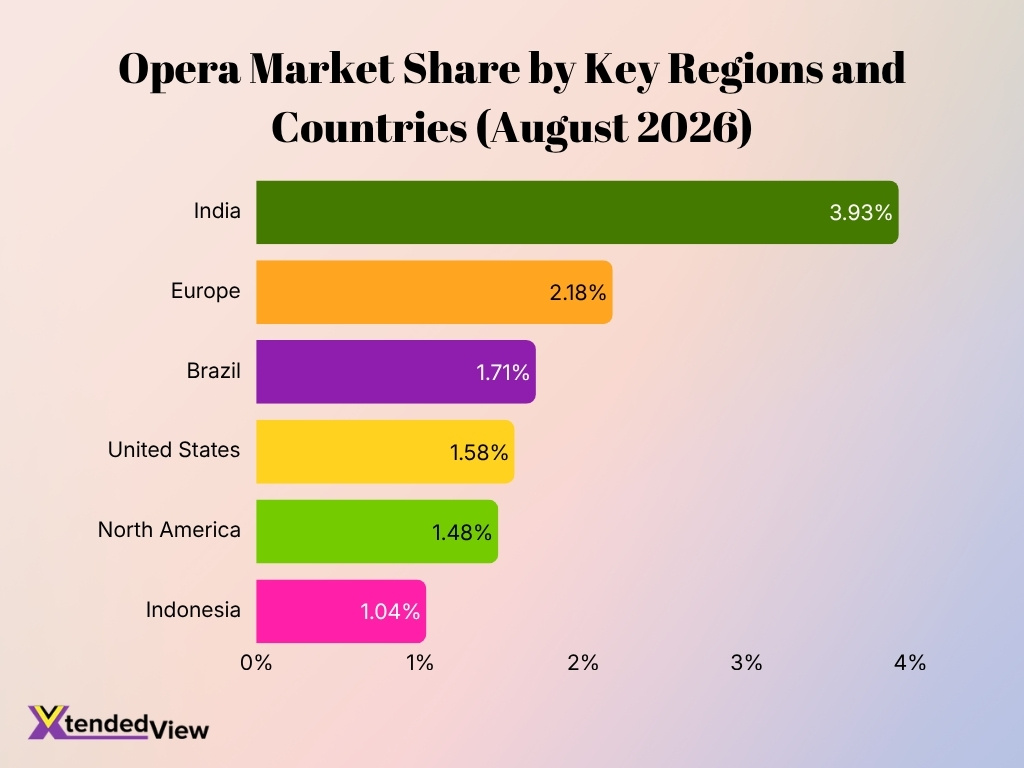
- Opera held 3.93% of India’s browser market across desktop, mobile and tablet devices in August 2026, more than double its 1.94% worldwide share.
- India ranked among Opera’s strongest large markets, where the browser placed second overall behind Chrome in August 2026.
- Opera accounted for 1.58% of U.S. browser usage across desktop, mobile and tablet devices in August 2026.
- Across North America, Opera held a 1.48% browser share, slightly below its U.S. share.
- Opera captured 2.18% of browser usage in Europe in August 2026, putting its European share about 12% above its worldwide average.
- In Brazil, Opera represented 1.71% of browser usage across desktop, mobile and tablet devices in August 2026.
- Opera held 1.04% of Indonesia’s browser market in August 2026, ranking behind Chrome, Safari, Edge, Firefox and Samsung Internet.
- On desktop in the U.K., Opera captured 1.34% in August 2026, while Chrome and Edge jointly accounted for more than 78% of usage.
- Country-level differences remain substantial: Opera’s 3.93% share in India was roughly 3.8 times its 1.04% share in Indonesia in August 2026. This ratio is calculated from the reported market-share figures.
Opera Browser Revenue and Financial Statistics
- Opera generated $178.1 million in revenue in Q2 2026, a 25% increase from $143.0 million one year earlier.
- Advertising contributed $115.4 million in Q2 2026, rising 27% year over year and accounting for roughly 65% of quarterly revenue.
- Query revenue reached $62.1 million, growing 21% year over year and contributing about 35% of Q2 2026 revenue.
- Adjusted EBITDA increased 32% to $42.4 million in Q2 2026, compared with $32.1 million in Q2 2025.
- Opera posted a 24% adjusted EBITDA margin in Q2 2026, up from 22% in the year-earlier period.
- Net income rose 76% year over year to $27.6 million in Q2 2026, lifting the quarterly net income margin from 11% to 15%.
- Revenue for the first six months of 2026 reached $353.8 million, up 24% from $285.7 million in the first half of 2025.
- Full-year 2025 revenue totaled $614.8 million, representing 28% year-over-year growth.
- Full-year 2025 adjusted EBITDA reached $142.5 million, equivalent to an approximately 23% margin.
- Following its Q2 performance, Opera raised 2026 full-year guidance to $734 million to $742 million in revenue and $172 million to $175 million in adjusted EBITDA.
Opera Browser Demographics and Geographic Distribution
- Opera reported 60 million Western-market MAUs at the end of Q4 2025, up by 2 million during that quarter alone.
- Western-market users represented roughly 21% of Opera’s 284 million total MAUs in Q4 2025. This percentage is calculated from disclosed figures.
- Opera GX primarily targets younger gamers; company disclosures have described the vast majority of GX users as Gen Z, making its audience profile different from Opera’s broader browser base.
- At 34 million GX users in Q4 2025, Opera estimated that the gaming browser had reached about 9% penetration of its 400-million-plus addressable gaming audience.
- Opera Mini has more than 100 million worldwide users, with a particularly important role in African markets where data affordability influences browsing behavior.
- A 2025 survey of 1,000 South Africans ages 16 to 35 found that 62% considered internet access too expensive, illustrating the economic profile of a key Opera Mini target segment.
- In the same survey, 86% of young respondents said more affordable internet access could significantly affect their lives, particularly through education, employment opportunities and access to information.
- About 63% of surveyed South Africans ages 16 to 35 said they ran out of mobile data at least every other month, while 31% did so every month.
- Opera Mini’s brand awareness in some of its largest African markets has reached as high as 94%, indicating a much stronger regional brand position than Opera’s global browser-share figure alone suggests.
- In Nigeria, nearly 40% of smartphone users surveyed had kept Opera Mini for more than one year, nearly one in five for over two years and close to one in 10 for more than three years.
Opera Browser Operating System Statistics
- Opera’s products span the world’s major desktop and mobile operating systems, including Windows, macOS, Android and iOS, allowing the company to address both PC-first and mobile-first markets.
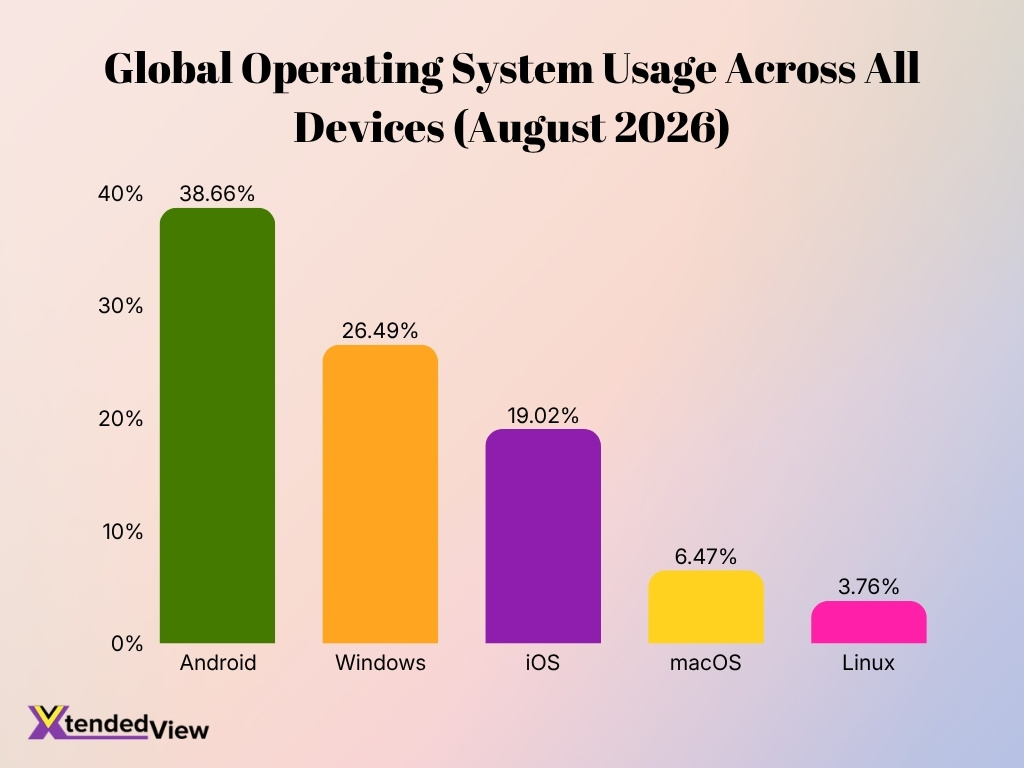
- Android represented 38.66% of worldwide operating-system usage across devices in August 2026, making it the largest OS environment available to Opera’s mobile products.
- Windows accounted for 26.49% of global OS usage, while it remained much more dominant when analysis focused on desktop-oriented devices.
- Windows held 60.14% of desktop, tablet and console OS usage worldwide in August 2026, giving Opera One and Opera GX access to a large Windows-centered PC audience.
- iOS accounted for 19.02% of global operating-system usage across devices in August 2026, forming a major addressable market for Opera’s iPhone browser.
- macOS accounted for 6.47% of global OS usage, while older OS X classifications represented another 4.90% in the August 2026 measurement.
- Linux held 3.76% of worldwide OS usage across devices and 8.52% within the desktop, tablet and console category.
- Opera Mini remains particularly tied to Android, and its global user base exceeded 100 million when integrated browser AI reached the product in 2025.
- Opera reported approximately 141 million smartphone browser MAUs in Q4 2025, giving its mobile products a substantial installed audience across supported smartphone operating systems.
Opera Browser Performance Statistics
- Opera’s built-in ad blocker can make content-heavy webpages load up to 90% faster by blocking advertising elements before they fully load.
- Earlier controlled tests found browsing with the integrated ad blocker was 62% faster on average than browsing without it.
- The same testing found that enabling native ad blocking could reduce browser memory consumption by up to 47%.
- In a test covering 66 content-rich websites, Opera with native ad blocking ran 45% faster than Chrome using a third-party ad-blocking extension.
- Opera Mini’s compression technology can reduce mobile data usage by up to 90%, which can improve browsing practicality on slower or metered connections.
- That level of compression can allow a user to browse for up to 10 times longer on the same data allowance, depending on the content loaded.
- Opera Mini’s integrated ad blocker has historically reduced page-loading time by about 40% compared with Opera Mini browsing without the blocker enabled.
- Opera One R3 expanded Split Screen to support four simultaneous webpages, increasing the browser’s built-in multitasking capacity without requiring four separate windows.
- In May 2026, Opera introduced a rebuilt native ad-blocking engine with uBlock-compatible filters, describing it as its fastest ad blocker to date. The update continued a native ad-blocking strategy that began in 2016.
Opera Browser Privacy, Security, VPN, and Ad Blocker Statistics
- Opera’s free browser VPN completed an independent no-log audit in 2024, supporting its claim that browsing activity and origin data are not stored or logged.
- The free VPN requires no account registration, reducing the amount of identifying information needed before a user can activate it.
- Opera VPN Pro supports protection on up to six devices under one subscription across Windows, macOS and Android.
- Opera’s integrated ad blocker has been available since 2016, giving the browser roughly a decade of built-in ad-blocking history by 2026.
- A European browser-choice survey found that 48% of respondents prioritized security features such as free VPN access, ad blocking and stronger privacy controls when considering a browser.
- Opera’s built-in ad blocker also blocks sources of tracking cookies and can stop cryptocurrency-mining scripts, combining advertising controls with tracking protection.
- Opera GX’s privacy tools include a built-in VPN operating under the same independently audited zero-log policy used across supported Opera browsers.
- Opera GX on Linux does not collect location data, browsing history, webpage content, search queries, or information entered into forms under its stated browser privacy model.
- The rebuilt 2026 ad blocker introduced compatibility with uBlock filter lists, while Opera continued supporting native blocking independently of third-party browser extensions.
Opera GX and Gaming Statistics
- Opera GX averaged 37 million monthly active users across PC and mobile in Q2 2026.
- GX’s audience grew 10% year over year in Q2 2026, showing continued growth seven years after the browser’s 2019 launch.
- Opera GX added 2 million MAUs sequentially between Q1 and Q2 2026, rising from 35 million to 37 million.
- In Q2 2025, GX averaged 33 million MAUs, meaning its audience increased by roughly 4 million over the following 12 months.
- Opera GX reached 34 million MAUs in Q4 2025 before climbing another 3 million during the first half of 2026.
- Opera estimated in late 2025 that GX had reached about 9% of an addressable gaming audience exceeding 400 million people.
- Opera GX expanded to Linux in March 2026, adding a third major desktop operating-system environment alongside Windows and macOS.
- GX Control lets users constrain browser RAM and network-resource consumption, while desktop versions also include gaming-oriented resource-management tools designed to leave more system capacity available for games.
- Since its 2019 launch, Opera GX grew from a new gaming-browser concept to a product serving tens of millions of users across desktop and mobile platforms by 2026.
Opera Browser AI and Aria AI Statistics
- Aria first launched in May 2023, giving Opera several years of native generative-AI integration by 2026.
- By December 2025, Opera’s upgraded browser AI was rolling out to products serving more than 80 million users across Opera One, Opera GX, and Opera Neon.
- Aria reached Opera Mini’s audience of more than 100 million users in April 2025, making AI available within one of Opera’s largest individual browser products.
- Aria became available without an Opera account across key desktop and Android products in September 2024, removing a previous sign-in requirement.
- Users without an account could generate up to five AI images for free after image-generation access was expanded on Android.
- In a user survey, 62% said they were likely to use AI image understanding for educational purposes.
- Another 52% said they would likely use image-understanding features while traveling or exploring unfamiliar places.
- A European browser survey found that 11% of respondents specifically considered built-in AI an important factor when choosing a browser.
- Opera introduced AI Tab Commands in March 2025, allowing users to organize or close tabs with natural-language instructions instead of performing those actions manually.
- Opera’s 2025 AI upgrade combined technologies from two major AI model ecosystems, using both GPT and Gemini models within its browser-AI architecture.
Opera Browser vs. Competitors
- Opera held 1.94% of the worldwide browser market in August 2026, placing it sixth among the browsers listed.
- Opera’s 1.94% market share was slightly behind Samsung Internet, which accounted for 2.01% globally.
- The gap between Opera and Samsung Internet was just 0.07 percentage points, indicating a closely contested position.
- Opera trailed Firefox’s 2.98% share by 1.04 percentage points in the worldwide browser market.
- Compared with Microsoft Edge at 5.36%, Opera’s global browser share was 3.42 percentage points lower.
- Market leader Chrome controlled 69.39% of worldwide browser usage, more than 35 times Opera’s 1.94% share.
- Safari ranked second with 15.83%, giving it a market share more than eight times larger than Opera’s.
- Despite competing against browsers from major technology companies, Opera maintained nearly 2% of the global browser market in August 2026.
Opera Mini and Opera One Statistics
- Opera Mini had more than 100 million users worldwide when Aria integration launched in April 2025.
- Opera Mini has accumulated more than 1 billion downloads worldwide, reflecting its long-running presence in mobile-first markets.
- Its compression technology can reduce browser data consumption by up to 90%, a key differentiator in markets where mobile data remains costly.
- Kenyan Opera Mini users on a participating mobile network can receive 1.5 GB of sponsored browsing data per month through the 2025 partnership program.
- Opera Mini’s average monthly Kenyan user base increased 13% after the free-data campaign returned.
- Opera One for iOS recorded 42% year-over-year user growth across Europe by Q2 2026.
- France delivered particularly strong Opera One for iOS growth, with its user base increasing 103% year over year by Q2 2026.
- European daily active users of Opera’s iOS browser had nearly tripled in two years by October 2025.
- During the first of those two 12-month periods, European iOS usage grew 57%, followed by a faster 88% increase in the next 12 months ending October 2025.
- Opera One R3 launched in January 2026 with upgraded AI, expanded tab tools, and four-way Split Screen functionality.
Frequently Asked Questions (FAQs)
Opera averaged 288 million monthly active users across its products and services in Q2 2026.
Opera held 1.94% of the worldwide browser market across all platforms in August 2026, ranking sixth globally.
Opera GX averaged 37 million monthly active users across PC and mobile in Q2 2026, up 10% year over year.
Combined Android and iOS MAUs grew 40% year over year in the U.S. and 66% in the U.K. during Q2 2026.
Opera’s annualized ARPU reached $2.46 in Q2 2026, representing a 25% year-over-year increase.
Conclusion
Opera’s statistics show a browser ecosystem with a large absolute audience despite holding a relatively modest share of the worldwide browser market. The company entered the second half of 2026 with 288 million average monthly active users, while Opera GX reached 37 million MAUs and continued to expand among gaming-focused users. Opera also maintained stronger positions in selected markets, including India, while its mobile audience recorded notable growth in the U.S., U.K., and several European countries.
Financial performance strengthened alongside these audience trends, with Q2 2026 revenue rising 25% to $178.1 million and adjusted EBITDA also increasing year over year. At the product level, Opera continued investing in AI, privacy, VPN services, native ad blocking, gaming tools, and mobile data-saving technology. Overall, the data suggests that Opera’s competitive strategy relies less on matching the largest browsers in global market share and more on building distinct products for gaming, AI-assisted browsing, privacy-conscious users, and mobile-first markets.
