



Sales is shaped by AI adoption, digital-first buying, and evolving customer expectations. Businesses across industries, from SaaS platforms optimizing subscription funnels to retail brands scaling omnichannel commerce, now depend heavily on data to guide every sales decision. Modern buyers research independently, expect personalized interactions, and often engage with sales teams only after forming clear preferences. As a result, sales teams must balance automation with human insight to stay competitive.
They rely on analytics to shorten deal cycles, improve conversion rates, and forecast revenue with greater accuracy. In this environment, understanding current sales statistics is not optional; it is essential for building strategies that actually convert. Let’s explore the latest data that reveals how modern selling works and where it is heading next.
Editor’s Choice
- 94% of sales leaders say AI tools are essential to meet business demands.
- Sales reps using AI are 3.7x more likely to hit quotas.
- 57% of sales professionals report longer sales cycles in 2025–2026.
- The global B2B e-commerce market will reach $36.16 trillion in 2026.
- 56% of B2B revenue in the U.S. comes from digital channels.
- Global B2C e-commerce is projected to hit $5.5 trillion by 2027.
- Sellers use an average of 8 tools to close deals, increasing workflow complexity.
Recent Developments
- AI investment ranks as the #1 growth strategy for sales teams in 2026.
- 74% of teams prioritize data hygiene to support AI-driven sales.
- Partner selling adoption increased to 94% of sales teams in 2026.
- 76% of leaders say usage-based pricing is more important than last year.
- Generative AI misuse may cost B2B firms over $10 billion annually.
- 85% of reps say AI frees time for high-value work.
- 42% of reps feel overwhelmed by tools, pushing companies to consolidate stacks.
- 82% of reps see AI as a career growth driver.
Global Sales Overview Statistics
- The global semiconductor industry is projected to reach $1 trillion in sales by 2026.
- Global online sales hit $17.3 billion on Cyber Monday 2025 alone.
- B2B e-commerce will exceed $36 trillion globally in 2026.
- B2C e-commerce is growing at a 14.4% CAGR globally.
- Over 56% of B2B revenue now comes from digital channels.
- The U.S. B2B e-commerce market is expected to reach $3 trillion by 2027.
- AI-driven revenue gains are highest in sales and marketing functions.
- Global buyers increasingly rely on self-service research before engaging sales teams.
B2B Sales Productivity Statistics
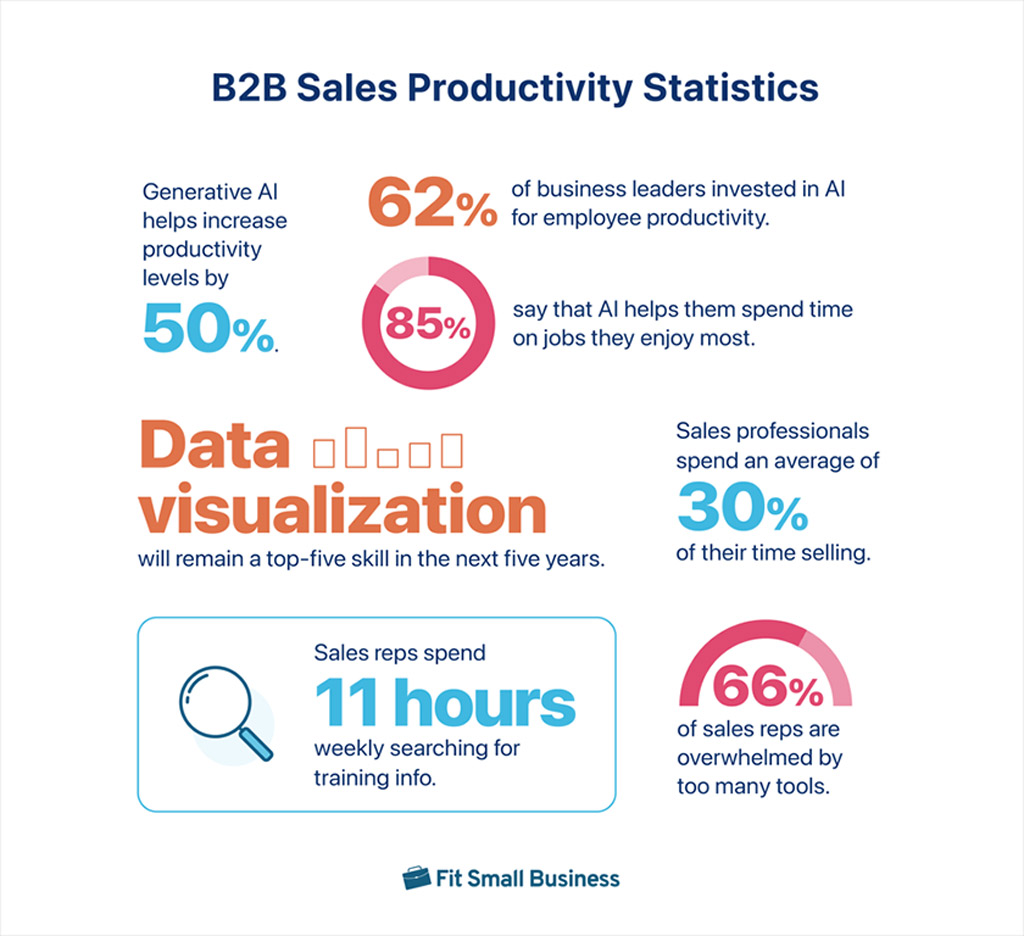
- Generative AI boosts productivity by 50%, highlighting its significant impact on operational efficiency in sales teams.
- 62% of business leaders are investing in AI, showing a strong shift toward AI-driven workforce productivity strategies.
- A notable 85% of professionals say AI helps them focus on enjoyable tasks, indicating higher job satisfaction and engagement.
- Sales professionals spend only 30% of their time actually selling, revealing a major gap caused by administrative and non-selling tasks.
- Sales reps spend 11 hours per week searching for training information, pointing to inefficiencies in knowledge access and onboarding processes.
- 66% of sales reps feel overwhelmed by too many tools, emphasizing the need for better tool consolidation and streamlined tech stacks.
- Data visualization is projected to remain a top-five skill, underlining its growing importance in data-driven sales decision-making.
B2C Sales Statistics
- Global B2C e-commerce will reach $5.5 trillion by 2027.
- Cyber Monday 2025 generated $17.3 billion in global online sales.
- Email marketing drives 2.8% average conversion rates for B2C brands.
- Social media is the top product discovery channel for consumers aged 18–44.
- 80% of marketers expect more purchases directly via social platforms.
- Average e-commerce conversion rates remain below 2% globally.
- Personalized email campaigns drive 50% more click-throughs.
- Buyers increasingly prefer self-service digital journeys over direct sales interaction.
Lead Generation and Prospecting Statistics
- 61% of marketers say generating traffic and leads remains their top challenge.
- Companies that excel at lead nurturing generate 50% more sales-ready leads at 33% lower cost.
- 79% of leads never convert due to a lack of proper follow-up.
- Businesses using marketing automation for prospecting see a 451% increase in qualified leads.
- 68% of B2B companies struggle with lead generation volume and quality.
- Cold calling success rates remain low, with less than 2% conversion.
- Email outreach generates an average $36 ROI for every $1 spent.
- 84% of B2B buyers start their purchasing process with a referral.
- LinkedIn drives 80% of B2B leads from social media.
Sales Touchpoints from Discovery Call to Sale
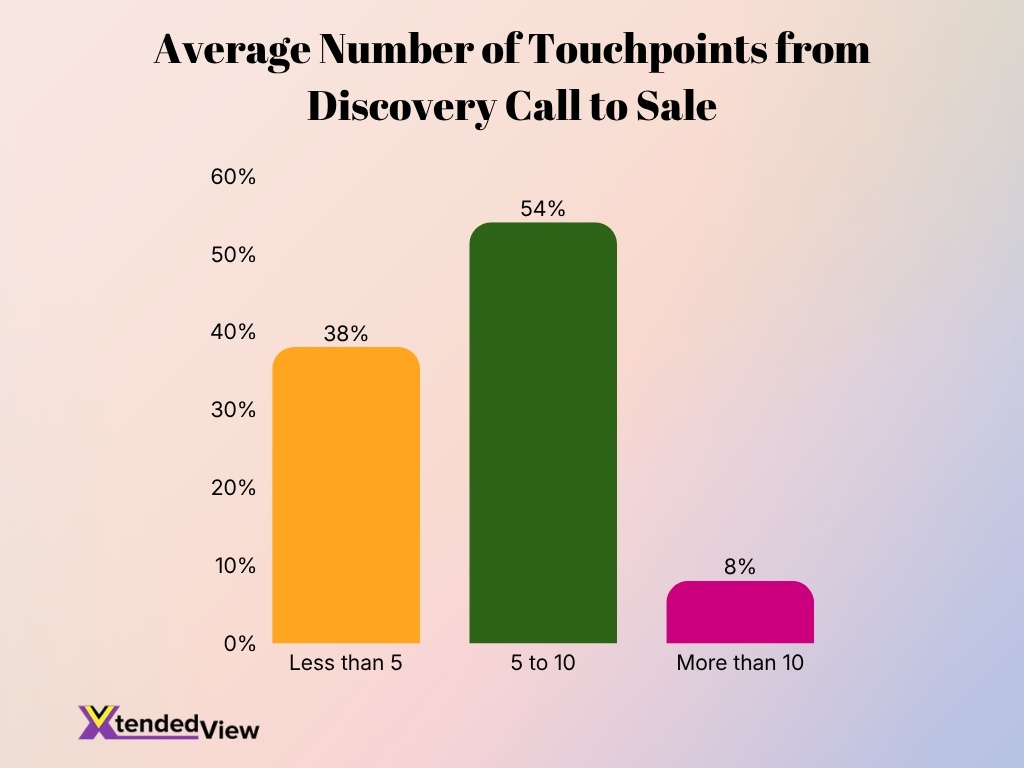
- The majority of deals (54%) are closed within 5 to 10 touchpoints, indicating this is the optimal engagement range for most sales cycles.
- A significant portion of sales (38%) is completed in fewer than 5 touchpoints, suggesting that high-intent leads or strong qualification can accelerate conversions.
- Only a small fraction (8%) of deals require more than 10 touchpoints, highlighting that prolonged sales cycles are relatively uncommon.
- The data shows that 92% of deals close within 10 touchpoints, emphasizing the importance of maintaining consistent and timely follow-ups early in the sales process.
- Sales teams should focus on efficient communication strategies within the first 5–10 interactions, as this window represents the highest probability of closing deals.
- Deals extending beyond 10 touchpoints may indicate complex sales processes, potential buyer hesitation, or inefficiencies in the pipeline.
Win Rate and Deal Cycle Statistics
- The average B2B win rate ranges between 20% and 30%.
- 57% of deals stall due to indecision among buyers.
- The average B2B sales cycle length increased by 22% in recent years.
- Deals involving multiple stakeholders have a 30% lower close rate.
- High-performing sales teams achieve win rates above 50%.
- 77% of B2B buyers describe their purchase process as complex or difficult.
- Companies using AI-driven insights reduce deal cycles by up to 30%.
- The average number of stakeholders in a B2B deal is 6 to 10 decision-makers.
Sales Conversion Rate Statistics
- The average website conversion rate across industries is 2.35%, while top performers reach 11%+.
- Companies that use CRO tools see conversion improvements of up to 223%.
- 70% of marketers actively invest in conversion rate optimization.
- Landing pages with personalized CTAs convert 202% better than generic ones.
- 47% of buyers view 3–5 pieces of content before engaging with sales.
- Companies with strong alignment between sales and marketing see 38% higher win rates.
- Mobile traffic accounts for over 58% of global web traffic, impacting conversion strategies.
- Slow-loading pages can reduce conversions by up to 7% per second delay.
Sales Funnel Conversion Benchmarks
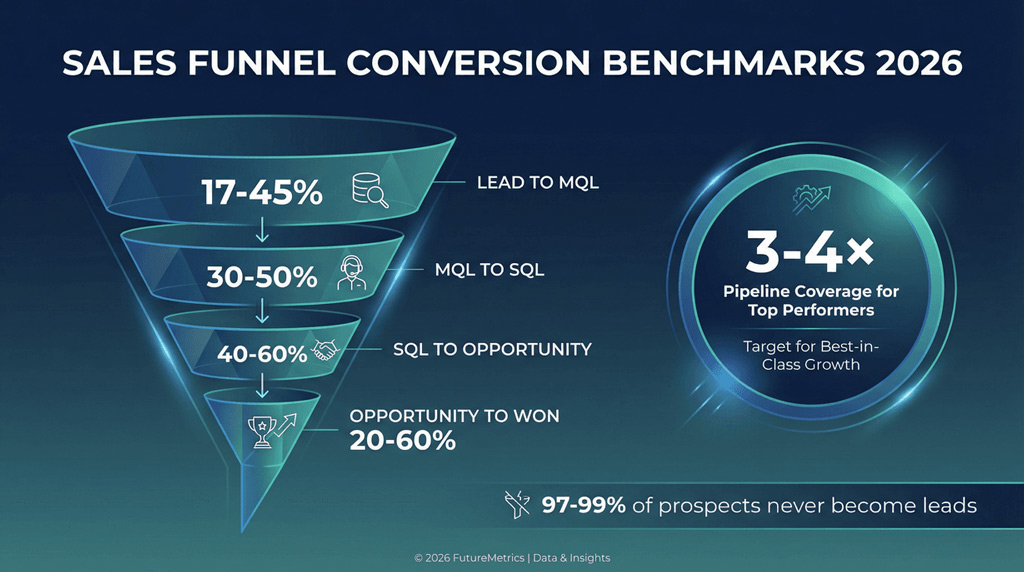
- Top-of-funnel conversion remains highly variable, with only 17%–45% of leads becoming MQLs, highlighting major inefficiencies in initial lead qualification.
- The transition from MQL to SQL sees moderate improvement, with conversion rates between 30%–50%, indicating better alignment between marketing and sales teams at this stage.
- Mid-funnel performance is relatively strong, as 40%–60% of SQLs convert into opportunities, suggesting higher intent and better-qualified prospects.
- The final stage (Opportunity to Win) shows a wide range of outcomes, with 20%–60% conversion, reflecting differences in sales execution, pricing, and competition.
- Pipeline coverage is a critical success factor, with top-performing companies maintaining 3x–4x pipeline coverage to sustain consistent revenue growth.
- A significant drop-off occurs early in the funnel, where 97%–99% of prospects never become leads, emphasizing the need for stronger targeting and lead capture strategies.
- Overall, the data reveals a progressive improvement in conversion rates deeper into the funnel, but also exposes major leakage at the top, making early-stage optimization essential for maximizing revenue outcomes.
Sales Revenue Growth and Forecasting Statistics
- Global corporate revenues are expected to grow by 6–8% annually through 2026.
- 67% of organizations struggle with accurate sales forecasting.
- Companies that use predictive analytics improve forecast accuracy by up to 20%.
- AI-driven forecasting tools can reduce errors by 30–50%.
- 44% of sales leaders say forecasting is their biggest challenge.
- Organizations with structured forecasting processes see 15% higher revenue growth.
- Data-driven companies are 23x more likely to acquire customers.
- Sales teams that track pipeline metrics regularly achieve 28% higher revenue growth.
Customer Acquisition Cost and Lifetime Value Statistics
- The average CAC has increased by over 60% in the last five years.
- SaaS companies aim for an LTV: CAC ratio of 3:1 for sustainable growth.
- 44% of companies prioritize reducing CAC in 2026.
- Improving customer retention by 5% can increase profits by 25% to 95%.
- Paid acquisition channels account for over 50% of CAC in most industries.
- Companies using referral programs reduce CAC by up to 30%.
- Subscription businesses generate 2–5x higher LTV than transactional models.
- CAC payback periods average 12 to 18 months for SaaS companies.
Customer Retention and Churn Statistics
- Increasing retention by just 5% can boost profits up to 95%.
- The average SaaS churn rate ranges from 5% to 7% annually.
- 65% of a company’s revenue comes from existing customers.
- Acquiring a new customer costs 5x more than retaining one.
- Companies with strong onboarding processes improve retention by 50%.
- 52% of customers switch brands due to poor customer experience.
- Loyalty programs increase retention rates by 5–10% on average.
- Subscription churn increases significantly after the first 90 days.
Key Benefits of Sales Automation for Businesses
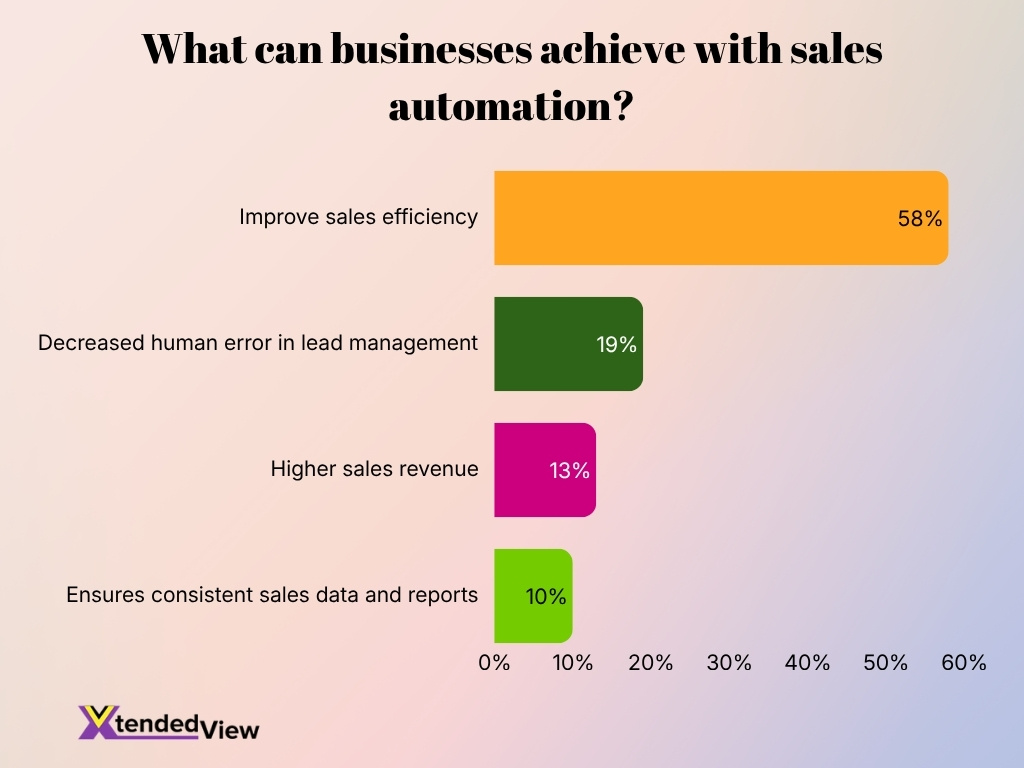
- Improved sales efficiency leads the impact, with 58% of businesses reporting significant gains—making it the most dominant benefit of sales automation.
- 19% of organizations experience reduced human error in lead management, highlighting automation’s role in improving data accuracy and reliability.
- 13% of businesses report higher sales revenue, showing that automation not only streamlines processes but also contributes directly to revenue growth.
- 10% of companies achieve more consistent sales data and reporting, enabling better decision-making and forecasting.
- Overall, the data indicates that efficiency and accuracy are the primary drivers, while revenue and reporting improvements follow as secondary but impactful outcomes.
Sales Productivity and Time Management Statistics
- Sales reps spend only 28% of their week actually selling.
- Administrative tasks consume over 30% of a rep’s workday.
- Top-performing reps spend 35-40% of their time on active selling.
- Top performers gain 5-8 extra selling weeks annually by focusing on high-value activities.
- Automation reduces manual workload by 30%, freeing time for core selling activities.
- 65% of salespeople using mobile CRM hit their quotas, compared to just 22% of non-users.
- Businesses using CRM systems report a 29% average increase in sales revenue.
- Salespeople lose 546 hours per year to inaccurate contact data.
- 78% of sellers missed quota in 2025, up from 69% the previous year.
Sales Technology and CRM Usage Statistics
- 91% of companies with 10+ employees use a CRM system to manage sales processes.
- CRM adoption improves sales by up to 29% and productivity by 34%.
- 87% of sales leaders say CRM tools are critical for growth.
- Mobile CRM usage has increased by over 50% in the last five years.
- Companies using CRM analytics see 15–20% higher deal closure rates.
- 74% of sales teams say CRM systems improve customer relationships.
- CRM data quality issues impact over 40% of businesses, reducing efficiency.
- Organizations integrating CRM with AI report 30% faster decision-making.
Sales Performance by Industry Statistics
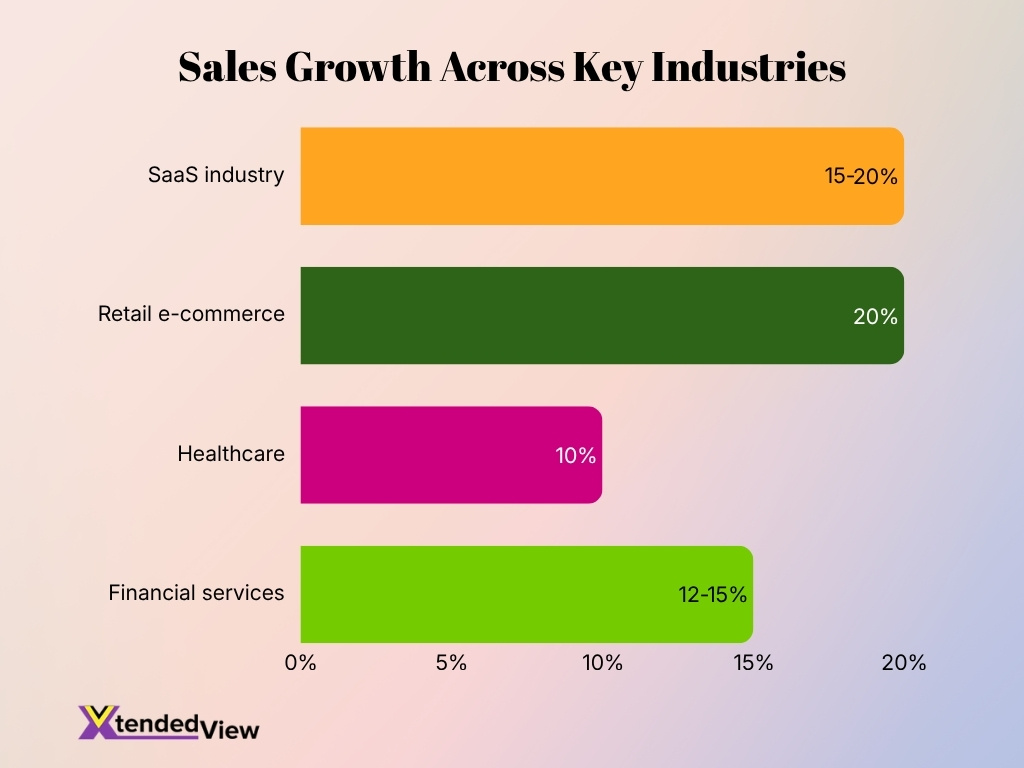
- The SaaS industry maintains average growth rates of 15–20% annually.
- Retail e-commerce sales account for over 20% of total retail sales globally.
- The healthcare sales sector is projected to grow by over 10% annually through 2026.
- Financial services firms report 12–15% revenue growth driven by digital sales channels.
- Manufacturing companies adopting digital sales tools see up to 25% productivity gains.
- Real estate sales cycles average 3 to 6 months, depending on market conditions.
- Automotive sales are increasingly digital, with over 60% of buyers researching online first.
- Tech companies report the highest win rates, averaging above 35%.
Remote and Hybrid Selling Statistics
- 80% of B2B sales interactions now occur in digital channels.
- Remote sales models reduce costs by up to 40% compared to traditional field sales.
- 75% of buyers prefer a rep-free sales experience.
- Virtual selling tools have increased adoption by over 50% since 2020.
- Hybrid sales teams achieve 50% higher revenue growth than traditional models.
- 68% of sales professionals say remote selling is as effective as in-person meetings.
- Video conferencing is used by over 70% of sales teams for client interactions.
- Companies investing in digital sales channels see 2x faster revenue growth.
Buyer Behavior and Decision-Making Statistics
- 77% of B2B buyers conduct extensive research before contacting sales.
- Buyers spend only 17% of their time meeting with suppliers during the purchase process.
- 80% of buyers expect a personalized buying experience.
- Millennials and Gen Z account for over 60% of B2B buyers.
- 72% of buyers expect sales reps to understand their needs immediately.
- Social proof influences 92% of purchasing decisions.
- Buyers consume an average of 3–7 pieces of content before engaging with a salesperson.
- 55% of buyers prefer digital self-service over traditional sales interactions.
Most Challenging Parts of the Sales Process
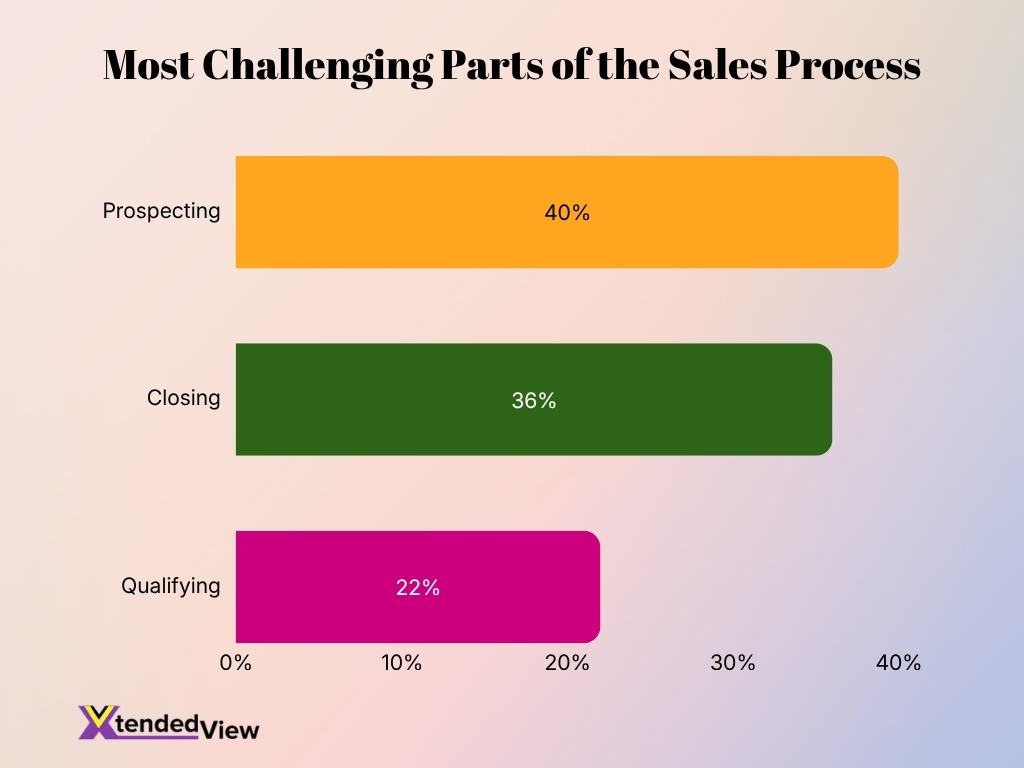
- Prospecting is the biggest challenge, with 40% of salespeople identifying it as the most difficult stage in the sales process.
- Closing deals ranks second, with 36% of sales professionals struggling to convert leads into customers.
- Qualifying leads is comparatively less challenging, but still significant, affecting 22% of salespeople.
- A clear trend shows that early-stage sales activities (prospecting + qualifying) account for a combined 62% of challenges, highlighting difficulties in lead generation and filtering.
- The narrow gap between prospecting (40%) and closing (36%) suggests that both pipeline building and deal conversion are nearly equally critical pain points.
- These insights indicate that sales teams should prioritize improving lead sourcing strategies, outreach efficiency, and closing techniques to enhance overall performance.
Future Trends in Sales Statistics
- The AI-driven sales tools market will reach $240.59 billion by 2030.
- 73% of sales teams already use AI tools, projected to rise significantly by 2027.
- The sales forecasting software market grows at 10.8% CAGR through 2033.
- 64% of B2B organizations increased sales automation investments in recent years.
- AI agents to power 1,000% more customer interactions by 2027, from 3.3B to 34B.
- Companies using AI in sales see up to 15% revenue uplift and 10-20% ROI boost.
- By 2027, 95% of seller research workflows will begin with AI.
- Digital channels to drive 56% of US B2B revenue in 2026.
- AI-powered automation will handle 60% of sales tasks by 2026.
Frequently Asked Questions (FAQs)
Global retail sales are expected to reach approximately $32.76 trillion in 2026.
Global B2C e-commerce is growing at a 14.4% CAGR, with projections reaching $5.5 trillion by 2027.
Online sales account for about 22% of total global retail sales, up from 19% in 2022.
Global trade, a key driver of sales, exceeded $35 trillion in 2025, with around 7% annual growth.
About 73% of business leaders expect increased revenue growth in 2026.
Conclusion
Sales reflect a clear shift toward data-driven decision-making, AI adoption, and digital-first engagement. Organizations that successfully integrate automation, predictive analytics, and customer-centric strategies consistently outperform their competitors. At the same time, rising customer acquisition costs, longer deal cycles, and increasingly informed buyers are forcing companies to refine their approach to selling. Teams that align marketing and sales, invest in the right technology stack, and focus on delivering personalized experiences are better positioned to drive sustainable growth.
Moreover, as AI continues to evolve, it will not replace sales professionals but will amplify their ability to build relationships and close deals more efficiently. Ultimately, the data highlights a simple reality: sales success now depends on how quickly teams adapt to changing buyer behavior and leverage technology to make smarter, faster decisions.
