


Customer experience (CX) now shapes how brands attract, convert, and retain customers. From ecommerce checkout flows to banking support interactions, every touchpoint influences how people perceive a company. In industries such as retail, telecom, and SaaS, companies increasingly rely on CX metrics to improve retention, reduce churn, and increase lifetime value.
Today, customer expectations revolve around speed, personalization, and convenience. Businesses that invest in seamless support systems and omnichannel experiences often outperform competitors. The statistics below reveal how CX affects satisfaction, loyalty, and revenue, and why companies continue to prioritize it as a strategic advantage.
Editor’s Choice
- 73% of consumers say customer experience plays a key role in their purchasing decisions, ranking just behind price and product quality.
- 3 in 4 American shoppers say CX is the deciding factor when choosing between competing brands.
- 80% of customers say the experience a company provides is as important as its products or services.
- Companies that prioritize CX can grow revenue 1.7× faster than companies that do not.
- 86% of customers will leave a brand after two poor service experiences.
- Customers are willing to pay up to 16% more for products and services that deliver better experiences.
- 99% of consumers say customer service influences their buying decisions.
- Poor customer service experiences place $3.8 trillion in global revenue at risk.
Recent Developments
- In the 2025 Global Customer Experience Index, 25% of U.S. brands saw CX scores decline, while only 7% improved.
- 89% of companies are expected to compete primarily on CX by 2026, surpassing product and price differentiation.
- 85% of customer interactions are expected to be handled without human intervention by 2025, largely due to AI adoption.
- Companies implementing AI in CX report up to 25% increases in customer satisfaction.
- AI-powered personalization is expected to transform CX strategies, with 73% of brands acknowledging its impact.
- 86% of business leaders expect predictive personalization to replace reactive engagement strategies in the coming years.
- Shoppers who use AI chat services during online shopping are 38% more likely to complete a purchase.
- During Cyber Week, AI-assisted retail experiences generated $13.5 billion in sales through AI agents.
Overall Customer Experience Overview
- 73% of consumers globally say CX influences their purchasing decisions.
- Customers are 2.4× more likely to stay loyal to brands that resolve issues quickly.
- 64% of customers will spend more if businesses resolve their issues in the channel where they already are.
- Brands delivering superior CX achieve 4% to 8% higher revenue growth than their industry peers.
- 50% of customers expect companies to anticipate their needs and proactively offer solutions.
- Companies that lead in CX grow 80% faster than competitors in revenue terms.
- In many industries, CX quality declined across effectiveness, ease, and emotion metrics during 2025.
- Surveys show 77% of Americans experienced a product or service issue in the last year, highlighting CX challenges.
Key Customer Experience Attributes That Matter Most to Consumers
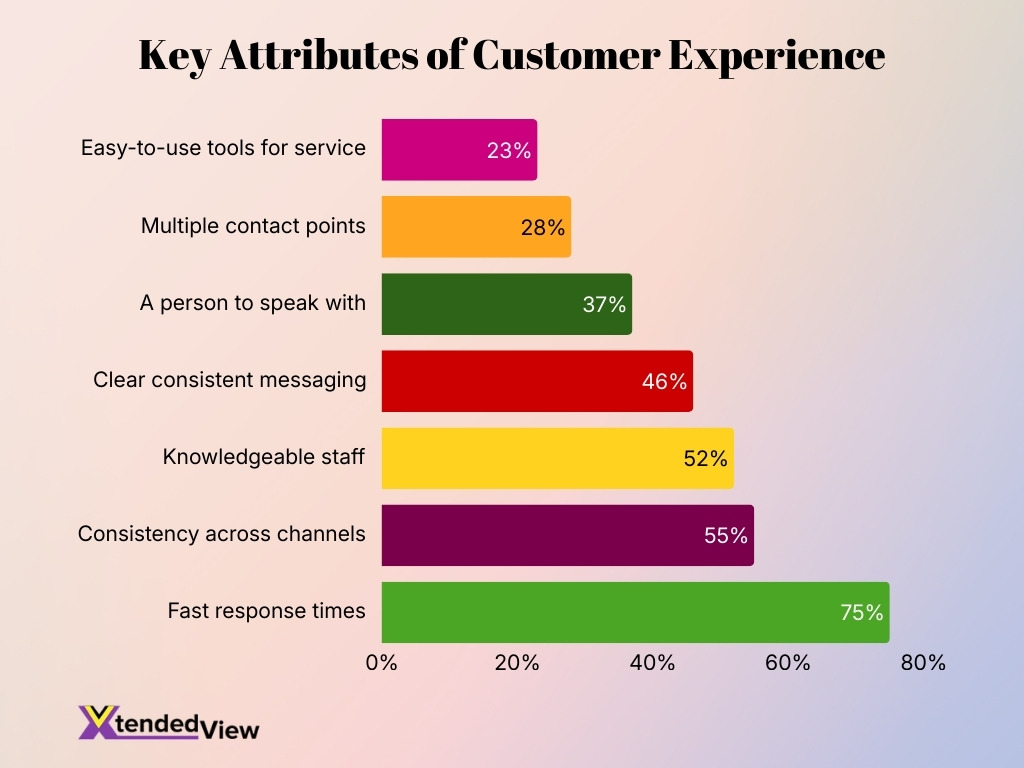
- Fast response times are the most important factor in customer experience, with 75% of customers saying quick support significantly improves their experience with a brand.
- Consistency across channels ranks second, with 55% of customers expecting a seamless experience whether they interact through websites, apps, social media, or customer support.
- Knowledgeable staff is another critical factor, as 52% of customers value support teams that can quickly understand issues and provide accurate solutions.
- Clear and consistent messaging influences 46% of customers, showing that transparent communication and aligned brand messaging across platforms help build trust.
- Having a real person to speak with remains important for 37% of consumers, highlighting that human support is still preferred for resolving complex issues.
- Multiple contact points, such as phone, chat, email, and social media, matter to 28% of customers, allowing them to choose the most convenient support channel.
- Easy-to-use service tools are valued by 23% of customers, indicating that intuitive self-service platforms and simple interfaces contribute to a better overall customer experience.
Importance of Customer Experience for Businesses
- CX leaders achieve revenue growth 80% faster than laggards.
- 65% of U.S. customers say positive brand experience influences more than advertising.
- 52% of consumers will pay more for a better customer experience.
- 73% of consumers cite experience as key in purchasing decisions.
- 89% of businesses expect CX as the primary competitive differentiator.
- 81% of businesses compete primarily on customer experience.
- 87% of customers with excellent experiences are likely to repurchase.
- Referred customers show 37% higher retention rates.
- 72% of customers switch after one bad experience.
- Organizations improving CX reduce churn and support costs simultaneously.
Customer Expectations and Preferences
- 72% of customers expect immediate service when they contact a company.
- 81% of consumers want conversations to continue without repeating information across channels.
- Around 43% of consumers are willing to pay more for greater convenience in customer interactions.
- 42% of customers will pay more for friendly and welcoming service experiences.
- 50% of customers expect brands to anticipate their needs before they reach out.
- Many consumers now expect self-service, live chat, and human support to work together seamlessly.
- A growing number of customers prefer digital-first support channels such as chat, messaging apps, and in-app help centers.
- Surveys show customers prioritize speed, convenience, and personalized responses over traditional service channels.
Customer Satisfaction and Dissatisfaction
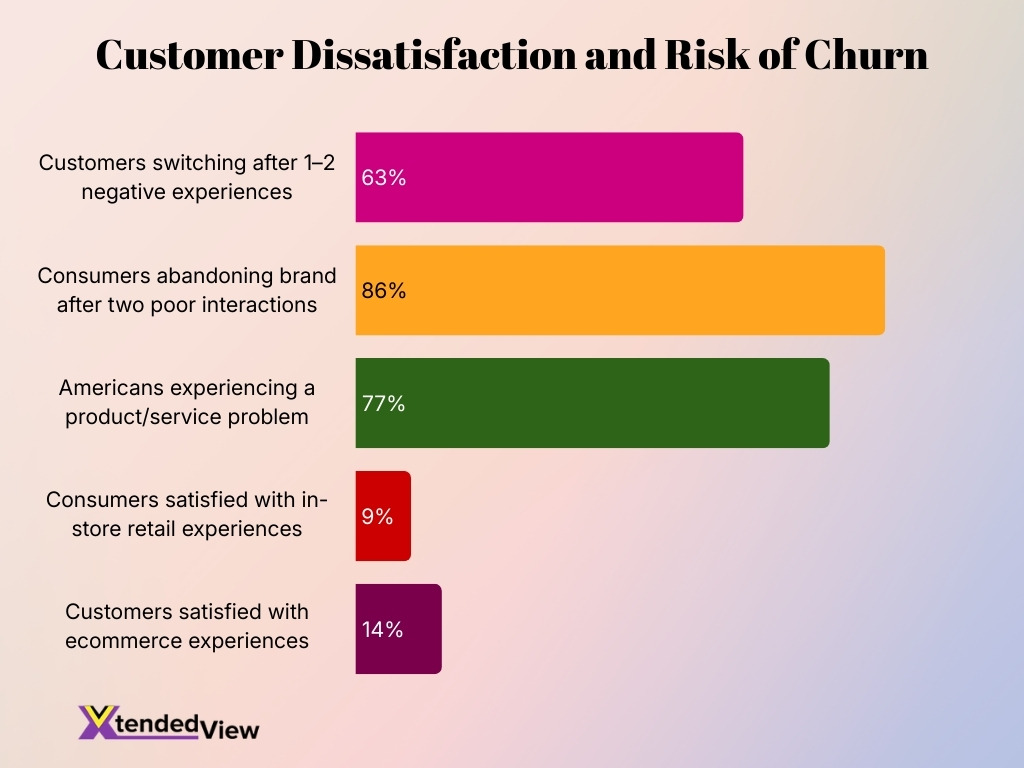
- 63% of customers would switch to a competitor after one or two negative support experiences.
- 86% of consumers say they will abandon a brand after two poor service interactions.
- Surveys show 77% of Americans experienced a product or service problem in the past year.
- Only 9% of consumers report satisfaction with in-store retail experiences.
- Just 14% of customers say they are satisfied with ecommerce experiences.
- Customers encountering repeated service issues are significantly more likely to share negative feedback publicly.
- Friction in customer journeys often leads to higher churn and lower brand trust.
- Many customers report dissatisfaction when the service requires high effort or multiple transfers between channels.
Customer Loyalty and Retention Statistics
- Increasing customer retention by just 5% can boost profits by 25% to 95%, making loyalty a major growth driver for businesses.
- About 65% of a company’s business comes from existing customers, highlighting the value of retention strategies.
- Loyal customers are 5× more likely to repurchase, 4× more likely to refer a friend, and 7× more likely to try new products from the same brand.
- Nearly 83% of customers say loyalty programs influence their decision to buy again from a brand.
- Companies with strong omnichannel engagement strategies retain 89% of customers, compared to 33% retention for companies with weak engagement.
- Research shows 60% to 70% of existing customers are likely to buy again, compared with 5% to 20% of new prospects.
- 68% of customers leave a company because they feel the business does not care about them.
- Businesses that invest in CX see customer lifetime value increase by up to 306%.
- A study found 77% of consumers stay loyal to brands that offer strong customer support.
Impact of Customer Experience on Revenue and Growth
- Companies that lead in CX outperform laggards by nearly 80% in revenue growth.
- Businesses that improve CX can increase revenue by 4% to 8% above market averages.
- Organizations that prioritize CX generate 5.7× more revenue than competitors that lag in experience management.
- Customers are willing to pay up to 16% more for products and services with superior experiences.
- Businesses that implement personalization in CX can increase revenue by 10% to 15%.
- 86% of buyers are willing to pay more for a better customer experience.
- Companies delivering excellent CX report 1.5× higher employee engagement, which correlates with improved productivity and revenue.
- Organizations that integrate CX analytics into business strategies can improve cross-selling and upselling success by 15% to 20%.
- Brands that prioritize CX outperform competitors in shareholder returns by up to three times over a decade.
Functions That Drive a Great Customer Experience in Companies
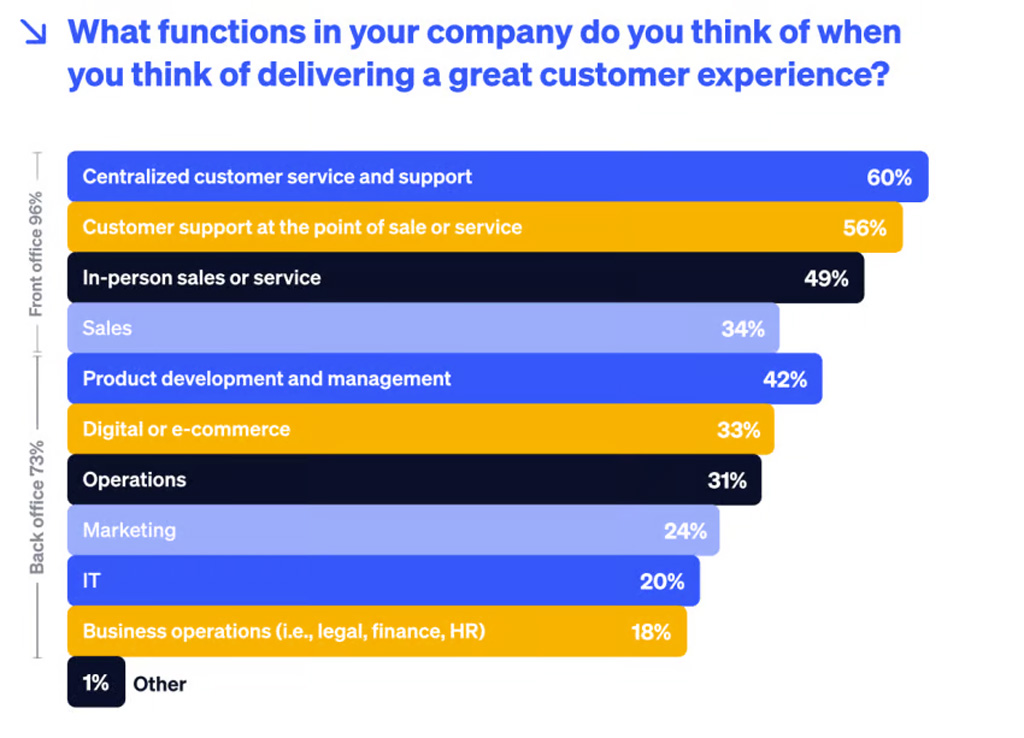
- Centralized customer service and support is the top function associated with delivering a great customer experience, cited by 60% of respondents, highlighting the importance of dedicated support teams.
- Customer support at the point of sale or service is identified by 56% of companies, showing that immediate assistance during the buying process is critical for positive customer interactions.
- In-person sales or service plays a major role in customer experience, with 49% of respondents saying face-to-face interactions significantly impact customer satisfaction.
- Product development and management are recognized by 42% of organizations, indicating that building products aligned with customer needs is a key element of delivering better experiences.
- Sales teams are considered part of the customer experience by 34% of companies, reflecting their role in guiding customers through purchasing decisions.
- Digital or e-commerce channels contribute to customer experience for 33% of businesses, emphasizing the growing importance of online platforms and seamless digital journeys.
- Operations departments influence customer experience according to 31% of respondents, particularly through efficient processes, delivery, and service fulfillment.
- Marketing is linked to customer experience by 24% of companies, demonstrating how brand messaging and communication shape customer perception.
- IT departments are mentioned by 20% of respondents, reflecting their role in supporting customer platforms, service systems, and digital infrastructure.
- Business operations functions such as legal, finance, and HR are associated with customer experience by 18% of organizations, showing that internal policies and processes also impact customers indirectly.
- Only 1% of respondents selected “Other”, indicating that most companies clearly associate customer experience with specific operational functions.
- Overall, front-office teams dominate customer experience responsibilities, with 96% of responses linked to front-office functions, compared to 73% associated with back-office departments.
Omnichannel and Cross-Channel Experience Statistics
- Companies with strong omnichannel strategies retain 89% of customers, while weak strategies retain just 33%.
- Customers who interact across multiple channels spend 4% more in-store and 10% more online than single-channel customers.
- Around 73% of shoppers use multiple channels during their buying journey.
- Businesses using omnichannel engagement strategies see 91% higher year-over-year customer retention rates.
- Consumers using omnichannel support have 23% higher satisfaction rates compared with single-channel interactions.
- 86% of buyers expect conversations with brands to move seamlessly between channels.
- Companies with omnichannel CX programs achieve 287% higher purchase rates.
- Research indicates 90% of consumers expect consistent interactions across channels, including mobile, web, and in-store.
- Businesses integrating CRM, messaging, and analytics platforms report significant improvements in CX efficiency and engagement.
Response Time and Speed of Support Statistics
- 90% of customers rate an immediate response as important when they have a customer service question.
- Nearly 60% of customers define immediate as within 10 minutes when contacting support.
- 82% of customers expect an immediate response from brands when they ask marketing or sales questions.
- Faster response times can increase customer satisfaction scores by up to 20%.
- 75% of customers expect consistent service regardless of channel, including live chat, phone, or social media.
- Companies that respond to customer inquiries within an hour are 7× more likely to qualify leads successfully.
- Delayed responses often result in higher churn and lower Net Promoter Scores (NPS).
- Around 62% of customers expect brands to respond to service requests within minutes on digital channels.
- Support teams using AI-driven tools report up to 37% faster response times compared to manual workflows.
Poor Customer Service Strongly Influences Brand Loyalty
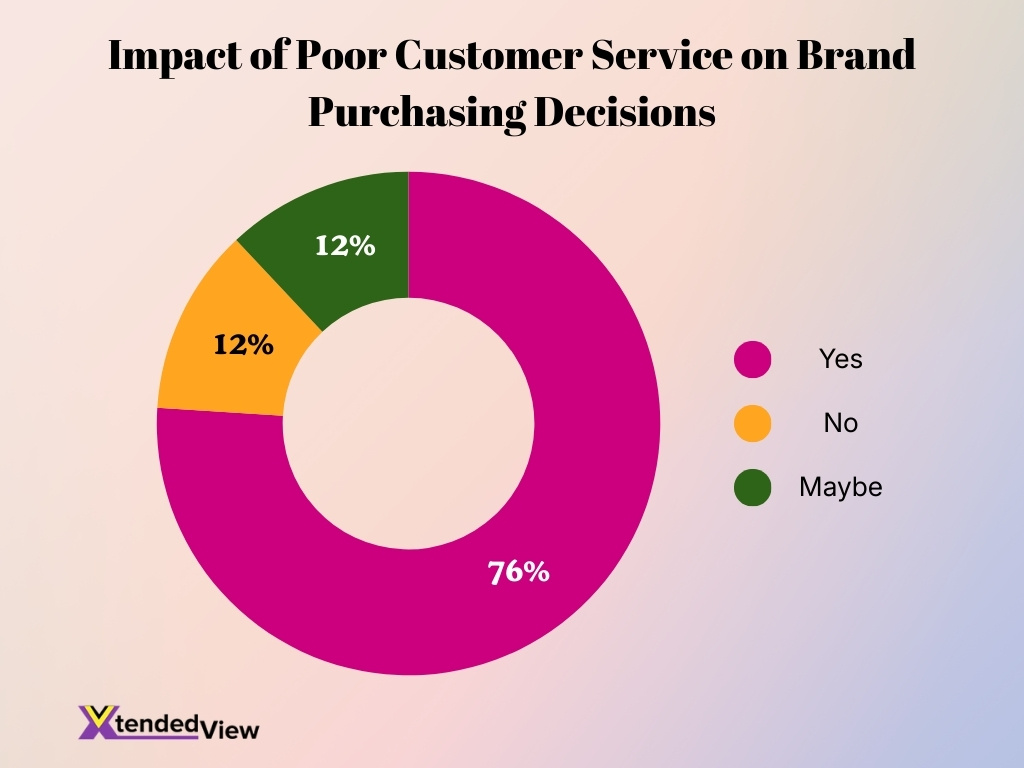
- A significant 76% of consumers say a poor customer service experience has made them stop purchasing from a brand, highlighting how critical support quality is for customer retention.
- Only 12% of respondents report that bad customer service has not affected their purchasing decisions, suggesting very few customers remain loyal after negative experiences.
- Another 12% of consumers say “maybe,” indicating that poor service can still influence future buying behavior depending on the severity of the issue.
- Overall, nearly 9 out of 10 consumers (88%) either stopped purchasing or considered stopping purchases after experiencing poor customer service.
- The data demonstrates that customer experience plays a decisive role in brand loyalty and long-term revenue, as negative interactions can quickly push customers toward competitors.
- Businesses that fail to maintain consistent, responsive, and helpful support risk losing a large majority of their customer base after just one poor experience.
First Contact Resolution and Customer Effort Statistics
- 67% of customer churn can be prevented if issues are resolved during the first interaction.
- Companies that achieve strong first-contact resolution rates see higher customer satisfaction and loyalty scores.
- Customers who exert high effort to resolve problems are 96% more likely to become disloyal.
- Reducing customer effort improves repeat purchases and increases loyalty metrics.
- Businesses that optimize first-contact resolution often reduce customer support costs by 20% to 30%.
- Customer effort score (CES) is increasingly used alongside NPS and CSAT to measure CX success.
- High-performing service teams achieve first-contact resolution rates above 70% to 75%.
- Studies show customers prefer quick solutions over elaborate service gestures, reinforcing the importance of low-effort interactions.
- Businesses improving CES metrics report stronger loyalty and retention outcomes across industries.
Personalization and Tailored Customer Experiences
- 71% of consumers expect companies to deliver personalized interactions.
- 76% of customers become frustrated when personalization is missing from brand interactions.
- Companies that excel at personalization generate 40% more revenue from those activities than average performers.
- Personalized product recommendations account for up to 35% of Amazon’s revenue.
- 80% of consumers are more likely to buy from brands that offer personalized experiences.
- Businesses implementing personalization strategies see 10% to 30% improvements in marketing efficiency.
- Nearly 63% of consumers expect personalization as a standard level of service.
- AI-powered personalization tools are projected to drive significant improvements in CX metrics by 2026.
- Companies investing in customer data platforms often report higher engagement and conversion rates.
Customer Support Preferences: Human Agents vs AI Chatbots
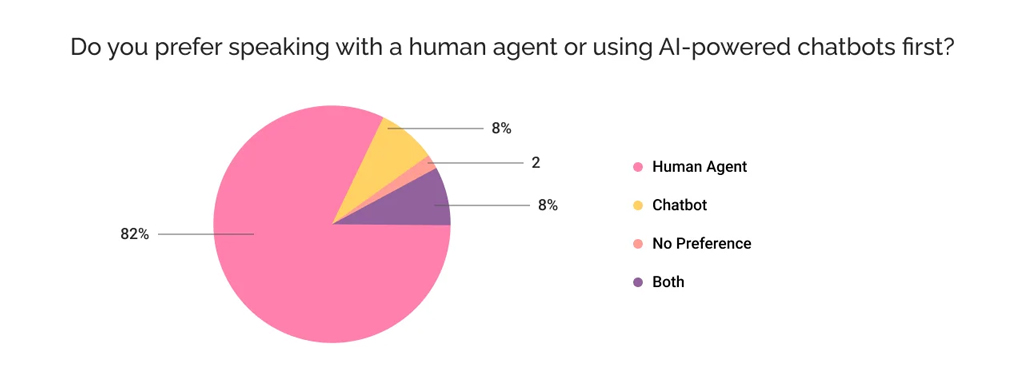
- A large majority of customers, about 82%, prefer speaking with a human agent first when seeking customer support.
- Only 8% of respondents prefer interacting with an AI-powered chatbot as their first point of contact.
- Around 8% of users report that they are comfortable using both human agents and chatbots, depending on the situation.
- Just 2% of customers say they have no specific preference between human agents and chatbots.
- The data highlights a strong trust and comfort gap, with human agents still dominating customer support preferences.
- Despite growing AI adoption, chatbots remain a secondary choice for most users when resolving issues.
- The combined openness to chatbots (8%) and hybrid support (8%) indicates that 16% of customers are receptive to AI-assisted support models.
- Overall, the results suggest that while AI chatbots are gaining traction, human interaction continues to be the most valued support channel for the majority of consumers.
Self-Service and Knowledge Base Usage Statistics
- Around 67% of customers prefer self-service options rather than speaking to a representative when resolving simple issues.
- Approximately 81% of customers attempt to solve problems themselves before contacting support.
- Companies that implement robust knowledge bases can reduce support ticket volumes by up to 20% to 30%.
- About 70% of customers expect a company website to include self-service support tools such as FAQs or help centers.
- Businesses that invest in self-service portals often report higher customer satisfaction and reduced operational costs.
- Mobile-friendly knowledge bases improve self-service success rates by over 30%, particularly for younger customers.
- Around 91% of customers would use an online knowledge base if it were tailored to their needs.
- Self-service channels such as chatbots and help centers can handle up to 70% of routine customer queries.
- Companies using knowledge-centered support strategies often experience shorter resolution times and improved first-contact resolution rates.
Digital, Mobile, and In-App Customer Experience Statistics
- As of 2025, over 60% of global customer service interactions occur through digital channels such as chat, email, and messaging apps.
- Around 73% of consumers prefer to use websites or mobile apps when interacting with brands for support or purchases.
- Mobile devices account for more than half of all global web traffic, influencing how brands design digital CX strategies.
- Customers using mobile apps show higher engagement and purchase frequency than those using only desktop platforms.
- Studies show 88% of online consumers are less likely to return after a poor website experience.
- Businesses that invest in mobile CX improvements can increase conversion rates by up to 30%.
- Digital-first customer journeys are growing rapidly, with nearly 70% of customers beginning their buying journey online.
- Companies implementing in-app messaging support report higher engagement and faster problem resolution.
- Consumers increasingly expect real-time assistance within apps, especially in fintech, ecommerce, and SaaS platforms.
Customer Satisfaction Scores Vary Significantly Across Industries
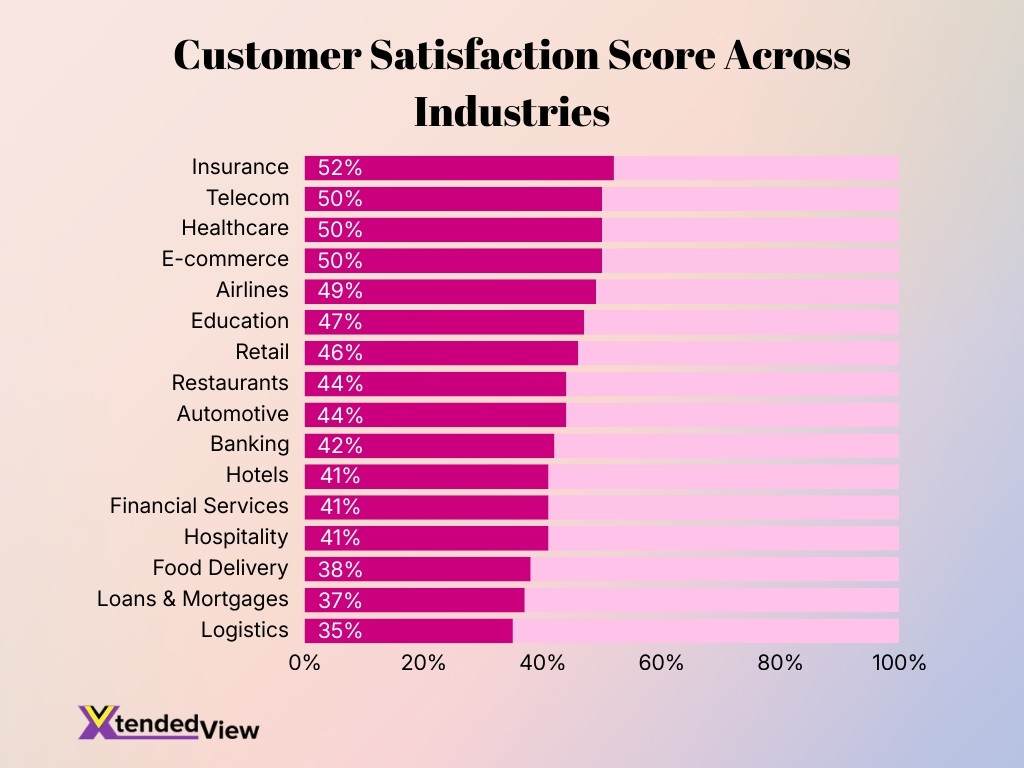
- The Insurance industry leads customer satisfaction with the highest CSAT score of 52%, making it the top-performing sector among all industries surveyed.
- Telecom, Healthcare, and E-commerce share the second-highest CSAT score at 50%, indicating moderate satisfaction but still leaving significant room for improvement.
- The airline industry records a CSAT score of 49%, placing it slightly below the top-performing sectors but still above the overall mid-range satisfaction level.
- Education (47%) and Retail (46%) show relatively average satisfaction levels, reflecting mixed customer experiences in these industries.
- Restaurants and Automotive both report 44% CSAT, suggesting that fewer than half of customers are fully satisfied with their service experiences.
- The Banking sector records a CSAT score of 42%, highlighting ongoing challenges in customer support, service speed, and overall user experience.
- Hotels, Financial Services, and Hospitality each have a 41% customer satisfaction score, placing them in the lower-middle tier of industries measured in the survey.
- Food Delivery services receive a CSAT score of 38%, showing that delivery delays, order accuracy, and service reliability may impact satisfaction levels.
- Loans and Mortgages rank among the lowest-performing sectors with a 37% CSAT score, indicating widespread dissatisfaction among customers.
- Logistics has the lowest customer satisfaction score at just 35%, making it the least satisfying industry for customers according to the survey.
- Overall, the results show that no industry exceeds a 60% satisfaction level, highlighting a significant gap between customer expectations and actual service experiences across multiple sectors.
- The data is based on a 2025 post-interaction survey of 18,283 respondents, providing insights into how consumers evaluate their service experiences across industries.
Metrics and KPIs for Measuring Customer Experience
- Net Promoter Score (NPS) remains one of the most widely used CX metrics for measuring customer loyalty and advocacy.
- Customer Satisfaction Score (CSAT) measures short-term satisfaction after service interactions or purchases.
- Customer Effort Score (CES) evaluates how easy it is for customers to resolve issues or complete actions.
- Companies using CX analytics and KPIs report higher retention and better decision-making outcomes.
- Tracking CX metrics can help businesses identify friction points in the customer journey.
- Organizations that actively monitor CX KPIs often experience improved service performance and higher loyalty rates.
- Advanced analytics tools allow companies to combine behavioral, transactional, and feedback data for deeper CX insights.
- Businesses using real-time CX dashboards can respond faster to emerging customer issues.
- Data-driven CX strategies often lead to more effective personalization and service optimization.
Frequently Asked Questions (FAQs)
73% of consumers say customer experience is a key factor influencing their purchasing decisions.
Over 50% of customers will switch to a competitor after a single unsatisfactory customer experience.
72% of customers expect immediate service when they contact a company for support.
U.S. companies lose about $75 billion annually because of poor customer service experiences.
3 in 4 consumers (around 75%) say they are willing to spend more with businesses that provide excellent customer experiences.
Conclusion
Customer experience has evolved from a support function into a strategic growth driver. Across industries, companies that invest in faster service, omnichannel engagement, and personalized interactions consistently outperform competitors. The statistics highlighted in this report show that customers now expect seamless digital experiences, responsive support, and tailored interactions across every touchpoint.
At the same time, emerging technologies such as AI, automation, and predictive analytics continue to reshape how businesses deliver service. Organizations that combine these technologies with human-centered support and data-driven insights can improve satisfaction, loyalty, and long-term revenue. As we move, businesses that prioritize customer experience will likely build stronger relationships, reduce churn, and unlock new opportunities for growth.
