


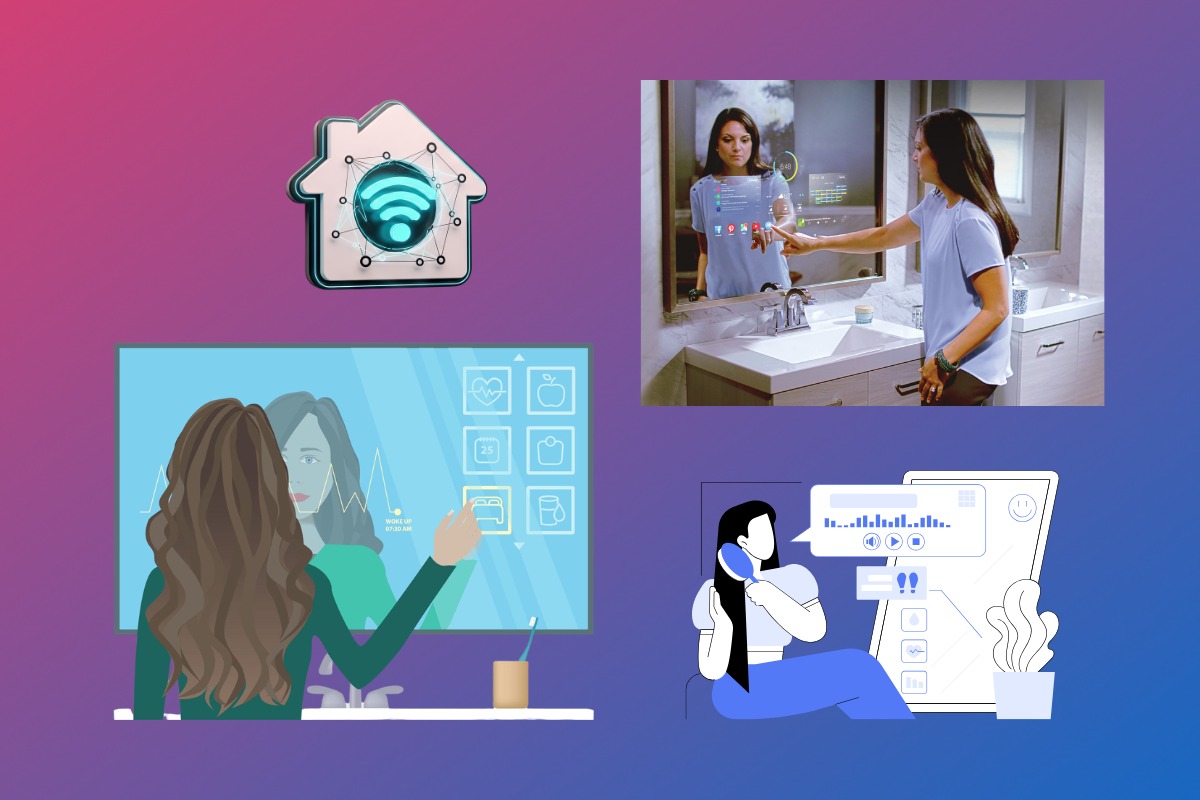
Smart mirrors are evolving from simple illuminated fixtures into connected digital interfaces that combine reflective surfaces with displays, cameras, sensors, artificial intelligence, augmented reality, and Internet of Things technology. Their applications extend across residential bathrooms, retail stores, hotels, health and wellness environments, fitness spaces, and vehicles. Retailers can use smart mirrors for virtual try-ons and personalized shopping experiences, while automotive systems use cameras and digital displays to improve rear visibility and support driver-monitoring functions.
Market estimates vary considerably because researchers define smart mirrors differently, with some focusing on residential and commercial products and others including automotive systems, software, and related services. Even with these methodological differences, current data points to expanding investment in AI features, AR shopping, OLED displays, health monitoring and connected-home integration. These statistics provide a detailed view of smart mirror market size, adoption, applications, regional performance, technology trends and growth opportunities.
Editor’s Choice
- The global smart mirror market reached $653.2 million in 2025 under one narrowly defined market model and is estimated to reach $710.7 million in 2026.
- Under that same model, worldwide revenue could reach $1.3 billion by 2033, nearly double the 2025 level.
- A broader 2026 market assessment values the industry at $3.38 billion and projects revenue of $10.37 billion by 2034.
- Another 2026 forecast expects smart mirror revenue to rise from $4.63 billion in 2026 to $7.43 billion in 2030, representing a 12.5% forecast CAGR.
- Wall-mounted products generated about 80% of 2025 revenue in one current smart mirror market analysis, highlighting the importance of fixed residential and commercial installations.
- Automotive applications represented 41.89% of 2025 smart mirror revenue in another market model, making vehicles a major commercial use case.
- LCD technology captured 73.07% of the smart mirror market in 2025, while OLED revenue is projected to grow at an 11.13% CAGR through 2031.
- Business-to-business sales represented 81.21% of 2025 market revenue, although business-to-consumer sales are projected to expand at a 12.27% CAGR through 2031.
- The related virtual mirror market reached $11.6 billion in 2024 and is estimated at $20.3 billion in 2026, reflecting strong commercial interest in AR-driven virtual try-on experiences.
- In the U.S., only 19% of surveyed consumers said in 2025 that they were excited about using AR or VR while shopping online, indicating that technical capability is expanding faster than broad consumer enthusiasm.
Recent Developments
- At CES 2025, a health-technology concept combined an interactive mirror with a base capable of collecting measurements related to heart, lung, weight, sleep, activity, and nutrition.
- The same concept brought information from smartwatches, scales, blood pressure monitors, sleep trackers and other connected sensors into one mirror interface, illustrating how mirrors could become centralized health dashboards.
- The CES 2025 health-mirror concept also incorporated an AI voice companion designed to provide real-time feedback, answer questions and guide users through their health information.
- Automotive smart mirrors also advanced in 2025. One major digital rearview system introduced a premium version with an OLED display to improve screen clarity.
- That automotive system also demonstrated water-shedding camera-lens technology designed to help keep the rear-facing camera clear of rain and moisture.
- Digital rearview technology had expanded to 124 vehicle models across more than 29 automotive brands by CES 2025, showing that camera-based mirrors have progressed well beyond pilot programs.
- Driver-monitoring technology is increasingly moving into the rearview-mirror area. Current systems can support 2D and structured-light 3D cabin monitoring for detecting occupants, objects and behavior.
- Research published in 2025 surveyed 228 consumers about virtual try-on technology and found that enjoyment, personal innovativeness, and perceived environmental benefits significantly influenced attitudes toward VTO and online purchase intentions.
- A separate 2025 virtual try-on study analyzed 400 online consumers and found that AR interactivity, aesthetics, and realism contributed to personalization, enjoyment, and behavioral responses.
- Meanwhile, 2026 U.S. shopping data suggests an adoption hurdle: 38.3% of U.S. digital shoppers said they had never used virtual or augmented reality for shopping and were not interested in trying it.
Smart Mirror Market Size Growth Statistics
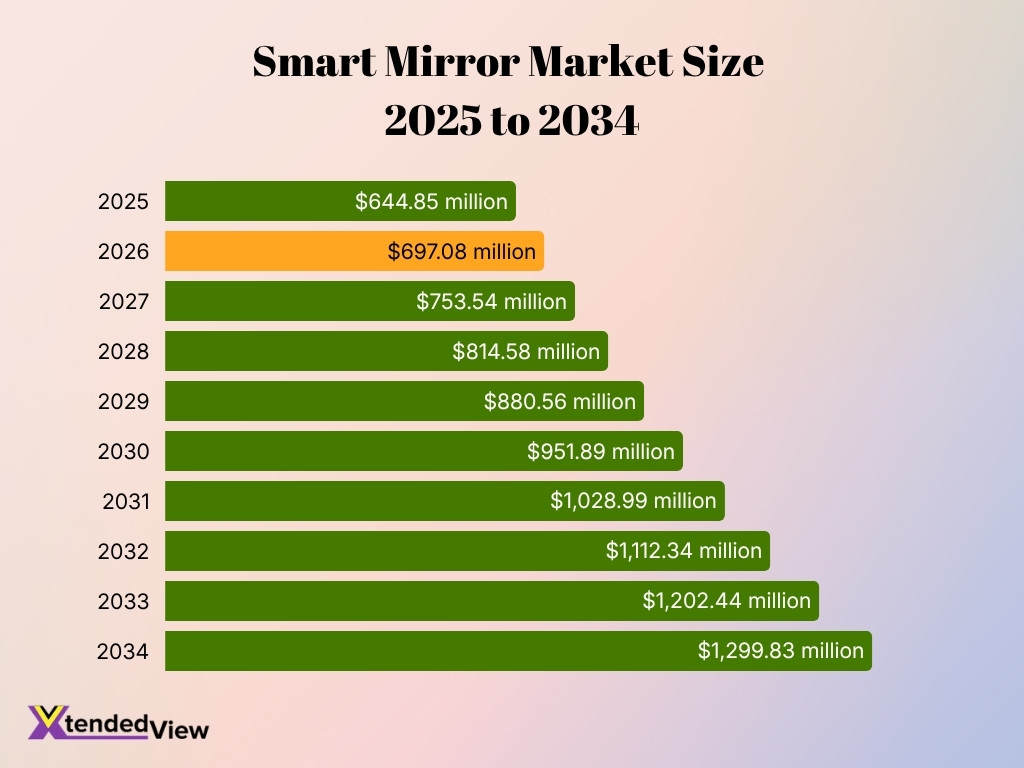
- The global smart mirror market is projected to grow from $644.85 million in 2025 to $1.30 billion by 2034, showing strong long-term market expansion.
- Smart mirror market revenue is expected to reach $697.08 million in 2026, up from $644.85 million in 2025.
- By 2028, the market is forecast to reach $814.58 million, continuing its steady year-over-year growth trajectory.
- The smart mirror industry is projected to approach the $1 billion milestone in 2030, when its market size reaches $951.89 million.
- The market is expected to surpass $1 billion for the first time in 2031, reaching approximately $1.03 billion.
- Smart mirror market revenue is projected to climb further to $1.11 billion in 2032 and $1.20 billion in 2033.
- By 2034, the smart mirror market is forecast to reach $1.30 billion, more than double its 2025 market size.
Smart Mirror Market Growth Rate and Forecast
- One current forecast expects the global smart mirror market to expand at an 8.8% CAGR from 2026 through 2033, reaching $1.3 billion by the end of the period.
- A broader market forecast projects a 15.03% CAGR from 2026 through 2034, taking revenue from $3.38 billion to $10.37 billion.
- Another 2026 forecast projects a 12.5% CAGR in the coming years, with market value rising from $4.63 billion in 2026 to $7.43 billion in 2030.
- A separate market model expects revenue to increase from $2.3 billion in 2026 to $5.6 billion in 2035, equal to a 10.5% CAGR.
- Another forecast places 2026 smart mirror technology revenue at $4.84 billion and projects 10.36% annual growth through 2032, when revenue could reach $8.8 billion.
- A 2025-based forecast expects a comparatively moderate 8% CAGR through 2035, with revenue rising from $639.4 million to $1.38 billion.
- Another market assessment forecasts an 8.22% CAGR and expects revenue to increase from $641.1 million in 2025 to $1.114 billion by 2032.
- The related smart bathroom mirror category has a projected 11.2% CAGR from 2023 through 2030, providing another indicator of demand for connected bathroom fixtures.
- Virtual mirrors represent a faster-growing adjacent market. Revenue is projected to reach $63.6 billion by 2030, based on a 33.1% CAGR from 2025 through 2030.
- Within smart mirrors, OLED represents a higher-growth display segment, with revenue projected to expand at an 11.13% CAGR through 2031, compared with LCD’s dominant 2025 market share.
Smart Mirror Adoption, Awareness, and Ownership Statistics
- In 2025, 45% of U.S. internet households owned at least one core smart-home device, creating a substantial installed base for additional connected products such as smart mirrors.
- A separate U.S. survey of 1,006 homeowners and renters found that 93% owned some form of smart device, although the study used a broader device definition than core smart-home research.
- That survey also found that 57% worried about data privacy, a relevant barrier for mirrors equipped with cameras, microphones or biometric sensors.
- In February 2026, 35% of U.S. adults reported having a smart speaker, making voice-controlled technology familiar to roughly one-third of adults.
- AI-enabled smart doorbells reached 18% ownership among U.S. adults in the same 2026 survey, compared with 13% for AI robot vacuums and 11% for AI smart thermostats.
- U.S. households spent an average of $896 on connected devices in 2025, compared with $764 in 2024, an increase of $132 per household in one year.
- Consumer enthusiasm remains more limited for immersive shopping: 19% of U.S. respondents in a 2025 survey said they were excited about using AR or VR while shopping online.
- Interest differs sharply by market. The same survey found 41% enthusiasm in India, compared with 19% in the U.S. and U.K. and only 8% in Japan.
- By 2026, 38.3% of U.S. digital shoppers said they had never used VR or AR for shopping and were not interested in doing so, indicating that virtual mirror adoption still faces a meaningful consumer-engagement barrier.
- Privacy remains important as smart mirrors collect more data. A 2025 U.S. security study examined 401 smart-home users across lighting, security, sensor, thermostat and voice-assistant categories to understand how privacy concerns vary by device type.
Smart Mirror Market Share by Application
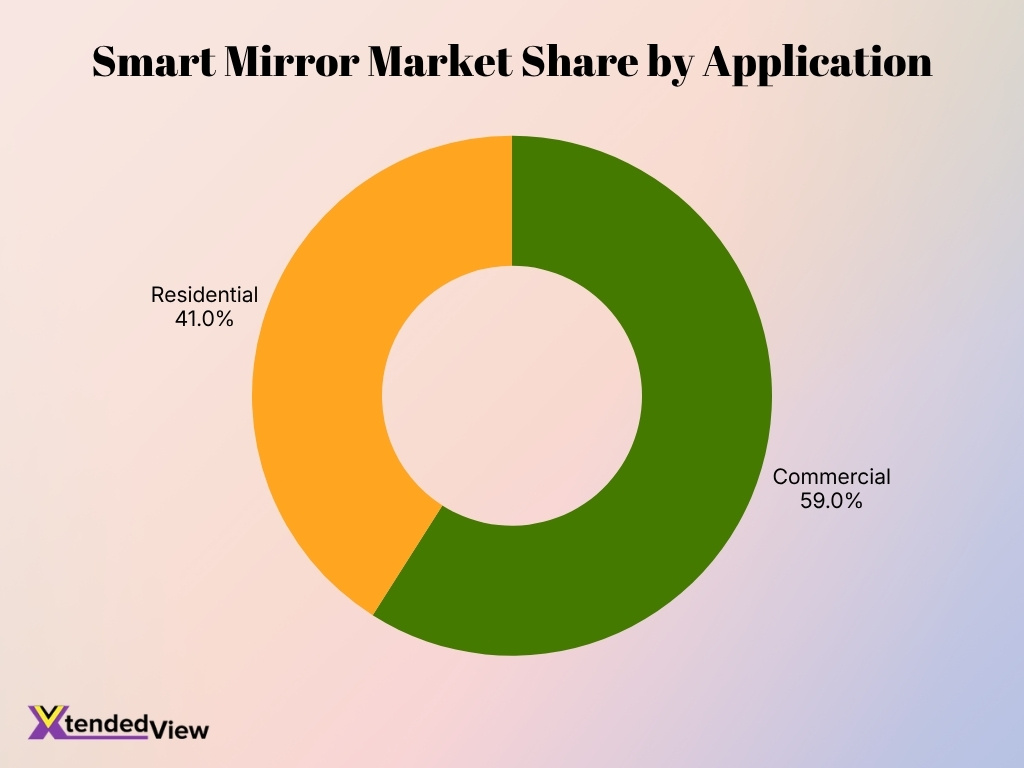
- The commercial segment dominated the smart mirror market in 2025, accounting for 59.0% of the total market share.
- The residential segment represented the remaining 41.0% of the smart mirror market.
- Commercial applications held an 18 percentage-point lead over residential applications, highlighting stronger adoption across retail, hospitality, healthcare, and other business environments.
- Despite trailing commercial use, the 41.0% residential share shows that smart mirrors have established a substantial presence in homes and personal living spaces.
- Overall, the data indicates that commercial applications remain the primary demand driver, while residential adoption contributes a significant portion of the market.
Smart Mirror Use in Residential and Commercial Spaces
- Residential applications accounted for 58.6% of the smart mirror market in 2025 under one market model, making homes the leading application segment in that analysis.
- Wall-mounted smart mirrors generated 64.2% of 2025 revenue in the same analysis, reflecting their suitability for bathrooms, dressing areas, and space-constrained interiors.
- Another current market analysis estimates that wall-mounted models represented about 80% of global smart mirror revenue in 2025, although its market definition differs from other published estimates.
- U.S. households spent an average of $896 on connected devices in 2025, up 17% from $764 in 2024. This expanding connected-device budget supports the addressable market for smart bathroom and bedroom products.
- Looking ahead, 29% of U.S. consumers surveyed in 2025 planned to increase device spending, while 24% expected to reduce it.
- Affordability remains a barrier to connected-home purchases: 51% of surveyed U.S. consumers expected technology affordability challenges, although that figure improved from 61% in 2024.
- Meanwhile, 23% of consumers expected to delay device purchases, while 17% anticipated being unable to afford the more advanced devices their households wanted.
- The wider smart-display market also shows strong residential demand. Residential smart-home applications generated 73.95% of smart-display revenue in 2025, while integrated formats such as smart mirrors are forecast to grow at a 25.74% CAGR through 2031.
- Commercial demand includes retail, hospitality, health care and fitness. One 2026 market analysis identifies residential bathrooms, fitness and wellness spaces, retail environments and hospitality as important sources of smart mirror growth.
- Business buyers remain particularly important: B2B transactions generated 81.21% of smart mirror sales in 2025, reflecting large orders from automakers, hotels, retailers and other organizations.
Smart Mirror Use in Retail and Hospitality
- The global virtual mirror market reached $11.6 billion in 2024 and is estimated to reach $20.3 billion in 2026, indicating substantial commercial investment in virtual product visualization.
- A 2025 academic study of 400 online consumers found that AR interactivity, aesthetics, and realism influenced personalization and enjoyment in virtual try-on experiences.
- Another 2025 study collected 783 valid questionnaires when examining virtual fitting rooms and fashion retail performance, including 327 virtual fitting room users and 394 nonusers.
- The study found that visual vividness, interactive control and personalized features positively influenced aspects of retail operational performance, although the relationship did not extend to every online purchase-intention measure.
- A smaller 2025 fashion study used an experimental sample of 91 participants to compare consumer perceptions of AR and physical experiences across size, fit and appearance.
- Hotels also face pressure to add connected technology. A 2025 global survey of more than 450 properties found that 56% of hotels felt pressure to continue upgrading their technology.
- The same survey found that 50% of hotels offered guests a verbal technology walk-through at check-in to explain features such as smart lighting, Wi-Fi and in-room entertainment.
- In a hospitality technology study, 71% of guests considered smart TVs or content streaming moderately or very important when selecting a hotel, illustrating demand for connected in-room experiences.
- In that study, 60% of guests also considered digital signage for property information and airline updates important, a function that interactive hotel mirrors could incorporate into the guest-room interface.
- Earlier traveler research found that 17.6% of respondents considered smart mirrors or interactive walls replacing TVs a must-have technology for creating a better future hotel stay.
Smart Mirror Use in Healthcare
- Health care represents the fastest-growing smart mirror application in one current forecast, with revenue projected to increase at a 10.02% CAGR through 2031.
- A 2025 feasibility study demonstrated an AI-enabled smart mirror capable of performing real-time heart rate and SpO₂ monitoring using a standard webcam and remote photoplethysmography.
- The experimental platform combined three core AI components: facial-expression analysis, remote photoplethysmography and conversational AI.
- Its facial-analysis component could estimate emotion and age while operating alongside the physiological monitoring system.
- Researchers converted a model originally designed for offline processing into a continuously streaming system, showing the technical feasibility of real-time monitoring through a mirror interface.
- The system also included a conversational health component with English and Korean support, demonstrating how future mirrors could combine measurements with spoken guidance.
- A separate health-mirror concept introduced in 2025 brought together measurements related to heart, lung, weight, sleep, activity and nutrition, showing the potential for a mirror to act as a central health dashboard.
- Current market segmentation now treats health monitoring, diagnostics and telemedicine as distinct smart mirror applications rather than grouping every nonresidential installation into a generic commercial category.
- The global smart mirror market itself is forecast to grow from $710.7 million in 2026 to $1.3 billion by 2033 under one narrower market definition, giving health-focused vendors a growing hardware ecosystem to build on.
- However, health mirrors that rely on cameras and personal data face a trust challenge. In a 2025 U.S. connected-consumer study of about 3,500 people, researchers found growing concern around privacy, security and transparency as consumers adopted more AI-enabled technology.
Smart Mirror Market Share by Installation Type
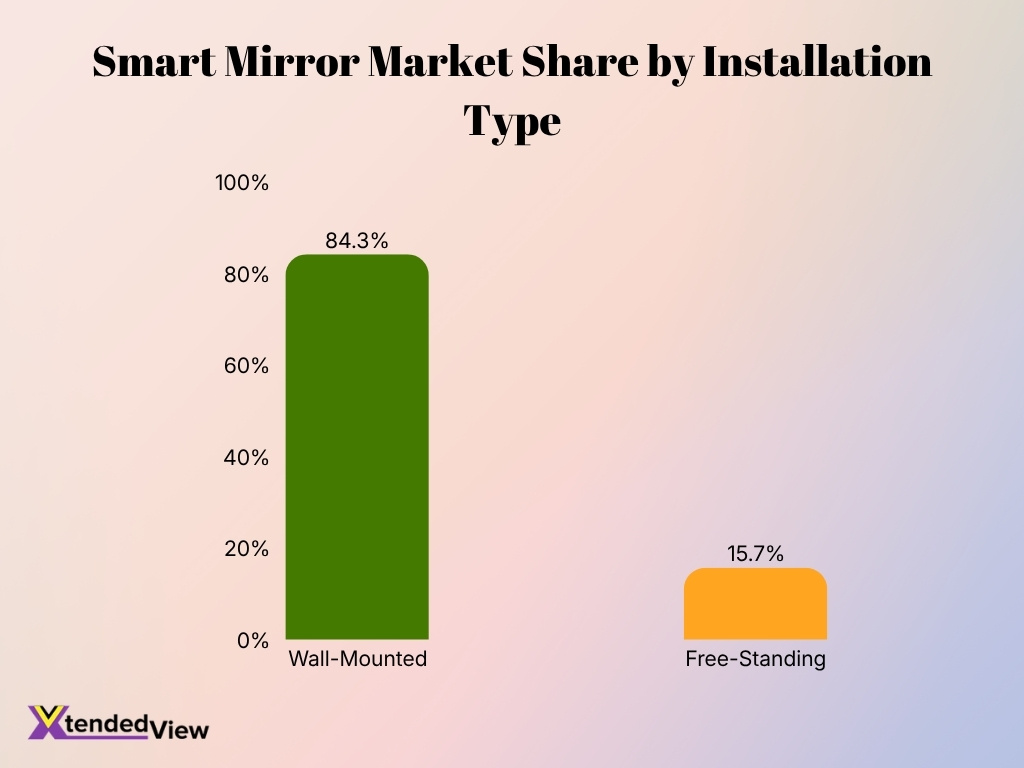
- Wall-mounted smart mirrors dominate the market, accounting for 84.3% of total market share in 2025.
- Free-standing smart mirrors hold just 15.7% of the market, making them a significantly smaller installation segment.
- Wall-mounted models command a market share that is more than five times higher than free-standing alternatives.
- The strong 84.3% wall-mounted share indicates that consumers and commercial buyers largely prefer space-efficient, permanently installed smart mirror solutions.
- Free-standing smart mirrors remain a niche segment, representing less than one-sixth of the overall market.
Smart Mirror Use in Automotive
- Automotive applications generated 41.89% of global smart mirror revenue in 2025 under one market model, the largest application share in that dataset.
- One leading digital rearview system was available on more than 29 automotive brands and 124 vehicle models worldwide at the beginning of 2025.
- By 2026, a current industry estimate placed deployment of that system at more than 140 vehicle models, illustrating continued expansion across automaker programs.
- The manufacturer behind that platform held an estimated 79% worldwide share of automatic-dimming automotive rearview mirrors in 2025, according to its regulatory filing.
- Automotive rearview mirrors and electronics generated 89% of that manufacturer’s consolidated net sales in 2025, highlighting the commercial importance of vehicle mirror technology.
- The company’s mirror and electronics customer list spans dozens of global vehicle manufacturers, including passenger vehicle, motorcycle, commercial vehicle and electric vehicle producers.
- New digital rearview technology shown in 2025 incorporated an OLED display and a water-shedding camera lens designed to improve display clarity and maintain rearward visibility in wet conditions.
- Mirror-integrated monitoring can support 2D and structured-light 3D sensing to identify passengers, objects, occupant behavior and the presence of life inside a vehicle.
- Hybrid camera-monitoring systems can use three cameras to capture side and rear views before combining the feeds for the driver.
- U.S. regulators continued studying camera-based rear visibility systems in 2025, including systems intended to replace or supplement conventional mirrors, as part of work related to federal rear-visibility requirements.
Smart Mirror Market Segmentation by Technology
- Electrochromic technology led the smart mirror market in 2025 under one current technology segmentation model.
- Electrochromic mirrors can automatically adjust tint or reflectivity, which supports adaptive glare control in automotive and other light-sensitive applications.
- Current smart mirror technology classifications also include semi-reflective, self-repairing, self-cleaning, and LCD/LED display mirrors alongside electrochromic products.
- Another market taxonomy divides products into self-dimming, self-cleaning, touchscreen and other technologies, illustrating how smart mirror functionality has expanded beyond simple embedded displays.
- Hardware generated 66.73% of smart mirror sales in 2025, showing that displays, cameras, sensors and mirror assemblies still account for most industry revenue.
- Services represent a smaller but faster-developing component and are forecast to grow at a 9.61% CAGR through 2031.
- LCD technology controlled 73.07% of smart mirror display revenue in 2025, while OLED is forecast to grow at an 11.13% CAGR through 2031.
- AI-enabled experimental mirrors can already combine remote photoplethysmography, facial analysis and conversational AI within one interface.
- Automotive systems demonstrated in 2025 can integrate OLED displays, driver monitoring and water-management technology into or around the rearview mirror.
- In the broader smart-display market, Wi-Fi-only products represented 86.95% of 2025 shipments, while Wi-Fi plus Matter devices are forecast to grow at a 22.41% CAGR through 2031, signaling stronger interoperability for connected displays and related smart-home products.
Smart Mirror Market Segmentation by Distribution Channel
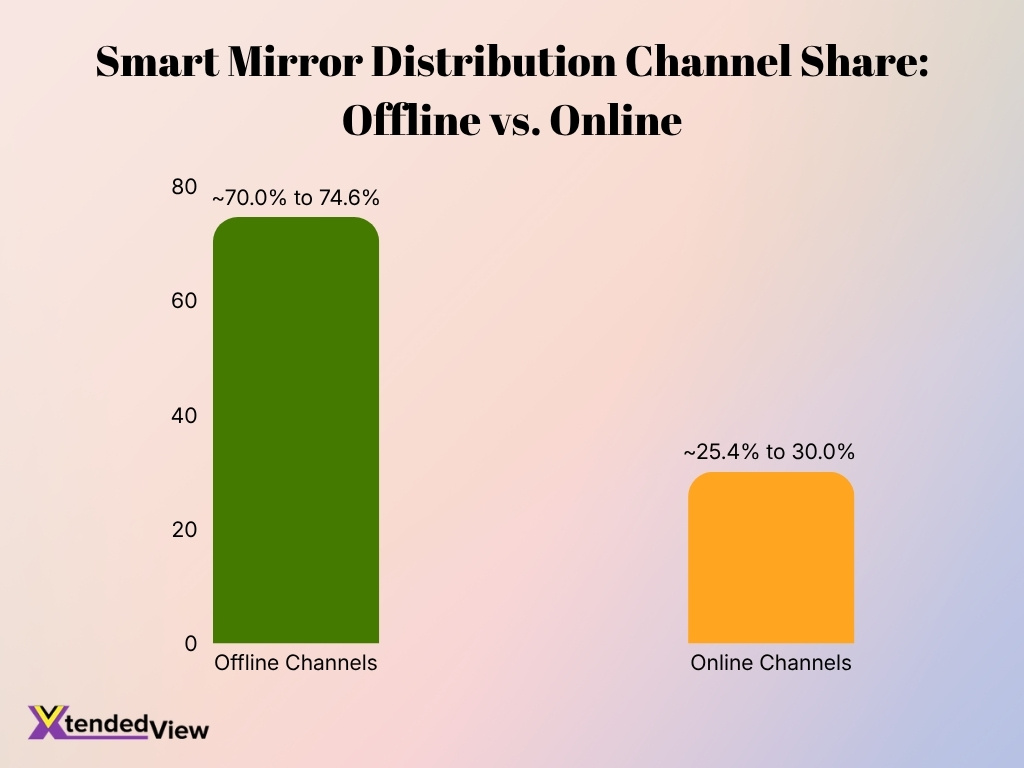
- Offline channels dominate smart mirror distribution, accounting for approximately 70.0% to 74.6% of the market in 2025/2026.
- The strong offline share reflects consumers’ preference to inspect mirror quality, size, design, and functionality in person before purchasing.
- Online channels hold around 25.4% to 30.0% of smart mirror sales, representing a smaller but expanding portion of the market.
- Online smart mirror sales are expected to grow faster as direct-to-consumer brands expand their digital presence and e-commerce adoption increases.
- Improved AR visualization tools could further support online purchases by helping buyers preview smart mirrors in their intended spaces before ordering.
Smart Mirror Market by Region
- North America generated 37.28% of global smart mirror revenue in 2025 under one 2026 market model, making it the largest regional market in that dataset. The region produced about $1.10 billion in 2025 and is estimated at $1.26 billion in 2026.
- The U.S. smart mirror market reached approximately $960 million in 2025 under the same methodology and is projected to expand at a 14.45% CAGR during the forecast period.
- Europe is estimated to generate about $910 million in 2026, with regional revenue projected to expand at a 13.70% CAGR over the forecast period.
- Germany’s smart mirror market was valued at approximately $140 million in 2025 and is projected to grow at a 14.26% CAGR, while the U.K. market stood at roughly $90 million and has a projected 15.04% CAGR.
- Asia Pacific is projected to reach approximately $840 million in 2026 under that market model, placing it behind North America and Europe in absolute revenue.
- A different methodology identifies Asia Pacific as the largest market, with $703 million in 2025 revenue and a 35.2% share. Within that estimate, China contributed $292 million, Japan $152 million, South Korea $112 million, and India $95 million.
- Under the same model, North America generated $520 million in 2025, representing 26% of worldwide revenue. The U.S. accounted for $448.2 million, and Canada contributed $72 million.
- Europe accounted for approximately $511 million, or 25.6%, of global 2025 revenue in that analysis. Germany is projected to record an 11.3% CAGR from 2026 through 2035.
- Latin America generated an estimated $144 million in 2025, including $71 million from Brazil and $44 million from Mexico. The region is projected to grow at about 12.7% annually.
- Another narrower smart mirror model gives North America an even larger 47.5% share of 2025 revenue and identifies it as the fastest-growing regional market from 2026 through 2033.
Smart Mirror Features, Artificial Intelligence, AR, and IoT Statistics
- Hardware generated 66.73% of smart mirror revenue in 2025, showing that displays, mirror assemblies, cameras, and sensors continue to account for most market value.
- Services represent a smaller segment but are projected to expand at a 9.61% CAGR through 2031, reflecting growing demand for software integration, maintenance and connected services.
- LCD displays captured 73.07% of smart mirror display revenue in 2025, while OLED revenue is forecast to grow at an 11.13% CAGR through 2031.
- Another 2026 forecast expects OLED smart mirrors to post a 17.90% CAGR through 2034, making OLED the fastest-growing display type in that market model.
- In one wall-mounted smart mirror analysis, interactive touchscreen products represented 43.62% of 2025 market value, compared with 36.53% for LED-backlit products and 19.85% for voice-controlled models.
- Voice-controlled wall-mounted mirrors generated approximately $290.3 million in 2025 in that analysis, highlighting growing demand for hands-free interaction.
- Interactive touchscreen mirrors generated approximately $637.8 million in 2025, making touch interaction the largest functionality category in the same dataset.
- A 2025 experimental health mirror combined three AI capabilities within one system: facial analysis, remote photoplethysmography, and conversational AI. The design demonstrates how mirrors can move beyond displaying information to interpreting visual and physiological signals.
- AR has become especially important in retail mirrors because it can digitally place makeup, eyewear, apparel or accessories onto a shopper’s image. A 2026 systematic review describes VTO primarily as a combination of AR- and AI-based applications used to improve online product evaluation.
- Connectivity also expands the mirror’s role as an IoT interface. Smart mirrors can connect with home automation systems, speakers, lighting, mobile devices, health sensors and other connected products rather than operating as isolated displays. This convergence remains one of the central drivers behind the projected 15.03% smart mirror market CAGR from 2026 to 2034 in one current forecast.
Smart Mirror Consumer Demographics and Price Statistics
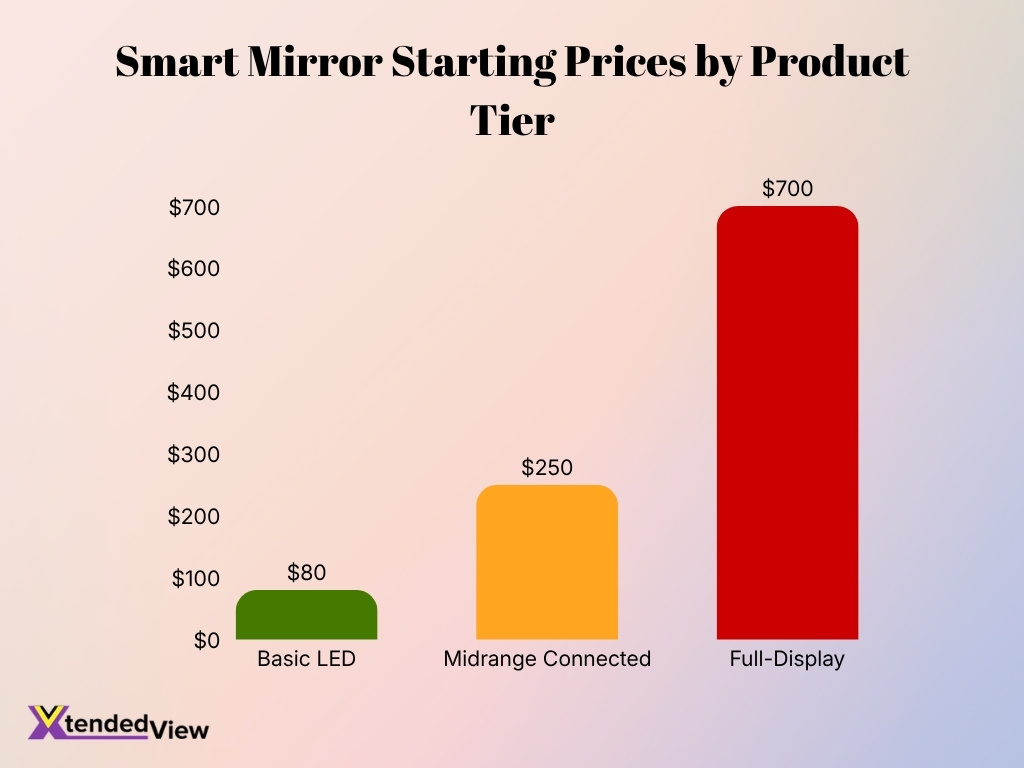
- Basic LED smart mirrors currently start at roughly $80 to $250, typically combining LED illumination with functions such as anti-fogging, dimming, and touch controls.
- Midrange connected bathroom mirrors generally cost around $250 to $700, with products in this tier adding functions such as Bluetooth speakers, weather displays, or voice control.
- Full-display smart mirrors equipped with features such as Wi-Fi, streaming applications, or touchscreen displays typically fall in the $700 to $1,500 range.
- A separate 2025 pricing assessment places the overall smart mirror range at approximately $100 to $2,000 or more, depending on size, connectivity, lighting, touchscreen functions, and customization.
- In Asia Pacific, midrange products priced from $1,000 to $1,499 generated $231.5 million in 2025, equal to 50% of market value in one regional market analysis.
- Price sensitivity matters because smart mirrors compete with other connected products for household technology budgets. In 2025, U.S. households spent an average of $896 on connected devices, compared with $764 in 2024.
- Age and technology familiarity can also influence adoption. Smart mirrors require consumers to accept displays, sensors, voice interfaces, and connected-home controls in spaces traditionally occupied by nonconnected products.
- Virtual try-on research provides another demographic indicator. A 2025 study surveyed 228 Italian consumers and found that enjoyment, consumer innovativeness, and perceived environmental benefits significantly influenced attitudes toward virtual try-on technology and online purchase intentions.
- A separate 2025 study analyzed 357 consumers in Bangladesh and specifically examined gender as a moderating factor in virtual try-on adoption and online shopping decisions.
- Price remains one of the clearest barriers to wider adoption because feature-rich mirrors can cost several times more than conventional mirrors. However, entry-level products below $250 create a lower-cost route into the category.
Smart Mirror Virtual Try-On and Retail Shopping Statistics
- A 2025 academic study surveyed 228 consumers and found that perceived enjoyment, innovativeness and environmental benefits significantly influenced attitudes toward virtual try-on and purchase intentions.
- Another 2025 study analyzed 357 participants to examine how virtual try-on affects online consumer decision-making and how gender moderates those relationships.
- A 2026 sustainable-fashion study used data from 402 online fashion shoppers to examine whether VTO improves product-selection accuracy and reduces return-related waste while accounting for privacy concerns.
- Research published in January 2026 examined AR virtual try-on specifically in luxury jewelry retail, testing how immersion, perceived innovativeness, and engagement affect purchase intention among high-involvement consumers.
- Consumer resistance remains significant. In February 2026, 38.3% of U.S. digital shoppers said they had never used virtual or augmented reality for shopping and were not interested in trying it.
- Only 16% of global consumers were using augmented reality in retail apps in one 2026 consumer-technology assessment, even though just 11% reported using no in-store technology at all.
- Physical stores remain important even as virtual tools expand. Approximately 62.9% of furniture and home-goods shoppers discover brands and products in stores, reinforcing the potential role of smart mirrors in connecting physical shopping with digital visualization.
- Retailers and brands represent one of the fastest-growing smart mirror customer groups, with the segment projected to expand at a 16.85% CAGR through 2034 in one current forecast.
- Commercial spaces already generated 59% of smart mirror revenue in 2025 under a narrower market definition, reflecting demand from stores and other business environments for interactive customer experiences.
- The adoption gap remains important for retailers: academic research consistently links VTO value to factors such as enjoyment, immersion, realism, and product evaluation, while 2026 consumer data shows that a substantial group of U.S. shoppers still rejects AR shopping altogether.
Smart Mirror Market Trends, Growth Drivers, Opportunities, and Challenges
- Global smart mirror revenue is projected to increase from $3.38 billion in 2026 to $10.37 billion by 2034 under one current market definition, representing a 15.03% CAGR.
- A narrower definition estimates $710.7 million in 2026 and projects $1.3 billion by 2033, equal to an 8.8% CAGR. The difference highlights the importance of checking which automotive, commercial, and consumer products each forecast includes.
- Another market model expects revenue to increase from $2.3 billion in 2026 to $5.6 billion by 2035, representing a 10.5% CAGR.
- Automotive remains an important growth engine. The segment represented 41.89% of 2025 revenue in one current market model, while health care is forecast to record the fastest application growth at 10.02% annually through 2031.
- Retail represents another opportunity. Retailers and brands are forecast to record a 16.85% CAGR through 2034, supported by virtual try-ons, personalized information and interactive store experiences.
- Consumer distribution is also shifting. Although B2B accounted for 81.21% of 2025 revenue, B2C sales are projected to grow at a 12.27% CAGR through 2031.
- Asia Pacific offers a significant long-term opportunity. One regional forecast expects its smart mirror market to increase from $559.4 million in 2026 to $1.6 billion by 2035, a 12.7% CAGR.
- Privacy presents a continuing challenge because smart mirrors may combine cameras, microphones, biometric information, and connected accounts. The issue becomes more important as AI-powered mirrors move into bathrooms, bedrooms, and health-monitoring environments.
- Consumer resistance to AR creates another adoption barrier: 38.3% of U.S. digital shoppers surveyed in 2026 had never used VR or AR for shopping and had no interest in trying it.
- Price can also restrict mass adoption. Current products range from roughly $80 for basic LED models to $1,500 or more for full-display systems, before installation, electrical work, or additional connected services.
Frequently Asked Questions (FAQs)
The global smart mirror market is estimated at $710.7 million in 2026, up from $653.2 million in 2025.
The market is projected to grow at an 8.8% CAGR from 2026 to 2033, reaching about $1.3 billion by 2033.
Wall-mounted smart mirrors accounted for 84.3% of market revenue in 2025.
North America ranked first with 47.5% of global smart mirror revenue in 2025 under this market definition.
Commercial applications accounted for 59.0% of global smart mirror revenue in 2025.
Conclusion
Smart mirrors sit at the intersection of connected homes, digital displays, automotive technology, artificial intelligence, augmented reality, and health monitoring. Their role continues to expand beyond displaying information, with newer systems supporting virtual try-ons, driver monitoring, digital rear visibility, biometric measurements, voice interaction, and connected-home controls. Residential and commercial installations remain important, while automotive, retail and health applications create additional opportunities for manufacturers and technology providers.
Published market estimates differ significantly because research firms use different definitions of the smart mirror industry, but the overall direction remains consistent: smart mirrors are becoming more interactive, connected and software-driven. Growth will increasingly depend on practical AI and AR features, lower hardware costs, improved display technology and stronger interoperability with other connected devices. At the same time, manufacturers will need to address privacy, cybersecurity, affordability and consumer acceptance, particularly as cameras and biometric sensors enter private spaces. As these challenges are addressed, smart mirrors have the potential to develop from specialized connected fixtures into broader digital interfaces across homes, vehicles, stores, hotels and health environments.