



Salesforce has been a dominant force in customer relationship management (CRM) and cloud software for over two decades. Its impact spans revenue growth, AI innovations, global adoption, and leadership in enterprise technology. Industries from finance to healthcare leverage Salesforce for sales automation and customer engagement, while global brands use its platform to streamline operations and enhance data insights. Explore the latest data and trends shaping Salesforce’s performance and influence in the tech ecosystem.
Editor’s Choice
- $37.9B – Salesforce’s total annual revenue in fiscal 2025, up ~9% year-over-year.
- 150,000+ – Estimated global number of companies using Salesforce.
- 21–21.7% – Approximate share of the CRM market Salesforce commands.
- 76,453 – Number of Salesforce employees as reported in 2025.
- $41.45–41.55B – Salesforce’s FY26 revenue guidance range.
- 54% of sellers report adoption of AI agents in sales workflows, 2026 State of Sales.
- $50B – Authorization for Salesforce share buybacks announced in 2026.
Recent Developments
- Salesforce forecasted FY27 revenue between $45.8B and $46.2B, slightly below some analyst expectations.
- Q4 FY26 revenue was $11.20B, a 12% year-over-year increase.
- The company’s share price dropped ~28% year-to-date amid investor concerns about growth.
- Annual recurring revenue from AI tools like Agentforce hit $800M in FY26.
- Salesforce raised its long-term revenue target to $63B by FY2030.
- It also expanded its $50B share buyback and increased dividends.
- Integration of Informatica, an $8B acquisition, aims to strengthen data and AI capabilities.
- RPO, remaining performance obligations, reached ~$72.4B in FY26, signaling future revenue.
- Salesforce continues to reassure investors about the strategic role of AI in growth.
What Is Salesforce?
- Salesforce is a global leader in cloud-based CRM software, designed to help businesses manage customer data, sales workflows, and service operations.
- Founded in 1999 by Marc Benioff and partners, Salesforce pioneered the SaaS CRM model.
- It offers a suite of cloud services, including Sales Cloud, Service Cloud, Marketing Cloud, and Commerce Cloud.
- The platform integrates AI tools like Agentforce and Data Cloud to automate tasks and enhance insights.
- Salesforce’s mobile-first interface supports remote sales and service activities for distributed teams.
- Trailhead, the company’s learning platform, has accelerated adoption through gamified skill development.
- Its AppExchange marketplace offers thousands of integrations and third-party apps.
- Salesforce serves customers of all sizes, from small businesses to Fortune 500 enterprises.
- It emphasizes customizability with low-code tools for tailored workflows.
Salesforce Services Market Growth Statistics
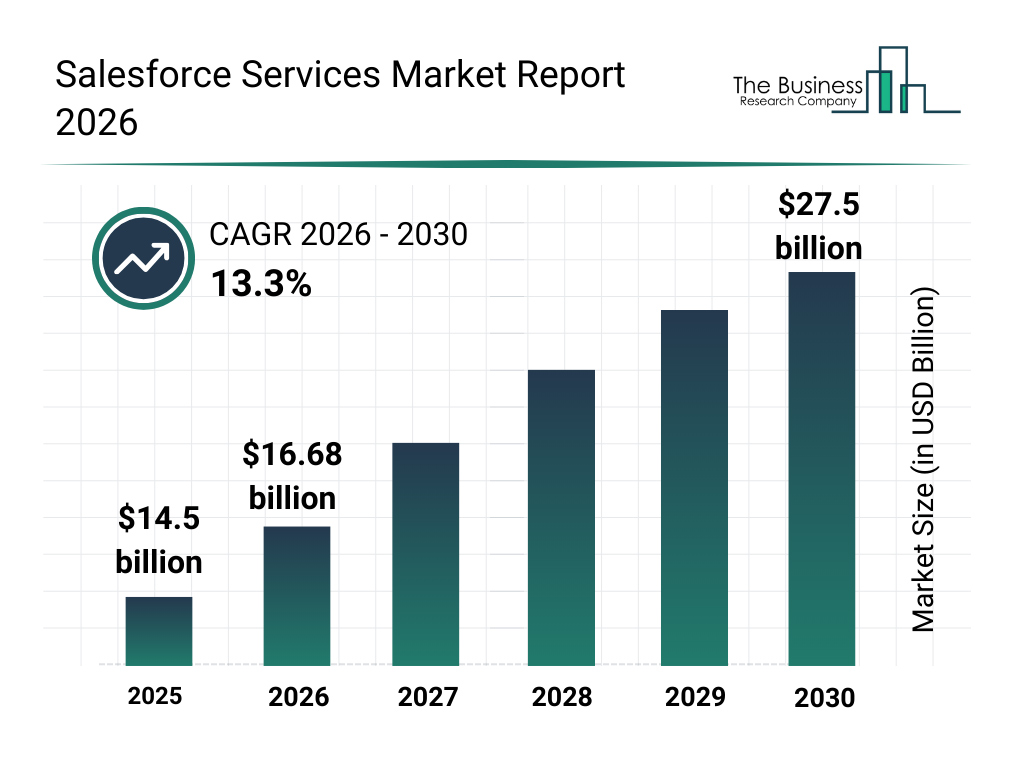
- The double-digit CAGR highlights accelerating digital transformation initiatives across enterprises leveraging Salesforce platforms.
- The global Salesforce services market is projected to grow from $14.5 billion in 2025 to $27.5 billion by 2030, nearly doubling within five years.
- In 2026, the market is expected to reach $16.68 billion, marking strong year-over-year expansion.
- The industry is forecast to grow at a robust 13.3% CAGR between 2026 and 2030, reflecting sustained enterprise demand.
- The total absolute growth over the forecast period (2025–2030) amounts to approximately $13 billion in additional market value.
- The upward trajectory from 2027 through 2029 indicates consistent annual gains, reinforcing long-term scalability in Salesforce consulting and implementation services.
- By 2030, the market is expected to surpass the $25 billion milestone, signaling increased investment in CRM optimization, cloud migration, and Salesforce ecosystem services.
Key Statistics Overview of Salesforce
- Salesforce’s annual revenue for FY25 was $37.9B, up approx 9% from FY24.
- Revenue grew from $34.86B in FY24 to $37.9B in FY25.
- FY26 revenue guidance is $41.45–41.55B, ~9–10% growth Y/Y.
- Salesforce commands roughly 20.7%–21.7% of the global CRM market.
- Global adoption includes 150,000+ companies using Salesforce.
- The platform holds a leading position in North America and across major regions.
- Salesforce reported around 76,453 employees in 2025.
- CRM market growth overall continues to drive adoption of Salesforce solutions.
- Adoption of AI tools by sellers is projected to reach near 90% by 2027.
Revenue Statistics of Salesforce
- FY25 total revenue: $37.9B, an ~9% increase over FY24.
- FY24 revenue was $34.86B.
- Salesforce’s fiscal 2026 guidance targets $41.45–41.55B.
- FY26 Q4 revenue was $11.20B, up 12% Y/Y.
- Salesforce’s quarterly revenue estimates for 2026 project ~$11B per quarter.
- Revenue growth rate averaged ~12.9% annually over recent periods.
- Subscription and support sales drive the bulk of revenue, typically above 90%.
- Remaining performance obligations, RPO, reached ~$72B+, indicating future revenue.
Revenue by Product and Cloud in Salesforce
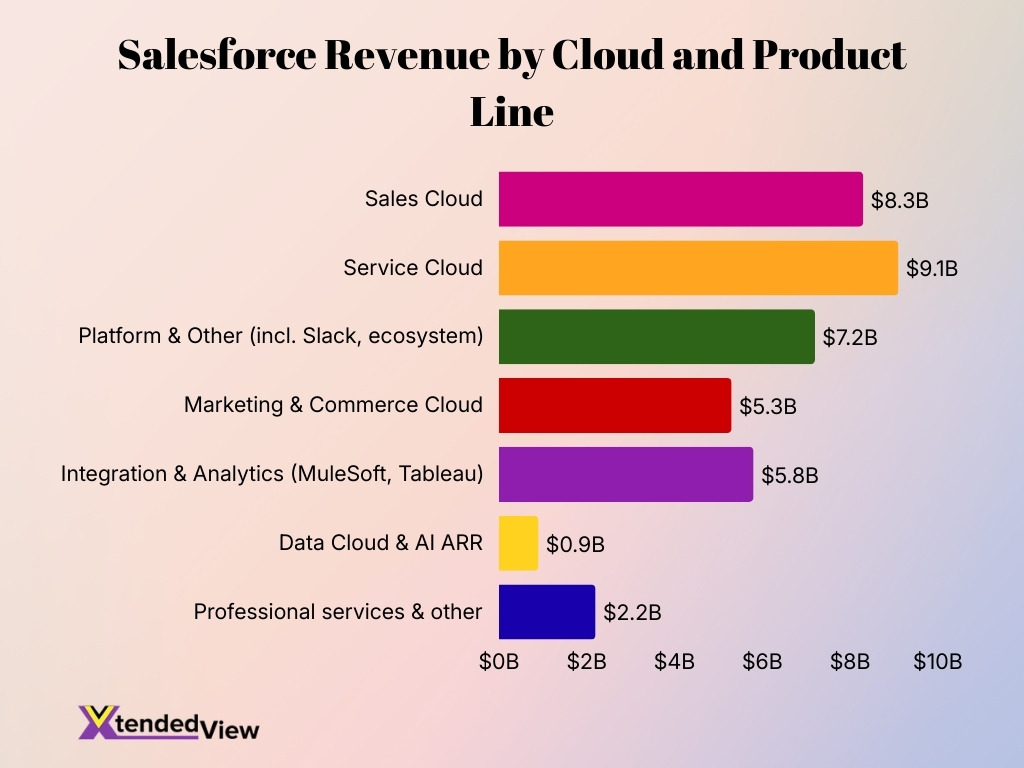
- Sales Cloud generated roughly $8.3 billion in revenue in FY25, making it one of Salesforce’s largest product lines.
- Service Cloud contributed about $9.1 billion in FY25, representing the single largest revenue segment for Salesforce.
- The Salesforce Platform and other services (including Slack and AppExchange ecosystem) delivered around $7.2 billion in FY25 revenue.
- Marketing and Commerce Cloud products, including Marketing Cloud, brought in approximately $5.3 billion in FY25.
- Integration and Analytics offerings, such as MuleSoft and Tableau, generated an estimated $5.8 billion in revenue for FY25.
- Data Cloud and AI‑related ARR reached about $900 million in FY25, reflecting strong uptake of AI‑first solutions.
- Agentforce and Data Cloud AI combined ARR surpassed $1.4 billion in FY26 Q3, driven by rapid enterprise adoption.
- Professional services and other revenue totaled $2.2 billion in FY25, accounting for roughly 6% of Salesforce’s total income.
- Subscription and support revenue accounted for about 94% of Salesforce’s $37.9 billion FY25 total, highlighting its cloud‑centric model.
- Industry‑specific clouds such as Health Cloud and other vertical offerings contributed to mid‑single‑digit percentage points of overall revenue growth in FY25.
Salesforce Revenue Distribution by Region
- The Americas generated approximately 67% of Salesforce’s total revenue in FY2025, remaining the company’s largest market.
- Europe contributed roughly 23% of total revenue, reflecting steady enterprise cloud adoption across the EU and UK.
- Asia-Pacific accounted for about 10% of total revenue, supported by growth in Japan, Australia, and India.
- Revenue from the Americas exceeded $25 billion in FY2025, up year over year from FY2024.
- EMEA revenue surpassed $8.5 billion in FY2025, driven by digital transformation initiatives across financial services and manufacturing sectors.
- Asia-Pacific revenue crossed $3.5 billion, with double-digit annual growth in select markets.
- Salesforce reported international revenue growth rates slightly higher than U.S. growth in FY2025, signaling stronger overseas expansion.
- Currency fluctuations reduced reported international revenue growth by approximately 1–2% in FY2025.
- Emerging markets in Southeast Asia showed increasing CRM adoption among mid-sized enterprises in 2025.
Profitability and Financial Performance of Salesforce
- Salesforce reported GAAP net income of $4.1 billion in FY2025, significantly higher than FY2024.
- Non-GAAP operating margin reached 31% in FY2025, up from 27% in FY2024.
- GAAP operating margin improved to approximately 19% in FY2025, reflecting cost optimization efforts.
- Free cash flow totaled $9.5 billion in FY2025, supporting shareholder returns.
- Salesforce authorized a $50 billion share repurchase program in 2026, one of the largest in the software sector.
- The company maintained over $13 billion in cash and cash equivalents at the end of FY2025.
- Remaining Performance Obligations (RPO) reached approximately $72 billion, indicating strong future revenue visibility.
- Subscription and support gross margin remained above 80%, reinforcing SaaS efficiency.
- Earnings per share, non-GAAP, rose in double digits year over year in FY2025.
CRM Market Share Breakdown and Competitive Landscape
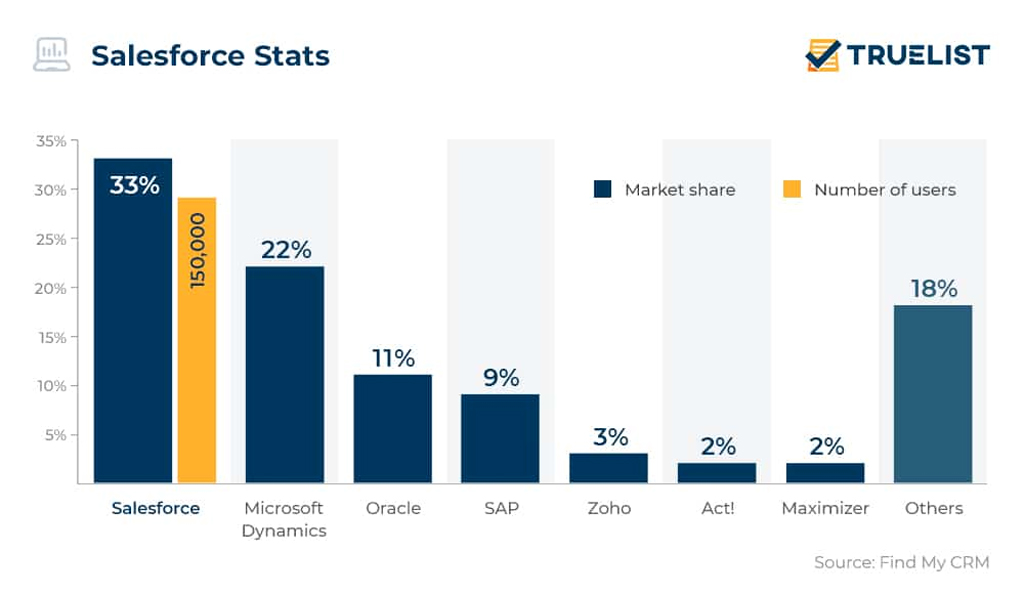
- Salesforce dominates the CRM market with a 33% share, making it the clear industry leader among all vendors.
- Salesforce is also reported to have 150,000 users, highlighting its massive global customer base.
- Microsoft Dynamics holds 22% market share, positioning it as the second-largest CRM provider.
- Oracle captures 11% of the market, maintaining a strong presence among enterprise customers.
- SAP accounts for 9% market share, reinforcing its foothold in large-scale business environments.
- Zoho controls 3% of the market, reflecting its growing adoption among SMBs.
- Both Act! and Maximizer hold 2% each, indicating relatively smaller but niche market positions.
- The “Others” category represents 18% of the market, showing that nearly one-fifth of the CRM space is fragmented across smaller vendors.
- The combined market share of the top four vendors, Salesforce, Microsoft Dynamics, Oracle, and SAP, totals 75%, demonstrating significant market concentration.
- The data clearly shows that Salesforce leads by an 11 percentage-point margin over Microsoft Dynamics, emphasizing its competitive advantage.
CRM Market Leadership of Salesforce
- Salesforce has been named the No. 1 CRM provider by IDC for more than a decade.
- It leads in sales automation, customer service, and marketing automation categories.
- Over 150,000 companies worldwide use Salesforce CRM solutions.
- Salesforce’s AppExchange marketplace includes 7,000+ partner apps, strengthening ecosystem leadership.
- Trailhead surpassed 5 million registered users, supporting workforce development.
- Salesforce ranks highly in enterprise CRM deployments among Fortune 500 firms.
- Industry clouds such as Financial Services Cloud and Health Cloud expand Salesforce’s leadership into regulated sectors.
- AI-powered CRM tools introduced in 2025 improved cross-sell and upsell efficiency metrics.
- Customer 360 integration differentiates Salesforce from legacy on-prem CRM systems.
Customer Statistics of Salesforce
- Salesforce serves over 150,000 customers globally, including small businesses and global enterprises.
- Fortune 500 companies account for a significant portion of enterprise contracts.
- More than 90% of Salesforce revenue comes from subscription and support contracts.
- Customer retention rates remain above 90% annually, reflecting recurring revenue stability.
- The average enterprise Salesforce deployment spans multiple cloud products.
- Salesforce supports customers in over 100 countries worldwide.
- Financial services, healthcare, retail, and manufacturing represent major customer segments.
- SMB adoption continues to rise due to flexible pricing tiers and scalable infrastructure.
- AI adoption among Salesforce customers increased significantly in 2025, especially in sales forecasting.
Salesforce Net Income Statistics
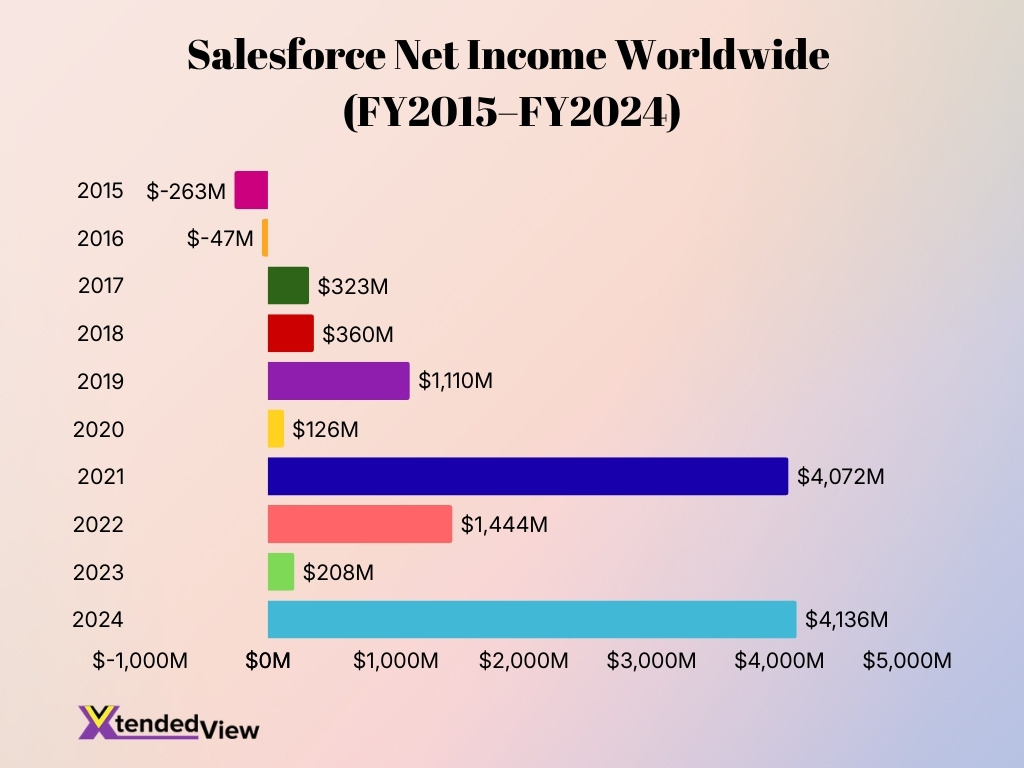
- Salesforce recorded a net loss of $263 million in FY2015, followed by a smaller $47 million loss in FY2016, marking its last consecutive loss years in the decade.
- The company returned to profitability in FY2017 with $323 million, improving further to $360 million in FY2018.
- Net income crossed the $1 billion mark in FY2019, reaching $1,110 million, signaling stronger operational efficiency.
- In FY2020, profit declined sharply to $126 million, reflecting margin pressures despite continued revenue growth.
- FY2021 saw a major surge, with net income jumping to $4,072 million, representing one of the highest annual profits in company history.
- Profit moderated in FY2022 to $1,444 million, indicating post-peak normalization.
- FY2023 reported a significant dip to $208 million, highlighting temporary profitability challenges.
- Salesforce achieved a record-breaking rebound in FY2024, with net income reaching $4,136 million, the highest in the past 10 years.
- Over the decade, Salesforce transitioned from consistent losses (2015–2016) to multi-billion-dollar profitability, demonstrating long-term financial maturation.
- The overall trend shows strong earnings volatility, but a clear upward trajectory toward sustainable profitability in recent fiscal years.
Number of Companies Using Salesforce
- More than 150,000 companies actively use Salesforce solutions worldwide.
- Salesforce dominates CRM deployments among Fortune 100 firms.
- Approximately 80% of top U.S. enterprises use Salesforce in some capacity.
- Over 5 million Trailhead users contribute to the Salesforce ecosystem talent pool.
- The AppExchange ecosystem includes thousands of independent software vendors.
- Salesforce partners operate in over 90 countries, expanding platform adoption.
- Mid-market firms increasingly adopt Salesforce for marketing automation and service automation.
- Industry-specific clouds expand usage in healthcare, government, and financial services.
- Global CRM penetration continues to grow, with Salesforce capturing a leading share of new cloud CRM implementations.
AI, Automation, and Agentic Work in Salesforce
- Over 54% of sales teams reported using AI tools in 2026, up significantly from prior years.
- Salesforce’s AI-driven solutions, including Agentforce and Einstein AI, generated approximately $800 million in annual recurring revenue in FY2026.
- AI-powered lead scoring improves conversion rates by measurable margins in enterprise deployments.
- Automation reduces manual sales tasks by nearly 30%, according to Salesforce research.
- Predictive analytics within Salesforce enhances forecasting accuracy across industries.
- Service Cloud AI tools shorten customer resolution time through automated case routing.
- Salesforce Data Cloud processes billions of customer records daily, supporting AI-driven personalization.
- AI agent adoption is projected to reach nearly 90% of sellers by 2027.
- Generative AI capabilities integrated into CRM workflows increase sales productivity metrics.
Adoption by Industry of Salesforce
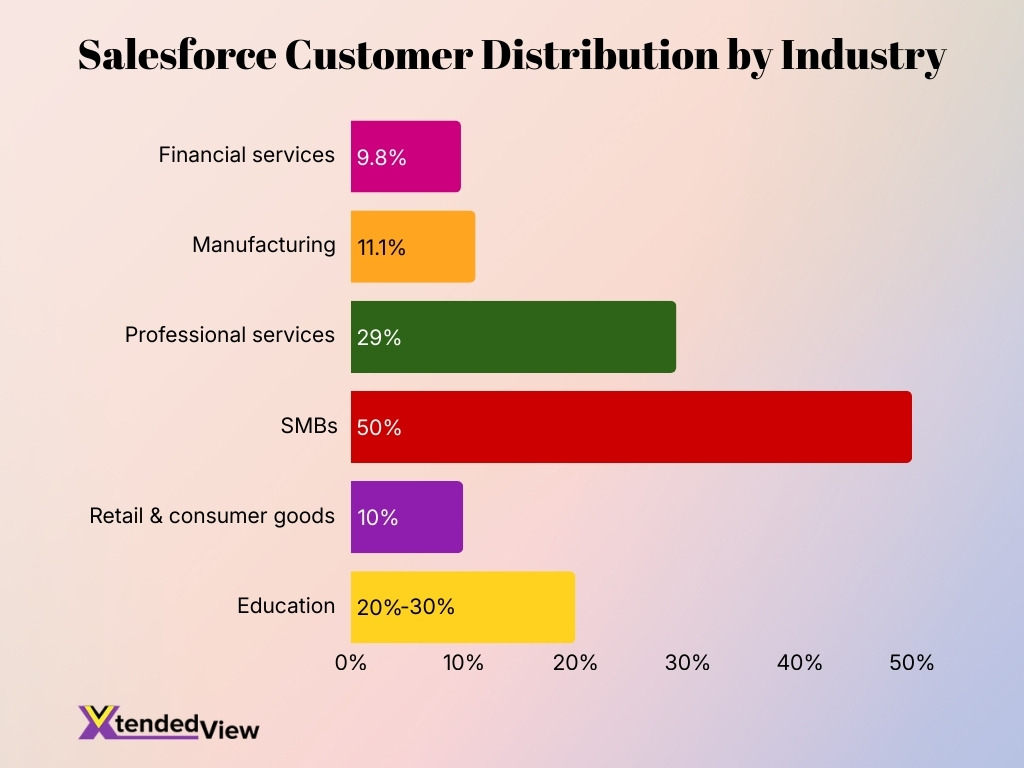
- Financial services account for 9.8% of all Salesforce customers, making it one of the platform’s largest verticals globally.
- Over 90% of Fortune 500 companies in financial services and banking rely on Salesforce for customer engagement and compliance‑driven workflows.
- In healthcare, 80% of patients report difficulty navigating their care journey, driving accelerated adoption of Health Cloud for care coordination.
- Retail and consumer goods firms using Commerce Cloud have contributed to double‑digit revenue growth, with segment growth exceeding 10% year‑over‑year.
- Manufacturing represents 11.1% of Salesforce users, with many deploying the platform for field service management and supply‑chain visibility.
- U.S. public sector agencies expanded CRM modernization in 2025, with state and federal bodies increasingly adopting Salesforce for citizen engagement.
- Technology and SaaS companies are among the heaviest adopters of Sales Cloud and Service Cloud, leveraging the platform for subscription lifecycle management.
- Professional services make up 29% of Salesforce users, the largest single industry segment, highlighting CRM’s role in project and client management.
- Educational institutions using Education Cloud report improvements in recruitment conversion rates and alumni engagement, with call‑to‑action response times dropping by 20–30%.
- Small and mid‑sized businesses across industries contribute to over 50% of new Salesforce customers, primarily on Essentials and Professional editions, due to scalable pricing.
ROI and Business Impact of Salesforce
- Salesforce delivers an average ROI of 314%, with high-adoption firms reaching up to 789%.
- Companies using Salesforce achieve 34% higher sales productivity through automation and efficiency.
- Salesforce adoption boosts company sales by up to 29% via improved pipeline management.
- Customers report 30% improved customer satisfaction after implementing Salesforce CRM.
- Forecast accuracy improves by 42% with Salesforce’s customer visibility tools.
- High Salesforce utilization yields 2.5 times more payback than average CRM ROI.
- Sales teams save 33% of time using Customer 360 for data reconciliation.
- Targeted campaigns on Salesforce increase conversions by 18%.
- Operational efficiency gains include 25% improvements for Salesforce users.
Stock and Valuation Statistics of Salesforce
- Salesforce’s (NYSE: CRM) market cap stands at $182.52 billion as of February 2026.
- FY2025 revenue reached $37.9 billion, up 9% year-over-year.
- The company authorized a record $50 billion share repurchase program in 2026.
- Institutional investors hold approximately 80-83% of Salesforce stock.
- Quarterly dividend increased 5.8% to $0.44 per share in 2026.
- Trailing P/E ratio at 26.01 as of February 2026.
- Total RPO reached $63.4 billion, up 11% year-over-year in FY2025.
- YTD stock return declined 26.47% in 2026.
- FY2025 non-GAAP EPS grew to $10.20, up year-over-year.
- FY2026 revenue guidance set at $40.5-40.9 billion, implying 7-8% growth.
- Operating cash flow hit $13.1 billion in FY2025, up 28% year-over-year.
Age Distribution of Salesforce Professionals
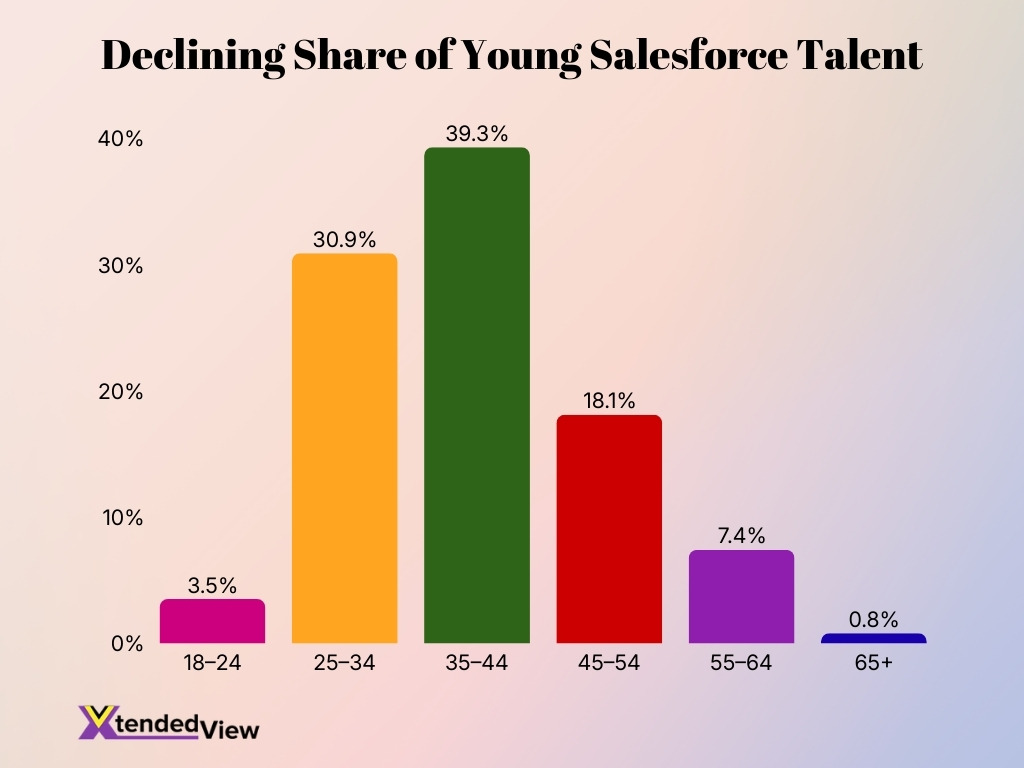
- The largest segment of Salesforce professionals falls within the 35–44 age group, accounting for 39.3% of the total workforce.
- The 25–34 age bracket represents the second-largest share at 30.9%, indicating strong mid-career participation.
- Combined, professionals aged 25–44 make up 70.2% of the Salesforce talent pool, showing clear dominance of experienced mid-level talent.
- Entry-level professionals aged 18–24 account for just 3.5%, highlighting a significant decline in young Salesforce talent.
- Professionals aged 45–54 represent 18.1%, reflecting a substantial presence of senior and experienced practitioners.
- The 55–64 age group holds 7.4%, suggesting continued participation of late-career professionals.
- Only 0.8% of the workforce is aged 65+, indicating minimal representation in the post-retirement segment.
- Overall, more than 64.8% of Salesforce professionals are aged 35 and above, signaling a maturing talent ecosystem.
Employee and Workforce Statistics of Salesforce
- Salesforce employed approximately 76,000+ employees globally in 2025, reflecting restructuring and efficiency initiatives.
- Workforce reductions in prior years aimed to optimize operating margins.
- Trailhead has trained over 5 million users, contributing to ecosystem workforce development.
- Salesforce ecosystem jobs are projected to exceed 12 million worldwide by 2028, according to IDC.
- The company maintains offices in over 30 countries, supporting global operations.
- Salesforce invests heavily in employee training, DEI programs, and leadership development initiatives.
- Hybrid and remote work models remain standard within Salesforce’s workforce strategy.
- Partner networks and consulting firms extend Salesforce’s effective workforce beyond internal employees.
- Employee productivity improvements align with margin expansion reported in FY2025.
Future Outlook and Growth Projections for Salesforce
- Salesforce projected FY2026 revenue between $41.45–$41.55 billion, reflecting steady growth.
- Long-term targets suggest reaching $63 billion in annual revenue by FY2030.
- The global CRM market is expected to grow at a compound annual rate above 10% through 2030.
- AI-powered CRM adoption is anticipated to accelerate across all enterprise sizes.
- International expansion remains a priority, particularly in Asia-Pacific markets.
- Industry-specific clouds are expected to contribute a larger portion of total revenue in the coming years.
- Subscription-based recurring revenue will continue driving predictable cash flows.
- Integration of AI and automation tools positions Salesforce for productivity-focused enterprise demand.
- Analysts forecast steady EPS growth supported by operational efficiencies and buyback programs.
Frequently Asked Questions (FAQs)
Salesforce reported $37.9 billion in annual revenue for FY2025.
Over 150,000 companies worldwide use Salesforce CRM.
Salesforce holds roughly 20.7% to 21.7% of the global CRM market share.
54% of sellers report using AI agents, and nearly 90% plan to by 2027.
Salesforce guided to $41.45 billion to $41.55 billion in revenue for FY2026.
Conclusion
Salesforce continues to lead the global CRM market with strong revenue growth, expanding AI capabilities, and consistent profitability improvements. Its diversified industry adoption, robust ecosystem, and aggressive shareholder returns reinforce its enterprise dominance. While market volatility and competition remain factors, Salesforce’s AI-driven roadmap and subscription model position it for sustained growth through the end of the decade.
For organizations evaluating CRM solutions or investors tracking SaaS leaders, the data highlights why Salesforce remains a central force in the enterprise cloud landscape.
