


Cyber attacks continue to place growing pressure on small businesses across the US and worldwide. From local retailers and healthcare clinics to accounting firms and manufacturers, even a single breach can interrupt operations, expose customer data, and create lasting financial losses. At the same time, AI-powered attacks and ransomware campaigns are making it easier for cybercriminals to target organizations with limited security resources. Explore the latest statistics below to understand how the threat landscape is changing and what the numbers reveal for small businesses.
Editor’s Choice
- 31% of all recorded breaches in 2026 began with the exploitation of software vulnerabilities, making it the leading initial access method ahead of stolen credentials.
- 48% of breaches now involve ransomware, highlighting how encryption-based attacks remain one of the biggest cybersecurity threats for organizations of every size.
- Attackers now use generative AI across 15 different attack techniques, accelerating reconnaissance, phishing, malware development, and exploitation.
- Small businesses accounted for 7,256 security incidents and 7,152 confirmed data disclosure cases in the latest SMB breach analysis.
- Among SMB breaches, 100% were financially motivated and carried out by external threat actors in the analyzed dataset.
- Mobile phishing attacks recorded 40% higher click rates than traditional email phishing simulations, reflecting the growing success of SMS and voice scams.
- The median time to fully resolve a critical vulnerability increased to 43 days in 2026, giving attackers longer opportunities to exploit exposed systems.
Recent Developments
- AI-assisted cyber attacks accelerated in 2026, with security researchers reporting wider use of generative AI for vulnerability discovery, phishing, and malware creation.
- Software vulnerability exploitation increased to 31% of breaches, representing a 55% year-over-year increase from the previous report.
- Third-party involvement now appears in 48% of breaches, representing a 60% increase compared with the prior year.
- Organizations fully remediated only 26% of critical vulnerabilities during 2025, down from 38% a year earlier.
- AI-assisted attacks have reduced the time required to identify and exploit vulnerabilities from months to hours in some campaigns.
- The White House announced a coordinated cybersecurity initiative during 2026 to strengthen collaboration between AI developers and critical infrastructure operators.
- Published software vulnerabilities increased 51% year over year during the first half of 2026, creating a larger attack surface for organizations.
- Ransomware claims increased 25% during the first half of 2026 compared with the previous year.
How Often Small Businesses Are Attacked
- Verizon analyzed more than 7,200 SMB security incidents in its latest dedicated small business dataset.
- System Intrusion, Social Engineering, and Basic Web Application Attacks together accounted for essentially all confirmed SMB breach patterns.
- 26% of SMB breaches began with vulnerability exploitation as the initial access vector.
- 13% of SMB breaches started through credential abuse.
- 9% of SMB breaches originated through phishing campaigns.
- 45% of SMB breaches included a human element somewhere in the attack chain.
- 55% of SMB breaches involved third-party relationships or suppliers, emphasizing supply chain exposure.
- Financially motivated external attackers were responsible for 100% of analyzed SMB breaches in Verizon’s dataset.
Types and Methods of Cyber Attacks on Small Businesses
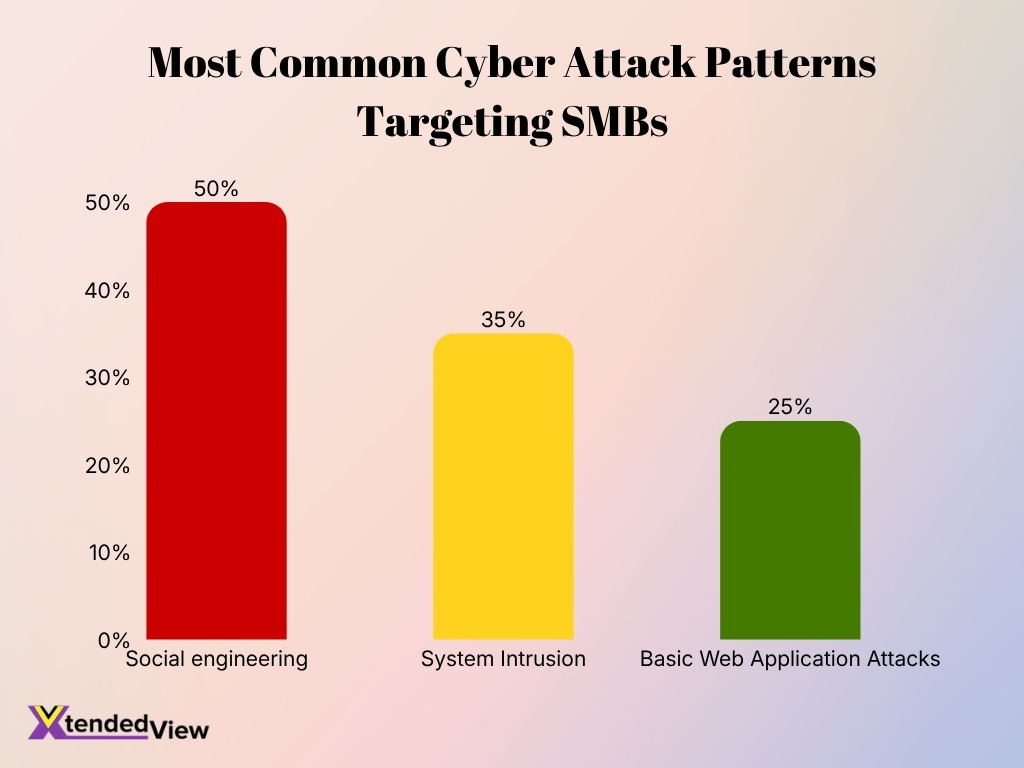
- System Intrusion accounted for over 35% of all breach patterns targeting small businesses.
- Basic Web Application Attacks represented 25% of security incidents across smaller organizations.
- Social engineering tactics were involved in over 50% of cyberattacks impacting SMBs.
- Attackers exploited software vulnerabilities to gain entry in 26% of SMB breaches.
- Credential abuse contributed to 13% of initial access breach events.
- Internal business information was compromised in 97% of analyzed small business breaches.
- Stolen credentials appeared among compromised assets in 31% of SMB breaches.
- Financial motivation drove 100% of analyzed small business cyberattacks.
- Ransomware was involved in 64% of all small business malware incidents.
Ransomware Attacks on Small Businesses
- 48% of all analyzed breaches involved ransomware, ranking it among the most prevalent cyber threats.
- Over 60% of ransomware attacks disproportionately impact small businesses lacking dedicated security teams.
- Severe cyber incidents cost affected SMBs more than 7% of annual revenue.
- Reported ransomware victims surged 43% year-over-year during Q2 2026.
- Researchers identified 91 active ransomware groups across 108 countries in Q2 2026.
- A total of 2,279 reported victims established a record high for global ransomware activity in Q2 2026.
- Documented attacks targeting US SMBs reached 769 cases during Q2 2026.
- More than 58% of victim organizations refused to pay ransom demands despite operational disruption.
Phishing and Social Engineering Attacks
- Social engineering ranks among the top 3 breach patterns affecting SMBs in 2026.
- Exactly 9% of all SMB breaches begin directly through targeted phishing attacks.
- Mobile phishing campaigns generate 40% higher click rates than standard email simulations.
- Over 45% of SMB breaches include a human element due to successful manipulation.
- AI-generated phrasing helps increase the success rate of phishing messages by 60%.
- Phishing accounts for 35% of the initial access methods in financial-sector breaches.
- Over 74% of threat actors combine phishing with credential theft to maximize success.
- SMS and voice phishing adoption surged by 300% globally during 2025 and 2026.
Initial Access Methods Used Against Small Businesses
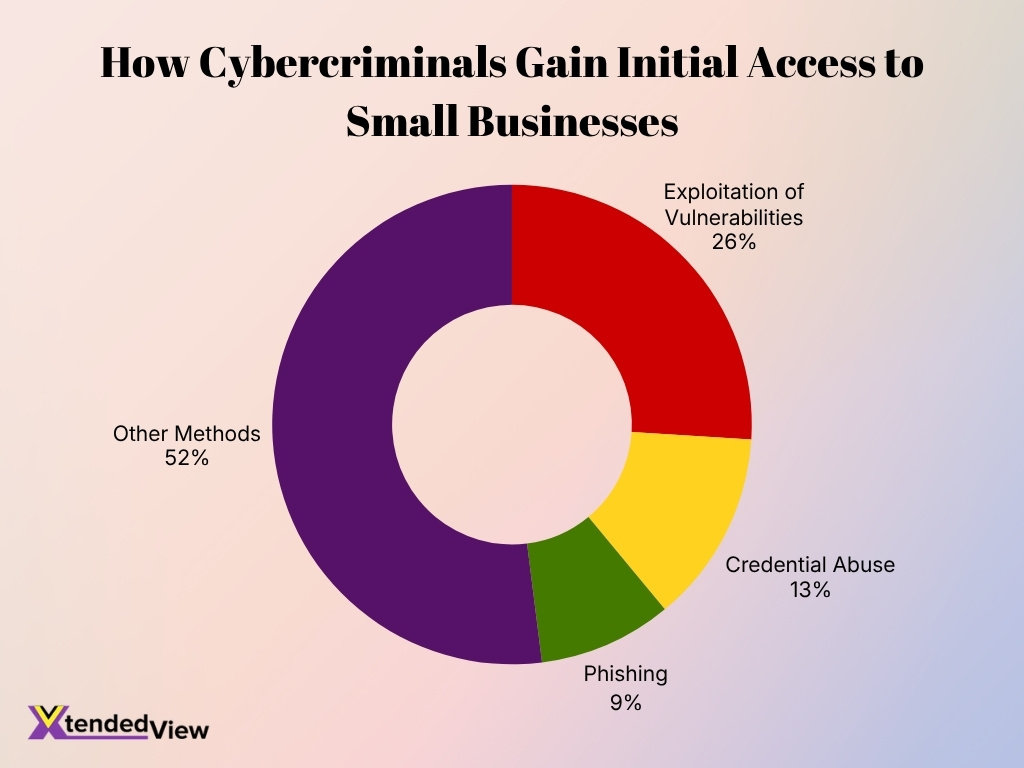
- Other methods account for 52% of initial access incidents, making them the largest combined category of attack entry points.
- Exploitation of vulnerabilities represents 26% of initial access, showing that unpatched or exposed systems remain a significant security risk for small businesses.
- Credential abuse accounts for 13% of initial access methods, highlighting the threat posed by stolen, compromised, or reused login credentials.
- Phishing contributes 9% of initial access incidents, demonstrating that deceptive emails and messages remain a notable entry point for attackers.
- Vulnerability exploitation is nearly twice as common as credential abuse, with shares of 26% versus 13%, respectively.
- Combined, vulnerability exploitation, credential abuse, and phishing make up 48% of observed initial access methods.
- The fact that 52% falls under other methods suggests small businesses face a broad and diverse attack surface beyond the three major identified techniques.
AI-Powered Threats to Small Businesses
- Cybercriminals now use generative AI across 15 distinct attack techniques, including reconnaissance, phishing, malware creation, and vulnerability exploitation.
- 31% of breaches now begin with software vulnerability exploitation, surpassing stolen credentials for the first time as attackers increasingly automate discovery with AI.
- Security analysts reported that AI-assisted attacks have reduced the time needed to identify exploitable vulnerabilities from months to just hours in some campaigns.
- Unauthorized employee use of AI tools (“shadow AI”) has become the third most common non-malicious cause of data loss, often exposing sensitive business information.
- AI-generated phishing messages continue to improve in quality, making fraudulent emails and messages harder for employees to distinguish from legitimate communications.
- The median time to fully remediate a critical vulnerability increased to 43 days, giving AI-assisted attackers a wider exploitation window.
- AI-powered cyberattacks increased by 89% year over year according to recent industry research, reflecting rapid adoption of automated attack tools.
- 91% of organizations using generative AI tools experienced at least one prompt that created a high data-leakage risk during security testing.
Why Small Businesses Are Targeted by Cybercriminals
- 100% of small business cyber breaches are financially motivated.
- External threat actors account for 100% of confirmed breaches in smaller organizations.
- Small and mid-sized enterprises represent 96% of all ransomware victims.
- Entry points are primarily driven by compromised credentials (38%) and unpatched vulnerabilities (29%).
- Approximately 55% of security breaches involve compromised third-party vendor relationships.
- Sensitive internal business information is exposed in 97% of compromised small business data.
- Automated attack scripts enable cybercriminals to compromise thousands of businesses simultaneously.
- Over 60% of smaller firms remain prime targets due to limited security staffing and delayed patching.
Expected Cyberattack Costs for Small Businesses
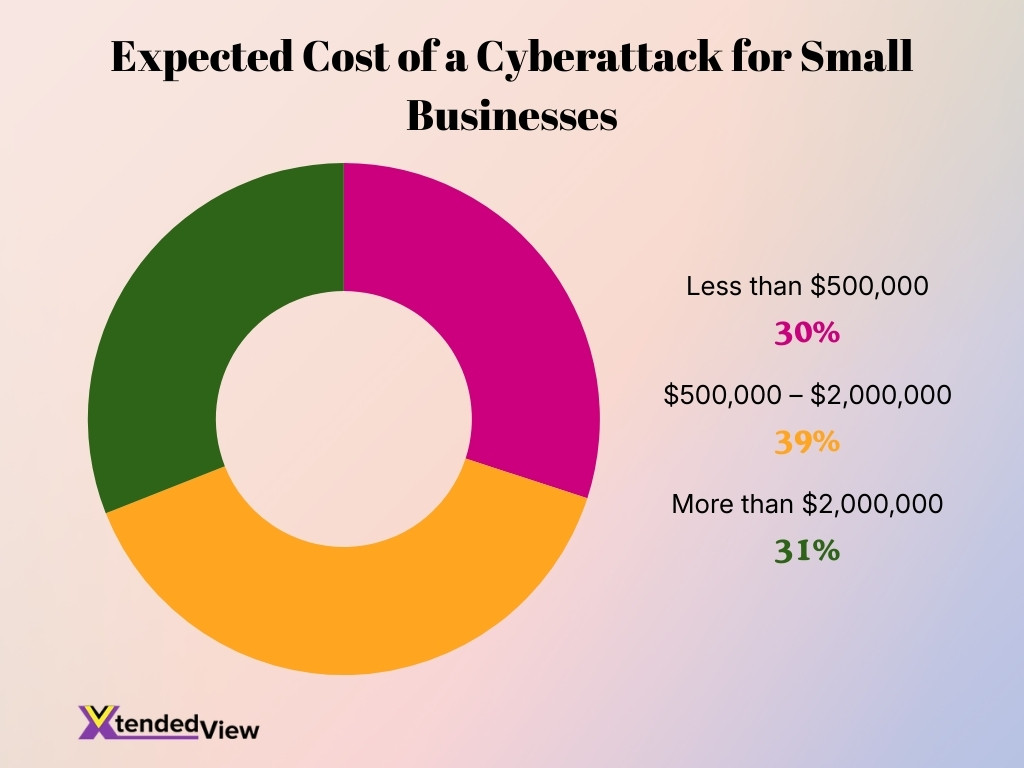
- 39% of small businesses expect a cyberattack to cost between $500,000 and $2,000,000, making this the most common cost range.
- Nearly 30% of businesses believe a cyber incident would cost less than $500,000, indicating that many still expect moderate financial damage.
- About 31% of small businesses anticipate losses of more than $2,000,000, highlighting the risk of severe financial impact.
- Overall, 70% of businesses estimate cyberattack costs could exceed $500,000, showing that major losses are a widespread concern.
- The data suggests that most small firms recognize cybersecurity threats as a high-cost business risk, not just a technical issue.
- With nearly one-third facing potential multi-million-dollar losses, proactive investment in cybersecurity is becoming essential.
- These figures emphasize that even smaller organizations are financially vulnerable to large-scale cyber incidents.
Impact of Cyber Attacks on Small Business Survival
- SMBs experiencing major cyber incidents often lose the equivalent of over 7% of annual revenue, placing long-term operations at risk.
- Average operational downtime following ransomware incidents has reached 24 days, crippling essential business capabilities.
- Nearly 60% of breached businesses reported severe financial losses between $10,000 and $100,000 following an incident.
- 45% of surveyed SMBs experienced at least one cybersecurity incident during the previous 12 months.
- A staggering 60% of small businesses are forced to shut down permanently within 6 months after experiencing a data breach.
- The average incident cost for a small business is $254,445, which frequently exceeds their annual cybersecurity investments.
- Prolonged operational downtime costs smaller companies an average of $53,000 per hour, instantly halting revenue generation and payroll.
- 40% of small business owners admitted that a cyberattack costing $100,000 or less would put them out of business completely.
Employee Training and Human Error in SMB Breaches
- 45% of SMB breaches included a human element, demonstrating the continued importance of employee awareness training.
- Mobile phishing attacks generated 40% higher click rates than traditional email phishing simulations.
- Human error contributed to 40% of cybersecurity incidents reported by surveyed SMB leaders.
- 81%of breaches involve weak or shared passwords through unsecured channels despite security awareness initiatives.
- AI-generated phishing emails are highly personalized and bypass traditional detection techniques in up to 60% of incidents.
- Credential abuse remained the initial access method in 13% of SMB breaches, emphasizing the importance of strong authentication practices.
- 31% of compromised SMB data included stolen credentials, reinforcing the value of multifactor authentication.
- Comprehensive training programs reduce threat susceptibility by 86%, prompting leaders to recommend continuous cybersecurity education.
Small Business Cyberattack Preparedness and Survival Statistics
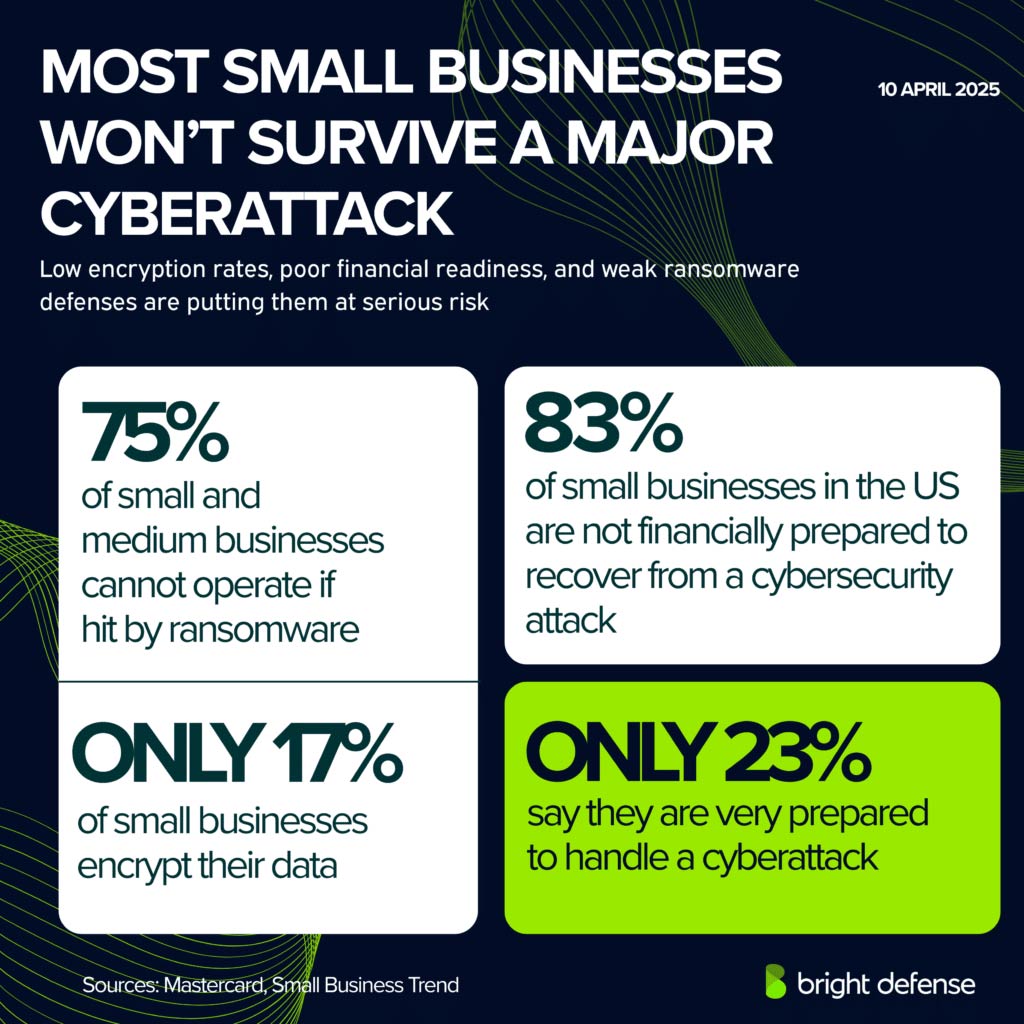
- 75% of small and medium businesses say they would be unable to continue operating if they were hit by a ransomware attack.
- A striking 83% of U.S. small businesses are not financially prepared to recover from the consequences of a cybersecurity attack.
- Only 17% of small businesses encrypt their data, highlighting a significant gap in basic cybersecurity protection.
- Just 23% of small businesses consider themselves very prepared to handle a cyberattack, leaving more than three-quarters without strong confidence in their defenses.
- The figures show that small businesses face both financial and operational vulnerabilities, with ransomware capable of threatening business continuity for 3 in 4 SMBs.
- The gap between preparedness and exposure is substantial, as only 23% feel highly prepared, while 83% lack adequate financial readiness for cyberattack recovery.
Small Business Cybersecurity Spending and Budgets
- 60% of SMBs expect to increase cybersecurity spending over the next 12 months as cyber risks and AI-driven threats continue to grow.
- 52% of SMB leaders rank cybersecurity and data protection among their top business priorities, second only to business growth.
- 87% of U.S. SMBs say they are at least somewhat confident in their cyber resilience, reflecting increased investment in security technologies and processes.
- Organizations that experienced multiple cyber incidents reported 91% confidence in their cyber resilience after increasing investments in security improvements.
- The median time to remediate a critical vulnerability increased to 43 days, encouraging businesses to invest more in patch management and vulnerability scanning tools.
- 31% of breaches now begin with vulnerability exploitation, prompting many SMBs to prioritize endpoint protection and patch management over legacy defenses.
- Security budget growth has slowed across many organizations as businesses balance cybersecurity spending with cyber insurance and operational costs.
- SMBs are increasingly consolidating overlapping security tools to maximize return on investment while maintaining protection against ransomware and phishing attacks.
Cyber Insurance Coverage for Small Businesses
- The latest study analyzed 15,431 cyber insurance claims involving SMBs.
- 39% of SMB cyber insurance claims were driven by ransomware.
- 19% of all claims resulted directly from Business Email Compromise.
- 40% of known financial losses came from response and recovery activities.
- 29% of financial losses were directly attributed to threat actor activities.
- The global cyber insurance market reached $14.7 billion and is projected to double by 2030.
- 71%of small and mid-sized businesses currently carry cyber insurance.
- $79,000was the average cyber claim cost for small businesses in 2025.
Industry-Specific Cyber Attack Statistics for Small Businesses
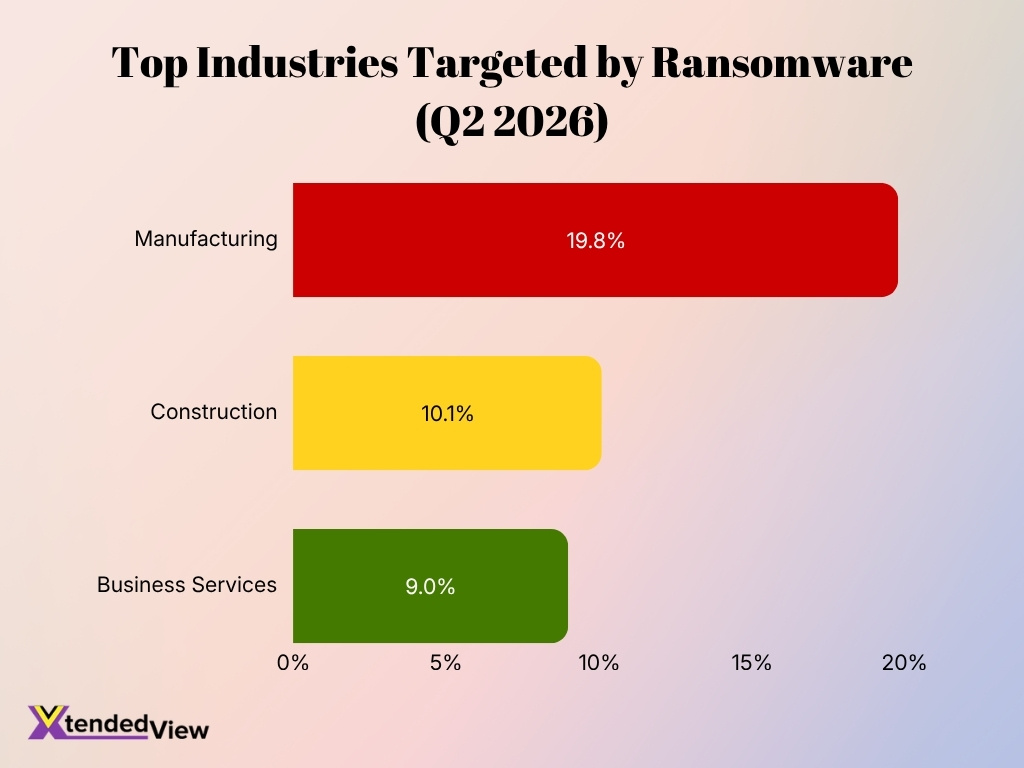
- Manufacturing accounted for 19.8% of ransomware claims in Q2 2026, making it the most targeted sector.
- Construction represented 10.1% of total ransomware claims during the same reporting period.
- Business services experienced 9% of all reported ransomware claims in Q2 2026.
- North America represented 49% of global ransomware cases recorded during May 2026.
- Business services recorded a 359% year-over-year increase in ransomware activity during May 2026.
- Healthcare and retail account for over 20% of SMB breaches due to sensitive customer and operational data.
- Third-party relationships and supply-chain attacks now involve 48% of security breaches in professional services.
- Over 50% of opportunistic ransomware campaigns target small businesses with exposed internet-facing systems.
Incident Response and Recovery Statistics
- Response and recovery costs represented 40% of total recorded financial losses across SMB cyber insurance claims.
- In the most severe cases, cyber incidents consumed more than 7% of annual SMB revenue, emphasizing the importance of rapid incident response.
- The median time to fully remediate a critical vulnerability increased to 43 days, extending exposure to follow-on attacks.
- Only 26% of critical vulnerabilities were fully remediated during 2025, compared with 38% the previous year.
- 34% of surveyed U.S. SMBs have a formal incident response plan, leaving many organizations underprepared for cyber incidents.
- 64% of SMBs reported recovering quickly after cyber incidents, suggesting that preparedness significantly improves recovery outcomes.
- Businesses with formal response plans experienced noticeably less operational damage than organizations without documented recovery procedures.
- Security experts increasingly recommend testing incident response plans through tabletop exercises because ransomware, supply-chain attacks, and AI-assisted threats continue to evolve.
Data Most Commonly Compromised in Small Business Breaches
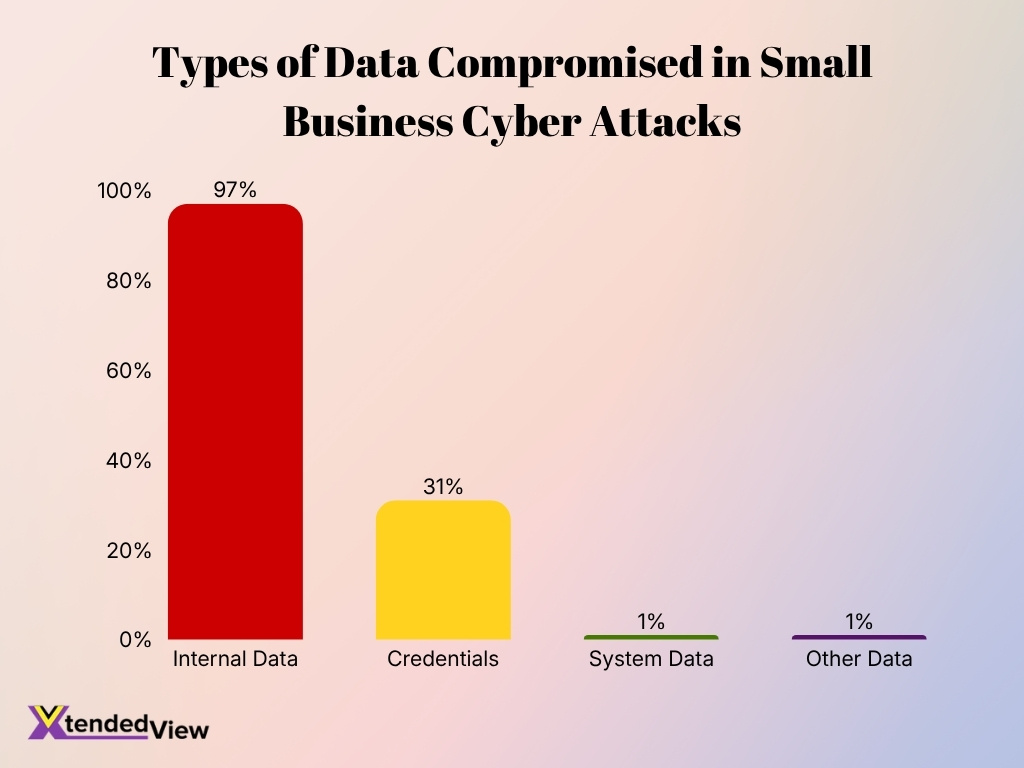
- Internal data is by far the most frequently compromised category, appearing in 97% of SMB breaches, highlighting the exposure of sensitive business information.
- Credentials are compromised in 31% of breaches, showing that usernames, passwords, and other authentication information remain major targets for attackers.
- System data accounts for just 1% of breaches, making it one of the least commonly compromised data categories among small businesses.
- Other types of data also represent only 1% of breaches, significantly below the shares recorded for internal data and credentials.
- The 66-percentage-point gap between internal data and credentials shows how heavily SMB cyber incidents are concentrated around internal business information.
Cybersecurity Compliance and Regulations for SMBs
- 85%of organizations report facing increased complexity in compliance requirements alongside expanding cyber threats.
- 47%of organizations fail compliance audits between two to five times over a three-year period.
- 33%of breached organizations are hit with a substantial regulatory fine in the immediate aftermath of a cyberattack.
- 48% of data breaches involve third-party organizations, heavily driving the need for stricter vendor risk management.
- 61% of clients expect service providers to deliver compliance support alongside traditional cybersecurity services.
- 67%of financial services SMBs maintain cyber insurance due to stricter industry regulations and compliance mandates.
- 64%of small businesses operate without a dedicated CISO, making structured compliance management extremely challenging.
- 46% of service provider customers report that rising operating costs directly compete with cybersecurity spending decisions.
- 22,000 confirmed breaches were analyzed globally to provide a reliable benchmark for security planning and compliance programs.
- 88%of SMB data breaches now involve ransomware, elevating the urgency of meeting stringent regulatory compliance.
Key Takeaways and Recommendations for Small Businesses
- 31% of breaches now begin with vulnerability exploitation, making timely patch management one of the highest-priority security activities.
- Because 48% of breaches involve ransomware, businesses should maintain offline, tested backups and recovery procedures.
- Since 48% of breaches also involve third-party organizations, organizations should regularly assess vendor security practices before sharing sensitive data.
- 60% of SMBs plan to increase cybersecurity spending, indicating that proactive investment is becoming a business necessity rather than an optional expense.
- Businesses should implement multifactor authentication because credential theft continues to play a major role in successful attacks.
- Continuous employee awareness training remains essential because phishing and human error continue to contribute significantly to SMB breaches.
- Maintaining a documented incident response plan improves resilience and helps reduce operational disruption after an attack.
- Combining prevention, cyber insurance, employee training, AI governance, and continuous monitoring provides the strongest long-term cybersecurity posture for SMBs.
Frequently Asked Questions (FAQs)
100% of analyzed small business breaches in the latest Verizon DBIR were financially motivated and carried out by external threat actors.
The report analyzed 7,256 security incidents, including 7,152 confirmed data disclosure cases, involving small and medium-sized businesses.
48% of all confirmed data breaches involved ransomware, making it one of the most common cyber threats in 2026.
The median time to fully resolve a critical vulnerability is 43 days, nearly two weeks longer than the previous year.
26% of small business breaches start with the exploitation of software vulnerabilities, making it the leading initial access vector for SMBs.
Conclusion
Small businesses continue to face an increasingly complex cybersecurity landscape as ransomware, phishing, AI-assisted attacks, and software vulnerability exploitation become more frequent. Recent research shows that organizations are responding by increasing cybersecurity budgets, strengthening cyber insurance coverage, improving incident response planning, and investing in employee awareness. Although no organization can eliminate cyber risk entirely, proactive security controls, rapid vulnerability management, tested recovery plans, and continuous employee training can significantly improve resilience against modern cyber threats.
