



Salesforce enters the year with a larger revenue base, stronger profitability, and a growing artificial intelligence business. The company generated $41.5 billion in fiscal 2026 revenue, while its first quarter of fiscal 2027 produced $11.1 billion as Agentforce and Data 360 gained momentum.
The platform has practical applications across sales, customer service, marketing, commerce and data management. For example, sales teams can use its CRM tools and AI agents to manage leads and pipeline activity, while service organizations can automate customer requests and connect support interactions with customer data. Salesforce also sells tools for commerce, collaboration, analytics and industry-specific workflows.
The Salesforce statistics below track how those use cases translate into revenue, growth, recurring subscriptions and earnings. They also compare the latest figures with fiscal 2025 results so readers can see where the business is accelerating.
Editor’s Choice
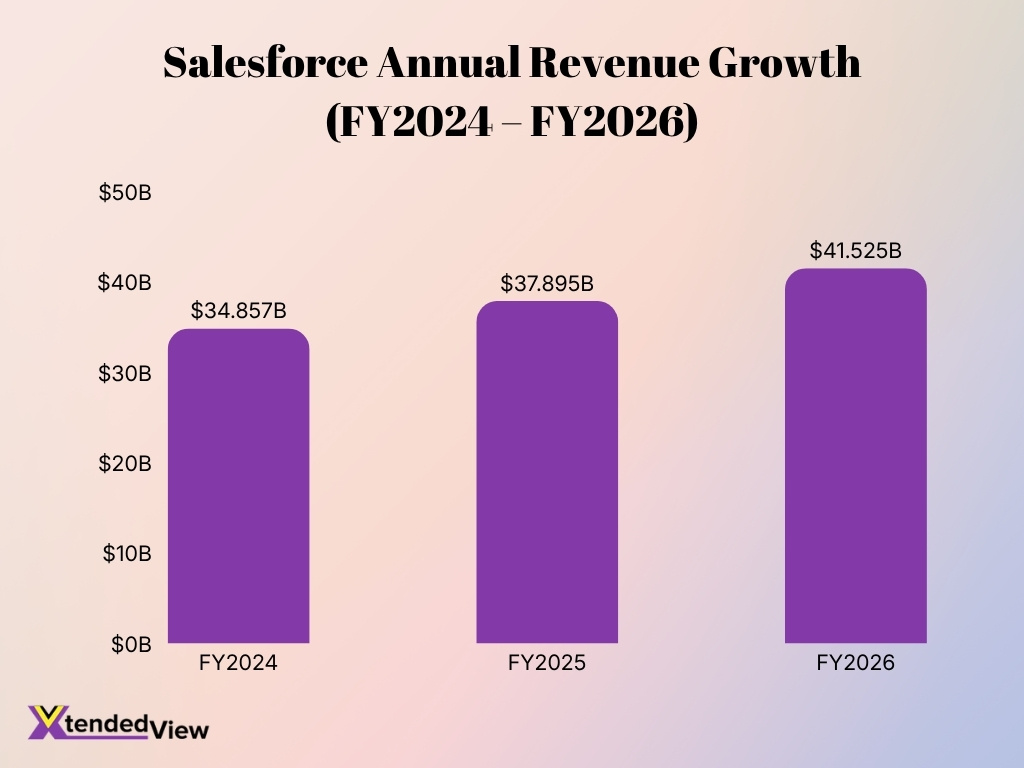
- Salesforce generated $41.525 billion in fiscal 2026 revenue, up from $37.895 billion in fiscal 2025 and $34.857 billion in fiscal 2024.
- Fiscal 2026 revenue increased 10% year over year, or 9% on a constant-currency basis.
- Subscription and support revenue reached $39.388 billion in fiscal 2026, compared with $35.679 billion a year earlier.
- Salesforce ended fiscal 2026 with $72.4 billion in remaining performance obligations (RPO), an increase of 14% year over year.
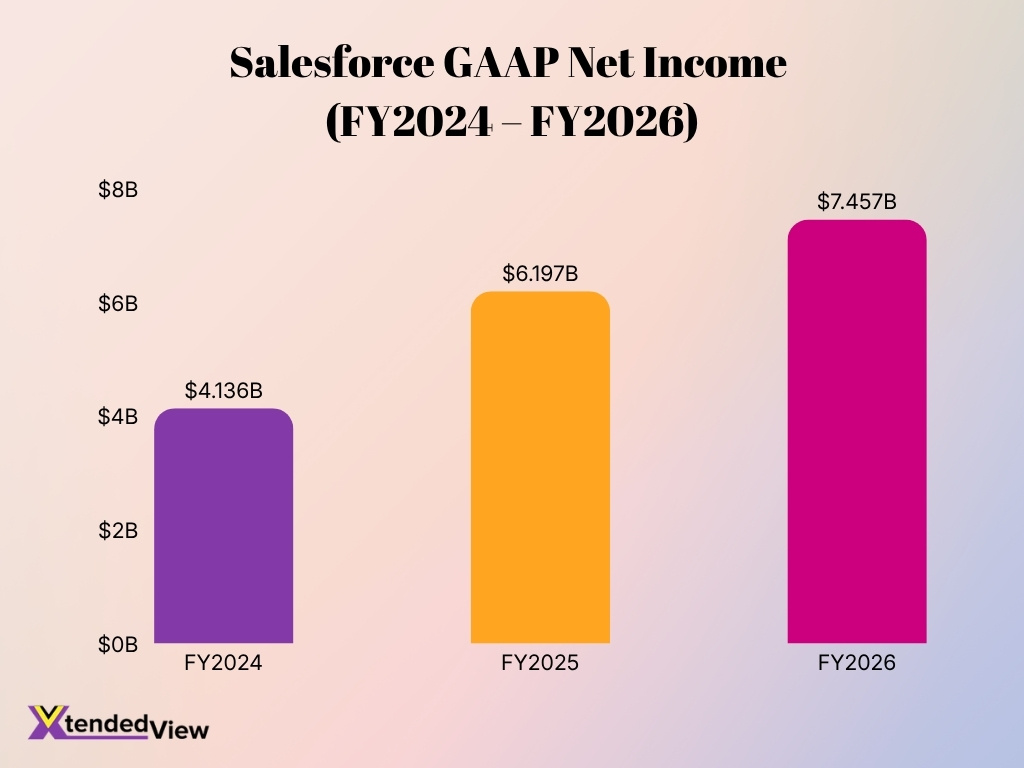
- The company earned $7.457 billion in GAAP net income in fiscal 2026, up from $6.197 billion in fiscal 2025.
- GAAP diluted earnings reached $7.80 per share in fiscal 2026, 23% higher than the prior year.
- Salesforce recorded a 20.1% GAAP operating margin and a 34.1% non-GAAP operating margin for fiscal 2026. Both measures increased by 110 basis points from fiscal 2025.
- In the first quarter of fiscal 2027, ended April 30, 2026, Salesforce generated $11.1 billion in revenue, up 13% year over year and 12% in constant currency.
- Agentforce and Data 360 reached nearly $3.4 billion in annual recurring revenue in Q1 fiscal 2027, representing growth of more than 200% year over year and including $1.1 billion of Informatica Cloud ARR.
- Salesforce expects fiscal 2027 revenue of $45.9 billion to $46.2 billion, which would put the company on track for another year of double-digit reported growth.
Recent Developments
- Salesforce completed its acquisition of Informatica on Nov. 18, 2025, adding data catalog, governance, data quality, privacy, metadata management and master data management capabilities to its platform.
- Informatica contributed $399 million to Salesforce’s fiscal 2026 revenue after the transaction closed late in the fiscal year.
- Salesforce announced a new $50 billion share repurchase authorization in February 2026, replacing its previously unused repurchase authorizations.
- The quarterly dividend increased 5.8% year over year to $0.44 per share in February 2026.
- In Q1 fiscal 2027, Agentforce ARR reached $1.2 billion, up 205% year over year. Combined Agentforce and Data 360 ARR approached $3.4 billion.
- Salesforce reported 3.8 billion Agentic Work Units delivered through Agentforce and Slack by the end of Q1 fiscal 2027, a 111% quarter-over-quarter increase.
- Salesforce agreed in June 2026 to acquire Fin for approximately $3.6 billion. The transaction is expected to close in Salesforce’s fourth quarter of fiscal 2027, subject to required approvals and closing conditions.
- Salesforce continued expanding through acquisitions in 2026, announcing deals involving Contentful and m3ter in June after earlier agreements involving Momentum and Cimulate.
- In July 2026, Salesforce introduced generally available Shopper Agent, Buyer Agent and Merchant Agent capabilities as part of its commerce push. Its data showed AI influenced 20% of global online sales, worth $262 billion, during the 2025 holiday shopping season.
- The Summer ’26 rollout continued Salesforce’s Agentforce expansion. Starting in July 2026, newly created agents moved to the new Agentforce Builder, while the company planned to enable the Agentforce platform by default for eligible organizations in August 2026.
Salesforce Revenue Statistics
- Salesforce reported $41.525 billion in total revenue for fiscal 2026, which ended Jan. 31, 2026.
- Total revenue stood at $37.895 billion in fiscal 2025, meaning Salesforce added roughly $3.63 billion of annual revenue in fiscal 2026.
- Fiscal 2024 revenue was $34.857 billion, so Salesforce added approximately $6.67 billion in annual revenue over the following two fiscal years.
- Subscription and support accounted for $39.388 billion, or about 94.8% of fiscal 2026 total revenue.
- Professional services and other revenue contributed $2.137 billion in fiscal 2026, down from $2.216 billion in fiscal 2025.
- Salesforce generated $11.2 billion in Q4 fiscal 2026 revenue, an increase of 12% year over year and 10% in constant currency.
- Q3 fiscal 2026 revenue totaled $10.259 billion, compared with $9.444 billion in the corresponding prior-year quarter.
- The company’s first quarter of fiscal 2027 generated $11.1 billion, a 13% year-over-year increase. Informatica contributed $444 million to that quarterly figure.
- Salesforce’s updated fiscal 2027 outlook calls for $45.9 billion to $46.2 billion in revenue, representing approximately 11% reported growth at the guidance range.
- Looking further ahead, Salesforce raised its fiscal 2030 revenue target to $63 billion, including Informatica.
Salesforce Revenue Growth Statistics
- Salesforce’s fiscal 2026 revenue grew 10% year over year, compared with 9% growth in fiscal 2025.
- On a constant-currency basis, fiscal 2026 revenue increased 9%, one percentage point below reported growth.
- Total revenue increased from $37.895 billion in fiscal 2025 to $41.525 billion in fiscal 2026, an absolute increase of approximately $3.63 billion.
- Salesforce’s Q3 fiscal 2026 revenue grew 9% year over year, or 8% in constant currency, reaching $10.3 billion.
- Growth accelerated in Q4 fiscal 2026, when revenue increased 12% year over year and 10% in constant currency.
- Q1 fiscal 2027 extended that acceleration, with reported revenue rising 13% year over year and constant-currency revenue increasing 12%.
- The Q1 fiscal 2027 result included $444 million from Informatica. Therefore, acquisition activity accounted for part of the difference between reported growth and Salesforce’s underlying organic expansion.
- Salesforce originally entered fiscal 2026 expecting 7% to 8% revenue growth, based on initial guidance of $40.5 billion to $40.9 billion. Actual fiscal 2026 revenue ultimately reached $41.5 billion and grew 10%.
- Management’s latest fiscal 2027 outlook calls for approximately 11% reported revenue growth, with the forecast range set at $45.9 billion to $46.2 billion.
- Agentforce provides one of Salesforce’s fastest-growing revenue streams: its ARR increased 205% year over year to $1.2 billion by Q1 fiscal 2027.
Salesforce Subscription and Support Revenue Statistics
- Subscription and support revenue reached a record $39.388 billion in fiscal 2026.
- The same category generated $35.679 billion in fiscal 2025 and $32.537 billion in fiscal 2024. That means subscription and support revenue expanded by roughly $6.85 billion in two years.
- Subscription and support revenue grew approximately 10% in fiscal 2026, broadly matching Salesforce’s total reported revenue growth.
- At approximately 94.8% of fiscal 2026 revenue, subscription and support remained the company’s dominant revenue source, highlighting Salesforce’s recurring-revenue model.
- Q3 fiscal 2026 subscription and support revenue reached $9.726 billion, up from $8.879 billion in the year-earlier period.
- Q4 fiscal 2026 subscription and support revenue climbed to $10.7 billion, representing 13% reported growth and 11% constant-currency growth.
- Informatica contributed $388 million to Q4 fiscal 2026 subscription and support revenue following completion of the acquisition in November 2025.
- Q1 fiscal 2027 subscription and support revenue reached $10.6 billion, up 14% year over year and 12% in constant currency.
- Informatica accounted for $428 million of Q1 fiscal 2027 subscription and support revenue.
- For the full fiscal 2027 year, Salesforce expects subscription and support revenue growth of slightly under 12%, or approximately 11% in constant currency, including about three percentage points of contribution from Informatica.
Salesforce Profit and Earnings Statistics
- Salesforce earned $7.457 billion in GAAP net income during fiscal 2026, compared with $6.197 billion in fiscal 2025 and $4.136 billion in fiscal 2024.
- That translates into roughly 20% year-over-year growth in GAAP net income between fiscal 2025 and fiscal 2026.
- Income from operations increased to $8.331 billion in fiscal 2026 from $7.205 billion in fiscal 2025.
- Salesforce’s fiscal 2026 GAAP operating margin reached 20.1%, an improvement of 110 basis points from the 19.0% reported for fiscal 2025.
- Non-GAAP operating margin rose to 34.1% in fiscal 2026 from 33.0% in fiscal 2025, also a 110-basis-point improvement.
- GAAP diluted earnings per share increased 23% to $7.80 in fiscal 2026, compared with $6.36 in fiscal 2025.
- Non-GAAP diluted EPS also increased 23%, reaching $12.52 for fiscal 2026.
- Salesforce recorded $9.520 billion in pretax income in fiscal 2026, up from $7.438 billion in fiscal 2025.
- Profitability continued to strengthen in Q1 fiscal 2027. GAAP diluted EPS reached $2.42, up 52% year over year, while non-GAAP diluted EPS increased 50% to $3.88.
- Q1 fiscal 2027 produced a 21.1% GAAP operating margin and 34.8% non-GAAP operating margin. For the full fiscal year, Salesforce currently expects a 20.6% GAAP margin and 34.3% non-GAAP margin.
Salesforce Cash Flow Statistics
- Salesforce generated $15.0 billion in operating cash flow during fiscal 2026, up from $13.1 billion in fiscal 2025 and $10.2 billion in fiscal 2024. That represents 15% year-over-year growth.
- Fiscal 2026 free cash flow reached $14.4 billion, compared with $12.4 billion in fiscal 2025, representing 16% year-over-year growth.
- Capital expenditures totaled $594 million in fiscal 2026, down from $658 million one year earlier. The lower capital spending helped operating cash flow translate efficiently into free cash flow.
- Investing activities used $8.59 billion in cash during fiscal 2026, compared with $3.16 billion in fiscal 2025. Acquisition spending accounted for much of the increase.
- Salesforce recorded about $9.3 billion in acquisition-related cash outflows during fiscal 2026, including approximately $8.1 billion tied to the Informatica transaction.
- Financing activities used $8.08 billion in cash in fiscal 2026. The company spent $12.6 billion on common-stock repurchases and about $1.6 billion on dividends and equivalents during the year.
- In the first quarter of fiscal 2027, Salesforce produced $6.7 billion in operating cash flow, up 3% year over year from roughly $6.5 billion in the comparable fiscal 2026 quarter.
- First-quarter fiscal 2027 free cash flow increased 4% year over year to $6.6 billion, compared with $6.3 billion in the prior-year quarter.
- Salesforce’s latest fiscal 2027 outlook projects both operating cash flow and free cash flow growth of approximately 4% to 5% year over year.
- As of Jan. 31, 2026, Salesforce had approximately $9.6 billion in cash, cash equivalents and marketable securities, plus $14.3 billion in accounts receivable and access to a $5 billion revolving credit facility.
Salesforce Customer Statistics
- Salesforce serves companies across virtually every industry and business size. Individual customers can have anywhere from one paying subscription to hundreds of thousands, illustrating the platform’s range from small deployments to enterprise-scale installations.
- No individual customer represented 10% or more of Salesforce’s total revenue in fiscal 2026 or fiscal 2025, limiting revenue dependence on any single account.
- Salesforce had closed more than 29,000 Agentforce deals by the end of fiscal 2026. Deal volume increased 50% quarter over quarter at that point.
- More than 60% of Agentforce and Data 360 bookings in the fourth quarter of fiscal 2026 came from expansions within existing customer accounts.
- Existing customers remained a major source of AI and data demand in the first quarter of fiscal 2027, accounting for more than 50% of Agentforce and Data 360 bookings.
- Agentforce accounts running in production increased nearly 50% quarter over quarter by the end of fiscal 2026, indicating that customers were moving more deployments beyond testing.
- 91% of Salesforce customers use at least one AppExchange app, while the marketplace has recorded more than 14 million installs.
- One financial-services customer expects Agentforce to resolve 20% of customer inquiries autonomously and reduce the cost of handling routine inquiries by an estimated 50%.
- A travel-sector customer reported a 15% reduction in average handle time after deploying Agentforce and estimates the technology could generate $2 million in annual cost savings.
- The U.S. Army Human Resources Command deployed Agentforce to support a potential audience of 9.2 million soldiers, veterans and military family members, showing how Salesforce technology can operate in large public-sector environments.
Salesforce Revenue by Product Statistics
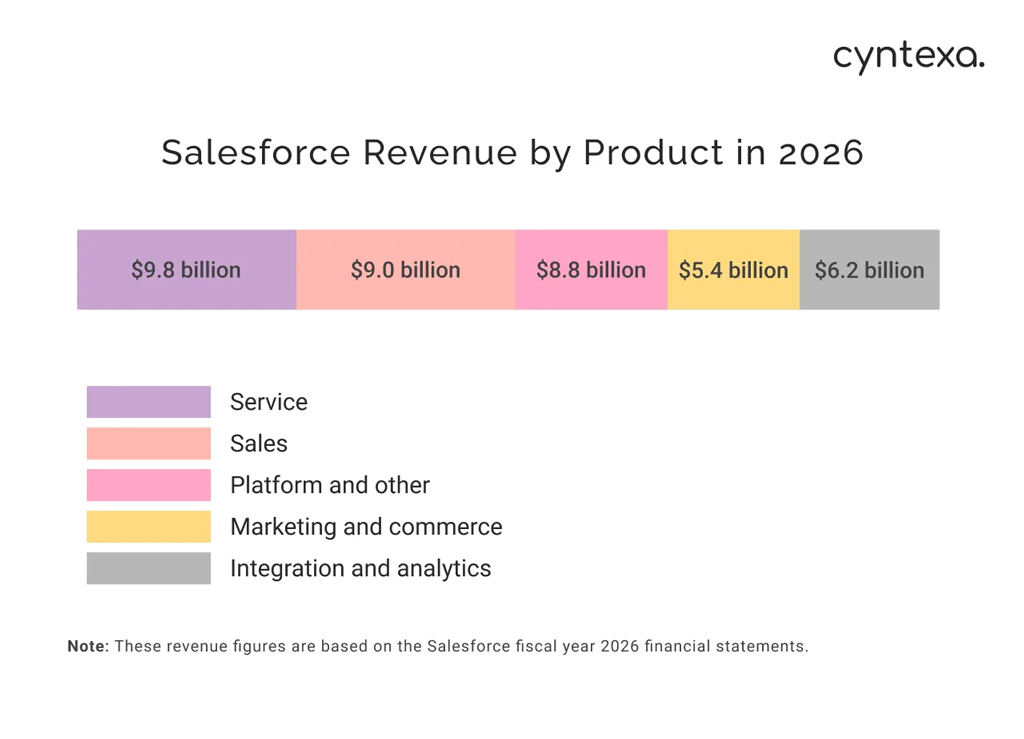
- Service was Salesforce’s largest product revenue segment in 2026, generating $9.8 billion and leading all other categories.
- Sales contributed $9.0 billion in revenue, making it Salesforce’s second-largest product segment during the year.
- Platform and other products generated $8.8 billion, only $200 million behind the Sales segment.
- Integration and analytics accounted for $6.2 billion in revenue, exceeding Marketing and commerce by $800 million.
- Marketing and commerce generated $5.4 billion, making it the smallest revenue segment among the five product categories shown.
- Combined, the five Salesforce product categories generated approximately $39.2 billion in revenue in fiscal 2026.
- The three largest categories, Service, Sales, and Platform and Other, collectively contributed $27.6 billion, representing roughly 70.4% of the revenue shown in the chart.
Salesforce Users and Usage Statistics
- Salesforce’s Trailblazer Community includes more than 20 million people across its ecosystem, including administrators, developers, customers, partners, and learners.
- More than 7 million people have used Trailhead to learn Salesforce-related skills and connect with the broader ecosystem.
- AppExchange has surpassed 14 million application installs, while 91% of Salesforce customers use at least one marketplace application.
- Salesforce had processed more than 28.6 trillion AI tokens by the end of Q1 fiscal 2027. Token processing increased 152% quarter over quarter.
- Agentforce and Slack had delivered 3.8 billion Agentic Work Units by Q1 fiscal 2027, up 111% quarter over quarter. The metric measures completed tasks performed by AI agents.
- Data 360 ingested 52 trillion records in Q1 fiscal 2027, an increase of 136% year over year.
- Of those records, 35 trillion entered through Zero Copy, representing year-over-year growth of 277%.
- Data 360 also processed 12 terabytes of unstructured data during Q1 fiscal 2027. In the full fiscal 2026 year, it processed 18 terabytes.
- Salesforce processed nearly 1 trillion API calls across its core products during Q1 fiscal 2027, illustrating the volume of system-to-system activity occurring across its platform.
- Slack’s Model Context Protocol surpassed 1 million active users within six weeks of launch, providing an early measure of usage for Salesforce’s agent-connected collaboration infrastructure.
Salesforce Employee Statistics
- Salesforce employed 83,334 people as of Jan. 31, 2026.
- The company had 76,453 employees one year earlier, meaning its workforce increased by 6,881 employees during fiscal 2026.
- That change represents approximately 9% year-over-year headcount growth, reversing the flatter workforce trend seen during Salesforce’s earlier profitability restructuring period.
- Salesforce’s employee count therefore grew from 76,453 in fiscal 2025 to 83,334 in fiscal 2026, while annual revenue increased from $37.9 billion to $41.5 billion over the same period.
- Eligible employees can buy company shares through the Employee Stock Purchase Plan at a 15% discount, subject to U.S. tax-code limits.
- Salesforce matches eligible employee donations to nonprofit organizations by as much as $10,000 per employee. The maximum had been $5,000 before increasing to $10,000 effective Feb. 1, 2025.
- Employees receive seven paid volunteer days each year for nonprofit and community activities.
- Salesforce conducts confidential employee engagement and experience surveys twice each year to measure workplace experience, culture and alignment with company values.
- The company’s fiscal 2026 workforce included employees represented by works councils or labor unions in some foreign subsidiaries, while none of its U.S. employees were represented by a labor union as of Jan. 31, 2026.
Global CRM Market Share by Vendor Statistics
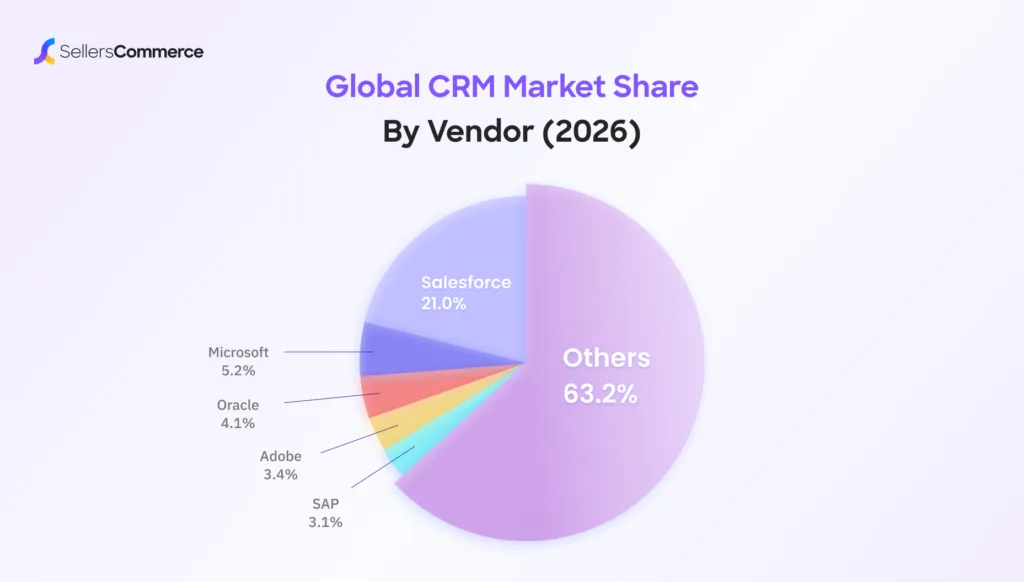
- Salesforce leads the global CRM market with a 21.0% share in 2026, significantly ahead of every other individually listed vendor.
- Microsoft holds 5.2% of the CRM market, making it the second-largest named vendor in the dataset.
- Oracle accounts for 4.1% of the global CRM market, placing it behind Salesforce and Microsoft.
- Adobe captures a 3.4% market share, maintaining a notable presence in the competitive CRM software landscape.
- SAP represents 3.1% of the global CRM market, the smallest share among the five major vendors individually highlighted.
- The five named CRM vendors collectively account for 36.8% of the global market, indicating substantial fragmentation across the industry.
- Other CRM vendors collectively control 63.2% of the market, showing that a large portion of global CRM demand is distributed among smaller and alternative providers.
- Salesforce’s 21.0% share is more than four times Microsoft’s 5.2%, highlighting Salesforce’s substantial lead among the major CRM vendors.
Salesforce Sales Cloud Statistics
- In Salesforce’s 2026 sales research covering more than 4,000 sales professionals, 54% of sellers said they had already used AI agents. Nearly nine in 10 expect to use them by 2027.
- 94% of sales leaders whose teams use AI agents consider them essential for meeting business demands.
- 85% of sales representatives using agents said AI allows them to spend more time on higher-value work instead of repetitive sales tasks.
- Sellers expect fully implemented agents to reduce prospect research time by 34% and email-drafting time by 36%.
- Sales representatives currently use an average of eight tools to close deals, while 42% say the number of tools they use feels overwhelming.
- Sellers who feel overwhelmed by their technology stack are 45% less likely to achieve quota, highlighting the value of consolidating CRM, communication and AI workflows.
- Sales representatives spend only about 30% of the average workweek actively selling, leaving most working hours for administration, preparation and other tasks.
- 79% of sales teams reported increasing revenue over the preceding 12 months, while 82% of sales professionals expressed confidence in their company’s growth strategy for the coming year.
- Despite that revenue growth, 67% of sales representatives did not expect to meet their current-year quota, and 84% reported missing quota in the previous year.
- Agentforce adoption has reached Salesforce’s largest transactions: all 10 of its biggest Q4 fiscal 2026 wins included Agentforce Sales alongside data, service, analytics and platform products.
Salesforce Service Cloud Statistics
- AI-agent adoption among customer-service organizations rose from 39% in 2025 to 66% in 2026, a 1.7-fold increase in one year.
- More broadly, 85% of service organizations now use at least one form of artificial intelligence, suggesting AI has moved beyond isolated pilot projects in customer support.
- 70% of service organizations using AI agents report measurable value within 60 days of deployment. Customer satisfaction ranks as the most commonly improved key performance indicator.
- Among teams using agents, 77% deploy them both externally and internally, rather than limiting their use to customer-facing conversations.
- AI handled approximately 30% of customer-service cases in 2025. Service professionals expect that proportion to reach 50% by 2027.
- Service organizations using agents expect them to lower both service costs and case-resolution times by an average of 20%.
- In Salesforce’s own support operation, Agentforce resolves approximately 76% of customer inquiries without a human, providing a large-scale example of Service Cloud, Data 360 and Agentforce working together.
- That deployment produced a 65% reduction in response time for 90% of users while supporting more than 1.7 million Help-site visitors.
- By Q1 fiscal 2026, Agentforce had handled more than 750,000 support requests, while Salesforce reported a 7% year-over-year decline in case volume on its Help operation.
- As deployments expanded, Salesforce reported that its Help Agent had handled more than 4 million customer inquiries, enabling round-the-clock multilingual support.
Salesforce Geographic Presence Statistics
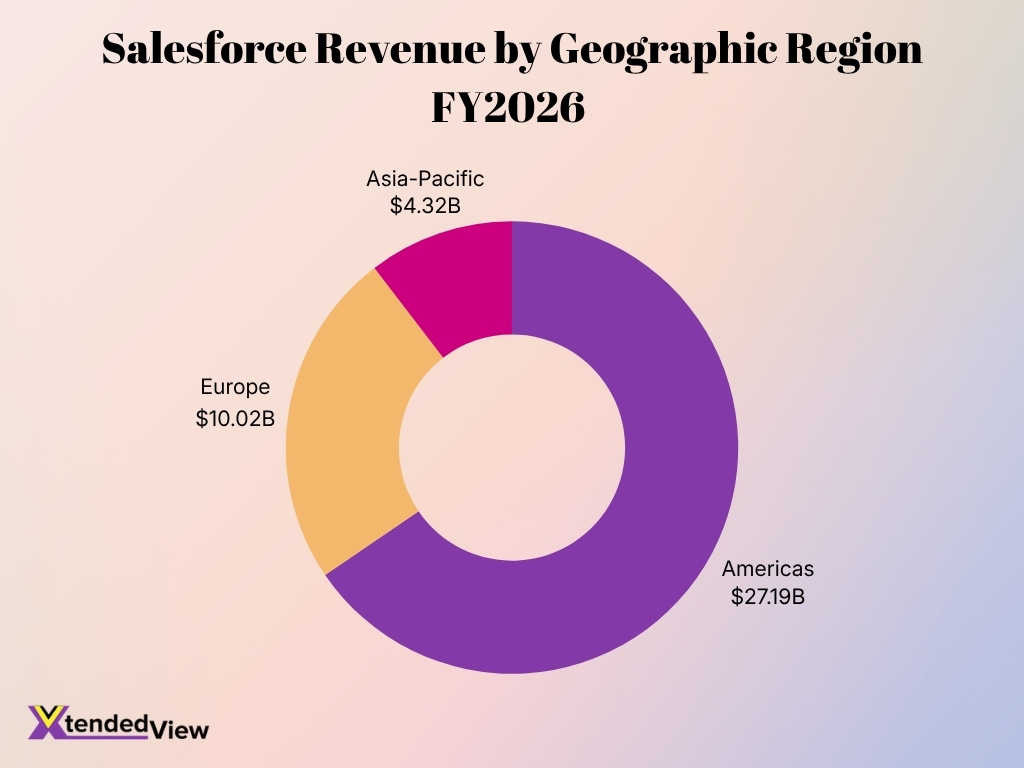
- Salesforce generated $27.19 billion in Americas revenue during fiscal 2026, making the Americas its largest regional market.
- The Americas contributed about 65% of total fiscal 2026 revenue, down from 67% in fiscal 2025 as international regions grew more quickly.
- Americas revenue increased 8% year over year, from $25.14 billion in fiscal 2025 to $27.19 billion in fiscal 2026.
- Europe generated $10.02 billion in fiscal 2026 revenue, compared with $8.89 billion in fiscal 2025 and $8.13 billion in fiscal 2024.
- European revenue rose 13% year over year, making Europe the fastest-growing of Salesforce’s three reported geographic regions in fiscal 2026.
- Asia-Pacific revenue reached $4.32 billion in fiscal 2026, up from $3.86 billion in fiscal 2025 and $3.44 billion in fiscal 2024.
- Asia-Pacific revenue grew 12% year over year and accounted for approximately 10% of Salesforce’s fiscal 2026 total revenue.
- Approximately 93% of Americas revenue came from the United States in fiscal 2026, fiscal 2025, and fiscal 2024. No country outside the U.S. contributed more than 10% of Salesforce’s worldwide revenue in those years.
- Assets located in the United States represented 82% of total assets as of Jan. 31, 2026, up from 81% one year earlier. Assets outside the Americas accounted for 16%, compared with 17% in fiscal 2025.
- Salesforce maintains operations across the Americas, Europe and Asia-Pacific and leases office space in countries across North America, South America, Europe, Asia, Africa and Australia. It also operates data centers in the U.S., Europe and Asia through co-location arrangements.
Salesforce Marketing and Commerce Cloud Statistics
- Salesforce’s latest marketing research surveyed nearly 4,500 marketing leaders worldwide, providing a broad view of how organizations are adapting marketing operations to AI and unified customer data.
- 75% of marketers now use AI, although only 34% say they are completely satisfied with their organization’s ability to capture value from that technology.
- Marketers using AI report stronger data connectivity: 75% are satisfied with their ability to connect customer touchpoints, compared with 60% among marketers not using AI.
- 83% of marketers recognize that customers increasingly expect personalized, two-way brand communication, yet only about one in four marketers are satisfied with how their data supports those interactions.
- During the 2025 holiday season, AI and agents influenced 20% of worldwide online sales, representing approximately $262 billion in revenue.
- Retailers operating their own shopper agents recorded sales growth 59% faster than retailers that had not deployed shopper agents during the measured holiday period.
- Traffic referred by AI converts at approximately eight times the rate of social-media traffic, according to the commerce data accompanying Salesforce’s 2026 agentic-commerce rollout.
- Global online sales accelerated sharply near the end of the 2025 holiday season, increasing 12% year over year during the final two weeks of December. U.S. sales increased 9% during that period.
- Among organizations using AI for commerce, approximately 39% report a major improvement in product discovery, an area where agents can combine search intent, preferences and browsing histories.
- AI-supported personalization is already producing measurable marketing outcomes: research cited in 2026 found marketers using AI for personalization reporting a 20% lift in ROI and a 19% rise in conversion rates.
Salesforce Partner Selling Plans by Industry
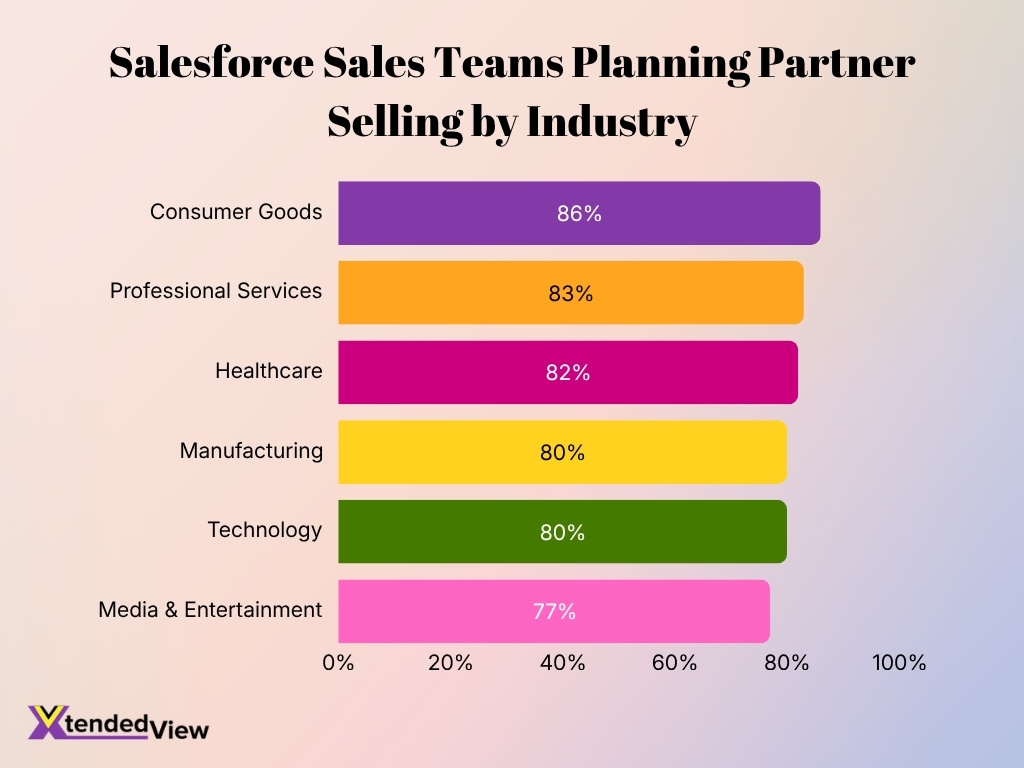
- Consumer goods leads all industries, with 86% of sales teams planning to engage in partner selling.
- Professional services ranks second at 83%, indicating strong reliance on partnerships to expand sales opportunities and reach customers.
- In the healthcare industry, 82% of sales teams plan to use partner selling, placing the sector among the leading adopters.
- Manufacturing and technology are tied at 80%, showing that partner-led sales strategies are widely planned across both industries.
- Media and entertainment records the lowest share at 77%, although more than three-quarters of sales teams still plan to pursue partner selling.
- Overall, partner selling is planned by at least 77% of sales teams across every industry surveyed, highlighting its broad role in Salesforce-related sales strategies.
Salesforce Data Cloud Statistics
- Data 360 ingested 112 trillion records during fiscal 2026, an increase of 114% compared with the previous fiscal year.
- Of that fiscal 2026 volume, 53 trillion records flowed through Zero Copy, representing 310% year-over-year growth.
- Data 360 also processed 18 terabytes of unstructured data during fiscal 2026 as Salesforce expanded the platform beyond traditional structured CRM records.
- Usage accelerated further in Q1 fiscal 2027, when Data 360 ingested 52 trillion records in a single quarter, up 136% year over year.
- Zero Copy accounted for 35 trillion of those Q1 records, a 277% year-over-year increase.
- Data 360 processed another 12 terabytes of unstructured data in Q1 fiscal 2027, equal to two-thirds of the volume processed during the entire preceding fiscal year.
- Data Cloud and AI annual recurring revenue had already surpassed $1 billion in Q1 fiscal 2026, representing growth of more than 120% year over year.
- By Q3 fiscal 2026, Agentforce and Data 360 ARR reached nearly $1.4 billion, up 114% year over year.
- At fiscal 2026 year-end, Agentforce and Data 360 ARR exceeded $2.9 billion, including $1.1 billion from the acquired Informatica cloud business.
- By Q1 fiscal 2027, combined Agentforce and Data 360 ARR approached $3.4 billion, while more than 50% of bookings for the two businesses came from expansions within existing customer accounts.
Salesforce Agentforce and Artificial Intelligence Statistics
- Agentforce annual recurring revenue reached $1.2 billion in Q1 fiscal 2027, increasing 205% year over year.
- At the end of fiscal 2026, Agentforce ARR stood at approximately $800 million, up 169% year over year, showing how rapidly the business scaled entering 2026.
- Salesforce had closed more than 29,000 Agentforce deals by Jan. 31, 2026, with total deal count increasing 50% quarter over quarter.
- Three months earlier, Salesforce had reported 18,500 Agentforce deals, including more than 9,500 paid deals. Paid-deal volume had increased 50% quarter over quarter at that stage.
- The number of Agentforce customer accounts running in production increased nearly 50% quarter over quarter by the end of fiscal 2026. In Q3, production accounts had grown 70% sequentially.
- Salesforce and Slack delivered 2.4 billion Agentic Work Units by fiscal 2026 year-end, up 57% from the previous quarter.
- That total climbed to 3.8 billion Agentic Work Units by Q1 fiscal 2027, a further 111% quarter-over-quarter increase.
- Salesforce had processed more than 19 trillion AI tokens by fiscal 2026 year-end, representing approximately five times the volume processed a year earlier.
- By Q1 fiscal 2027, cumulative processed AI tokens had risen above 28.6 trillion, a 152% quarter-over-quarter increase.
- More than 60% of Agentforce and Data 360 bookings in Q4 fiscal 2026 came from existing customer expansion. The proportion remained above 50% in Q1 fiscal 2027, indicating that installed customers form a major part of Salesforce’s AI growth strategy.
Frequently Asked Questions (FAQs)
Salesforce generated $41.5 billion in fiscal 2026 revenue, up 10% year over year.
Salesforce held about 20.0% of the worldwide CRM market in 2025, keeping its No. 1 CRM ranking.
Agentforce reached $1.2 billion in ARR in Q1 fiscal 2027, up 205% year over year.
Data 360 ingested 52 trillion records in Q1 fiscal 2027, representing 136% year-over-year growth.
Salesforce reported $11.1 billion in Q1 fiscal 2027 revenue, up 13% year over year and 12% in constant currency.
Conclusion
Salesforce’s statistics show a company expanding beyond its traditional CRM foundation into enterprise data and AI agents. Fiscal 2026 revenue reached $41.5 billion, while Agentforce ARR climbed to $1.2 billion by Q1 fiscal 2027 and combined Agentforce and Data 360 ARR approached $3.4 billion.
At the same time, Salesforce retained 20.0% of the worldwide CRM market, generated $15.0 billion in annual operating cash flow, and expanded its industry-specific businesses to $6.6 billion in ARR. Data 360’s rapidly rising record volumes and growing Agentforce usage show that customers are moving AI workloads into active business operations.