



Oracle remains one of the world’s largest enterprise software and cloud providers, serving organizations across finance, healthcare, retail, manufacturing, and the public sector. Its rapid cloud expansion and AI investments continue to reshape how businesses deploy databases, enterprise applications, and infrastructure at scale. As enterprises accelerate digital transformation and AI adoption, Oracle’s financial performance and cloud growth have become key indicators for the broader technology market. Explore the statistics below to understand Oracle’s latest performance, market momentum, and cloud infrastructure growth.
Editor’s Choice
- Oracle generated a record $67.4 billion in fiscal 2026 revenue, representing 17% year-over-year growth.
- Total cloud revenue reached $34.0 billion in FY2026, increasing 39% from the previous fiscal year.
- Oracle Cloud Infrastructure (OCI) revenue climbed to $18.1 billion during FY2026, posting 77% annual growth.
- During Q4 FY2026, Oracle reported $19.2 billion in quarterly revenue, up 21% year over year.
- Oracle’s remaining performance obligations expanded to $638 billion by the end of FY2026, highlighting strong long-term demand.
- In FY2025, Oracle generated $57.4 billion in total revenue before accelerating significantly in FY2026.
- Oracle Cloud Infrastructure revenue increased 93% during Q4 FY2026, making it the company’s fastest-growing major business segment.
Recent Developments
- Oracle expanded its partnership with Google to integrate Gemini AI models into Oracle enterprise software during 2026.
- Oracle announced record FY2026 cloud revenue of $34.0 billion, reflecting continued enterprise migration to cloud services.
- The company increased quarterly cloud revenue to $9.9 billion in Q4 FY2026, representing 47% growth year over year.
- Oracle reported FY2026 operating cash flow of $32.0 billion, up 54% from the previous fiscal year.
- Remaining performance obligations rose by $85 billion in one quarter, reaching $638 billion during FY2026.
- Oracle continued expanding AI-ready cloud infrastructure to support increasing enterprise demand for generative AI workloads throughout 2026.
- FY2026 cloud infrastructure revenue nearly doubled, reflecting accelerating adoption of OCI among enterprise customers.
- Oracle maintained its multi-cloud strategy by supporting Oracle Database deployments across major public cloud platforms.
Oracle Annual Revenue Growth Statistics
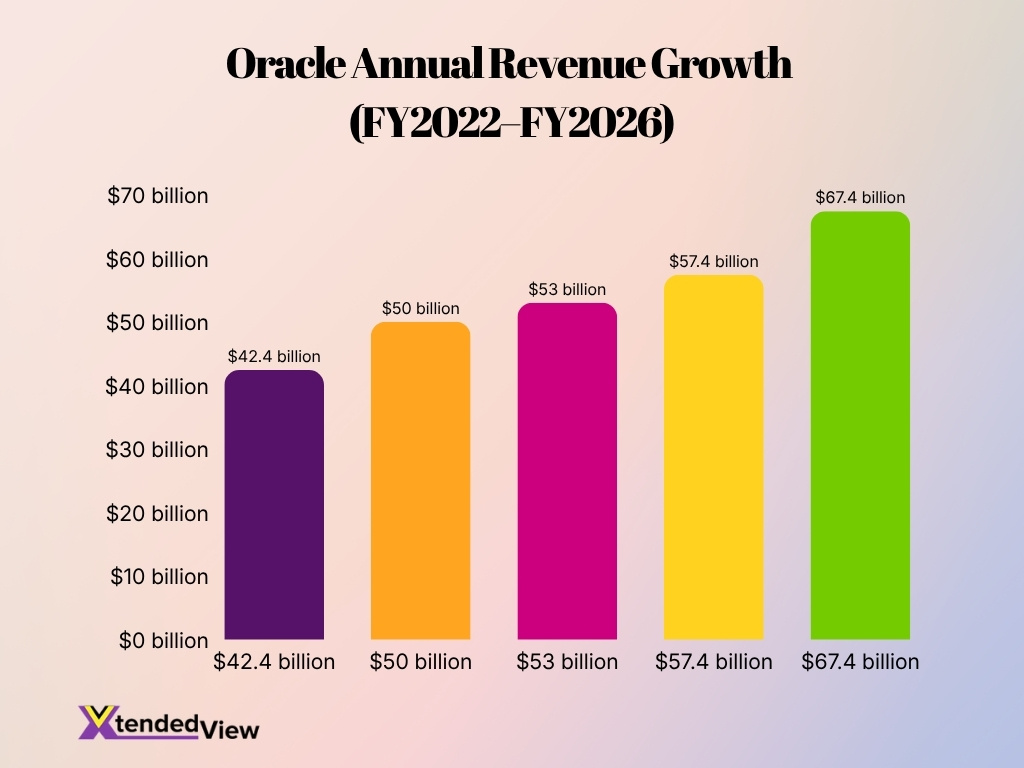
- Oracle’s annual revenue increased from $42.4 billion in FY2022 to $67.4 billion in FY2026, reflecting strong long-term business growth.
- Revenue climbed to $50.0 billion in FY2023, representing an increase of approximately 17.9% compared to FY2022.
- In FY2024, Oracle generated $53.0 billion in revenue, marking a steady 6.0% year-over-year increase.
- Oracle’s revenue reached $57.4 billion in FY2025, growing by approximately 8.3% over the previous fiscal year.
- FY2026 recorded Oracle’s highest annual revenue of $67.4 billion, an increase of around 17.4% from FY2025.
- Over the FY2022 to FY2026 period, Oracle’s annual revenue expanded by $25.0 billion, representing an overall growth of nearly 59%.
Oracle Financial Performance Statistics
- Oracle reported GAAP earnings per share of $5.83 during FY2026, representing 34% annual growth.
- FY2026 non-GAAP earnings per share increased to $7.63, up 27% from FY2025.
- Q4 FY2026 GAAP EPS reached $1.45, increasing 21% year over year.
- Oracle generated $20.6 billion in GAAP operating income during FY2026, up 17% annually.
- FY2026 GAAP net income climbed to $17.0 billion, increasing 36% from the previous fiscal year.
- Non-GAAP operating income reached a record $28.9 billion during FY2026.
- Operating cash flow increased to $32.0 billion, reflecting strong profitability despite elevated AI infrastructure investments.
- Oracle reported negative free cash flow of $23.7 billion in FY2026 as it accelerated large-scale cloud data center expansion.
Oracle Cloud Revenue Growth
- Oracle’s total cloud revenue increased to $34.0 billion during FY2026, up 39% year over year.
- Q4 FY2026 cloud revenue reached $9.9 billion, reflecting 47% annual growth.
- Cloud infrastructure generated $18.1 billion in FY2026 revenue, increasing 77% from FY2025.
- Cloud applications revenue totaled $15.9 billion during FY2026, up 11% year over year.
- During Q4 FY2025, Oracle cloud revenue stood at $6.7 billion, providing the base for accelerated FY2026 growth.
- OCI revenue expanded from $3.0 billion in Q4 FY2025 to $5.8 billion in Q4 FY2026.
- Oracle projected cloud growth above 40% entering FY2026, driven by AI workloads and enterprise migrations.
- Cloud revenue represented more than half of Oracle’s FY2026 total company revenue for the first time.
Oracle FY2026 Revenue by Segment
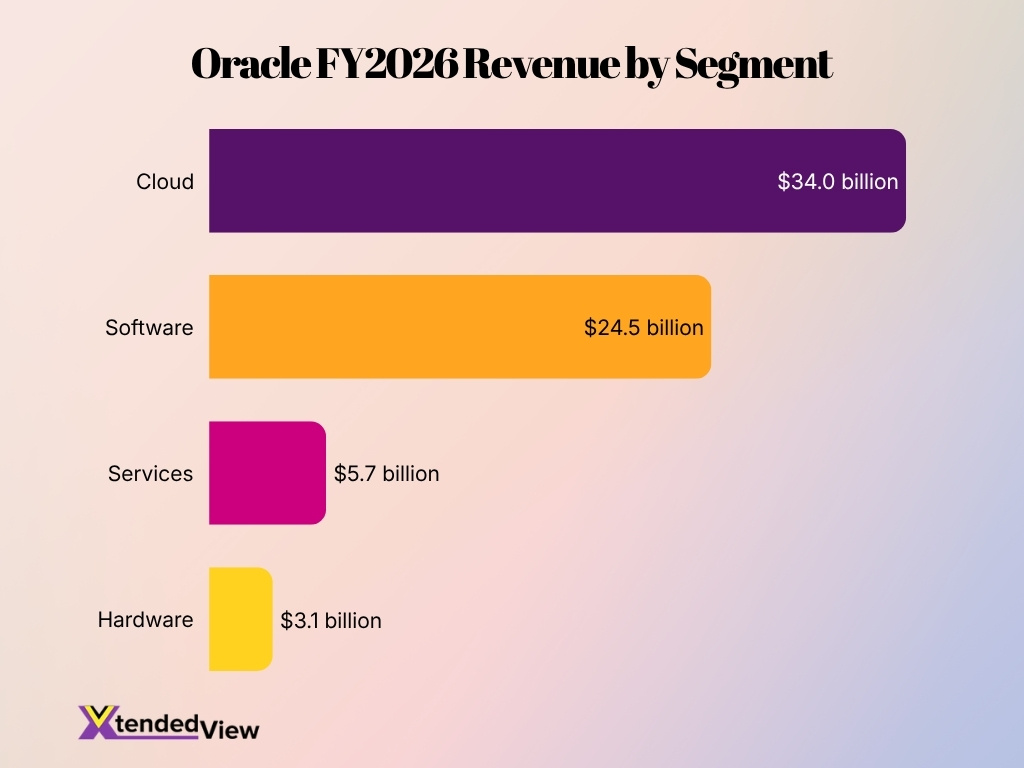
- Cloud generated the largest share of Oracle’s FY2026 revenue, contributing $34.0 billion, highlighting the company’s continued focus on cloud infrastructure and cloud applications.
- Software remained Oracle’s second largest revenue stream, generating $24.5 billion, demonstrating the sustained demand for its database, middleware, and enterprise software products.
- Services contributed $5.7 billion in FY2026 revenue, reflecting Oracle’s ongoing revenue from consulting, support, and managed services.
- Hardware accounted for $3.1 billion in revenue, making it the smallest business segment while continuing to support Oracle’s integrated enterprise solutions.
- Oracle generated a combined $58.5 billion from its Cloud and Software businesses, representing the overwhelming majority of its $67.3 billion in segment revenue.
- The revenue mix shows Oracle’s strategic transition toward cloud-driven and software-focused operations, with these two segments contributing nearly 87% of total FY2026 segment revenue.
- Oracle’s relatively smaller Services and Hardware revenues underscore the company’s increasing dependence on high-margin, recurring cloud and software businesses for long-term growth.
Oracle Cloud Infrastructure Statistics
- Oracle Cloud Infrastructure (OCI) generated $18.1 billion in FY2026 revenue.
- OCI revenue increased 77% during FY2026 compared with the previous fiscal year.
- Q4 FY2026 OCI revenue reached $5.8 billion, representing 93% year-over-year growth.
- OCI generated $3.0 billion during Q4 FY2025 before nearly doubling one year later.
- Oracle continued investing heavily in AI infrastructure, resulting in $55.7 billion in FY2026 capital expenditures.
- Enterprise AI demand remained a major driver of OCI expansion throughout FY2026.
- Oracle’s multi-cloud strategy enabled Oracle Database services across Oracle Cloud, Microsoft Azure, Google Cloud, and AWS.
- Oracle’s remaining performance obligations reached $638 billion, providing substantial visibility into future cloud infrastructure revenue.
Oracle Database Popularity Ranking
- Oracle ranked No. 1 among more than 380 database systems in the July 2026 composite popularity ranking.
- Oracle recorded a popularity score of 1,132 points in July 2026, placing it 286 points ahead of the second-ranked database.
- MySQL ranked second with 846 points, equivalent to about 74.7% of Oracle’s measured popularity score.
- Microsoft SQL Server ranked third with 698 points, leaving Oracle with a 434-point advantage.
- PostgreSQL ranked fourth with 687 points, only 11 points behind Microsoft SQL Server but 445 points behind Oracle.
- Oracle also ranked No. 1 specifically among relational database management systems in July 2026.
- Oracle held the same relational database rank in July 2025, June 2026 and July 2026, indicating stable leadership during the measured period.
- Oracle maintained the database ranking’s top position through the first quarter of 2025, while PostgreSQL and Snowflake recorded notable growth.
- The July 2026 popularity score decreased by 7.67 points from the comparable prior measurement, although Oracle retained a wide lead over every competitor.
Oracle Database Market Share
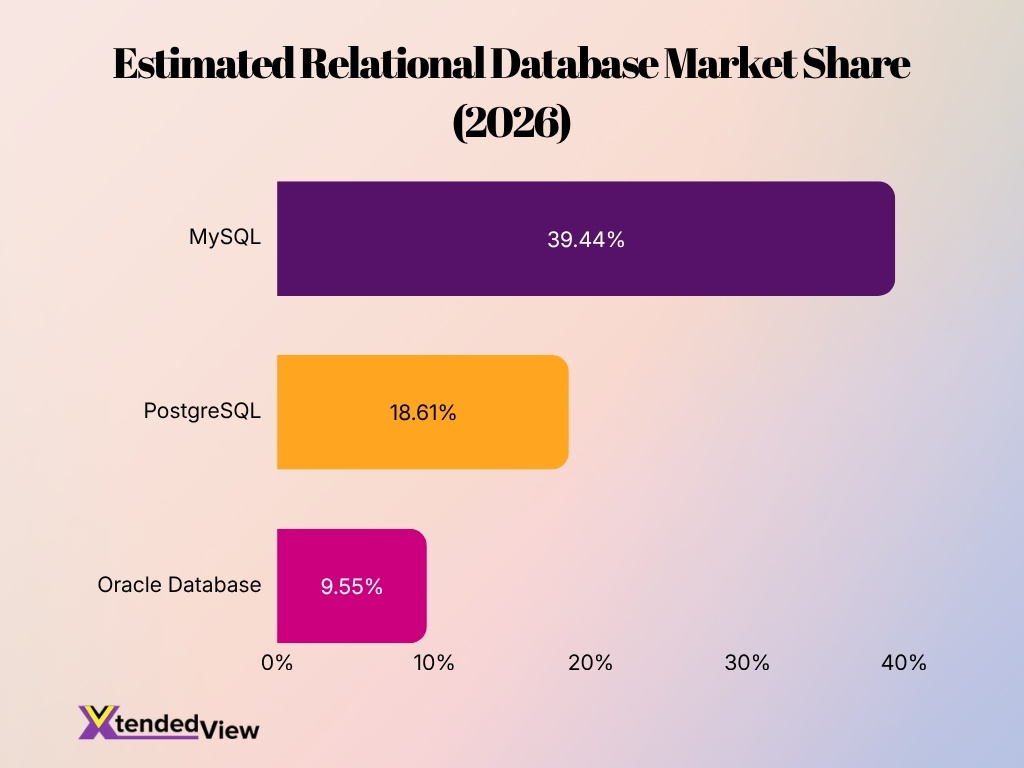
- Oracle Database held an estimated 9.55% share of tracked relational database installations in 2026, ranking third within that technographic dataset.
- The same dataset identified approximately 37,397 organizations using Oracle Database technologies. This count reflects detected business deployments rather than every licensed installation.
- MySQL led the tracked relational database category with a 39.44% share, giving it a lead of 29.89 percentage points over Oracle Database.
- PostgreSQL accounted for an estimated 18.61% of detected relational database deployments, nearly double Oracle Database’s measured share.
- Relational database platforms retained 57.3% of the broader database market in 2025, showing that structured transactional systems still represented the largest database segment.
- Meanwhile, the NoSQL segment was projected to expand at a 17.8% compound annual growth rate, increasing competitive pressure on established relational database vendors.
- The global relational database market was valued at approximately $70.76 billion in 2024 and was projected to reach $258.57 billion by 2035.
- That forecast represents an expected 12.5% compound annual growth rate from 2025 to 2035, supported by cloud migration, analytics, AI, and transaction-intensive applications.
Oracle Customer Statistics
- Oracle reported a worldwide customer base of more than 430,000 organizations in 2025 and 2026.
- Those customers operated across more than 170 countries, giving Oracle a customer footprint that spans nearly every major commercial market.
- Other current company materials place Oracle’s coverage at more than 175 countries, depending on the business unit and customer program measured.
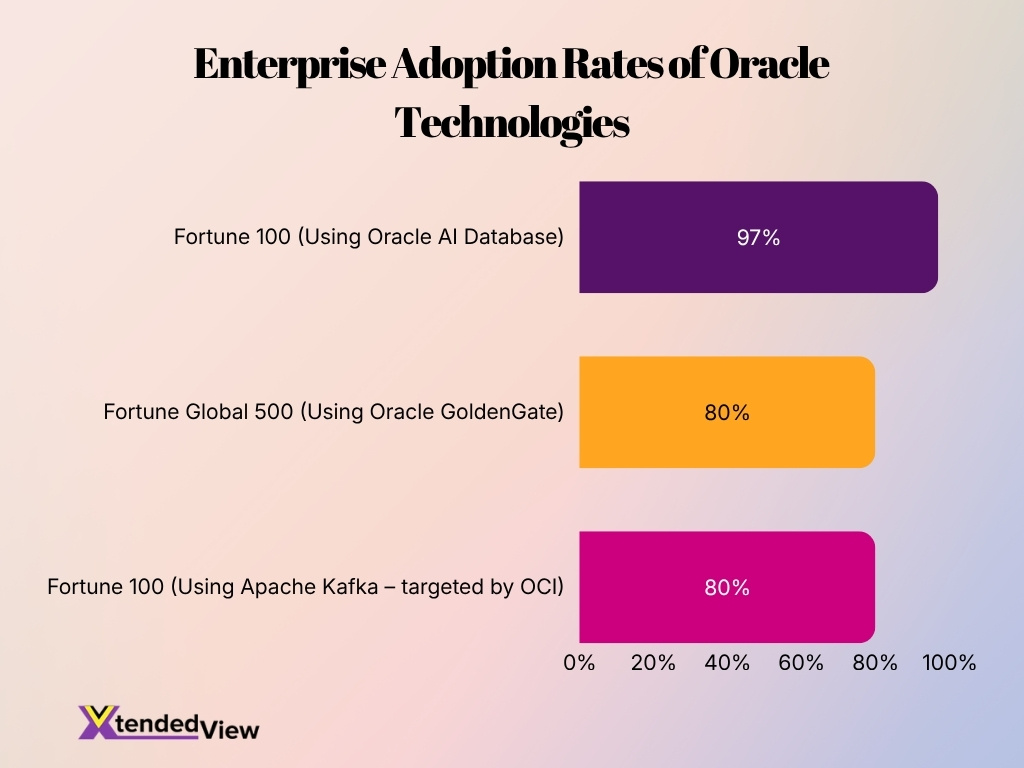
- Oracle said 97% of Fortune 100 companies run critical workloads on Oracle AI Database.
- In addition to large enterprises, hundreds of thousands of smaller organizations use Oracle AI Database for business-critical workloads.
- Oracle Support provides round-the-clock assistance to its global customer base through approximately 18,000 specialists.
- Those support teams provide services in more than 20 languages, helping organizations manage deployments across regional and regulatory environments.
- Oracle employed more than 130,000 people in 2025 to serve its global cloud, database, applications and support customer base.
- Oracle’s named technology customers include major AI, semiconductor, social media and transportation companies, illustrating adoption across high-compute industries.
Oracle User Base Statistics
- Oracle’s overall solutions ecosystem serves 430,000-plus customers, which provides the broadest available indicator of its organizational user base.
- Detected Oracle Database deployments covered about 37,397 customer organizations in one 2026 relational database technology dataset.
- Oracle AI Database supports workloads at 97 of every 100 Fortune 100 companies, based on the company’s current adoption statement.
- Oracle GoldenGate serves thousands of customers that use the platform for real-time data movement, replication, and integration.
- More than 80% of Fortune Global 500 companies use Oracle GoldenGate, showing its strong presence in large-scale enterprise data environments.
- The 2025 global developer survey collected 49,019 responses, providing a broad benchmark for comparing enterprise database usage with the wider developer ecosystem.
- Professional developers represented 76% of respondents in that survey, while another 15% described themselves as aspiring or adjacent developers.
- The database-use portion of the survey received 26,083 responses, equal to 53.2% of the full respondent base.
- US-based developers accounted for 20.4% of geographically identified respondents, making the United States the survey’s largest national group.
Oracle Enterprise Usage Statistics
- Oracle AI Database supports critical systems at 97% of Fortune 100 companies, placing it among the most widely adopted enterprise database platforms.
- Oracle GoldenGate operates within more than 80% of Fortune Global 500 organizations, primarily supporting real-time replication and data integration workloads.
- Oracle’s enterprise ecosystem reaches 430,000-plus commercial, government and institutional customers worldwide.
- The company’s customer operations span 175-plus countries, supporting multinational deployments and regional data residency requirements.
- OCI offered more than 200 AI and cloud services across public cloud, edge, customer data centers and multicloud environments in 2025.
- Oracle received a Leader designation in a major strategic cloud platform assessment for the third consecutive year in 2025.
- Oracle GoldenGate became the first data replication cloud service in 2017 and added a serverless experience with built-in elasticity in 2021.
- OCI Streaming with Apache Kafka targets a technology already used by 80% of Fortune 100 companies for event streaming and mission-critical data integration.
- Oracle’s current deployment model allows enterprises to run the database in public cloud, other hyperscale clouds, their own data centers, or a dedicated cloud environment placed at the customer’s location.
Oracle Database Adoption Statistics
- 97% of Fortune 100 businesses use Oracle AI Database for at least some critical workloads, according to Oracle’s 2026 product data.
- Oracle Database adoption extends beyond large corporations to hundreds of thousands of smaller companies, including organizations in retail, banking, telecommunications and government.
- Customers can deploy Oracle AI Database through four primary models: OCI public cloud, multicloud, Cloud@Customer and on-premises infrastructure.
- The multicloud option supports Oracle AI Database on three external hyperscale cloud platforms, allowing customers to keep Oracle technology while using another provider’s infrastructure and credits.
- Oracle AI Database supports relational, vector, JSON, graph, spatial, text and columnar data within one converged engine, reducing the need to adopt separate databases for each data type.
- Oracle provides MongoDB API compatibility, giving organizations a migration or coexistence path for document-oriented applications without abandoning SQL analytics.
- Oracle GoldenGate added more than 30 data sources and targets to improve interoperability across Oracle, non-Oracle, and multicloud environments.
- The company reported that GoldenGate had supported zero-downtime migration methods for more than 25 years, making migration continuity a long-standing adoption feature.
- Oracle offers a free database tier and lightweight container deployment, allowing developers to begin building without purchasing a production license at the testing stage.
Oracle Database Usage Statistics
- Oracle Database achieved a July 2026 popularity score 34% higher than MySQL’s, based on the composite scores of 1,132 and 846.
- Its popularity score stood 62% above Microsoft SQL Server’s 698-point result.
- Oracle’s score was approximately 65% higher than PostgreSQL’s 687 points in the same ranking.
- Oracle registered nearly three times MongoDB’s popularity score, with MongoDB placing fifth at 386 points.
- Oracle’s measured score exceeded Snowflake’s 216 points by more than five times, although Snowflake continued gaining attention in cloud analytics.
- Oracle AI Database can process seven major data categories, relational, vector, JSON, graph, columnar, spatial and text, within the same database context.
- Oracle supports at least four open development interfaces and standards highlighted in its current product materials: SQL, REST, JavaScript and Apache Iceberg.
- The database integrates with widely used AI development frameworks, including LangChain and LlamaIndex, so teams can connect AI workflows directly to governed enterprise data.
- One analyst assessment cited by Oracle found that Oracle AI Database enabled 87% faster data refreshes in the evaluated use case.
Oracle Global Presence Statistics
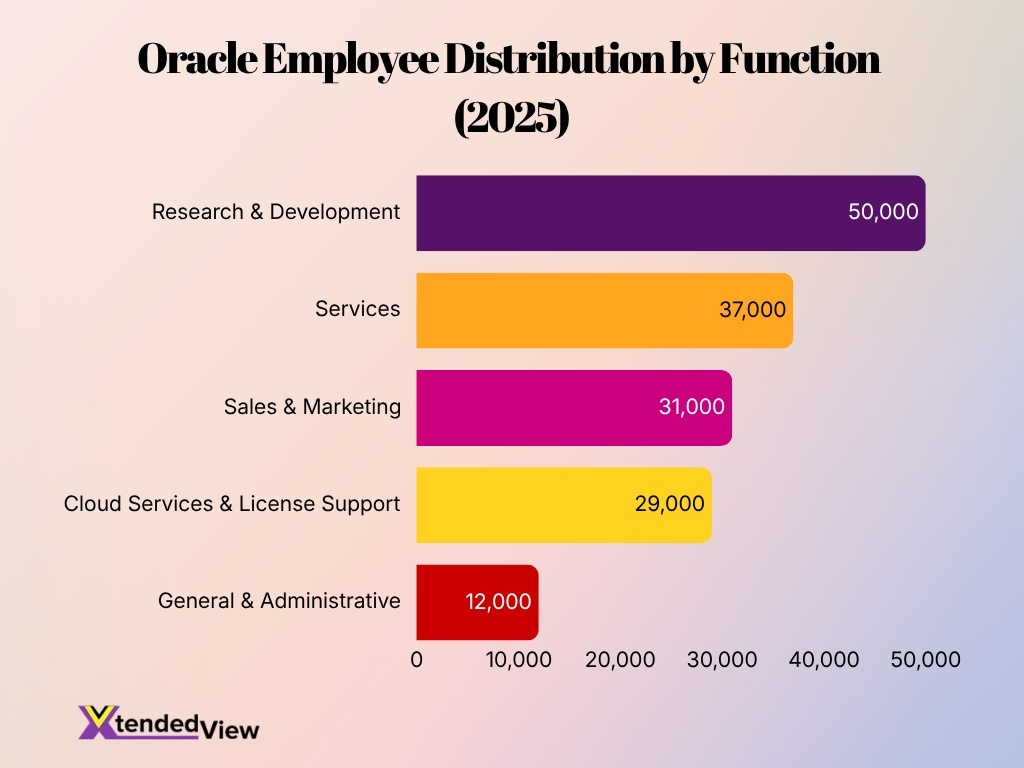
- Oracle employed approximately 162,000 full-time workers as of May 31, 2025.
- Research and development represented the company’s largest reported employee group, with approximately 50,000 workers.
- Oracle employed about 37,000 services professionals, supporting implementation, consulting, and customer operations.
- Cloud services and license support operations accounted for approximately 29,000 employees.
- The sales and marketing organization employed roughly 31,000 people, while general and administrative roles accounted for about 12,000.
- Oracle operated more than 50 public cloud regions across 28 countries in 2026.
- Its commercial cloud included 41 regions in 26 countries, separate from sovereign and government-only cloud environments.
- Customers could access two or more commercial regions for in-country disaster recovery in 14 countries and the European Union.
- Oracle maintained two dedicated EU Sovereign Cloud regions in Madrid and Frankfurt, both operated within the European Union.
- At least 10 countries had two commercial OCI regions available for multiregion continuity, including the United States, Canada, India, Japan, Brazil and Australia.
Oracle AI and Machine Learning Statistics
- Oracle’s planned Texas AI data center has a power capacity of 1.2 gigawatts, reflecting the scale required to train and run large AI models.
- The same AI facility is designed to support up to 500,000 NVIDIA GPUs, creating substantial capacity for model training and inference workloads.
- Oracle AI Database services were available across more than 200 data centers in 2026, allowing enterprises to place AI workloads closer to their applications and regulated data.
- Oracle’s multicloud database footprint included 22 AWS locations, 15 Google Cloud locations, 33 Microsoft Azure locations and 135 Oracle Cloud locations.
- Oracle Fusion Applications delivered more than 1,000 AI agents by July 2026, covering business processes such as finance, human resources, sales, service and supply chain management.
- Oracle introduced 22 Fusion Agentic Applications in 2026 to automate outcome-focused workflows rather than individual isolated tasks.
- Large AI contracts helped lift Oracle’s remaining performance obligations to $638 billion at the end of FY2026, up 363% from the previous year.
- Customers prepaid or supplied $75 billion in AI hardware, including GPUs, under large infrastructure contracts. This arrangement reduced Oracle’s need to finance all AI capacity itself.
- Oracle Cloud Infrastructure revenue rose 84% year over year in Q3 FY2026, reaching $4.9 billion as demand for AI computing accelerated.
- Oracle’s AI platform supported models from at least four major external AI providers, including offerings associated with Google, Meta, OpenAI and xAI.
Oracle Security Statistics
- Oracle Cloud Infrastructure reported alignment with more than 70 global, regional and industry standards, including requirements for payments, healthcare, privacy and government workloads.
- Oracle Database@Google Cloud completed 12 new global compliance certifications in 2025, expanding its suitability for regulated multicloud deployments.
- Those certifications covered six ISO standards, including controls for information security, cloud privacy, business continuity and service management.
- Oracle’s January 2026 Critical Patch Update published risk matrices for more than 30 product families, spanning databases, middleware, applications, Java and enterprise systems.
- Every Oracle Cloud region contains at least three fault domains, allowing customers to distribute workloads across separate physical hardware.
- OCI operated three distinct US government security environments for federal civilian, defense and national security workloads.
- The US defense environment held an Impact Level 5 accreditation, supporting sensitive unclassified workloads for the Department of Defense.
- Oracle’s UK government cloud used two geographically separated regions, located in London and Newport, to strengthen resilience and data sovereignty.
- Oracle’s EU Sovereign Cloud employed more than 1,500 EU residents across support and operations functions in 2026.
- The EU Sovereign Cloud organization operated through seven dedicated legal entities and more than 130 regional support and operations teams.
Oracle Comparison Statistics
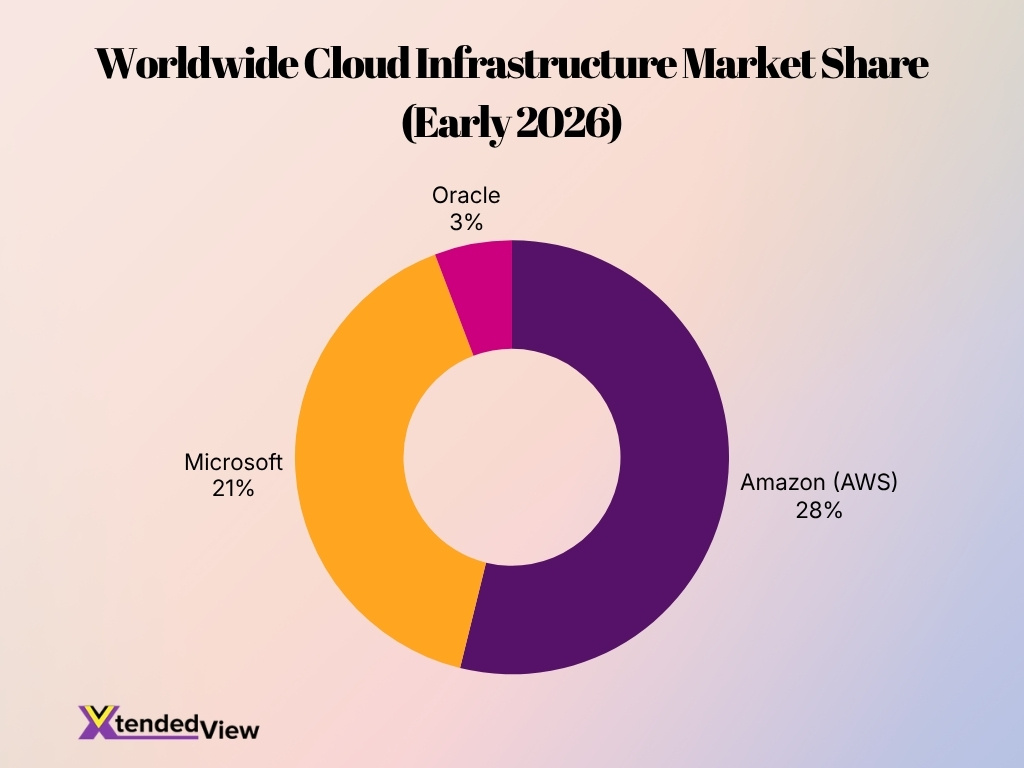
- Amazon held approximately 28% of the worldwide cloud infrastructure market in early 2026, compared to 21% for Microsoft and 3% for Oracle.
- The three largest providers collectively captured 63% of enterprise cloud infrastructure spending by early 2026.
- Global cloud infrastructure revenue reached $129 billion in Q1 2026, representing a massive 35% year-over-year growth.
- Oracle’s FY2026 cloud infrastructure growth rate of 77% substantially exceeded the overall cloud market average.
- Microsoft Azure revenue increased 43% in its latest 2026 fiscal quarter, while Oracle grew faster from a smaller base.
- A 2025 benchmark found AWS produced the shortest run times while OCI delivered the lowest costs across all processor families.
- AWS’s Arm instance ran up to 49% faster than its own tested Intel and AMD alternatives in recent benchmark tests.
- Oracle recorded $67.4 billion in FY2026 revenue, alongside a massive $638 billion contracted backlog.
Oracle Product Portfolio Statistics
- Oracle offered more than 200 AI and cloud services across public cloud, dedicated cloud, hybrid environments and customer data centers in 2026.
- Its core cloud applications portfolio covered at least five major business functions: finance, human resources, supply chain, sales and customer service.
- Oracle AI Database supported at least seven data types and processing models, including relational, vector, graph, JSON, spatial, text and columnar workloads.
- The distributed cloud portfolio offered four principal deployment models: public cloud, dedicated cloud, hybrid cloud and multicloud.
- Oracle AI Agent Studio combined three development approaches, no-code, low-code and pro-code, within one governed application framework.
- The 2026 builder environment supported at least five widely used developer tools and workflows, including Visual Studio Code, command-line interfaces, Git, Codex and Claude Code.
- Oracle’s cloud applications portfolio included four prominent enterprise suites highlighted across its regional infrastructure: Fusion Cloud ERP, NetSuite, Fusion Cloud HCM and Fusion Cloud Supply Chain Planning.
- Oracle Cloud HCM supported business requirements across more than 200 jurisdictions and provided product capabilities in 27 languages.
- Oracle’s cloud payroll product included localized functionality for 13 countries, helping multinational employers address local payroll rules.
- FY2026 software revenue reached $24.5 billion, showing that licensed and supported software remained a major part of Oracle’s portfolio despite rapid cloud growth.
Frequently Asked Questions (FAQs)
Oracle reported $67.4 billion in total revenue for FY2026, representing 17% year-over-year growth.
Oracle Cloud Infrastructure generated $18.1 billion in FY2026 revenue, growing 77% year over year.
Oracle’s total cloud revenue reached $34.0 billion in FY2026, an increase of 39% from the previous fiscal year.
Oracle ended FY2026 with $638 billion in remaining performance obligations, up 363% year over year.
Oracle reported GAAP earnings per share (EPS) of $5.83 and non-GAAP EPS of $7.63 for FY2026.
Conclusion
Oracle continued to strengthen its position in enterprise technology by accelerating cloud infrastructure growth, expanding AI capabilities and investing heavily in global data center capacity. The company’s growing cloud revenue, large contracted backlog and multicloud strategy demonstrate strong long-term demand from enterprise customers. At the same time, Oracle continued expanding its security, compliance and product portfolio to support organizations operating across regulated industries and global markets. While competition in cloud infrastructure remains intense, Oracle’s rapid AI-driven growth and enterprise database leadership position it as one of the industry’s most influential technology providers.
