



The retail sector is evolving rapidly, driven by changing consumer behavior, rising digital commerce, and shifting economic conditions. From global sales forecasts to the surge in mobile and AI‑powered shopping, new patterns are reshaping how products move from store to shopper. This evolution plays out in real ways, from big‑box stores closing doors and reallocating resources to online sales growth that outpaces inflation. These shifts affect industries such as grocery retail expansion and e‑commerce fulfillment networks, highlighting retail’s ongoing transformation. Read on to understand the key numbers and trends defining retail.
Editor’s Choice
- Global retail sales are projected to exceed $33.7 trillion in 2026.
- Global e‑commerce sales are expected to reach nearly $6.88 trillion by 2026.
- E‑commerce made up about 15.8–16.4% of total U.S. retail sales in Q3 2025.
- U.S. online shopping sales hit $901.09 billion in the first eight months of 2025.
- Holiday online spend topped $257.8 billion in 2025, up 6.8% YoY.
- Mobile devices accounted for 56.4% of online holiday sales in 2025.
- Significant global AI spending growth is expected to exceed $2 trillion in 2026.
Recent Developments
- Over 300 U.S. stores were slated to close in 2026, a continuation of retail contraction.
- More than 8,000 U.S. chain store closures occurred in 2025 amidst a broader downsizing trend.
- Visa reported a 7% YoY increase in U.S. payment volume, reflecting strong spending.
- American Express saw 10% growth in retail spending year over year.
- German grocer Aldi increased U.S. sales by 14% in 2025 and plans aggressive expansion.
- Amazon increased same‑day grocery orders by about 40% since early 2025, reflecting stronger rapid‑delivery demand rather than a 40‑fold jump.
- AI‑driven retail traffic rose sharply, with 693% YoY increase in AI‑related site visits during the holidays.
- Cyber Monday online sales reached $14.25 billion during the 2025 season.
Global Retail Sales Overview
- Total global retail sales are forecast at $33.7 trillion in 2026.
- Global e‑commerce revenue is expected at $6.88 trillion in 2026.
- E‑commerce’s share of all retail is projected to be around 21.5% worldwide.
- B2B e‑commerce markets could reach $36 trillion globally in 2026.
- Latin American e‑commerce is expected to surpass $215 billion in 2026.
- E‑commerce growth in Latin America is 1.5× faster than the global average.
- Mobile purchases represent 84% of e‑commerce transactions in Latin America.
- Cross‑border online retail expansion continues to diversify global retail channels.
Global Retail Market Growth Outlook
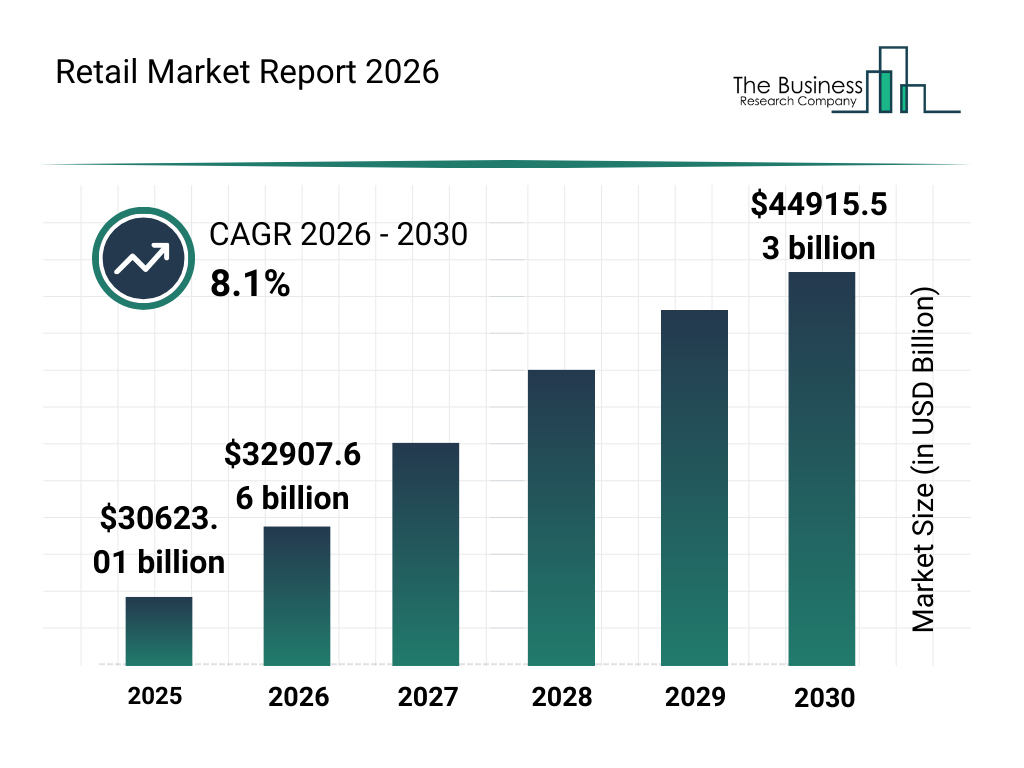
- The global retail market was valued at $30,623.01 billion in 2025, highlighting the scale of worldwide consumer spending.
- In 2026, the retail market size is projected to reach $32,907.6 billion, reflecting continued expansion across physical and digital channels.
- The retail industry is forecast to grow at a strong CAGR of 8.1% from 2026 to 2030, signaling sustained long-term momentum.
- Market size is expected to cross $35 trillion in 2027, supported by rising e-commerce penetration and mobile shopping adoption.
- By 2028, the global retail market is projected to surpass $38 trillion, driven by omnichannel strategies and digital payment growth.
- Retail sales are forecast to exceed $41 trillion in 2029, reflecting strong consumer demand and supply-chain digitization.
- The market is expected to reach $44,915.5 billion by 2030, marking a major milestone for the global retail sector.
- Between 2025 and 2030, the retail market is set to add over $14 trillion in absolute value, underscoring its economic significance.
- The projected growth trajectory highlights retail as one of the largest and fastest-expanding global industries through the end of the decade.
US Retail Sales Trends
- U.S. retail e‑commerce sales in Q3 2025 were $310.3 billion.
- E‑commerce grew 5.1% YoY in Q3 2025 vs. Q3 2024.
- E‑commerce share of total U.S. retail was 16.4% (seasonally adjusted).
- The first eight months of 2025 saw $901.09B in online sales.
- 2025 Q2 online sales up 5.28% YoY at $292.93B.
- U.S. holiday consumers spent $44.2B online over Thanksgiving weekend.
- The average U.S. holiday shopper spent $337.86 in 2025, up from 2024.
- In‑store holiday shopping increased 3% YoY in 2025.
E-commerce Sales Statistics
- Global online retail sales could hit $6.88T in 2026.
- WebandCrafts estimates $6.86T worldwide e‑commerce in 2025.
- U.S. e‑commerce accounted for about 15.5% of total retail in 2025.
- Mobile accounted for 56.4% of holiday online spend in 2025.
- Buy now, pay later (BNPL) contributed $20B during the 2025 holiday sales.
- Holiday online shopping traffic grew 2% YoY in 2025.
- Cyber Five retail web traffic rose 15.5% YoY.
- Black Friday online traffic increased 16% YoY in 2025.
Worldwide Retail Sales Growth Trends
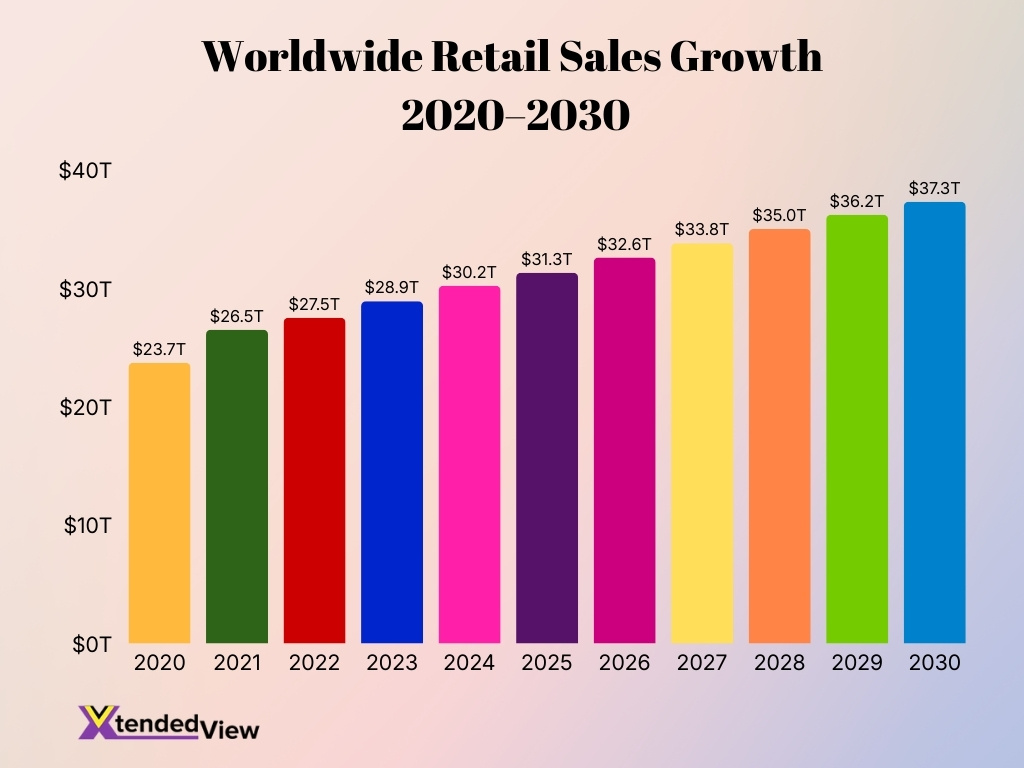
- Global retail sales reached $23.7 trillion in 2020, reflecting a pandemic-impacted baseline year for the retail industry.
- In 2021, worldwide retail sales rebounded sharply to $26.5 trillion, marking a strong post-pandemic recovery driven by pent-up consumer demand.
- Retail sales grew to $27.5 trillion in 2022, showing steady normalization across both physical and digital retail channels.
- By 2023, global retail sales hit $28.9 trillion, continuing a consistent upward trajectory despite inflationary pressures.
- Worldwide retail sales crossed $30.2 trillion in 2024, highlighting the expanding scale of global consumer spending.
- In 2025, retail sales are projected to reach $31.3 trillion, indicating sustained momentum in global retail markets.
- Global retail sales are expected to rise to $32.6 trillion in 2026, supported by population growth and rising disposable incomes.
- By 2027, worldwide retail sales are forecast at $33.8 trillion, reflecting long-term structural growth in retail consumption.
- Retail sales are projected to hit $35.0 trillion in 2028, reinforcing the resilience of the global retail sector.
- In 2029, global retail sales are estimated at $36.2 trillion, driven by emerging markets and digital commerce expansion.
- Worldwide retail sales are forecast to reach $37.3 trillion by 2030, representing a $13.6 trillion increase from 2020 levels.
In-Store Retail Statistics
- More than 8,000 U.S. stores closed in 2025.
- Over 300 stores were projected to close in 2026.
- Physical retail remains significant, with 129.5M U.S. shoppers visiting stores during the 2025 holiday weekend.
- In‑store holiday shopping posted 3% YoY growth.
- Department stores continue to downsize footprints in 2026.
- Some supermarkets are expanding; Aldi plans 180 new U.S. stores in 2026.
- Walmart’s online revenue jumped 27%, supporting its in‑store presence.
- Self‑checkout installations expected to exceed 1.2M globally by 2025.
Retail Consumer Behavior
- Globally, there are 4.96 billion retail consumers as of early 2026.
- Online shopping now involves an estimated 2.77 billion global consumers as of 2025.
- About 80.4% of U.S. consumers shop online, showing widespread digital adoption.
- In 2025, 58% of U.S. consumers shopped online weekly, pointing to habitual e‑commerce behavior.
- Around 86% of shoppers read reviews before making an online purchase, influencing buying decisions.
- 70% of consumers engage in value‑seeking behaviors like comparing prices or using loyalty rewards.
- U.S. holiday shoppers numbered 202.9 million in 2025, up from 197 million in 2024.
- Average holiday spending per U.S. consumer reached $337.86 in 2025, up from $315.56.
- Consumers are increasingly using AI tools to research and compare prices during peak shopping events.
- Retailers are adjusting assortments and pricing based on data‑driven insights into consumer missions and expectations.
Top Retailers by Revenue
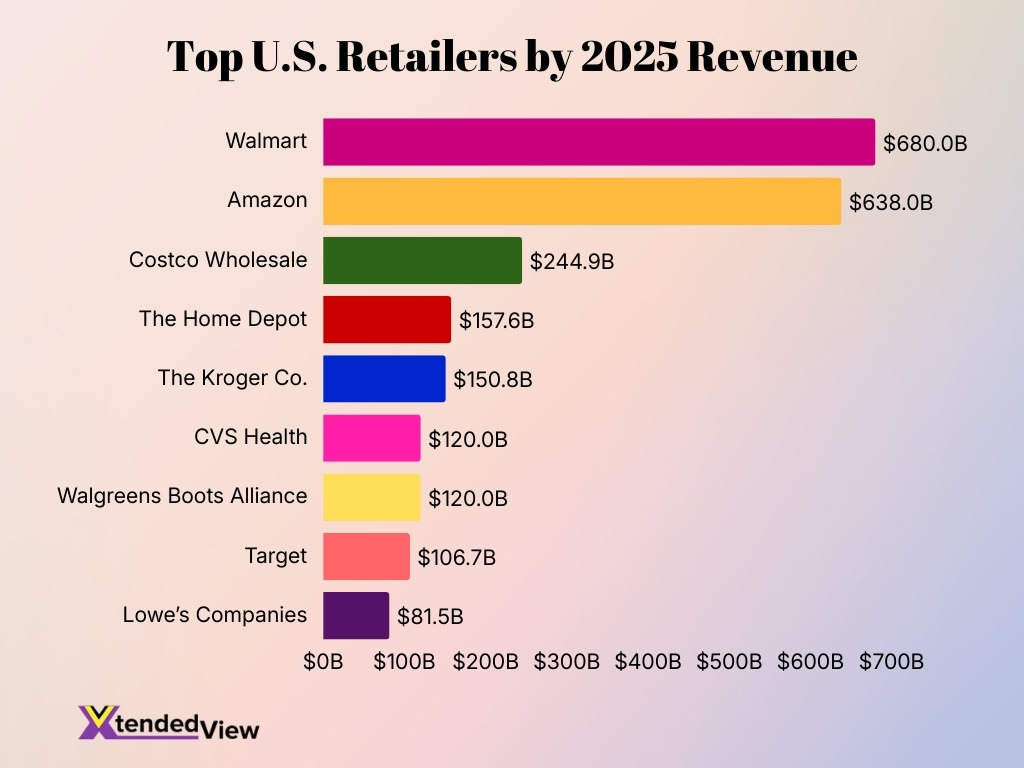
- Walmart remained the largest U.S. retailer by revenue in 2025, exceeding $680 billion.
- Amazon closely followed with approximately $638 billion in revenue.
- Costco Wholesale posted around $244.9 billion in global retail revenue.
- The Kroger Co. generated roughly $150.8 billion in sales.
- The Home Depot recorded about $157.6 billion in revenue.
- CVS Health and Walgreens Boots Alliance each reported sales above $120 billion.
- Target achieved approximately $106.7 billion in 2025 retail revenue.
- Lowe’s Companies contributed about $81.5 billion in sales.
- Retailers with diversified offerings, especially those blending online and offline channels, continue to outperform in revenue growth.
- Market cap rankings place Amazon and Walmart at the top globally in 2025.
Mobile Shopping Statistics
- Mobile devices now account for roughly 59% of global e‑commerce sales as of 2025.
- In the U.S., about 44% of online retail sales occurred via mobile in 2024.
- Around 75% of e‑commerce website traffic comes from mobile devices.
- Smartphone research influences at least 70% of in‑store purchases, per consumer behavior studies.
- Global mobile commerce was projected at ~$3.2 trillion in 2025, comprising 46% of online sales.
- Mobile shopping usage continues to rise with faster networks and app‑based checkouts boosting accessibility.
- Buy Now Pay Later (BNPL) options on mobile contributed $20 billion in holiday purchases.
- Strong mobile adoption is key in holiday events, with 56.4% mobile share of online transactions in 2025.
- AI‑driven mobile shopping tools saw 693% YoY growth in engagement during the 2025 holiday season.
- Mobile continues to shape retail strategy as a primary commerce channel for younger consumers.
Holiday Retail Sales
- U.S. holiday online sales hit a record $257.8 billion in 2025, up 6.8% from 2024.
- Cyber Monday sales reached $14.25 billion in 2025.
- Thanksgiving weekend online sales totaled $44.2 billion in 2025.
- 202.9 million consumers participated over the 2025 Cyber Week.
- In‑store holiday traffic grew 3% year‑over‑year in 2025.
- Sunday after Thanksgiving drew 32.6 million in‑store shoppers, a 27% increase vs. 2024.
- Saturday holiday shopping saw 62.7 million in‑store consumers in 2025.
- 38.7 million shopped online on Sunday after Thanksgiving, up from 32.8 million.
- Black Friday saw strong mobile momentum with $8.6 billion in early online sales in 2025.
- BNPL mobile transactions grew 11%, representing major holiday payment adoption.
Retailers’ Store Fulfillment Capabilities: Key Insights
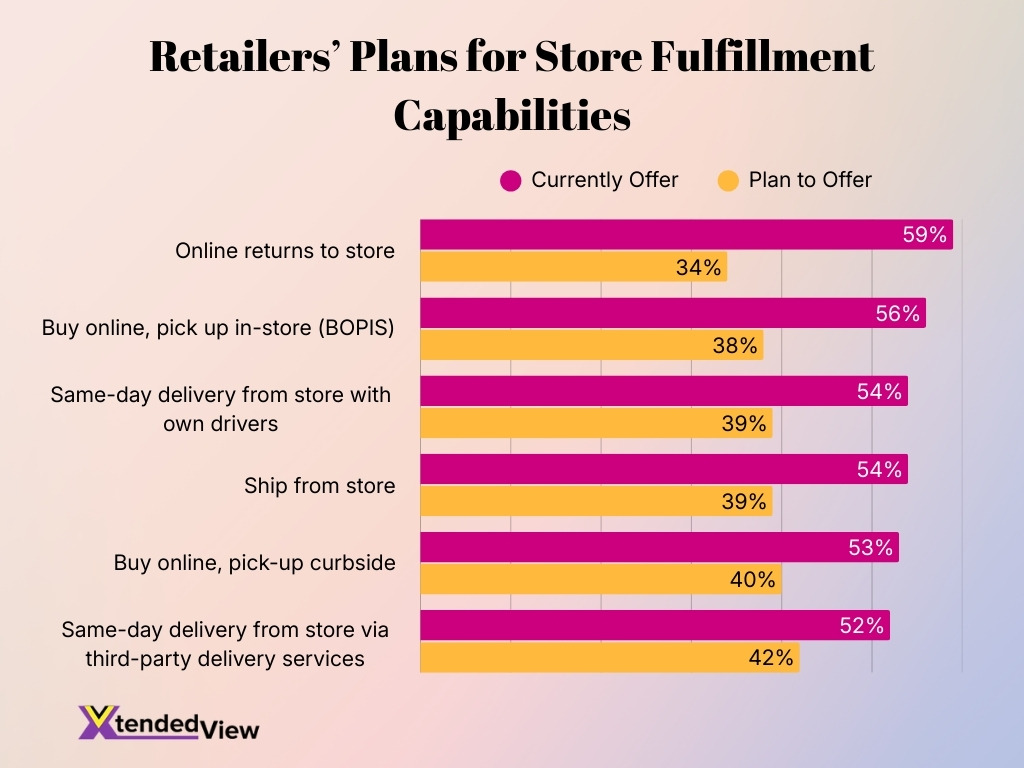
- Online returns to store are the most widely adopted capability, with 59% of retailers currently offering it, while an additional 34% plan to introduce this service.
- Buy online, pick up in-store (BOPIS) is already supported by 56% of retailers, and 38% more plan to roll it out, highlighting its importance in omnichannel retail strategies.
- Same-day delivery from store using own drivers is offered by 54% of retailers today, with 39% planning future adoption, signaling steady investment in in-house last-mile logistics.
- Ship-from-store capabilities are currently used by 54% of retailers, and another 39% intend to add this option, reinforcing stores’ roles as localized fulfillment hubs.
- Curbside pickup for online orders is available at 53% of retailers, while 40% plan to implement it, reflecting continued demand for fast, contactless pickup options.
- Same-day delivery via third-party services is currently offered by 52% of retailers, with the highest planned expansion rate at 42%, showing strong reliance on external delivery partners for speed and scale.
Number of Retail Stores
- The U.S. retail landscape includes more than 2.8 million retail establishments when non‑store and sole proprietorship outlets are counted.
- Physical store counts vary significantly by retailer, with chains like Dollar General planning 20,838+ locations in 2026.
- Department store closures continue, with Macy’s shutting 150 locations by 2026.
- Kroger planned to close 60 underperforming supermarkets in 2026.
- Retail contraction persisted with 4,100+ store and restaurant closures in 2025.
- UBS analysts project potential closures reaching 45,000 stores by 2029.
- Retailers like REI also announced multi‑location closures in urban markets.
- Amid closures, expansion continues in select segments like discount and convenience retail.
Retail Employment Stats
- Retail is one of the largest private‑sector employers in the U.S., supporting an estimated 16.2 million jobs (about 12.6% of nonfarm employment).
- Overall, retail sales workers’ employment is projected to decline by about 2% from 2022 to 2032, according to labor projections.
- In 2023, 3.1 million workers were employed as retail salespersons and cashiers, plus nearly 3 million first‑line supervisors.
- Seasonal hiring for the 2025 holiday period was the weakest since the Great Recession, with an estimated 265,000–365,000 new positions, down by up to 40% from 2024.
- Major retailers like Nike cut 775 U.S. jobs in 2026 as automation and operational efficiency reshape staffing.
- Walmart reports a very large workforce, more than 2.1 million global employees, though growth in headcount has lagged behind revenue gains.
- Walmart also plans AI‑focused employee training programs for 2.1 million workers to adapt skills for emerging tech roles.
- AI usage at work more broadly has risen, with 12% of U.S. workers using AI daily and roughly 25% using it weekly, though adoption in retail jobs remains uneven.
- Retail job contraction and transformation reflect broader labor market shifts toward automation, digital tools, and productivity‑driven staffing models.
Mobile Usage for In-Store Shopping Activities
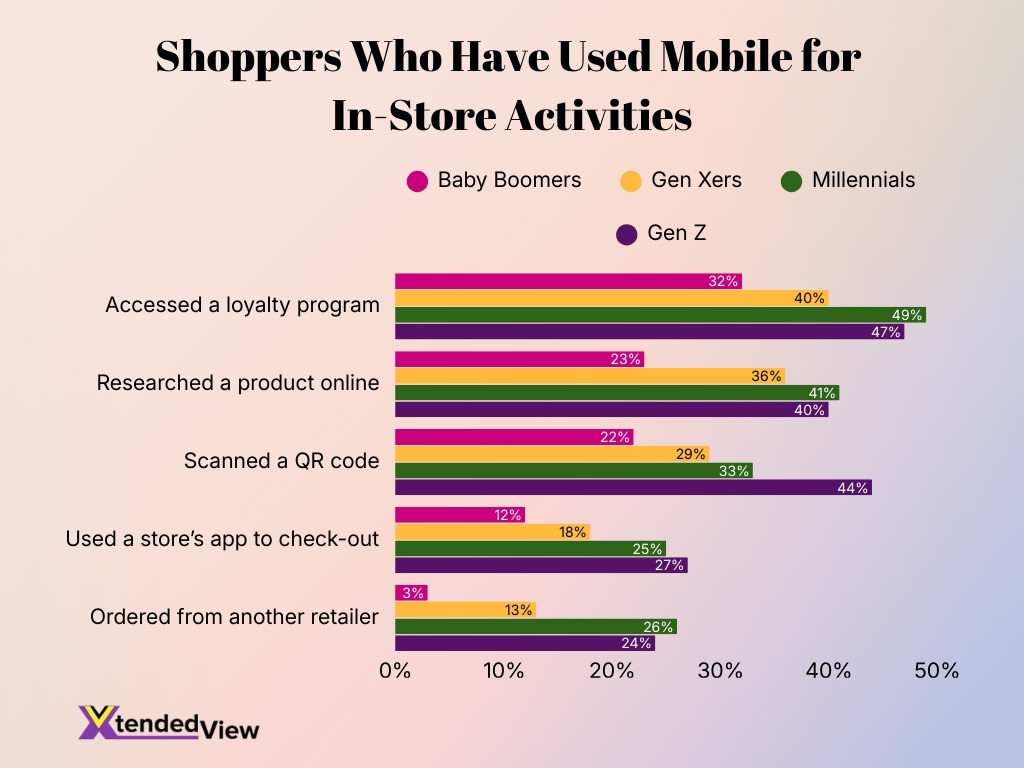
- 42% of shoppers use their mobile phones to access loyalty programs while inside a store, making this the most common in-store mobile activity overall.
- Millennials (49%) and Gen Z (47%) are the most active generations in accessing loyalty programs via mobile, compared to 32% of Baby Boomers.
- 35% of shoppers research a product online while shopping in-store, highlighting the growing role of mobile-assisted decision-making at the point of sale.
- Millennials (41%) and Gen Z (40%) lead in in-store product research, while usage drops to 23% among Baby Boomers.
- 32% of consumers have scanned a QR code in-store, signaling strong adoption of QR-enabled shopping experiences.
- Gen Z shows the highest QR code usage at 44%, significantly higher than 22% among Baby Boomers, reflecting a clear generational behavior gap.
- Only 20% of shoppers have used a store’s mobile app to check out, indicating that mobile checkout adoption remains relatively limited.
- Gen Z (27%) and Millennials (25%) are the most comfortable with app-based checkout, compared to just 12% of Baby Boomers.
- 17% of shoppers ordered from another retailer while inside a store, revealing how mobile access increases competitive price comparison.
- This behavior is most pronounced among Millennials (26%) and Gen Z (24%), while it is nearly absent among Baby Boomers (3%).
Brick‑and‑Mortar Trends
- U.S. brick-and-mortar sales reached $5.93 trillion in 2024, comprising 81.6% of total retail sales.
- Global brick-and-mortar sales totaled $24.2 trillion in 2024, up 3.63% year-over-year.
- 64% of consumers shop in brick-and-mortar stores weekly, highlighting ongoing reliance on physical retail.
- Retail foot traffic rose 0.4% year-over-year in 2024, outperforming 2023 levels amid economic pressures.
- 96% of grocery stores now offer self-checkout systems, with 10,000 global retailers adopting them by 2024.
- 86% of consumers use self-checkout, preferring it for speed, with 43% favoring it over traditional registers.
- 97.2 million Americans (34.2% of consumers) regularly use BOPIS, driving $154.3 billion in 2025 sales.
- 45% of consumers primarily shop in brick-and-mortar stores, with 62% buying groceries in-store.
Retailers Are Rapidly Adopting AI Across Core Business Functions
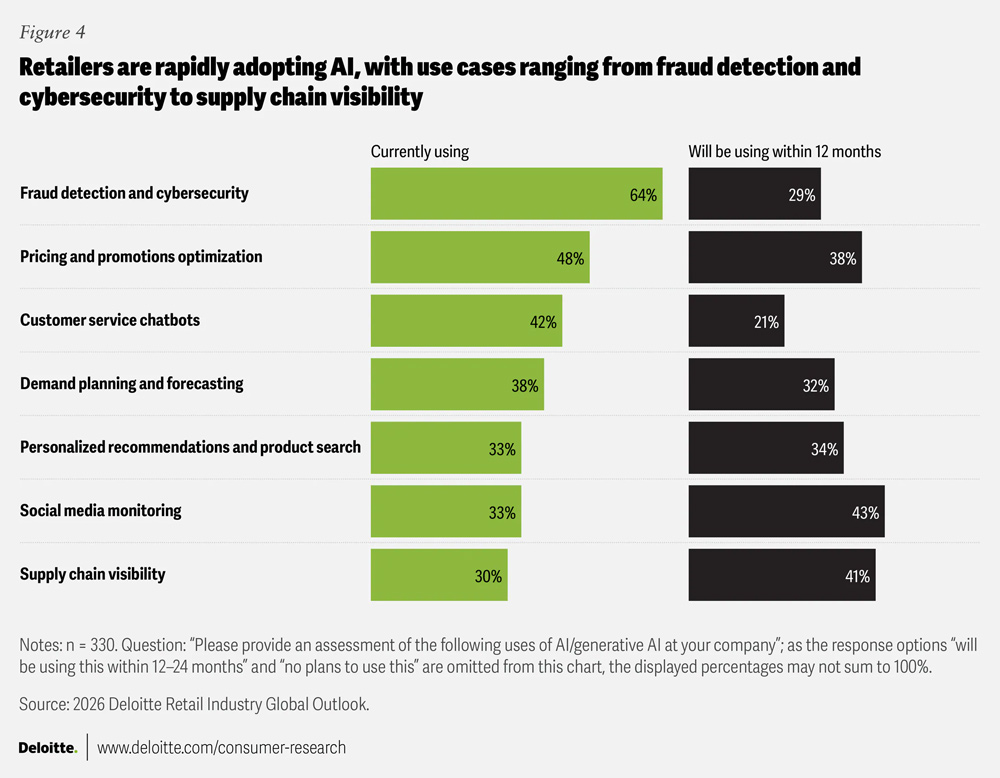
- Fraud detection and cybersecurity are the most mature AI use cases in retail, with 64% of retailers already using AI, while another 29% plan to adopt it within the next 12 months, highlighting security as a top priority.
- Pricing and promotions optimization ranks second, with 48% currently leveraging AI and an additional 38% expected to implement it within a year, reflecting strong demand for data-driven pricing strategies.
- Customer service chatbots are already in use by 42% of retailers, but only 21% plan near-term adoption, suggesting this segment is entering a more mature phase of AI deployment.
- Demand planning and forecasting show balanced adoption momentum, with 38% using AI today and 32% planning to adopt within 12 months, underscoring AI’s growing role in inventory and sales forecasting.
- Personalized recommendations and product search are used by 33% of retailers, while 34% expect to adopt these AI capabilities soon, indicating steady expansion in personalization-driven commerce.
- Social media monitoring demonstrates strong future growth, with 33% currently using AI and a higher 43% planning adoption within the next year, making it one of the fastest-growing AI use cases.
- Supply chain visibility has the lowest current adoption at 30%, but forward-looking interest is high, with 41% of retailers planning AI implementation within 12 months, signaling a major shift toward real-time supply chain intelligence.
Omnichannel Retail & Consumer Experience Metrics
- Omnichannel retail continues to strengthen, integrating online and in‑store touchpoints for seamless customer journeys.
- Retailers are linking digital data with physical experiences to optimize shopping paths and personalize engagement.
- Hybrid services like click‑and‑collect have grown, reflecting customers’ blended preferences.
- Unified customer profiles across channels increase conversion and loyalty.
- Mobile wallet integration and contactless checkouts enhance on‑site experiences.
- Real‑time point‑of‑sale analytics allow retailers to adjust offers and pricing dynamically.
- Digital receipts, virtual fitting, and AR‑assisted browsing are improving convenience.
- Customer experience metrics increasingly factor in speed, personalization, and ease of returns.
Retail Media & Advertising Spend
- US retail media spend reached $58.79 billion in 2025, rising to $69.33 billion in 2026.
- Global retail media networks market hit $30.02 billion in 2023, forecasted at $56.97 billion by 2030 with 10.5% CAGR.
- Retail media accounted for 10.7% of global ad spend in 2022, projected to surge 60% by 2027.
- Global digital retail media ad spend is estimated at $136 billion in 2024.
- US retail media expected to reach $60 billion in 2025, up 20% year-over-year.
- Global retail media projected to exceed $140 billion in 2025 with high double-digit growth.
- Global retail media networks are valued at $3.89 billion in 2024, growing to $16.86 billion by 2034 at 20.10% CAGR.
- AI-driven retail media boosts ad performance by 30%, cuts costs 25%, and lifts engagement 1.5x.
- Amazon captured 77% of US digital retail media ad spend in 2025.
- Display ads held 39% share of the retail media networks market in 2023.
Frequently Asked Questions (FAQs)
Retail sales in the United States increased by 0.6% month‑over‑month in November 2025.
E‑commerce retail sales accounted for about 16.4% of total U.S. retail sales in July 2025.
Latin America’s e‑commerce market is expected to reach approximately $215.31 billion in 2026.
Worldwide retail sales were projected to total about $31.3 trillion in 2025, up approximately 4% from 2024.
U.S. online holiday retail sales reached a record $257.8 billion in 2025, rising about 6.8% year‑over‑year.
Conclusion
The retail sector reflects a dynamic blend of digital acceleration and traditional commerce, shaped by evolving consumer expectations, technological innovation, and strategic adaptation. Mobile and omnichannel experiences have become baseline expectations, while AI and data‑driven strategies distinguish market leaders. Labor dynamics are shifting as automation and reskilling initiatives reshape employment landscapes.
Advertising and retail media investment keep growing, complementing broader market expansion. These data‑backed trends paint a picture of retail that is more interconnected, increasingly tech‑enabled, and deeply consumer‑centric, a landscape where agility and insight drive success.
