


Huawei has evolved from a telecom equipment provider into a global force in 5G, cloud computing, and consumer electronics. Today, its technologies power telecom networks, enterprise systems, and smart devices used by millions of people and organizations worldwide. From enabling high-speed connectivity for smart cities to supporting AI-driven automation in manufacturing and autonomous vehicles, Huawei plays a central role in modern digital infrastructure.
Despite facing geopolitical challenges and trade restrictions, the company continues to adapt by investing heavily in research, building its own ecosystem, and expanding into new industries like cloud services and smart mobility. These shifts highlight how Huawei balances resilience with innovation in a rapidly changing tech landscape. Let’s explore the data behind Huawei’s growth, innovation, and market position.
Editor’s Choice
- Huawei generated CNY 880.9 billion ($126–127 billion) in revenue in 2025, reflecting 2.2% growth year over year.
- The company recorded CNY 862.1 billion ($118 billion) revenue in 2024, marking a strong 22.4% growth from 2023.
- Huawei invested CNY 192.3 billion in R&D in 2025, representing 21.8% of total revenue.
- Over the last decade, Huawei’s cumulative R&D investment exceeded CNY 1.38 trillion.
- Huawei held approximately 165,000 active granted patents globally by the end of 2025.
- About 53.7% of Huawei’s workforce (114,000 employees) worked in R&D roles in 2025.
- Huawei’s HarmonyOS surpassed 1 billion active users in 2024, highlighting rapid ecosystem growth.
Recent Developments
- Huawei’s revenue growth slowed to 2.2% in 2025, compared to 22.4% growth in 2024, signaling market stabilization.
- The company reported net profit of around CNY 68 billion ($9.8 billion) in 2025, up 8.7% year over year.
- Huawei’s consumer business generated CNY 344.5 billion in 2025, growing only 1.6% YoY.
- Its ICT infrastructure segment grew 2.6% in 2025, reaching about CNY 375 billion.
- The intelligent automotive solutions unit surged 72% to CNY 45 billion in 2025.
- Huawei partnered with automakers to deliver 589,100 smart vehicles in 2025, a 32% increase.
- Over 36 million devices were powered by HarmonyOS by late 2025 in select deployments.
- Huawei regained the top smartphone vendor position in China in 2025 despite a shrinking market.
- The company continues to invest heavily in chip alternatives and AI computing to counter U.S. sanctions.
General Statistics and Huawei Company Overview
- Huawei was founded in 1987 and is headquartered in Shenzhen, China.
- The company operates in over 170 countries and regions worldwide.
- Huawei’s total assets reached approximately CNY 1.29 trillion ($176+ billion) in 2024.
- The company’s total equity stood at CNY 544.6 billion in 2024, reflecting strong reinvestment.
- Huawei’s liability ratio remained stable at 57.8% in 2024, indicating controlled financial leverage.
- The firm employs over 200,000 people globally, with a large share in technical roles.
- Huawei serves telecom operators, enterprises, and consumers across network infrastructure, cloud, devices, and AI.
- The company has transitioned toward self-reliance in chips and software due to global trade restrictions.
- Huawei remains a leading provider of 5G infrastructure globally, despite restrictions in several Western markets.
Revenue Statistics by Region for Huawei
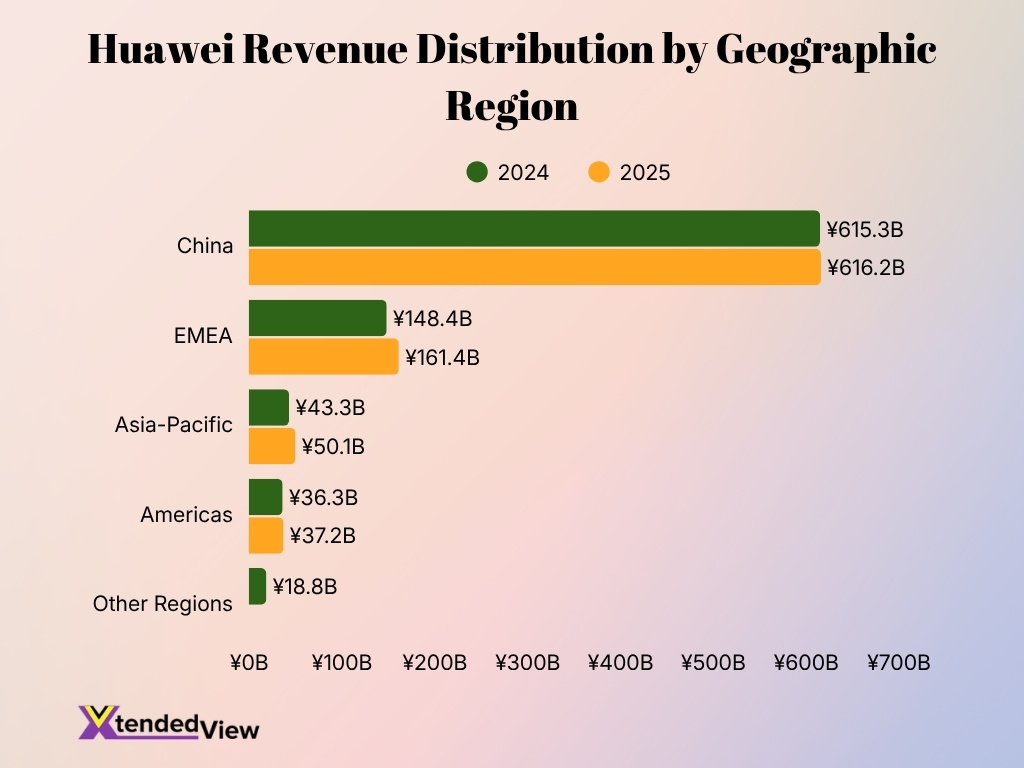
- China accounted for CNY 615.3 billion in revenue in 2024, representing 71.4% of total revenue.
- In 2025, China remained dominant with CNY 616.2 billion in revenue, showing stable growth.
- The EMEA region generated CNY 148.4 billion in 2024, the second-largest contributor.
- EMEA revenue increased to CNY 161.4 billion in 2025, reflecting 8.8% growth.
- Asia-Pacific revenue reached CNY 43.3 billion in 2024, with steady expansion.
- In 2025, Asia-Pacific revenue grew to CNY 50.1 billion, a 15.7% increase.
- The Americas contributed CNY 36.3 billion in 2024, despite ongoing restrictions.
- Americas’ revenue rose slightly to CNY 37.2 billion in 2025, a 2.4% increase.
- Other regions generated CNY 18.8 billion in 2024, showing diversification into emerging markets.
History and Huawei Milestone Statistics
- Huawei achieved a major milestone by becoming the world’s largest smartphone vendor in 2020.
- The company reported record revenue of over CNY 891 billion in 2020, its historical peak.
- Huawei shipped over 200 million smartphones in 2018, marking its peak device expansion phase.
- In 2019, Huawei was placed on the U.S. Entity List, restricting access to American technology.
- By 2022, Huawei experienced revenue declines due to sanctions but maintained strong R&D investment.
- In 2023–2024, Huawei staged a recovery with double-digit revenue growth driven by consumer devices.
- HarmonyOS was launched in 2019 as a response to Android restrictions.
- By 2024, HarmonyOS became the second-largest mobile OS in China, surpassing iOS.
- Huawei replaced a significant portion of foreign components with domestic alternatives by 2024.
Revenue and Profit Statistics of Huawei
- Huawei’s total revenue reached CNY 880.9 billion in 2025, up from CNY 862.1 billion in 2024.
- The company posted CNY 62.6 billion in net profit in 2024, despite heavy investments.
- Net profit increased to CNY 68 billion in 2025, reflecting recovery momentum.
- Huawei’s 2024 revenue grew 22.4% YoY, one of its fastest growth rates in recent years.
- Revenue growth slowed significantly in 2025 to 2.2%, indicating market maturity.
- Consumer business revenue rose to CNY 339 billion in 2024, up 38.3% YoY.
- ICT infrastructure remained the largest segment with CNY 369.9 billion revenue in 2024.
- Intelligent automotive revenue jumped from CNY 4.6 billion (2023) to CNY 26.3 billion (2024).
- Huawei’s cloud business generated over CNY 38.5 billion in 2024.
Revenue Statistics by Business Segment of Huawei
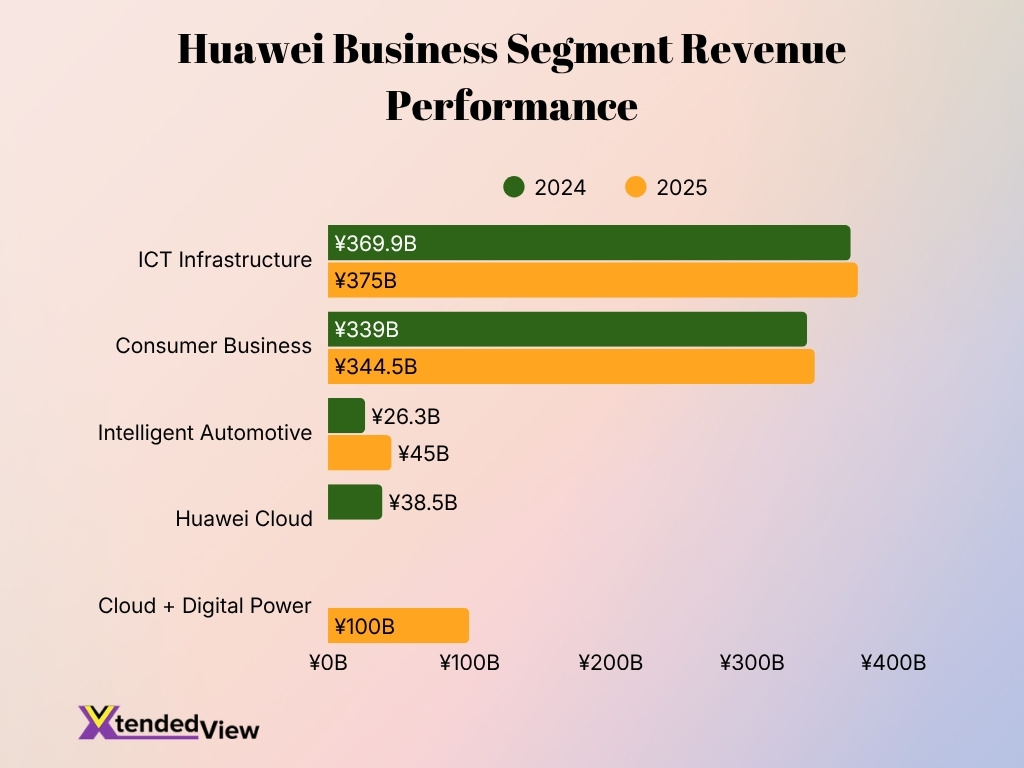
- Huawei’s ICT Infrastructure segment generated CNY 375 billion in 2025, maintaining its position as the largest contributor.
- The Consumer Business segment recorded CNY 344.5 billion in 2025, showing modest 1.6% YoY growth.
- Huawei Cloud and Digital Power combined contributed over CNY 100 billion in 2025, reflecting steady enterprise demand.
- The Intelligent Automotive Solutions segment surged to CNY 45 billion in 2025, up 72% YoY.
- In 2024, ICT Infrastructure revenue stood at CNY 369.9 billion, accounting for about 43% of total revenue.
- Consumer Business revenue grew to CNY 339 billion in 2024, driven by smartphone recovery.
- Huawei Cloud revenue exceeded CNY 38.5 billion in 2024, marking double-digit growth.
- Digital Power solutions contributed significantly to energy infrastructure projects, with revenue growth above 20% YoY in 2024.
- Automotive solutions revenue jumped from CNY 4.6 billion in 2023 to CNY 26.3 billion in 2024, highlighting rapid diversification.
Cloud Computing and Data Center Statistics of Huawei
- Huawei Cloud generated over CNY 38.5 billion ($5.3 billion) in revenue in 2024.
- The company operates data centers in more than 30 regions worldwide, supporting enterprise clients.
- Huawei Cloud serves over 3 million enterprise users globally.
- It ranks among the top 5 cloud providers in China, alongside Alibaba Cloud and Tencent Cloud.
- Huawei Cloud offers over 240 cloud services and 210 solutions, covering AI, big data, and security.
- In 2025, Huawei expanded its AI cloud capabilities with Ascend-powered computing infrastructure.
- The company’s cloud business grew at double-digit rates in 2024–2025, driven by enterprise adoption.
- Huawei supports government and public sector digital transformation projects across Asia and Africa.
- Its cloud ecosystem integrates with HarmonyOS and IoT platforms, enabling cross-device services.
Workforce and Employee Statistics at Huawei
- Huawei employed over 207,000 people globally in 2025, marking a 2% increase from the previous year.
- 53.7% of employees (114,000+) were dedicated to R&D roles in 2025, driving innovation in 5G and AI.
- The company hired 18,000+ fresh graduates annually in 2024-2025, focusing on engineering and AI talent.
- Huawei’s workforce spanned 170+ countries with 45% international employees, ensuring global diversity.
- Average employee age stood at 31 years in 2025, highlighting a youthful technical workforce.
- Huawei invested ¥10.3 billion ($1.4 billion) in employee training programs, including 2,000+ ICT academies worldwide.
- Partnerships with 2,600+ universities globally supported recruitment and joint research initiatives in 2025.
- 130,000+ employees participated in the shareholding program, holding 1.4% of company shares for performance alignment.
- Revenue per employee reached ¥1.79 million ($245,000) in 2025, up 18% from 2024.
- Employee retention rate was 92% in 2025, bolstered by competitive salaries averaging ¥500,000 annually.
Huawei Patent Filings by Country
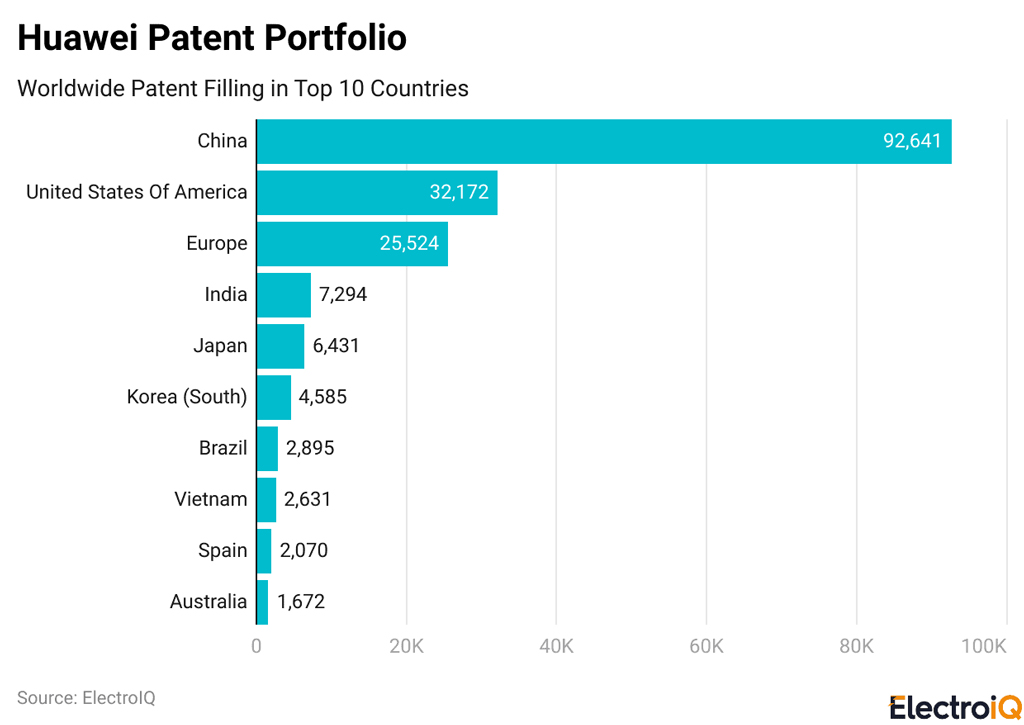
- China dominates Huawei’s patent portfolio with 92,641 filings, accounting for the vast majority of its global intellectual property footprint.
- The United States ranks second with 32,172 patents, showing Huawei’s strong presence despite regulatory challenges.
- Europe follows closely with 25,524 filings, highlighting its importance as a major innovation and market hub.
- India emerges as a growing market with 7,294 patents, indicating increasing strategic focus in the region.
- Japan contributes 6,431 patents, reflecting Huawei’s engagement in a mature and competitive tech ecosystem.
- South Korea records 4,585 filings, aligning with its strong semiconductor and telecom industry relevance.
- Among emerging markets, Brazil leads with 2,895 patents, followed by Vietnam (2,631), signaling expansion in developing economies.
- Spain accounts for 2,070 filings, reinforcing Huawei’s footprint in Southern Europe.
- Australia has the lowest count among the top 10 with 1,672 patents, yet it still represents a strategic presence.
- The data shows a heavy concentration in Asia and major global economies, emphasizing Huawei’s focus on high-growth and innovation-driven markets.
HarmonyOS and Operating System Statistics of Huawei
- HarmonyOS surpassed 900 million active users by June 2024, establishing itself as one of the fastest-growing mobile operating systems globally.
- HarmonyOS achieved a 17% market share in mainland China during Q2 2025, making it the second-largest mobile operating system in the country, ahead of iOS at 16%.
- By late 2025, HarmonyOS 5 and 6 combined reached 27 million device activations, with devices being added at a rate of 100,000 per day.
- 8 million developers have joined the HarmonyOS ecosystem since its launch in 2019, with over 10 million registered developers on the platform as of 2025.
- HarmonyOS ecosystem apps exceeded 30,000 applications, with over 9,000 apps deeply integrated with 70+ system-level innovative features.
- HarmonyOS PC shipments are projected to surge tenfold to 1.4 million units in 2026, compared to 141,000 units sold in 2025.
- HarmonyOS maintains a 4% global market share in smartphones while holding 17% of China’s smartphone market, reflecting strong regional adoption momentum.
- In 2025, HarmonyOS deployments exceeded 48 million connected devices across smartphones, tablets, IoT devices, and smart home applications.
- Huawei continues investing in HarmonyOS Next, a fully independent OS version without Android compatibility, with all 2025 devices transitioning to this native platform.
Smartphone Market Share Statistics of Huawei Globally
- Huawei’s global smartphone market share dropped below 5% in 2022–2023 due to sanctions.
- In 2024, Huawei’s global share rebounded slightly to around 8%, driven by domestic recovery.
- The company shipped approximately 35–40 million smartphones globally in 2024.
- Huawei’s flagship Mate series drove premium segment growth in China and limited global markets.
- Apple and Samsung continued to dominate globally with over 40% combined share, limiting Huawei’s expansion.
- Huawei’s global ranking improved to the top 5 smartphone vendors in 2024.
- The company focused on high-end devices and ecosystem integration rather than volume growth.
- Huawei’s comeback was fueled by its in-house Kirin chip revival in 2023–2024.
- Global shipments remained constrained due to limited access to advanced chip manufacturing.
Huawei Smartphone Market Share in China
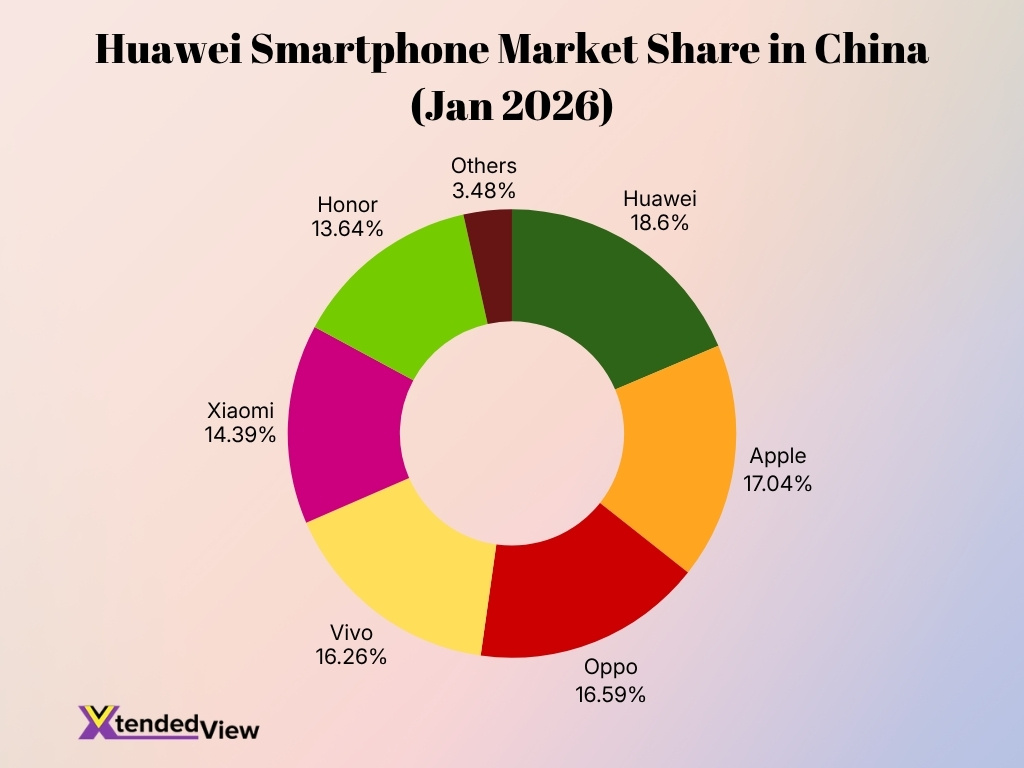
- Huawei leads the Chinese smartphone market with a 18.6% share, securing the #1 position among all brands.
- Huawei outperforms Apple by a margin of 1.56%, reinforcing its competitive edge in the premium segment.
- Huawei maintains a lead over Oppo (16.59%) and Vivo (16.26%), with a gap of around 2%, showing strong market control.
- Huawei’s market share is 4.21% higher than Xiaomi’s (14.39%), highlighting its dominance over mid-tier competitors.
- Despite leading, Huawei remains below the 20% threshold, indicating a highly competitive and balanced market structure.
- Huawei is a key driver of domestic dominance, as Chinese brands collectively hold over 79%+ of the total market share.
- The close competition between Huawei and other top brands (within ~2–3%) shows that market leadership is strong but not absolute.
- Huawei’s leadership position reflects its resurgence and strong brand loyalty in China.
AppGallery and Ecosystem Statistics of Huawei
- Huawei’s AppGallery had over 580 million monthly active users globally in 2025.
- The platform hosts more than 2.3 million apps, covering mobile, IoT, and enterprise use cases.
- AppGallery ranked among the top 3 app marketplaces globally by user base.
- Huawei reported over 6 million registered developers worldwide contributing to its ecosystem.
- In 2024, AppGallery app distribution reached 432 billion downloads annually.
- The HMS ecosystem supports over 200,000 integrated apps globally.
- Huawei invested heavily in developer incentives and revenue-sharing programs, especially in Asia and Europe.
- AppGallery usage grew rapidly in emerging markets, particularly in Latin America and Southeast Asia.
- Huawei expanded its ecosystem to include payments, cloud storage, maps, and AI services, strengthening user retention.
5G, Base Station, and Network Infrastructure Statistics of Huawei
- Huawei remains one of the top global suppliers of 5G infrastructure, competing with Ericsson and Nokia.
- The company has deployed over 3.5 million 5G base stations worldwide as of 2025.
- Huawei supports more than 300 commercial 5G networks globally.
- In China alone, Huawei contributed to building over 60% of the country’s 5G base stations.
- Huawei’s 5G contracts span 170+ countries, despite restrictions in the U.S. and parts of Europe.
- The company leads in 5G standard-essential patents, giving it a strong licensing advantage.
- Huawei is actively investing in 6G research, with pilot testing expected before 2030.
- Its telecom equipment revenue remained stable at over CNY 370 billion annually, showing resilience.
- Huawei’s network solutions power industries like smart cities, healthcare, and manufacturing automation.
5G Development Leadership by Company
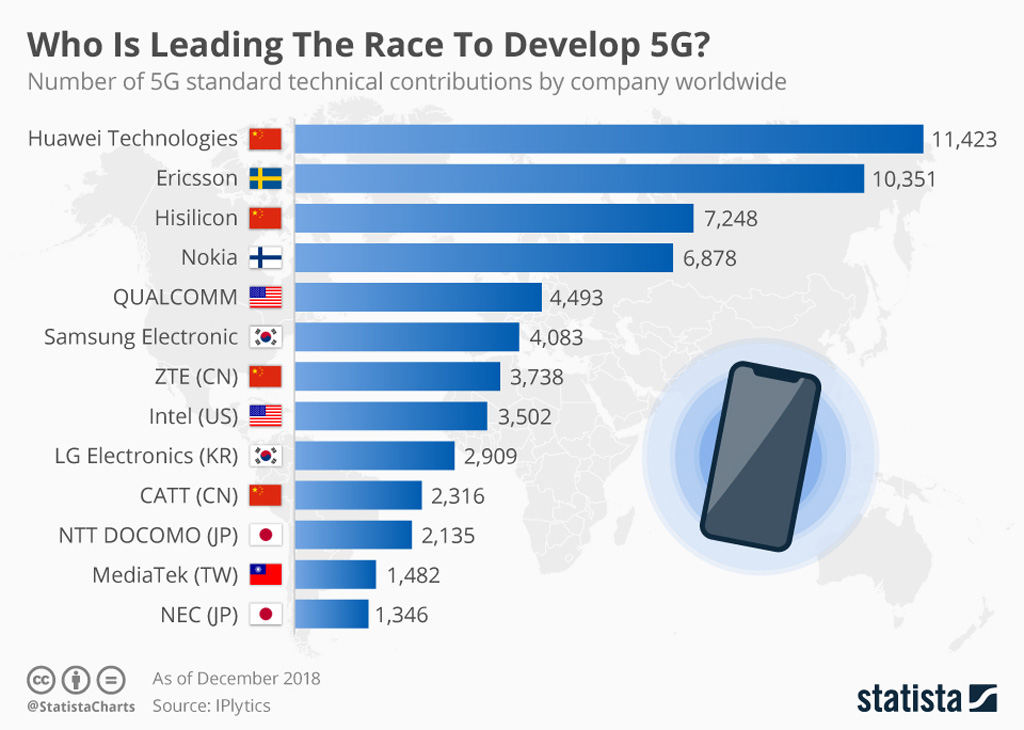
- Huawei Technologies dominates the 5G race with 11,423 technical contributions, making it the clear global leader by a significant margin.
- Ericsson ranks second with 10,351 contributions, staying highly competitive but still trailing Huawei by over 1,000 contributions.
- Hisilicon secures third place with 7,248 contributions, reinforcing China’s strong presence in 5G innovation.
- Nokia follows closely at 6,878 contributions, maintaining a solid position among top European telecom players.
- QUALCOMM leads among U.S. firms with 4,493 contributions, highlighting its critical role in chipset and wireless technology development.
- Samsung Electronics contributes 4,083, making it a key Asian player in both infrastructure and device-level 5G advancements.
- ZTE records 3,738 contributions, further strengthening China’s dominance with multiple companies in the top tier.
- Intel contributes 3,502, showing its involvement in 5G despite not being a primary telecom infrastructure provider.
- LG Electronics reaches 2,909 contributions, reflecting moderate participation compared to other Korean competitors like Samsung.
- CATT (China Academy of Telecommunications Technology) contributes 2,316, emphasizing institutional support behind China’s 5G push.
- NTT DOCOMO posts 2,135 contributions, representing Japan’s telecom innovation efforts in the global 5G ecosystem.
- MediaTek contributes 1,482, showcasing its growing influence in mobile chipsets and connectivity solutions.
- NEC records the lowest among listed players with 1,346 contributions, yet remains part of the global 5G development landscape.
Digital Power and Green Energy Statistics of Huawei
- Huawei Digital Power serves customers in 170+ countries, focusing on renewable energy solutions.
- The company delivered over 400 GW of digital power products globally by 2025.
- Huawei’s solar inverter shipments ranked No.1 globally for multiple years.
- Its solutions helped customers reduce over 600 million tons of CO₂ emissions annually.
- Huawei deployed smart PV systems in more than 160 countries, accelerating clean energy adoption.
- The company integrates AI-driven energy management systems for efficient power distribution.
- Digital Power revenue saw 20%+ growth in 2024, driven by global demand for green energy.
- Huawei supports EV infrastructure with charging network solutions and energy storage systems.
- Its energy solutions are widely used in data centers, telecom networks, and industrial applications.
Automotive and Smart Mobility Statistics of Huawei
- Huawei’s Intelligent Automotive Solutions revenue reached CNY 45 billion in 2025, up 72.1% YoY from CNY 26.16 billion.
- HIMA business delivered 589,107 vehicles in 2025, representing a 32% YoY increase from 2024 deliveries.
- Huawei holds 6.4% market share in smart cockpit domain controller installations with 620,220 units shipped in China during 2025.
- Huawei Technologies captured 7.1% market share as the second-largest cockpit domain controller chip supplier after Qualcomm’s 72.7% in 2025.
- HarmonyOS cockpit AR-HUD systems achieved 21.2% market share in China with 341,077 units installed, ranking second among all suppliers in 2025.
- HIMA reached 1 million cumulative vehicle deliveries in just 43 months, the fastest pace among Chinese EV startups as of October 2025.
- December 2025 HIMA deliveries hit 89,611 units, marking an 81.13% YoY increase and the third consecutive month of record monthly sales.
- HIMA’s average transaction price stands at CNY 390,000 ($55,200), ranking first among Chinese brands with monthly sales exceeding 10,000 units.
- Huawei collaborated with five automaker brands under HIMA, including partnerships with Seres (Aito) and Chery for intelligent vehicle platforms.
Huawei R&D Investment Trends
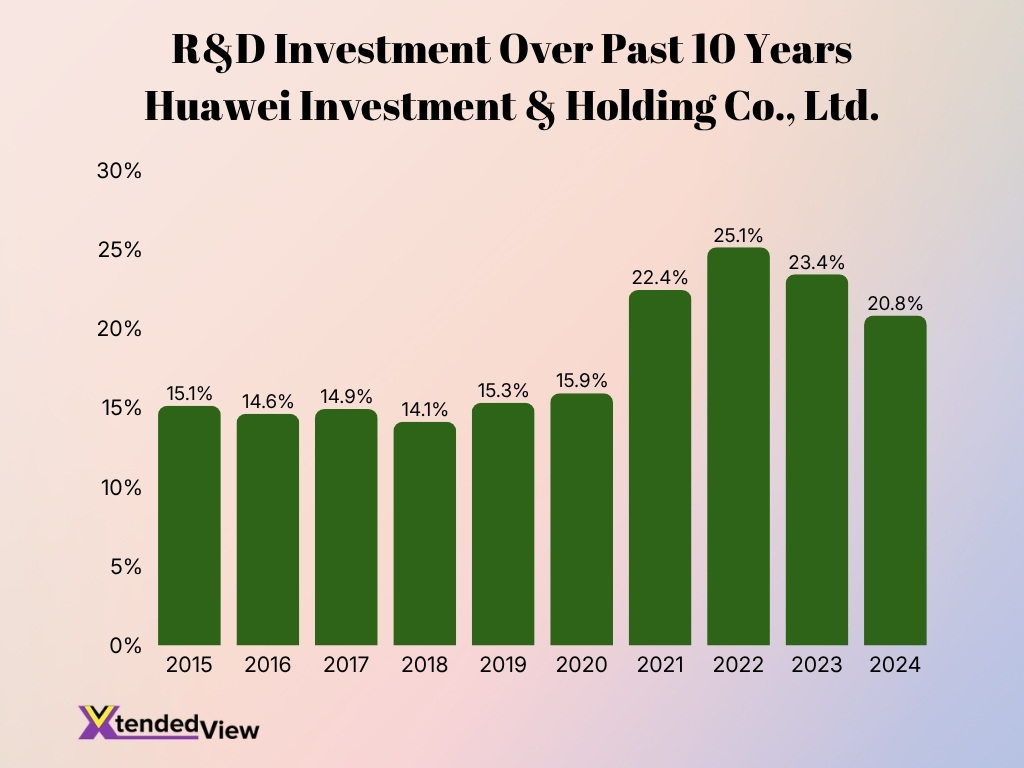
- Huawei maintained a consistently strong R&D investment ratio, staying above 14% of revenue throughout 2015–2020, showing a long-term commitment to innovation.
- The R&D spending ratio reached its lowest point at 14.1% in 2018, indicating a temporary dip before a strong upward trajectory.
- From 2019 (15.3%) to 2020 (15.9%), Huawei showed steady growth, signaling increased focus on research amid rising global competition.
- A major surge occurred in 2021, where R&D investment jumped to 22.4%, marking a significant strategic shift toward innovation and technology development.
- Huawei recorded its highest-ever R&D investment at 25.1% in 2022, highlighting peak commitment to advanced technologies like 5G, AI, and cloud computing.
- Although slightly declining, R&D spending remained elevated at 23.4% in 2023, reflecting continued aggressive investment despite external pressures.
- In 2024, the ratio dropped to 20.8%, but still represents a historically high level compared to pre-2021 figures.
- Over the past 10 years, Huawei transitioned from mid-teen R&D intensity (~14–15%) to over 20%, indicating a structural shift toward innovation-driven growth.
- The overall trend highlights Huawei’s positioning as a technology-first company, with R&D as a core competitive advantage.
- The sharp increase post-2020 aligns with global tech race dynamics and Huawei’s push for self-reliance in key technologies.
Sanctions and Trade Restrictions Impact Statistics on Huawei
- Huawei’s global smartphone market share fell from 17% in Q1 2019 to below 5% by 2022 following U.S. Entity List placement.
- Smartphone shipments declined over 40% cumulatively between 2020 and 2022 due to chip shortages from sanctions.
- Loss of Google Mobile Services led to consumer business revenue dropping nearly 50% from 2020 to 2021.
- Annual revenue remained resilient above CNY 850 billion, reaching CNY 880.9 billion in 2025 despite restrictions.
- R&D spending surged to 21.8% of revenue in 2025, totaling CNY 192.3 billion for self-reliance in chips and OS.
- HarmonyOS user base exceeded 27 million by late 2025, with 17% share of China’s smartphone OS market in Q2.
- Kirin chips like 9030 enabled the Mate 80 series, reducing foreign supplier dependence post-sanctions.
- China’s smartphone market share hit 16.4-17% in 2025, regaining top vendor spot with 46.7-46.8 million shipments.
- Network infrastructure revenue dipped 7% in 2021 from Western market bans, but stabilized with domestic support.
Frequently Asked Questions (FAQs)
Huawei reported total revenue of CNY 880.9 billion ($126–127 billion) in 2025, reflecting 2.2% year-over-year growth.
Huawei invested CNY 192.3 billion ($27.5 billion) in R&D in 2025, accounting for 21.8% of its total revenue.
Approximately 53.7% of Huawei’s workforce (around 114,000 employees) were engaged in R&D activities in 2025.
Huawei held about 165,000 active granted patents worldwide as of the end of 2025.
Huawei held roughly 18% to 19% smartphone market share in China in 2025, making it the top smartphone vendor in the country.
Conclusion
Huawei’s data tells a clear story of resilience and strategic transformation. While sanctions disrupted its global smartphone dominance, the company pivoted toward enterprise solutions, cloud computing, and automotive technologies. At the same time, heavy investments in R&D and a growing ecosystem around HarmonyOS continue to strengthen its long-term position.
Looking ahead, Huawei’s influence will likely expand in 5G infrastructure, AI computing, and green energy systems. As industries across the U.S. and globally adopt connected technologies, Huawei’s innovations will remain central to shaping next-generation digital infrastructure.
