

Cell phones now sit at the center of both personal communication and everyday work. Employees use smartphones to answer email, review documents, communicate with teams, and handle approvals, while the same devices provide instant access to social media, messaging, and entertainment. With 91% of U.S. adults owning a smartphone in the latest data and employees increasingly completing work from mobile devices, smartphones have become an integral part of modern workplaces. At the same time, personal scrolling, notifications, and after-hours communication can interrupt focused work and weaken work-life boundaries.
Editor’s Choice
- 91% of U.S. adults owned a smartphone in 2025, unchanged from 2024 and up sharply from 35% when comparable tracking began in 2011.
- The average American respondent spent 3 hours and 6 minutes of the workday on non-work phone activities in a survey of more than 3,400 people.
- Gen Z respondents in that survey reported 234 minutes per workday of personal phone use, compared with 214 minutes for millennials, 146 minutes for Gen X, and 77 minutes for baby boomers.
- A 2026 U.S. employee survey found that workers averaged 158 minutes per week doing work from mobile devices among Gen Z, compared with 194 minutes among older generations.
- 56% of surveyed employees said work-related mobile notifications blurred the boundary between their professional and personal lives.
- In 2024 workplace research, 76% of workers said they used a personal device for work-related tasks, and 53% did so at least daily.
- In 2025 U.S. workplace research, 85% of workers said they received work emails, calls, or messages outside normal working hours; 36% of that group received them at least daily.
- A 2025 survey of 500 full-time workers found 86% relied on mobile apps for work, further showing how smartphones have shifted from optional accessories to everyday work tools for many employees.
Recent Developments
- A 2026 study found that U.S. employees spent about 8% of the workweek working from mobile devices, translating to nearly 21 business days per year.
- 51% of surveyed employees said mobile-device work improved their work-life balance, suggesting phones can provide flexibility when employees control how and when they use them.
- However, 56% said work notifications blurred personal and professional boundaries, highlighting the trade-off that comes with greater mobile accessibility.
- 62% of respondents said small mobile screens made work more difficult, while 42% cited limited software functionality as a mobile-work problem.
- In 2026, 46% of surveyed employees reported reviewing work documents on mobile devices, while 27% had electronically signed contracts from their phones.
- Recent experimental research found that increasing the physical distance between workers and their smartphones reduced smartphone use, although it did not eliminate overall digital distraction because workers could shift attention to computers instead.
- A 2024 natural quasi-experiment involving 82 employees found that 48% used smartphones at work at least some days after their employer removed a ban, while 52% still reported never using them at work.
- Importantly, that experiment found that removing the personal-smartphone ban reduced work-life conflict among users without producing a significant change in work performance, suggesting that phone-policy effects can extend beyond productivity alone.
- In a 2025 survey of 3,573 full-time U.S. workers, 55% said long hours and an “always-on” culture were normal at their companies, while 35% had taken a work call during a vacation.
Cell Phone Use at Work Statistics
- A survey of more than 3,400 Americans found respondents estimated 186 minutes of non-work phone activity per workday.
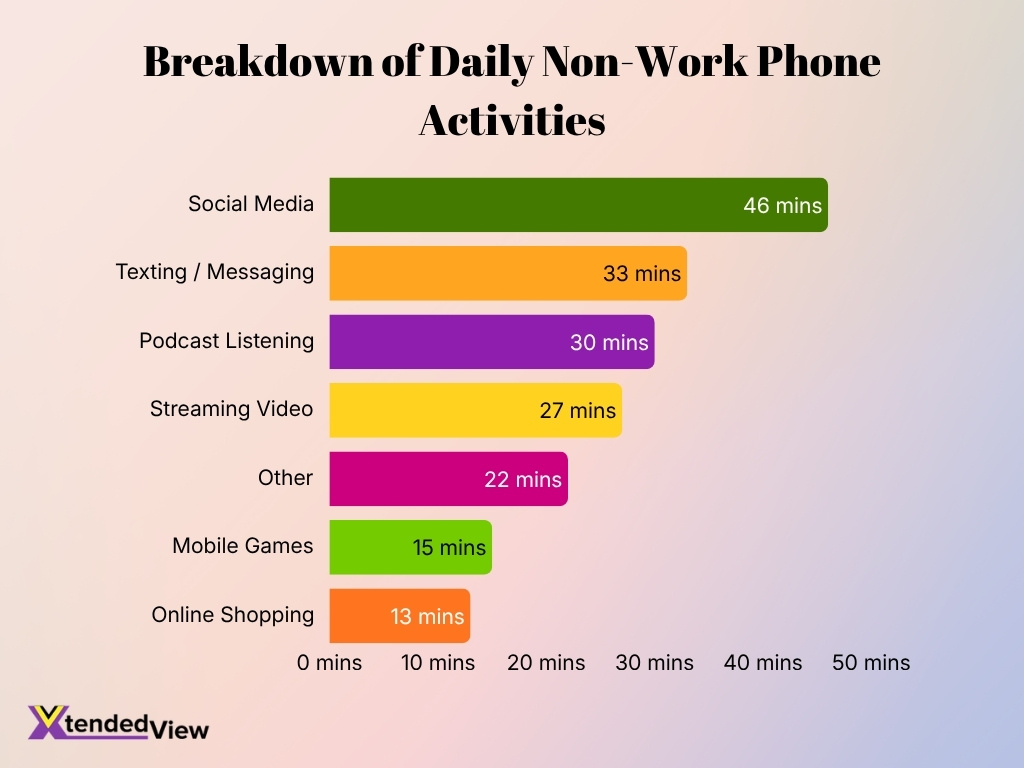
- Of that daily total, employees reported spending an average of 46 minutes on social media, making it the largest individual category measured in the survey.
- Workers also reported 33 minutes per workday texting or messaging for non-work purposes.
- Podcast listening accounted for another 30 minutes per workday, according to the same research.
- Employees estimated spending 27 minutes streaming video and 15 minutes playing mobile games during the workday.
- Online shopping accounted for 13 minutes per workday, while other non-work activities accounted for another 22 minutes.
- Phone use varied substantially by location. Respondents in Texas averaged 4 hours and 40 minutes of personal phone activity during work, compared with 2 hours and 6 minutes in Wisconsin.
- Work use remains substantial, too. 61% of employees in a 2026 U.S. survey said they had worked from a mobile device while physically at the office.
- Outside the office, 49% worked from mobile during lunch, 36% while traveling for work, and 30% during their commute.
- Convenience and necessity each motivated 64% of surveyed mobile workers to use their devices for work, while 46% cited flexibility and 41% cited productivity.
Employee Cell Phone Usage Statistics
- In 2024 research, 76% of workers used personal devices for work-related tasks, making employee-owned technology a major part of workplace computing.
- 53% of workers used personal devices for work at least once a day, showing that BYOD behavior often forms part of employees’ daily routines rather than occasional remote work.
- At the same time, 69% of workers received a laptop, phone, or another device from their employer.
- Among employees with employer-provided devices, 39% used them for personal or non-work activities, illustrating how work and personal device use can flow in both directions.
- A 2026 survey found 56% of employees had sent an email from their phone with an automated “sent from my…” signature.
- Directors were 66% more likely than entry-level employees to have used such a mobile email signature, indicating that seniority can influence mobile work behavior.
- Gen Z employees reported 158 minutes of mobile work per week, about 23% less than the 194 minutes recorded among older workers.
- 38% of Gen Z employees reported working from their phones during commutes, making them 15% more likely than millennials to do so.
- Remote employees were twice as likely as on-site employees to work from their phones while completing personal errands.
- In a 2024 workplace experiment, 39 of 82 employees, or 48%, used their smartphones at work at least some days after their employer lifted its previous phone ban.
Time Spent on Cell Phones During Work Hours
- U.S. respondents estimated an average of 186 minutes, or 3 hours and 6 minutes, of non-work phone activity during a workday in research based on more than 3,400 people surveyed in December 2024.
- Gen Z recorded the highest level at 234 minutes per workday, equivalent to 3 hours and 54 minutes.
- Millennials averaged 214 minutes per day, calculated from the reported 20-minute gap between millennials and Gen Z.
- Gen X respondents averaged 146 minutes, while baby boomers averaged 77 minutes, a difference of more than 2.5 hours between Gen Z and baby boomers.
- Workers under lenient workplace phone policies reported 202 minutes of daily personal phone use, compared with 163 minutes where policies were described as moderate.
- Surprisingly, respondents under strict policies still reported 183 minutes per day, 20 minutes more than workers under moderate policies. The survey establishes an association, not proof that stricter rules caused higher use.
- Social media represented 46 of the 186 daily minutes, or roughly one-quarter of the reported non-work phone time.
- Messaging, podcasts and video streaming together accounted for 90 minutes per workday, based on reported averages of 33, 30 and 27 minutes, respectively.
- Work-related mobile use tells a different story: a 2026 U.S. survey found employees spent an average of about 8% of their workweek working from mobile devices, equivalent to nearly 21 business days across a year.
- Among those employees, Gen Z averaged 158 minutes of work-related mobile use per week, while older generations averaged 194 minutes, showing that high personal phone use among younger workers does not necessarily translate into more work-related mobile time.
Smartphone Checking Frequency at Work
- In a 2024 survey of more than 1,000 workers in Britain, 60% said they could not go an entire workday without checking their phones.
- Conversely, 39% believed they could complete a full workday without checking their phones, showing a sizable minority felt able to stay away from their devices.
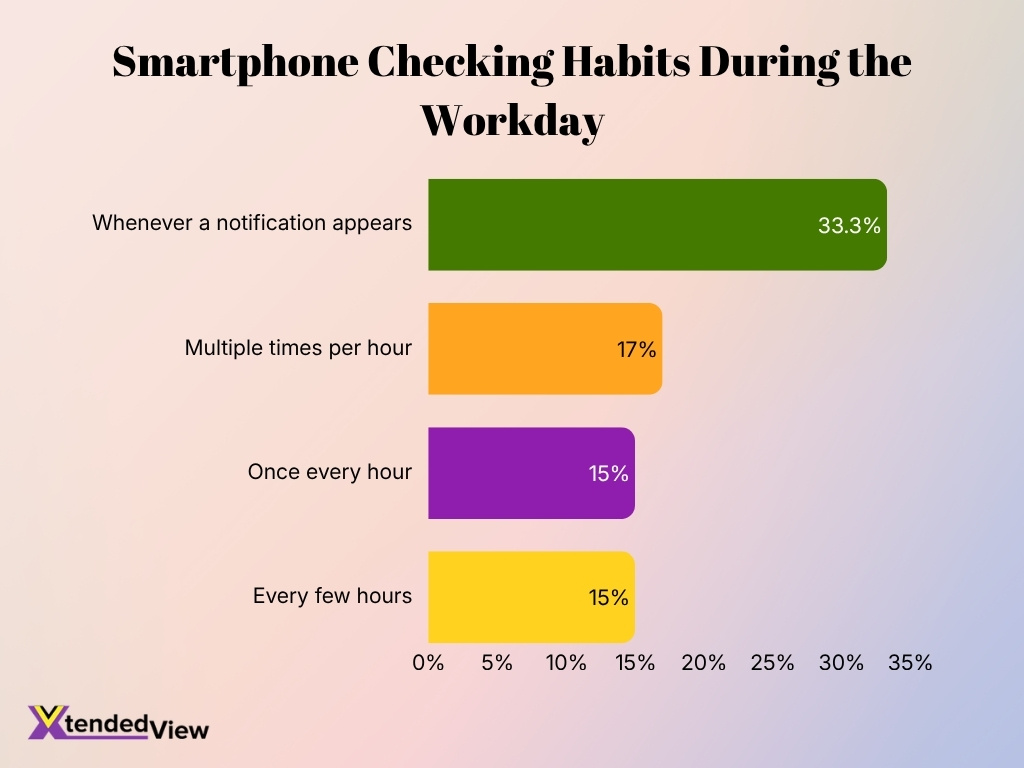
- One-third of workers in the same research, 33.33%, said they checked their phones whenever a notification appeared.
- Another 17% checked their phones multiple times per hour, creating repeated opportunities for task switching during the workday.
- 15% checked once every hour, while another 15% reported checking their phones every few hours.
- Earlier deskless-worker research found 47% checked their phones one to two times per hour during work.
- Another 17% of deskless workers reported checking their phones four to five times per hour, while 11% described their checking as ongoing.
- Workplace notifications extend beyond phones alone: a 2024 survey found 31% of employees were distracted by a digital notification every 15 minutes, equivalent to roughly 160 interruptions in a typical week.
- In that study, 77% of employees said notifications from workplace digital tools distracted them, demonstrating that the attention problem includes both personal phones and employer communication systems.
- The checking cycle can also continue after employees clock out: in 2025, 85% of U.S. workers said they received work emails, calls or messages after hours.
Personal vs. Work-Related Cell Phone Use
- 76% of workers in a 2024 workplace survey said they used a personal device for work-related tasks. More than half, 53%, did so at least daily.
- Meanwhile, 69% of workers said their employer assigned them a laptop, computer, mobile phone or another device for work.
- Among employees who received a work device, 39% used it for personal or non-work activities, showing that personal and professional use can flow in both directions.
- In 2026 research covering 1,000 full-time U.S. employees, 75% used mobile phones to send work emails, making email the most common mobile work activity measured.
- The same 2026 research found the average surveyed U.S. employee accumulated nearly 21 full business days per year of work performed from a mobile phone.
- In a 2025 survey of 500 full-time employees, 86% relied on mobile apps for work, particularly for communication and collaboration.
- Mobile work regularly extends into personal time: 89% of employees in that 2025 survey said they checked work apps after hours.
- In addition, 66% completed work tasks outside regular working hours, highlighting how mobile access can make the end of the formal workday less distinct.
- Another 2025 workplace study found chats sent outside the standard 9-to-5 period had increased 15% year over year, with an average of 58 messages per user arriving before or after regular hours.
Social Media and Personal Messaging Use at Work
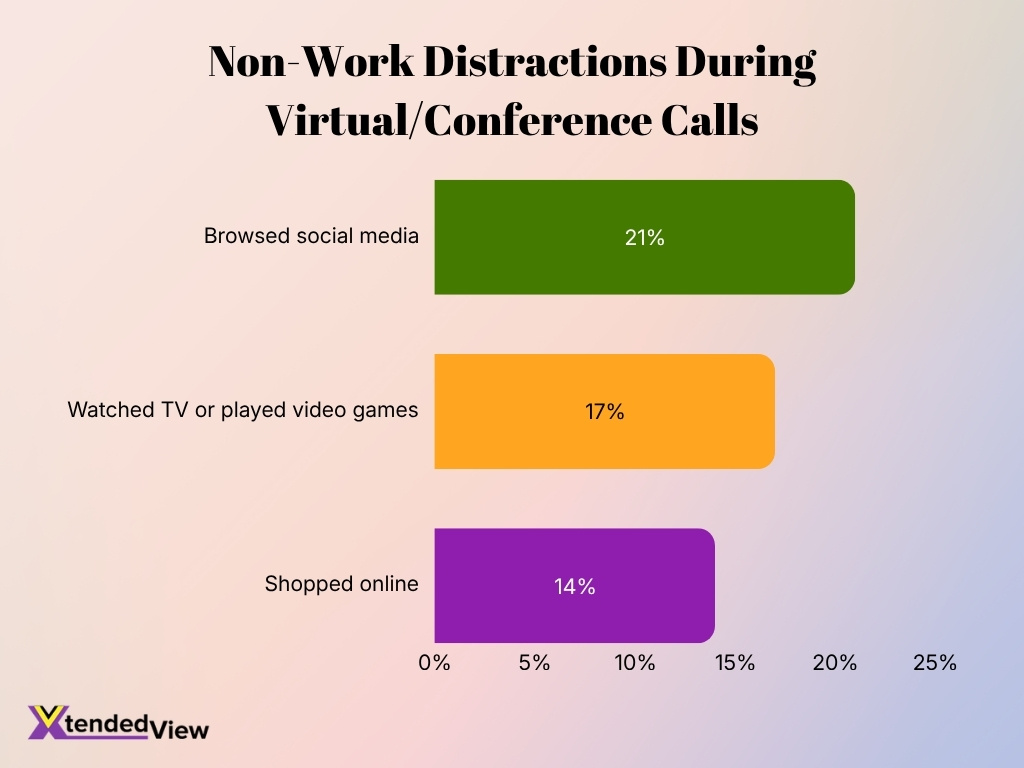
- During video and conference calls, 21% of hybrid or remote employees reported browsing social media, according to 2024 workplace research.
- In the same survey, 14% shopped online while participating in work calls, illustrating how digital multitasking extends beyond social networking.
- Another 17% watched television or played video games during work, while 12% did laundry during video or conference calls.
- Work messaging creates its own volume of digital traffic. Global 2025 workplace data showed the average employee received 153 work-platform messages per day.
- Employees also received an average of 117 emails per day, adding another stream of communication competing for attention.
- After-hours messaging grew 15% year over year in 2025, with employees averaging 58 work messages before or after the traditional 9-to-5 schedule.
- By 11 a.m., 54% of users were active in messaging, making that hour a particularly dense period for meetings, messages and other digital activity.
- Nearly 29% of active workers returned to their inboxes by 10 p.m., showing how digital communication increasingly reaches into late-evening personal time.
- In 2025 research, employees using workplace productivity tools faced a meeting, email or chat interruption roughly every two minutes during core work hours. The figure covers digital interruptions across devices, not smartphones alone.
- Consequently, 48% of employees in a global workplace survey described their work as chaotic and fragmented, compared with 52% of leaders.
Cell Phone Use During Meetings
- In 2026 UK research, 31.7% of employees admitted to scrolling on their phones during a meeting at least once in the previous month.
- A 2024 survey of 1,200 business leaders found 52% of workers often or always multitasked during virtual meetings with at least two attendees; 34% said often and 18% said always.
- In-person meetings reduced, but did not eliminate, multitasking: 35% of respondents reported doing it very often or always during face-to-face meetings.
- Generational attitudes differed considerably. 76% of Gen Z workers considered work-related phone use acceptable during an in-person meeting, compared with 55% of baby boomers.
- U.S. respondents were also relatively accepting of work-related smartphone use: 68% said using a phone for work during an in-person meeting was acceptable, compared with 60% of UK respondents.
- 76% of U.S. workers considered leaving an in-person meeting to take an urgent call acceptable, compared with 70% of UK workers.
- Personal phone use ranked among the three least acceptable behaviors in both virtual and in-person meetings in the 2024 research.
- Separate 2024 workplace research found 21% of hybrid or remote workers browsed social media during video or conference calls, while 14% shopped online during calls.
- The same study found 17% watched TV or played video games during work, while 4% reported working another job during work time.
- Meeting pressure remains high beyond smartphone use itself. In 2025 digital-work data, 60% of meetings were unscheduled or ad hoc among the highest-volume meeting users measured.
Cell Phone Use by Employee Demographics and Industry
- In 2026 U.S. research, Gen Z employees averaged 158 minutes of work on mobile devices per week, compared with 194 minutes among older generations.
- Despite recording less overall mobile work time, 38% of Gen Z employees worked from phones during their commutes, making them 15% more likely than millennials to do so.
- Meeting etiquette also varies by generation. 76% of Gen Z workers considered work-related phone use acceptable during in-person meetings, versus 55% of baby boomers.
- Seniority influences mobile communication patterns as well. Directors were 66% more likely than entry-level employees to have sent an email with an automated mobile-device signature.
- However, 38% of Gen Z respondents considered a “sent from my…” signature rushed or informal, while 35% of older generations viewed it as a normal part of work culture.
- Work arrangement also matters. Remote employees were twice as likely as on-site employees to use their phones for work while completing personal errands.
- In small-business research published in 2025, 60% of organizations expected employees to use mobile phones for work tasks even though they did not necessarily provide phones to every employee.
- Among smaller organizations that did not provide phones to all staff, 65% expected employees to use personal mobile devices for work.
- The divide extends internationally. A 2025 government survey found 97.6% of urban Indians ages 15-29 used mobile phones during the previous three months, compared with 96.8% in rural areas. While this is not workplace-specific, it shows the high level of mobile access among younger working-age populations.
- Among mobile-phone owners ages 15-29 in the same survey, smartphones accounted for 97.6% in urban areas and 95.5% in rural areas, demonstrating how broadly smartphone access now extends beyond U.S. workplaces.
Workplace BYOD Statistics
- A 2025 workforce-security study found 67% of organizations used BYOD smartphones, while only 13% relied exclusively on corporate-owned smartphones. Another 20% used a combination of both approaches.
- BYOD was much less prevalent for laptops: 22% of organizations used BYOD laptops, compared with 59% relying on corporate-owned laptops and 19% using both.
- Nearly 70% of respondents said mobile-device support had increased in importance during the previous two years.
- At the same time, 97% of organizations blocked corporate-resource access on at least some BYOD mobile devices, reflecting the security controls surrounding employee-owned hardware.
- Among IT and security professionals whose organizations had BYOD policies, only about half of personal devices were enrolled in security-management tools, according to 2025 security research.
- 21% of respondents said their company prohibited BYOD but did not actually enforce the policy, creating a gap between written rules and employee behavior.
- In early 2026 research covering 319 U.S. managed service providers, 55% reported at least one BYOD-related security incident among clients during the previous 24 months.
- Those incidents included a 16% confirmed data-breach rate, while 21% involved incidents without confirmed data loss and 18% were near misses stopped before impact.
- Corporate laptops received far more oversight: providers monitored 79% of corporate laptops but only 24% of employee-owned devices in the 2026 study.
- Among providers reporting BYOD incidents, 45% cited credential theft or account compromise, 42% cited email or messaging compromise, 40% malware, 31% data leakage and 29% lost or stolen devices.
Mobile Device Use for Work Tasks
- 75% of U.S. employees surveyed in 2026 said they sent work emails from their phones, making email the leading mobile work task in the study.
- 46% reviewed work documents on mobile devices, showing that smartphones increasingly serve as document-access tools rather than communication devices alone.
- Another 27% electronically signed contracts from their phones, extending mobile use into formal business transactions.
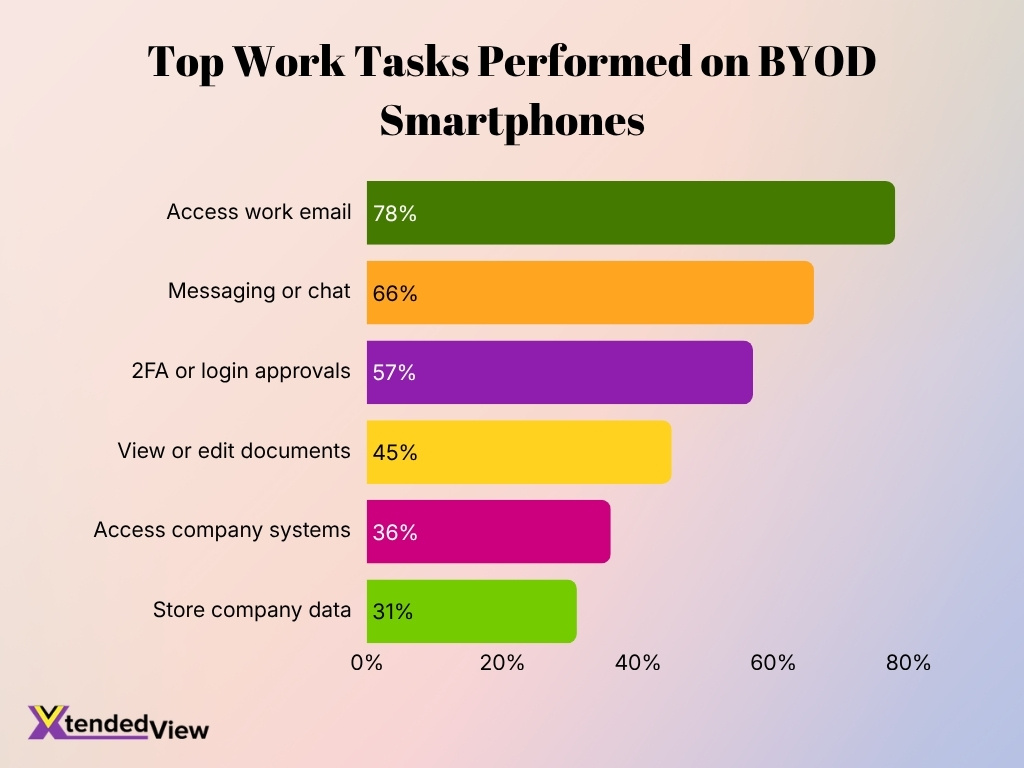
- A 2026 BYOD survey found 78% of employees using personal smartphones for work accessed work email from those devices.
- 66% used messaging or chat tools on personal smartphones for work, making collaboration the second-most common activity measured in that survey.
- 57% used their personal smartphones for two-factor authentication or login approvals, illustrating the phone’s expanding role in workplace identity verification.
- 45% viewed or edited work documents from their personal smartphones, while 36% accessed company systems such as databases, administrative tools or customer-management platforms.
- 31% stored company data or work files on their personal smartphones, an important figure because locally stored information can increase security exposure if devices remain unmanaged.
- Although employees increasingly work from phones, 62% of surveyed workers in 2026 said small screens made mobile work more difficult, while 42% cited limited software functionality.
- Even with those limitations, the average surveyed U.S. employee performed enough work on a mobile phone to equal nearly 21 eight-hour business days per year.
Workplace Cell Phone Distraction Statistics
- A controlled 2025 workplace study involving 22 participants across two five-hour knowledge-work sessions found that placing smartphones farther away significantly reduced phone use.
- However, reduced phone access did not significantly change overall work or leisure time because participants shifted some non-work activities to their computers. This finding suggests removing a phone does not automatically remove digital distraction.
- In 2025 workplace telemetry, heavily connected employees encountered meetings, emails, or chats about every two minutes during core work hours.
- Across a full day, the highest-volume users received approximately 275 digital interruptions, although this measurement includes computers and other connected devices rather than smartphones alone.
- 48% of employees said their work felt chaotic and fragmented, suggesting that digital overload has become a broader workplace attention issue.
- Employees averaged 117 emails and 153 work-platform messages daily in 2025 telemetry, creating hundreds of potential attention demands before accounting for other applications.
- Half of meetings took place during the two periods identified as peak productivity hours, 9-11 a.m. and 1-3 p.m., further limiting uninterrupted focus time.
- 60% of meetings were ad hoc or unscheduled among employees with the highest meeting volume, adding another unpredictable source of workday interruption.
- The attention load extends beyond office hours. Meetings beginning after 8 p.m. increased 16% year over year, while 30% of meetings crossed multiple time zones.
- Consequently, smartphone-distraction statistics need context: current experimental evidence shows that restricting access can reduce phone-specific use, but workers may simply move the same non-work activity to another digital device.
Employee Productivity and Cell Phone Use
- A 2025 controlled workplace study followed 22 participants through two five-hour knowledge-work sessions and found that placing smartphones outside immediate reach significantly reduced smartphone use.
- However, reduced smartphone access produced no significant change in total work or leisure time because participants shifted some non-work activities from their phones to their computers.
- The same experiment found that increasing phone distance did not eliminate task fragmentation, suggesting that the activity and digital environment matter alongside the physical device itself.
- A separate workplace field experiment found that banning personal smartphones produced a substantial increase in employee effort on a routine calling task. However, the higher effort did not necessarily translate into greater economic benefits for the employer.
- A 2025 diary study examined how personal smartphone interruptions affect task accomplishment, frustration and post-work rumination, reinforcing the distinction between an interruption and the total amount of time employees spend on their phones.
- Current mobile work also supports productive activity. 75% of surveyed U.S. employees in 2026 used their phones for work email, while 46% reviewed work documents on mobile devices.
- At the same time, 62% of surveyed employees said small screens made mobile work more difficult, while 42% cited limited software functionality as a challenge.
- Another 38% worried about making a costly mistake while working from a mobile device, and 34% said they lacked necessary apps for completing work.
- Therefore, current evidence does not support treating all smartphone time as lost productivity. Experimental findings show that restricting phones can reduce phone-specific distraction, while employees may transfer non-work behavior to another screen.
Cell Phone Use and Work-Life Balance
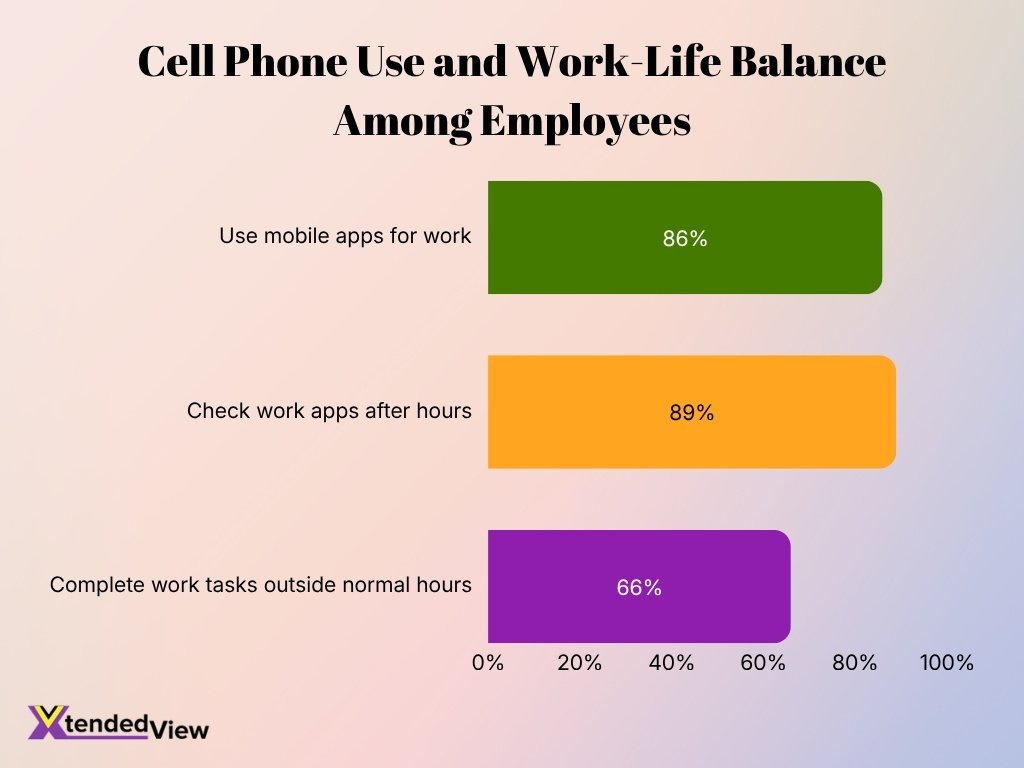
- 89% of employees check work-related apps after normal working hours, showing how mobile connectivity extends work beyond the traditional workday.
- 86% of employees use mobile apps for work, highlighting smartphones as a core part of everyday workplace communication and productivity.
- 66% of employees complete work tasks outside normal working hours, indicating that mobile access may be contributing to increasingly blurred work-life boundaries.
- The gap between employees who check work apps after hours (89%) and those who actually complete tasks after hours (66%) suggests that after-hours mobile engagement does not always translate into active work.
- Overall, the figures show that mobile work habits are widespread, with more than 8 in 10 employees remaining connected to work through mobile apps.
Benefits and Drawbacks of Cell Phones in the Workplace
- In 2026, 75% of surveyed U.S. employees said they used phones to send work emails, making communication one of the clearest practical benefits of workplace mobile use.
- 46% reviewed work documents on mobile devices, while 27% electronically signed contracts from their phones, allowing some business processes to continue without a desktop computer.
- Mobile flexibility can support employees’ personal schedules: 51% of surveyed employees said mobile-device work improved their work-life balance.
- However, 56% said work-related mobile notifications blurred their personal and professional lives, showing that flexibility can come with weaker boundaries.
- Screen size remains a practical drawback, with 62% saying smaller screens made work harder and 42% reporting limitations in software functionality.
- Mobile access also creates security exposure. In 2025, 85% of surveyed organizations reported that mobile-device attacks were increasing.
- Mobile AI has added another layer of risk: 93% of organizations reported employees using generative AI tools on mobile devices in their daily workflows.
- 64% of organizations identified potential data compromise caused by employees entering sensitive information into generative AI as their leading mobile-device risk.
- Despite those risks, only 45% of organizations provided comprehensive training covering mobile AI risks in 2025, illustrating a gap between mobile adoption and employee preparation.
Workplace Cell Phone Privacy and Security Statistics
- 85% of organizations in a 2025 global mobile-security study said attacks involving mobile devices were increasing.
- In response, 75% of organizations increased mobile-security spending during the previous year.
- 93% of organizations reported employees using generative AI applications on mobile devices for daily work, substantially expanding the types of information employees can process from phones.
- Yet only 17% of businesses reported having specific security controls designed to counter AI-assisted attacks.
- Among organizations conducting employee smishing simulations, 39% found that as many as half of employees tested clicked a malicious link, highlighting the human element of mobile security.
- 64% of organizations considered data compromise from employees entering sensitive or proprietary information into generative AI their top mobile-device-use risk.
- Mobile device management correlates with stronger AI oversight: 63% of organizations using MDM regularly audited AI-generated content, versus 48% of organizations without MDM.
- U.S. research published in 2026 found providers monitored 79% of corporate laptops but only 24% of employee-owned devices, exposing a large management gap around BYOD.
- In the same 2026 research, 55% of surveyed U.S. managed service providers reported at least one client BYOD security incident during the previous 24 months.
- Security controls must also account for employee privacy. Federal cybersecurity guidance notes that BYOD can expose both organizations and employees to data-loss and privacy risks, making separation of personal and corporate information a core consideration when employers manage personal phones.
Workplace Cell Phone Policies and Restrictions
- BYOD is already routine in many organizations: three in four IT workers surveyed for 2025 security research said employees regularly brought personal devices into work environments.
- Yet only 52% said their organizations explicitly permitted BYOD, revealing a gap between actual employee behavior and formal company policy.
- Among organizations that formally prohibited BYOD, just 22% reported that employees actually complied with the ban.
- 29% of security professionals identified BYOD itself as a heightened security risk, compared with 28% who cited unapproved software and 27% who cited friends or family using work devices.
- A 2025 study of adult social care found 50% of surveyed providers used BYOD, but only half of those organizations had a BYOD policy in place.
- Among employees using personal devices in those workplaces, only 40% remembered signing a policy or guidance document, indicating that having rules does not guarantee employee awareness.
- A separate 2025 compliance survey found 63% of organizations had written policies governing off-network messaging apps, while 58% prohibited employees from using those apps for business communication.
- Experimental research found that a workplace smartphone ban generated a substantial increase in effort during a routine calling task, but researchers did not find that the additional effort necessarily produced greater economic returns for the employer.
- Another workplace experiment found that removing a personal-smartphone ban did not significantly reduce work performance, while employees who began using smartphones at work experienced reduced work-life conflict.
- Taken together, the evidence suggests employers need to distinguish between security restrictions, distraction controls and complete phone bans. Each targets a different problem, and current experimental evidence does not show that one universal policy produces the same outcome across workplaces.
Frequently Asked Questions (FAQs)
Surveyed U.S. employees spend about 8% of their workweek working from mobile devices, equivalent to nearly 21 full business days per year.
In 2026 research, 75% of surveyed U.S. employees said they use their mobile phones to send work emails.
A workforce-security study found 67% of organizations use BYOD smartphones, compared with 13% using only corporate-owned smartphones and 20% using a combination.
Recent BYOD research found 78% of employees using personal smartphones for work access work email, while 66% use messaging or chat applications.
A 2025 workplace study found employees who had used smartphones took a median of 2.68 minutes to complete a Stroop task, versus 1.81 minutes without smartphone use, a difference of 0.87 minutes. They also recorded a median of 6.45 errors versus 4.25 errors.
Conclusion
Cell phone use at work cannot be described simply as productive or distracting. Smartphones have become important tools for communication, documents, authentication, and flexible work, but the same connectivity can contribute to interruptions, after-hours work, and security exposure. Current evidence shows that restricting smartphones can reduce phone-specific use without necessarily eliminating digital distraction, while BYOD adoption continues to create security and policy challenges. For employers, the data support clear expectations for personal use, after-hours communication, and mobile security rather than treating every minute of smartphone activity as equivalent.