



Xiaomi remains one of the world’s largest smartphone manufacturers, with a broad presence across China, India, Europe, Latin America, and Southeast Asia. However, its smartphone business is navigating a more difficult operating environment as rising memory and component costs, weaker entry-level demand, and intense competition affect shipment volumes. At the same time, Xiaomi is moving further into premium price segments, increasing average selling prices and expanding higher-end product lines to improve its revenue mix.
These trends matter across both consumer and industry markets. Retailers and distributors can use Xiaomi’s regional shipment patterns to understand where demand remains strongest, while investors and competitors can track its pricing and premiumization strategy to assess how the company is responding to lower unit growth. The following Xiaomi smartphone statistics examine its global market share, shipments, revenue, regional performance, pricing trends, and competitive position.
Editor’s Choice
- Xiaomi shipped 165.2 million smartphones in 2025, down 2% from 168.5 million units in 2024.
- Smartphone revenue totaled RMB 186.4 billion in 2025, a 2.8% decrease from RMB 191.8 billion in 2024.
- Xiaomi’s worldwide smartphone shipments fell 26.4% year over year in Q2 2026, from 42.4 million to 31.2 million units.
- The company reached 33.8 million smartphone shipments in Q1 2026, before quarterly volume declined further during Q2.
- Xiaomi’s smartphones priced at RMB3,000 or more accounted for a record 32.1% of its mainland China unit sales in Q2 2026, up 4.5 percentage points year over year.
- Xiaomi maintained a top-three global shipment position for 24 consecutive quarters through Q2 2026.
- Xiaomi’s smartphone gross margin narrowed to 8.5% in Q2 2026, compared with 11.5% in Q2 2025 as higher component costs reduced handset profitability.
Recent Developments
- Xiaomi’s Q2 2026 smartphone ASP increased 25.9% year over year, reflecting a deliberate move toward premium and upper-midrange devices as component costs rose.
- Premium-priced models represented 32.1% of Xiaomi’s mainland China smartphone unit sales in Q2 2026, the highest proportion the company had reported for that metric.
- Xiaomi captured 16.2% of China’s RMB3,000-RMB4,000 smartphone segment in Q2 2026, up 3.3 percentage points from the prior-year quarter.
- The Xiaomi 17T Series, launched in May 2026, helped lift the contribution of premium overseas smartphones and pushed quarterly ASP from RMB1,310.1 in Q1 to RMB1,351 in Q2.
- Xiaomi’s Q2 2026 smartphone shipments declined to 31.2 million units as the company adjusted shipment timing and pricing amid rising memory costs.
- Industry-wide memory costs had risen by nearly 300% year over year by Q2 2026, putting particular pressure on low-cost smartphones where memory represented a large share of the bill of materials.
- Xiaomi unveiled the Xiaomi 18 Fold in September 2026 with prices ranging from RMB10,999 to RMB14,999, extending the company’s push into high-end foldables.
- Xiaomi’s reported smartphone gross margin fell by 1.6 percentage points sequentially, from 10.1% in Q1 2026 to 8.5% in Q2, with higher key-component prices cited as the main reason.
Global Xiaomi Smartphone Market Share
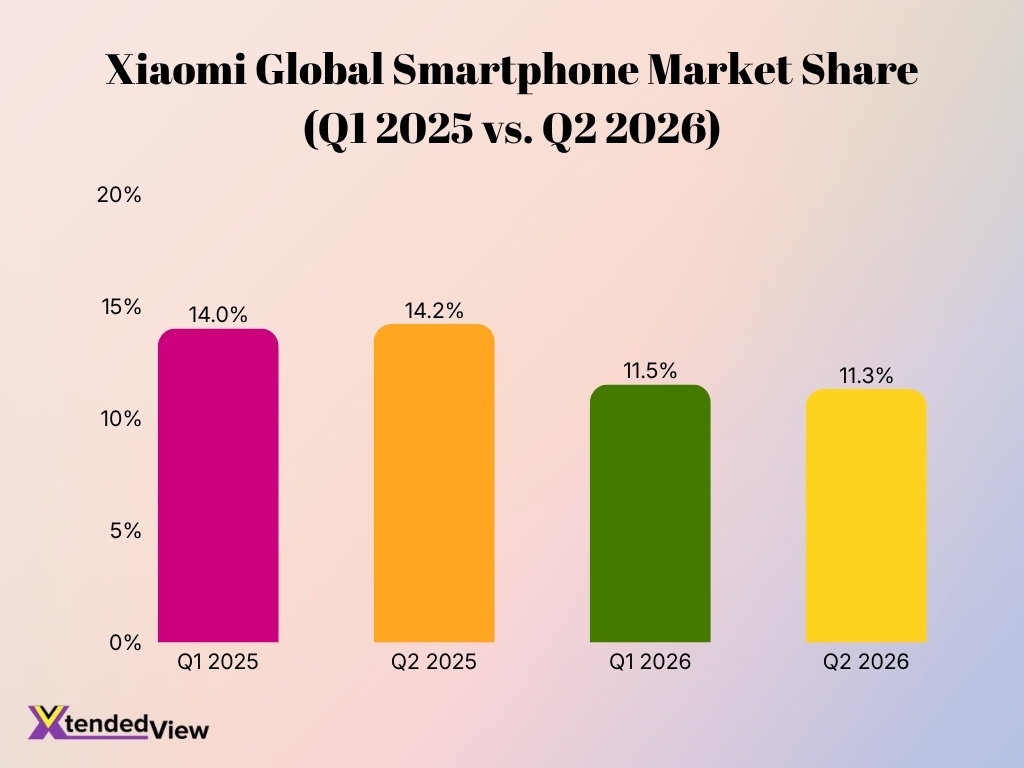
- Xiaomi accounted for 11.3% of global smartphone shipments in Q2 2026, compared with 14.2% in Q2 2025 under final market estimates.
- A separate global tracking series placed Xiaomi at 11% in Q2 2026, down from 14% one year earlier. Differences reflect methodology and rounding between market trackers.
- Xiaomi held approximately 11.5% of worldwide smartphone shipments in Q1 2026 under one quarterly tracker, compared with 14% in Q1 2025.
- Another Q1 2026 measurement put Xiaomi’s share at 11.3%, confirming its No. 3 global position.
- Xiaomi’s Q4 2025 worldwide shipment share was approximately 11.3%, lower than its 14% share during each of the first three quarters of 2025 in the same tracking series.
- Xiaomi achieved a 14.4% global smartphone share in the first half of 2025, when shipments reached 84.2 million units.
- Xiaomi’s Q2 2025 global share reached 14.7% under another quarterly measurement, illustrating its stronger market position before the 2026 component-cost shock.
- Xiaomi’s decline from 14.2% in Q2 2025 to 11.3% in Q2 2026 equaled a 2.9-percentage-point loss of global shipment share under final quarterly data.
- Despite that share contraction, Xiaomi remained the No. 3 global smartphone vendor in Q2 2026, behind Samsung and Apple and ahead of OPPO and vivo in final shipment rankings.
Xiaomi Smartphone Shipments and Sales Volume
- Xiaomi recorded 165.2 million smartphone shipments in full-year 2025, compared with 168.5 million in 2024.
- First-half 2025 shipments totaled 84.2 million units, an increase of 1.8% year over year.
- Xiaomi shipped 43.3 million smartphones in Q3 2025, representing 0.5% year-over-year growth.
- Q2 2025 worldwide shipments reached 42.4 million units under final historical market data.
- Xiaomi entered 2026 with 33.8 million Q1 shipments, reflecting the first major impact of higher memory costs and weaker mass-market demand.
- Q2 2026 shipments fell to 31.2 million units, a decrease of 2.6 million units from Q1 2026.
- Xiaomi therefore shipped approximately 65 million smartphones in the first half of 2026, based on the company’s reported Q1 and Q2 totals.
- Compared with the 84.2 million units shipped in H1 2025, the roughly 65 million units shipped in H1 2026 indicate a decline of about 19.2 million units, or roughly 23%, based on reported quarterly totals.
- Xiaomi’s Q2 2026 shipment volume was 11.2 million units lower than in Q2 2025, underscoring how strongly entry- and midrange demand weakened during the year.
Xiaomi Smartphone Market Position and Ranking
- Xiaomi ranked No. 3 worldwide in Q2 2026, with 31.2 million shipments and an 11.3% share under final global shipment estimates.
- Xiaomi had maintained a global top-three shipment position for 24 consecutive quarters by the end of Q2 2026.
- In Q2 2026, Xiaomi ranked No. 2 in Southeast Asia, where its shipment share reached 19.3%.
- Xiaomi also ranked No. 2 in Latin America in Q2 2026 with a 16.2% smartphone shipment share.
- In the Middle East, Xiaomi held the No. 2 position with 13.5% share during Q2 2026.
- Xiaomi ranked No. 3 in Europe in Q2 2026 and captured 16.5% of regional smartphone shipments.
- The company also ranked No. 3 in Africa, where its Q2 2026 market share reached 10.9%.
- Xiaomi ranked among the top five smartphone brands in 67 countries and regions in Q2 2026, up from 65 countries and regions in Q1 2026.
- Its top-three footprint expanded from 47 countries and regions in Q1 2026 to 53 in Q2, despite the company’s global shipment decline.
- For comparison, Xiaomi ranked among the top three in 61 countries and regions during H1 2025, showing that its geographic ranking footprint remains broad even as 2026 conditions vary sharply by quarter.
Xiaomi Smartphone Revenue and Financial Performance
- Xiaomi’s smartphone business generated RMB186.4 billion in revenue in 2025, compared with RMB191.8 billion in 2024.
- Smartphone revenue reached RMB96.1 billion in the first half of 2025, with a 12% gross margin.
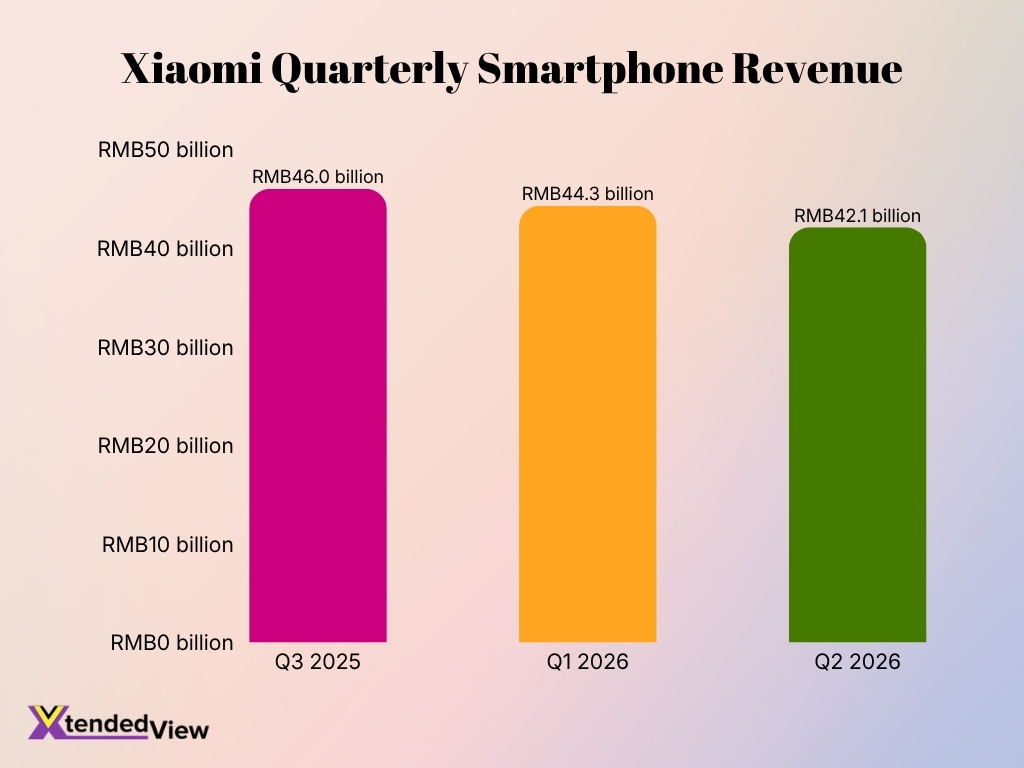
- Xiaomi recorded RMB46.0 billion in smartphone revenue in Q3 2025, down 3.1% year over year.
- Smartphone revenue came to RMB44.3 billion in Q1 2026, alongside a 10.1% handset gross margin.
- Q2 2026 smartphone revenue declined sequentially to RMB42.1 billion, about RMB2.2 billion below the previous quarter.
- For the first six months of 2026, smartphones contributed RMB86.392 billion in segment revenue, versus RMB96.132 billion in the first half of 2025.
- First-half smartphone gross profit declined from RMB11.503 billion in 2025 to RMB8.076 billion in 2026, a drop of roughly 29.8%.
- Xiaomi’s Q2 2026 smartphone gross profit totaled approximately RMB3.60 billion, compared with RMB5.22 billion in Q2 2025.
- Xiaomi’s 2025 smartphone ASP averaged RMB1,128.7 per unit, down 0.8% from RMB1,138.2 in 2024, before climbing sharply during the first half of 2026.
- Smartphones represented 38.7% of Xiaomi’s total Q2 2026 revenue, down from 44.7% in Q1 as the company’s other business lines increased their contribution.
Xiaomi Smartphone Growth Trends and Year-over-Year Changes
- Xiaomi shipped 165.2 million smartphones in 2025, down about 2% from 168.5 million in 2024. Even with the decline, Xiaomi kept its place among the world’s three largest smartphone vendors.
- Xiaomi’s global smartphone market share reached 13.3% for full-year 2025, supporting a top-three worldwide ranking for the fifth consecutive year.
- The slowdown became much sharper in Q2 2026, when Xiaomi’s worldwide shipments fell 26.4% year over year, from 42.4 million to 31.2 million units.
- Xiaomi’s worldwide shipment share fell from 14.2% in Q2 2025 to 11.3% in Q2 2026, a decline of 2.9 percentage points in one year.
- Globally, the smartphone market contracted 7.4% year over year in Q2 2026, but Xiaomi’s shipment decline was more than three times as steep as the overall market contraction.
- Xiaomi’s China shipment performance weakened substantially in Q2 2026, with shipments declining 21.7% year over year as higher component costs hit lower-priced Android models particularly hard.
- In contrast, Xiaomi’s Latin American business expanded during 2025. Full-year shipments reached 24.6 million units, up 8% from the previous year and enough to move Xiaomi into second place in the region.
- Xiaomi also grew in Southeast Asia in 2025, increasing annual smartphone shipments 4% to 17.0 million units while lifting regional share to 17%.
- Europe showed a different pattern: Xiaomi’s 2025 smartphone shipments slipped 1% to 21.8 million units, broadly matching the region’s overall 1% decline.
Xiaomi Smartphone Quarterly Performance Statistics
- Xiaomi shipped approximately 41.8 million smartphones in Q1 2025, giving it about 14.1% of global shipments under one quarterly measurement.
- Q2 2025 shipments increased to 42.4 million units, while Xiaomi’s global share reached approximately 14.7% under the same shipment-tracking methodology.
- Xiaomi’s shipments climbed again to roughly 43.4 million units in Q3 2025, making it the company’s strongest quarter by unit volume among the first three quarters of that year.
- In Q4 2025, shipments fell to about 37.8 million units, while global share dropped to roughly 11.1%, signaling weakening momentum before 2026.
- Xiaomi began 2026 with 33.8 million smartphone shipments in Q1, about 4 million fewer units than in the preceding quarter.
- Its Q1 2026 global shipment share stood near 11.3% to 11.5%, depending on tracker methodology, compared with around 14% in Q1 2025.
- Xiaomi’s Q2 2026 volume declined further to 31.2 million units, its lowest quarterly shipment level across the six-quarter period from Q1 2025 through Q2 2026.
- The company’s Q2 2026 global share was measured at roughly 11% to 11.5%, leaving Xiaomi in third place worldwide despite the steep shipment decline.
- Across Q1 and Q2 2026 combined, Xiaomi shipped roughly 65 million smartphones, compared with more than 84 million in the first half of 2025, based on reported quarterly totals.
Xiaomi Smartphone Market Share by Region
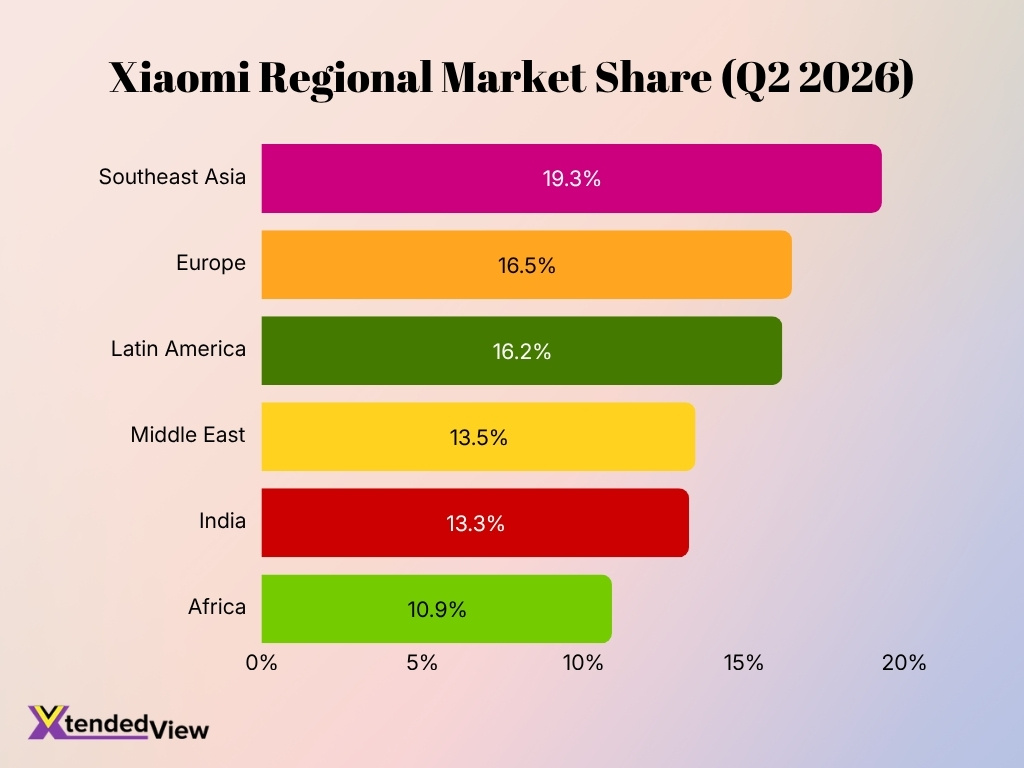
- Xiaomi held 16.5% of European smartphone shipments in Q2 2026, ranking third in the region.
- In Latin America, Xiaomi captured 16.2% of smartphone shipments in Q2 2026 and ranked second.
- Xiaomi’s strongest major regional share in Q2 2026 came from Southeast Asia, where it held 19.3% and ranked second.
- In the Middle East, Xiaomi held 13.5% of smartphone shipments during Q2 2026, securing the No. 2 position.
- Xiaomi held 10.9% of Africa’s smartphone market in Q2 2026 and ranked third among vendors.
- In India, Xiaomi accounted for 13.3% of smartphone shipments in Q2 2026, which placed it fourth in the market under one regional shipment dataset.
- During full-year 2025, Xiaomi’s regional share reached 20.3% in Europe, 17.5% in Latin America and 17.0% in Southeast Asia under annual shipment reporting.
- Xiaomi’s African share stood at 12.7% in 2025, up 1.4 percentage points year over year before declining during the first half of 2026.
- Xiaomi ranked among the top three smartphone vendors in 53 countries and regions in Q2 2026 and among the top five in 67, illustrating how widely its regional position extends beyond its largest markets.
Xiaomi Smartphone Market Share by Country
- In mainland China, Xiaomi’s unit-sales share stood at 14.2% in Q2 2026, after reaching 14.4% in Q1.
- Xiaomi sold approximately 8.4 million smartphones in mainland China during Q2 2026, down from 10.3 million in Q1.
- In India, Xiaomi held about 13% shipment share in Q2 2026, compared with 12% in Q1 under another quarterly measurement.
- Xiaomi’s India share remained close to 13% throughout Q1, Q2 and Q3 2025, before easing to 12% in Q4.
- India shipped 154.2 million smartphones during 2025, and Xiaomi remained one of the country’s four largest vendors despite increasing competition from vivo, Samsung and OPPO.
- Xiaomi shipped approximately 4.2 million smartphones in India in Q4 2025, placing it fourth for that quarter.
- In China, Xiaomi’s shipment share fell from about 19% in Q1 2025 to 13% in Q1 2026 under quarterly shipment estimates, showing a substantial domestic-market reset.
- Xiaomi’s share in China fell further to approximately 12% in Q2 2026 under shipment-based estimates, while another unit-sales dataset placed the company at 14.2%; the difference reflects methodology and channel measurement.
- In 2025, Xiaomi finished No. 2 in mainland China by units sold, with a 16.6% share, 0.7 percentage points higher than in 2024.
Xiaomi Smartphone Market Share in China
- Xiaomi captured 16.6% of mainland China smartphone unit sales in 2025, up from approximately 15.9% in 2024.
- That 2025 performance moved Xiaomi to No. 2 in mainland China by units sold, one of its strongest annual domestic rankings in recent years.
- Xiaomi sold 11.5 million smartphones in China in Q2 2025, corresponding to a 16.8% unit-sales share under the company’s referenced market dataset.
- In Q3 2025, domestic unit sales slipped to 10.8 million, while Xiaomi’s share remained relatively firm at 16.7%.
- Xiaomi sold 11.1 million smartphones in China in Q4 2025, but its market share decreased to 15.7% as competitors gained ground.
- Q1 2026 China sales declined to 10.3 million units, reducing Xiaomi’s unit-sales share to 14.4%.
- By Q2 2026, Xiaomi’s Chinese smartphone sales fell to 8.4 million units, roughly 27% below the Q2 2025 level in the same dataset.
- Shipment-based market estimates put Xiaomi at 12.4% of China’s smartphone market in Q2 2026, down from 15.1% a year earlier.
- Xiaomi suffered the steepest shipment decline among China’s major vendors in Q2 2026 at approximately 21% to 22% year over year, largely because rising memory and component costs hit its lower-priced portfolio particularly hard.
- Despite lower overall volumes, Xiaomi continued pushing higher-priced devices, including the Xiaomi 18 Fold launched in September 2026 at RMB10,999 to RMB14,999, as it sought more premium-market exposure.
Xiaomi Smartphone Market Share in India
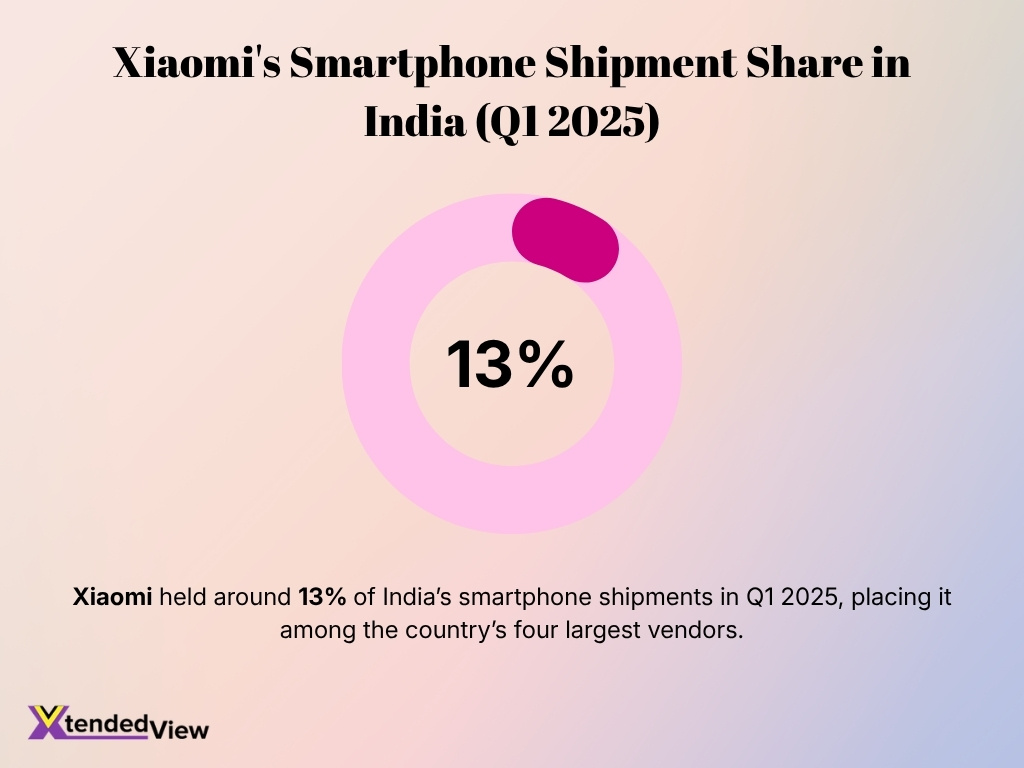
- Xiaomi held around 13% of India’s smartphone shipments in Q1 2025, placing it among the country’s four largest vendors.
- Its share remained at approximately 13% in Q2 2025, while vivo led the market with 24%.
- Xiaomi again accounted for about 13% in Q3 2025, showing a relatively stable share through India’s first three quarters.
- The company’s share eased to 12% in Q4 2025, when it shipped roughly 4.2 million units and ranked fourth.
- India’s overall smartphone market shipped 154.2 million units in 2025, down 1% year over year as softer consumer demand and affordability pressures limited replacement purchases.
- Xiaomi entered Q1 2026 with roughly 12% of Indian smartphone shipments, while the overall market contracted 2% year over year.
- Xiaomi’s share recovered to approximately 13% in Q2 2026, even as the Indian smartphone market fell 11% year over year amid record-high memory costs and repeated price increases.
- A separate Q2 2026 regional dataset placed Xiaomi at 13.3% and No. 4 in India, broadly confirming the quarterly shipment-share estimate.
- Xiaomi’s India share therefore remained within a narrow 12%-13% range across six consecutive quarters from Q1 2025 through Q2 2026, even though its competitive ranking weakened relative to earlier periods.
Xiaomi Smartphone Market Share in Europe
- Xiaomi shipped 21.8 million smartphones in Europe during 2025, down about 1% from the previous year.
- Those shipments represented approximately 16% of Europe’s 2025 smartphone market under a Europe-excluding-Russia measurement, leaving Xiaomi in third place behind Samsung and Apple.
- A broader regional dataset used in Xiaomi’s annual reporting put its 2025 European share at 20.3%, highlighting how geographic coverage and market definitions can materially affect regional share figures.
- Europe shipped 134.2 million smartphones in 2025, a 1% year-over-year decline as weaker demand offset growth in premium devices.
- Xiaomi shipped 5.3 million smartphones in Europe excluding Russia in Q1 2025, giving it about 16% of the regional market.
- Q1 2026 shipments fell to 4.5 million units, a 15% year-over-year decline, while Xiaomi’s share decreased to 14% in the same geographic dataset.
- Under the broader regional measurement, Xiaomi held 17.2% of European shipments in Q1 2026 and remained the region’s No. 3 smartphone vendor.
- Xiaomi’s broader European share eased again to 16.5% in Q2 2026, although it retained third place.
- Europe’s overall smartphone shipments fell 10% year over year to about 35 million units in Q2 2026, reaching the region’s weakest second-quarter volume in three years as higher device prices and reduced promotions limited demand.
- Xiaomi has now spent more than 20 consecutive quarters among Europe’s top three smartphone vendors, demonstrating sustained regional scale even as its 2026 shipment volumes contracted.
Xiaomi Smartphone Market Share in Latin America
- Xiaomi shipped 24.6 million smartphones in Latin America in 2025, an 8% increase from the previous year. This growth moved the company into second place across the region.
- Latin America recorded a record 140.5 million smartphone shipments in 2025, up 3% year over year, giving Xiaomi exposure to one of the few major regions that expanded during the year.
- Based on 24.6 million shipments and a 140.5 million-unit regional market, Xiaomi captured roughly 17.5% of Latin American shipments in 2025.
- Xiaomi ranked second in Latin America in Q2 2026 with 4.9 million smartphone shipments, behind Samsung.
- Xiaomi controlled approximately 16% of Latin American shipments in Q2 2026, compared with roughly 19% a year earlier.
- Xiaomi’s Latin American shipments fell 27% year over year in Q2 2026, substantially faster than the regional market’s 12% contraction.
- The total Latin American smartphone market dropped to 30.3 million units in Q2 2026, as higher memory costs translated into higher retail prices and weaker entry-level demand.
- Xiaomi’s 4.9 million Q2 2026 units were approximately 1.8 million fewer than the roughly 6.7 million units implied by its 27% year-over-year decline.
- Despite its 2026 volume decline, Xiaomi retained the No. 2 regional position in Q2, showing that its channel reach and Redmi-led portfolio still provide significant scale across Latin America.
Xiaomi Smartphone Market Share in Southeast Asia
- Xiaomi shipped 17.0 million smartphones in Southeast Asia during 2025, a 4% increase from the previous year.
- Xiaomi captured 17% of Southeast Asian smartphone shipments in 2025, finishing second for the full year.
- The Southeast Asian smartphone market totaled approximately 100 million units in 2025, down 1% year over year. Xiaomi therefore grew while the broader regional market contracted.
- Xiaomi briefly reclaimed the No. 1 regional position in Q2 2025, shipping 4.7 million smartphones and taking 19% share.
- Xiaomi’s Q2 2025 shipments increased 8% year over year, supported by demand for Redmi models and wider retail distribution.
- By Q2 2026, Southeast Asian smartphone shipments had fallen 23% year over year to 19.3 million units, the region’s lowest quarterly volume since 2014 under one market estimate.
- Xiaomi’s Southeast Asian shipments declined 21% year over year in Q2 2026, broadly tracking the severe regional downturn.
- Even as unit volume contracted, Xiaomi’s average selling price in Southeast Asia jumped 43.5% year over year in Q2 2026, the second-largest ASP increase among the top five vendors.
- Xiaomi held approximately 19.3% of Southeast Asian shipments in Q2 2026 under another regional measurement, enough for second place.
- Southeast Asia’s market ASP increased 31% year over year to $342 in Q2 2026, illustrating how component inflation pushed both Xiaomi and the wider market toward higher-priced devices.
Xiaomi Smartphone Price Segment Statistics
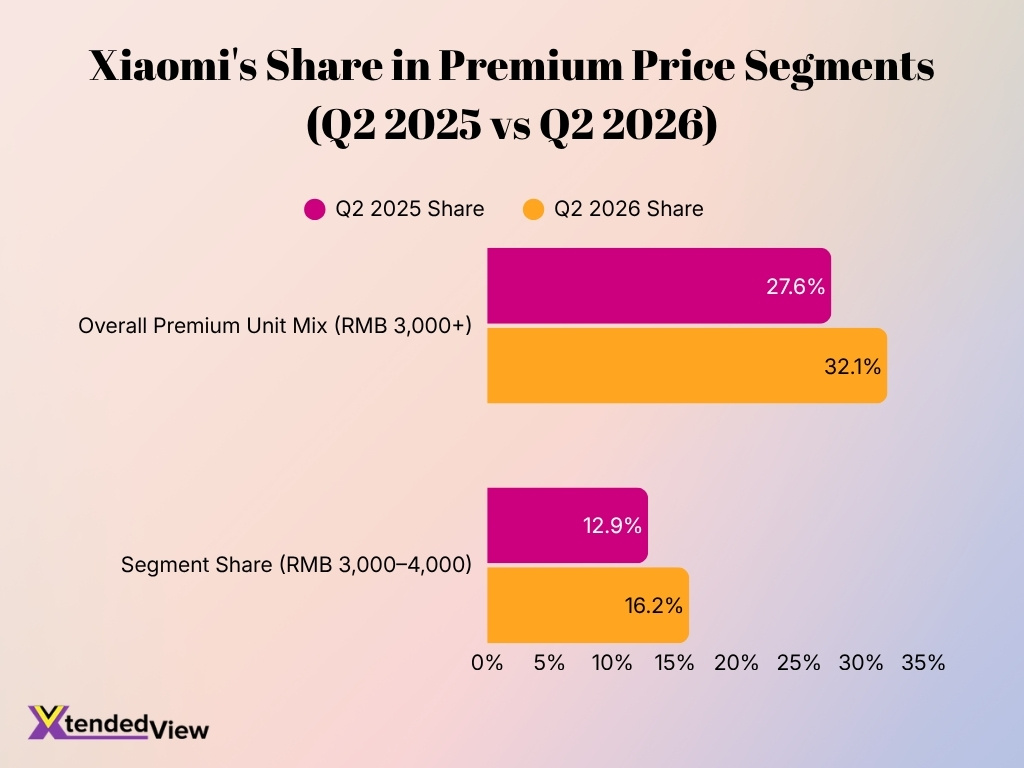
- Smartphones priced at RMB3,000 or more accounted for 32.1% of Xiaomi’s mainland China unit sales in Q2 2026, the highest share the company had reported.
- The same RMB3,000-plus category represented 27.6% of Xiaomi’s Chinese sales in Q2 2025, meaning its premium mix increased by 4.5 percentage points in one year.
- Xiaomi captured 16.2% of China’s RMB3,000-RMB4,000 smartphone segment in Q2 2026, up from 12.9% one year earlier.
- The company therefore gained 3.3 percentage points of share in the RMB3,000-RMB4,000 tier between Q2 2025 and Q2 2026.
- For full-year 2025, smartphones priced at RMB3,000 or above accounted for a record 27.1% of Xiaomi’s mainland China unit sales, up 3.8 percentage points year over year.
- Xiaomi controlled 17.3% of China’s RMB4,000-RMB6,000 segment in 2025, an increase of 0.5 percentage points from 2024.
- In the higher RMB6,000-RMB10,000 tier, Xiaomi’s 2025 market share increased 2.3 percentage points to 4.5%, indicating progress in a segment historically dominated by higher-priced competitors.
- During the first half of 2025, Xiaomi held 24.6% of the RMB4,000-RMB5,000 segment in mainland China, ranking No. 1 in that price band.
- Xiaomi also captured 12.0% of China’s RMB5,000-RMB6,000 segment in H1 2025, up 2.5 percentage points year over year.
- Rising component costs have made these higher tiers increasingly important: by Q2 2026, memory costs had risen nearly 300% year over year and represented more than 65% of the bill of materials for some low-end smartphones.
Xiaomi Premium Smartphone Sales Statistics
- Xiaomi’s premium smartphones, defined in mainland China as models priced at RMB3,000 or higher, accounted for 27.1% of its Chinese unit sales in 2025.
- Premium penetration had risen to 32.1% by Q2 2026, an increase of 5 percentage points compared with Xiaomi’s full-year 2025 mix.
- During H1 2025, premium devices represented 26.2% of Xiaomi’s Chinese smartphone sales, up 4.4 percentage points year over year.
- Xiaomi’s worldwide smartphone ASP climbed to a record RMB1,351 in Q2 2026, up 25.9% from RMB1,073 in Q2 2025.
- That ASP increase helped limit the decline in smartphone revenue to 7.5% year over year in Q2 2026, even though unit shipments fell by more than 26%.
- Xiaomi expanded its global premium portfolio in February 2026 with the Xiaomi 17 starting at €999, while Xiaomi 17 Ultra started at €1,499.
- The Leica Leitzphone powered by Xiaomi launched internationally at €1,999, placing it firmly within the ultra-premium smartphone tier.
- In September 2026, Xiaomi introduced Xiaomi 18 Fold in China with prices ranging from RMB10,999 to RMB14,999, extending its presence in premium foldables.
- Xiaomi’s 4.5% share in China’s RMB6,000-RMB10,000 category during 2025 remained much smaller than its position in mid-premium segments, but its 2.3-percentage-point annual gain showed measurable movement upward.
- Premiumization has become more important to Xiaomi’s economics because Q2 2026 global smartphone revenue reached $109 billion despite lower industry shipments, while the worldwide market ASP increased 17% year over year.
Xiaomi vs Competitors Smartphone Market Share
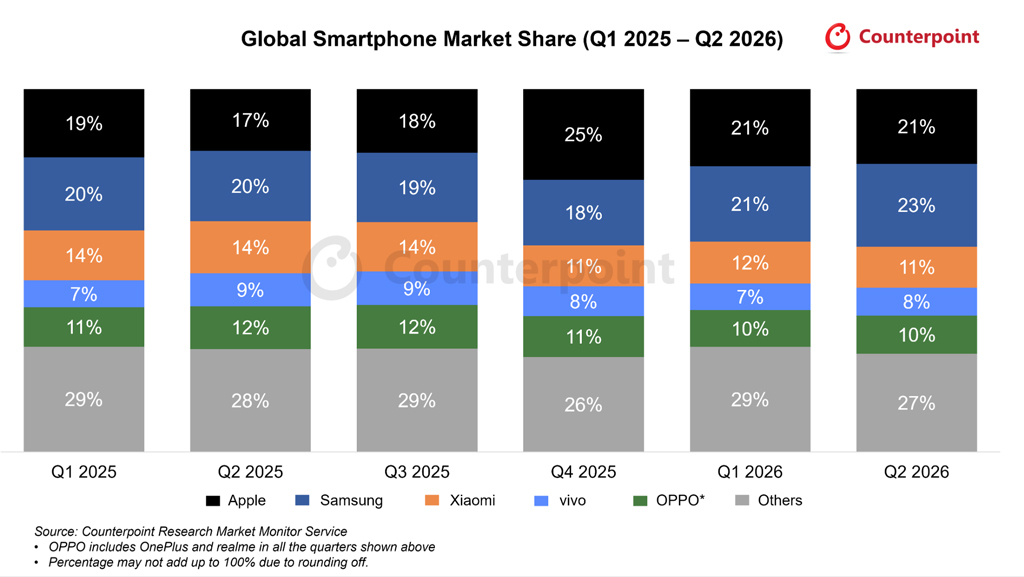
- Samsung strengthened its global smartphone market share from 20% in Q1 2025 to 23% in Q2 2026, making it the largest individual brand in the latest quarter.
- Apple increased its market share from 19% in Q1 2025 to 21% in Q2 2026, after reaching a period-high 25% in Q4 2025.
- Xiaomi maintained a steady 14% market share throughout the first three quarters of 2025 before falling to 11% in Q4 2025.
- Xiaomi’s share recovered slightly to 12% in Q1 2026, but slipped back to 11% in Q2 2026, down 3 percentage points from Q2 2025.
- vivo remained relatively stable, with its global market share fluctuating between 7% and 9% across the six quarters.
- OPPO, including OnePlus and realme, peaked at 12% in Q2 and Q3 2025 before declining to 10% in both Q1 and Q2 2026.
- Samsung and Apple together controlled 44% of the global smartphone market in Q2 2026, compared with 39% in Q1 2025.
- The combined share of Xiaomi, vivo and OPPO declined from 32% in Q1 2025 to 29% in Q2 2026.
- The Others category remained substantial, accounting for between 26% and 29% of the global smartphone market throughout the period.
- By Q2 2026, the market ranking stood at Samsung 23%, Apple 21%, Xiaomi 11%, OPPO 10% and vivo 8%, highlighting Samsung’s lead and Xiaomi’s position as the third-largest individual brand.
Frequently Asked Questions (FAQs)
Xiaomi shipped 31.2 million smartphones worldwide in Q2 2026, down 26.4% year over year.
Xiaomi held 11.3% of the global smartphone market in Q2 2026, ranking No. 3 worldwide.
Xiaomi shipped 165.2 million smartphones in 2025, a 2% decline from 168.5 million units in 2024.
Xiaomi generated RMB 186.4 billion in smartphone revenue in 2025, down 2.8% year over year.
Xiaomi’s smartphone ASP reached a record RMB 1,351 per unit in Q2 2026, up 25.9% year over year.
Conclusion
Xiaomi remains a major force in the global smartphone industry, holding the No. 3 worldwide position despite a significant decline in shipments during 2026. Rising component costs and weaker demand for lower-priced smartphones have placed pressure on the company’s traditional volume-driven strategy, particularly in markets where Redmi and other affordable devices account for a large share of sales.
At the same time, Xiaomi is increasingly relying on higher average selling prices and premium smartphones to support revenue and strengthen margins. Its growing share of higher-priced smartphone sales in China, continued top-three presence across dozens of countries and strong positions in Latin America and Southeast Asia show that the company still has considerable global reach. Going forward, Xiaomi’s performance will depend on how effectively it balances affordable-device scale with premium expansion, protects regional market share and manages higher hardware costs in an increasingly competitive smartphone market.
