


Artificial intelligence is changing how people search, discover, and consume information online. Instead of scanning a list of blue links, users increasingly receive AI-generated summaries, conversational answers, and personalized recommendations directly within search platforms. This shift affects digital marketing, e-commerce, customer support, publishing, and enterprise knowledge management by changing how brands earn visibility and traffic. Explore the statistics below to understand how AI is reshaping search.
Editor’s Choice
- More than 2 billion users now have access to Google AI Overviews, making it one of the largest AI-powered search experiences worldwide.
- Google AI Overviews appear on more than 20% of Google searches, while question-based searches trigger them much more frequently.
- During the first four months of 2026, 68.01% of Google searches in the U.S. ended without a click to another website.
- Google reported that AI Mode surpassed 1 billion monthly users during 2026, highlighting rapid adoption of conversational search.
- Gartner forecast that traditional search engine volume would decline by 25% by 2026 as users increasingly adopt AI assistants and answer engines.
- When Google AI Overviews appear, click-through rates can fall by nearly 60%, significantly changing organic search performance.
- AI-powered search now influences billions of monthly queries across consumer search, enterprise knowledge retrieval, shopping, and customer service, making AI integration a mainstream search experience rather than an experimental feature.
Recent Developments
- Google expanded AI-powered Search significantly during 2026, integrating conversational AI deeper into the core search experience.
- AI Mode now supports longer prompts, file uploads, image inputs, and conversational follow-up questions directly within Search.
- Google introduced Search Console reporting for generative AI visibility, enabling publishers to monitor AI Overview impressions separately.
- Research published in 2026 analyzed 55,393 Google queries across 19 categories to measure AI Overview behavior and citation quality.
- A separate global academic study examined 24,000 search queries across 243 countries, documenting the rapid international expansion of AI search between 2024 and 2025.
- Another large-scale study evaluated 11,500 real-world search queries to compare traditional Google Search, AI Overviews, and Gemini responses.
- AI Overview availability expanded dramatically from 7 countries in 2024 to 229 countries in 2025, illustrating one of the fastest global feature rollouts in search history.
- Google continues adding agentic AI capabilities, allowing Search to complete tasks, monitor information, and interact with connected apps rather than simply returning results.
Google Searches and AI Chats by Year
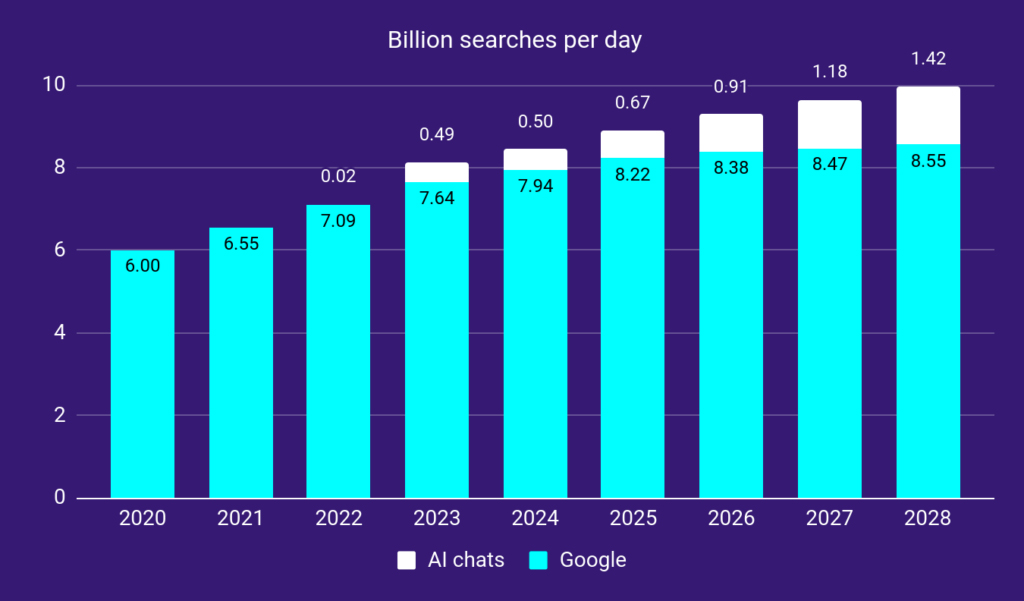
- Google searches increased from 6.0 billion per day in 2020 to 8.55 billion per day by 2028, highlighting steady long-term growth in daily search activity.
- AI chats were virtually nonexistent in 2020 and 2021, but reached 0.02 billion per day in 2022 as generative AI adoption began.
- Daily AI chat volume jumped from 0.49 billion in 2023 to 0.50 billion in 2024, reflecting continued expansion in AI-assisted search behavior.
- By 2025, AI chats climbed to 0.67 billion per day, while Google searches also rose to 8.22 billion per day.
- In 2026, users generated approximately 0.91 billion AI chats per day, alongside 8.38 billion Google searches.
- AI chat usage is projected to exceed 1 billion daily interactions in 2027, reaching 1.18 billion chats per day.
- By 2028, AI chats are expected to hit 1.42 billion per day, representing their highest level in the chart.
- The combined total of Google searches and AI chats is projected to grow from 6.0 billion daily in 2020 to nearly 10 billion (9.97 billion) daily by 2028.
- Despite rapid AI adoption, Google remains the dominant platform, accounting for 8.55 billion daily searches in 2028 compared with 1.42 billion AI chats.
- The data shows that AI chats are complementing rather than replacing traditional search, with both channels experiencing sustained growth over the forecast period.
AI Search Platform Adoption and Market Scale
- Google AI Overviews now reach over 2 billion users, making them one of the world’s largest generative AI deployments.
- Google announced that AI Mode exceeded 1 billion monthly users during 2026.
- Google Search remains the dominant discovery platform with roughly 136 billion monthly visits, despite increasing AI competition.
- AI-powered search experiences now operate across more than 200 countries, reflecting rapid international rollout.
- AI search exposure expanded from 7 countries to 229 countries within roughly one year.
- Google’s AI-powered Search increasingly combines traditional rankings, AI summaries, multimodal search, and conversational interactions into a single interface.
- Enterprise adoption of AI search continues growing as organizations integrate AI assistants into workplace search, customer support, and internal knowledge systems.
- Google continues expanding AI features beyond search results, including personalized recommendations, task completion, and agent-based interactions.
AI Search Market Growth and Forecasts
- Analysts project that traditional search volume will decline by 25% by 2026 due to growing reliance on AI assistants.
- Industry research shows AI Overview visibility ranges from 15% to 25% and exceeds 45% for information-heavy query groups.
- The global AI search engines market is projected to reach $49.83 billion in 2026 and $110.52 billion by 2033.
- The generative AI segment is expected to dominate the search landscape with a 55.2% market share in 2026.
- The web search application segment is expected to lead the overall market by holding a 62.7% share in 2026.
- Google continues integrating new capabilities while maintaining a 91.31% search engine market share worldwide in July 2026.
- North America is projected to heavily lead the AI search market by capturing a 41.4% regional share in 2026.
- The U.S. AI Search Engine Market alone is forecasted to reach $24.02 billion by 2035 with a 16.27% CAGR.
AI Search Adoption by Users and Marketers
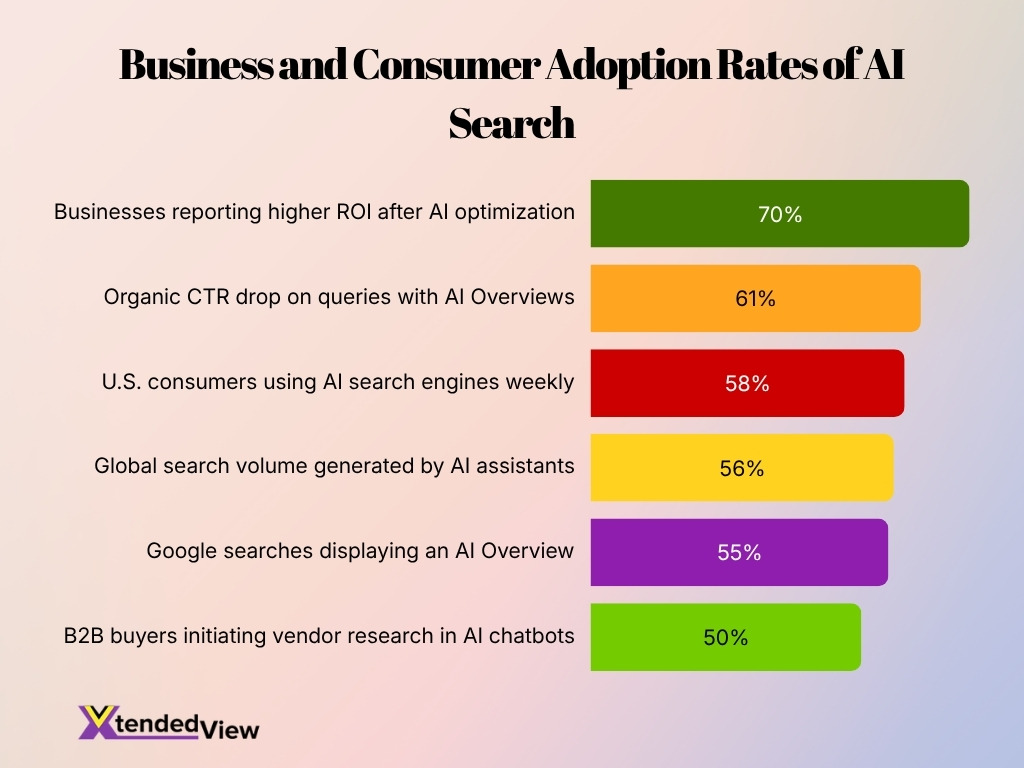
- AI assistants now generate 45 billion monthly sessions, representing 56% of global search engine volume.
- Google’s AI Overviews have reached a staggering 2 billion monthly active users globally.
- 58% of U.S. consumers now engage with AI-powered search engines at least once per week.
- Exactly 50% of B2B buyers initiate their vendor research within AI chatbots instead of traditional search engines.
- AI-driven referral traffic converts at a rate 23 times higher than standard organic search traffic.
- Approximately 55% of all Google searches currently display an AI Overview in some format.
- Organic click-through rates drop by 61% on queries where AI Overviews appear.
- Visitors arriving from AI search tools spend 45% more time on-site than traditional organic visitors.
- Only 16% of Fortune 500 companies are currently tracking their AI search visibility and performance.
- Nearly 70% of businesses report a higher ROI after integrating AI into their search optimization strategies.
Google AI Overviews and AI Mode Statistics
- A 2026 analysis of 11,500 real-user queries found that AI Overviews appeared for 51.5% of searches in the sample and usually displayed above standard organic results.
- Another 2026 study covering 55,393 queries across 19 categories found AI Overviews on 13.7% of all queries, showing that prevalence varies sharply by sample design and search intent.
- In the same study, AI Overviews appeared for 64.7% of question-based searches, compared with a much lower rate across all query types.
- About 58% of U.S. adults in a March 2025 browsing panel conducted at least one search that produced an AI-generated summary.
- AI Overview exposure expanded from seven countries in 2024 to 229 countries in 2025, indicating a rapid international rollout.
- The share of COVID-related queries that received AI answers rose from about 1% in 2024 to more than 66% in 2025, a reported increase of roughly 5,600%.
- Users can enter longer, more specific questions and ask follow-up questions within AI-powered search experiences, which expands search beyond one-query, one-results-page behavior.
- AI search features rely on the core search index and ranking systems, so pages still need to meet established crawling, indexing, and quality requirements before they can appear.
- AI-generated experiences can use a broader set of supporting links because query fan-out may run several related searches to assemble one response.
- Traditional ranking position does not guarantee AI inclusion; one 2026 comparison recorded an average source overlap below 0.20 between standard search, AI Overviews, and a conversational AI model.
Zero-Click Search and Declining Organic Clicks
- Users clicked a standard search result during 8% of visits when an AI summary appeared, compared with 15% when no AI summary appeared.
- Users clicked a source link inside an AI summary during only 1% of visits to search pages that contained one.
- Search sessions ended immediately after 26% of pages with an AI summary, compared with 16% of pages containing only traditional results.
- These figures indicate that an AI summary reduced the observed traditional-result click rate by about 47%, from 15% to 8%, in the measured U.S. browsing sample.
- Research published in 2026 estimated that AI Overview exposure caused a measurable decline in daily traffic to English-language reference articles.
- Early-2026 clickstream research placed the U.S. Google zero-click rate at approximately 68%, up from 60.45% in 2024.
- The same research associated AI Overview appearances with an organic click-through-rate decline of nearly 60%.
- A separate analysis found that clicks to the top-ranking result fell by 34.5% when an AI Overview appeared in its original 2025 dataset.
- An updated analysis published in 2026 estimated that the click reduction for top-ranking pages had widened to approximately 58%.
- Zero-click behavior does not mean that search demand disappeared. Instead, more users complete informational tasks directly on the results page without visiting a publisher, retailer, or service provider.
AI-Powered Search Usage Statistics
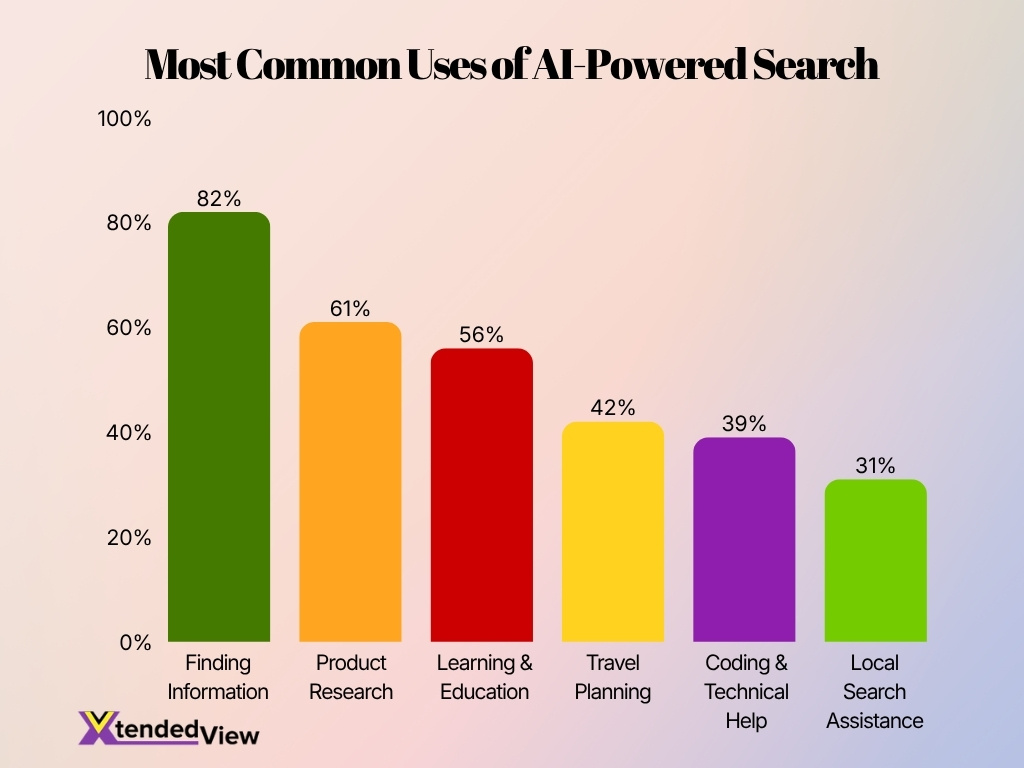
- Finding information is the leading use case for AI-powered search, with 82% of users relying on it for quick answers, research, and general knowledge.
- 61% of users turn to AI-powered search for product research, highlighting its growing role in comparing products, reading summaries, and making informed purchase decisions.
- More than half of users (56%) use AI search for learning and education, showing its importance in explaining concepts, answering academic questions, and supporting self-learning.
- Travel planning is another popular application, with 42% of users using AI search to discover destinations, build itineraries, and compare travel options.
- Around 39% of users depend on AI-powered search for coding and technical help, making it a valuable resource for developers, IT professionals, and students.
- 31% of users leverage AI-powered search for local search assistance, such as finding nearby businesses, restaurants, services, and local recommendations.
- The data shows that AI-powered search is used most heavily for information retrieval and decision-making, while specialized tasks like coding and local discovery continue to gain adoption.
- The wide range of use cases demonstrates that AI-powered search has evolved beyond traditional web search, becoming a versatile tool for education, shopping, travel, and technical problem-solving.
AI Search Behavior and Query Patterns
- Question-based queries trigger AI-generated summaries much more often, reaching 64.7% in one 2026 study.
- Users are typing longer, detailed requests instead of reducing their search needs to two or three keywords.
- Controversial questions frequently generated AI Overviews in a 2026 benchmark despite higher factual risks.
- Repeating identical query phrases across two runs did not always return the same AI answer.
- A consumer survey showed that 29% of respondents used generative AI for travel-related tasks.
- Among those who used AI for travel tasks, 84% reported that it improved their experience.
- Another 27% of respondents had used generative AI for banking or personal finance needs.
AI Referral Traffic and Conversion Performance
- Referral traffic from generative AI tools to U.S. retail websites increased by 1,200% between July 2024 and February 2025.
- During the 2024 holiday shopping season, AI-driven retail referrals increased by 1,300% year over year.
- On Cyber Monday 2024, generative AI referral traffic to retail sites rose by 1,950% year over year.
- AI referrals to U.S. travel, leisure, and hospitality websites grew by 1,700% from July 2024 to February 2025.
- AI-driven traffic to U.S. banking websites increased by 1,200% during the same seven-month period.
- From July 2024 through February 2025, overall U.S. website traffic from AI referrals increased by more than 10 times, although it remained small compared with traditional search traffic.
- A 2025 behavioral analytics study found that AI-referred visitors converted at roughly three times the rate of traffic from other measured channels.
- In that study, referrals from one AI assistant produced a subscription conversion rate 17 times higher than direct traffic and 15 times higher than search traffic.
- Referrals from a second answer engine converted at about seven times the rate of both direct and traditional search traffic in the same dataset.
- Referrals from another major AI platform converted at about four times the direct-traffic rate and three times the search-traffic rate, although performance varied by conversion type.
The AI Search Audience
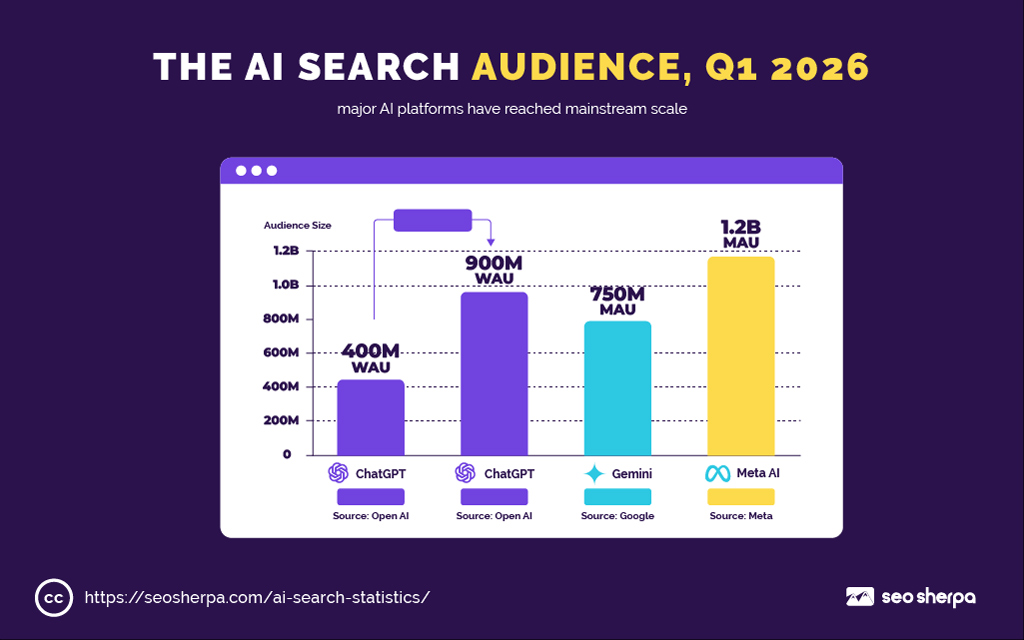
- Meta AI has the largest AI search audience, reaching 1.2 billion monthly active users (MAU) in Q1 2026, highlighting its massive global adoption.
- ChatGPT recorded 900 million weekly active users (WAU), making it one of the most frequently used AI platforms worldwide.
- Another reported milestone shows ChatGPT reaching 400 million weekly active users (WAU), demonstrating its rapid growth over time.
- Gemini attracted 750 million monthly active users (MAU), positioning it among the leading AI-powered search and assistant platforms.
- Among the platforms shown, Meta AI leads with 1.2 billion users, followed by ChatGPT at 900 million WAU, while Gemini reaches 750 million MAU.
- The chart shows that major AI search platforms have achieved mainstream scale, with every featured platform serving hundreds of millions of active users.
- Both ChatGPT and Meta AI have surpassed significant audience milestones, reinforcing the growing demand for AI-powered search and conversational assistants.
- The figures indicate that AI search adoption accelerated rapidly during Q1 2026, with platforms competing to attract and retain large active user bases.
- The presence of multiple platforms with audiences above 750 million reflects increasing competition in the AI search market and broader consumer acceptance.
- Overall, the data highlights that AI search has entered the mainstream, with leading platforms collectively serving billions of active users across weekly and monthly usage metrics.
AI Search Traffic Quality and User Engagement
- AI-referred retail visitors viewed 12% more pages per visit than those from traditional sources.
- These same retail visitors recorded a 23% lower bounce rate after their initial page view.
- AI-referred retail sessions consistently lasted 8% longer compared to non-AI traffic sources.
- Despite deeper engagement, AI-referred retail traffic converted 9% less often than conventional traffic.
- 84% of users applying generative AI to travel tasks reported a significantly improved experience.
- Overall AI-referred website traffic grew by a staggering 632% year-over-year across all industries.
- Visitors arriving from AI platform referrals convert at an average of 12% to 16%.
- AI-referred shoppers spend 48% more time evaluating product pages than non-AI visitors.
- AI search traffic converts at roughly 4.4 times the rate of traditional organic search visitors.
Factors That Influence AI Visibility and Inclusion
- A 2025 study of 1,702 citations and 1,100 URLs found metadata strongly drives AI citation behavior.
- A minimum 0.70 quality score and 12 positive signals achieved substantially higher citation rates.
- A 2026 analysis of 18,000+ fetched pages revealed longer structured pages have stronger citation influence.
- Content containing numerical evidence and comparisons contributed more information to AI-generated answers.
- High semantic alignment between a page and query increased the likelihood of AI content citation.
- Sites blocking AI-specific crawlers appeared significantly less often in AI Overviews.
- Unique content establishes a stronger foundation for AI visibility than mass-produced pages.
- Relying on a specific word count or schema provides a 0% guarantee for AI system inclusion.
AI Citation Statistics
- A 2025 study analyzed more than 24,000 conversations, 65,000 responses, and 366,000 citations generated by AI search systems.
- Only 9% of citations in that dataset pointed to news sources, despite news content playing an important role in current-information queries.
- News citations concentrated among a relatively small group of publishers, indicating that AI exposure does not spread evenly across the available news ecosystem.
- Low-credibility news sources appeared infrequently in the cited responses, although the systems did not eliminate credibility and bias concerns.
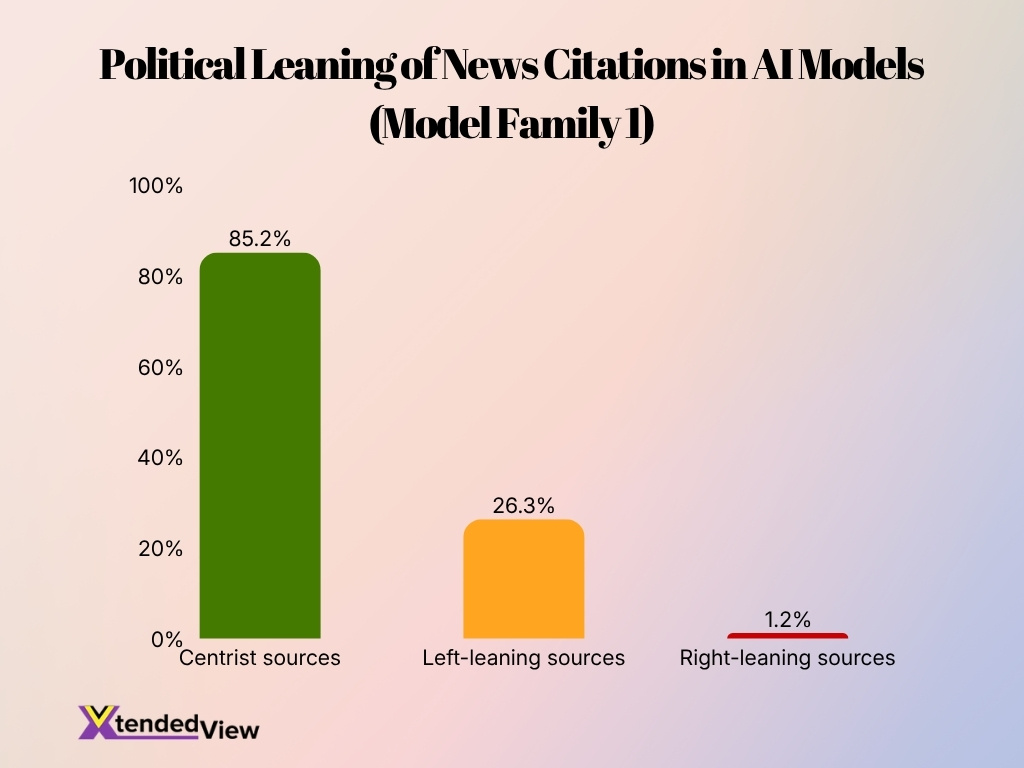
- In the news dataset, centrist sources represented 85.2% of citations from one model family, 75.2% from another, and 72.8% from a third.
- Left-leaning sources represented 26.3%, 23.6%, and 14.5% of citations across the three model families studied.
- Right-leaning sources accounted for only 0.3% to 1.2% of citations across those same model families.
- A separate study of 55,936 queries found that 37% of cited domains were unique to AI-based search engines and did not appear in the traditional-search comparison set.
- A 2026 citation framework analyzed 21,143 valid citations, 23,745 citation records, and 18,151 fetched pages across 602 controlled prompts.
- That research found that some platforms cited more sources, while others cited fewer sources but drew more heavily from each selected page when composing the final answer.
AI Search Rankings and Visibility
- An analysis of 863,000 search results found that only 38% of AI Overview citations came from pages ranking in the top 10 organic results in 2026, down from 76% in the previous study.
- The same research evaluated roughly 1.9 million citations, providing evidence that AI citation visibility and conventional organic rankings no longer move in lockstep.
- Another 2025 dataset covering 362,000 keywords found that 94% of AI Overviews included at least one source from the top 20 organic results.
- That study recorded a 90% query-level overlap between AI Overview citations and the top 10 results. However, this does not mean that 90% of all cited pages ranked in the top 10.
- A controlled comparison of traditional and AI search recorded an average source overlap below 0.20, showing that platforms can produce sharply different source sets for the same information need.
- AI search systems showed a stronger preference for earned media and independent third-party sources than for brand-owned or social content in large-scale 2025 experiments.
- Citation rankings can change when a researcher repeats the same prompt. A 2026 study found substantial visibility variation during both daily and 10-minute sampling intervals.
- Apparent differences between two domains may fall within the measurement noise when analysts rely on only one or a few generated responses.
- AI-generated search exposed users to fewer long-tail information sources and less response variety than traditional search in an analysis of 2.8 million results.
- Strong traditional rankings still support discoverability, but brands must also earn inclusion in the external sources that AI platforms trust and cite. This conclusion follows from the observed preference for third-party authority and limited cross-platform overlap.
GEO Adoption and Measurement Trends
- 50% of consumers were using AI-powered search by late 2025, driving the need to measure visibility beyond traditional search.
- AI-powered search could influence $750 billion in revenue by 2028.
- A 2026 survey of 1,115 communications professionals showed uncertainty about which function should own GEO.
- Organizations are shifting to tracking brand mentions, citation frequency, and source position instead of keyword rankings.
- Measuring AI visibility requires repeated testing as the same prompts can yield varying results across runs.
- A 2026 measurement study quantified how quickly citation results change using separate tests at 10-minute intervals.
- Citation distributions show a power-law pattern, with a few domains capturing most of the visibility.
- Researchers advise reporting confidence intervals around citation share rather than exact percentages.
- Teams should segment GEO measurement by platform, language, and market due to differing AI engine sensitivities.
- AI-feature traffic blends into standard web search reporting, requiring referral analysis to assess its full impact.
AI Search Performance Metrics
- AI citation rate: Studies show using named, authoritative citations can lift AI visibility by 40%.
- Brand mention rate: Including specific statistics can boost your citation rate by 37%.
- Share of voice: Actively managing Generative Engine Optimization (GEO) helps capture 30-40% more AI referral traffic.
- Citation position: Approximately 38% of pages cited in Google AI Overviews also rank in the top 10 organic results, down from 76% previously.
- Prompt coverage: AI Overviews appear on over 40% of US queries, drastically altering click-through dynamics.
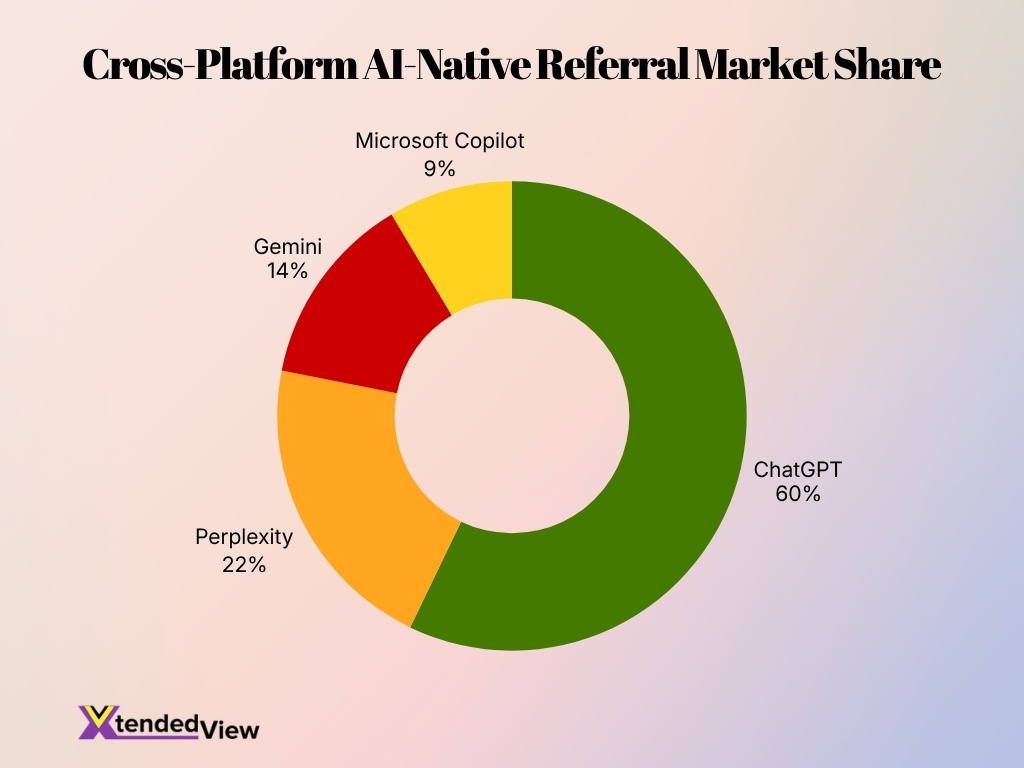
- Cross-platform consistency: ChatGPT leads AI-native referrals with a 55-60% share, followed by Perplexity (18-22%), Gemini (10-14%), and Microsoft Copilot (6-9%).
- Citation stability: Using a variety of technical vocabulary can earn 15% more AI references.
- AI referral sessions: AI-driven referral traffic to US retail sites saw a massive 693% year-over-year surge during the 2025 holiday season.
- Engaged-session and conversion rates: AI-referred traffic converts 31% better than non-AI traffic, with a 33% lower bounce rate.
- Assisted revenue and conversions: Brands optimizing for AI visibility experienced a 254% year-over-year increase in AI-driven revenue per visit during the 2025 holiday season.
AI Search and Content Optimization
- Roughly 60% of traditional queries now result in zero clicks as AI summaries fulfill user intent.
- Purely AI-generated content secures the top ranking position just 9% of the time.
- Only 17% of the sources cited within AI Overviews rank in the top 10 organic results.
- Nearly 44.2% of all LLM citations are extracted directly from the first 30% of a webpage’s text.
- AI Overviews reduce the organic click-through rates by 34.5% for traditionally top-ranking pages.
- Almost 70% of readers move on after scanning only the first third of an AI overview.
- Over 80% of consumers now rely on AI summaries for at least 40% of their daily searches.
- Approximately 26% of searches featuring AI summaries end without users making additional clicks.
- Visitors from AI search tools spend 68% more time on-site compared to traditional organic traffic.
AI Integration in Search: Key Trends
- AI search expanded from seven countries in 2024 to 229 countries in 2025 in a study that executed 24,000 queries across 243 countries.
- The same research generated 2.8 million AI and traditional results, documenting rapid changes in geographic availability, source diversity, and topic coverage.
- AI answers appeared for only about 1% of COVID-19 queries in 2024, but the figure exceeded 66% in 2025.
- Consumers increasingly use conversational queries, follow-up questions, and multimodal inputs rather than completing every task through isolated keyword searches.
- Search platforms are moving from information retrieval toward task completion, including planning, comparison, shopping, and other multistep activities.
- AI search does not always reduce community engagement. One 2026 study associated AI Overviews with a 12% increase in daily comments and a 12.3% increase in commenting users in eligible online communities.
- Those engagement gains concentrated in discussions involving personal experience, opinions, and advice rather than straightforward factual information.
- The later introduction of conversational AI Mode largely eliminated the measured engagement gains for experience-based discussions, showing that interface design can alter downstream behavior.
- AI search may concentrate attention among fewer publishers because it surfaces fewer long-tail sources than traditional results.
- As a result, search strategy in 2026 increasingly combines SEO, digital public relations, structured content, brand authority, conversion measurement, and platform-specific GEO.
Frequently Asked Questions (FAQs)
Google AI Overviews reach more than 2 billion users worldwide.
A 2026 study found AI Overviews on 13.7% of all queries and 64.7% of question-based queries.
A 2026 causal study found that AI Overview exposure reduced daily traffic to matched English-language reference pages by approximately 15%.
Users clicked a traditional search result on 8% of visits with an AI summary, compared with 15% when no summary appeared.
AI-driven U.S. website referrals grew by more than 10 times from July 2024 to February 2025, while retail referrals increased 693% year over year during the 2025 holiday season.
Conclusion
AI integration is transforming search from a traditional list of links into an intelligent system that can summarize, compare, and complete tasks. While strong organic rankings remain valuable, they no longer guarantee visibility in AI-generated responses. Organizations now need to combine SEO with GEO by creating accurate, original, and well-structured content that AI systems can easily interpret and trust. Success increasingly depends on earning authoritative third-party mentions, monitoring AI citations and referral performance, and measuring visibility across multiple AI platforms.
As AI-powered search continues to expand globally, brands that prioritize credibility, user value, and consistent optimization will be better positioned to maintain visibility and drive meaningful business results.
