


Smartphone battery life now shapes how people work, stream, travel, and play. Longer-lasting batteries help remote workers stay productive throughout the day, while efficient power management lets gamers and video creators spend more time using demanding apps without reaching for a charger. Battery technology has also become a major factor in purchase decisions as consumers keep their devices longer and expect better longevity. Explore the statistics below to see how smartphone battery life continues to evolve.
Editor’s Choice
- Consumers now keep their smartphones for about 3.5 years globally, compared with roughly two years a decade ago, increasing the importance of long-term battery health.
- Poor battery life remains one of the leading reasons consumers replace their smartphones, alongside slower performance and physical damage.
- 85% of consumers consider sustainability an important factor when buying their next smartphone, driving demand for batteries that last longer before degrading.
- Modern flagship smartphones in 2026 can exceed 25 hours of continuous web browsing in standardized endurance tests, compared with around 11 hours for an average smartphone.
- Several flagship Android devices released during 2025–2026 feature batteries between 6,000 mAh and 7,500 mAh, reflecting the industry’s move toward higher-capacity silicon-based batteries.
- Independent battery testing now evaluates autonomy, charging speed, and energy efficiency instead of relying only on battery capacity, giving consumers a more complete view of performance.
- Standardized testing organizations now measure battery performance across more than 100 measurement points and approximately 150 hours of testing per smartphone.
Recent Developments
- Smartphone makers accelerated the adoption of silicon-carbon battery technology during 2025–2026, allowing larger battery capacities without significantly increasing phone thickness.
- Several flagship smartphones introduced in 2026 now ship with batteries exceeding 7,000 mAh, a major jump from premium devices launched just a few years earlier.
- Battery endurance has improved even when battery size remains unchanged, thanks to more efficient chipsets and software optimization. Samsung’s Galaxy S26 Ultra, for example, lasts longer than its predecessor despite using the same battery capacity.
- Regulatory requirements in Europe now require energy labels for smartphones, including information on battery endurance, durability, and cycle life, making battery quality easier to compare.
- Independent testing labs increasingly evaluate wired charging, wireless charging, quick charging, and battery efficiency using repeatable laboratory conditions.
- Phone reviewers now publish separate endurance scores for web browsing, video playback, and gaming, helping consumers compare real-world performance instead of relying only on manufacturer claims.
- High-refresh-rate OLED displays continue becoming more power efficient, contributing to longer battery life across premium smartphones released in 2025 and 2026.
- Battery optimization through AI-based power management has become a common feature across flagship Android devices, improving daily endurance without increasing battery size.
Smartphone Battery Life Overview
- Most flagship smartphones released in 2025–2026 deliver well over a full day of moderate usage under typical real-world conditions.
- Average smartphones achieve around 11 hours in standardized continuous web browsing tests, while top-performing models exceed 20 hours.
- Battery capacity alone does not determine endurance because chipset efficiency, display technology, software optimization, and network usage significantly affect runtime.
- Modern battery evaluations measure autonomy, charging speed, and efficiency to provide a complete assessment of smartphone battery performance.
- Testing protocols now simulate both home/office use and mobile use, creating results that better reflect everyday smartphone usage.
- Real-world testing includes activities such as video streaming, gaming, voice calls, idle standby, and music playback instead of measuring only standby time.
- Battery efficiency has become increasingly important because faster charging and larger batteries also require better thermal management.
- Consumers increasingly evaluate smartphones based on battery longevity over multiple years, rather than only first-day battery life.
Mobile Battery Market Statistics
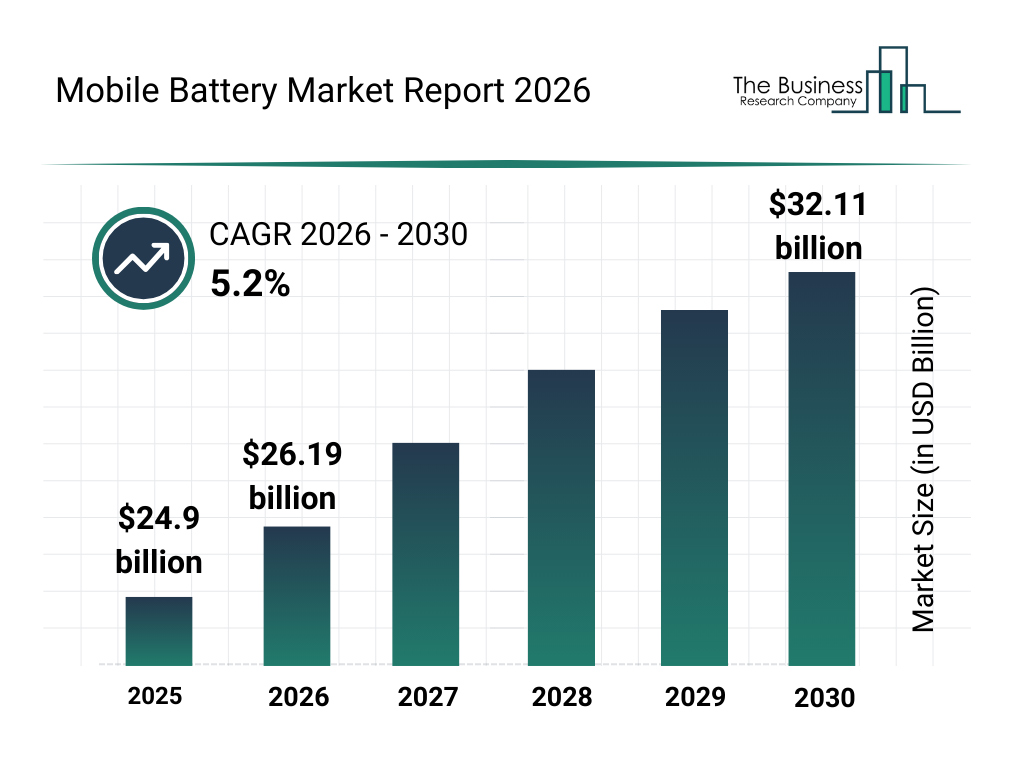
- The global mobile battery market was valued at $24.90 billion in 2025, establishing a strong base for continued expansion.
- In 2026, the market is projected to reach $26.19 billion, an increase of approximately $1.29 billion from the previous year.
- The market is expected to grow at a 5.2% CAGR between 2026 and 2030, reflecting steady demand for higher-capacity and longer-lasting mobile batteries.
- By 2027, the mobile battery market is estimated to reach approximately $27.55 billion, supported by rising smartphone usage and battery replacement demand.
- The market could expand to nearly $28.98 billion in 2028, maintaining consistent year-over-year growth.
- In 2029, the global market is projected to surpass $30 billion, reaching an estimated $30.49 billion.
- By 2030, the mobile battery market is forecast to reach $32.11 billion, representing an increase of about $5.92 billion compared with 2026.
- Overall, the market is expected to grow by approximately 22.6% from 2026 to 2030, highlighting sustained investment and demand across the mobile device industry.
Global Smartphone Battery Life Statistics
- Global smartphone replacement cycles have increased to approximately 3.5 years, placing greater emphasis on batteries that retain capacity over time.
- Surveys consistently identify poor battery life as one of the primary reasons consumers upgrade smartphones.
- 70% of consumers surveyed by GSMA say they care about the environmental impact of their smartphones, increasing interest in longer-lasting batteries and repairs.
- 85% of consumers consider sustainability important when purchasing a new smartphone, encouraging manufacturers to improve battery durability.
- Global flagship smartphones increasingly ship with 6,000–7,500 mAh batteries, particularly in Asian markets.
- Battery endurance improvements during 2025–2026 came from both larger battery capacities and more efficient processors, rather than capacity increases alone.
- Energy labeling rules introduced in Europe now provide standardized information about battery endurance and cycle durability for smartphones sold in participating markets.
- Independent laboratory benchmarking has become a widely accepted reference for comparing smartphone battery performance across brands worldwide.
Longest-Lasting Smartphones
- In independent testing during 2026, the OnePlus 15 achieved approximately 25 hours and 13 minutes of continuous web browsing, setting one of the highest endurance scores recorded.
- The OnePlus 15R also exceeded 21 hours in standardized battery testing, demonstrating that strong battery life is available beyond premium flagship pricing.
- The Asus ROG Phone 9 Pro surpassed 20 hours of battery life in web browsing tests, making it one of the strongest gaming-focused smartphones for endurance.
- Motorola’s Moto G 2026 delivered roughly 19 hours of battery life despite targeting the budget smartphone segment.
- Apple’s iPhone 17 Pro Max reached nearly 18 hours in standardized endurance testing, leading the current iPhone lineup.
- The Samsung Galaxy S26 Ultra exceeded 16 hours in standardized testing while improving on the previous generation without increasing battery capacity.
- The Motorola Razr Ultra (2025) became the first foldable smartphone to enter several long-battery-life rankings with approximately 15 hours and 42 minutes of endurance.
- Independent lab rankings show that several 2025–2026 Android smartphones now comfortably provide two-day battery life under moderate usage.
Battery Life Rankings by Brand
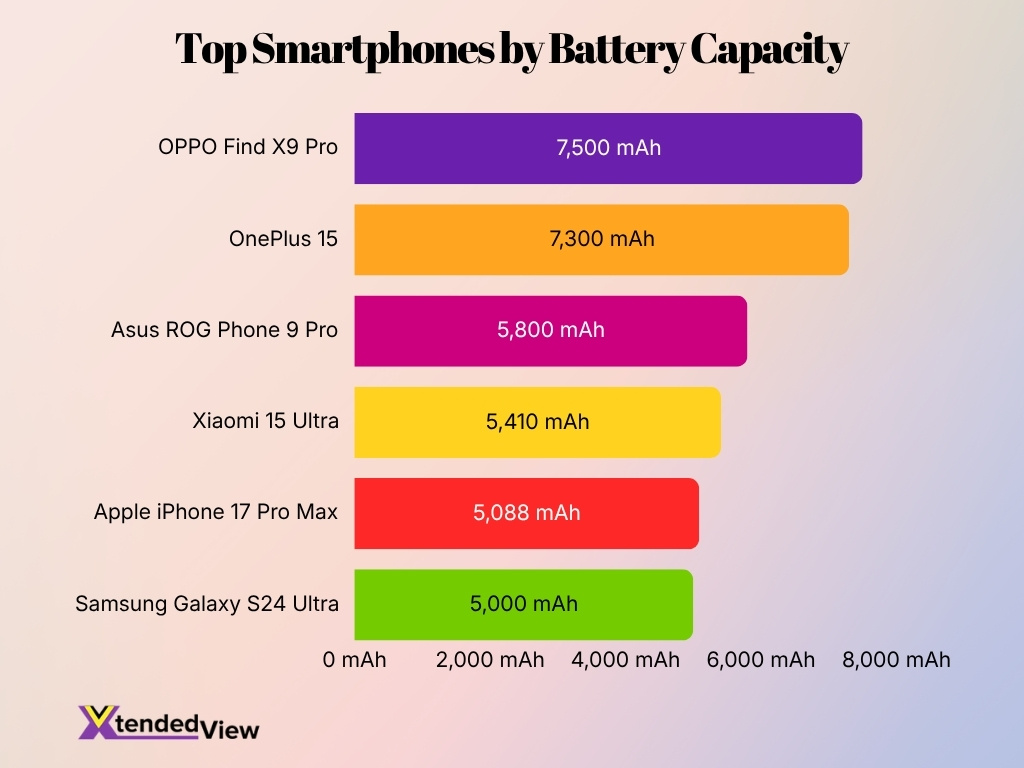
- The OnePlus 15 packs a 7,300 mAh battery and lasts 26 hours and 26 minutes in standardized performance tests.
- Samsung Galaxy S24 Ultra manages around 16.75 hours of continuous web browsing on a highly efficient 5,000 mAh cell.
- The Apple iPhone 17 Pro Max delivers 17.5+ hours of web browsing utilizing a relatively smaller 5,088 mAh battery capacity.
- The Asus ROG Phone 9 Pro dominates gaming endurance with 20 hours and 34 minutes of runtime from a 5,800 mAh battery.
- Xiaomi 15 Ultra utilizes a 5,410 mAh battery to achieve a solid 17 hours of continuous workflow benchmark testing.
- The OPPO Find X9 Pro features a massive 7,500 mAh capacity that powers over 34 hours of continuous Wi-Fi endurance.
- The OPPO Find X9 Pro pairs its class-leading battery size with exceptionally fast 80W wired charging capabilities.
- OnePlus 13 reached an impressive 19 hours and 45 minutes of battery life during continuous cellular web browsing tests.
Battery Life Rankings by Operating System
- Recent large-scale testing found that iOS and Android flagship devices now deliver comparable battery performance, with both platforms exceeding 16 hours on leading models.
- The iPhone 17 Pro Max ranks among the longest-lasting smartphones tested in North America, approaching 18 hours of continuous web browsing.
- Android currently holds the overall battery-life record through the OnePlus 15, which surpassed 25 hours in standardized testing.
- Android manufacturers benefit from adopting silicon-carbon battery technology, enabling capacities above 7,000 mAh while maintaining slim designs.
- Apple continues to achieve competitive endurance despite using batteries below 5,100 mAh, highlighting the efficiency of hardware and software integration.
- Android offers greater variation in battery life because manufacturers use different chipsets, displays, battery capacities, and charging systems.
- Modern operating systems dynamically optimize background processes, adaptive refresh rates, and AI-assisted power management to extend battery life.
- Battery optimization updates released through operating system upgrades continue improving real-world endurance after devices reach consumers.
Battery Life Rankings by Price Range
- Smartphones priced under $200 now regularly deliver 18 to 19 hours of battery life in standardized web browsing tests, showing that strong endurance is no longer limited to premium devices.
- The Moto G (2026), priced below $200, recorded approximately 19 hours and 10 minutes of battery life, outperforming many flagship smartphones.
- Mid-range smartphones in the $300–$600 segment increasingly include 6,000–7,000 mAh batteries, narrowing the endurance gap with premium models.
- Premium smartphones priced above $800 focus more on chipset efficiency and software optimization than simply increasing battery size.
- Several flagship phones above $1,000 now exceed 16 hours in continuous battery testing despite having smaller batteries than some mid-range Android devices.
- Budget phones generally achieve longer endurance because they use less power-hungry processors and lower-resolution displays.
- Premium foldable smartphones have significantly improved battery efficiency in 2025–2026, with several models now comfortably lasting an entire day under normal usage.
- Across all price segments, battery life has improved year over year as manufacturers adopt more efficient silicon-carbon batteries and advanced power management.
Smartphone Battery Capacity in India
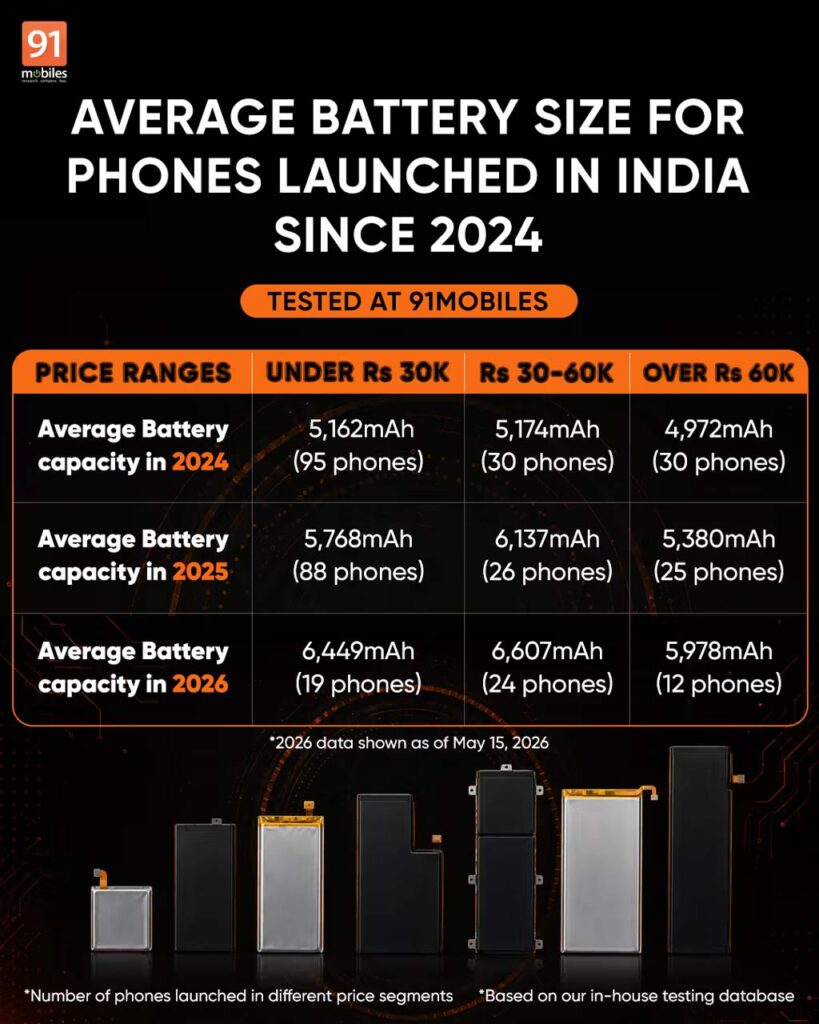
- Average smartphone battery capacity increased across all three price segments between 2024 and 2026, highlighting the industry’s growing focus on longer battery life.
- Phones priced under Rs 30K recorded an increase from 5,162 mAh in 2024 to 6,449 mAh in 2026, representing growth of nearly 25%.
- The Rs 30K–60K segment had the largest average battery capacity in every year, rising from 5,174 mAh in 2024 to 6,607 mAh in 2026.
- Midrange phones experienced the strongest overall battery growth, with average capacity increasing by approximately 27.7% between 2024 and 2026.
- Premium smartphones priced over Rs 60K consistently had the smallest batteries, although their average capacity still climbed from 4,972 mAh to 5,978 mAh.
- In 2025, phones priced between Rs 30K and Rs 60K crossed the 6,000 mAh threshold, reaching an average battery capacity of 6,137 mAh.
- By 2026, both the under Rs 30K and Rs 30K–60K categories averaged more than 6,400 mAh, indicating that high-capacity batteries are becoming mainstream.
- The battery-capacity gap between midrange and premium phones widened from 202 mAh in 2024 to 629 mAh in 2026.
- Budget smartphones showed particularly great improvement between 2025 and 2026, with average battery size rising by 681 mAh, from 5,768 mAh to 6,449 mAh.
- The findings suggest that price is no longer a direct indicator of battery size, as affordable and midrange phones now offer larger batteries than premium models.
- The 2026 figures are based on data available through May 15, 2026, with smaller samples of 19, 24, and 12 phones across the three price categories.
Smartphone Battery Life by Year
- Between 2020 and 2026, flagship smartphone battery endurance increased by over 50% in benchmarks.
- In 2025, multiple smartphones exceeded the 20-hour battery-life milestone in web browsing tests.
- By 2026, several smartphones surpassed 25 hours, establishing a new industry benchmark.
- Average flagship battery capacity has increased from 4,500–5,000 mAh to 6,000–7,500 mAh.
- Battery improvements increasingly stem from processor efficiency rather than battery capacity alone.
- Silicon-carbon batteries became a major trend during 2025–2026 by enabling higher energy density.
- Foldable smartphones showed massive annual battery-life gains due to more efficient displays.
- Flagship Android battery charging speeds improved substantially to support 80W to 100W wired charging.
Battery Performance by Chipset
- The latest 3nm flagship chipsets improve overall power efficiency by up to 20% compared to the previous generation.
- Apple’s newest processor reduces power consumption by 30% during demanding high-performance workloads.
- Upgrading to a next-generation processor adds an average of 2 to 3 hours of real-world battery life.
- Advanced manufacturing processes decrease thermal throttling by nearly 25%, significantly reducing wasted battery energy.
- Dedicated on-device AI power management engines reduce smartphone idle battery drain by up to 15%.
- Modern gaming-optimized chipsets sustain optimal frame rates while consuming 20% less battery power.
- Several flagship smartphones with next-generation processors have officially surpassed 20 hours of continuous battery life.
- Processor efficiency accounts for over 40% of the variance in battery endurance among devices with identical capacities.
Battery Performance in Real-World Tests
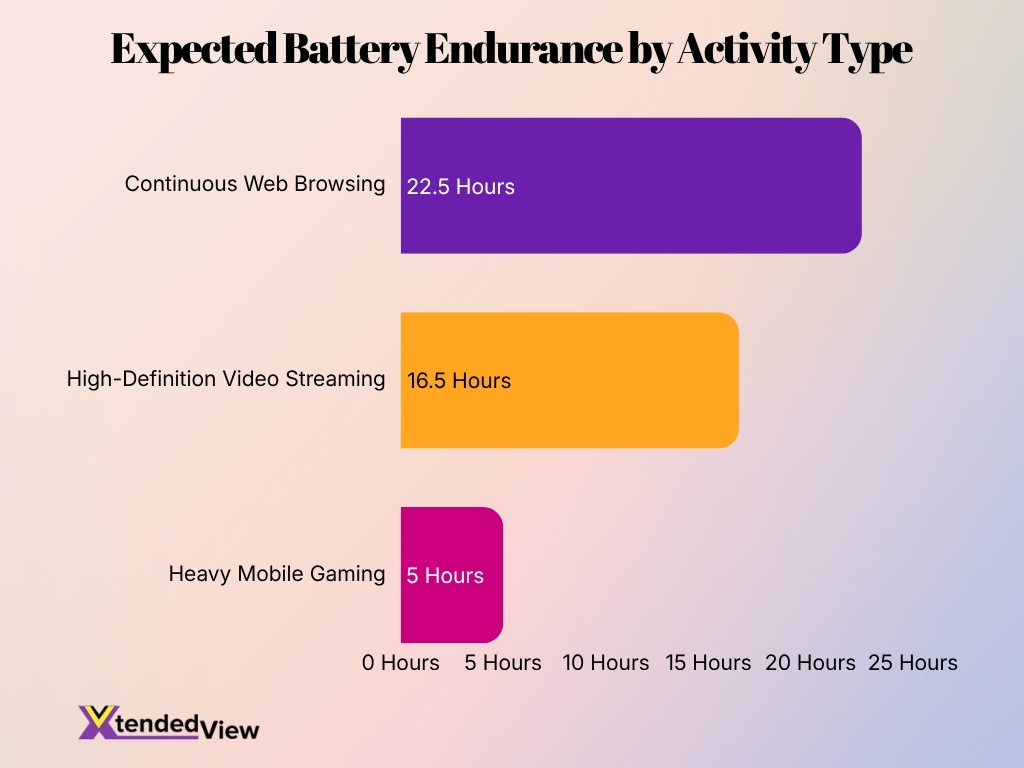
- Top smartphones achieve 20–25 hours of continuous web browsing in controlled tests.
- Standardizing display brightness at 200 nits is common practice for ensuring fair battery comparisons.
- Heavy mobile gaming can deplete a full smartphone battery in just 4 to 6 hours of continuous play.
- Streaming high-definition video over Wi-Fi typically yields 15 to 18 hours of playback on flagship devices.
- A weak cellular signal can increase smartphone battery drain by up to 30 percent during daily use.
- Modern fast charging technologies can replenish 50 percent of a battery in roughly 15 to 30 minutes.
- Background application activity accounts for nearly 20 percent of overall power consumption in real-world scenarios.
- Using 5G networks instead of 4G LTE typically reduces total battery endurance by approximately 10 to 15 percent.
Battery Performance in Gaming
- The Asus ROG Phone 9 Pro delivers exactly 20 hours and 34 minutes of overall battery endurance.
- Modern flagship smartphones easily sustain over 10 hours of continuous heavy gaming workloads.
- The RedMagic 11 Pro pairs its high-end graphics with a massive 7000 mAh battery capacity.
- Intensive gaming activities can drain smartphone batteries up to 3 times faster than standard video playback.
- Advanced vapor chamber cooling improves power efficiency by reducing thermal throttling by up to 40%.
- Utilizing adaptive refresh rate technology can conserve up to 30% of overall battery power during gameplay.
- High-refresh displays running at 165Hz consume roughly 60% more power than standard 60Hz screens.
- Dedicated software balancing modes can extend total gaming time by securely capping frame rates at 60 FPS.
Battery Performance in Video Streaming
- Continuous YouTube video playback tests on devices like the OnePlus 8 reached 9 hours and 37 minutes.
- OLED displays drop to just 15% of peak power usage during dark video scenes.
- Streaming dark-themed media on an OLED screen saves up to 55% more power than an LCD panel.
- Next-generation silicon-carbon batteries deliver a 10% to 20% capacity increase in the same physical space.
- Advanced silicon-carbon battery energy densities now reach between 400 and 500 Wh/kg.
- Watching a Netflix show on an OLED display consumes around 80mW versus 180mW on an LCD.
- High-density battery technology enables new flagships to pack massive 6,000mAh capacities for extended streaming.
- Viewing vibrant media on an OLED device uses approximately 18% less battery power per hour than alternatives.
Fastest Charging Smartphones
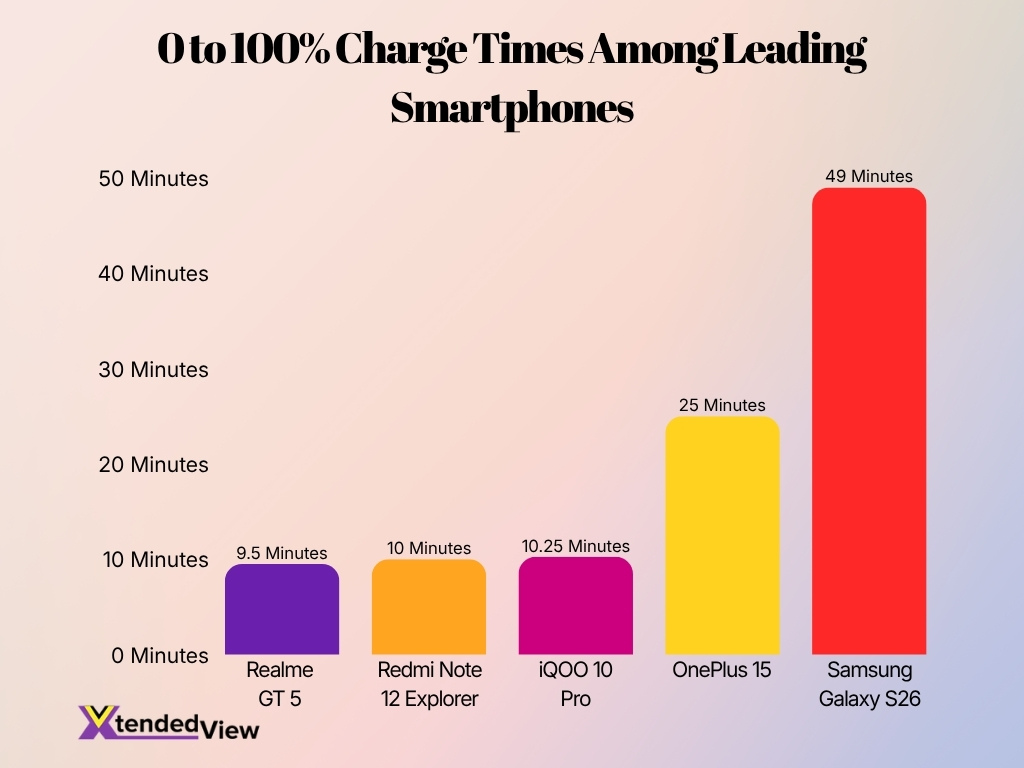
- The Realme GT 5 achieves a complete 0 to 100% charge in a staggering 9 minutes and 30 seconds utilizing 240W fast charging technology.
- A massive 7,300 mAh battery allows the OnePlus 15 to reach a full charge in just 25 minutes using a 120W adapter.
- The Redmi Note 12 Explorer can completely replenish its 4,500 mAh battery in exactly 10 minutes with its 210W charging speeds.
- Global consumer demand for smartphone charging times under 15 minutes recently surged by 45% year-over-year.
- Devices supporting 240W speeds use multicell batteries to split voltage, effectively reducing charging heat generation by 20%.
- Batteries undergoing extreme 240W charging are rigorously tested to withstand 1,600 charge cycles while maintaining 80% of their original capacity.
- The iQOO 10 Pro leverages 200W power delivery to fully charge its 4,700 mAh battery in exactly 10 minutes and 15 seconds.
- Mainstream competitors remain more conservative, with the Samsung Galaxy S26 peaking at 60W for a 49-minute full charge.
- The Honor Magic7 Pro balances rapid wired speeds with an industry-leading 80W wireless charging option.
- Fast charging smartphones now dominate 70% of market shipments as consumers increasingly prioritize minimizing daily downtime.
Battery Health and Longevity
- European regulations in 2025 mandate smartphone batteries retain 80% capacity after 800 charge cycles.
- Several flagship smartphones tested in 2026 achieved verified durability ratings of 1,000 charge cycles.
- Mid-range smartphone ownership cycles are projected to increase from 3.0 to 4.1 years under new standards.
- Standard lithium-ion batteries typically degrade to 80% of original capacity after 400 to 500 charge cycles.
- Maintaining battery charge levels between 20% and 80% can increase overall lifespan by up to 50%.
- Exposing smartphones to ambient temperatures above 35°C (95°F) permanently reduces total battery capacity.
- Silicon-carbon smartphone batteries deliver up to 20% higher energy density while maintaining traditional longevity.
- Using adaptive overnight charging features can reduce long-term battery degradation by up to 30%.
Battery Testing Methods
- Batteries are tested to retain 80% of their original capacity after enduring 500 to 800 complete charge cycles.
- Controlled laboratory evaluations run strictly at an ambient temperature of 23°C (73°F) to ensure consistent baseline results.
- Screen brightness is standardized at exactly 200 nits across all automated web browsing and streaming simulations.
- Fast-charging validation accurately measures the exact minutes required to safely restore a depleted device to 50% capacity.
- Standardized background drain testing evaluates standby performance, which commonly averages a 1% to 2% power loss per hour.
- Extreme environmental stress tests expose smartphones to 40°C heat or 0°C cold to quantify thermal degradation metrics.
- European energy labels legally mandate displaying precise battery endurance scores formatted in exact hours and minutes.
- Continuous active usage benchmarks rigorously verify that modern flagship devices sustain 10 to 12 hours of uninterrupted screen-on time.
Factors That Affect Smartphone Battery Life
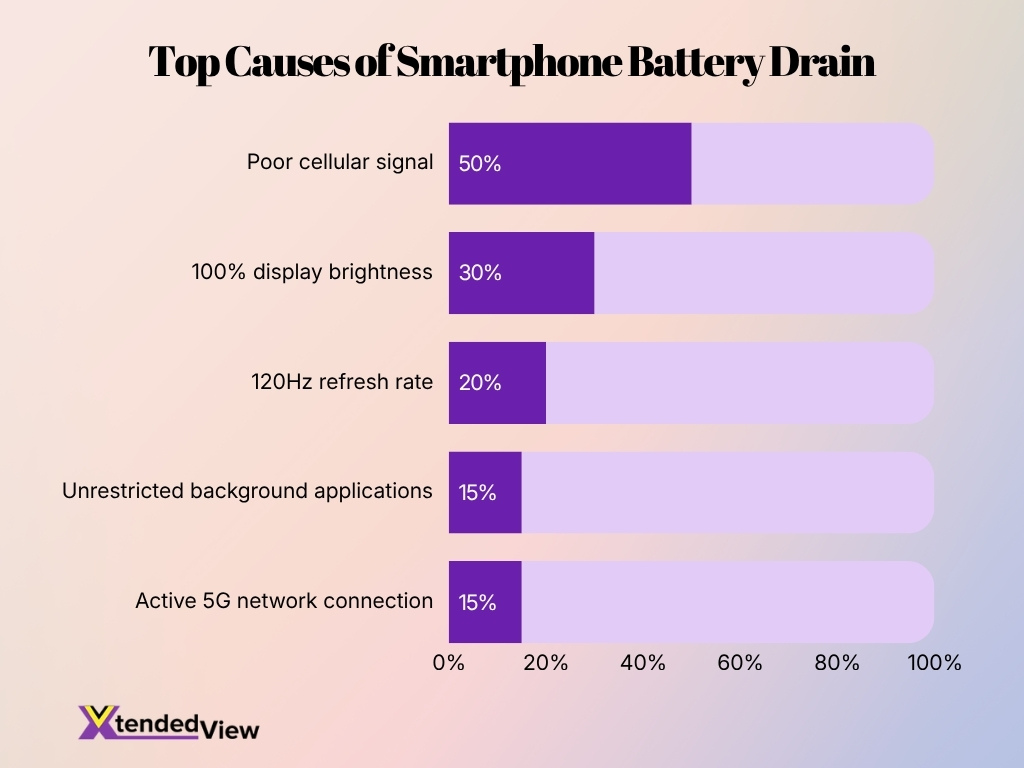
- Displays running at 100% brightness can drain a battery up to 30% faster than auto-brightness settings.
- Operating continuously at a 120Hz refresh rate consumes approximately 20% more battery than a standard 60Hz display.
- Smartphones struggling with a poor cellular signal can experience an increased battery drain of up to 50%.
- Intensive mobile gaming can completely deplete a fully charged smartphone battery in just 3 to 4 hours.
- Exposing a device to temperatures above 95°F (35°C) can permanently degrade battery capacity by 20% over a year.
- Active 5G network connections typically drain a smartphone battery 10% to 20% faster than standard 4G LTE networks.
- Unrestricted background applications and location services account for roughly 15% of daily power consumption.
- Continuous GPS navigation on mobile data can reliably consume 10% to 15% of battery life per hour.
Battery Technology and Innovation Statistics
- Silicon-carbon batteries have become one of the biggest smartphone battery innovations since 2024, enabling substantially larger capacities without increasing device thickness.
- Several flagship smartphones introduced during 2026 now feature batteries above 7,000 mAh, compared with the traditional 5,000 mAh standard seen only a few years ago.
- Samsung adopted silicon-carbon battery technology in its latest foldable smartphones during 2026, joining other manufacturers already using the technology.
- New energy labeling regulations require manufacturers to disclose battery endurance, repairability, and durability, increasing transparency for consumers.
- Smartphone batteries sold under current European regulations must withstand at least 800 charge cycles while retaining 80% capacity, improving long-term reliability.
- Some flagship smartphones listed in the European product registry now declare 1,000 battery cycles, exceeding minimum regulatory requirements.
- Repairability scores are now displayed alongside battery endurance on official energy labels, helping consumers evaluate overall device longevity.
- The industry increasingly prioritizes battery density, charging efficiency, durability, and sustainability instead of focusing exclusively on larger battery capacities.
Frequently Asked Questions (FAQs)
The OnePlus 15 currently leads major battery rankings with approximately 25 hours and 13 minutes of continuous web browsing on a single charge.
Smartphone batteries must retain at least 80% of their original capacity after 800 full charge cycles under the latest European ecodesign requirements.
Several flagship smartphones launched in 2026 feature batteries ranging from 7,300 mAh to 8,500 mAh, significantly higher than the previous 5,000 mAh norm.
Top-performing smartphones now deliver more than 30 hours of continuous video playback in standardized battery tests, with the OnePlus 15 reaching approximately 30 hours and 6 minutes.
The Pixel 8a and later models are designed to retain 80% battery capacity for about 1,000 charge cycles, compared with 800 cycles for earlier Pixel generations.
Conclusion
Smartphone battery life reached another milestone, driven by larger silicon-carbon batteries, more efficient processors, and smarter software optimization. Flagship devices now routinely deliver one to two full days of real-world use, while budget and mid-range phones continue to narrow the performance gap. At the same time, charging speeds have accelerated, battery durability standards have become more transparent, and new regulations now help consumers compare long-term battery health before making a purchase. As innovation continues, battery life, charging performance, and longevity will remain among the most influential factors shaping the next generation of smartphones.
