



Claude has become one of the fastest-growing AI assistants in the global generative AI market. Businesses now use Claude to automate customer support, accelerate software development, summarize legal documents, and improve enterprise workflows. Meanwhile, students, marketers, developers, and researchers increasingly rely on Claude for daily productivity tasks across web and mobile platforms.
The platform’s rapid growth reflects broader enterprise AI adoption, especially as organizations prioritize secure AI systems with strong reasoning and coding capabilities. From Fortune 500 deployments to mobile app expansion, Claude’s footprint widened significantly throughout. This article explores the latest Claude statistics, market trends, adoption figures, and usage data shaping the AI industry today.
Editor’s Choice
- Claude reached approximately 18.9 million monthly active users in early 2026, making it one of the fastest-growing AI assistants globally.
- Claude.ai generated around 202.9 million monthly web visits in January 2026, up sharply from 2025 traffic levels.
- Anthropic reportedly achieved an estimated $14 billion annualized revenue run rate in February 2026.
- Claude mobile apps surpassed 7.38 million monthly active app users during 2026.
- More than 70% of Fortune 100 companies reportedly use Claude in some capacity.
- India accounted for 5.8% of total Claude.ai usage, ranking second globally behind the United States.
- Anthropic’s valuation climbed to nearly $380 billion after its 2026 funding rounds.
- Anthropic reported that over 49% of occupations now show measurable Claude usage for at least one-quarter of associated tasks.
- Claude usage diversification increased in 2026, with the top 10 tasks dropping from 24% to 19% of total activity.
Recent Developments
- Anthropic launched a suite of 10 specialized financial AI agents designed for valuation analysis, audit review, and market research workflows.
- Claude became integrated into productivity environments such as Microsoft Excel and Office applications during 2026 enterprise rollouts.
- Anthropic expanded Claude Code usage limits after partnering with SpaceX’s Colossus One infrastructure initiative.
- The company reportedly committed up to $200 billion toward cloud and chip infrastructure agreements with Google over five years.
- Anthropic executives disclosed that Claude revenue and usage grew roughly 80x year over year in Q1 2026.
- Claude reportedly attracted more than one million new sign-ups per day during periods of rapid adoption in 2026.
- Anthropic’s Economic Index reports showed increasing AI automation trends, with directive delegation rising from 27% to 39% in less than one year.
- Claude usage in educational workflows increased substantially, with educational tasks representing roughly 15% of total activity in 2026.
- Anthropic expanded enterprise-focused Claude offerings across finance, operations, and software engineering sectors throughout 2025 and 2026.
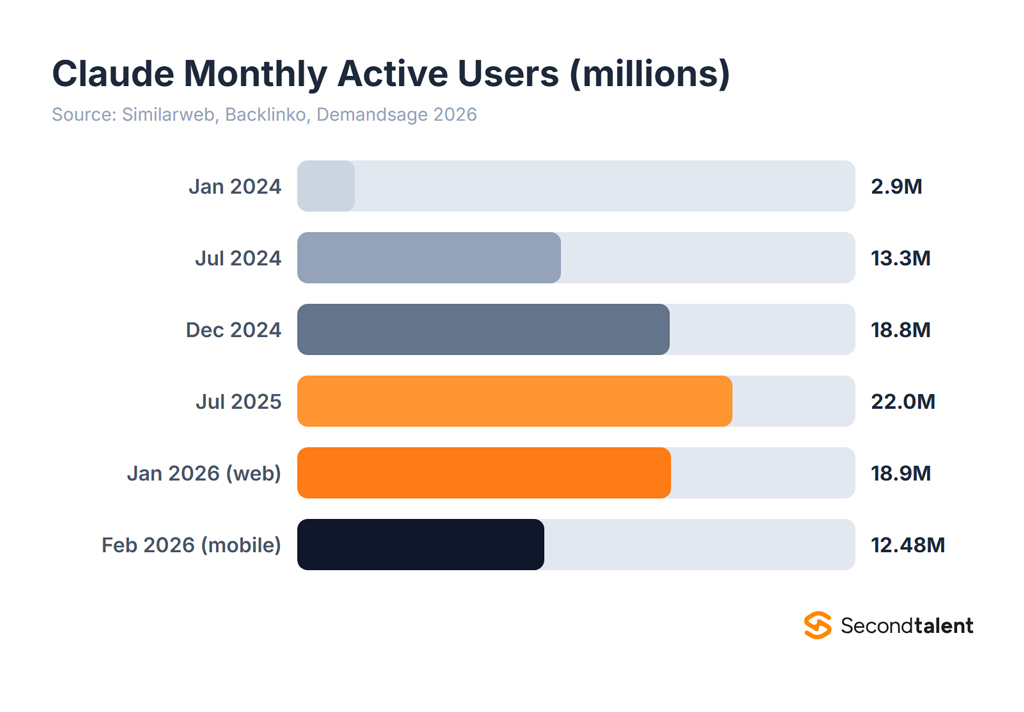
Claude Monthly Active Users Show Strong Growth
- Claude’s monthly active users increased from 2.9 million in Jan 2024 to 22.0 million in Jul 2025, showing rapid adoption in less than two years.
- The platform saw a major jump between Jan 2024 and Jul 2024, growing from 2.9 million to 13.3 million monthly active users.
- By Dec 2024, Claude reached 18.8 million monthly active users, adding 5.5 million users compared with Jul 2024.
- Claude recorded its highest figure in the chart at 22.0 million monthly active users in Jul 2025.
- The data shows a decline in web-based usage from 22.0 million in Jul 2025 to 18.9 million in Jan 2026.
- Claude’s mobile monthly active users reached 12.48 million in Feb 2026, highlighting growing mobile adoption.
- The gap between Jan 2026 web users and Feb 2026 mobile users was about 6.42 million users.
- Overall, Claude’s user base expanded significantly from 2024 to 2025, before showing separate web and mobile usage figures in 2026.
- The trend suggests Claude has built a large active user base, with both web and mobile channels contributing to its overall reach.
Claude AI User Base and Adoption Statistics
- Claude’s estimated consumer user base ranged between 18 million and 30 million users globally in 2026.
- Claude web users increased dramatically from about 2.9 million in January 2024 to nearly 19 million by 2026.
- Anthropic reported that AI adoption now affects nearly half of measured occupations in workplace settings.
- More than 80% of surveyed AI users reported using multiple AI platforms, including Claude alongside competing assistants.
- Claude adoption accelerated among high-income professionals and technical workers during 2026.
- Coding and writing tasks together represented nearly 50% of Claude usage activity according to research.
- Claude usage expanded to over 150 countries worldwide, reflecting growing international adoption.
- Personal usage trends increased significantly, rising from 35% to 42% of sampled conversations between late 2025 and early 2026.
- Users increasingly relied on Claude for autonomous workflows rather than simple assistance tasks.
- Around 6% of Claude users reportedly used the platform for personal advice and emotional guidance conversations.
Claude App Downloads and Mobile Usage Statistics
- Claude mobile apps reached approximately 7.38 million monthly active users during 2026.
- Some market estimates placed mobile MAUs above 12 million users by February 2026.
- Mobile usage reportedly increased 49.15% month over month during early 2026 growth periods.
- Claude expanded mobile availability across iOS and Android markets globally in 2025 and 2026.
- Daily active mobile users reportedly climbed to 11.3 million according to industry estimates.
- Mobile growth accelerated as users increasingly relied on AI assistants for workplace productivity on smartphones.
- The Android app positioned itself as an all-in-one assistant for writing, coding, and research workflows.
- Mobile adoption rose significantly among younger users aged 18 to 24.
- Mobile feature parity expanded with desktop offerings, including voice, file uploads, and coding workflows throughout 2026.
Claude AI Market Share Compared to Competitors
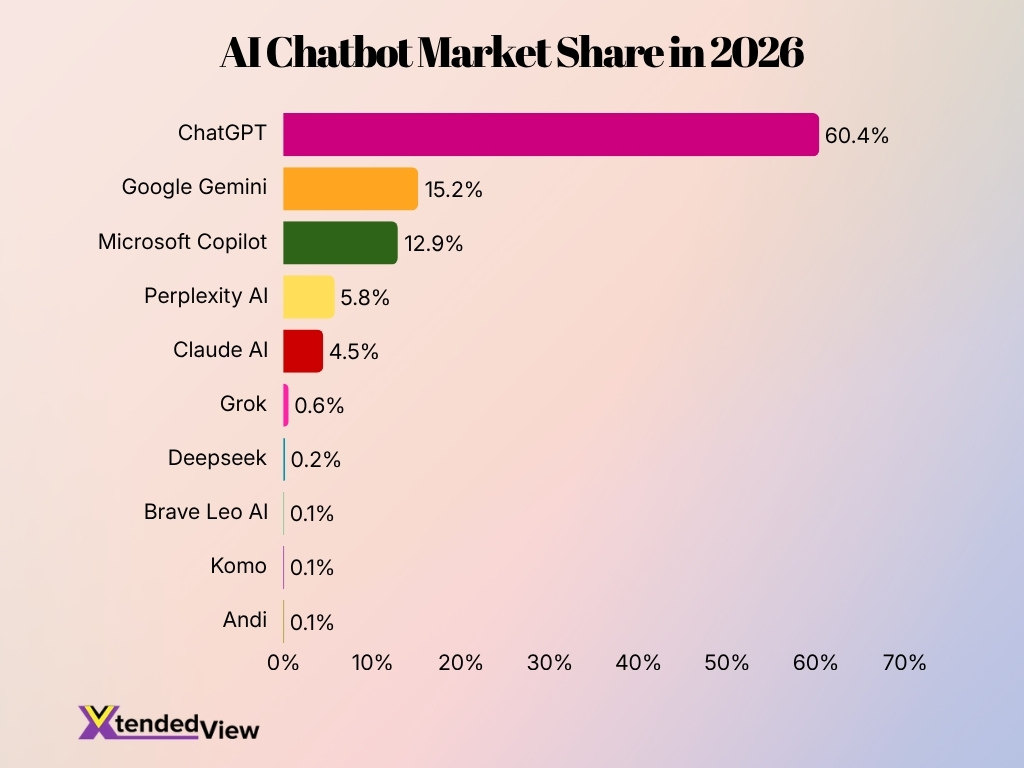
- ChatGPT dominates the AI chatbot market with a massive 60.4% market share, making it the clear leader among major chatbot platforms.
- Google Gemini ranks second with 15.2%, showing strong adoption but still trailing ChatGPT by a wide margin.
- Microsoft Copilot holds the third position with 12.9%, supported by its integration across Microsoft products and enterprise workflows.
- The top three platforms, ChatGPT, Google Gemini, and Microsoft Copilot, together account for 88.5% of the AI chatbot market.
- Perplexity AI captures 5.8% of the market, reflecting growing interest in AI-powered search and answer engines.
- Claude AI accounts for 4.5%, showing a smaller but notable presence in the competitive AI chatbot landscape.
- The combined share of Perplexity AI and Claude AI is 10.3%, indicating that alternative AI assistants are gaining traction among users.
- Smaller chatbot platforms such as Grok, Deepseek, Brave Leo AI, Komo, and Andi each hold less than 1% of the market.
- Grok has a 0.6% share, making it the largest among the smaller AI chatbot platforms listed.
- Deepseek holds 0.2%, while Brave Leo AI, Komo, and Andi each represent only 0.1% of the market.
- The data shows a highly concentrated market, where one platform, ChatGPT, controls more than three-fifths of total AI chatbot usage.
- The gap between ChatGPT at 60.4% and Google Gemini at 15.2% is 45.2 percentage points, highlighting ChatGPT’s strong lead.
Claude Enterprise Adoption and Business Customer Statistics
- Over 70% of Fortune 100 companies integrated Claude into at least one workflow by 2026, highlighting strong enterprise penetration.
- Enterprise customer growth exceeded 3x year over year between 2025 and 2026.
- Claude usage in large organizations increased as AI copilots became standard tools for knowledge workers.
- Approximately 65% of enterprises deployed it for internal productivity tasks such as documentation and reporting.
- Financial services firms accounted for nearly 18% of enterprise use cases, driven by compliance and data analysis needs.
- Adoption in software engineering teams grew rapidly, with over 40% of enterprise developers using AI coding assistants regularly.
- Healthcare organizations increased AI usage, supporting clinical documentation and summarization workflows.
- Demand for secure AI systems pushed adoption due to privacy-focused architecture and governance features.
- Small and mid-sized businesses adoption grew, with over 35% reporting cost savings from automation in 2026.
Claude Revenue and Valuation Statistics
- Anthropic reached a $14 billion annualized revenue run rate in early 2026.
- Company valuation hit $380 billion after $30 billion Series G funding in February 2026.
- Revenue run rate surged to over $30 billion by April 2026, up from $9 billion end-2025.
- Revenue grew over 10x annually for three years through early 2026.
- Enterprise customers drive approximately 80% of total revenue in 2026.
- Over 1,000 business customers spend more than $1 million annually as of April 2026.
- Claude Code generated a $2.5 billion run-rate revenue, with enterprise over half by early 2026.
- Customers spending over $100,000 annually grew 7x in the past year through 2026.
- Eight of the Fortune 10 companies are Claude customers in 2026.
Claude Usage Patterns by Industry and Sector
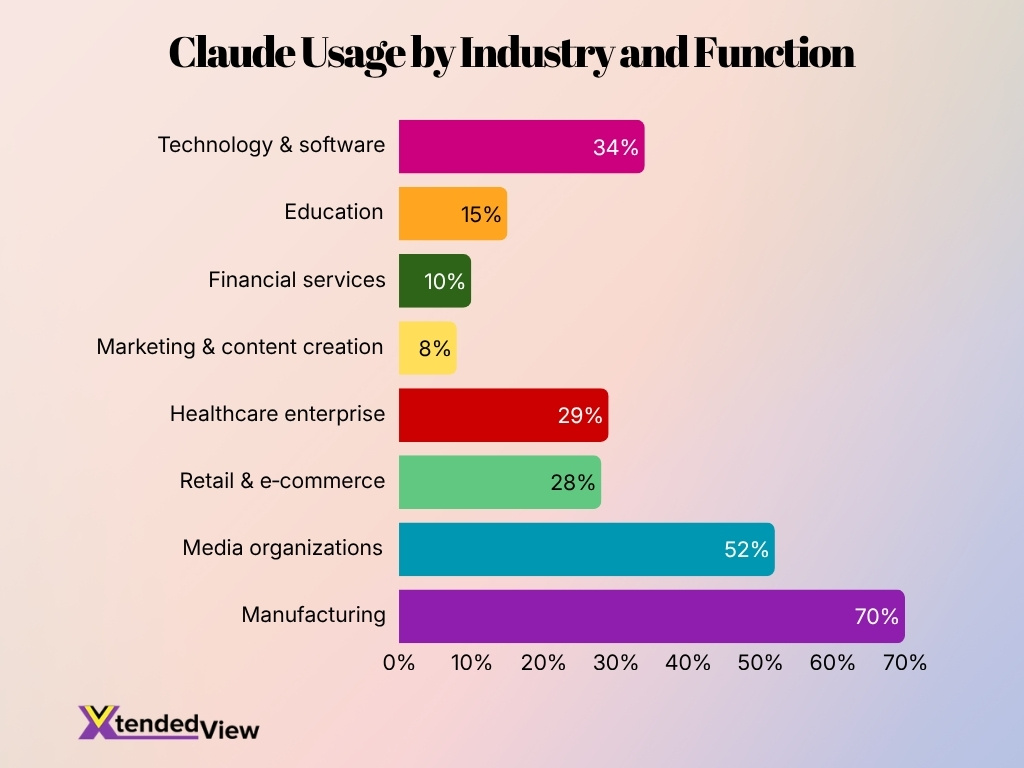
- Technology and software development leads with 34% of Claude tasks in computer and mathematical categories.
- Education sector holds 15% of total Claude usage for instruction and library tasks.
- Financial services account for 10% in business and financial operations via Claude.
- Marketing and content creation represent 8% of arts, design, and media workloads.
- Healthcare leads adoption alongside finance in enterprise AI with 29% market share.
- Legal sector favors Claude for compliance in regulated industries like finance and healthcare.
- Retail and e-commerce utilize Claude for customer support with 28% in service tickets.
- Media organizations leverage 52% augmentation tasks for content summarization.
- Manufacturing adopts for analytics in high-compliance sectors with 70% Fortune 100 usage.
Claude API Usage and Call Volume Statistics
- API usage grew by over 300% year over year from 2025 to 2026.
- Developers generated billions of API calls monthly, with estimates exceeding 5 billion requests per month.
- Coding-related API calls accounted for nearly 40% of total usage, reflecting strong developer adoption.
- Enterprise API usage increased as companies integrated AI into CRM, ERP, and analytics systems.
- Average API latency improved by 25% in 2026, enhancing real-time application performance.
- API pricing adjustments encouraged broader adoption among startups and mid-sized businesses.
- Over 100,000 developers actively used APIs globally by early 2026.
- API-driven automation reduced operational workloads by up to 30% in enterprise deployments.
- Multimodal capabilities expanded, enabling text, image, and code processing within a single interface.
Claude Model Performance and Benchmark Statistics
- Models consistently ranked among the top performers in reasoning benchmarks, outperforming many competitors in long-context tasks.
- Claude achieved over 90% accuracy in certain coding benchmarks during evaluations.
- The model demonstrated strong performance in legal and financial document analysis tasks.
- Context window expanded significantly, supporting inputs exceeding 200,000 tokens in advanced models.
- Benchmark tests showed superior performance in multi-step reasoning tasks.
- Hallucination rates reduced compared to earlier versions through improved training techniques.
- Multilingual capabilities extended across 50+ languages.
- Enterprise users reported improved output quality for summarization and report generation tasks.
- Significant gains appeared in STEM-related problem-solving benchmarks in 2026.
Claude.ai Social Media Traffic Insights
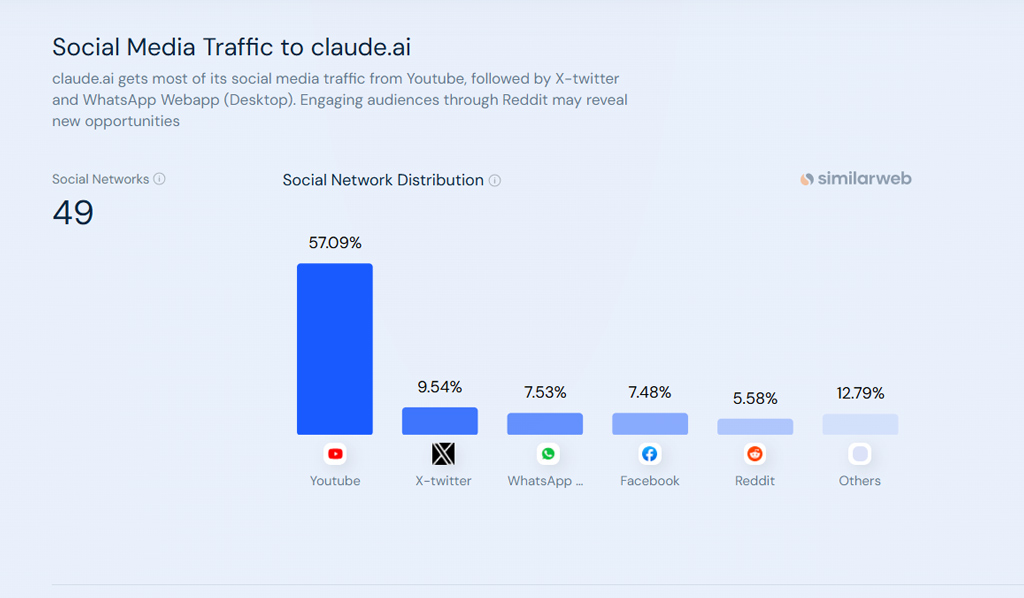
- YouTube dominates social traffic to claude.ai, contributing 57.09% of total social media traffic.
- X-twitter ranks second with 9.54%, showing that text-based social platforms still play a role in Claude’s audience discovery.
- WhatsApp Webapp (Desktop) accounts for 7.53%, suggesting that shared links and peer-to-peer recommendations may support traffic growth.
- Facebook contributes 7.48%, placing it close to WhatsApp as a mid-level traffic source.
- Reddit generates 5.58% of claude.ai’s social traffic, indicating a smaller but potentially valuable community-driven audience.
- Other platforms together account for 12.79%, showing that Claude’s social traffic is spread across several smaller networks beyond the top five.
- The data shows that claude.ai receives traffic from 49 social networks, reflecting a broad social discovery footprint.
- Overall, the chart highlights that video-led discovery through YouTube is the strongest social traffic driver for claude.ai.
Claude Response Time and Task Completion Statistics
- Average response times reduced by approximately 30% between 2025 and 2026.
- Typical response latency ranged between 1.5 to 3 seconds for most queries in 2026.
- Task completion accuracy improved by 20% year over year.
- Coding tasks were completed faster, reducing developer time by up to 40%.
- Enterprise users reported improved turnaround times for document processing tasks.
- Long-context tasks were handled efficiently without significant delays.
- Batch processing capabilities improved efficiency for high-volume users.
- Performance remained consistent across peak usage periods.
- Response reliability improved with fewer incomplete outputs.
Claude Usage by Region and Country Statistics
- The United States generated about 21.6% of global Claude AI usage, making it the largest single‑country market.
- India contributed roughly 5.8% of worldwide Claude activity, ranking it second globally.
- The United Kingdom accounted for approximately 3.5–4% of total Claude usage.
- Japan represented about 4.3% of global Claude AI usage, reflecting strong East‑Asian adoption.
- Brazil and Mexico together drove over 6% of Claude activity in Latin America, led by Brazil’s ~3.5% share.
- Germany and France jointly accounted for nearly 5% of Claude usage in Western Europe.
- Canada and Australia combined made up roughly 4–5% of global Claude adoption.
- Asia‑Pacific economies outside India and Japan contributed about 12–15% of total Claude usage, driven by mobile‑first markets.
- North America as a region hosted over 30% of all Claude activity, led by enterprise and developer use.
- Claude usage now spans more than 150 countries, with top‑20 countries generating over 70% of all traffic.
Claude User Age Distribution
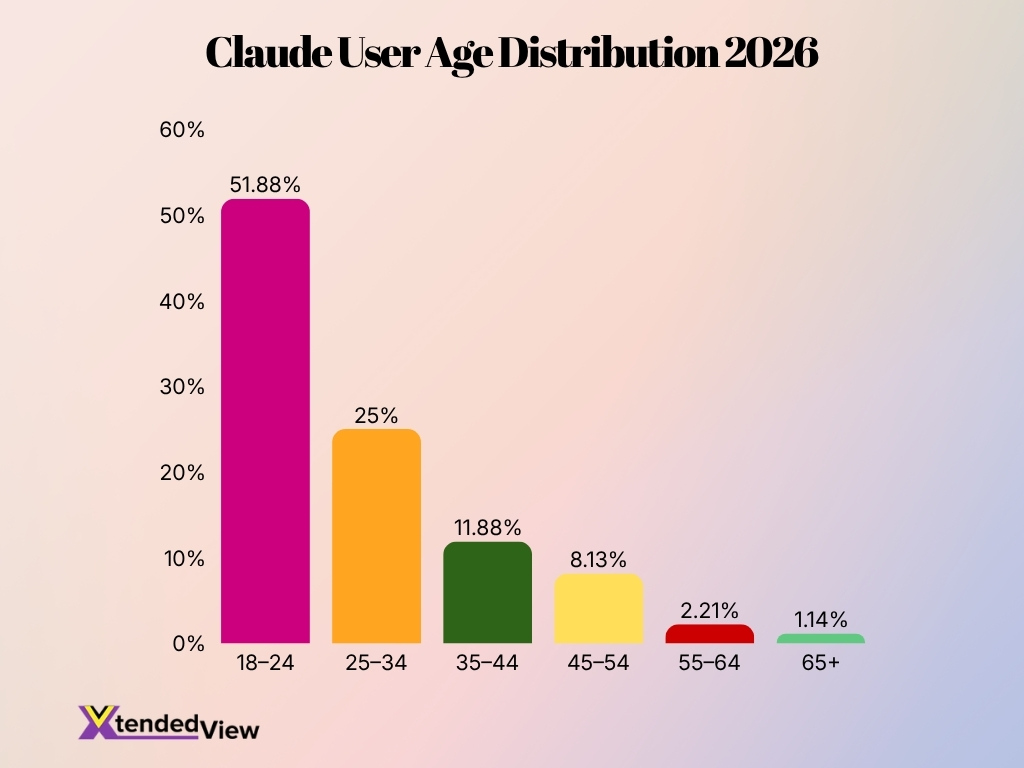
- The 18–24 age group makes up the largest share of Claude users, accounting for 51.88% of total users.
- More than half of Claude’s user base comes from younger users aged 18–24, showing strong adoption among students, early professionals, and digital-native audiences.
- The 25–34 age group represents the second-largest segment, with 25.0% of Claude users.
- Together, users aged 18–34 account for 76.88% of Claude’s total user base.
- The 35–44 age group contributes 11.88%, indicating moderate usage among mid-career professionals.
- Users aged 45–54 make up 8.13% of Claude’s audience, showing lower adoption among older working-age groups.
- The 55–64 age group represents only 2.21% of Claude users.
- The 65+ age group has the smallest share, at just 1.14%.
- Claude’s audience is heavily skewed toward younger users, with usage dropping sharply after the 34-year age mark.
- The data suggests that Claude is especially popular among Gen Z and younger millennials, likely due to use cases such as studying, coding, writing, productivity, and research.
Claude Session Duration and Engagement Statistics
- Average session duration ranged between 6 and 14 minutes.
- Power users spent up to 25 minutes per session.
- Engagement improved as repeat usage increased by over 35% in 2026.
- Daily active users grew steadily, with peaks during working hours.
- Bounce rates remained relatively low at 32% to 38%.
- Advanced feature usage showed higher session depth and retention rates.
- Mobile engagement increased by over 50% year over year.
- Frequent users averaged multiple sessions per day.
- Engagement improved after UI and performance updates in 2025 and 2026.
Claude Safety, Reliability, and Trust Statistics
- Constitutional AI framework reduced harmful outputs by ~50%+ compared to earlier model versions.
- Hallucination rates decreased by approximately 20%–30% across benchmark evaluations.
- Around 65%–75% of enterprise users cited trust and safety as a primary adoption driver.
- Alignment with human intent improved in 90%+ of responses based on internal testing metrics.
- Over 60% of regulated industry adopters reported easier compliance integration with safety features.
- Safety guardrails reduced unsafe or policy-violating outputs by 40%–60% in controlled scenarios.
- User trust scores increased by 25%+ following transparency and explainability enhancements.
- Platform maintained 99.9%+ uptime, ensuring high reliability and availability.
- Security-focused architecture helped reduce data exposure risks by ~35%, supporting enterprise-grade protection.
Claude Task Categories and Common Use Cases
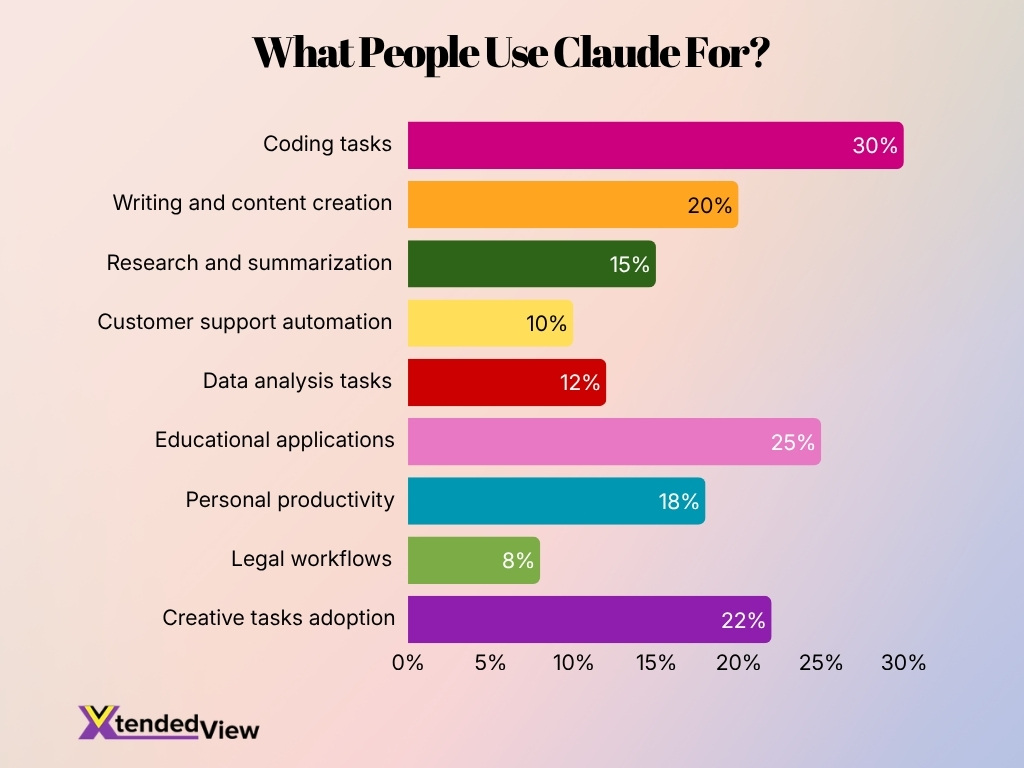
- Coding tasks accounted for nearly 30% of total Claude usage.
- Writing and content creation represented approximately 20% of overall activity.
- Research and summarization made up around 15% of total use cases.
- Customer support automation contributed to about 10% of enterprise deployments.
- Data analysis tasks accounted for nearly 12% of usage across industries.
- Educational applications saw a growth of over 25% in AI-assisted learning use cases.
- Personal productivity tasks increased by approximately 18% in 2026.
- Legal workflows, including contract review, represented around 8% of professional use.
- Creative tasks adoption grew by over 22% among non-technical users.
Claude Model-Specific Usage Statistics
- Claude 3 models accounted for over 70% of total interactions on the platform.
- Advanced Claude models like Opus saw 75% adoption among enterprise users.
- Opus variants achieved 80.8% on SWE-bench for reasoning and coding tasks.
- Lightweight Haiku models were preferred for high-volume API use cases at $1/$5 per million tokens.
- Usage shifted toward higher-capability models with enterprise API at 70-75% of revenue in 2026.
- Multimodal capabilities drove 52% of tasks as augmentation across diverse categories.
- Developers chose models balancing latency and cost, with Sonnet at $3/$15 per million tokens.
- Enterprise clients favored premium Opus for critical workflows, holding 29% AI market share.
- Model upgrades boosted user retention to 62% over six months and satisfaction to 92%.
Claude Code and Developer Tool Adoption Statistics
- Over 100,000 developers actively used APIs and tools globally in 2026.
- 73% of engineering teams use AI coding tools daily, up from 41% in 2025.
- 95% of developers use AI tools at least weekly for coding tasks.
- Claude Code dominates small companies with 75% adoption rate.
- 46% of developers rate Claude Code as their most loved tool.
- Claude Code adoption grew from 3% to 18% among professionals in nine months.
- 25B+ API calls processed monthly by Claude, 45% enterprise-driven.
- Developers report up to 164% increase in story completion with Claude Code.
- 70% of Fortune 100 companies use tools powered by Claude.
- 41-68% of developers actively use Claude or Claude Code.
Frequently Asked Questions (FAQs)
Claude has approximately 18.9 million monthly active users globally in 2026.
Anthropic’s valuation reached nearly $380 billion following its latest funding rounds in 2026.
Claude.ai recorded around 202.9 million monthly visits in January 2026.
More than 70% of Fortune 100 companies reportedly use Claude in at least one workflow.
Around 6% of Claude users use the chatbot for personal advice and emotional guidance.
Conclusion
Claude’s growth trajectory highlights how quickly AI assistants are becoming essential tools across industries. From enterprise adoption and developer integration to global user expansion, the platform continues to scale at an impressive pace. Notably, its focus on safety, reasoning performance, and enterprise readiness positions it as a strong competitor in the AI landscape.
Looking ahead, continued investment in infrastructure, model performance, and developer tools will likely shape how businesses and individuals interact with AI daily. As adoption deepens across regions and sectors, Claude stands as a clear indicator of how generative AI is transitioning from experimentation to real-world utility.
