



Desktop browsers remain central to work, research, software development, online shopping, and other tasks that benefit from larger screens and full-featured web applications. In August 2026, desktop devices generated 49.11% of measured global web usage, almost level with mobile at 49.36%. Chrome controlled 73.28% of worldwide desktop browser activity, showing how concentrated desktop browsing remains. These figures matter for enterprise IT teams planning application compatibility and for web development and e-commerce teams prioritizing browser testing.
Editor’s Choice
- Chrome controlled 73.28% of the worldwide desktop browser market in August 2026.
- Microsoft Edge held 10.46%, leaving Chrome with roughly seven times Edge’s desktop share.
- Firefox reached 5.31%, compared with 5.24% for Safari, making their positions unusually close in August.
- Chrome, Edge and Firefox together accounted for 89.05% of worldwide desktop browser activity in August 2026.
- Chrome and Edge together controlled 83.74% of desktop browser activity, highlighting the scale of browsers built around Chromium.
- Desktop represented 49.11% of global web usage in August 2026, compared with 49.36% for mobile and 1.54% for tablets.
- Chrome’s desktop share increased from 70.58% in July 2026 to 73.28% in August, a 2.70-percentage-point monthly rise.
- Edge moved in the opposite direction, declining from 11.15% in July to 10.46% in August 2026.
- Firefox also moved from 6.51% in July to 5.31% in August, while Safari shifted from 5.66% to 5.24%.
Recent Developments
- In February 2026, Firefox 148 introduced a centralized AI controls section that lets desktop users manage or block generative AI features.
- Firefox’s AI controls cover five major feature categories at launch: translations, PDF image alt text, AI-assisted tab grouping, link previews and sidebar chatbots.
- Firefox subsequently expanded its built-in VPN, reporting in May that more than 1 million users had signed up to try it within two months.
- Chrome expanded Gemini browser features to India, New Zealand and Canada in March 2026 and added support for more than 50 additional languages.
- In April 2026, Chrome introduced a desktop AI Mode experience that can display a webpage side by side with AI-generated search assistance, reducing the need to switch between search and content tabs.
- Chrome expanded Gemini features to several Asia-Pacific markets in April and to markets across Latin America, Africa and the Middle East in June, extending AI-assisted browsing well beyond its earlier U.S. rollout.
- Microsoft Edge expanded Copilot functionality in May 2026, including reasoning across multiple open tabs, browsing-history context and long-term memory based on previous chats.
- Microsoft Edge announced that its Stable channel would move to a two-week release cycle beginning with Edge 152 on Aug. 27, 2026. Its Extended Stable channel remains on an eight-week schedule.
- Safari’s 2026 release schedule included Safari 26.3 in February, 26.4 in March, 26.5 in May, and 26.6 in July, while Safari 27 entered beta in July.
Global Desktop Browser Market Share Overview
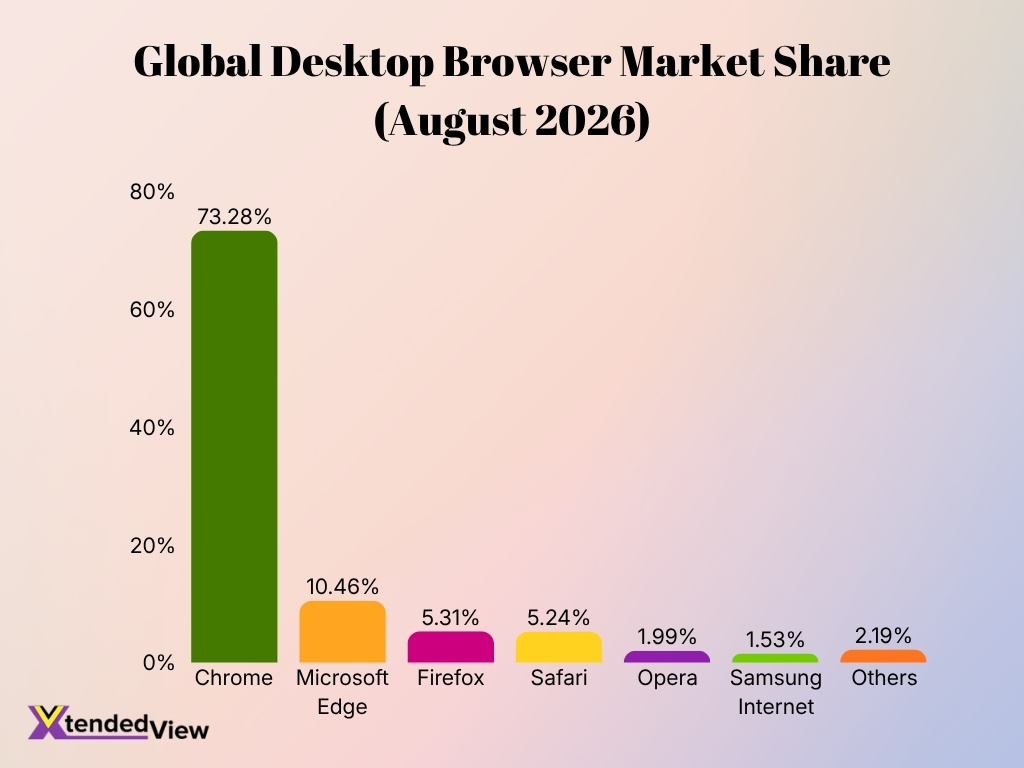
- Chrome held 73.28% of worldwide desktop browser activity in August 2026.
- Edge ranked second with 10.46%, placing it 62.82 percentage points behind Chrome.
- Firefox ranked third at 5.31%, although its lead over Safari was only 0.07 percentage points.
- Safari represented 5.24% of global desktop browser activity in August 2026.
- Opera held 1.99%, less than two-fifths of Firefox’s desktop share.
- Samsung Internet accounted for 1.53% of the measured desktop browser market.
- The six named leaders together represented 97.81% of worldwide desktop browser activity, leaving about 2.19% for other browsers and classifications.
- Chrome’s 73.28% desktop share was higher than its 69.39% share across all device categories, showing that its position was even stronger on computers.
- Safari showed the reverse pattern: its 5.24% desktop share was far below its 15.83% all-device share, reflecting Safari’s much stronger position on mobile and tablet hardware.
Top Desktop Browsers by Market Share
- Chrome, 73.28%: Nearly three-quarters of measured worldwide desktop browser activity came through Chrome in August 2026.
- Microsoft Edge, 10.46%: Edge ranked second globally and captured about one desktop browser visit for every seven attributed to Chrome.
- Firefox, 5.31%: Firefox held third place, narrowly moving ahead of Safari in the August data.
- Safari, 5.24%: Safari trailed Firefox by only 0.07 percentage points, making third and fourth place effectively neck and neck that month.
- Opera, 1.99%: Opera remained below the 2% mark, although it still ranked among the six largest measured desktop browsers.
- Samsung Internet, 1.53%: Its desktop classification was smaller than Opera’s by 0.46 percentage points.
- Chrome’s share exceeded the combined Edge, Firefox, Safari and Opera shares of 23.00% by more than threefold.
- The gap between first-place Chrome and second-place Edge reached 62.82 percentage points, illustrating the limited competitive pressure at the top of the desktop market.
- By contrast, only 0.07 percentage points separated Firefox and Safari, so relatively small monthly changes can alter their ranking.
Desktop Browser Market Share Trends Over Time
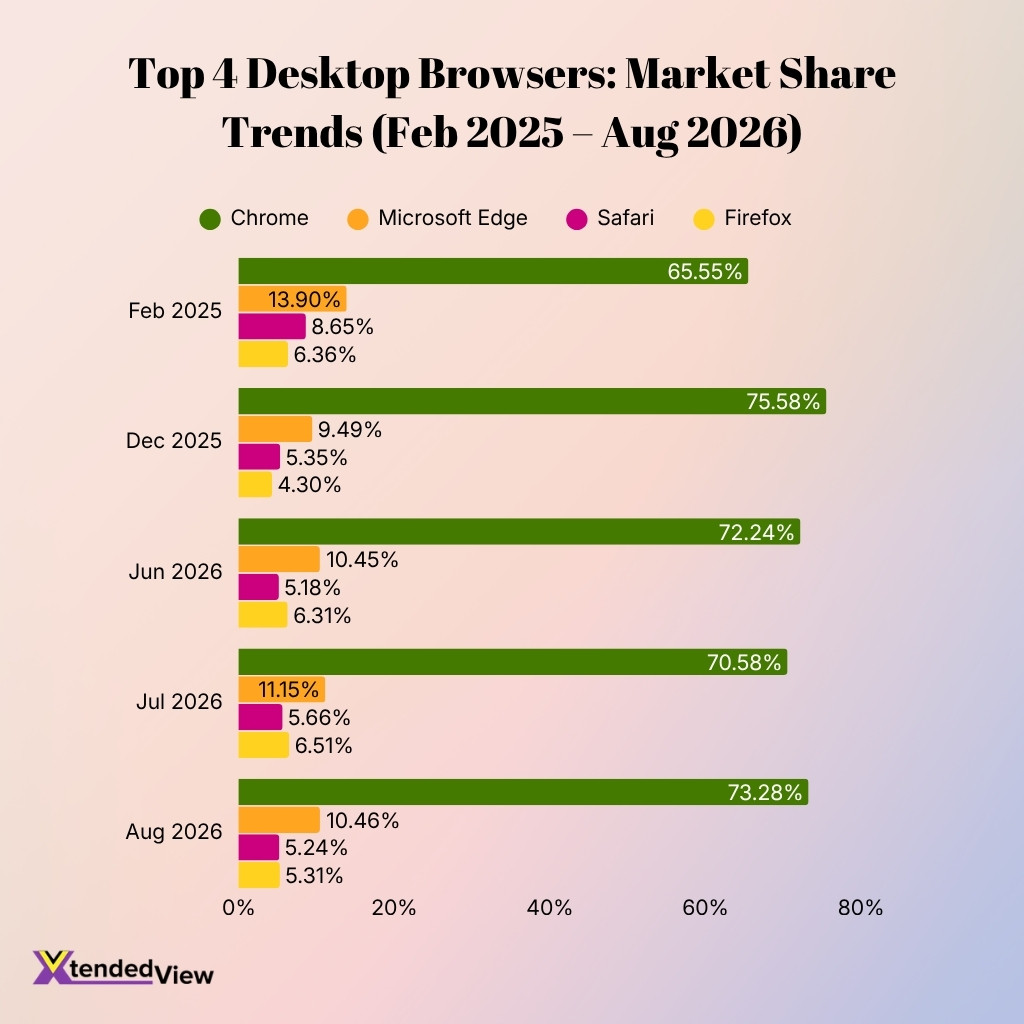
- In February 2025, Chrome held 65.55% of worldwide desktop browser activity, with Edge at 13.90%, Safari at 8.65%, Firefox at 6.36%, and Opera at 2.90%.
- By December 2025, Chrome’s desktop share had climbed to 75.58%, roughly 10 percentage points above its February level.
- Edge stood at 9.49% in December 2025, down from the 13.90% reported for February 2025.
- Safari’s desktop share measured 5.35% in December 2025, compared with 8.65% in February of that year.
- Firefox finished December 2025 at 4.30%, versus 6.36% in the February snapshot.
- Chrome recorded 72.24% in June 2026 and 70.58% in July, before rising to 73.28% in August. These monthly swings show why a single month’s share should not automatically be treated as a long-term trend.
- Edge moved from 10.45% in June to 11.15% in July, then fell back to 10.46% in August 2026.
- Firefox moved from 6.31% in June to 6.51% in July before dropping to 5.31% in August 2026.
- Safari moved from 5.18% in June to 5.66% in July and then 5.24% in August, keeping it close to Firefox throughout the summer.
- Despite short-term movement, Chrome remained the clear leader in every 2025 and 2026 desktop snapshot cited here, while Edge consistently occupied the second-place position.
Desktop vs. Mobile vs. Tablet Browser Usage
- Mobile generated 49.36% of worldwide measured web usage in August 2026.
- Desktop followed at 49.11%, leaving mobile ahead by only 0.25 percentage points.
- Tablet usage accounted for 1.54%, making it a much smaller web-access category than either desktop or mobile.
- Desktop and mobile together represented roughly 98.47% of usage in the three-platform comparison, leaving tablets with a small fraction of overall activity.
- Chrome’s desktop share reached 73.28%, while its combined mobile-and-tablet share was 65.69%, showing stronger relative penetration on computers.
- Safari showed the opposite pattern: it captured only 5.24% of desktop browser activity but 26.06% of combined mobile-and-tablet activity.
- Firefox held 5.31% of desktop activity but only 0.72% on mobile and tablet combined, making its market position far more desktop-oriented.
- Samsung Internet represented 2.48% of mobile-and-tablet browser usage, compared with 1.53% in the desktop dataset.
- Opera showed less variation between the two categories, with 1.99% on desktop and 1.90% across mobile and tablets.
- Across desktop, mobile, and tablet browsers combined, Chrome held 69.42% in August 2026, followed by Safari at 15.84%, Edge at 5.34%, Firefox at 2.98%, Samsung Internet at 2.01%, and Opera at 1.94%.
Desktop Browser Market Share by Country
- In the United States, Chrome controlled 65.55% of desktop browser activity in August 2026. Edge held 12.81%, Safari 10.84%, Firefox 5.92%, Opera 2.40%, and Brave 1.10%.
- India had one of the strongest Chrome concentrations among major markets, with 90.91% desktop share. Edge followed at only 3.16%, while Opera held 2.18% and Firefox 1.98%.
- China’s desktop browser market looked markedly different. Chrome held 52.38%, Edge reached 26.78%, 360 Safe captured 8.48%, and QQ Browser accounted for 3.69%.
- In the United Kingdom, Chrome accounted for 56.02% of desktop browsing, while Edge reached a substantial 22.18%. Safari ranked third at 12.44%.
- Canada’s desktop market gave Chrome 58.56%, followed by Safari at 16.21% and Edge at 14.28%. Firefox represented another 6.54%.
- Germany stood out for Firefox adoption. Chrome held 55.48%, but Firefox reached 15.45%, putting it ahead of Edge at 13.96%.
- In Japan, Chrome controlled 64.12% of desktop browser traffic, while Edge reached 23.03%. Firefox followed at 5.26%, and Safari held 3.87%.
- Brazil recorded an 80.75% Chrome share, while Edge captured 8.57% and Firefox 6.89%. Safari represented just 0.69% of measured desktop traffic.
- Chrome’s share differed by 38.53 percentage points between India and China, illustrating how national software ecosystems, operating systems, and user preferences can produce very different browser markets.
- Edge’s 26.78% share in China was more than eight times its 3.16% share in India, despite both countries representing major Asian internet markets.
Desktop Browser Market Share by Region
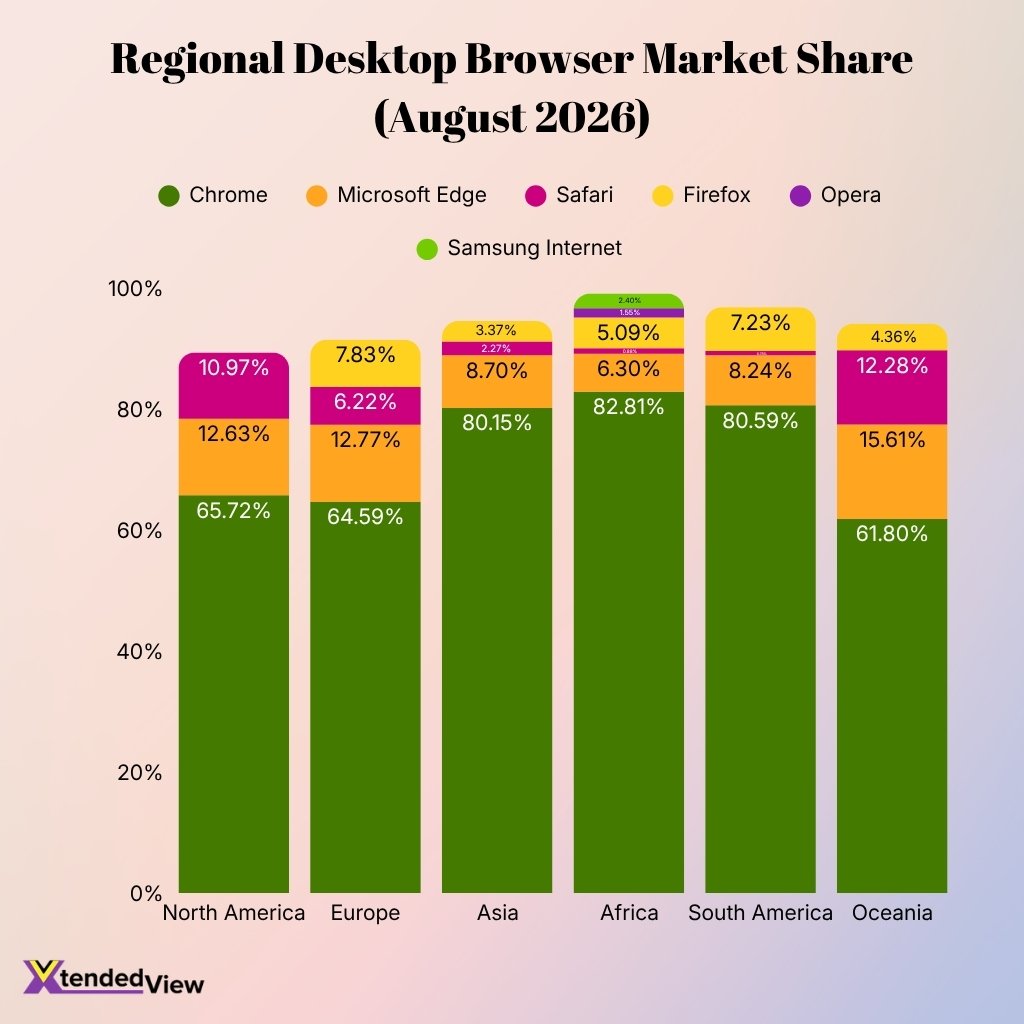
- In North America, Chrome held 65.72% of desktop browser traffic in August 2026. Edge followed at 12.63%, while Safari accounted for 10.97%.
- Europe had a more fragmented desktop market. Chrome held 64.59%, followed by Edge at 12.77%, Firefox at 7.83%, and Safari at 6.22%.
- Chrome’s position was stronger in Asia, where it controlled 80.15% of desktop browser activity. Edge ranked second at 8.70%, while Firefox held 3.37%.
- Africa recorded an even higher Chrome share of 82.81%. Edge captured 6.30%, Firefox 5.09%, Samsung Internet 2.40%, and Opera 1.55%.
- In South America, Chrome held 80.59% of desktop traffic, followed by Edge at 8.24% and Firefox at 7.23%. Safari represented only 0.73%.
- Oceania showed a more competitive desktop market. Chrome accounted for 61.80%, Edge for 15.61%, and Safari for 12.28%, while Firefox held 4.36%.
- Edge’s regional share ranged from 6.30% in Africa to 15.61% in Oceania, a difference of 9.31 percentage points.
- Firefox performed particularly well in Europe and South America, reaching 7.83% and 7.23%, respectively. Its Asian desktop share was much lower at 3.37%.
- Safari’s regional differences were even larger. It captured 12.28% in Oceania and 10.97% in North America, compared with 2.27% in Asia and 0.88% in Africa.
- Chrome exceeded 80% in Asia, Africa and South America, while staying below two-thirds in Europe, North America and Oceania. These differences make regional browser testing important for international websites rather than relying solely on worldwide averages.
Chrome Desktop Browser Statistics
- Chrome held 73.28% of worldwide desktop browser traffic in August 2026, maintaining a commanding lead over every competing desktop browser.
- Chrome reached 65.55% in the United States, meaning its U.S. desktop share sat 7.73 percentage points below its worldwide share.
- India’s Chrome desktop share reached 90.91%, about 17.6 percentage points above the worldwide figure.
- Chrome accounted for 80.15% of Asian desktop browsing and 82.81% in Africa, demonstrating substantially greater concentration outside several mature Western desktop markets.
- South America also recorded a high Chrome share of 80.59%, while Brazil reached 80.75%.
- Chrome’s share fell to 55.48% in Germany and 52.38% in China, two of the lowest figures among the large countries examined in this part.
- Chrome 151.0 alone represented 18.61% of U.S. desktop browser-version activity in August 2026. Chrome 149.0 accounted for another 11.37%, and Chrome 150.0 held 10.77%.
- Gemini in Chrome can work with content from the current tab and, on computers, users can share up to 10 open tabs with the assistant for cross-tab tasks.
- Chrome expanded its AI browser features to India, New Zealand and Canada in March 2026, adding support for more than 50 additional languages.
- By July 2026, Chrome’s AI functionality had expanded further into the U.K., where desktop users gained tools for summarizing content and comparing information across multiple tabs.
Microsoft Edge Desktop Browser Statistics
- Edge held 10.46% of worldwide desktop browser traffic in August 2026, placing it second globally.
- In the United States, Edge captured 12.81% of desktop browser activity, 2.35 percentage points above its worldwide share.
- Edge reached 12.77% in Europe and 12.63% in North America, showing similar adoption levels across those two regions.
- Edge held 15.61% of desktop traffic in Oceania, making it the region’s second-largest browser behind Chrome.
- The browser reached 26.78% in China, its highest share among the major countries examined here.
- Japan also showed strong Edge usage at 23.03%, compared with Chrome’s 64.12%.
- In the United Kingdom, Edge held 22.18% of desktop traffic, almost double its worldwide share.
- India represented the other end of the spectrum: Edge held only 3.16% of desktop browser activity compared with Chrome’s 90.91%.
- Edge 151 alone captured 9.65% of U.S. desktop browser-version activity in August 2026, placing that individual release among the country’s leading browser versions.
- In May 2026, Edge expanded Copilot capabilities across open tabs. The browser can use multiple tabs, browsing history and past chats as context, adding an AI-driven workflow layer to its desktop product.
Firefox Desktop Browser Statistics
- Firefox held 5.31% of worldwide desktop browser traffic in August 2026, narrowly exceeding Safari.
- In the United States, Firefox reached 5.92%, giving it a slightly stronger position than its worldwide average.
- Firefox captured 5.95% in North America and 7.83% in Europe, indicating a stronger desktop position in Europe.
- Germany was a notable outlier: Firefox held 15.45% of desktop traffic, enough to rank second ahead of Edge’s 13.96%.
- South America recorded a 7.23% Firefox share, putting it only about one percentage point behind Edge’s 8.24%.
- Firefox reached 6.89% in Brazil, compared with 5.26% in Japan and 3.28% in China.
- Firefox’s desktop share fell to 1.98% in India, where Chrome controlled more than nine-tenths of measured activity.
- Africa recorded a 5.09% Firefox share, more than five times Safari’s 0.88% in the region’s desktop market.
- Firefox 153.0 accounted for 7.24% of measured desktop browser-version activity in Germany in August 2026, while Firefox 154.0 added another 3.61%.
- The browser’s 2026 desktop roadmap includes PDF splitting, merging and reordering, customizable hotkeys and expanded on-device translation, reflecting continued investment in desktop productivity features.
Safari Desktop Browser Statistics
- Safari held 5.24% of worldwide desktop browser traffic in August 2026.
- Safari accounted for 10.84% of U.S. desktop browsing, more than double its worldwide desktop share.
- North America showed a similar pattern, with Safari reaching 10.97% of desktop browser activity.
- Canada recorded an even higher 16.21% Safari desktop share, placing Safari second ahead of Edge’s 14.28%.
- In the United Kingdom, Safari captured 12.44% of desktop browser activity and ranked third behind Chrome and Edge.
- Oceania recorded a 12.28% Safari share, compared with 6.22% in Europe.
- Safari’s position was considerably smaller in Asia at 2.27%, while its share fell to 0.88% in Africa and 0.73% in South America.
- China recorded a 3.09% Safari desktop share, while Japan stood at 3.87% and India at only 0.63%.
- Safari 26.5 alone accounted for 3.22% of U.S. desktop browser-version activity in August 2026.
- Safari’s 2026 release sequence included versions 26.3, 26.4, 26.5 and 26.6, followed by the Safari 27 beta in July. Safari continues to use WebKit as its rendering engine.
Opera and Other Desktop Browsers Statistics
- Opera held 1.99% of worldwide desktop browser traffic in August 2026, keeping it below Firefox and Safari but ahead of many smaller alternatives.
- Opera’s European desktop share reached 3.22%, compared with 2.24% in North America and 1.32% in Asia.
- Germany recorded a 3.83% Opera share, higher than the overall European figure.
- Opera held 2.18% in India and 2.04% in Brazil, while South America as a whole recorded 1.84%.
- Brave captured 1.10% of U.S. desktop browser activity, while its North American share stood at 1.11%.
- Brave reached 1.21% in Japan and 0.84% in South America, showing a small but measurable desktop footprint across different markets.
- China had a more distinctive alternative-browser market: 360 Safe held 8.48% of desktop browsing, making it the country’s third-largest measured desktop browser.
- QQ Browser accounted for another 3.69% of Chinese desktop activity, exceeding both Firefox at 3.28% and Safari at 3.09%.
- Samsung Internet registered 2.54% of European desktop traffic, 2.40% in Africa and 3.07% in Germany, although its primary ecosystem remains mobile.
- Opera added Browser Connector in April 2026. The feature allows users to connect AI services to an active browser session through MCP, giving supported tools access to contextual information such as open tabs and page content when users grant permission.
Global Browser Engine Market Share
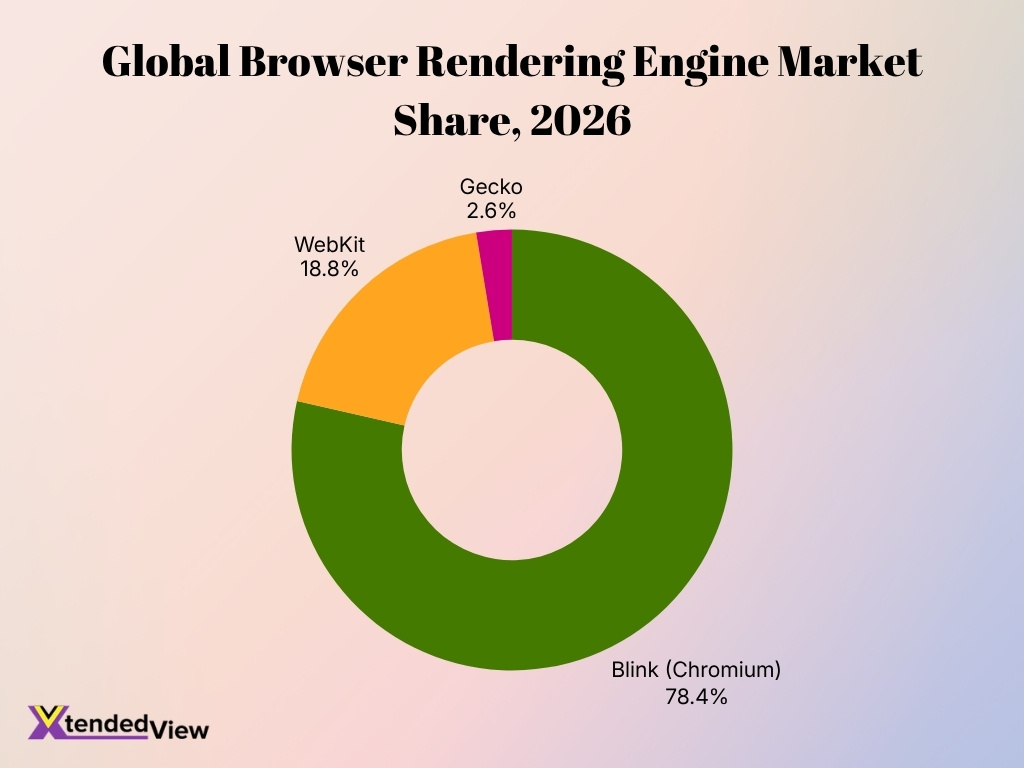
- Blink (Chromium) dominates the global browser engine market with a 78.4% share, powering Chrome, Edge, Opera, Brave, and Vivaldi.
- WebKit ranks second with an 18.8% global share, driven primarily by Apple’s Safari browser.
- Gecko, the engine behind Firefox, accounts for just 2.6% of global browser usage across all devices.
- Blink’s share is more than 4 times larger than WebKit’s, highlighting Chromium’s strong influence across the browser ecosystem.
- Together, Blink and WebKit control 97.2% of the global browser engine market, leaving only a small share for alternative engines.
Desktop Browser Version Usage Statistics
- Chrome 151.0 was the largest explicitly identified desktop release in August 2026, accounting for 18.86% of worldwide desktop browser-version activity.
- Chrome 145.0 represented another 8.48%, despite sitting six major-version numbers behind Chrome 151.
- Chrome 150.0 captured 7.98%, putting three separate Chrome versions among the largest measured desktop browser versions.
- Edge 151 held 7.49% of worldwide desktop browser-version activity, making it the largest non-Chrome version among the explicitly reported leaders.
- Chrome 149.0 added another 3.28%, showing that users did not move to the newest major Chrome release simultaneously.
- Chrome 151.0’s 18.86% desktop share was more than 2.5 times Edge 151’s 7.49% share in the same dataset.
- The four explicitly reported Chrome desktop versions, 145, 149, 150 and 151, totaled 38.60% of worldwide desktop version activity. This calculation excludes additional Chrome releases and therefore does not represent Chrome’s full browser share.
- Across desktop, mobile and tablet devices, Chrome 151.0 represented 9.29% of browser-version activity in August 2026. Its much higher 18.86% desktop figure shows why version statistics should always specify device type.
- Edge changed its Stable release strategy in 2026. Starting with Edge 152, Stable moved to a two-week major release cycle, while managed organizations can use an eight-week Extended Stable cycle.
- Firefox 153 and Firefox 153 ESR both launched on July 21, 2026, giving enterprises a long-support option alongside the standard release channel.
Enterprise and Business Desktop Browser Adoption
- Edge captured 10.46% of worldwide desktop browser activity in August 2026, compared with only 5.36% when all device types were included. Its desktop-heavy profile makes Edge especially relevant to workplace browser analysis.
- Chrome showed a similar desktop skew, with 73.28% on desktop compared with 69.39% across all platforms.
- Together, Chrome and Edge controlled 83.74% of worldwide desktop browser activity, giving Chromium-based products a substantial presence in environments where organizations deploy web applications.
- Chrome’s enterprise management supports Windows, Mac, Linux and ChromeOS through cloud-based browser management, allowing organizations to apply policies across several desktop platforms.
- Edge Stable switched to a two-week major-version cadence starting with version 152 in August 2026. This increases update frequency for standard deployments.
- To give managed organizations more testing time, Edge Extended Stable retains an eight-week release cycle, four times the length of the standard major-version cycle.
- Assisted support for Edge Stable covers the current release and two previous Stable versions, giving approximately six weeks of coverage across supported Stable releases.
- Edge Extended Stable supports the current and one previous Extended Stable release, providing approximately 16 weeks of assisted-support coverage.
- Firefox 153 ESR launched on July 21, 2026. The release incorporated enterprise-focused improvements introduced since Firefox 140 ESR, giving organizations another managed-browser option with an extended support model.
- Firefox also maintains dedicated enterprise policies for authentication, bookmarks, extensions, privacy settings, and other browser controls. Firefox 152, for example, changed managed extension behavior so force-installed extensions update automatically.
Desktop Browser Market Share by Operating System
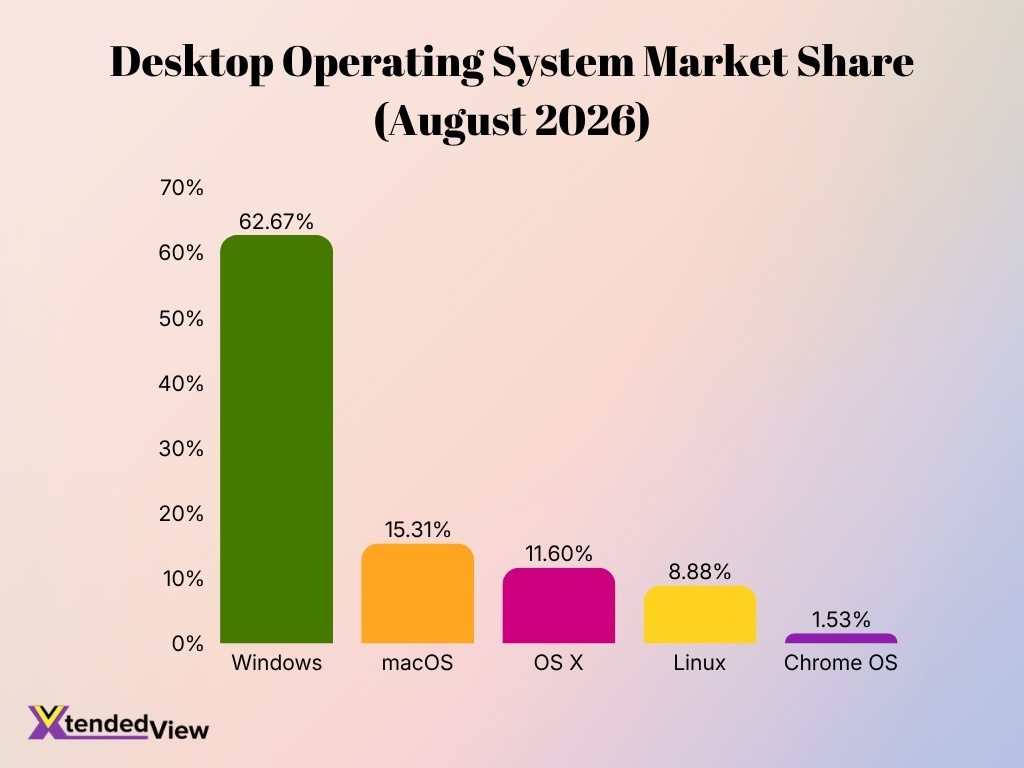
- Windows represented 62.67% of worldwide desktop operating-system activity in August 2026, making it the largest desktop platform by a substantial margin.
- macOS accounted for 15.31% of desktop OS activity, while separately classified OS X versions represented another 11.60%.
- Combining the reported macOS and OS X categories produces 26.91% of worldwide desktop activity, although the dataset separates those categories because of version identification.
- Linux reached 8.88% of measured worldwide desktop operating-system activity in August 2026.
- Chrome OS represented 1.53%, giving it a much smaller desktop footprint than Windows, Apple’s desktop platforms or Linux.
- Windows’ 62.67% share was roughly seven times Linux’s 8.88% share, highlighting the scale of the Windows environment for desktop browser deployment.
- Windows and the reported macOS/OS X categories together represented 89.58% of measured desktop operating-system activity.
- The browser market is more concentrated than the operating-system market: Chrome alone held 73.28% of worldwide desktop browser activity, exceeding Windows’ 62.67% share. This indicates that Chrome’s reach necessarily extends across multiple operating systems.
- Cross-platform availability remains important for browser competition. Edge supports Windows, macOS, and several 64-bit Linux distributions, including Ubuntu 18.04 or later, Debian 10 or later, openSUSE 15.5 or later, and Fedora Linux 39 or later.
Desktop Browser Security and Privacy Feature Adoption
- Chrome reported in February 2025 that more than 1 billion users had adopted Enhanced Protection, its higher-security Safe Browsing mode.
- Enhanced Protection users were reported to be twice as safe from scams as users on Standard Protection, based on internal measurements.
- Chrome began extending Always Use Secure Connections to those 1 billion-plus Enhanced Protection users with Chrome 147 in April 2026, ahead of a broader default rollout planned for Chrome 154.
- Chrome’s Enhanced Protection also uses an on-device AI model on desktop to identify previously unseen scam pages, adding local analysis to existing phishing and malware defenses.
- Chrome reported that its broader notification-abuse defenses cut unwanted Android notifications by more than 7 billion per day in Q1 2026, illustrating the scale at which browser-level abuse protections can operate.
- Firefox enables Total Cookie Protection by default for all users worldwide, isolating cookies by website to reduce cross-site tracking.
- Firefox also disables cross-site tracking cookies by default for all users, while Strict Enhanced Tracking Protection blocks all cross-site cookies.
- Edge reports that approximately 53% of its users have received at least one warning that a saved password appeared in a known set of exposed credentials.
- Firefox’s privacy controls cover known third-party trackers, social-media trackers, cryptominers, cookies and fingerprinting technologies, while some AI features such as automated translation operate locally on the user’s device.
- With Chrome at 73.28%, Edge at 10.46% and Firefox at 5.31% of worldwide desktop activity, privacy and security defaults in just these three browsers can potentially affect behavior across 89.05% of measured desktop browser activity.
Desktop Browser Extension and Add-on Usage Statistics
- Nearly half of Firefox users had installed at least one extension by late 2025, showing that add-ons reach a substantial portion of the browser’s user base.
- Earlier in August 2025, the reported figure was almost 40% of Firefox users, indicating that published adoption estimates can vary with measurement timing and definition.
- The Firefox extension ecosystem was supported by more than 10,000 developers in late 2025.
- uBlock Origin had about 11.19 million Firefox users when checked in September 2026, making it a clear example of an add-on with an eight-figure active audience.
- uBlock Origin also carried a 4.8 out of 5 rating from more than 22,000 reviews, showing substantial engagement alongside its large user base.
- Monthly registrations by Chrome extension developers more than doubled over the previous year, according to the 2026 extension ecosystem update.
- AI has become a measurable extension category: 17% of extensions created during the previous year incorporated AI functionality.
- Chrome planned to expand extension-developer registration to more than 120 additional countries during 2026, widening access to its extension publishing ecosystem.
- Manifest V3 is now the only supported manifest value for Chrome extensions, and new Manifest V2 extensions are no longer accepted.
- Firefox has also adopted Manifest V3 but maintains its own implementation choices. From Nov. 3, 2025, new Firefox extensions must explicitly declare whether they collect or transmit personal data, and those disclosures appear during installation and in extension information pages.
Frequently Asked Questions (FAQs)
Chrome holds 73.28% of the worldwide desktop browser market as of August 2026.
Microsoft Edge accounts for 10.46% of worldwide desktop browser usage as of August 2026, ranking second behind Chrome.
Chrome holds 65.55% of the U.S. desktop browser market as of August 2026, followed by Edge at 12.81% and Safari at 10.84%.
Chrome controls 90.91% of India’s desktop browser market as of August 2026, compared with 3.16% for Edge and 2.18% for Opera.
Chrome 151.0 is the leading explicitly identified desktop browser version, accounting for 18.86% of worldwide desktop browser-version activity in August 2026.
Conclusion
Desktop browsing remains highly concentrated, with Chrome holding 73.28% of worldwide desktop activity and Chrome and Edge together accounting for 83.74%. However, regional differences, operating systems, browser versions, enterprise requirements, and privacy settings continue to create a more complex market beneath the global totals. Windows still represents 62.67% of desktop operating-system activity, while security features now reach audiences measured in the hundreds of millions or billions.
For businesses, developers and marketers, browser testing therefore needs to account for location, operating system, release version, security configuration and extension use rather than relying on global browser rankings alone.
