

6G development accelerated as the wireless industry moved beyond early research toward formal technical requirements, standardization, spectrum studies, prototypes, and large-scale test environments. The next generation of mobile connectivity is being designed to extend the capabilities of 5G with substantially higher data rates, lower latency, greater connection density, integrated sensing, AI-native network functions, and closer coordination between terrestrial and satellite networks.
These advances could support autonomous transportation, intelligent manufacturing, industrial robotics, immersive extended reality, precision positioning and connectivity in locations that conventional mobile infrastructure struggles to reach. With commercial 6G deployment broadly expected around 2030, governments, telecom operators, equipment manufacturers and research institutions are already investing heavily in the technologies needed to make those applications practical. The following 6G statistics examine the market outlook, technical performance, R&D activity, infrastructure investment, patents and other developments shaping the industry.
Editor’s Choice
- A 2026 global market estimate places the broader 6G market at $12.24 billion in 2026, up from $9.48 billion in 2025. Because commercial 6G networks have not launched, this figure includes products, research, and technologies associated with the emerging ecosystem rather than mature 6G service revenue.
- That estimate represents 29.2% year-over-year growth between 2025 and 2026.
- Another 2026 forecast expects the 6G technology market to reach $14.94 billion by 2030, after rising from $1.66 billion in 2024 to $2.38 billion in 2025 under its narrower market definition.
- A separate forecast published in 2025 projects the commercial 6G market at $110.46 billion by 2036, compared with $11.40 billion in 2030.
- That 2030-2036 projection translates to a 46% CAGR, highlighting the steep growth expected once commercial networks begin scaling.
- One May 2026 connectivity forecast expects approximately 4.6 million 6G connections in 2029 and 2.9 billion by 2035.
- Europe announced €116 million for 20 new 6G research and innovation projects in 2026, expanding the associated portfolio to 100 projects.
- China’s first phase of 6G technology trials generated a reserve of more than 300 key technologies before the country moved into its second trial phase in 2026.
Recent Developments
- In February 2026, technical experts finalized draft IMT-2030 performance requirements, establishing a common framework for evaluating proposed 6G radio technologies.
- By June 2026, the IMT-2030 evaluation framework specified three evaluation methods: simulation, analytical assessment, and inspection.
- The same evaluation work defines seven test environments, including new indoor factory environments for hyper-reliable low-latency communication and integrated sensing and communication.
- The first official 3GPP 6G Work Item received approval in 2026 under Release 21, marking a shift from broad 6G studies toward normative standardization.
- The developing 6G architecture study contained 24 Key Issues by May 2026, illustrating the breadth of architectural questions under formal examination.
- A February 2026 U.S. demonstration completed a pre-standard 6G over-the-air session in Texas using an AI- and cloud-native architecture.
- Another 2026 prototype demonstrated a 400 MHz component carrier with 30 kHz subcarrier spacing while exploring centimeter-wave spectrum around 6-8 GHz.
- China authorized 6 GHz-band spectrum for 6G technical trials in selected areas in May 2026, giving researchers spectrum for testing technologies against emerging international scenarios and performance targets.
- Sweden announced a national 5G, 6G, and AI test center in June 2026 backed by more than SEK 300 million in investment.
6G Market Size Growth
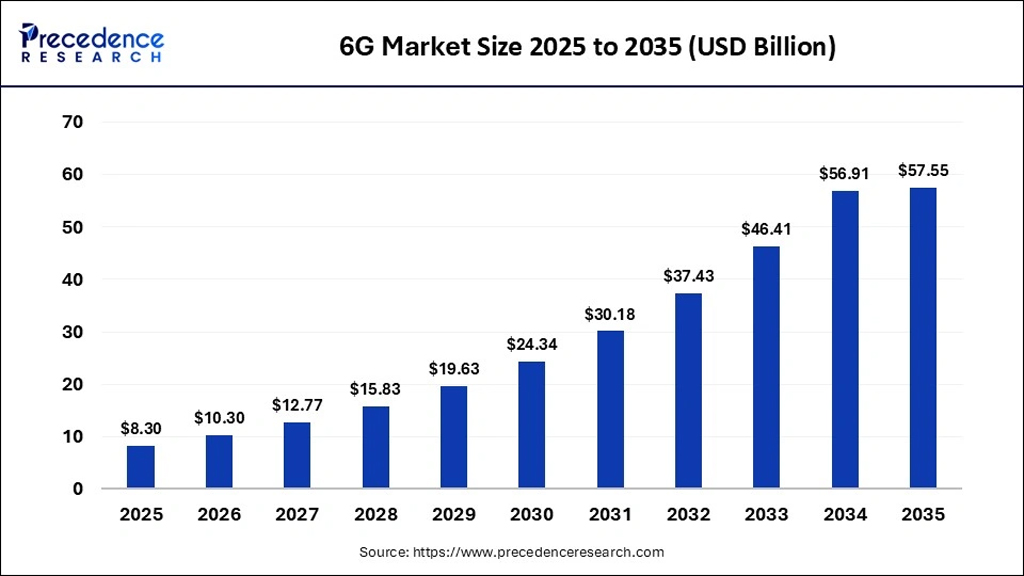
- The global 6G market is projected to grow from $8.30 billion in 2025 to $57.55 billion by 2034.
- The market is expected to expand by approximately 593% between 2025 and 2034, reaching nearly 6.9 times its initial size.
- Based on the projected figures, the 6G market represents an implied CAGR of about 24% over the forecast period.
- The market is forecast to cross $10 billion in 2026, increasing from $8.30 billion a year earlier.
- By 2030, the 6G market is expected to reach $24.34 billion, nearly three times its 2025 level.
- Growth is projected to accelerate after 2030, with market size rising from $30.18 billion in 2031 to $46.41 billion in 2033.
- Between 2033 and 2034 alone, the market is projected to increase by $11.14 billion, reaching $57.55 billion.
6G Market Forecast
- A 2026 connections forecast projects approximately 4.6 million 6G connections by 2029, suggesting the first commercial deployments could remain limited compared with mature 5G networks.
- The same forecast expects global 6G connections to reach 2.9 billion by 2035, indicating rapid adoption after initial commercialization.
- A market forecast published in 2025 projects revenue of $87.57 billion in 2035 under a model that begins at $11.40 billion in 2030.
- That model places the market at $110.46 billion in 2036, almost 10 times its projected 2030 value.
- A separate 2026 forecast estimates a $76.76 billion market by 2035, compared with $11.70 billion in 2030.
- Another 2026 model projects the market to reach $88.60 billion in 2035, showing that even recent forecasts differ by billions of dollars because they classify 6G revenue differently.
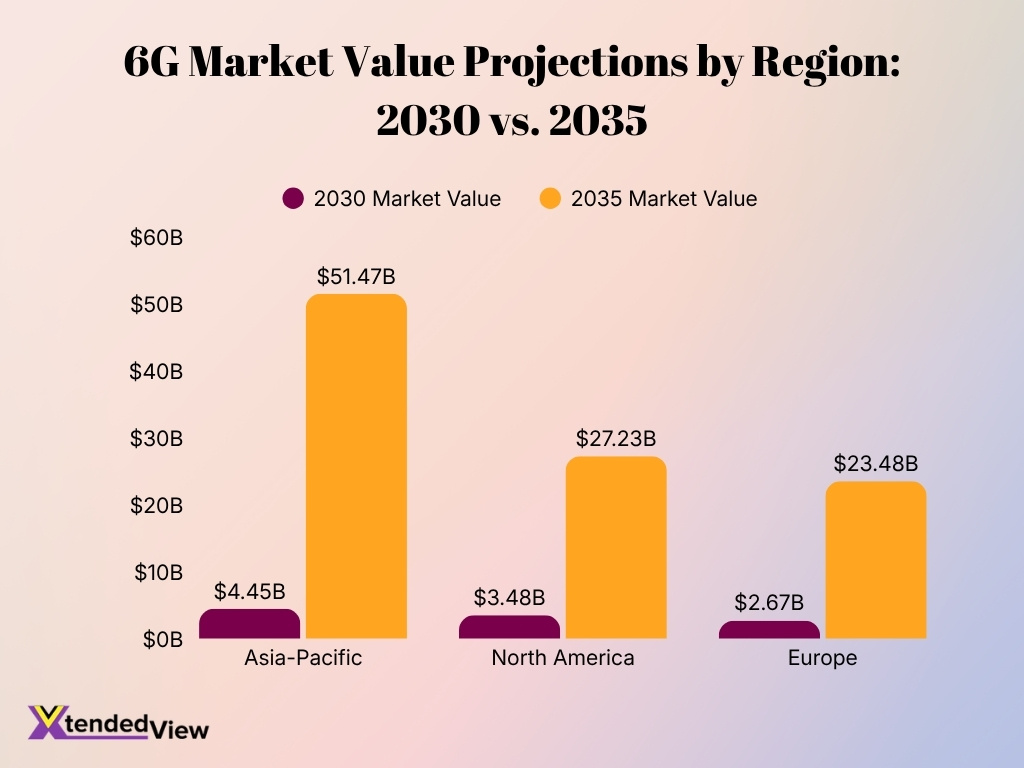
- Asia-Pacific’s 6G market could expand from $4.45 billion in 2030 to $51.47 billion in 2035 under one regional forecast.
- First implementable 3GPP specifications are targeted for 2029, while broader commercial readiness is expected around 2030, providing an important timeline for interpreting revenue forecasts that accelerate after the decade’s end.
6G Research and Development Statistics
- Europe allocated €116 million to 20 additional projects announced in 2026, covering research areas such as AI-native networking, radio technologies, security and quantum integration.
- Those additions expanded the European research portfolio to 100 projects, showing the scale of coordinated public-private 6G development before commercial rollout.
- The broader European program had already committed €630 million in public Horizon Europe funding by 2026.
- An additional €270 million was planned for 2026 and 2027 to support further European research and innovation activities.
- China’s first 6G technology trial phase produced more than 300 key technologies, and officials confirmed that the second phase had begun by January 2026.
- A U.S. communications research roadmap published in June 2026 established five research goals for federal 6G work over the following five to seven years after six months of external stakeholder engagement.
- Sweden’s Digital Arena initiative carries an investment of more than SEK 300 million to create test infrastructure spanning 5G, 6G and AI.
- A 2026 Japanese demonstration tested stable 40 GHz-band millimeter-wave communication for multiple high-speed vehicles, combining distributed MIMO with frequency and timing pre-compensation.
- Research into spectrum above 100 GHz has already progressed into formal technical feasibility work covering propagation, channel models, antennas, components, and deployment architectures, giving sub-terahertz research a defined role in the IMT-2030 development process.
6G Market Share by Region
- Asia-Pacific’s market is forecast at approximately $4.45 billion in 2030, making the region a major projected center of early 6G commercialization.
- Asia-Pacific could reach $51.47 billion by 2035, according to the same forecast.
- The region’s projected 50.4% CAGR from 2030 to 2035 exceeds the corresponding forecasts for North America and Europe in the same research series.
- North America’s 6G market is projected at approximately $3.48 billion in 2030, reflecting anticipated early deployment and infrastructure modernization in the U.S. and Canada.
- North America’s market could increase to $27.23 billion by 2035, representing a forecast CAGR of 40.9%.
- Europe’s corresponding market is projected at approximately $2.67 billion in 2030.
- Europe could reach $23.48 billion in 2035, with a forecast CAGR of 43.7% between 2030 and 2035.
- Beyond market forecasts, Europe has committed €630 million in public funding to its smart-network and 6G initiative since 2021 by March 2026, giving the region a sizable publicly backed R&D base ahead of commercialization.
- In the U.S., preparations now include spectrum planning for future 6G auctions in 2028, while a 2026 pre-standard over-the-air 6G trial in Texas shows that technical development is progressing alongside policy work.
6G Standardization and Commercial Launch Timeline
- In February 2026, international experts completed a draft containing 20 minimum technical performance requirements for IMT-2030 radio interfaces. Seven requirements cover capabilities that are new to the 6G evaluation framework.
- The IMT-2030 framework contains six usage scenarios: immersive communication, hyper-reliable and low-latency communication, massive communication, ubiquitous connectivity, AI and communication, and integrated sensing and communication.
- Release 20 serves as the principal 6G study phase, while Release 21 introduces normative 6G work and the first set of technical specifications intended for the IMT-2030 submission.
- Release 21 officially opened on Nov. 4, 2025, while Release 20 remains open with an indicated end date of June 18, 2027.
- The first official 6G Work Item received approval under Release 21 in 2026, marking the formal start of normative 6G standardization.
- Release 21 Stage 2 is targeted for completion in March 2028, according to a May 2026 industry progress report.
- The Release 21 ASN.1/OpenAPI freeze is expected in March 2029, establishing an important milestone for implementable specifications.
- Technology proposals for IMT-2030 are targeted for early 2029, while the complete system definition is expected to reach the international standards process by mid-2030 at the latest.
- Commercial 6G introduction is broadly targeted around 2030. Current standards work describes this as a deployment objective rather than a guaranteed global launch date.
6G Trials and Testing Statistics
- In February 2026, a U.S. trial completed a pre-standard 6G over-the-air session in Plano, Texas, using an AI- and cloud-native end-to-end architecture.
- The Texas trial operated in the 7 GHz range with 400 MHz of carrier bandwidth and focused on uplink performance, energy efficiency, and spectral utilization.
- A 2026 prototype separately demonstrated a 400 MHz component carrier with 30 kHz subcarrier spacing, aligned with study items for Release 20.
- That prototype explored centimeter-wave frequencies around 6-8 GHz and device configurations with four transmit/receive antennas to investigate stronger cell-edge performance.
- Another 2026 prototype completed a data call between a 6G radio testbed and a prototype device with processing extending up to the IP layer.
- A March 2026 Japanese trial used the 40 GHz band to connect multiple high-speed vehicles traveling in opposite directions. The system improved average throughput by approximately 1.3 times versus the conventional method.
- A related 2025 test used four distributed antennas, a 100 MHz signal bandwidth, and 60 kHz subcarrier spacing to investigate 40 GHz communication in high-mobility environments.
- A 2025 outdoor AI-assisted radio trial across three locations improved throughput by as much as 100% compared with a non-AI approach under the same conditions.
- Researchers also demonstrated 140 Gbps of aggregate bidirectional real-time wireless transmission in the 71-86 GHz range in 2025, more than twice the rate achieved with the previous approach used in that project. The experiment targeted high-capacity wireless backhaul for the 6G era rather than a commercial 6G handset link.
6G Peak Network Data Rate
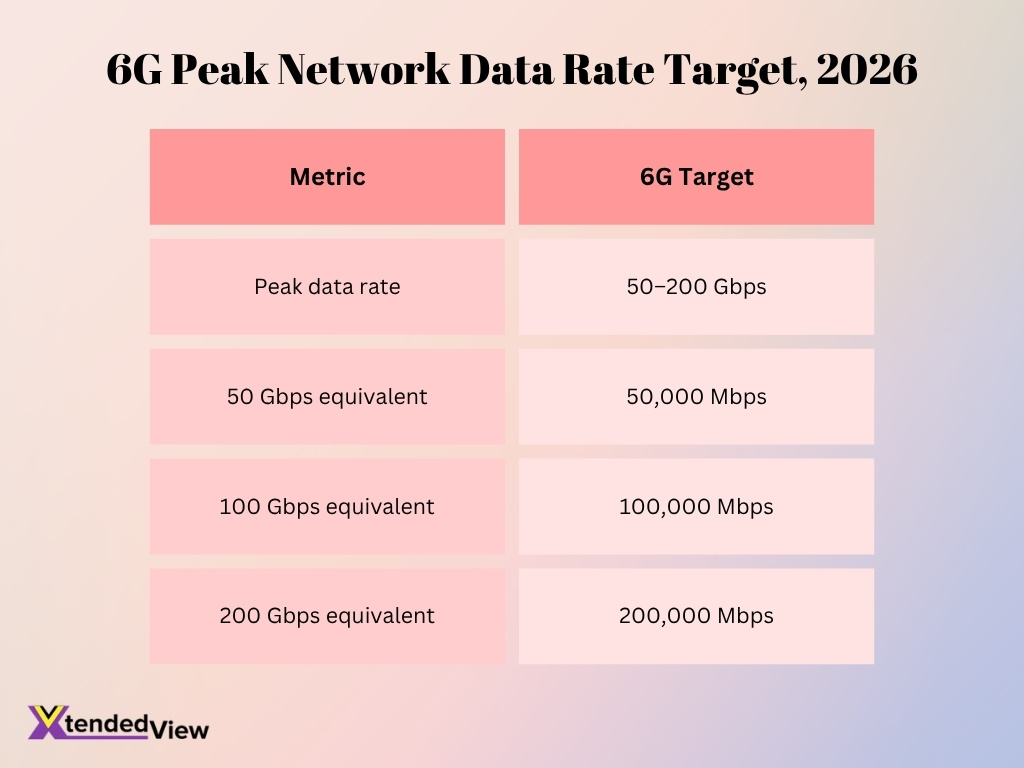
- 6G peak data rates are targeted to reach between 50 Gbps and 200 Gbps, signaling a major increase in next-generation wireless capacity.
- At the lower end, 50 Gbps equals approximately 50,000 Mbps, enabling extremely high-throughput connectivity.
- A 100 Gbps 6G connection would deliver the equivalent of 100,000 Mbps in peak network speed.
- At the upper target of 200 Gbps, 6G could achieve peak rates of about 200,000 Mbps.
- The difference between the minimum and maximum targets represents a 4X increase, from 50 Gbps to 200 Gbps.
6G Latency Statistics
- The IMT-2030 framework targets radio-network latency of approximately 0.1 to 1 millisecond, depending on the usage scenario.
- At the lower end, 0.1 ms equals 100 microseconds, illustrating how demanding the radio-interface target is.
- A 1 ms target allows only one-thousandth of a second for the measured radio-network latency component.
- The framework pairs low latency with reliability targets corresponding to successful data transmission probabilities of 1 − 10⁻⁵ to 1 − 10⁻⁷.
- At the stricter end, a failure probability of 10⁻⁷ corresponds mathematically to about one failed transmission per 10 million attempts under the defined evaluation assumptions.
- Hyper-reliable and low-latency communication is one of six official IMT-2030 usage scenarios, making latency a core design requirement rather than an optional enhancement.
- The June 2026 evaluation framework introduced seven test environments, including a dedicated Indoor Factory-HRLLC environment for evaluating high-reliability, low-latency performance.
- A 2026 prototype data call specifically tested features designed to reduce latency at scale while addressing the traffic requirements of AI-enhanced extended reality.
- The latency targets remain evaluation requirements rather than measured promises for future consumer networks. Real-world end-to-end latency will also depend on transport, processing, application servers, and physical distance.
6G Connection Density and Network Capacity Statistics
- IMT-2030 targets connection density between 1 million and 100 million devices per square kilometer.
- The top-end target of 100 million devices per square kilometer equals an average of 100 devices per square meter when distributed uniformly, illustrating the scale envisioned for dense machine connectivity.
- Area traffic capacity is targeted at 30 to 50 Mbps per square meter or higher.
- At 50 Mbps per square meter, one square kilometer would mathematically correspond to 50 Tbps of aggregate area capacity if the target applied uniformly across the full area; this is an illustrative conversion, not a commercial network forecast.
- Spectrum efficiency aims to reach 1.5 to 3 times IMT-2020 levels, helping networks add capacity without relying entirely on additional spectrum.
- Massive communication is one of the framework’s six usage scenarios, alongside ubiquitous connectivity and immersive communication.
- The 2026 evaluation guidelines define seven environments for testing candidate technologies rather than evaluating capacity under one universal network configuration.
- Future networks must maintain connectivity at mobility levels reaching 1,000 km/h, extending capacity requirements beyond stationary dense IoT deployments to trains and other high-speed platforms.
- High-precision positioning targets of 1 to 10 centimeters add another network function alongside communications capacity, reflecting 6G’s planned integration of connectivity, positioning and sensing.
Key 6G Spectrum and Frequency
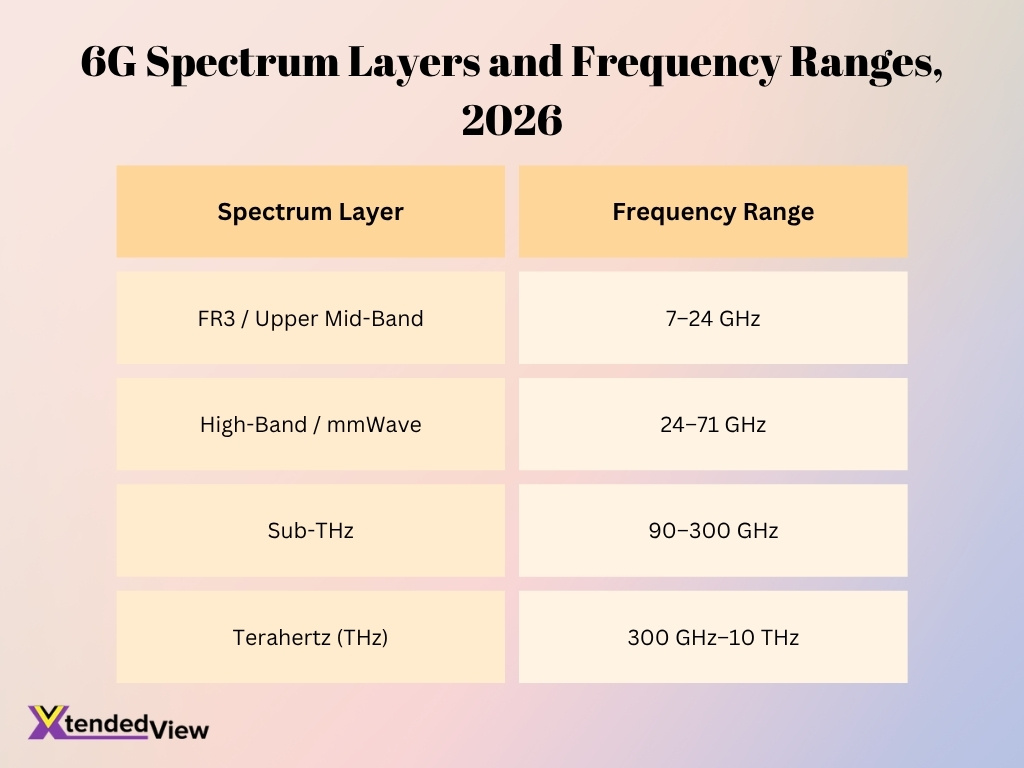
- FR3 / upper mid-band spectrum spans 7–24 GHz, offering a potential balance between coverage, mobility, and network capacity for future 6G systems.
- High-band/mmWave frequencies range from 24–71 GHz, extending 5G capabilities toward very high-capacity connectivity in dense urban and industrial environments.
- Sub-THz spectrum covers 90–300 GHz and is being researched for extreme data throughput using very wide bandwidth over relatively short distances.
- The terahertz spectrum extends from 300 GHz to 10 THz, representing the highest-frequency layer under study for ultra-high-bandwidth communications and sensing.
- As 6G moves toward higher frequencies, networks could gain substantially more bandwidth and capacity, but challenges involving signal propagation, coverage, and RF hardware become more significant.
- The broad 7 GHz to 10 THz research range shows that 6G is expected to use a multi-layer spectrum strategy rather than depend on a single frequency band.
6G Artificial Intelligence Statistics
- AI and communication, or AIAC, is one of the six formal IMT-2030 usage scenarios.
- The IMT-2030 capability framework explicitly includes distributed learning, data processing, and AI model inference among expected AI-enabled features.
- In a 2026 telecommunications survey, 77% of respondents expected AI-native networks to launch before 6G deployment.
- The same survey found 65% of telecom operators said AI was driving network automation.
- About 60% of respondents said their organizations were using or evaluating generative AI, up from 49% in 2024.
- Furthermore, 90% said AI was helping increase annual revenue, reduce annual costs, or both, showing why operators are investing in AI before commercial 6G arrives.
- A 2025 industry survey found that 66% of respondents investing in AI for 5G monetization or 6G R&D aimed to deploy AI services on the RAN for operational or user requirements.
- In that survey, 53% aimed to use AI to improve RAN spectral efficiency, while 50% planned to colocate AI and RAN applications on common infrastructure.
- A 2025 outdoor 6G-oriented AI radio trial recorded a 100% maximum throughput improvement compared with its conventional non-AI implementation under the same test conditions.
- A 2025 operator-led AI-native RAN study reported a field trial covering more than 5,000 5G-Advanced base stations, using the deployment to evaluate AI functions relevant to future 6G architecture, including latency, network energy use, and root-cause identification.
6G Energy Efficiency Statistics
- Sustainability is one of four overarching design principles in the IMT-2030 framework, alongside security and resilience, connecting the unconnected, and ubiquitous intelligence.
- The 2026 IMT-2030 evaluation framework contains 20 minimum technical performance requirements, seven of which are new relative to the previous-generation evaluation framework. Energy-related evaluation sits within a broader push toward sustainable network design.
- IMT-2030 targets 1.5 to 3 times higher spectrum efficiency than IMT-2020. More efficient use of spectrum can reduce the infrastructure and energy required to carry a given amount of traffic, although spectrum efficiency and energy efficiency are separate metrics.
- Future 6G systems are being designed for connection densities as high as 100 million devices per square kilometer, making low-power operation important as the number of connected endpoints increases.
- Area traffic capacity is targeted at 30 to 50 Mbps per square meter or more, so 6G must support substantially greater traffic intensity while simultaneously pursuing sustainability objectives.
- A dedicated energy-efficiency recommendation for IMT-2020 networks and beyond was approved in April 2026, formalizing requirements for end-to-end monitoring and control across devices, access networks, core networks, data networks, services and applications.
- The 2026 framework recognizes six 6G usage scenarios, including AI and communication and massive communication. Both can create additional processing demands, strengthening the need to optimize energy consumption alongside performance.
- 6G hardware research is also targeting energy efficiency. A U.S. research roadmap published in June 2026 set five research goals for the next five to seven years, including hardware validation intended to lower costs and improve energy efficiency.
6G Coverage and Non-Terrestrial Network Statistics
- Ubiquitous connectivity is one of the six official IMT-2030 usage scenarios, putting broader geographic access directly into the 6G framework.
- Coverage is also one of 15 capabilities identified in the original IMT-2030 framework, which calls for improved cell-edge service through enhanced link budgets.
- IMT-2030 targets mobility of approximately 500 to 1,000 km/h, expanding the performance envelope for high-speed trains and other fast-moving platforms that may rely on combinations of terrestrial and non-terrestrial coverage.
- Satellite broadband subscriptions stood at approximately 10 million globally at the end of 2025 and are forecast to reach around 33 million by the end of 2031.
- That forecast implies an increase of roughly 23 million satellite broadband subscriptions in six years, or more than three times the 2025 subscriber base.
- By comparison, fixed wireless access connections delivered over mobile networks are forecast to reach approximately 350 million by 2031, showing that satellite connectivity will complement rather than replace terrestrial wireless infrastructure.
- Total fixed broadband connections worldwide are projected to approach 2 billion by 2031, creating a large addressable connectivity environment in which fiber, mobile FWA and satellite systems can coexist.
- A 2026 U.S. research roadmap explicitly identifies space-air-ground convergence as a 6G research theme, including non-terrestrial channel models, terrestrial/non-terrestrial integration and device-to-device communications.
- India had approved 136 telecom R&D projects with nearly ₹543 crore in funding by June 30, 2026, covering areas including 6G, satellite communications, and non-terrestrial networks.
6G Patent and Intellectual Property Statistics
- As of the first half of 2025, China accounted for approximately 40.3% of global 6G patent applications, according to data reported in China’s 2025 internet-development research.
- An independent 2026 patent corpus identified approximately 5,521 6G-related patent families, covering technologies such as AI-native networking, integrated sensing, and reconfigurable surfaces.
- In that dataset, annual families increased from about 62 in 2020 to 1,277 in 2024, a more than 20-fold increase in four years. The 2025 and 2026 figures remained incomplete because of patent-publication lag.
- A separate 2026 patent landscape tracking about 15,000 patent filings estimated that 6G-related filings increased 34% during 2025. Because its search methodology differs from other patent datasets, the total should not be directly combined with family counts from other studies.
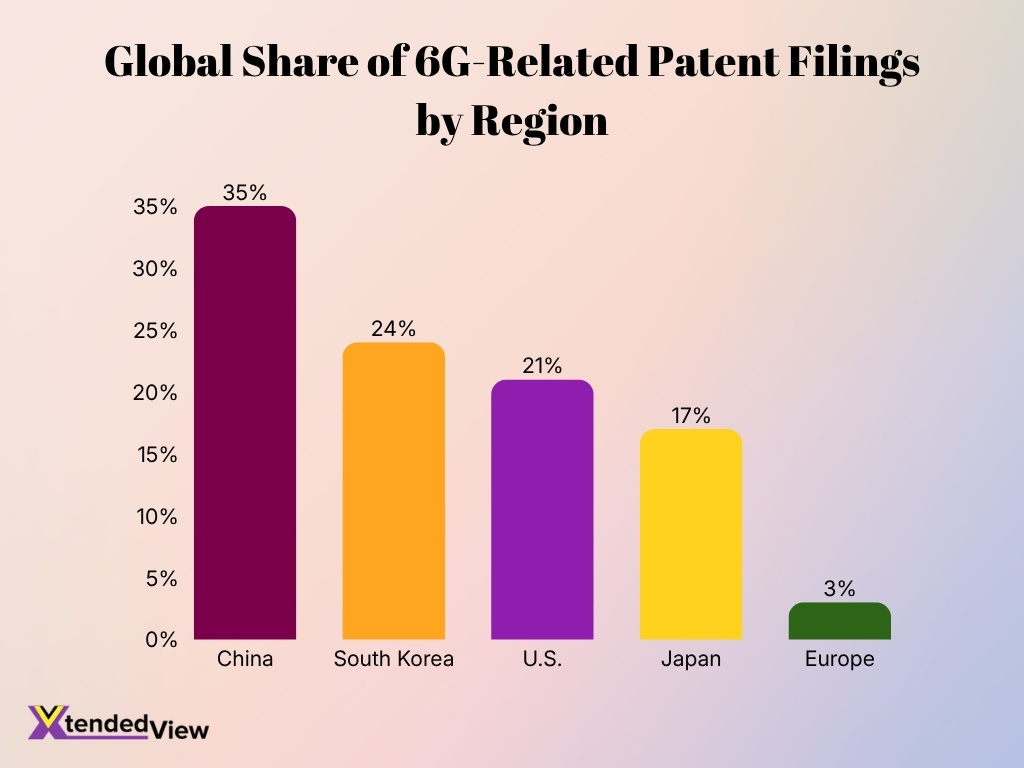
- That same dataset attributed 35% of tracked filings to China, 24% to South Korea, 21% to the U.S., 17% to Japan, and 3% to Europe.
- Integrated sensing and communication represents a fast-growing niche: one 2026 patent study identified 639 patent families specifically associated with 6G ISAC.
- The ISAC dataset recorded 176 patent families in 2024 alone and calculated multi-year filing growth of 1,031%, although recent years remain subject to normal publication lag.
- Within that ISAC corpus, one applicant held 417 patent families, more than 18 times the 22 families attributed to the second-ranked applicant.
- The same ISAC analysis counted 208 PCT records, 149 European records, 101 U.S. records, 88 Indian records, and 73 Chinese records, demonstrating that emerging 6G intellectual property is being protected across multiple major jurisdictions.
- A broader 2026 wireless patent analysis found that 85% of records in its combined 5G/6G corpus touched the H04W wireless-network classification, compared with 34.4% involving H04L digital transmission.
6G Infrastructure Investment Statistics
- Europe announced €116 million for 20 new 6G projects in March 2026, covering research and innovation in areas including AI-native networking, radio technology, security and quantum integration.
- Those projects form part of €630 million in public funding committed through the broader European smart-networks research initiative since 2021.
- The European project portfolio reached 100 projects following the 2026 funding round.
- An additional €270 million was planned for investment during 2026 and 2027, extending the region’s public commitment to next-generation network research.
- India had approved 104 6G R&D projects worth ₹271 crore through its telecom technology development program as of February 2026.
- By June 30, 2026, the broader Indian telecom R&D portfolio had expanded to 136 projects with nearly ₹543 crore in sanctioned funding, including 6G, quantum communication, satellite, optical and telecom-security projects.
- India’s earlier 6G terahertz and advanced optical communication testbed agreements received a combined ₹240.51 crore grant, providing research infrastructure for domestic next-generation communications development.
- India also established 100 academic 5G laboratories intended partly to build a 6G-ready academic and startup ecosystem.
- India’s broader telecom equipment manufacturing incentive program carries an outlay of ₹12,195 crore, providing an industrial base that can support domestic networking hardware development as the sector moves toward 6G.
- Europe, meanwhile, expects its 2026 research round to support applications across at least five highlighted sectors: healthcare, mobility, space connectivity, media and smart manufacturing, illustrating how infrastructure funding is extending beyond conventional consumer mobile broadband.
6G vs. 5G Statistics
- The IMT-2020 framework supports peak rates up to 20 Gbps, while IMT-2030 targets approximately 50 to 200 Gbps depending on the scenario. At the top of the 6G range, that represents a 10-fold increase over the 5G peak requirement.
- 5G’s wide-area user-experienced data-rate target is 100 Mbps, compared with roughly 300 to 500 Mbps or more under IMT-2030, about three to five times higher at the stated 6G target range.
- IMT-2020 supports connection density of up to 1 million devices per square kilometer. IMT-2030 extends the target range to 1 million to 100 million, giving 6G a top-end target as much as 100 times the 5G figure.
- 5G was designed for mobility of up to 500 km/h, while 6G’s framework extends the upper target to 1,000 km/h.
- 5G’s low-latency benchmark reaches approximately 1 millisecond over the air, while IMT-2030 targets radio-network latency from 0.1 to 1 ms. The most aggressive 6G target is therefore one-tenth of the 5G benchmark, although the metrics are not perfectly identical.
- IMT-2030 introduces six usage scenarios, compared with the three broad IMT-2020 categories of enhanced mobile broadband, massive machine-type communications and ultra-reliable low-latency communications.
- The original IMT-2030 framework specifies 15 capabilities, with nine derived from 5G and six new capability dimensions, underscoring that 6G is partly an extension of existing mobile-network technology rather than a complete architectural reset.
- Commercial 5G had reached almost 3.3 billion subscriptions by the second quarter of 2026, while commercial 6G subscriptions had not yet begun.
- Around 390 service providers had launched commercial 5G by mid-2026, and more than 90 had launched or soft-launched 5G standalone networks. Those deployments will form part of the infrastructure and operational foundation from which operators eventually transition toward 6G.
- Global 6G subscriptions are forecast to reach 180 million by the end of 2031, while 5G subscriptions are forecast at 6.4 billion that year. Under that forecast, 6G would still represent only an early portion of the global mobile market one year after its expected initial commercialization.
Frequently Asked Questions (FAQs)
IMT-2030 targets peak data rates of 50 to 200 Gbps, with user-experienced rates of approximately 300 to 500 Mbps or higher.
6G targets a connection density of 1 million to 100 million devices per square kilometer, depending on the use case.
One current market forecast projects the global 6G market to grow from $11.40 billion in 2030 to $110.46 billion in 2036, representing a 46% CAGR.
Global 6G subscriptions are forecast to reach approximately 180 million by the end of 2031, excluding early adoption of AI-enabled IoT devices such as autonomous vehicles, smart glasses and drones.
IMT-2030 targets radio-network latency of 0.1 to 1 millisecond and spectrum efficiency approximately 1.5 to 3 times higher than IMT-2020.
Conclusion
6G statistics show an industry moving steadily from exploratory research toward standardization, testing, and early implementation planning. IMT-2030 targets peak data rates of 50 to 200 Gbps, connection density as high as 100 million devices per square kilometer, and radio-network latency down to 0.1 milliseconds, while also expanding the role of AI, sensing, positioning, energy efficiency, and ubiquitous connectivity.
Commercial 6G deployment is broadly expected to begin around 2030, meaning many of today’s market-size, subscriber and revenue figures remain forecasts rather than observed commercial results. Even so, expanding R&D programs, spectrum trials, patent activity, pre-standard network demonstrations and infrastructure investments show that the foundations are already being built. As standards mature through the remainder of the decade, the focus will increasingly shift from experimental performance to scalable networks capable of connecting people, machines, vehicles, sensors and non-terrestrial systems within a more intelligent wireless ecosystem.