



Twitter, now rebranded as X, continues to shape how people consume real-time information and participate in global conversations. It plays a central role in breaking news distribution, political discourse, financial market sentiment, and customer service interactions. For example, media organizations rely on X for instant news updates, while brands use it to handle customer queries and manage public perception in real time.
At the same time, the platform is evolving beyond traditional social media. With the introduction of subscriptions, long-form content, and payment features, X is positioning itself as a multi-functional digital ecosystem. These changes have influenced user behavior, engagement patterns, and advertiser strategies. Understanding the latest statistics helps marketers, analysts, and businesses make informed decisions, so let’s explore the data behind Twitter.
Editor’s Choice
- X (Twitter) has approximately 557 million monthly active users globally in 2026.
- The platform recorded around 561 million MAUs as of mid-2025, reflecting slight fluctuations year over year.
- Daily active users range between 245 million and 251 million globally.
- Monetizable daily active users (mDAU) reached 237.8 million, indicating strong ad exposure potential.
- The United States leads with over 104–105 million users, the highest among all countries.
- Approximately 63%–66% of users are male, showing a skewed gender distribution.
- X generated roughly $2.5 billion in revenue in 2024, despite ongoing monetization challenges.
Recent Developments
- X rebranded from Twitter in 2023 under Elon Musk, shifting toward an “everything app” model.
- The platform saw a user increase of over 50% between 2024 and 2025, according to some estimates.
- However, other datasets suggest a 4%–7% fluctuation in MAU growth, indicating inconsistent reporting.
- X introduced premium subscriptions, with over 650,000 X Premium users reported.
- The platform continues to face competition from Threads, which reached 400 million MAUs in 2025.
- X lost around 32 million users after the 2022 acquisition, reflecting early churn.
- Daily usage still grew by 14% year over year in earlier growth phases, showing resilience.
- The platform increasingly emphasizes video content and creator monetization tools.
- X has shifted focus toward payments, long-form content, and AI integration as part of its product roadmap.
Overview of Twitter (X) Platform
- X ranks among the top 15 social media platforms globally by user base.
- The platform processes hundreds of millions of tweets daily, reflecting high activity levels.
- X is widely recognized as the primary platform for real-time news consumption, with 59% of users relying on it for news.
- Around 90% of users also use other social media platforms, showing cross-platform behavior.
- The platform supports short-form posts, long-form content, live streams, and Spaces audio chats.
- X remains a top platform for public discourse among journalists, politicians, and brands.
- Users generate billions of monthly visits, including 4.39 billion visits in October 2025.
- X continues to evolve into a multi-functional platform combining social media, payments, and commerce features.
- The platform plays a key role in customer service, with over 50% of users contacting brands via tweets or messages.
Key Statistics of Twitter Usage
- X users spend an average of 11 minutes per day on the platform.
- Monthly usage averages about 3.7 hours per user, indicating shorter session durations.
- Around 44% of monthly users log in daily, showing strong engagement.
- Approximately 37.8% of users use X to research brands and products.
- About 53% of users contact brands for customer service on X.
- Nearly 64% of users prefer messaging a brand over calling, highlighting digital-first behavior.
- X users are 36% more likely to try new products early, making it valuable for product launches.
- The platform drives about 2.99% of global referral traffic to third-party sites.
- Users on X are 2x more likely to make in-app purchases compared to other platforms.
X (Twitter) Revenue Trends and Growth Insights (2017–2027)
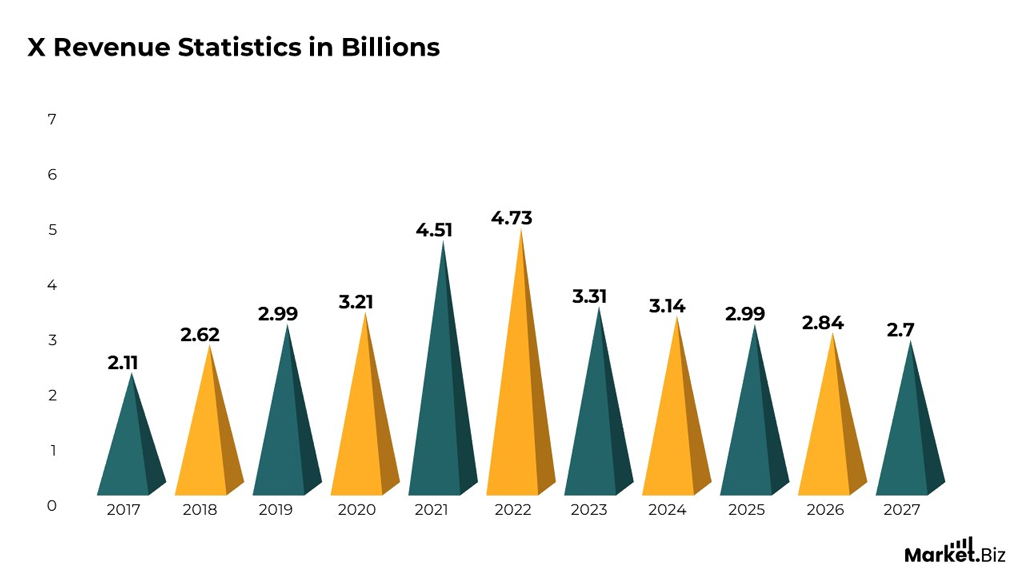
- X (Twitter) revenue grew steadily from $2.11 billion in 2017 to $4.73 billion in 2022, marking its peak performance period.
- The platform saw a strong growth phase between 2019 and 2021, jumping from $2.99 billion to $4.51 billion, reflecting rapid monetization expansion.
- 2022 recorded the highest revenue at $4.73 billion, highlighting the platform’s strongest financial year on record.
- After 2022, revenue experienced a sharp decline, dropping to $3.31 billion in 2023, a ~30% decrease year-over-year.
- The downward trend continued with revenues falling to $3.14 billion in 2024 and $2.99 billion in 2025, indicating ongoing monetization challenges.
- By 2026, revenue is projected to decline further to $2.84 billion, showing continued contraction in earnings.
- 2027 estimates revenue at $2.70 billion, bringing it close to pre-growth levels seen around 2018–2019.
- Overall, the data highlights a clear rise (2017–2022) followed by a consistent decline (2023–2027), signaling a shift in business performance and revenue stability.
- Despite recent declines, long-term revenue remains higher than 2017 levels, indicating net growth over the decade.
Monthly Active Users on the Twitter Platform
- X (Twitter) has approximately 557 million monthly active users (MAUs) in 2026.
- The platform recorded about 561 million MAUs in 2025, showing relatively stable growth.
- In contrast, official historical reporting showed 368.4 million MAUs in 2022, before reporting methodology changed.
- The U.S. accounts for over 18% of total global MAUs, making it the largest user base.
- Japan ranks second with approximately 67 million users, reflecting strong regional adoption.
- India contributes over 25 million users, although growth has slowed recently.
- X saw a 5%–7% fluctuation in MAU growth between 2024 and 2025, indicating market uncertainty.
- Globally, social media penetration continues to rise, with X maintaining a top-tier position among real-time platforms.
- Estimates suggest MAUs could reach 600+ million by late 2026, depending on monetization success.
Daily Active Users on Twitter Network
- X records approximately 245–251 million daily active users (DAUs) globally.
- Around 44% of monthly users log in daily, reflecting consistent engagement.
- The platform’s DAU base grew by 14% year over year in earlier periods, indicating strong retention.
- U.S. users represent a significant portion of DAUs, with over 30% of American users checking the app daily.
- News consumption drives daily usage, with 59% of users relying on X for news updates.
- Approximately 80% of users access X via mobile devices daily, reinforcing mobile-first behavior.
- Daily engagement spikes during major global events, increasing activity by 20%–40% during breaking news cycles.
- X Spaces and live features have contributed to a notable increase in real-time participation metrics.
- The platform’s DAU/MAU ratio remains around 40%–45%, considered strong among social platforms.
X (Twitter) Users vs Other Social Networking Platforms
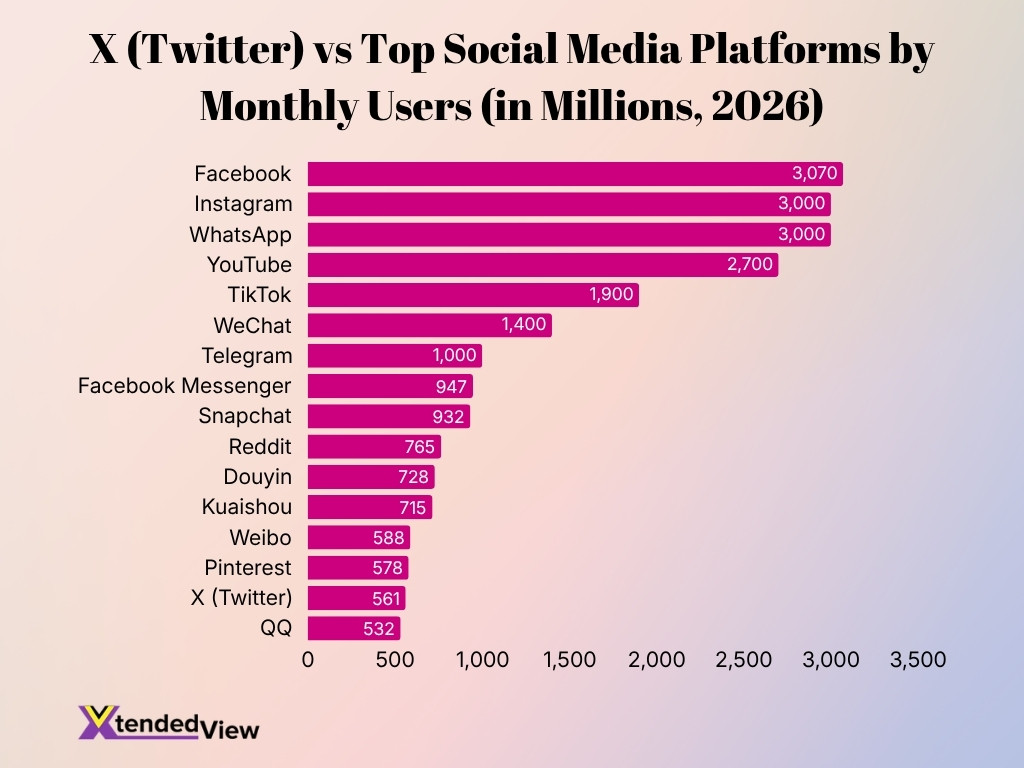
- X (Twitter) has 561 million monthly active users, positioning it 15th globally among major social platforms.
- Compared to Facebook (3,070M users), X’s user base is nearly 5.5× smaller, highlighting a significant scale gap.
- Instagram and WhatsApp (3,000M each) have over 5× more users than X, showing Meta’s ecosystem dominance.
- YouTube (2,700M users) exceeds X by almost 2.1 billion users, driven by massive video consumption.
- TikTok (1,900M users) has more than 3× the user base of X, reflecting rapid growth in short-form content.
- Even messaging platforms like WeChat (1,400M) and Telegram (1,000M) significantly outperform X in total users.
- Mid-tier platforms such as Snapchat (932M) and Reddit (765M) still maintain larger audiences than X.
- Region-specific platforms like Douyin (728M) and Kuaishou (715M) surpass X, emphasizing strong local market dominance.
- Pinterest (578M users) is very close to X, with only a 17 million user difference, indicating tight competition in this tier.
- X remains ahead of QQ (532M users) by just 29 million users, showing minimal separation at the lower end of the top platforms.
- Despite a smaller user base, X (Twitter) holds a strong influence in real-time news, politics, and public discourse, making its impact disproportionate to its size.
Usage of Twitter by Region and Country
- The United States leads with over 104–105 million users, the largest national audience.
- Japan follows with approximately 67 million users, showing strong engagement per capita.
- India has over 25 million users, though growth has slowed compared to previous years.
- Brazil ranks among the top markets with around 24 million users, driven by social engagement trends.
- The United Kingdom has approximately 19 million users, maintaining steady adoption.
- X usage in Europe accounts for roughly 15%–20% of global users, depending on the region.
- Emerging markets in Southeast Asia show double-digit growth rates, particularly in Indonesia and the Philippines.
- The Middle East and North Africa region has seen rapid adoption, with growth exceeding 10% annually.
- Regional engagement varies, with Japan and the U.S. showing higher daily usage rates than global averages.
Demographics Overview of Twitter Users
- Around 63%–66% of X users are male, indicating a gender imbalance.
- Approximately 34%–37% of users are female, showing gradual diversification.
- The largest user segment falls between 18 to 34 years old, making up over 50% of the audience.
- X attracts a more educated audience, with a higher share of college-educated users compared to other platforms.
- Around 42% of users have a college degree, highlighting professional usage.
- Urban users dominate, with over 70% of users located in metropolitan areas.
- X users tend to have higher-than-average household incomes, especially in the U.S.
- Politically engaged users are more active on X than on most other platforms.
- The platform is widely used by journalists, policymakers, and business leaders, shaping public discourse.
Users of Twitter by Age Group
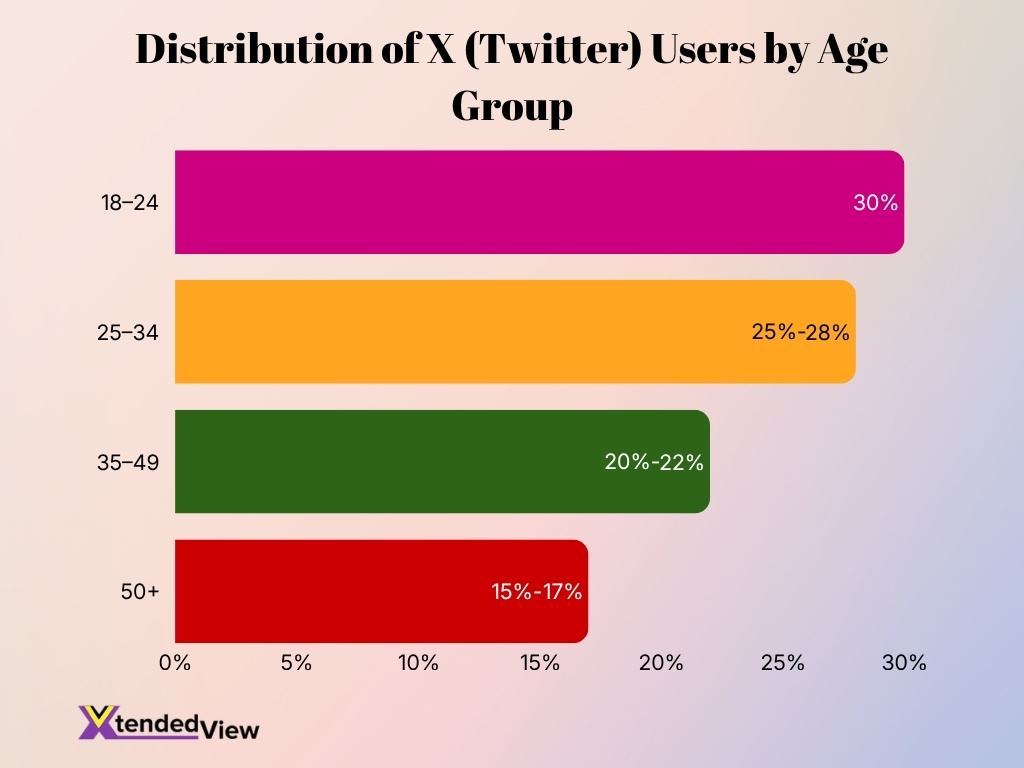
- Users aged 18–24 account for around 30% of the total user base, making them the largest group.
- The 25–34 age group represents approximately 25%–28% of users, a key demographic for advertisers.
- Users aged 35–49 make up about 20%–22%, showing strong mid-career engagement.
- The 50+ age group accounts for roughly 15%–17%, indicating slower adoption among older users.
- Teen usage (13–17) remains limited due to platform competition and content moderation concerns.
- Younger users are 2x more likely to engage with trending topics and viral content.
- Older users tend to use X primarily for news and information rather than entertainment.
- Gen Z users show higher engagement with video and Spaces features, reflecting evolving content preferences.
- Millennials remain the most valuable demographic for advertisers, combining engagement and purchasing power.
Twitter Users by Gender Distribution
- Approximately 63%–66% of X users are male, making it one of the more male-dominated platforms.
- Female users account for around 34%–37% of the total user base.
- In the United States, about 56% of male internet users use X, compared to 44% of female users.
- Gender disparity is more pronounced in tech, finance, and crypto-related discussions, where male participation exceeds 70%.
- Female engagement tends to be higher in lifestyle, entertainment, and brand interaction content categories.
- The gender gap has narrowed slightly since 2022, with female user growth increasing by 2%–3% annually.
- Non-binary and diverse gender representation is growing, but still underreported in official datasets.
- Female users are more likely to engage with brand content and customer service interactions.
- Male users are more likely to follow news, sports, and financial content, driving platform discourse trends.
Users of Twitter by Device Type
- Over 80% of X users access the platform via mobile devices, highlighting mobile-first behavior.
- Desktop usage accounts for roughly 15%–18% of total traffic, mainly among professionals and media users.
- Android users represent about 70% of mobile traffic globally, dominating platform access.
- iOS users contribute significantly to revenue, with higher ad engagement rates compared to Android users.
- The X mobile app consistently ranks among the top 10 social media apps in global downloads.
- Tablet usage remains minimal, accounting for less than 5% of total sessions.
- Mobile users spend 30% more time on the platform compared to desktop users.
- Push notifications drive engagement, with over 60% of users enabling notifications.
- Progressive web app (PWA) adoption has improved accessibility in emerging markets with low bandwidth usage optimization.
Twitter (X) Desktop Traffic Sources Breakdown
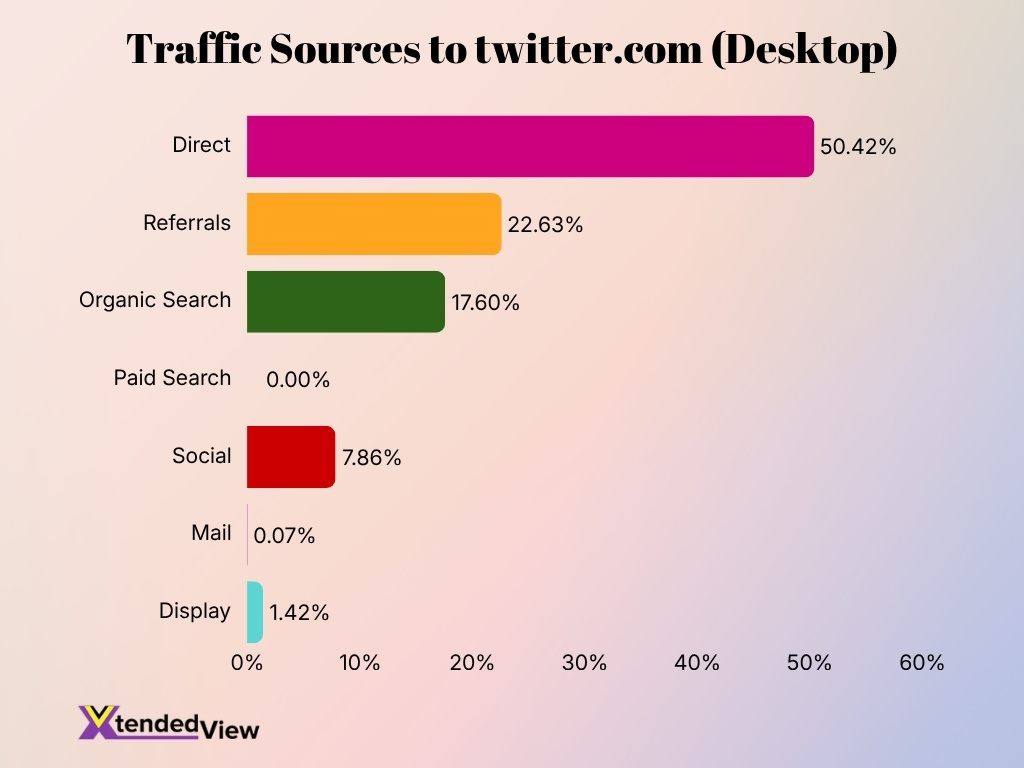
- Direct traffic dominates with a massive 50.42% share, indicating strong brand recall and habitual usage among users.
- Referrals contribute 22.63%, making them the second-largest traffic source, highlighting the importance of external websites and link sharing.
- Organic search drives 17.60% of traffic, showing that search engines remain a key discovery channel for Twitter content.
- Social traffic accounts for 7.86%, which is relatively low for a social platform, suggesting limited cross-platform traffic inflow.
- Display ads generate only 1.42%, indicating minimal impact of banner and programmatic advertising on desktop visits.
- Email (Mail) contributes just 0.07%, making it an almost negligible traffic source for Twitter.
- Paid search stands at 0.00%, showing no measurable contribution, implying Twitter relies heavily on organic and direct channels rather than paid acquisition.
- Overall, over 73% of traffic (Direct + Referrals) comes from non-search sources, reinforcing Twitter’s position as a destination-driven platform rather than a discovery-first channel.
Time Spent on Twitter and Usage Habits
- Users spend an average of 11 minutes per day on X, lower than platforms like TikTok or Instagram.
- Monthly usage averages around 3.7 hours per user, reflecting quick-session behavior.
- Approximately 44% of users log in daily, showing consistent engagement.
- Peak usage times occur during morning (8–10 AM) and evening (6–9 PM) hours, aligning with commute and leisure periods.
- Users check X multiple times a day, with an average of 5–6 sessions daily.
- News-driven spikes increase usage by 20%–40% during major global events.
- Around 70% of users follow at least one brand, indicating commercial relevance.
- Users prefer short-form, real-time content over long-form posts, although long-form adoption is growing.
- Mobile-first habits dominate, with 80%+ of sessions occurring on smartphones.
Content Creation on Twitter and Posting Frequency
- Over 500 million tweets are posted daily, reflecting high content volume.
- Approximately 6,000 tweets are sent every second globally.
- Around 80% of users are passive consumers, while only 20% actively create content.
- The average user posts once every 2–3 days, depending on activity level.
- Brands post 1–2 tweets per day on average, balancing visibility and engagement.
- Tweets with images receive 35% more engagement than text-only posts.
- Video tweets generate up to 10x more engagement than standard tweets.
- Hashtags increase engagement by up to 100% when used strategically.
- Threads and long-form posts are gaining traction, with increased dwell time and interaction rates.
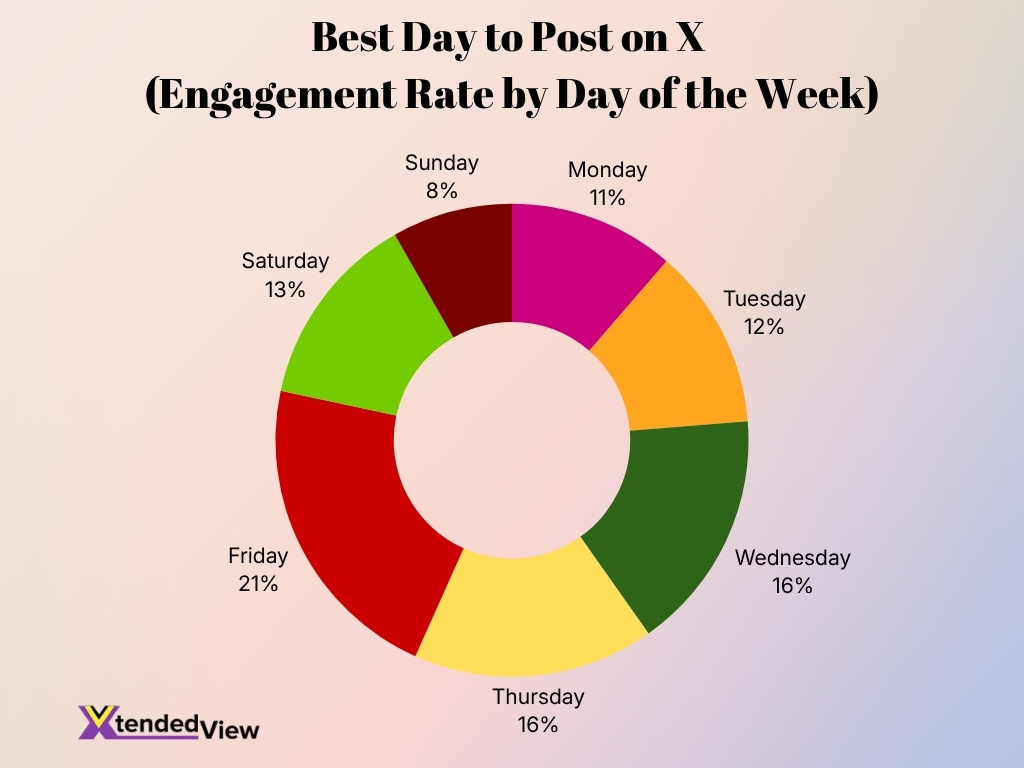
Best Days to Post on X for Maximum Engagement
- Friday is the top-performing day, with the highest engagement rate of 21%, making it the most effective day to publish content.
- Mid-week days (Wednesday and Thursday) show strong performance, each with 16% engagement, indicating consistent audience activity during this period.
- Saturday maintains moderate engagement at 13%, suggesting weekend activity is still relevant but lower than weekdays.
- Tuesday (12%) and Monday (11%) show slightly lower engagement, indicating a gradual build-up in user activity early in the week.
- Sunday records the lowest engagement at 8%, making it the least effective day for posting on X.
- Overall, engagement trends peak toward the end of the workweek, with a clear upward trajectory from Monday to Friday, followed by a decline over the weekend.
- For an optimal content strategy, brands and creators should prioritize posting between Wednesday and Friday, especially targeting Friday for maximum reach and interaction.
Engagement Metrics on the Twitter Platform
- The average engagement rate per tweet is around 0.05%–0.1%, lower than newer platforms.
- Tweets with images see 35% higher engagement, while videos significantly outperform static content.
- Replies and conversations drive higher engagement than standalone posts, especially in trending discussions.
- Tweets posted during peak hours receive 20%–30% more interactions.
- Verified accounts and influencers achieve 2x higher engagement rates than regular users.
- Polls and interactive content formats increase engagement by 15%–20%.
- Retweets account for a significant portion of engagement, with over 25% of interactions coming from shares.
- Engagement is highly event-driven, with spikes during sports events, elections, and global news cycles.
- Brands that respond to users see 3x higher customer satisfaction scores.
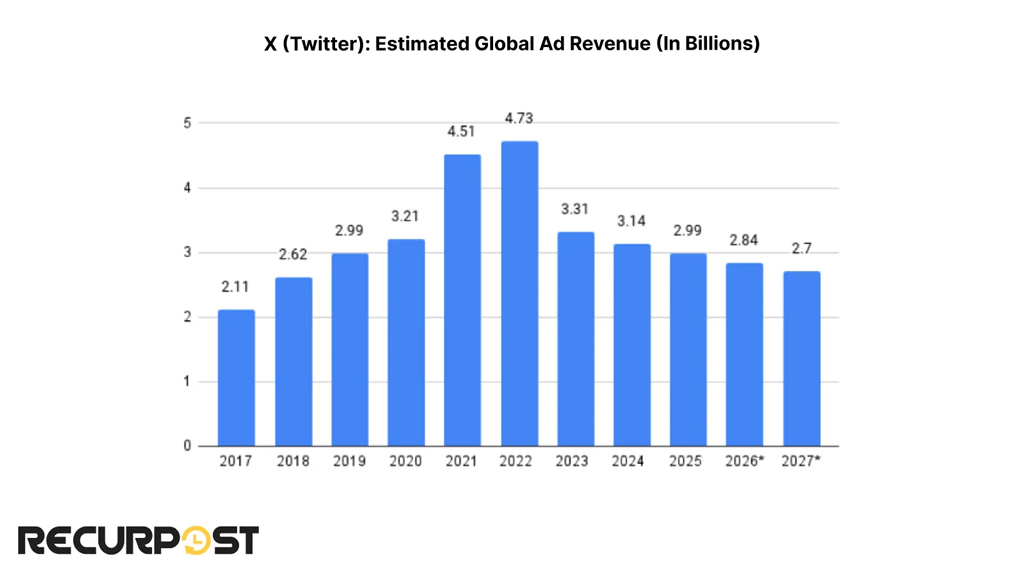
X (Twitter) Ad Revenue Trends: Growth Peak and Decline Insights
- Steady growth phase (2017–2020): Ad revenue increased from $2.11 billion in 2017 to $3.21 billion in 2020, reflecting consistent platform monetization growth.
- Sharp acceleration in 2021: Revenue surged to $4.51 billion, marking a significant ~40% YoY increase, the fastest growth in the period.
- Peak performance in 2022: X (Twitter) reached its highest ad revenue of $4.73 billion, indicating the platform’s strongest monetization year.
- Post-peak decline (2023): Revenue dropped sharply to $3.31 billion, a decline of approximately 30% from the 2022 peak, signaling a major advertising pullback.
- Continued downward trend: Revenue is projected to fall further to $3.14 billion in 2024 and $2.99 billion in 2025, showing sustained contraction.
- Long-term decline projections: Estimates suggest revenue will decrease to $2.84 billion in 2026 and $2.70 billion by 2027, approaching pre-2020 levels.
- Overall trend insight: Despite strong growth until 2022, X’s ad business is experiencing a multi-year decline, highlighting challenges in advertiser retention and platform stability.
- Net change perspective: From peak ($4.73B in 2022) to projected $2.70B in 2027, revenue is expected to decline by over 43%, indicating a substantial market correction.
- Key takeaway: The data reflects a boom-to-bust cycle, where rapid growth was followed by a prolonged decline, making X’s ad revenue trajectory highly volatile.
Frequently Asked Questions (FAQs)
Twitter (X) has approximately 557 million monthly active users globally.
Around 245–259 million users access Twitter daily, depending on the dataset.
About 63.7% of Twitter users are male, compared to 36.3% female users.
Twitter generated roughly $2.5 billion in revenue in 2024, with most income from ads.
Approximately 44% of monthly users are active daily on the platform.
Conclusion
Twitter, now operating as X, maintains a distinct position in the social media landscape by focusing on real-time, public conversations. Despite fluctuations in user growth and advertising revenue, the platform continues to attract users who value immediacy, news access, and direct interaction with brands, creators, and public figures. Its influence remains especially strong in industries such as media, finance, politics, and technology.
Looking ahead, X’s long-term success will depend on how effectively it balances innovation with stability. The push toward subscriptions, creator monetization, and integrated services like payments signals a broader strategic shift. However, sustaining user trust and advertiser confidence will remain critical. As the platform continues to evolve, these trends and statistics offer a clear lens into where X stands today and where it may head next.
