


Sales follow-up has become a defining factor in modern revenue growth, especially as buyer journeys grow longer and more complex. Whether it’s a SaaS company nurturing inbound leads, a real estate agent reconnecting with prospects, or an eCommerce brand recovering abandoned carts, timely and consistent follow-ups directly influence deal outcomes. Buyers today expect quick responses, personalized communication, and multiple touchpoints before making a decision.
At the same time, many sales teams still struggle with delayed responses, inconsistent outreach, or early abandonment of leads. This gap creates a significant opportunity for businesses that implement structured follow-up systems and disciplined outreach strategies. In fact, companies that prioritize follow-up timing, persistence, and channel optimization consistently outperform competitors in both conversion rates and revenue growth. Let’s explore the latest statistics to understand how follow-up strategies shape sales success.
Editor’s Choice
- 80% of successful sales require five or more follow-ups, yet most reps stop early.
- 44% of salespeople give up after just one follow-up attempt, leaving significant revenue untapped.
- Nearly 48% of sales reps never follow up at all, highlighting a major process gap.
- The first follow-up email can boost reply rates by up to 49%.
- 60% of customers reject an offer four times before accepting, reinforcing the need for persistence.
- Businesses that respond first win 35% to 50% of deals, emphasizing speed advantage.
- 78% of buyers choose the first company to respond, not necessarily the cheapest or best.
Recent Developments
- In 2025–2026, multichannel follow-up (email + phone + LinkedIn) has increased success rates significantly.
- Sales teams now require an average of 8 touchpoints to reach a prospect, up from ~3–4 a decade ago.
- AI-powered follow-ups can handle up to 90% of initial customer queries instantly.
- Cold calling success rates rose to 6.7% in 2025, nearly triple earlier benchmarks when paired with follow-ups.
- Personalization and follow-up failures account for 75% of lost leads.
- Structured follow-up systems are now tracked via CRM tools like HubSpot Sales Hub.
- Sales teams using analytics-driven follow-ups see higher retention and conversion rates.
- Companies responding within 5 minutes are 100× more likely to connect with leads.
Key Sales Follow-Up Statistics You Can’t Ignore
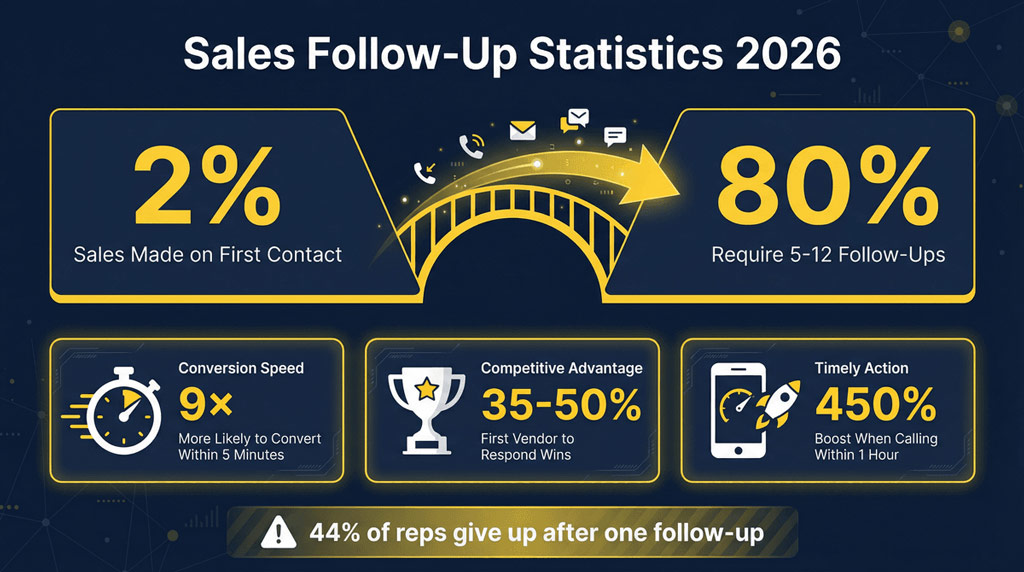
- Only 2% of sales are made on the first contact, highlighting the critical need for consistent follow-ups.
- A massive 80% of deals require 5–12 follow-ups, proving that persistence is a key driver of conversions.
- Responding quickly gives a huge edge; leads are 9x more likely to convert if contacted within 5 minutes.
- Speed also creates a competitive advantage, with the first vendor to respond winning 35–50% of deals.
- Timely outreach significantly boosts results; calling within 1 hour can increase conversions by 450%.
- Despite this, 44% of sales reps give up after just one follow-up, missing out on the majority of potential deals.
Sales Follow Up Conversion Statistics
- Companies that follow up first close 35–50% more deals.
- 80% of deals require at least five follow-ups, reinforcing persistence.
- Businesses responding within 5 minutes see 21× higher qualification rates.
- Follow-up emails increase response likelihood by 11% on average.
- Cold outreach sequences with 3 emails generate ~9% reply rates.
- Following up every 21–30 days improves conversion rates by 47%.
- Multi-touch strategies outperform single-touch outreach in nearly all industries.
- Personalized follow-ups significantly increase deal closure probability.
Number of Follow-Ups Needed to Close a Sale
- 80% of sales require five or more follow-ups before closing a deal.
- On average, it takes 8 attempts to successfully reach a prospect.
- 60% of prospects say “no” four times before eventually saying yes.
- Only 10% of salespeople make more than three follow-up attempts.
- The optimal B2B email sequence usually includes 2–3 follow-ups.
- 9–10 follow-ups can increase contact rates by up to 80%.
- 44% of sales reps stop after just one follow-up, missing conversion potential.
- Persistent follow-ups can boost response rates by 25–30% compared to single attempts.
- Buyers average 7–13 interactions with a brand before making a purchase decision.
- Companies with structured follow-up strategies see 47% higher lead conversion rates.
Sales Follow-Up Persistence Statistics
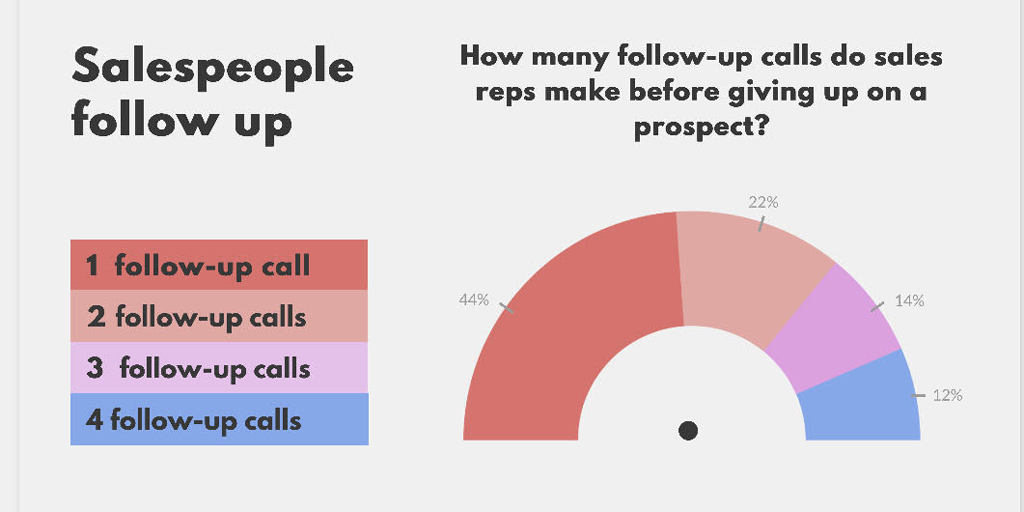
- 44% of sales reps give up after just 1 follow-up call, indicating a significant drop-off in persistence at the earliest stage.
- Only 22% continue to a second follow-up, showing that nearly half of reps do not attempt further engagement beyond the first outreach.
- A smaller segment, 14% of reps, make it to 3 follow-up calls, highlighting declining persistence as attempts increase.
- Just 12% of salespeople reach 4 follow-up calls, demonstrating that very few reps fully exhaust follow-up opportunities.
- Overall, the data reveals a sharp decline in follow-up effort after the first attempt, suggesting missed opportunities in lead conversion.
- The majority of sales reps (78%) stop at two or fewer follow-ups, underscoring a lack of long-term follow-up strategy.
- This trend indicates that consistent multi-touch follow-ups remain underutilized, despite their known impact on closing deals.
Sales Follow-Up Response Rate Statistics
- Follow-up emails generate 2–3× higher response rates than initial outreach alone.
- The average cold email reply rate sits at 8.5% in 2025, but increases with follow-ups.
- Sending at least one follow-up email boosts replies by 49%.
- Campaigns with 4–7 follow-ups see response rates above 27%.
- Prospects are 3× more likely to reply after the second or third touchpoint.
- Email sequences with personalization increase reply rates by up to 32%.
- Follow-ups sent within the same thread maintain higher engagement continuity.
- SMS follow-ups achieve open rates above 90%, outperforming email significantly.
- Response rates drop sharply after day 10 without follow-up, highlighting timing importance.
Sales Follow-Up Timing Statistics
- Responding within 5 minutes increases conversion likelihood by 21×.
- Leads contacted within the first hour are 7× more likely to convert.
- Waiting more than 24 hours reduces response rates by over 60%.
- The average company response time remains 42 hours, far from optimal.
- Following up within 24–48 hours delivers the highest engagement rates.
- Prospects contacted immediately are 100× more likely to connect.
- Delayed follow-ups result in significant lead decay within the first 48 hours.
- Automated follow-ups reduce response delays by up to 70%.
Best Days and Times for B2B Email Performance Insights
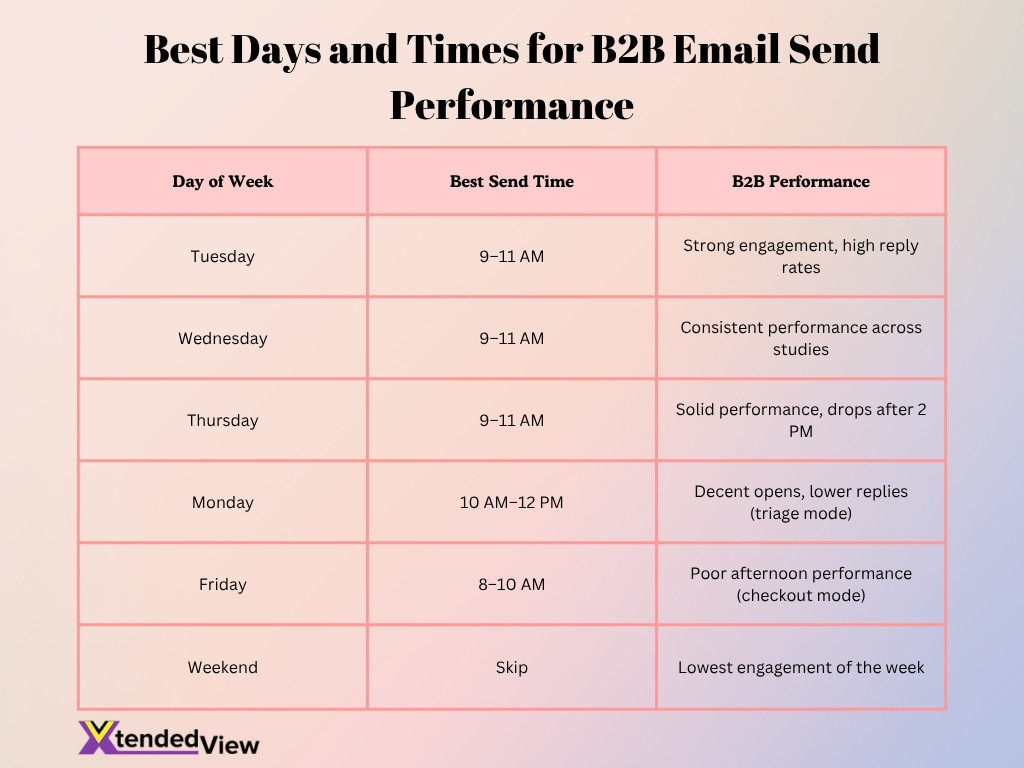
- Tuesday to Thursday (9–11 AM) emerges as the peak performance window, delivering strong engagement and high reply rates.
- Wednesday (9–11 AM) stands out for its consistent performance across multiple studies, making it a reliable benchmark day.
- Thursday (9–11 AM) maintains solid results, but performance drops significantly after 2 PM, indicating a narrow optimal window.
- Monday (10 AM–12 PM) shows decent open rates, but lower replies, as professionals are typically in “triage mode” catching up on tasks.
- Friday (8–10 AM) sees limited effectiveness, with poor performance in the afternoon due to “checkout mode” behavior.
- Weekends should be avoided, as they consistently record the lowest engagement rates of the entire week.
- Overall, midweek mornings (9–11 AM) represent the highest ROI time slot for B2B email campaigns.
- Timing strategy should prioritize early-day engagement and avoid post-lunch or late-week fatigue periods to maximize results.
Speed to Lead and First Response Time Statistics
- Companies that respond first win 35–50% of deals.
- 78% of buyers purchase from the first responder, not necessarily the best offer.
- Responding within 5 minutes makes you 100× more likely to connect with a lead.
- The odds of qualifying a lead drop by 80% after 5 minutes.
- Sales teams using automation respond 2–3× faster than manual processes.
- Leads contacted within 1 hour are 7× more likely to convert.
- Immediate follow-ups improve customer experience and trust metrics.
- Slow response times contribute to significant revenue leakage across industries.
Email Follow-Up Open and Reply Rate Statistics
- The average email open rate across industries is 21–25% in 2025, increasing with follow-ups.
- Follow-up emails achieve 30% higher open rates than initial emails.
- Personalized subject lines boost open rates by 26%.
- Email sequences with 4–7 messages yield 3× more replies.
- Short emails under 125 words see higher response rates.
- Including a single CTA increases reply rates by 371%.
- Follow-ups sent in the same thread improve context retention and engagement.
- Emails with personalization tokens improve conversion likelihood significantly.
Sales Follow-Up Channel Performance (Email, Phone, SMS, Social)
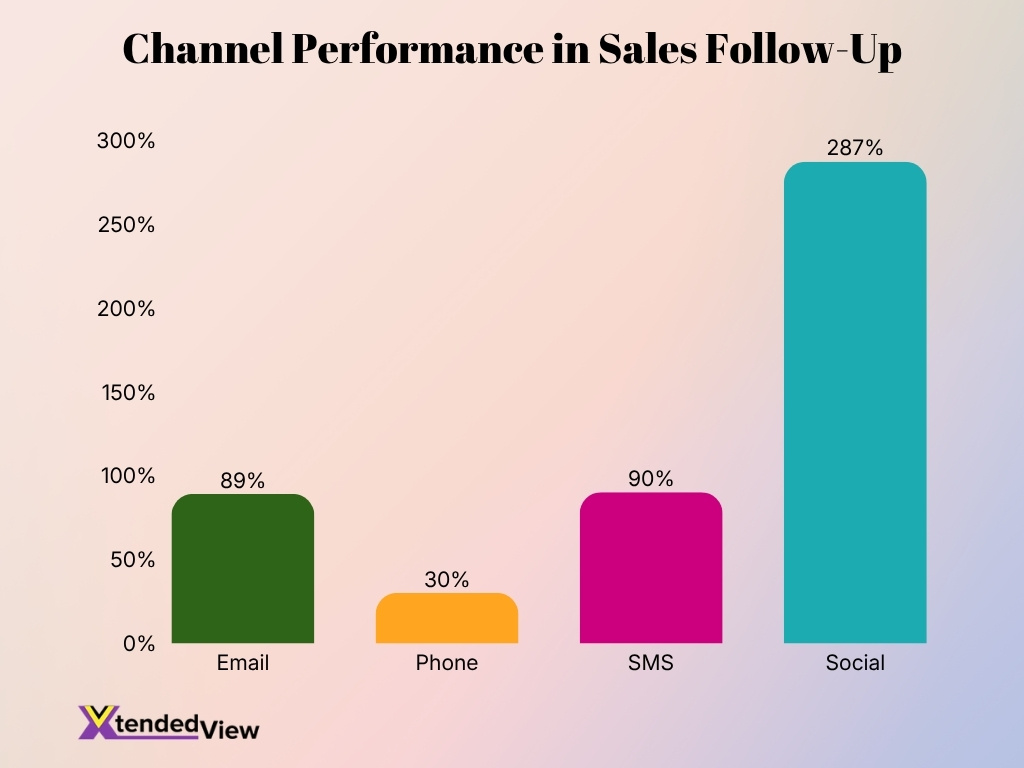
- Email remains the top channel, used by 89% of sales professionals.
- Phone calls still deliver conversion rates up to 30% higher than email in certain industries.
- SMS boasts open rates above 90%, making it highly effective for follow-ups.
- LinkedIn follow-ups generate higher response rates in B2B environments.
- Multichannel outreach increases engagement by up to 287%.
- Email follow-ups provide the lowest cost per touchpoint.
- Social media follow-ups improve brand familiarity and trust signals.
- Combining phone and email increases conversion rates significantly compared to single-channel outreach.
Phone and Voicemail Follow-Up Statistics
- Phone calls convert at rates up to 30% higher than email alone.
- Sales reps make an average of 52 calls per day, but fewer than 1 in 4 include structured follow‑ups.
- Leaving voicemails increases callback rates by up to 22%.
- Prospects respond better when voicemail messages are under 30 seconds.
- Call‑back rates improve by over 40% when follow‑up calls occur within 24 hours.
- Combining voicemail and email follow‑ups increases response rates by roughly twice the baseline.
- Cold calling success rates rose to 6.7% in 2025 with structured follow‑up sequences.
- Making 5–8 call attempts increases connection rates by more than 60% versus fewer attempts.
- Around 80% of cold calls now go to voicemail, underscoring the need for voicemail‑email combos.
- Multi‑channel (call + email) follow‑up sequences can boost meeting‑book rates by 8–12% versus single‑channel.
Multi-Touch and Multi-Channel Follow-Up Statistics
- Sales campaigns using 3+ channels see engagement rates increase by up to 287%.
- Companies using multi-touch strategies report higher conversion rates across all industries.
- The average deal now requires 8–12 touchpoints, compared to 5–7 in 2020.
- Combining email + phone increases response rates by up to 3×.
- Multi-channel outreach improves brand recall and buyer trust significantly.
- Prospects exposed to multiple channels are twice as likely to engage.
- Social + email sequences deliver higher engagement in B2B pipelines.
- Multi-touch campaigns reduce lead drop-off by over 30%.
How Company Size Impacts Follow-Up Email Effectiveness
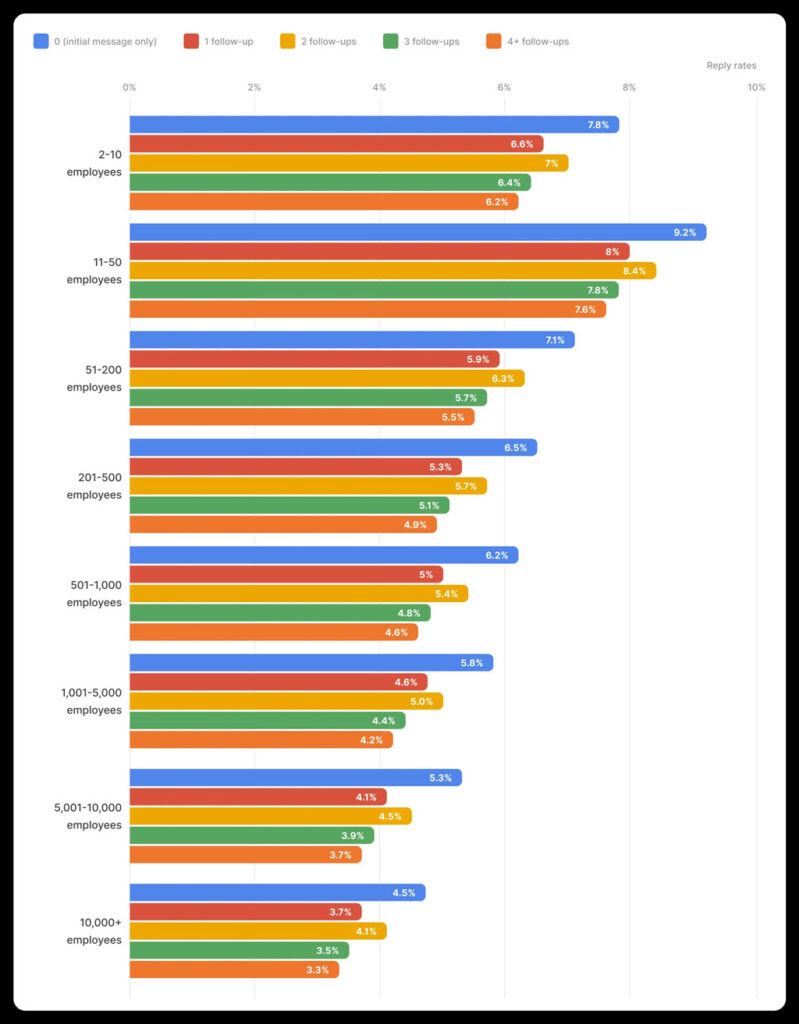
- Smaller companies respond more actively: Businesses with 11–50 employees show the highest reply rates, peaking at 9.2% (no follow-up), and the strongest engagement across all segments.
- Initial outreach performs best across all sizes: The highest reply rate consistently occurs at 0 follow-ups, indicating that the first email drives the most engagement regardless of company size.
- Follow-ups show diminishing returns: Reply rates gradually decline with each additional follow-up, e.g., in 2–10 employee companies, replies drop from 7.8% → 6.2% by 4+ follow-ups.
- Mid-sized companies maintain moderate engagement: Organizations with 51–200 employees maintain steady performance, ranging from 7.1% (initial) to 5.5% (4+ follow-ups).
- Large enterprises are less responsive overall: Companies with 10,000+ employees have the lowest engagement, with reply rates falling from 4.5% (initial) to just 3.3% (4+ follow-ups).
- Follow-up tolerance decreases with company size: Smaller firms tolerate more follow-ups, while larger organizations show sharper declines, highlighting lower patience for repeated outreach in enterprise environments.
- Sweet spot for follow-ups is 1–2 touches: Across most segments, 1–2 follow-ups maintain relatively strong performance (e.g., 8.4% for 11–50 employees) before sharper drop-offs occur.
- Consistent downward trend across all segments: Every company size shows a clear negative correlation between the number of follow-ups and reply rate, reinforcing the risk of over-following.
- Best-performing segment overall: The 11–50 employee group dominates across all follow-up stages, consistently outperforming larger organizations.
- Strategic takeaway: For optimal results, prioritize high-quality initial outreach and limit follow-ups to 2–3 maximum, especially when targeting larger enterprises.
Sales Follow-Up Cadence and Sequence Length Statistics
- Optimal follow-up sequences typically include 5–7 touches over 2–3 weeks.
- Campaigns with 4–7 emails generate 3× more replies than shorter sequences.
- Sequences longer than 10 touches show diminishing returns in engagement.
- The ideal gap between follow-ups is 2–3 days for early-stage outreach.
- Extending cadence beyond 30 days improves long-term conversion by up to 47%.
- Consistent cadence improves pipeline predictability and deal velocity.
- Irregular follow-ups reduce engagement and lower reply rates significantly.
- Structured sequences outperform ad-hoc outreach in both B2B and B2C sales cycles.
Sales Follow-Up Metrics by Sales Funnel Stage
- Early-stage leads see 80% requiring 5+ follow-ups for sales success.
- Follow-ups within 5 minutes boost early lead qualification odds by 100x.
- Mid-funnel nurturing increases qualified leads ready to buy by 50%.
- Increasing mid-funnel follow-ups to 4 touchpoints improves conversion by 15%.
- Late-stage deals average 5-7 touchpoints to successfully close.
- 95% of converted leads reached by the 6th follow-up attempt.
- Top-of-funnel follow-ups generate high volume but only 2-4% conversion rates.
- Bottom-of-funnel opportunity win rates average 15-30%.
- Funnel-specific strategies boost MQL-to-SQL conversions by up to 20%.
- Aligned stage follow-ups increase overall pipeline velocity by 15%.
How Sales Follow-Ups Impact Productivity
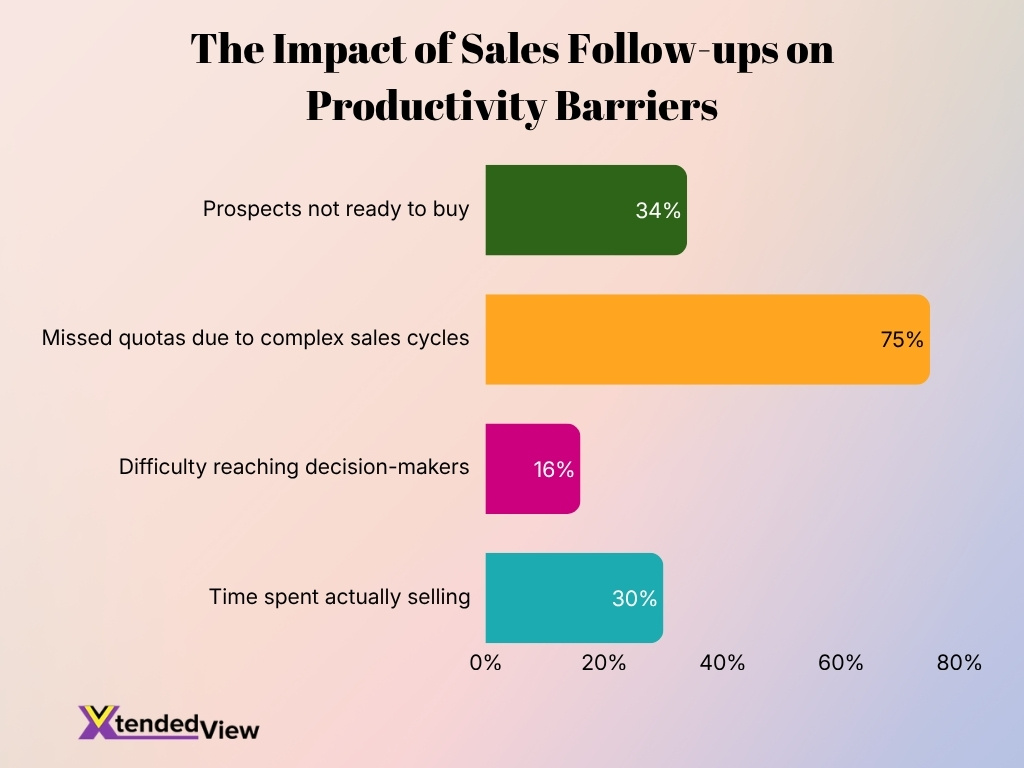
- 34% of sales professionals report that prospects don’t convert because they aren’t ready to buy, highlighting the need for consistent follow-ups and nurturing strategies.
- A significant 75% of B2B sales reps fail to meet their quotas due to complex sales cycles, indicating that longer deal timelines require more structured follow-up processes.
- About 16% of sales professionals identify difficulty in reaching decision-makers as a major barrier, emphasizing the importance of multi-channel outreach and persistence.
- Sales professionals spend only ~30% of their time actually selling, revealing a major productivity gap caused by administrative tasks and inefficient follow-ups.
- The data clearly shows that ineffective follow-up strategies contribute directly to lost opportunities, missed quotas, and reduced sales efficiency.
- Improving follow-up timing, personalization, and frequency can significantly increase conversions and optimize sales productivity.
B2B vs B2C Sales Follow-Up Statistics
- B2B sales cycles often require 6–10 follow‑ups on average, while B2C typically needs 3–5.
- 80% of B2B deals require 5 or more follow‑ups to close.
- B2C buyers who respond within up to 24 hours of a follow‑up see 2–3x higher conversion rates.
- Email accounts for roughly 70% of B2B follow‑up touches, compared with SMS and phone dominating 60%+ of B2C follow‑ups.
- B2B follow‑ups across 4–5 channels yield up to 2x higher contact rates than single‑channel sequences.
- B2B deals involving 3+ decision makers often require 2–3x more follow‑ups than simple single‑buyer scenarios.
- B2C follow‑ups within the first 24 hours of a lead drop‑off can reclaim up to 40% of abandoned carts.
- Multi‑channel B2B cadences of 12–16 touches increase meeting rates by roughly 70–80% versus shorter sequences.
- Only 2% of sales close on the first contact, yet 80% require 5–12 follow‑ups.
- Sales teams with a standardized B2B follow‑up process achieve up to 78% higher conversion rates than those without one.
Sales Automation and AI in Follow-Up Statistics
- AI-powered tools can automate up to 80–90% of follow-up tasks.
- Sales teams using AI report 30% higher productivity.
- Automated follow-ups reduce response times by up to 70%.
- AI-driven personalization increases email engagement by 20–30%.
- Chatbots handle initial follow-ups for over 60% of inbound leads.
- CRM-integrated automation improves lead tracking and follow-up consistency.
- AI tools help prioritize leads based on conversion likelihood and behavior.
- Companies adopting AI follow-ups see higher ROI and faster deal cycles.
Frequently Asked Questions (FAQs)
Around 80% of sales require at least 5 or more follow-ups to successfully close a deal.
Nearly 92% of sales reps stop after 4 or fewer follow-ups, even though more attempts are usually needed.
About 48% of salespeople never make a single follow-up attempt after initial contact.
Sales teams using structured follow-up systems see up to 78% higher conversion rates compared to those without one.
Up to 95% of successful contacts happen by the 6th follow-up attempt, highlighting the importance of persistence.
Conclusion
Sales follow-up is no longer optional, it directly shapes revenue outcomes in today’s competitive environment. The data clearly shows that speed, persistence, and strategic timing are the key drivers behind successful conversions. Businesses that respond quickly, maintain consistent follow-up sequences, and engage prospects across multiple channels gain a measurable advantage in winning deals.
Moreover, the rise of automation and AI has transformed how sales teams manage follow-ups at scale. Tools that enable instant responses, personalized messaging, and intelligent lead prioritization help teams stay efficient without losing the human touch. As buyer expectations continue to evolve, relying on single-touch outreach or delayed responses will only widen the performance gap.
Ultimately, organizations that invest in structured follow-up systems, align outreach with the sales funnel, and leverage data-driven insights will see stronger pipelines, higher win rates, and sustained revenue growth.
