



Software-as-a-Service (SaaS) continues to redefine how modern businesses operate, replacing traditional software with flexible, cloud-based solutions that scale with demand. From CRM platforms driving sales performance to cloud accounting systems streamlining financial operations, SaaS now plays a central role across industries such as finance, healthcare, retail, and e-commerce.
As organizations prioritize remote work, automation, and real-time data access, SaaS adoption has accelerated at an unprecedented pace. At the same time, the rise of AI-powered features, usage-based pricing, and product-led growth models is reshaping how companies build, sell, and scale software.
With billions in global spending and rapid innovation across vertical and horizontal solutions, SaaS has become a cornerstone of digital transformation strategies. Understanding the latest statistics not only reveals where the market stands today but also highlights where it is heading next, so let’s dive into the data shaping SaaS.
Editor’s Choice
- The global SaaS market is projected to reach $465.03 billion in 2026.
- SaaS revenue was valued at $408.21 billion in 2025, showing strong year-over-year growth.
- The SaaS market is expected to grow at a CAGR of 18.7% through 2034.
- Companies use an average of 106 SaaS applications in 2024, reflecting widespread adoption.
- Around 75% of all business applications will be SaaS-based in 2025.
- SaaS accounts for over 40% of public cloud spending, highlighting its dominance.
- Software spending is forecast to grow 15.2% in 2026, making it the fastest-growing IT segment.
Recent Developments
- Enterprise software budgets increased by 58% year-over-year, largely driven by AI-powered SaaS tools.
- AI-native SaaS tools are seeing growth rates exceeding 400% to 600% in some categories.
- SaaS vendors are raising prices by 20% to 37% due to AI integration.
- SaaS funding in enterprise applications declined 6% in 2025, signaling market consolidation.
- Despite funding drops, SaaS acquisitions increased by 6% year-over-year in 2025.
- Private equity investment in SaaS surged 66% in 2025, reflecting continued investor confidence.
- AI is becoming the primary budget line item in enterprise software procurement.
- Smaller companies reduced SaaS spending by about 8%, shifting budgets toward AI-native tools.
Key SaaS Statistics Overview
- The SaaS market is expected to reach $374–$375 billion in 2026 based on multiple projections.
- Global SaaS revenue is forecast to hit $793.10 billion by 2029.
- SaaS accounts for the largest share of cloud spending globally.
- About 81% of companies automate at least one process using SaaS tools.
- The number of SaaS apps per company dropped from 112 in 2023 to 106 in 2024, indicating consolidation.
- SaaS consolidation rates declined from 14% to 5% year-over-year.
- Around 90% of organizations will adopt hybrid cloud by 2027, boosting SaaS demand.
- SaaS adoption reached 73% of organizations globally by 2023, and continues rising.
- SaaS applications dominate IT strategies due to scalability and remote accessibility benefits.
SaaS Market Growth Trends and Key Insights
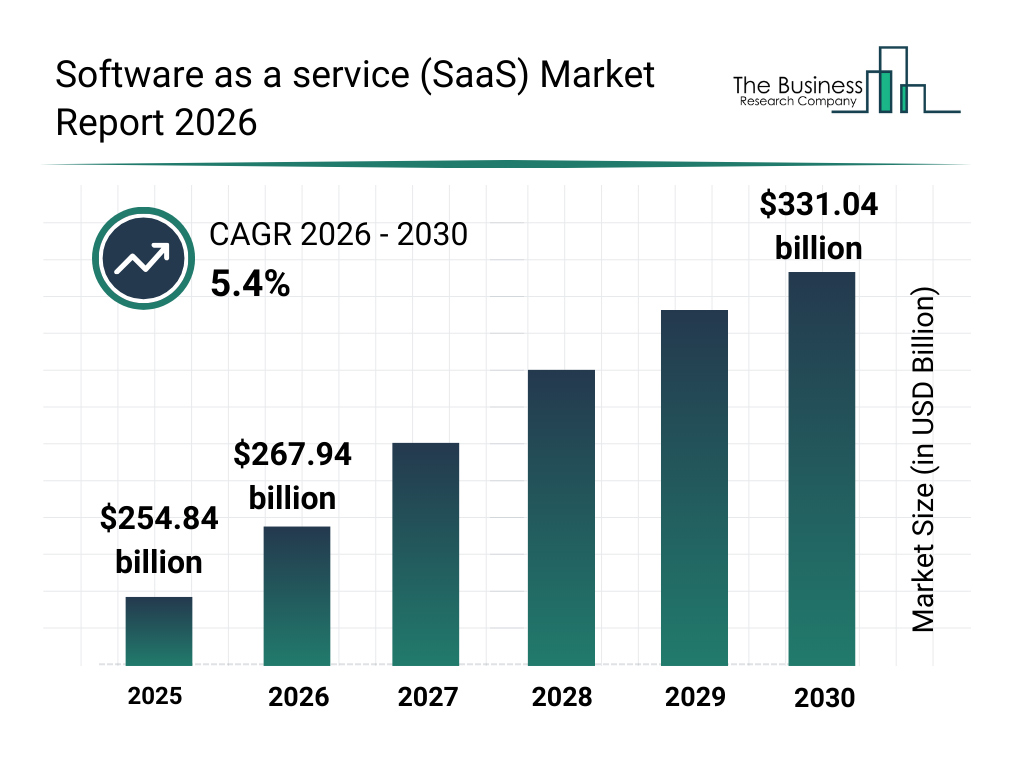
- The global SaaS market is projected to grow from $254.84 billion in 2025 to $331.04 billion by 2030, reflecting strong long-term expansion.
- In 2026, the market is expected to reach $267.94 billion, indicating steady year-over-year growth.
- The industry is forecasted to grow at a CAGR of 5.4% between 2026 and 2030, highlighting consistent and sustainable momentum.
- By 2027, the market size is estimated at around $281 billion, continuing the upward trajectory.
- The SaaS market is expected to surpass $296 billion in 2028, driven by increasing enterprise adoption.
- In 2029, the market is projected to reach approximately $312 billion, nearing the $300 billion milestone.
- The market is set to cross the $330 billion mark by 2030, solidifying SaaS as a dominant software delivery model.
- Overall, the data reflects a steady annual increase of roughly $12–$20 billion, indicating reliable growth rather than volatility.
- The consistent rise suggests strong demand fueled by cloud adoption, digital transformation, and subscription-based models.
Industry Size and Number of SaaS Companies
- There are approximately 30,000 SaaS companies worldwide.
- The United States hosts around 17,000 SaaS companies, dominating globally.
- Canada contributes roughly 2,000 SaaS companies to the ecosystem.
- The top 10 SaaS companies hold a combined valuation of over $1.3 trillion.
- Nearly 15,000 SaaS companies operate in the marketing sector alone.
- Venture capital allocated 47% of funding to SaaS models in 2023, showing strong investor interest.
- Early-stage SaaS startups received over $30 billion in funding in 2022.
- Vertical SaaS companies reported 31% growth vs. 28% for horizontal SaaS, indicating niche expansion.
Regional Distribution of SaaS Markets
- North America held 46.9% of the global SaaS market share in 2025.
- The U.S. SaaS market alone is expected to reach $141.06 billion in 2026.
- Europe accounted for 19% of global SaaS revenue in 2025.
- Europe’s SaaS market is projected to reach $70.81 billion in 2026.
- Asia-Pacific held 22% of global SaaS revenue in 2025.
- Asia-Pacific SaaS revenue is expected to grow to $86.06 billion in 2026.
- Latin America represented 7.3% of global SaaS demand in 2025.
- The Middle East & Africa contributed 4.8% of global SaaS revenue in 2025.
- Around 63% of European SMEs use cloud apps, with 43% using SaaS solutions.
Adoption of SaaS Across Industries and Verticals
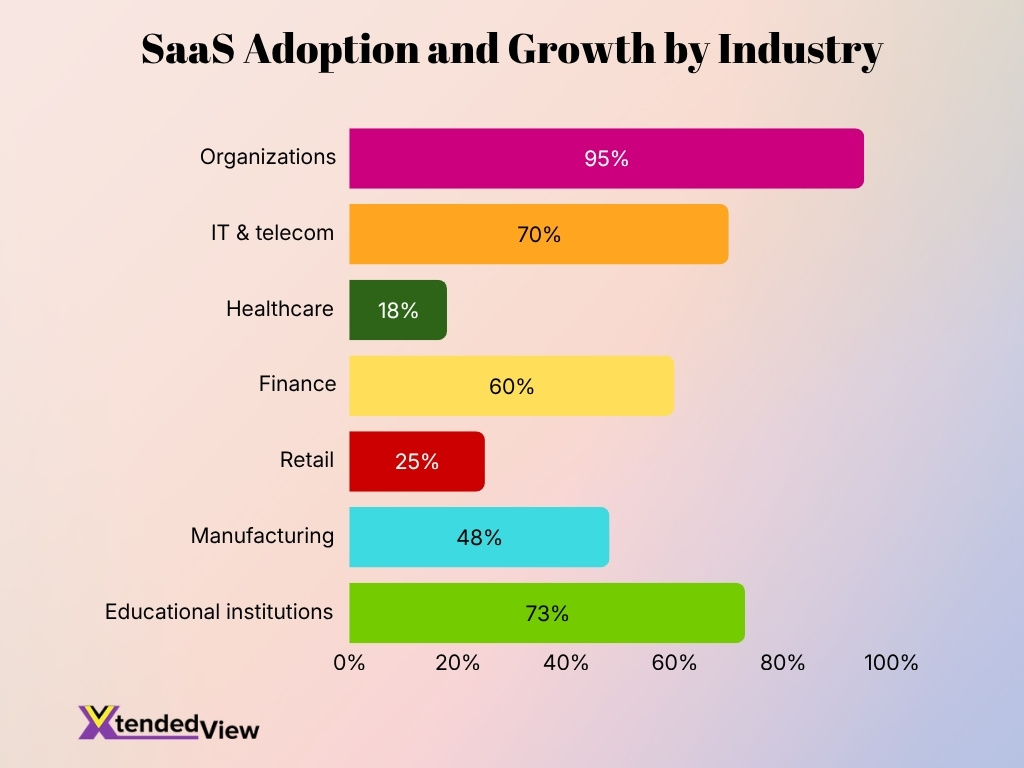
- Around 95% of organizations use SaaS in at least one business function as of 2025.
- The IT and telecom sector leads SaaS adoption, with over 70% of workloads delivered via SaaS.
- In healthcare, SaaS adoption grew by 18% year-over-year in 2025, driven by telehealth and EHR platforms.
- The finance sector uses SaaS for over 60% of core applications, including fraud detection and compliance.
- Retail companies increased SaaS usage by 25% since 2023, mainly for e-commerce and CRM tools.
- Manufacturing SaaS adoption rose to 48% in 2025, reflecting digital transformation initiatives.
- Educational institutions report 73% SaaS adoption, especially for LMS and remote learning tools.
- Vertical SaaS (industry-specific solutions) is growing at 30%+ annually, outpacing horizontal SaaS.
- Legal and compliance SaaS tools saw 22% adoption growth in 2024–2025, reflecting regulatory pressure.
Usage Patterns and Application Sprawl in SaaS
- Companies used an average of 106 SaaS applications in 2024, down from 112 in 2023.
- Large enterprises can manage 300+ SaaS apps, leading to operational complexity.
- Around 57% of SaaS apps go unused or underutilized, increasing waste.
- IT teams report spending 10–20% of their time managing SaaS sprawl.
- Shadow IT accounts for up to 40% of SaaS usage, often outside IT control.
- SaaS consolidation efforts reduced app portfolios by 6% in 2024, showing optimization trends.
- Organizations report an average of $135,000 in wasted SaaS spend annually due to unused licenses.
- Employee onboarding involves access to 10–15 SaaS tools on average, depending on role.
- Nearly 70% of IT leaders say SaaS sprawl is their top operational challenge.
Spending and Budget Allocation for SaaS
- SaaS spending accounts for approximately 30% of total IT budgets in 2025.
- Global SaaS spending is expected to reach $232 billion in 2026 within enterprise IT budgets.
- Companies increased SaaS budgets by 12% year-over-year in 2025.
- Enterprises spend an average of $3,500 per employee annually on SaaS tools.
- 45% of organizations plan to increase SaaS budgets further in 2026.
- IT leaders report that AI-enabled SaaS tools receive 25% higher budget allocation than traditional tools.
- SMBs allocate around 20% of their tech budgets to SaaS solutions.
- Finance teams say SaaS is the fastest-growing expense category after payroll.
- Nearly 60% of companies overspend on SaaS due to poor visibility into usage.
Adoption of SaaS by Company Size (SMB, Mid-Market, Enterprise)
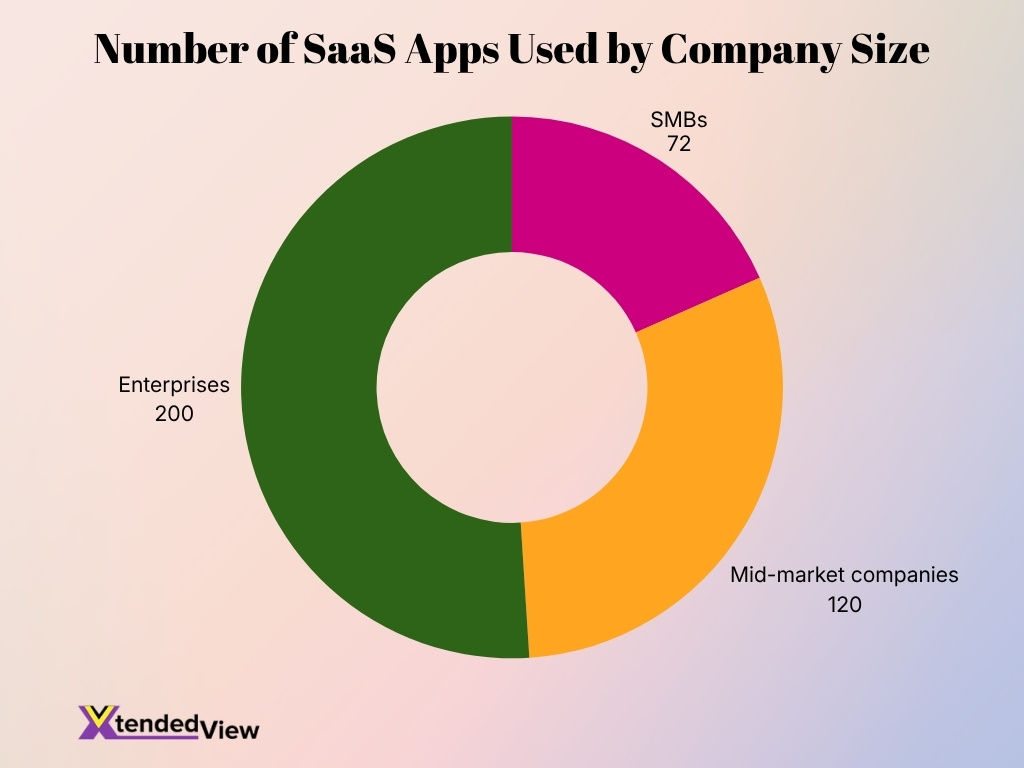
- Small businesses (SMBs) use an average of 72 SaaS applications in 2025.
- Mid-market companies use around 120 SaaS apps per organization, showing higher complexity.
- Enterprises use over 200 SaaS applications on average, reflecting large-scale operations.
- 78% of SMBs say SaaS helps them scale faster without heavy IT infrastructure.
- About 85% of enterprises prioritize SaaS-first strategies for new software purchases.
- Mid-market firms increased SaaS spending by 19% in 2025, outpacing SMB growth.
- 64% of SMBs rely on SaaS for accounting and financial management.
- Enterprises report that over 50% of their IT stack is SaaS-based.
- SaaS adoption among startups exceeds 90%, making it the default operating model.
Revenue, Profitability, and Margin Benchmarks in SaaS
- Top-performing SaaS companies achieve gross margins of 70% to 85%.
- The median SaaS gross margin stands at around 75% in 2025.
- Net profit margins for mature SaaS firms range between 15% and 25%.
- Early-stage SaaS startups often operate at negative margins of -20% to -40%.
- Companies with strong product-led growth models report 10–20% higher margins.
- Average revenue per user (ARPU) increased by 8% year-over-year in 2025.
- SaaS companies with retention rates above 120% NRR show significantly higher profitability.
- Operating margins improve after reaching $100M ARR, marking a key scaling milestone.
- Customer support and infrastructure costs account for 20–30% of SaaS expenses.
Valuations, Funding, and M&A Activity in SaaS
- SaaS valuations averaged 6x to 10x ARR in 2025, down from peak levels in 2021.
- Public SaaS companies saw valuation multiples stabilize around 7x ARR in 2025.
- Venture capital funding for SaaS reached $120 billion globally in 2024.
- Private equity investments in SaaS grew 66% in 2025, indicating strong buyout activity.
- SaaS M&A deals increased by 6% year-over-year in 2025.
- Late-stage SaaS funding rounds declined by 15% in 2025, reflecting cautious markets.
- AI-focused SaaS startups command 2x higher valuation multiples than traditional SaaS.
- The median deal size for SaaS acquisitions reached $50 million in 2025.
- Strategic acquisitions account for over 70% of SaaS M&A activity, led by large tech firms.
Leading SaaS Companies by Market Capitalization
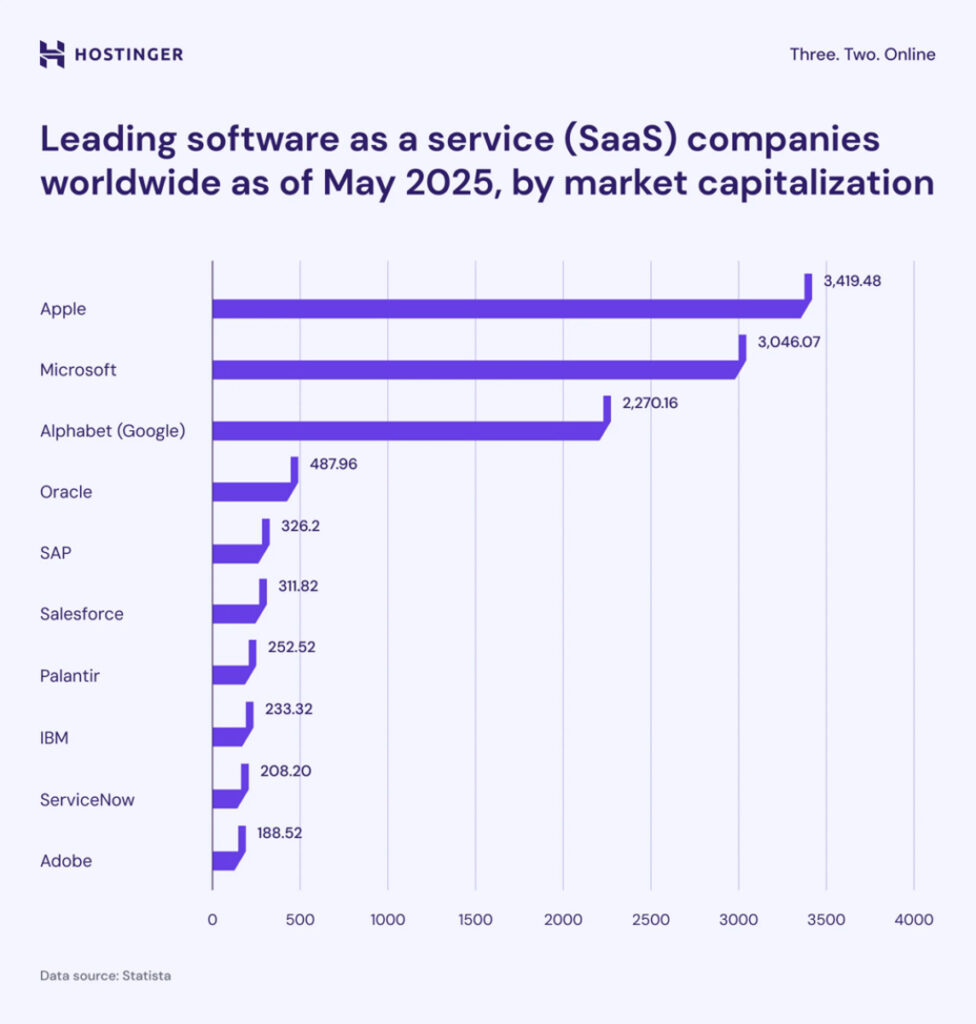
- Apple dominates the market with a massive valuation of $3,419.48 billion, making it the most valuable SaaS-related company globally.
- Microsoft follows closely at $3,046.07 billion, reinforcing its strong position in cloud computing and enterprise SaaS solutions.
- Alphabet (Google) ranks third with $2,270.16 billion, showing the growing influence of cloud and AI-driven SaaS services.
- There is a significant valuation gap between the top 3 giants and the rest, with Oracle in fourth place at just $487.96 billion.
- Mid-tier SaaS leaders like SAP ($326.20B) and Salesforce ($311.82B) continue to hold strong positions in enterprise software.
- Emerging and specialized SaaS players such as Palantir ($252.52B) and ServiceNow ($208.20B) are steadily gaining market traction.
- Legacy tech companies like IBM still maintain a notable presence with $233.32 billion, despite increased competition from cloud-native firms.
- Adobe, valued at $188.52 billion, rounds out the list, highlighting its dominance in creative and digital experience software.
- The top 3 companies alone account for over $8.7 trillion, demonstrating extreme market concentration in the SaaS ecosystem.
- Overall, the data highlights a clear shift toward cloud, AI, and subscription-based models, which continue to drive massive valuations in the SaaS industry.
Pricing Models and Billing Trends in SaaS
- Subscription-based pricing remains dominant, used by over 85% of SaaS companies.
- Usage-based pricing adoption increased to 61% in 2025, driven by API and AI services.
- Hybrid pricing models (subscription + usage) grew by 15% year-over-year.
- Annual billing is preferred by 65% of SaaS vendors, improving cash flow.
- Monthly billing still accounts for 35% of SaaS subscriptions, especially in SMB markets.
- Companies using usage-based pricing report 38% faster revenue growth.
- SaaS pricing increased by 20% to 37% in 2025 due to AI feature integration.
- About 48% of SaaS companies offer tiered pricing to cater to different customer segments.
- Enterprises increasingly demand custom pricing contracts, accounting for over 40% of deals.
Freemium, Free Trial, and Conversion Rates in SaaS
- Around 44% of SaaS companies use a freemium model as part of their acquisition strategy.
- Freemium-to-paid conversion rates average 2% to 5%, depending on product complexity.
- Free trial conversion rates are significantly higher, ranging between 10% and 25%.
- SaaS companies offering both freemium and free trials see 30% higher user acquisition rates.
- About 60% of product-led SaaS companies rely heavily on free trials for growth.
- Users who engage with onboarding flows during trials are 3x more likely to convert.
- The average free trial duration is 14 days, though some extend to 30 days for enterprise tools.
- SaaS companies using usage-based freemium models report 20% higher retention post-conversion.
- Approximately 80% of SaaS buyers prefer trying a product before purchasing.
SaaS Runway Insights by ARR
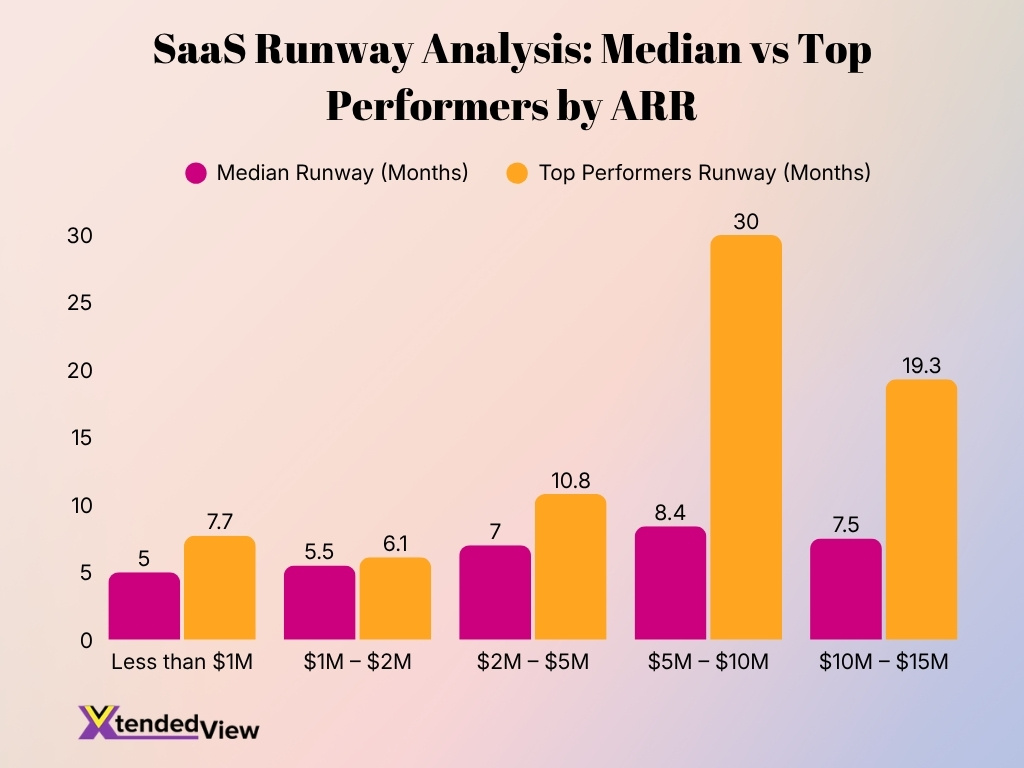
- SaaS companies with ARR below $1M have a median runway of just 5.0 months, while top performers extend it to 7.7 months, indicating early-stage cash constraints.
- In the $1M–$2M ARR range, runway remains tight with a median of 5.5 months, and only a slight improvement among top performers at 6.1 months.
- SaaS businesses generating $2M–$5M ARR show healthier financial stability, with median runway increasing to 7.0 months and top performers reaching 10.8 months.
- A significant jump appears in the $5M–$10M ARR segment, where top performers achieve an exceptional 30.0 months runway, compared to a median of 8.4 months—highlighting strong capital efficiency among elite SaaS firms.
- For SaaS companies with $10M–$15M ARR, the median runway slightly declines to 7.5 months, while top performers maintain a strong 19.3 months, suggesting scaling challenges impact cash reserves.
- Across all ARR tiers, top-performing SaaS companies consistently maintain 2x–3x longer runway than the median, emphasizing the importance of efficient cash management.
- The data reveal that runway does not increase linearly with ARR, and higher revenue does not always guarantee longer financial sustainability.
- Overall, maintaining a runway above 12+ months appears to be a distinguishing factor for top SaaS performers, especially in mid-to-late growth stages.
Customer Acquisition Cost and LTV Benchmarks in SaaS
- The average SaaS customer acquisition cost (CAC) ranges between $200 and $1,200, depending on the segment.
- Enterprise SaaS CAC can exceed $5,000 per customer due to longer sales cycles.
- The ideal SaaS LTV: CAC ratio is 3:1, considered a healthy benchmark.
- Top-performing SaaS companies achieve LTV: CAC ratios of 5:1 or higher.
- Payback periods for CAC average 12 to 18 months.
- SaaS companies using inbound marketing reduce CAC by up to 61% compared to outbound.
- Customer lifetime value (LTV) increased by 9% year-over-year in 2025.
- Companies with strong onboarding processes reduce CAC payback time by 20% to 30%.
- SaaS firms allocating more than 40% of revenue to sales and marketing tend to scale faster.
Churn, Retention, GRR, and NRR in SaaS
- The average SaaS churn rate ranges between 5% and 7% annually for B2B companies.
- SMB-focused SaaS products experience higher churn rates of 10% to 20% annually.
- Enterprise SaaS churn is typically lower, at below 5% annually.
- Gross revenue retention (GRR) benchmarks range from 85% to 95%.
- Net revenue retention (NRR) for top SaaS companies exceeds 120%, driven by expansion revenue.
- Companies with onboarding programs reduce churn by up to 67%.
- SaaS businesses with strong customer success teams improve retention by 15% to 25%.
- Monthly churn rates average 3% to 5% across SaaS industries.
- Reducing churn by just 5% can increase profits by 25% to 95%.
Biggest SaaS Security Concerns
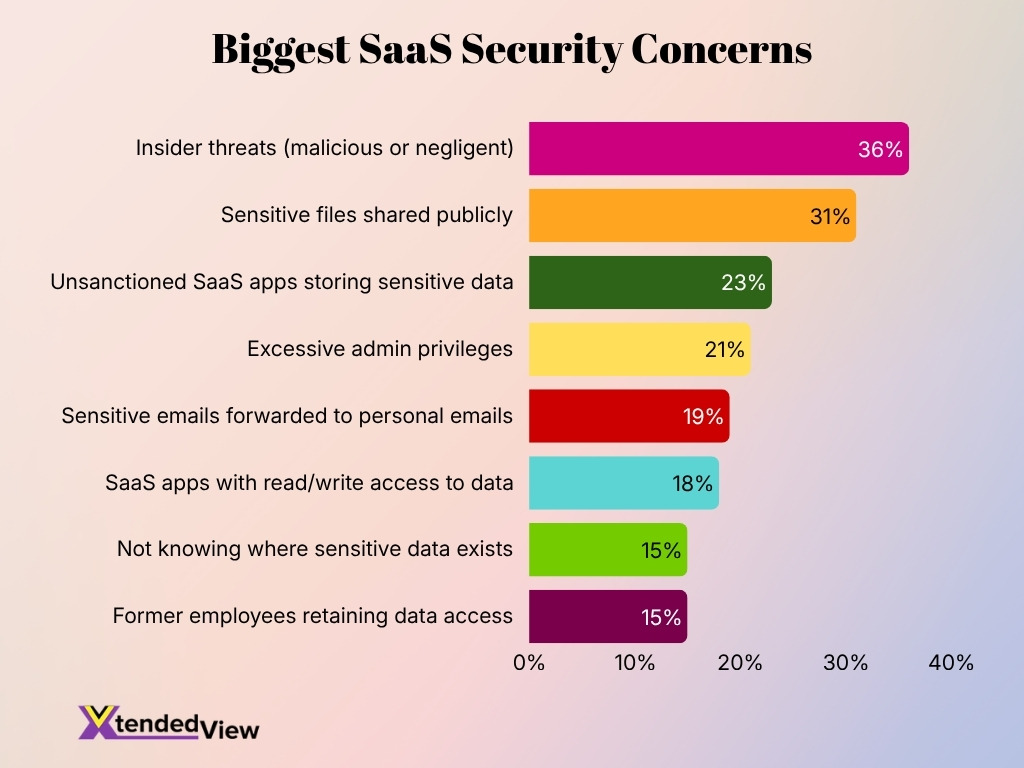
- Insider threats are the top concern, affecting 36% of organizations, highlighting risks from both malicious actions and employee negligence.
- 31% of companies report issues with sensitive files being shared publicly, indicating major gaps in data governance and access control.
- Around 23% worry about unsanctioned SaaS apps storing sensitive data, emphasizing the growing problem of shadow IT.
- Excessive admin privileges impact 21% of organizations, increasing the risk of unauthorized access and misuse of critical systems.
- 19% of businesses face risks from employees forwarding sensitive emails to personal accounts, exposing data outside secure environments.
- 18% are concerned about SaaS apps with read/write access, which can lead to data leaks or unintended modifications.
- A notable 15% of organizations admit they don’t know where their sensitive data resides, pointing to poor data visibility and tracking systems.
- Another 15% report that former employees still retain access to data, revealing weaknesses in offboarding and access revocation processes.
- Overall, the data shows that human-related risks (insiders, access misuse) dominate SaaS security concerns more than purely technical threats.
AI-Powered Innovations and Adoption in SaaS
- Over 70% of SaaS companies will have integrated AI features into their platforms by 2025.
- AI-powered SaaS tools are growing at 400%+ rates in emerging categories.
- Generative AI adoption in SaaS increased by 65% year-over-year in 2025.
- AI-driven automation reduces operational costs by 20% to 30% in SaaS businesses.
- Around 48% of SaaS companies report improved customer retention due to AI features.
- AI-powered analytics tools improve decision-making speed by up to 5x.
- Chatbots and AI assistants handle up to 80% of customer queries in SaaS platforms.
- SaaS companies investing in AI report 25% higher revenue growth rates.
- AI-native SaaS startups receive 2x higher valuations than traditional SaaS firms.
Frequently Asked Questions (FAQs)
The global SaaS market is projected to reach $375.57 billion to $465.03 billion in 2026, depending on forecast models.
The SaaS market is growing at a CAGR of around 18.7% through 2034.
By 2025, about 85% of all business applications are expected to be SaaS-based.
North America accounts for approximately 46.9% of the global SaaS market share.
Organizations use an average of around 106 SaaS applications per company globally.
Conclusion
The SaaS industry reflects a market that has moved beyond rapid adoption into a phase of optimization, consolidation, and intelligent growth. While companies continue to expand their SaaS portfolios, they are also focusing on efficiency, reducing application sprawl, improving security, and maximizing return on investment. At the same time, evolving pricing strategies, rising customer acquisition costs, and stricter retention benchmarks are pushing SaaS businesses to operate with greater precision.
A key trend shaping the future is the integration of AI across nearly every layer of SaaS, from customer support and analytics to product functionality and sales processes. This shift is not only driving higher revenue growth but also redefining user expectations and competitive dynamics across the market.
Looking ahead, businesses that align their SaaS investments with measurable outcomes, strong customer experience, and scalable infrastructure will gain a clear advantage. By staying informed on these metrics and trends, decision-makers can better navigate the complexities of the SaaS ecosystem and build strategies that deliver long-term value.
