



Amazon continues to shape how people shop, stream, and build digital infrastructure across the globe. What started as an online bookstore has evolved into a multi-industry giant spanning eCommerce, cloud computing, advertising, and logistics. Today, businesses rely on Amazon Web Services to run applications at scale, while millions of sellers use its marketplace to reach global customers. At the same time, consumers depend on Amazon for fast delivery, competitive pricing, and a seamless shopping experience.
From powering enterprise IT systems to enabling same-day delivery in major cities, Amazon influences both digital and physical economies. Its investments in AI, automation, and logistics continue to redefine customer expectations and operational efficiency. As competition intensifies and technology advances, Amazon’s role only becomes more critical. Let’s explore the latest Amazon statistics to understand its scale, growth, and evolving impact.
Editor’s Choice
- Amazon generated approximately $716.9 billion in revenue in 2025, up 12% year over year.
- The company reported $638 billion in revenue in 2024, reflecting 11% annual growth.
- Amazon has more than 310 million active users globally, with over 230 million in the U.S. alone.
- The platform hosts around 9.7 million sellers worldwide, making it one of the largest marketplaces globally.
- Amazon Prime membership exceeds 220–230 million users globally as of 2025.
- AWS generated about $128.7 billion in revenue in 2025, growing nearly 19% YoY.
- Amazon holds roughly 37.6% of the U.S. eCommerce market share, maintaining its leadership position.
Recent Developments
- Amazon plans to invest $200 billion in 2026, focusing on AI, robotics, and infrastructure.
- AWS is projected to potentially reach $600 billion in annual revenue by 2036, driven by AI growth.
- Amazon reported Q4 2025 revenue of $213.4 billion, a 14% year-over-year increase.
- AWS grew 24% YoY in Q4 2025, marking its fastest growth in over a year.
- Amazon’s advertising revenue increased by 22–23% in 2025, driven by Prime Video ads.
- The company is scaling drone delivery, aiming to complete its 1 millionth delivery in 2026.
- Amazon’s operating income reached $80 billion in 2025, up from $68.6 billion in 2024.
- Prime Video advertising is projected to reach $806 million in 2025, nearly doubling from 2024.
Overview and Key Facts of Amazon
- Amazon was founded in 1994 by Jeff Bezos and is headquartered in Seattle, Washington.
- The company operates across the eCommerce, cloud computing, advertising, and AI sectors.
- Amazon employs over 1.5 million people globally, making it one of the largest employers.
- It processes roughly $16.3 million in sales every second.
- Amazon delivers over 1.6 million packages daily, highlighting its logistics scale.
- Around 66% of shoppers start product searches directly on Amazon, not search engines.
- The company is valued at over $2 trillion, placing it among the world’s most valuable firms.
- Amazon supports millions of third-party sellers, creating a global retail ecosystem.
Market Breakdown: Leading U.S. E-Commerce Platforms by Share
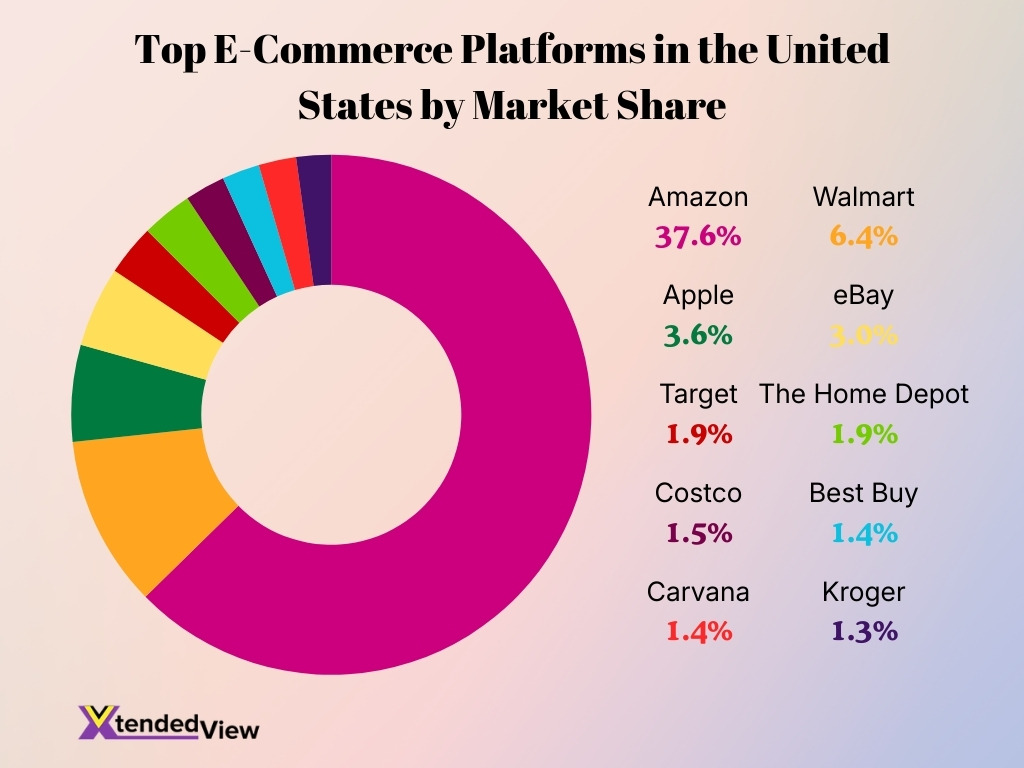
- Amazon dominates the market with a massive 37.6% share, accounting for more than one-third of total U.S. e-commerce sales.
- Walmart ranks second but far behind, holding only 6.4%, highlighting a significant gap between the leader and competitors.
- Apple secures third place with 3.6%, driven largely by direct-to-consumer product sales and ecosystem loyalty.
- eBay follows closely with a 3.0% share, maintaining relevance through its marketplace and resale model.
- Target and The Home Depot each hold 1.9%, showing strong performance in retail-driven e-commerce segments like essentials and home improvement.
- Mid-tier platforms like Costco (1.5%) and Best Buy (1.4%) continue to leverage their physical retail presence to support online growth.
- Carvana (1.4%) stands out as a niche player, demonstrating how specialized vertical platforms can compete in e-commerce.
- Kroger captures 1.3%, reflecting the growing importance of online grocery shopping in the U.S. market.
- The top 10 platforms collectively highlight a highly concentrated market, with Amazon alone outperforming the combined share of several competitors.
- Overall, the data indicates a winner-takes-most dynamic, where a single platform dominates while others compete within smaller share segments.
Market Share and Industry Position of Amazon
- Amazon controls about 37.6% of the U.S. eCommerce market, far ahead of competitors.
- AWS holds roughly 30% of the global cloud infrastructure market, leading the industry.
- Amazon ranks among the top five largest tech companies globally.
- It is the second-largest company by revenue globally, based on recent figures.
- Around 66% of U.S. consumers begin product searches on Amazon, reinforcing dominance.
- Amazon’s advertising business is now a top digital ad platform alongside Google and Meta.
- The platform hosts millions of brands and sellers, making it a central retail ecosystem.
- Amazon continues to dominate logistics with same-day and next-day delivery leadership.
Amazon Revenue Growth Trends Over the Years
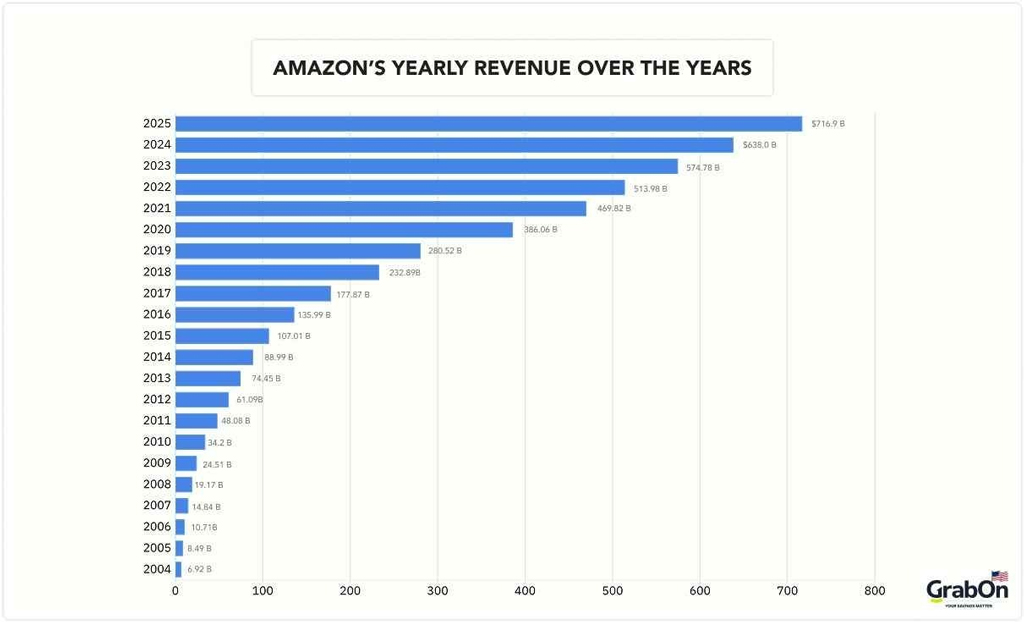
- Amazon’s revenue skyrocketed from just $6.92 billion in 2004 to $716.9 billion in 2025, reflecting an extraordinary long-term growth trajectory.
- The company crossed the $100 billion milestone in 2015, reaching $107.01 billion, marking a major turning point in its global expansion.
- Revenue nearly doubled between 2017 ($177.87B) and 2020 ($386.06B), driven by rapid growth in e-commerce and cloud services.
- A significant surge occurred during the pandemic, with revenue jumping from $280.52 billion in 2019 to $386.06 billion in 2020, an increase of over $100 billion in a single year.
- Amazon surpassed the $500 billion mark in 2022, reporting $513.98 billion, solidifying its dominance in global retail and tech.
- Growth continued steadily post-pandemic, reaching $574.78 billion in 2023 and $638.0 billion in 2024.
- The latest data shows Amazon hitting an all-time high of $716.9 billion in 2025, highlighting continued expansion across multiple business segments.
- Over the entire period, Amazon achieved more than a 100x increase in revenue, showcasing one of the most successful scaling stories in modern business history.
- Early-stage growth (2004–2010) was steady but modest, rising from $6.92B to $34.2B, before accelerating rapidly in the following decade.
- The data reflects a clear trend of compounding growth, with larger absolute revenue gains occurring each year as the business scaled globally.
Profit and Valuation Statistics of Amazon
- Amazon reported $59.2 billion in net profit in 2024, nearly doubling year over year.
- Operating income increased to $80 billion in 2025, up from $68.6 billion in 2024.
- AWS contributes approximately 57–58% of Amazon’s operating income, despite a lower revenue share.
- Amazon’s valuation exceeded $2.16 trillion in 2025, placing it among the top global companies.
- Q4 2025 operating income reached $25 billion, up from $21.2 billion in 2024.
- AWS’s operating income alone hit $11.4 billion in Q3 2025, highlighting profitability.
- Amazon’s profit margins improved due to advertising and cloud services growth.
- The company maintains strong cash flow driven by high-margin AWS and ad segments.
Customer and User Base Statistics of Amazon
- Amazon has over 310 million active users globally, with a strong concentration in North America.
- The U.S. alone accounts for more than 230 million Amazon users, representing nearly 70% of its user base.
- Around 80% of U.S. households have at least one Amazon account, highlighting deep market penetration.
- Approximately 66% of online shoppers begin product searches directly on Amazon instead of search engines like google.com.
- Amazon serves customers in over 100 countries worldwide, supporting global retail operations.
- The platform records more than 2.5 billion monthly visits globally, reflecting consistent user engagement.
- About 89% of U.S. consumers are more likely to buy from Amazon than from other eCommerce sites.
- Nearly 73% of Amazon users check prices on the platform even when shopping elsewhere.
- Over 50% of global Amazon traffic comes from mobile devices, showing cross-platform usage trends.
Key Reasons Why Consumers Prefer Amazon
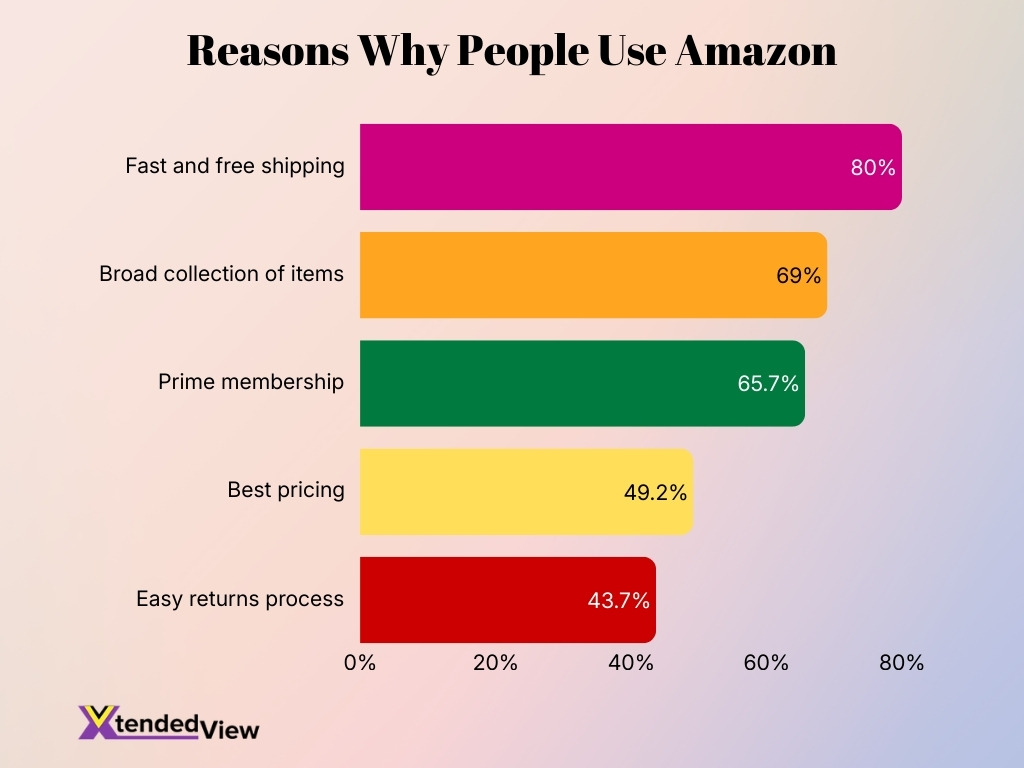
- Fast and free shipping dominates user preference, with a massive 80% of users choosing Amazon primarily for its delivery speed and cost advantage.
- A strong 69% of users value the broad collection of items, highlighting Amazon’s extensive product catalog as a key competitive edge.
- Prime membership drives loyalty, with 65.7% of users benefiting from bundled perks like faster delivery, streaming, and exclusive deals.
- Nearly 49.2% of users are attracted by competitive pricing, reinforcing Amazon’s positioning as a cost-effective shopping platform.
- An efficient, easy returns process influences 43.7% of users, showing that convenience and low-risk purchasing play a critical role in user satisfaction.
Marketplace and Seller Statistics of Amazon
- Amazon hosts more than 9.7 million sellers globally, with over 2 million active sellers.
- Around 60% of total Amazon sales come from third-party sellers.
- U.S.-based sellers account for approximately 35% of the total seller base.
- More than 50% of sellers generate at least $1,000 per month in sales.
- Over 25,000 sellers surpass $1 million in annual revenue, showing strong scalability.
- Amazon adds around 3,700 new sellers daily, expanding its marketplace ecosystem.
- Fulfillment by Amazon (FBA) is used by over 80% of sellers, simplifying logistics.
- Small and medium businesses sell more than 4,000 items per minute globally.
- Amazon sellers exported over $80 billion worth of goods globally in recent years.
Mobile Usage and App Statistics of Amazon
- The Amazon mobile app has been downloaded over 500 million times globally on Android alone.
- More than 70% of Amazon customers shop using mobile devices.
- Mobile app users account for nearly 60–65% of total Amazon sales.
- The Amazon app consistently ranks among the top shopping apps in the U.S. App Store and Google Play.
- U.S. users spend an average of 1 hour per week on the Amazon app.
- Amazon’s mobile conversion rate is estimated at 10–12%, higher than many eCommerce platforms.
- Voice shopping via Alexa devices continues to grow, with millions of users making purchases through voice commands.
- The app supports multiple localized versions, enhancing usability in over 20 countries.
- Mobile push notifications drive 20–30% of repeat purchases, improving retention rates.
Amazon Prime User Growth Trends and Insights
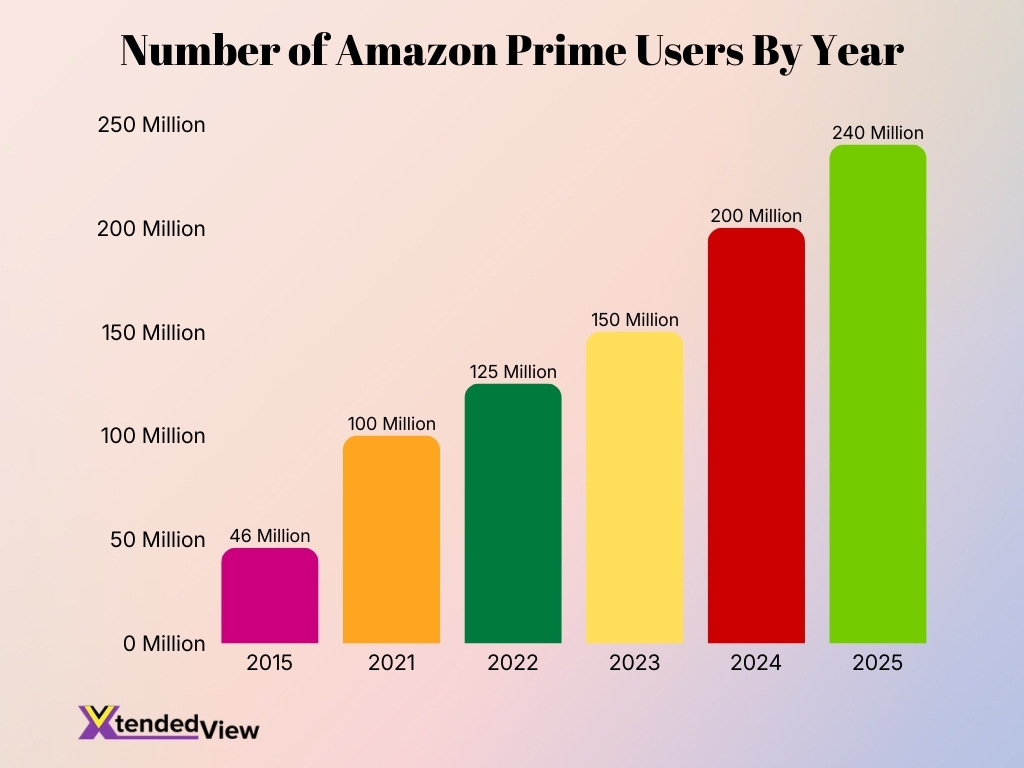
- Amazon Prime users grew from 46 million in 2015 to a projected 240 million by 2025, showing massive long-term adoption.
- The platform more than doubled its user base between 2015 and 2021, reaching 100 million users.
- Between 2021 and 2022, Prime added 25 million new users, reflecting steady post-pandemic growth.
- User count increased from 125 million in 2022 to 150 million in 2023, marking a 20% YoY growth.
- A significant jump occurred between 2023 and 2024, with users rising from 150 million to 200 million, adding 50 million users in a single year.
- By 2025 (projected), Amazon Prime is expected to reach 240 million users, indicating continued strong expansion.
- Overall, Amazon Prime added approximately 194 million users over the 10-year period (2015–2025).
- The data highlights a consistent upward growth trajectory, driven by increasing demand for fast shipping, exclusive content, and bundled services.
- The acceleration after 2022 suggests stronger global penetration and higher subscription retention rates.
- Amazon Prime is evolving into a dominant subscription ecosystem, combining e-commerce, entertainment, and logistics benefits to scale its user base.
Third-Party vs First-Party Sales Statistics of Amazon
- Third-party sellers account for about 60% of total units sold on Amazon.
- First-party (1P) retail sales contribute roughly 40% of total sales volume.
- Third-party services generated over $140 billion in revenue in 2024, including fees and commissions.
- Amazon earns significant margins from third-party services, often higher than retail margins.
- FBA fees account for a major portion of third-party revenue streams.
- Third-party sellers dominate categories like electronics, home goods, and apparel.
- Amazon’s private label (1P) brands represent a smaller but strategic portion of sales.
- Seller services grew by over 20% year-over-year in 2025, reflecting marketplace expansion.
- Third-party seller share has steadily increased from ~30% in 2010 to 60%+ today.
Advertising and Marketing Statistics of Amazon
- Amazon’s advertising revenue reached $68.6 billion in 2025, up 22% from 2024.
- Q4 2025 ad revenue hit $21.3 billion, growing 22-23% year-over-year.
- Sponsored Products account for the majority of Amazon’s ad revenue, forming the core of its marketplace ads.
- Amazon ranks as the third-largest digital ad platform globally, trailing Google and Meta.
- Amazon captured over 35% of the global retail media market share in 2025.
- Full-funnel advertising added $12 billion in incremental revenue for Amazon in 2025.
- Average ACoS for Amazon advertising ranges from 20-36%, with 30% typical.
- Over 74% of third-party sellers use Sponsored Product Ads on Amazon.
- 56% of global marketing leaders plan to increase Amazon ad spend.
- Amazon DSP expanded to include streaming services like Netflix and Spotify in 2025.
Amazon Traffic Sources Breakdown: Where Visitors Come From
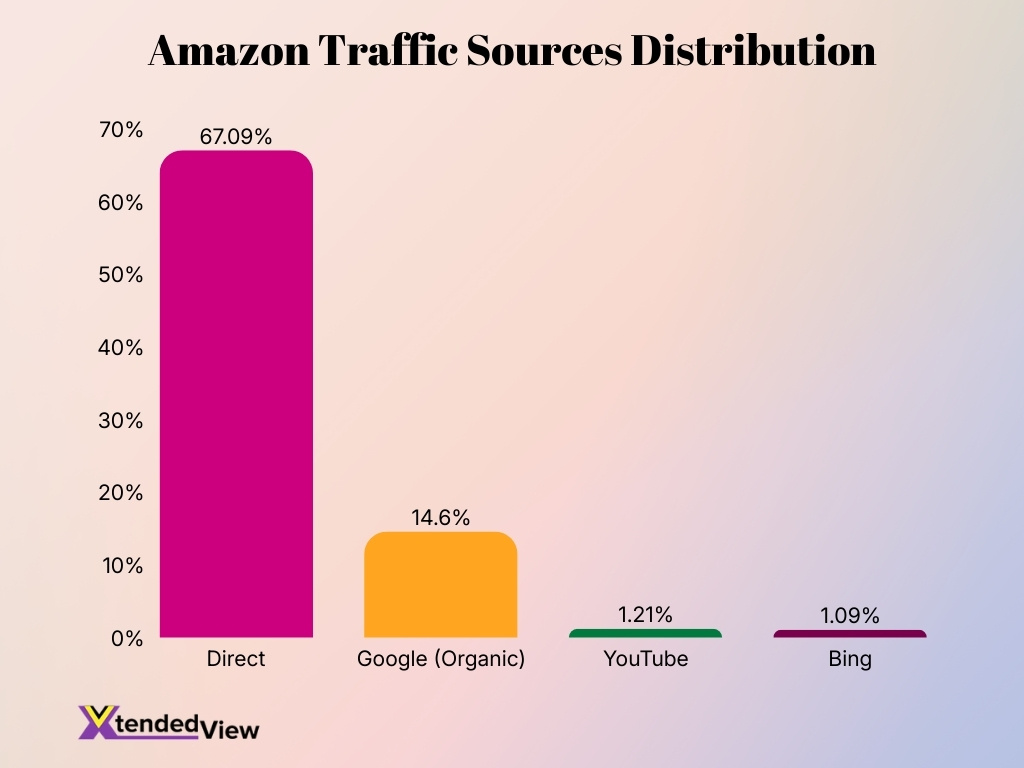
- Direct traffic dominates Amazon with a massive 67.09% share, showing strong brand loyalty and repeat users who visit the platform directly.
- Google (Organic) contributes 14.6% of traffic, making it the second-largest source, highlighting the importance of SEO and product search visibility.
- YouTube drives 1.21% of traffic, indicating a growing role of video content, reviews, and influencer marketing in purchase decisions.
- Bing accounts for 1.09% of traffic, showing a smaller but still relevant share from alternative search engines.
- The data clearly shows that over two-thirds of Amazon’s traffic is non-search driven, emphasizing its position as a destination platform rather than a discovery platform.
- Search engines (Google + Bing) together contribute around 15.69%, reinforcing that organic search still plays a key supporting role in customer acquisition.
- Video and referral platforms (like YouTube) currently have a limited but strategic influence, especially for product discovery and reviews.
AWS (Amazon Web Services) Statistics of Amazon
- AWS generated approximately $128.7 billion in revenue in 2025, growing nearly 19% year over year.
- In 2024, AWS revenue stood at around $107.6 billion, reflecting strong cloud demand.
- AWS contributes roughly 15–17% of Amazon’s total revenue but over half of its operating income.
- The platform holds about 30–31% of the global cloud infrastructure market, leading competitors.
- AWS’s operating income exceeded $36 billion annually, making it Amazon’s most profitable segment.
- Over 1 million active customers use AWS globally, including startups, enterprises, and governments.
- AWS offers more than 200 fully featured cloud services, spanning AI, storage, and computing.
- Amazon continues investing heavily in AI infrastructure, with AWS expected to drive future growth.
- AWS data centers operate in over 30 geographic regions worldwide, ensuring global reach.
Logistics, Shipping, and Delivery Statistics of Amazon
- Amazon delivers over 1.6 million packages per day globally, showcasing massive logistics scale.
- The company operates more than 1,100 fulfillment and logistics facilities worldwide.
- Amazon Logistics handles over 70% of its own deliveries in the U.S., reducing reliance on third parties.
- Same-day and next-day delivery services now cover over 90% of U.S. Prime members.
- Amazon shipped more than 7 billion items with same-day or next-day delivery in 2024.
- The company operates a fleet of over 75 cargo aircraft and 40,000+ delivery vans.
- Amazon’s robotics systems assist in over 75% of warehouse operations, improving efficiency.
- Delivery costs account for a significant portion of expenses, exceeding $90 billion annually.
- Amazon continues to expand drone delivery, aiming for wider rollout by 2026.
Amazon Seller Distribution Insights by Country
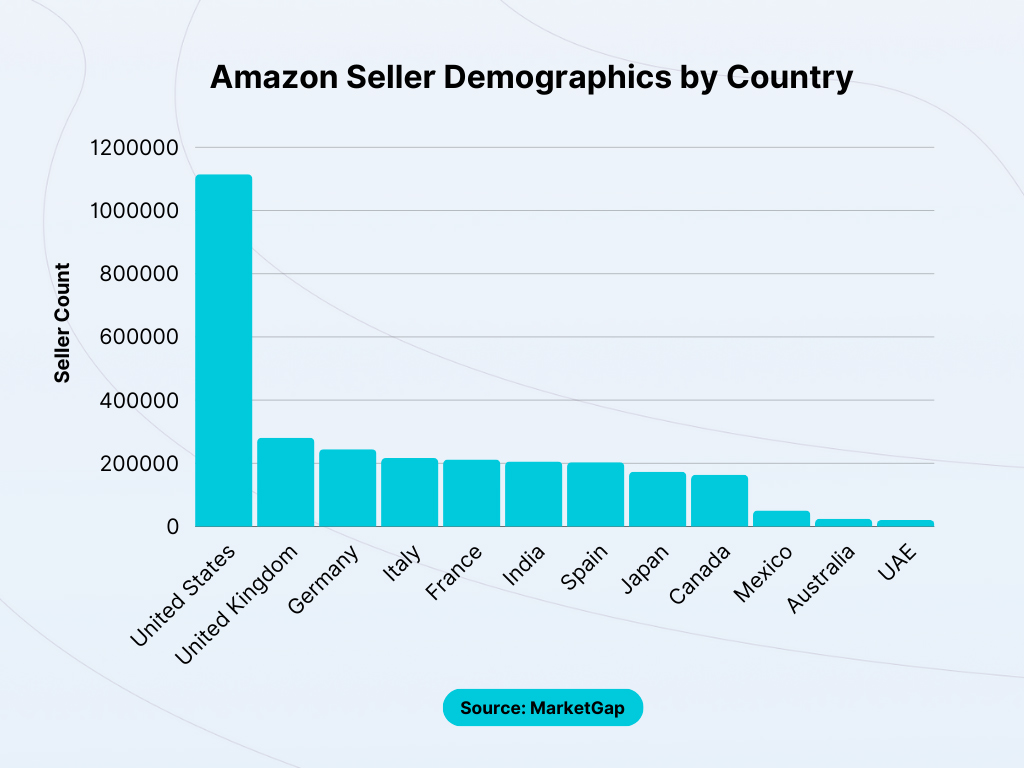
- The United States dominates Amazon’s seller ecosystem with 1.11 million sellers, accounting for a massive 37.82% of the total share.
- The United Kingdom ranks second with 281,257 sellers (9.54%), followed by Germany at 244,425 sellers (8.30%), showing strong European participation.
- A cluster of European countries, including Italy (7.36%), France (7.19%), and Spain (6.90%), collectively contributes a significant share, highlighting Europe as a key seller hub.
- India emerges as a major contributor with 205,884 sellers, capturing 6.99%, reflecting rapid growth in emerging markets.
- Japan (5.89%) and Canada (5.55%) maintain solid mid-tier positions, each contributing over 160,000 sellers.
- Countries like Mexico (1.73%), Australia (0.82%), and the UAE (0.71%) represent smaller but growing seller bases.
- Emerging markets such as Brazil (0.53%), Turkey (0.20%), and Singapore (0.06%) currently have minimal representation, indicating future expansion opportunities.
- The top 3 countries (the US, UK, Germany) alone account for over 55% of total Amazon sellers, showing a highly concentrated seller distribution.
- Overall, Amazon’s marketplace is heavily skewed toward North America and Europe, while Asia and other regions are still developing in seller participation.
Fulfillment and FBA Statistics of Amazon
- Over 80% of Amazon sellers use Fulfillment by Amazon (FBA) services.
- FBA enables sellers to reach Prime customers, increasing conversion rates significantly.
- Sellers using FBA experience up to 30–50% higher sales growth compared to non-FBA sellers.
- Amazon processes billions of items annually through its fulfillment network.
- The company operates over 175 fulfillment centers globally, supporting fast delivery.
- FBA fees and services contribute billions to Amazon’s third-party services revenue.
- Amazon’s fulfillment network uses advanced robotics and AI for inventory optimization.
- Small businesses using FBA sell more than 4,000 items per minute globally.
- FBA helps sellers expand internationally through cross-border logistics programs.
Sales Event and Seasonal Sales Statistics of Amazon
- Amazon Prime Day generated over $14.2 billion in global sales in 2025, a record high.
- U.S. consumers spent approximately $12.7 billion during Prime Day 2024, showing strong demand.
- Prime Day sees conversion rates exceeding 20–25%, significantly higher than average eCommerce rates.
- Amazon’s holiday season accounts for nearly 35% of its annual revenue, driven by Q4 performance.
- Black Friday and Cyber Monday contribute billions, with Cyber Week sales exceeding $38 billion in the U.S.
- Prime members account for over 80% of purchases during Prime Day events.
- Amazon sells millions of devices (Echo, Fire TV) during seasonal events at discounted prices.
- Third-party sellers generate more than 60% of Prime Day sales, highlighting marketplace strength.
- Seasonal promotions significantly boost new Prime subscriptions and engagement.
Regional and Country-Wise Statistics of Amazon
- The United States generated $438 billion in Amazon net sales in 2024, about 68% of global revenue.
- Germany contributed $40.9 billion in 2024, representing 6.4% of total sales.
- United Kingdom sales reached $37.9 billion in 2024, holding 5.9% market share.
- Japan accounted for $27.4 billion in revenue during 2024, or 4.3% globally.
- International segment revenue hit $161.9 billion in 2025, up 13% year-over-year.
- Amazon India boasts over 150 million active users in 2025.
- North America drove 59.5% of the $716.9 billion total revenue in 2025.
- The rest of the world’s sales exceeded $98.4 billion in 2024.
- Saudi Arabia and the UAE saw e-commerce shoppers double in recent years.
- Amazon operates in over 20 countries with localized marketplaces worldwide.
Frequently Asked Questions (FAQs)
Amazon generated approximately $716.9 billion in total revenue in 2025, up about 12% from 2024.
Amazon Prime has an estimated 220–250 million global subscribers as of 2025–2026.
AWS recorded about $128.7 billion in revenue in 2025, growing roughly 19% year over year.
AWS contributes approximately 57% of Amazon’s total operating income, despite a smaller share of revenue.
Amazon has over 310 million active customers globally, including about 230 million in the U.S.
Conclusion
Amazon’s scale extends far beyond online retail. It operates as a global infrastructure provider through AWS, a logistics powerhouse with advanced fulfillment systems, and a dominant marketplace connecting millions of buyers and sellers. The data shows consistent growth across revenue, cloud services, and advertising, while logistics and Prime continue to reinforce customer loyalty.
As Amazon invests heavily in AI, automation, and global expansion, its influence across industries will likely deepen. For businesses, it remains a critical platform for sales and cloud infrastructure. For consumers, it continues to redefine convenience and speed. These statistics highlight not just Amazon’s current dominance but also its trajectory toward shaping the next phase of digital commerce and technology.
