


Bring Your Own Device (BYOD) policies continue to reshape modern workplaces as companies balance flexibility, productivity, and cybersecurity. Organizations across healthcare, retail, finance, and technology now rely on employee-owned smartphones, laptops, and tablets to support hybrid work and reduce hardware expenses. At the same time, IT teams face rising pressure to secure sensitive business data across unmanaged devices and remote networks. The statistics below highlight how BYOD adoption has evolved, where the market is heading, and how businesses are adapting their security and device management strategies.
Editor’s Choice
- The global BYOD market reached $131.1 billion in 2024 and is projected to grow to $153.1 billion in 2025.
- Analysts expect the BYOD market to hit $619.5 billion by 2034, growing at a 16.8% CAGR.
- The BYOD security market climbed to $82.1 billion in 2025 worldwide.
- BYOD security spending could surpass $225 billion by 2034 as enterprises expand mobile workforce protections.
- North America accounted for more than 39% of the global BYOD market share in 2024.
- Around 44% of employees used personal smartphones for work-related tasks in 2025.
- Microsoft reported that over 90% of ransomware incidents originated from unmanaged devices connected to corporate environments.
- Approximately 78% of employees still used personal devices for work even when company policies prohibited BYOD.
- Laptop devices held nearly 48.6% of the BYOD security market segment share in 2025.
- The BYOD security industry is forecast to grow at more than 19.2% CAGR between 2026 and 2035.
Recent Developments
- Enterprises increased investments in mobile device management and endpoint security platforms throughout 2025 to support hybrid work expansion.
- BYOD security vendors increasingly adopted Zero Trust frameworks to reduce unauthorized access risks from unmanaged devices.
- Around 34% of organizations implemented Zero Trust Network Access tools by late 2025.
- Businesses accelerated cloud-based BYOD deployments as remote teams required secure access to applications and internal systems.
- The Asia-Pacific region emerged as the fastest-growing BYOD security market during the current forecast period.
- More organizations introduced company-owned, personally enabled (COPE) strategies to balance employee flexibility with IT control.
- Mobile identity management solutions gained traction as companies expanded multi-factor authentication requirements.
- About 58% of organizations adopted multi-factor authentication tools for BYOD-related access management in 2025.
- Enterprises increasingly integrated AI-powered threat detection into BYOD security ecosystems during 2025 and 2026.
- Security vendors expanded endpoint visibility tools because nearly 40% of edge devices remained unmanaged in enterprise environments.
What Is BYOD and How It Works
- BYOD stands for “Bring Your Own Device,” a workplace policy that allows employees to use personal devices for business tasks.
- Common BYOD devices include smartphones, laptops, tablets, and wearable technology connected to company networks.
- Organizations typically use mobile device management software to separate business data from personal files on employee devices.
- Cloud collaboration tools and SaaS platforms accelerated BYOD adoption by enabling secure remote access from personal devices.
- Many enterprises deploy VPNs and encrypted communication systems to secure employee connections from remote locations.
- BYOD environments often rely on identity verification systems, including biometric authentication and multi-factor login procedures.
- Organizations adopting BYOD policies frequently reduce hardware procurement costs by shifting device ownership to employees.
- Many businesses now combine BYOD with COPE and CYOD programs to improve governance and compliance management.
- BYOD programs became more common after remote work adoption surged globally during and after the pandemic years.
- Modern BYOD systems increasingly integrate endpoint detection and response tools to monitor unusual user activity.
BYOD Security Market Growth
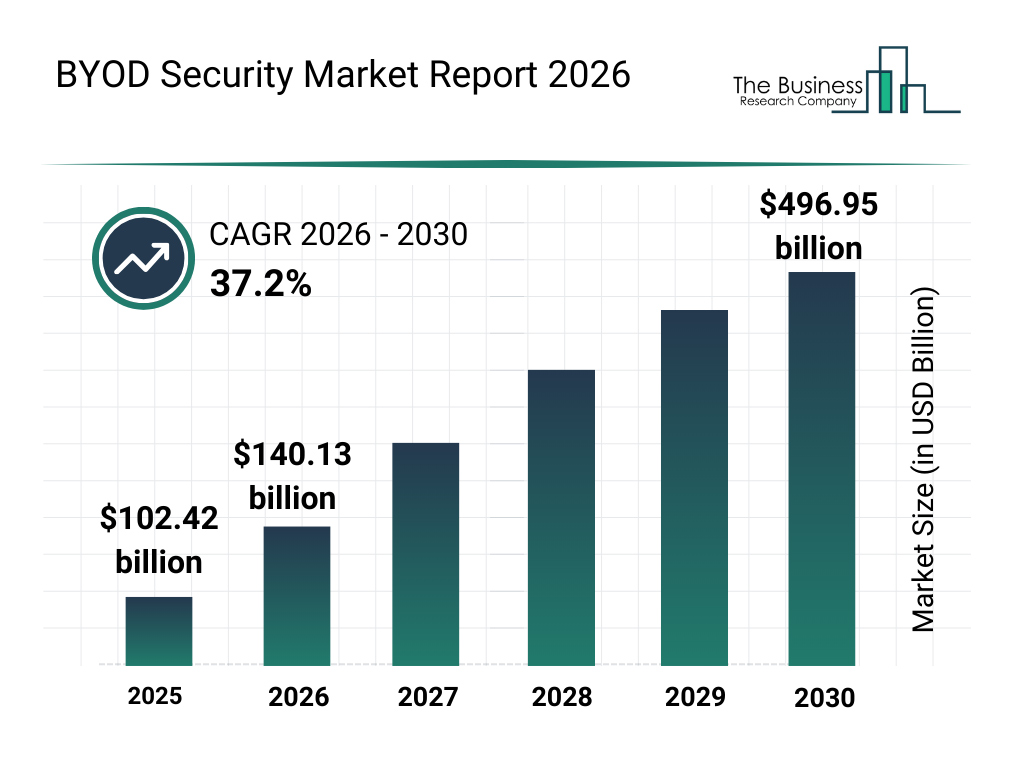
- The BYOD security market is projected to grow rapidly from $102.42 billion in 2025 to $496.95 billion by 2030.
- The market is expected to record a strong CAGR of 37.2% between 2026 and 2030, showing major growth in enterprise mobile security demand.
- In 2026, the BYOD security market is estimated at $140.13 billion, up from $102.42 billion in 2025.
- The data shows that the market could nearly quadruple between 2026 and 2030, rising from $140.13 billion to $496.95 billion.
- The sharp growth reflects increasing adoption of remote work, hybrid work, mobile devices, and employee-owned devices in organizations.
- Businesses are likely investing more in mobile device management, endpoint protection, access control, data encryption, and identity security to protect BYOD environments.
- The rising market value indicates that BYOD security is becoming a core cybersecurity priority rather than just an optional IT policy.
- By 2030, the BYOD security market is expected to reach almost $500 billion, highlighting strong long-term demand for secure workplace mobility solutions.
BYOD Adoption Rates Worldwide
- More than 50% of global organizations officially support some form of BYOD policy.
- Around 44% of employees worldwide used personal smartphones for work in 2025.
- Approximately 32% of workers relied on personal computers for business tasks in 2025.
- 78% of employees used personal devices at work even without formal policies.
- North America was the largest regional BYOD market in 2024 due to enterprise mobility.
- Asia-Pacific recorded the fastest growth rate as businesses expanded digital workplace infrastructure.
- Hybrid work models significantly increased BYOD participation among small and mid-sized businesses.
- Technology, financial services, and consulting sectors reported the highest adoption levels globally.
- Smartphone-based BYOD outpaced tablet usage due to mobile-first workflows.
- BYOD expansion accelerated in emerging markets where enterprises prioritized cost-efficient mobility solutions.
BYOD Adoption by Country and Region
- North America held 39% of the global BYOD market in 2024, with the U.S. as the largest adopter.
- 82% of companies worldwide have already adopted a BYOD policy, led by enterprise mobility investments.
- 69% of U.S. IT leaders view BYOD as beneficial for their organization due to hybrid work.
- Asia-Pacific is the fastest-growing BYOD region, projected to grow at 16.02% CAGR through 2031.
- India has over 80% of enterprises implementing BYOD, driven by affordable smartphones and SaaS.
- 67% of employees use personal devices for work, with 66% relying on smartphones even without a formal policy.
- 39% of companies cite security as the top BYOD barrier, while 64% of cybersecurity pros fear data loss.
- The global BYOD market will reach $132.22 billion in 2025 and grow to $276.39 billion by 2030.
- 50.3% of urban Indian employees use personal devices for work, but 80% prefer keeping work and personal data separate.
BYOD Usage by Device Type
- Smartphones remained the most widely used BYOD device category in 2025 workplace environments.
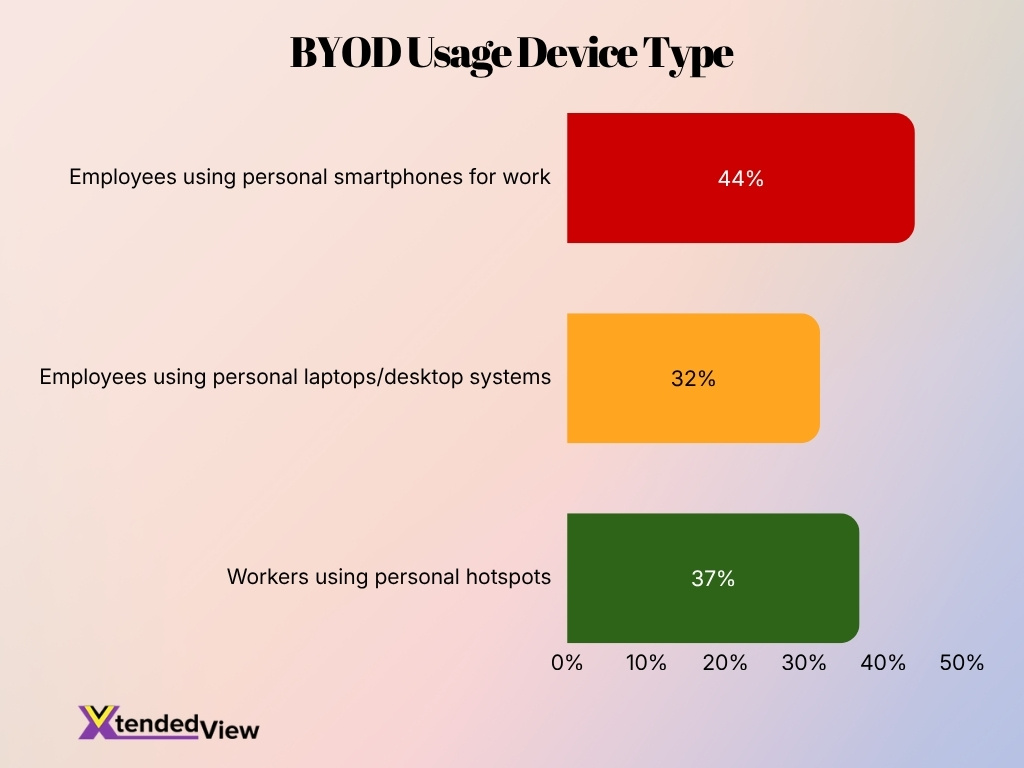
- Around 44% of employees used personal smartphones for work communication and productivity tasks.
- Approximately 32% of employees used personal laptops or desktop systems for work-related responsibilities.
- Personal hotspots became increasingly common, with 37% of workers using them to access company systems remotely.
- Laptops accounted for 48.6% of the BYOD security market share in 2025.
- Android smartphones dominated enterprise BYOD ecosystems because of their large global user base and lower hardware costs.
- iOS devices remained popular in North American enterprise environments due to strong mobile security capabilities.
- Tablet adoption in BYOD programs continued across healthcare, education, and retail industries for mobile field operations.
- Wearable technology integration within BYOD ecosystems expanded slowly as businesses tested productivity and health-monitoring applications.
- Enterprises increasingly prioritize cross-platform device management solutions capable of supporting Windows, macOS, Android, and iOS systems simultaneously.
BYOD and Employee Productivity Statistics
- 68% of companies see higher productivity when employees use personal devices.
- Using personal devices can enhance productivity by up to 55% and increase employee satisfaction by 56%.
- Over 80% of organizations now have formal BYOD policies in place.
- 95% of organizations allow employees to use personal devices for work in some capacity.
- The average worker using BYOD works two extra hours per day.
- 67% of employees rely on personal devices for work, with or without a formal policy.
- Organizations save an average of $341 per employee annually through reduced equipment costs.
- 66% of employees use smartphones for work tasks, regardless of formal approval.
- 31% of businesses plan to expand their BYOD initiatives in the near future.
BYOD and Employee Satisfaction Statistics
- 53% of organizations report increased job satisfaction after implementing BYOD.
- Working with personal devices boosts productivity by up to 55% and happiness by 56%.
- 68% of organizations report improved employee productivity from BYOD policies.
- The average BYOD worker works two extra hours per day compared to non-BYOD employees.
- 80% of employees prioritize flexible work options when evaluating job offers.
- 90% of employees now use a mix of company and personal devices for work.
- 69% of IT decision-makers in the US believe BYOD is a positive move for their company.
- Employees using personal devices show greater comfort and convenience, reducing learning curves significantly.
- Over 80% of organizations currently use BYOD to support hybrid and remote work.
Benefits of BYOD for Organizations
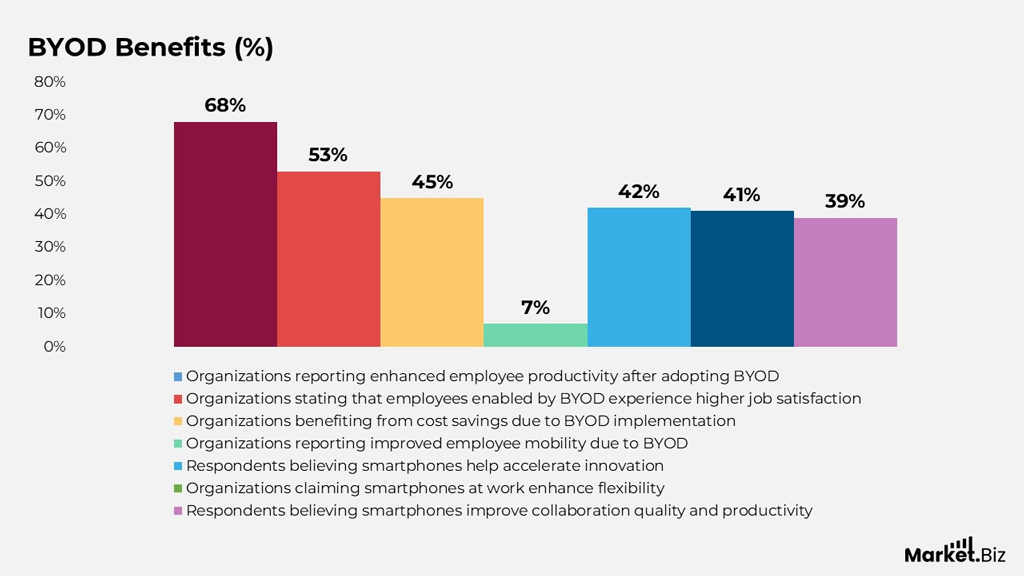
- Employee productivity is the strongest reported benefit of BYOD, with 68% of organizations saying productivity improved after adoption.
- Job satisfaction also sees a major boost, as 53% of organizations report that BYOD-enabled employees experience higher satisfaction at work.
- Cost savings remain a key driver of BYOD adoption, with 45% of organizations benefiting financially from BYOD implementation.
- Smartphones play a major role in workplace innovation, as 42% of respondents believe they help accelerate innovation.
- Workplace flexibility improves with smartphone use, according to 41% of organizations that say smartphones at work enhance employee flexibility.
- Collaboration and productivity quality are also positively affected, with 39% of respondents saying smartphones improve collaboration quality and overall productivity.
- Employee mobility appears to be the weakest reported BYOD benefit in this data, with only 7% of organizations citing improved mobility.
- Overall, the data shows that BYOD is most strongly linked to productivity, satisfaction, and cost efficiency, making it a strategic workplace technology trend rather than just a device policy.
Cost Savings from BYOD Implementation
- Organizations save $300–$350 per employee annually on hardware with BYOD.
- 90% of organizations report reduced corporate hardware purchasing costs after BYOD implementation.
- Small businesses cut upfront IT investments by 40–50% by letting employees use existing personal devices.
- Cloud platforms in BYOD environments reduced on-premise infrastructure costs by 23% for enterprises.
- Onboarding costs dropped 25–30% since employees already owned compatible BYOD devices.
- Operational downtime decreased 35% due to the elimination of delays in company-issued hardware deployments.
- 68% of enterprises redirected IT budgets from device procurement to cybersecurity and endpoint protection.
- Office infrastructure expenses fell 20–28% as hybrid work expanded with mature BYOD strategies.
- 82% of businesses reinvested BYOD savings into mobile security, cloud software, and collaboration tools.
- Cost-efficiency remained the top reason 76% of enterprises expanded BYOD initiatives in 2025–2026.
Top BYOD Security Threats and Statistics
- Over 95% of organizations now allow employees to use personal devices for work in some capacity.
- Approximately 48% of organizations have suffered data breaches linked to unmanaged personal devices.
- In 2024, about 53% of companies experienced a mobile security incident, causing data loss or downtime.
- 84% of IT leaders cite Shadow IT as a significant BYOD risk.
- 50% of personal devices were exposed to phishing attacks in recent years.
- Users are 2x more likely to click a phishing link on a personal device than on a company-owned one.
- Remote employees are 2x more likely to use unauthorized apps on personal devices than on corporate ones.
- 55% of professionals believe smartphones are their most exposed endpoints for security vulnerabilities.
- BYOD contributes to a 34% increase in productivity across organizations.
BYOD Adoption by Industry and Sector
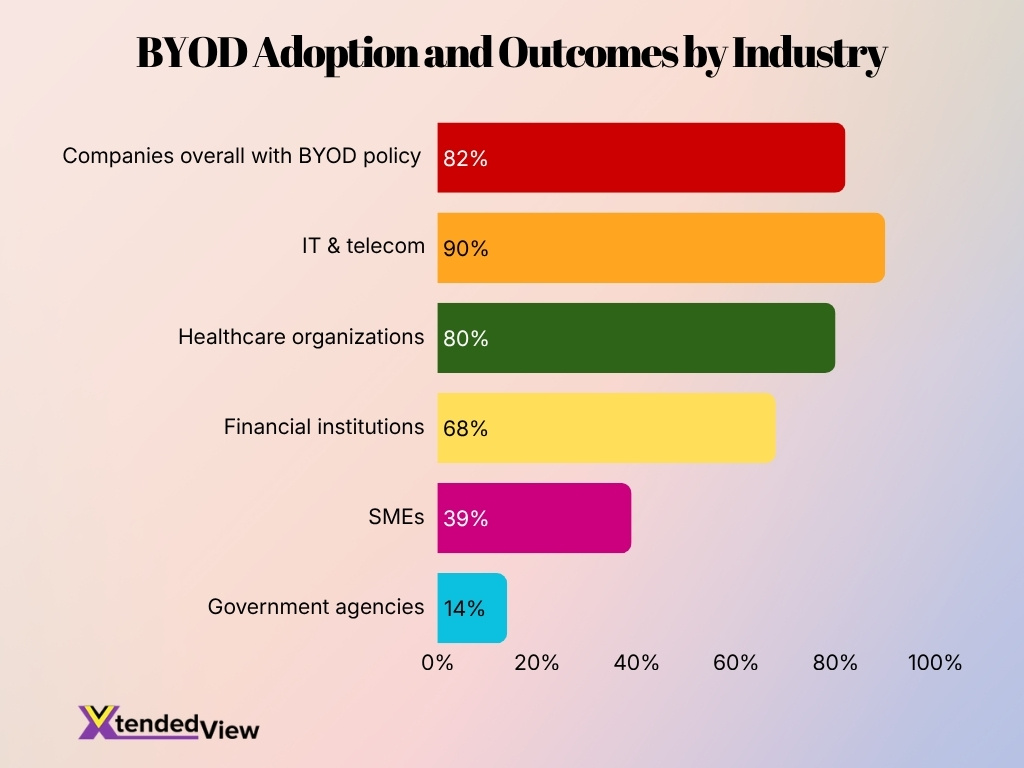
- 82% of companies have already adopted a BYOD policy across all sectors.
- The IT and telecommunications sector leads with 90% of employees using a mix of work and personal devices on the job.
- 80% of healthcare organizations have implemented BYOD policies to support telemedicine and mobile patient records.
- Financial institutions show 68% of organizations reporting improved productivity after implementing BYOD programs.
- Retail companies benefit from $341 per employee in savings when switching from work-issued smartphones to BYOD.
- The education sector is witnessing the most rapid adoption of BYOD practices as digital learning becomes standard.
- Small and mid-sized businesses: 39% of IT professionals at SMEs are concerned about device management for BYOD.
- Government agencies: Only 14% of organizations report not experiencing resistance to BYOD adoption while maintaining compliance.
Data Loss and Breach Statistics Related to BYOD
- 62% of organizations experience data loss from unmanaged employee devices in BYOD environments.
- Approximately 48% of organizations have suffered data breaches linked to unmanaged personal devices.
- Microsoft research found 80–90% of successful ransomware attacks come from unmanaged devices.
- Data loss is the #1 security concern surrounding BYOD, and 45% of employees don’t change passwords after breaches.
- 53% of organizations have experienced data breaches linked to personal devices.
- More than 90% of security incidents involving lost or stolen devices resulted in an unauthorized data breach.
- More than 70 million mobile devices are lost or stolen each year worldwide, risking unencrypted data access.
- 44% of data breaches in 2025 involved ransomware, up sharply year-over-year.
- Around 43% of organizations cited data leakage risks as the primary challenge in BYOD security frameworks.
- Even with BYOD restrictions, 78% of IT leaders say employees use personal devices without approval.
BYOD Policy Requirements and Best Practices
- Over 80% of organizations use BYOD today, with 82% having formal policies in place.
- 68% of organizations report improved employee productivity after implementing BYOD policies.
- 70% of BYOD use cases involve unmanaged devices entering the workplace.
- 48% of organizations suffered data breaches linked to unsecured personal devices in the past year.
- 30% of IT leaders cite information security as the biggest obstacle to BYOD adoption.
- More than 90% of security incidents involving lost/stolen devices resulted in unauthorized data breaches.
- 80% of organizations said security awareness training reduced staff susceptibility to phishing attacks.
- 61% of organizations support BYOD for non-employees, including contractors and partners.
- Mobile Device Management holds about 42% market share in 2025 as enterprises prioritize centralized control.
Key BYOD Security Concerns Among Organizations
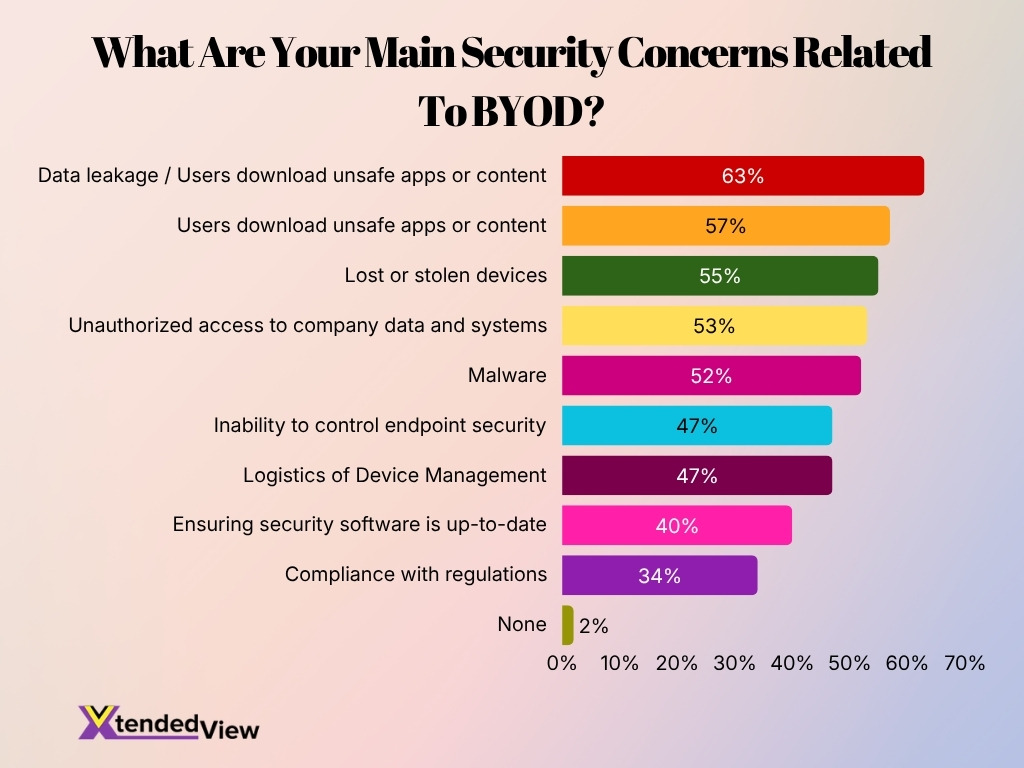
- Data leakage is the biggest BYOD security concern, reported by 63% of respondents, showing that companies are highly worried about sensitive information leaving controlled environments.
- Unsafe app or content downloads are a major risk, with 57% citing users downloading risky apps or content as a security concern.
- Lost or stolen devices concern 55% of organizations, highlighting the danger of company data being exposed through personal smartphones, laptops, or tablets.
- Unauthorized access to company data and systems affects 53% of respondents, making access control a critical part of any BYOD policy.
- Malware threats are cited by 52%, showing that personal devices can become entry points for malicious software inside business networks.
- Endpoint security control remains a challenge, with 47% saying they struggle to control security on employee-owned devices.
- Device management logistics are also a concern for 47%, indicating that BYOD programs require strong mobile device management and IT support.
- Keeping security software up to date is a problem for 40% of respondents, increasing the risk of vulnerabilities on unmanaged or poorly maintained devices.
- Regulatory compliance is a concern for 34%, especially for businesses handling sensitive customer, financial, or healthcare data.
- Only 2% reported having no BYOD security concerns, which shows that nearly all organizations see BYOD as a potential security risk.
Remote Work and Hybrid Work Impact on BYOD
- 74% of organizations now allow some form of BYOD due to hybrid work demands.
- 68% of employees prefer using personal devices for work when hybrid policies permit.
- 52% of companies reported increased security incidents linked to BYOD in hybrid environments.
- 81% of IT leaders say hybrid work made BYOD adoption essential for business continuity.
- 39% of organizations expanded BYOD policies specifically after shifting to hybrid models.
- 63% of remote workers use personal laptops as their primary work device outside the office.
- 47% of businesses invested more in mobile device management (MDM) to support hybrid BYOD.
- 56% of employees say BYOD flexibility influences their decision to accept hybrid work roles.
- 71% of organizations plan to increase BYOD support budgets in 2026 due to hybrid work trends.
BYOD Challenges and Barriers to Adoption
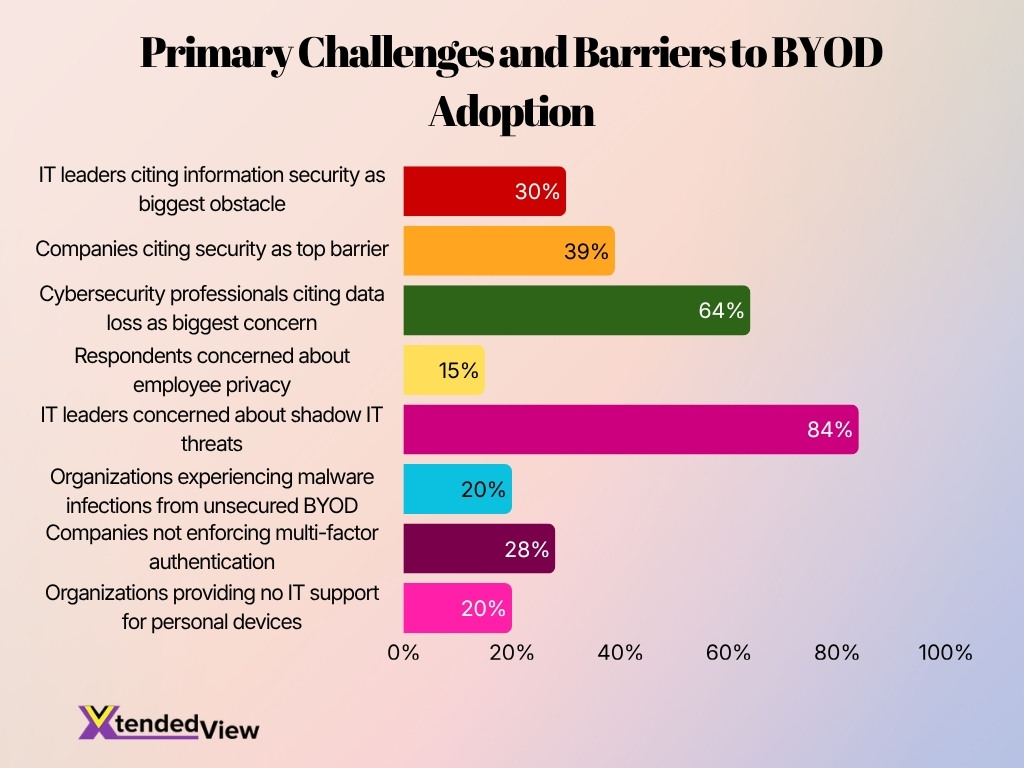
- 30% of IT leaders say information security is the biggest obstacle to BYOD adoption.
- 39% of companies cite security as the top barrier to BYOD implementation.
- 64% of cybersecurity professionals say data loss is their biggest BYOD-related concern.
- 15% of respondents are concerned about employee privacy when implementing BYOD policies.
- 84% of IT leaders are concerned about shadow IT threats from unmanaged devices.
- Over 1 in 5 organizations have experienced malware infections linked to unsecured BYOD use.
- 28% of companies still don’t enforce multi-factor authentication for employee-owned devices.
- 20% of organizations provide no IT support for personal devices in BYOD environments.
Frequently Asked Questions (FAQs)
More than 95% of organizations now allow some level of BYOD usage in the workplace.
Around 67% of employees use personal devices for work purposes, even when policies are unofficial.
The global BYOD market is expected to reach $619.5 billion by 2034.
About 44% of employees use personal smartphones for work-related tasks in 2025.
BYOD adoption can improve employee productivity by up to 55% in enterprise environments.
Conclusion
Bring Your Own Device policies have evolved from a cost-saving initiative into a core component of modern workplace strategy. Organizations across industries now rely on employee-owned devices to support hybrid work, improve operational flexibility, and accelerate digital collaboration. At the same time, rising ransomware attacks, unmanaged endpoints, and compliance challenges continue to push businesses toward stronger mobile security frameworks.
The data show that BYOD adoption will continue to expand as enterprises invest in Zero Trust security, AI-powered threat detection, endpoint management, and cloud-based collaboration tools. Companies that balance flexibility with clear governance policies and proactive cybersecurity investments will likely see the strongest long-term benefits from BYOD environments.
