



Computer vision now powers some of the most important AI-driven systems across healthcare, manufacturing, automotive, retail, and security. Hospitals use computer vision models to analyze medical scans faster, while retailers rely on visual AI to improve checkout automation and inventory tracking. At the same time, autonomous driving systems, smart factories, and robotics platforms continue to increase demand for real-time image recognition and video analytics.
As businesses accelerate AI adoption, computer vision has become one of the fastest-growing segments in enterprise technology spending. This article explores the latest computer vision statistics, including market growth, regional trends, industry adoption, and emerging developments shaping the future of visual AI.
Editor’s Choice
- The global computer vision market reached $20.75 billion in 2025 and is projected to grow to $24.14 billion in 2026.
- Analysts expect the market to surpass $72.8 billion by 2034, driven by AI-powered automation and the adoption of edge computing.
- North America accounted for 34.3% of the global computer vision market share in 2025.
- The AI in the computer vision segment is forecast to grow at a 19.1% CAGR between 2025 and 2032.
- The U.S. AI in the computer vision market alone generated $7.1 billion in 2025 revenue.
- The machine vision market reached $12.56 billion in 2025 and is expected to hit $26.88 billion by 2034.
- Healthcare computer vision applications generated $5.57 billion in 2025 market value globally.
- Computer vision adoption in retail continues to rise as AI-powered checkout systems and shelf analytics reduce operational costs.
- Automotive companies increasingly deploy computer vision for ADAS, driver monitoring, and autonomous navigation systems.
- Enterprise demand for edge AI processing continues to accelerate because businesses want faster visual analysis with lower latency.
Recent Developments
- NVIDIA and OpenAI announced a strategic AI infrastructure partnership involving at least 10 gigawatts of NVIDIA systems for next-generation AI deployment.
- Meta agreed to acquire a 49% stake in Scale AI for $14.8 billion in 2025, highlighting growing demand for AI training data and computer vision infrastructure.
- Google introduced Gemini 3.5 and expanded AI-driven scientific research initiatives during its 2026 developer conference.
- NVIDIA revealed new AI hardware platforms in 2025 to support large-scale computer vision and robotics workloads.
- Meta accelerated investment in custom AI chips and edge AI systems to reduce dependence on third-party GPU providers.
- AI-powered perception systems for Level 2+ and Level 3 autonomous vehicles entered broader commercial deployment in 2025.
- Open-source AI development activity increased sharply in 2025, with NVIDIA becoming one of the leading contributors to AI repositories.
- Enterprises expanded investment in multimodal AI systems capable of processing images, video, audio, and text simultaneously.
- Retail and e-commerce companies accelerated the deployment of AI-based visual search and automated checkout technologies in 2025.
- Governments and enterprises increased spending on AI surveillance and smart city infrastructure across North America and the Asia-Pacific.
Global Computer Vision Market Overview
- The global computer vision market was valued at $20.75 billion in 2025.
- Market revenue is forecast to increase to $24.14 billion in 2026.
- Industry analysts estimate the market will exceed $58.29 billion by 2030.
- Another forecast projects the market to reach $72.8 billion by 2034.
- Asia-Pacific held more than 41% market share in 2025, making it the fastest-growing regional market.
- AI-powered visual inspection remains one of the top enterprise applications for computer vision systems.
- Demand for real-time video analytics continues to increase across transportation, logistics, and manufacturing sectors.
- Edge AI integration has become a major growth driver because businesses want local image processing without relying on cloud infrastructure.
- Smart surveillance systems represent one of the largest commercial deployment areas for computer vision technologies.
- Autonomous systems and robotics continue to increase enterprise demand for visual recognition technologies worldwide.
Computer Vision Market Revenue Growth
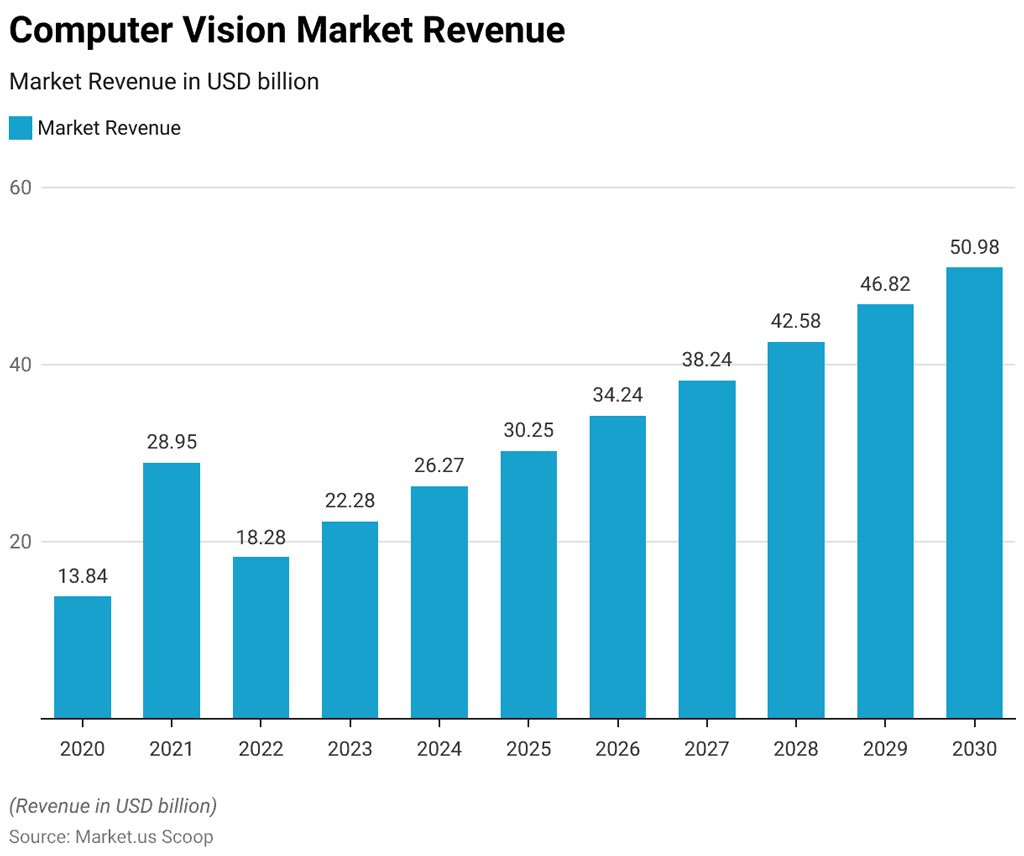
- The computer vision market revenue is projected to reach $50.98 billion by 2030, showing strong long-term growth.
- In 2020, the market revenue stood at $13.84 billion, indicating that the sector has grown significantly over the decade.
- The market saw a sharp jump in 2021, reaching $28.50 billion, the highest year-on-year increase shown in the chart.
- Revenue dropped to $18.28 billion in 2022, suggesting a temporary market correction after the strong 2021 surge.
- From 2023 onward, the market shows consistent annual growth, rising from $22.28 billion in 2023 to $50.98 billion in 2030.
- Between 2025 and 2030, computer vision revenue is expected to increase from $30.25 billion to $50.98 billion.
- The market is forecast to add more than $20 billion in revenue between 2025 and 2030.
- By 2028, the computer vision market is projected to cross $40 billion, reaching $42.58 billion.
- The data suggests that AI-powered automation, industrial use cases, healthcare imaging, autonomous systems, and smart surveillance may continue to drive demand for computer vision technologies.
- Overall, the chart indicates a strong upward trend, with the computer vision market expected to grow by nearly 3.7 times from $13.84 billion in 2020 to $50.98 billion in 2030.
Computer Vision Use Cases in Healthcare
- The global computer vision healthcare market reached $5.57 billion in 2025 and will surpass $21 billion by 2032.
- More than 70% of FDA-approved AI medical devices rely on computer vision and imaging analysis technologies.
- AI-powered medical imaging systems now detect abnormalities in X-rays, CT scans, and MRIs with 30–50% faster turnaround times.
- Stanford researchers found AI vision systems achieved dermatologist-level accuracy with ≥91% area under the sensitivity-specificity curve in skin cancer classification.
- AI-assisted pathology systems reduce diagnostic review time by nearly 50% in some clinical workflows and increase malignancy detection by 50%.
- AI retinal imaging systems screen diabetic retinopathy with 77–100% sensitivity and 93.3% accuracy compared to human grading.
- U.S. healthcare AI spending hit $1.4 billion in 2025, nearly tripling 2024’s investment due to radiologist shortages.
- Computer vision patient-monitoring systems achieve a 0.92 macro F1-score for object detection and a 0.98 F1-score for patient-role classification.
- 22% of healthcare organizations implemented domain-specific AI tools in 2025, a 7x increase over 2024.
Computer Vision Use Cases in Automotive and Mobility
- ADAS systems are installed in 361.4 million light vehicles globally in 2025, representing the largest commercial computer vision application.
- The autonomous vehicle market is projected to exceed $2.3 trillion by 2030, driving massive demand for visual perception systems.
- More than 58% of automotive OEMs and fleet operators adopted computer vision-based driver monitoring systems in 2025 for fatigue and distraction detection.
- Over 90% of autonomous vehicle decision-making relies on camera-based environmental perception for real-time object detection.
- LiDAR-computer vision fusion achieves 98% accuracy on the KITTI validation dataset for 3D object detection in self-driving cars.
- The smart parking market powered by computer vision will grow from $7.6 billion in 2025 to $21.3 billion by 2035 at 10.8% CAGR.
- AI dashcams with visual AI improved driver safety by 73% and reduced accident costs by 48% in fleet operations.
- Edge AI adoption in automotive vision systems accelerated in 2025, cutting latency from 1000–2200ms (cloud) to 300–700ms (edge) for faster safety response.
Computer Vision Adoption by Industry
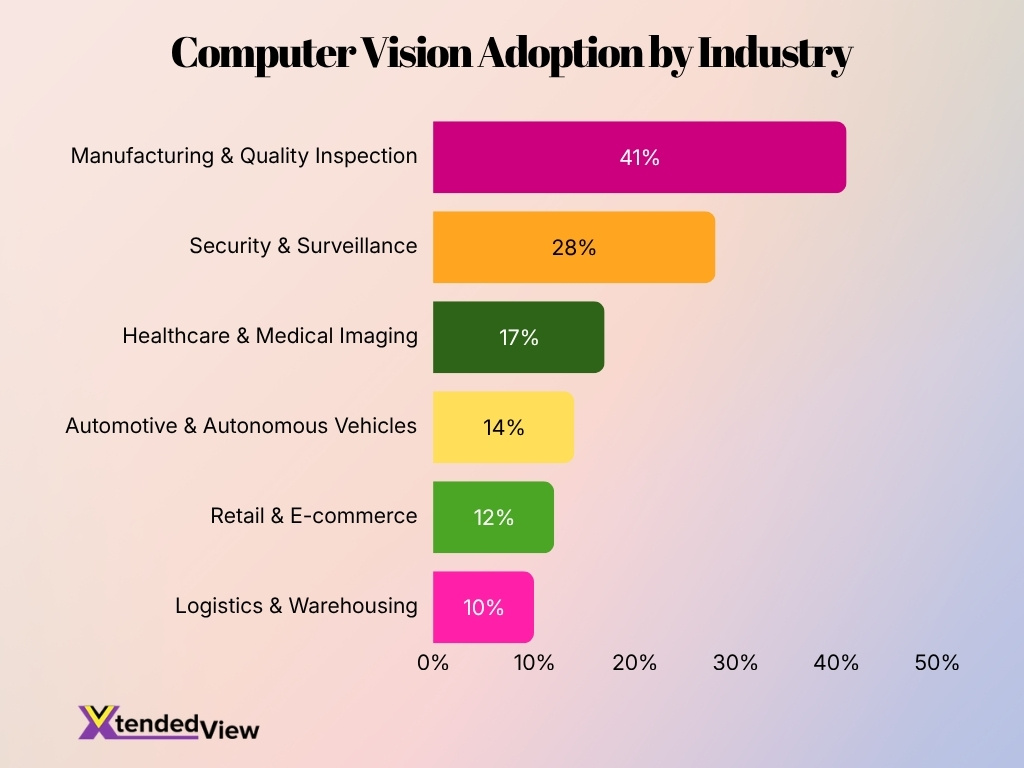
- Manufacturing & Quality Inspection leads computer vision adoption with 41%, showing that industries are using visual AI heavily for defect detection, quality control, and automation.
- Security & Surveillance ranks second with 28% adoption, highlighting the growing use of computer vision for monitoring, threat detection, facial recognition, and smart camera systems.
- Healthcare & Medical Imaging has 17% adoption, reflecting computer vision’s role in diagnostics, medical scans, disease detection, and image-based analysis.
- Automotive & Autonomous Vehicles account for 14% adoption, driven by use cases such as driver assistance systems, object detection, lane recognition, and self-driving technology.
- Retail & E-commerce shows 12% adoption, with computer vision being used for visual search, inventory tracking, customer behavior analysis, and checkout automation.
- Logistics & Warehousing has the lowest adoption among the listed sectors at 10%, but it remains important for package sorting, warehouse automation, barcode scanning, and inventory monitoring.
- The data shows that computer vision adoption is strongest in sectors where accuracy, automation, safety, and real-time visual analysis are critical.
- Overall, industrial and security-related applications dominate computer vision adoption, while sectors like retail and logistics are still developing broader use cases.
Computer Vision Use Cases in Retail and E-commerce
- 78% of retailers plan to deploy cashier-less checkout systems by 2027 using computer vision.
- 62% of shoppers say AI-powered visual search makes finding products easier than text search.
- The global smart retail market will reach $143.5 billion by 2032 with 21.4% CAGR.
- AI shelf-monitoring reduces stockout rates by 30% and boosts inventory accuracy to 98%.
- Computer vision tracks customer dwell time with 95% accuracy and maps traffic flow in real-time.
- AI image tagging lifts e-commerce conversion rates by 25% and boosts product discovery by 40%.
- Virtual try-on adoption grew 180% in 2025, reducing fashion return rates by 35%.
- Visual AI loss prevention cuts shrinkage by 28% and identifies suspicious behavior in under 2 seconds.
- Grocery chains invested $4.2 billion in checkout automation in 2025, cutting labor costs by 22%.
- Visual AI boosts warehouse automation efficiency by 45% and speeds order fulfillment by 33%.
Computer Vision Use Cases in Manufacturing and Industrial Automation
- The machine vision market reached $12.56 billion in 2025 due to rising factory automation demand.
- Computer vision systems detect production defects with 95%+ consistency versus manual inspection methods.
- Smart factories deploy AI vision systems for predictive maintenance, reducing equipment downtime by 30–50%.
- Industrial robots integrate real-time visual recognition, achieving 20–30 items/minute for object handling and assembly.
- Semiconductor manufacturers use computer vision for wafer inspection, catching 99.9% of defects at micron-level precision.
- AI-powered visual inspection reduces manufacturing defects by up to 90% in certain production environments.
- Automotive factories expanded computer vision for weld inspection, paint analysis, and cutting quality issues by 40–60%.
- Warehouse robotics uses computer vision for picking/sorting, achieving 98%+ accuracy at 100+ packages/hour.
- Manufacturers adopting AI-driven automation report 25–35% improved operational efficiency and 20–40% reduced downtime.
- Industrial edge AI deployments grew 45% in 2025 as factories need low-latency processing near equipment.
Computer Vision Use in Security Systems
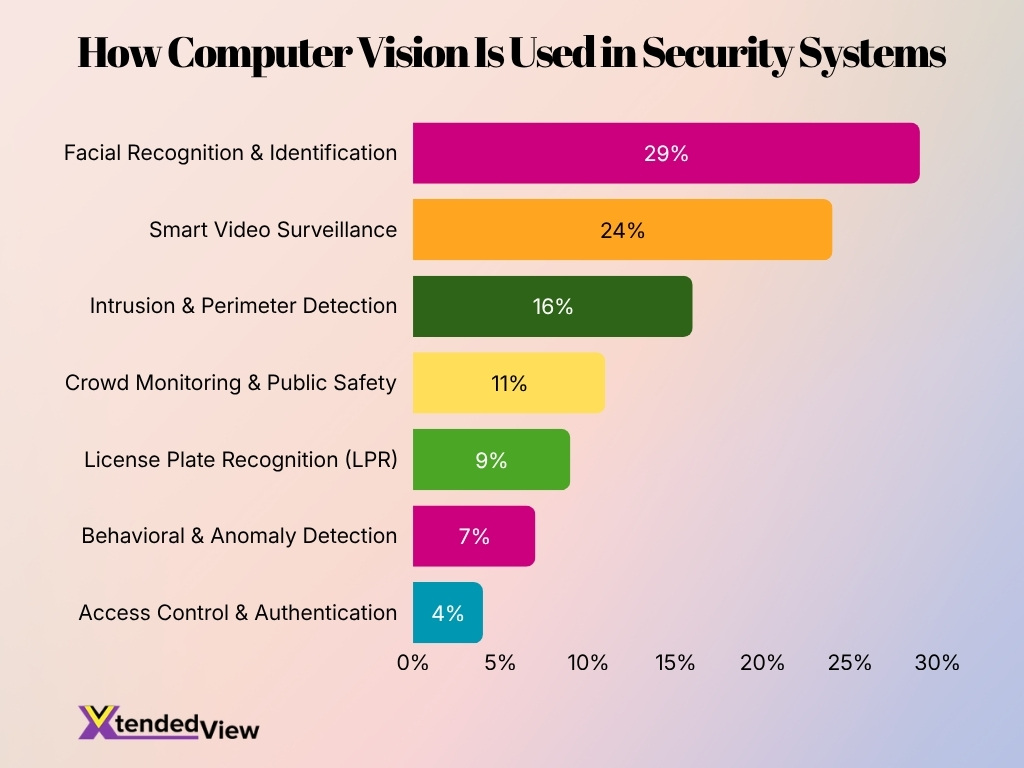
- Facial Recognition & Identification is the leading computer vision use case in security systems, with the highest adoption share at 29%.
- Smart Video Surveillance follows closely with 24% adoption, showing that automated monitoring is a major part of modern security infrastructure.
- Together, facial recognition and smart video surveillance account for 53% of total adoption, indicating that identity detection and real-time monitoring dominate the security sector.
- Intrusion & Perimeter Detection holds a 16% adoption share, highlighting the growing use of computer vision for detecting unauthorized movement around restricted areas.
- Crowd Monitoring & Public Safety represents 11% of adoption, making it an important application for airports, stadiums, public venues, and urban surveillance systems.
- License Plate Recognition (LPR) accounts for 9%, showing steady use in traffic enforcement, parking systems, tolling, and vehicle tracking.
- Behavioral & Anomaly Detection has a 7% adoption share, suggesting that AI-based threat prediction and suspicious activity detection are still emerging but gaining relevance.
- Access Control & Authentication has the lowest adoption share at 4%, indicating that computer vision-based entry systems are still less widely used compared to surveillance and identification tools.
- Overall, the data shows that computer vision in security is mainly focused on recognition, surveillance, and threat detection, rather than standalone authentication systems.
Computer Vision Use Cases in Robotics and Drones
- The drone market will grow from $44.32 billion in 2025 to $111.88 billion by 2030 at a CAGR of 20.3%.
- The agricultural drones market will surge from $2.01 billion in 2024 to $8.03 billion by 2029 at a CAGR of 32.0%.
- Amazon has deployed over 750,000 robots in warehouses, achieving a 75% reduction in picking and packing times.
- Robotics startups raised around $6.4 billion in 2024, tracking toward $7.5 billion, far exceeding 2023’s $6.9 billion.
- The AI in the drone market is valued at $2.17 billion in 2025 and projected to reach $7.12 billion by 2032.
- AI-powered drones provide millimeter-level accuracy in crop monitoring while reducing pesticide use significantly.
- By the end of 2025, approximately 55% of all deep neural network data analysis will occur on edge devices.
- The warehouse robotics market was valued at $14.7 billion in 2024 and will grow at a CAGR of over 23.1% through 2034.
Regional Breakdown of the Computer Vision Market
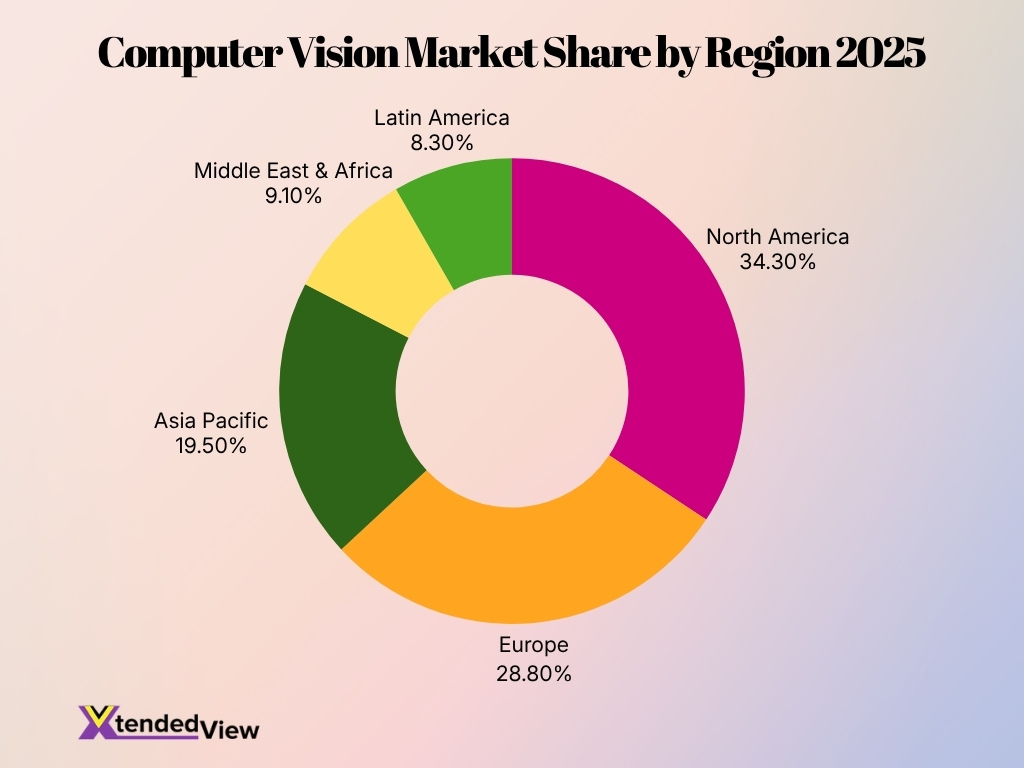
- North America leads the global computer vision market with the highest share of 34.30%, showing strong adoption across industries such as healthcare, automotive, manufacturing, and security.
- Europe holds the second-largest market share at 28.80%, supported by the growing use of AI-powered automation, industrial inspection, and smart surveillance technologies.
- Asia Pacific accounts for 19.50% of the market, making it a major growth region due to rising investments in AI, robotics, smart cities, and consumer electronics.
- The Middle East & Africa region represents 9.10% of the computer vision market, indicating gradual adoption across security, infrastructure, retail, and industrial sectors.
- Latin America has the smallest regional share at 8.30%, but the region still shows potential as businesses increase digital transformation and automation initiatives.
- Together, North America and Europe contribute 63.10% of the global market, highlighting that developed economies currently dominate computer vision adoption.
- Emerging regions, including Asia Pacific, the Middle East & Africa, and Latin America, collectively account for 36.90%, showing room for future expansion as AI infrastructure improves.
Computer Vision Hardware Market Statistics
- The global machine vision hardware market will grow from $15.83 billion in 2025 to $23.63 billion by 2030 at a CAGR of 8.3%.
- GPU demand surged 35% annually in 2025 due to exploding AI training and computer vision workloads.
- NVIDIA held ~92% of the discrete GPU market and over 80% of AI hardware for computer vision in 2025.
- AI camera shipments rose 28% in 2025 across manufacturing, transportation, and smart retail sectors.
- The Edge AI processor market reached $ 3.05 billion in 2025 and will grow at a CAGR of 18.4% through 2033.
- Industrial smart cameras now provide onboard AI inference for real-time defect detection in over 58% of new deployments.
- The global image sensor market will hit $49.82 billion by 2030, growing at a CAGR of 7.7%.
- Automotive camera demand increased 12% year-over-year as ADAS became standard, with the market valued at $8.44 billion in 2025.
- AI server spending reached $73.8 billion in Q2 2025, up 3.1X year-over-year, driven by multimodal AI and computer vision.
- The AI chip market will reach $564.87 billion by 2032 from $203.24 billion in 2025, at a CAGR of 15.7%.
Computer Vision Software and Algorithms Market Statistics
- The global computer vision market is projected to reach $27.39 billion in 2025.
- The market is expected to grow to $68.38 billion by 2031 at a CAGR of 15.77%.
- Software is advancing at a CAGR of 15.87% through 2031, outpacing hardware growth.
- Automotive is the fastest-growing end-user segment at a CAGR of 18.23% during 2026–2031.
- Edge solutions held 47.33% of the deployment share in 2025 and are growing at a CAGR of 17.29%.
- Inspection and quality assurance commanded 41.08% of application revenue in 2025.
- North America contributed 49.01% of global computer vision revenue in 2025.
- The top five players (Intel, NVIDIA, Cognex, Keyence, Sony) accounted for around 38% of market revenue.
- The AI in the computer vision market is estimated at $34.94 billion in 2026 and will reach $254.51 billion by 2033.
- AI in computer vision is growing at a CAGR of 32.8% from 2026 to 2033.
Change in Computer Vision Market Size
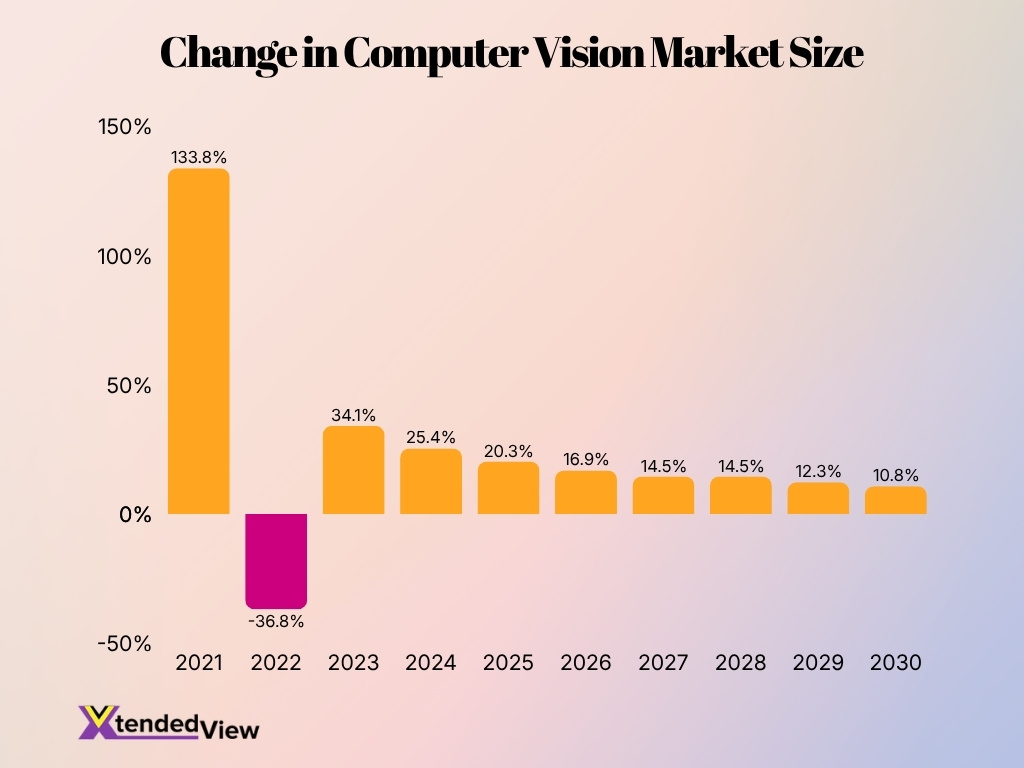
- The computer vision market saw its strongest growth in 2021, with market size increasing by 133.8%, indicating a major acceleration in adoption and investment.
- In 2022, the market recorded a sharp decline of -36.8%, showing a temporary contraction after the unusually high growth seen in the previous year.
- The market rebounded strongly in 2023, growing by 34.1%, suggesting renewed demand and recovery across computer vision applications.
- Growth continued in 2024 at 25.4%, but at a slower pace compared to 2023, showing that the market began moving toward more stable expansion.
- From 2025 to 2030, the growth rate is projected to gradually decline from 20.3% to 10.8%, indicating market maturation.
- The years 2027 and 2028 show the same projected growth rate of 14.5%, suggesting a short period of steady market performance.
- By 2030, the market is still expected to grow by 10.8%, showing that computer vision will remain an expanding sector, though at a more moderate pace.
- Overall, the data shows a shift from rapid early-stage growth to more sustainable long-term expansion in the computer vision market.
Edge vs Cloud Deployment in Computer Vision
- 75% of enterprise-generated data will be processed at the edge by 2025, up from just 10% previously.
- The global edge AI market is valued at $25.65 billion in 2025 and will reach $165.05 billion by 2035.
- Manufacturing plants using AI-driven predictive maintenance achieve 40–60% reductions in unplanned downtime.
- Edge AI for autonomous vehicles delivers 40% faster processing time and 25% higher perception accuracy than cloud systems.
- Edge AI chips consume only 1–5 watts versus 50+ watts for traditional CPUs/GPUs, dramatically lowering power costs.
- 57% of consumers say they would be excited to shop at cashier-less stores using edge-based computer vision.
- Edge video analytics reduces network latency by processing data locally, enabling real-time threat detection in surveillance.
- Hybrid edge-cloud architectures handle real-time workloads at the edge while using the cloud for scalable model training.
- The AI in the computer vision market will grow from $23.42 billion in 2025 to $63.48 billion by 2030 at 22.1% CAGR.
Computer Vision Model Performance and Accuracy Benchmarks
- Modern computer vision models achieve image classification accuracy above 90% on ImageNet.
- Vision Transformer architectures outperform CNNs by 2–5% on major image recognition tasks.
- OpenAI’s multimodal AI systems scored 85% accuracy on text-and-image reasoning benchmarks in 2025.
- YOLOv8 reaches 53.7% mAP at 147 FPS, while Faster R-CNN hits 49.4% mAP at 25 FPS for real-time detection.
- AI-powered medical imaging systems matched radiologist-level performance with 94.5% sensitivity in cancer detection.
- Autonomous driving perception datasets grew to over 500,000 annotated frames, improving model training quality by 30%.
- Optimized AI accelerators boosted real-time inference speeds to 200+ FPS on edge AI chips.
- Multimodal computer vision systems reduced hallucinations by 40% and bias by 25% through new fairness training.
- Models trained on synthetic datasets cut labeling costs by 60% while improving scalability by 35%.
- AI benchmarking now weighs fairness, explainability, and energy efficiency at 30% of the total model evaluation score.
Challenges and Limitations in Computer Vision Adoption
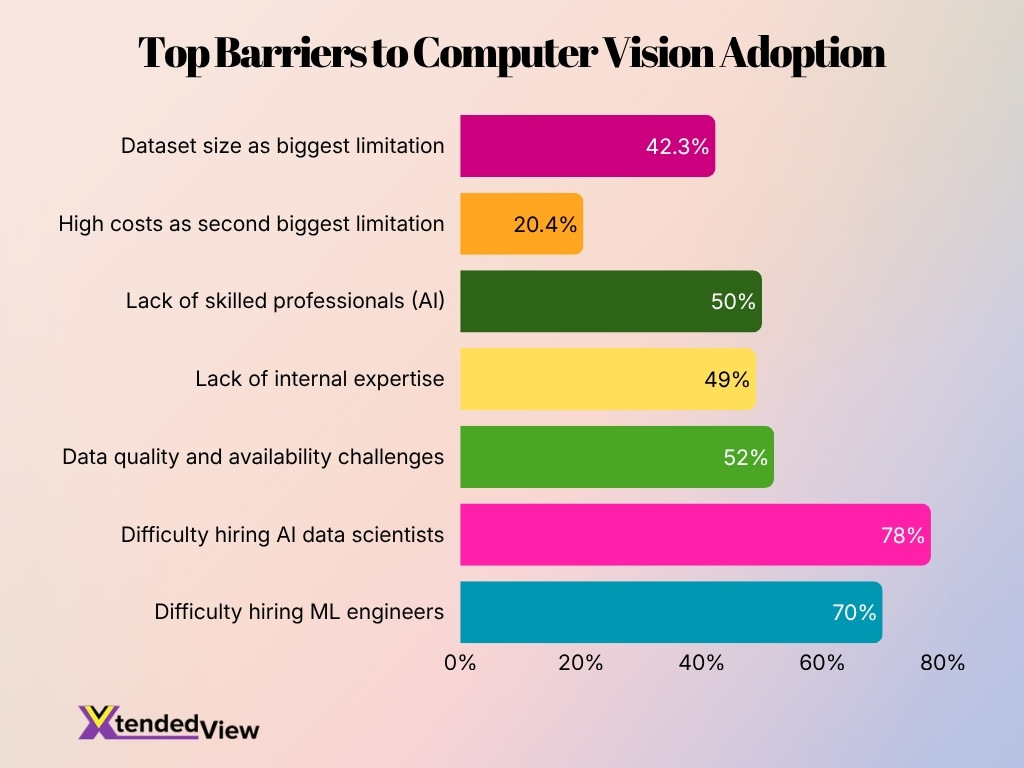
- 42.3% of organizations cite the size of required datasets as the biggest limitation in computer vision.
- 20.4% of businesses identify high costs as the second biggest limitation for computer vision adoption.
- 50% of businesses cite lack of skilled professionals as the biggest barrier to AI adoption in 2025.
- 49% of organizations report a lack of internal expertise as a major AI adoption obstacle.
- 52% of respondents say data quality and availability are the biggest AI adoption challenges.
- 78% of organizations struggle to hire AI data scientists due to talent shortages.
- 70% of companies face difficulties hiring machine learning engineers for computer vision roles.
- 15:1 is the AI talent demand-to-supply ratio, with 500,000+ positions competing for 40,000 annual graduates globally.
Deep Learning and Neural Network Adoption in Computer Vision
- The computer vision market reached $19.83 billion in 2024 and is growing at 19.8% annually.
- Deep learning for computer vision achieves 99% accuracy in controlled settings.
- The AI in the computer vision market will hit $63.48 billion by 2030, up from $23.42 billion in 2025.
- Deep learning framework adoption surged by over 45% as organizations deploy neural networks.
- Vision Transformer models outperform CNNs by almost 4 times in computational efficiency and accuracy.
- The global AI chipset market will reach $91.96 billion by 2025, driven by neural network inference.
- Self-supervised learning reduces labeled dataset dependency by leveraging unlabeled data for feature extraction.
- Generative AI spending jumped 3.2x year-over-year to $37 billion in 2025, fueling visual AI systems.
Investment, Funding, and M&A in Computer Vision Startups
- AI startups globally attracted more than $100 billion in venture funding during 2025.
- Meta agreed to invest $14.8 billion in Scale AI, marking one of the largest AI infrastructure deals.
- Computer vision in the healthcare market reached $4.86 billion in 2025 with 24.3% CAGR growth.
- Autonomous vehicle startups raised a record $21.4 billion across 34 deals through April 2026.
- Robotics M&A activity exceeded $1.2 billion in disclosed transaction values during 2024.
- Defense tech funding hit $49.1 billion in 2025, nearly doubling from 2024’s $27.2 billion.
- The generative AI content market will jump from $15.2 billion in 2024 to $175.3 billion by 2033.
- Edge AI startup Axelera AI raised $68 million for efficient edge inference and machine vision chips.
Frequently Asked Questions (FAQs)
The global computer vision market is projected to reach $24.14 billion in 2026.
The computer vision market is forecast to grow at a 14.8% CAGR from 2026 to 2034.
The AI in the computer vision market could reach $342.34 billion by 2035.
North America held 34.3% of the global computer vision market share in 2025.
The AI in the computer vision market is projected to grow at a 22.1% CAGR from 2025 to 2030.
Conclusion
Computer vision has evolved from a niche AI capability into a core technology powering automation, analytics, and intelligent decision-making across industries. From healthcare imaging and autonomous vehicles to retail automation and industrial robotics, organizations continue increasing investment in visual AI systems that improve efficiency, reduce costs, and support real-time operations.
The market’s rapid growth reflects rising enterprise demand for edge AI, multimodal systems, and advanced neural network architectures. At the same time, concerns around privacy, bias, infrastructure costs, and regulation continue shaping how organizations deploy computer vision technologies at scale.
As AI hardware becomes more efficient and visual models grow more capable, computer vision will likely remain one of the most influential segments of the global AI economy throughout the next decade.
