


Battery storage capacity now sits at the center of modern energy systems, helping utilities balance renewable power and enabling data centers to maintain uninterrupted operations. From stabilizing solar-heavy grids in California to powering AI infrastructure globally, battery storage plays a critical role in both energy reliability and decarbonization. As capacity scales rapidly across regions and applications, the numbers reveal where the industry is headed. Let’s dive into the data.
Editor’s Choice
- Global energy storage installations reached 275.3 GWh in 2025, marking a 61.3% year-over-year increase.
- The world is projected to add 353.4 GWh of new storage capacity in 2026, driven by AI and grid demand.
- Global battery storage deployments hit 108 GW in 2025, up 40% from 2024.
- Installed battery storage capacity is now 11x higher than in 2021, showing exponential growth.
- Global lithium-ion battery demand reached 1.59 TWh in 2025, with storage demand rising 51% YoY.
- China alone installed 167 GWh of storage in 2025, dominating global capacity additions.
- The global battery energy storage market is expected to grow from $12.9 billion in 2026 to over $102 billion by 2035.
Recent Developments
- Battery storage demand grew 43% globally in 2025, driven by renewable energy expansion.
- The U.S. installed 58 GWh of energy storage in 2025, a 30% annual increase.
- Global grid-connected BESS installations reached 156 GWh by October 2025, up 38% YoY.
- Utility-scale battery shipments surged to 556.74 GWh in 2025, nearly doubling from 2024.
- Total global energy storage market installations exceeded 100 GW annually for the first time in 2025.
- Lithium-ion batteries accounted for ~90% of new deployments, reinforcing dominance in 2025.
- The EU added 27.1 GWh of battery storage in 2025, a 45% increase YoY.
- Global lithium-ion battery market size surpassed $150 billion in 2025, up over 20% YoY.
Global Battery Energy Storage Capacity Overview
- Global battery storage reached 267 GW (610 GWh) of capacity in 2025.
- In 2024, global installed battery capacity stood at 86 GW, nearly doubling with new additions.
- Annual additions rose to 106–108 GW in 2025, showing strong acceleration.
- Total installations are expected to approach ~350 GWh added in 2026 alone.
- Grid-scale battery storage is projected to reach ~970 GW globally by 2030.
- Storage demand is increasingly driven by AI data centers and electrification needs.
- Stationary storage demand grew faster (51%) than EV battery demand (26%) in 2025.
- Battery storage systems are now considered an investable asset class by 2026, enabling portfolio aggregation.
Battery Energy Storage Market Growth
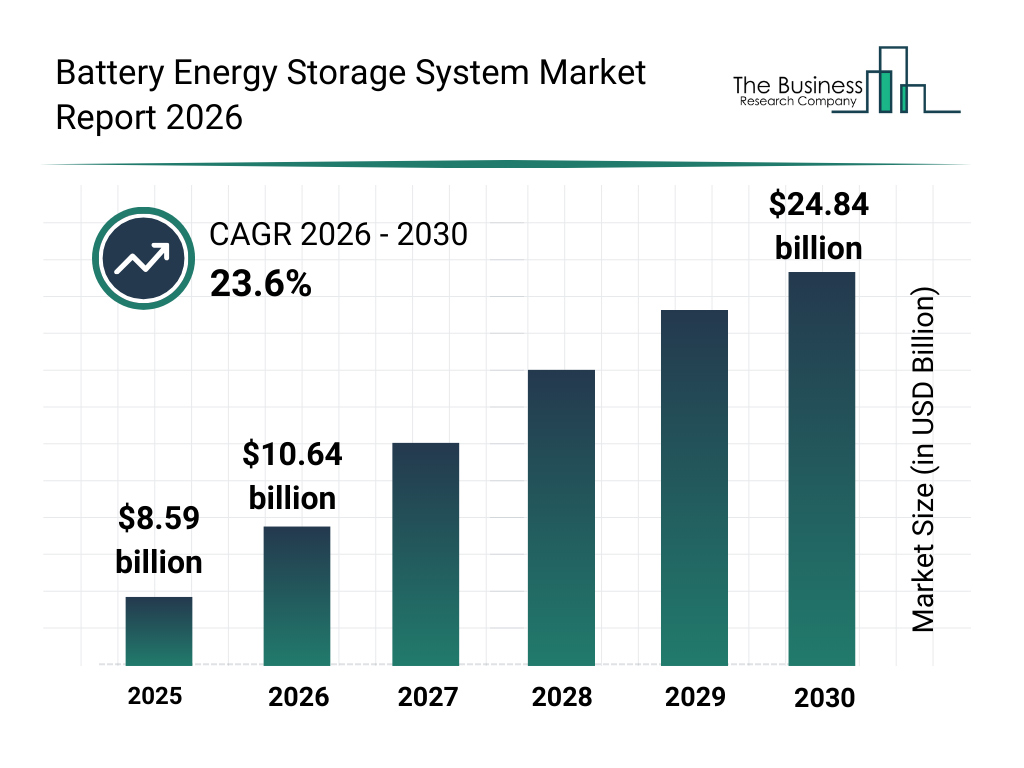
- The global battery energy storage system (BESS) market is projected to grow rapidly, reaching $24.84 billion by 2030, up from $8.59 billion in 2025.
- The market is expected to expand at a strong CAGR of 23.6% between 2026 and 2030, highlighting accelerating adoption across industries.
- In the near term, the market increases from $8.59 billion (2025) to $10.64 billion (2026), reflecting early-stage momentum.
- The industry is forecast to nearly triple in size over five years, indicating robust investment and scaling of storage infrastructure.
- Mid-period growth (2027–2029) shows a consistent upward trajectory, with the market crossing the approximately $15–20 billion range before 2030.
- The steep growth curve signals rising demand driven by renewable energy integration, grid stability needs, and energy transition policies.
- The data reflects a compounding growth pattern, where yearly additions increase significantly as the market matures.
- By 2030, the market expansion underscores a shift toward large-scale energy storage deployment as a core component of global energy systems.
Historical Growth of Battery Storage Capacity
- Global battery storage capacity increased 11-fold between 2021 and 2025.
- In 2022, global grid-scale additions were just 11 GW annually, compared to over 100 GW today.
- Annual installations grew from 69 GW in 2024 to over 100 GW in 2025.
- Energy storage deployments grew 43% year-over-year in 2025.
- Battery prices have fallen by ~90% since 2010, enabling mass adoption.
- Global lithium-ion shipments reached over 612 GWh in 2025, nearly doubling YoY.
- Utility-scale storage capacity in H1 2025 alone hit 86.7 GWh, up 54% YoY.
- EU battery capacity expanded from 7.8 GWh in 2021 to 77.3 GWh in 2025.
Installed Battery Storage Capacity by Region
- China accounted for 167 GWh of new installations in 2025, the largest globally.
- The U.S. installed 52.1 GWh in 2025, with strong growth expected in 2026.
- Europe added 25.3 GWh in 2025, with projections of 35.1 GWh in 2026.
- Australia deployed 11.4 GWh in 2025, showing steady expansion.
- The Middle East installed 8 GWh in 2025, expected to more than double to 20.1 GWh in 2026.
- Chile installed 3.7 GWh in 2025, forecast to reach 6 GWh in 2026.
- Japan deployed 2.5 GWh in 2025, expected to grow to 4.2 GWh in 2026.
- Asia-Pacific held over 53% market share in 2025, dominating global storage demand.
Global Battery Storage Capacity Targets by Country
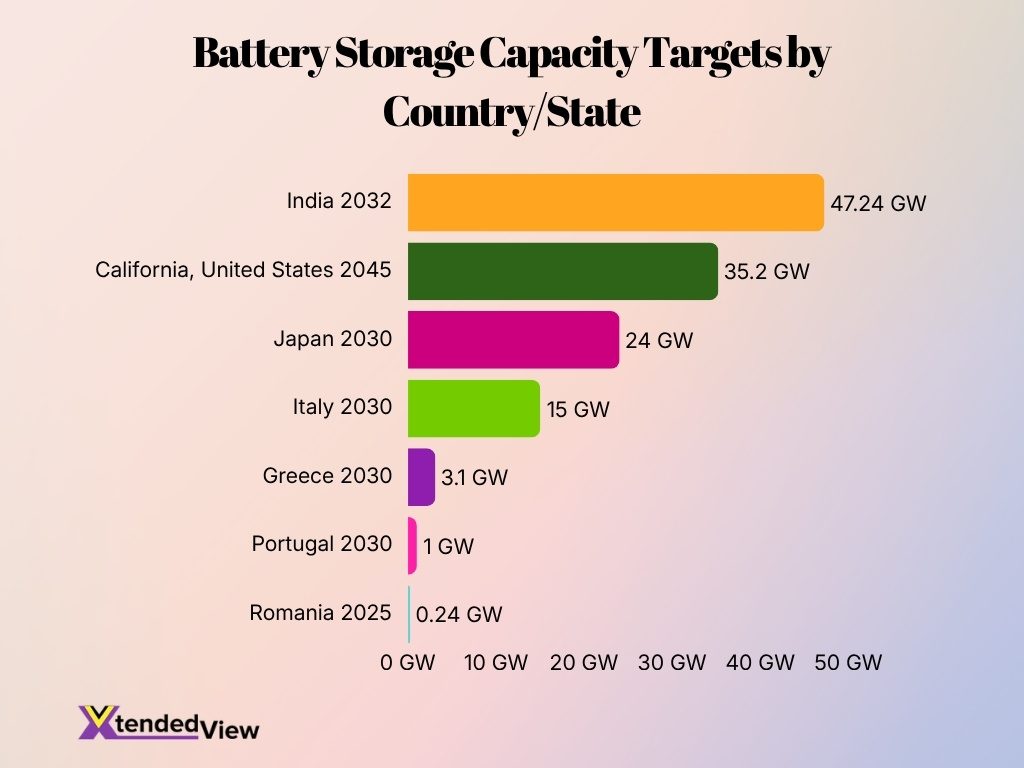
- India leads globally with a massive target of 47.24 GW by 2032, positioning itself as the top market for battery storage expansion.
- California (U.S.) ranks second, aiming for 35.2 GW by 2045, highlighting its long-term commitment to grid stability and renewable integration.
- Japan targets 24 GW by 2030, making it one of the most aggressive adopters in Asia for energy storage deployment.
- Italy plans 15 GW by 2030, reflecting strong European Union momentum toward clean energy storage infrastructure.
- Greece’s target stands at 3.1 GW by 2030, indicating emerging adoption in smaller European markets.
- Portugal aims for 1 GW by 2030, showing gradual but steady investment in battery storage capacity.
- Romania has the smallest target at 0.24 GW by 2025, suggesting it is still in the early stages of deployment.
- The top two regions (India and California) alone account for a combined 82.44 GW, significantly outpacing other countries on the list.
- There is a clear capacity gap between leading markets (47.24 GW) and smaller adopters (below 5 GW), indicating uneven global adoption.
- Most countries are targeting 2030 as a key milestone year, emphasizing its importance for global energy transition goals.
Utility-Scale Battery Storage Capacity
- Global utility-scale battery storage accounted for over 70% of total installed capacity in 2025, driven by grid-scale projects.
- The U.S. utility-scale battery fleet surpassed 30 GW / 80 GWh in 2025, nearly doubling from 2023 levels.
- China added more than 130 GWh of utility-scale storage in 2025, representing the largest single-country contribution.
- California alone hosts over 13 GW of utility-scale battery capacity, making it the largest regional market in the U.S.
- Utility-scale projects larger than 100 MW now account for over 60% of new installations globally.
- The average duration of grid-scale battery systems increased to 4 hours in 2025, up from 2.5 hours in 2020.
- Investment in utility-scale storage exceeded $50 billion globally in 2025, reflecting strong investor confidence.
- Over 1,000 utility-scale battery projects were operational worldwide by early 2026.
Residential Battery Storage Capacity
- Global residential battery storage installations reached ~25 GWh in 2025, growing 35% YoY.
- The U.S. installed over 3.2 GWh of residential battery capacity in 2025, led by rooftop solar adoption.
- Germany remains Europe’s largest residential market with over 1 million home battery systems installed by 2025.
- Australia saw residential battery penetration exceed 40% of new solar installations in 2025.
- Average residential battery system size increased to 10–15 kWh per household in 2025.
- The cost of home battery systems declined by ~15% between 2023 and 2025, improving accessibility.
- Over 70% of residential storage installations are paired with solar PV systems, highlighting co-deployment trends.
- Japan installed over 300,000 residential battery systems annually by 2025, driven by energy security concerns.
India’s Energy Storage Capacity Growth
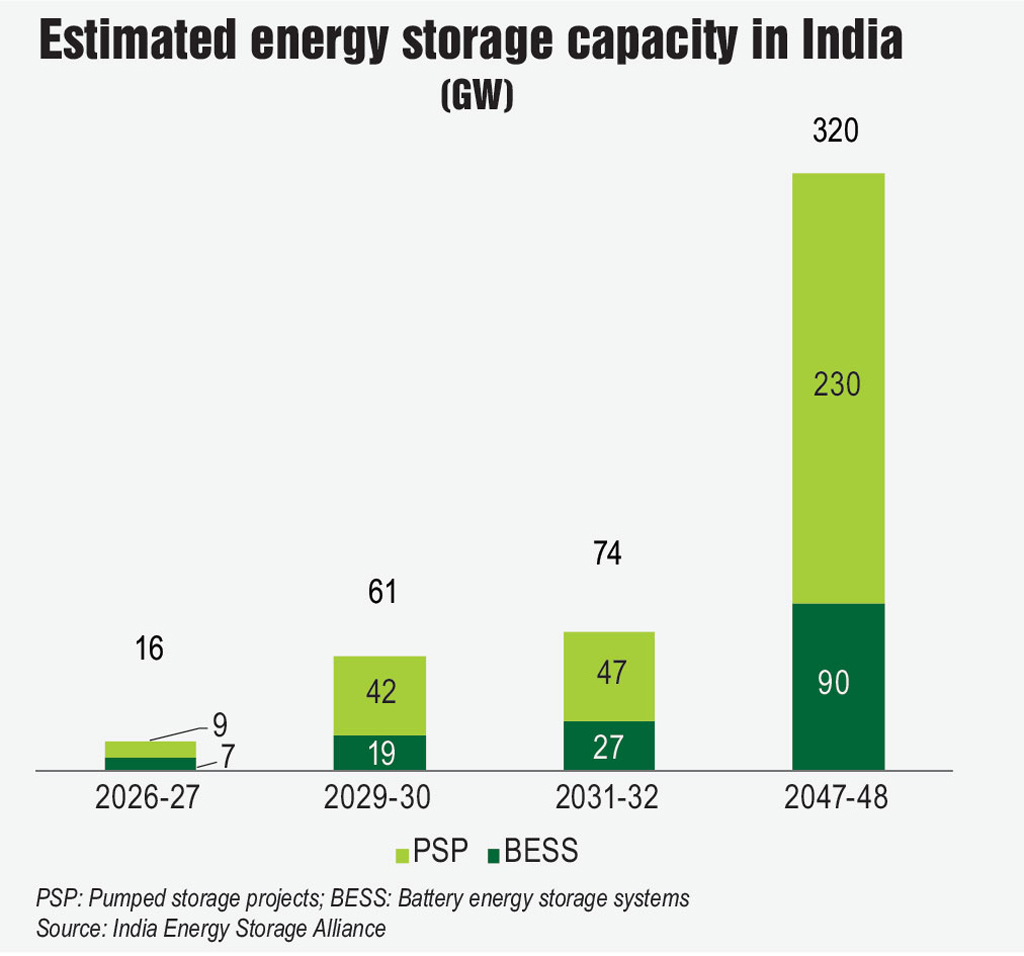
- India’s total energy storage capacity is projected to grow from 16 GW in 2026–27 to a massive 320 GW by 2047–48, indicating a 20x increase over two decades.
- Pumped Storage Projects (PSP) dominate the long-term outlook, expanding from 9 GW to 230 GW, making up the largest share of total capacity.
- Battery Energy Storage Systems (BESS) show strong growth, rising from 7 GW in 2026–27 to 90 GW by 2047–48, reflecting increasing adoption of flexible and fast-response storage technologies.
- By 2029–30, total capacity is expected to reach 61 GW, with PSP contributing 42 GW and BESS 19 GW, highlighting the early-stage dominance of pumped storage.
- In 2031–32, capacity climbs further to 74 GW, with 47 GW from PSP and 27 GW from BESS, showing a gradual increase in battery storage share.
- The share of BESS steadily increases over time, signaling a shift toward modern, scalable, and decentralized storage solutions.
- The sharp rise to 320 GW by 2047–48 aligns with India’s long-term goals for renewable energy integration and grid stability.
- Overall, the data indicate a hybrid storage strategy, combining large-scale PSP infrastructure with rapidly scaling battery systems to meet future energy demands.
Commercial and Industrial Battery Storage Capacity
- Commercial and industrial (C&I) battery storage accounted for ~15% of global capacity additions in 2025.
- The global C&I storage market reached ~40 GWh in installed capacity by 2025.
- The U.S. C&I segment grew 28% YoY in 2025, driven by demand charge management.
- China’s industrial battery storage installations exceeded 20 GWh in 2025, supporting manufacturing hubs.
- Average system size for C&I projects ranges between 500 kWh and 10 MWh, depending on facility scale.
- Peak shaving applications can reduce electricity bills by up to 30% for commercial users.
- The adoption of battery storage in data centers grew over 50% in 2025, driven by AI workloads.
- Retail and logistics sectors account for over 25% of C&I battery deployments globally.
Battery Storage Capacity by Application
- Grid stabilization and frequency regulation represent over 40% of global battery storage use cases.
- Renewable energy integration accounts for ~35% of storage applications globally.
- Backup power and resilience applications contribute ~15% of total installations.
- Electric vehicle (EV) charging infrastructure is driving fast-growing storage demand, with over 10 GWh deployed in 2025.
- Microgrid applications saw 25% annual growth in battery capacity deployment in 2025.
- Data center backup systems accounted for over 8 GWh of deployments globally in 2025.
- Energy arbitrage applications increased by ~30% YoY, especially in deregulated markets.
- Residential self-consumption systems represent ~20% of total installed capacity globally.
Battery Storage Capacity by Technology Type
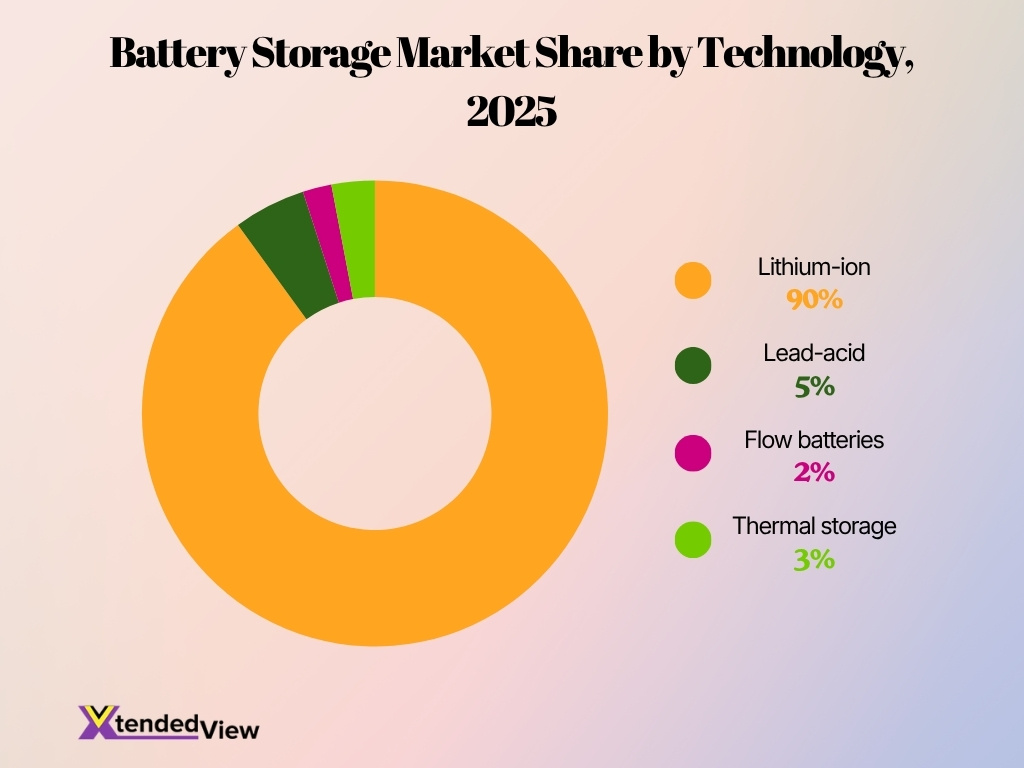
- Lithium-ion batteries dominate with ~90% market share in 2025.
- Lead-acid batteries account for ~5% of total installations, mainly in legacy systems.
- Flow batteries represent less than 2% of global capacity, but are growing in long-duration storage projects.
- Sodium-ion batteries entered commercialization in 2025, with early deployments under 1 GWh globally.
- Solid-state battery pilot projects increased by over 40% in 2025, though commercial use remains limited.
- Hybrid systems combining lithium-ion and flow technologies grew ~20% YoY.
- Long-duration energy storage technologies are projected to reach 10% market share by 2030.
- Thermal energy storage systems remain niche, contributing less than 3% of total installed capacity.
Lithium-Ion Battery Storage Capacity Statistics
- Lithium-ion battery demand reached 1.59 TWh globally in 2025, up significantly from 2024.
- Stationary storage demand for lithium-ion batteries grew 51% YoY in 2025.
- Lithium-ion batteries accounted for over 90% of new storage installations globally.
- Global lithium-ion battery manufacturing capacity exceeded 3 TWh annually in 2025.
- China controls over 70% of global lithium-ion battery production capacity.
- Battery energy density improved by ~5–7% annually between 2020 and 2025.
- Average lithium-ion battery pack prices fell to ~$139/kWh in 2023, with further declines expected through 2026.
- Recycling capacity for lithium-ion batteries grew over 30% globally in 2025, supporting circular supply chains.
Battery Storage Capacity Additions Per Year
- Global battery storage additions reached ~108 GW in 2025, a record high.
- Annual additions increased from ~60 GW in 2024, reflecting a strong acceleration.
- Energy storage installations grew over 60% YoY in 2025.
- China accounted for over 50% of annual additions in 2025, leading globally.
- The U.S. contributed ~25% of global additions, making it the second-largest market.
- Europe added ~20–25 GWh annually in 2025, driven by policy incentives.
- Global annual additions are projected to exceed 350 GWh in 2026.
- Battery storage additions are expected to grow at a CAGR of over 25% through 2030.
Battery Energy Storage Market Dominated by Large-Scale Systems
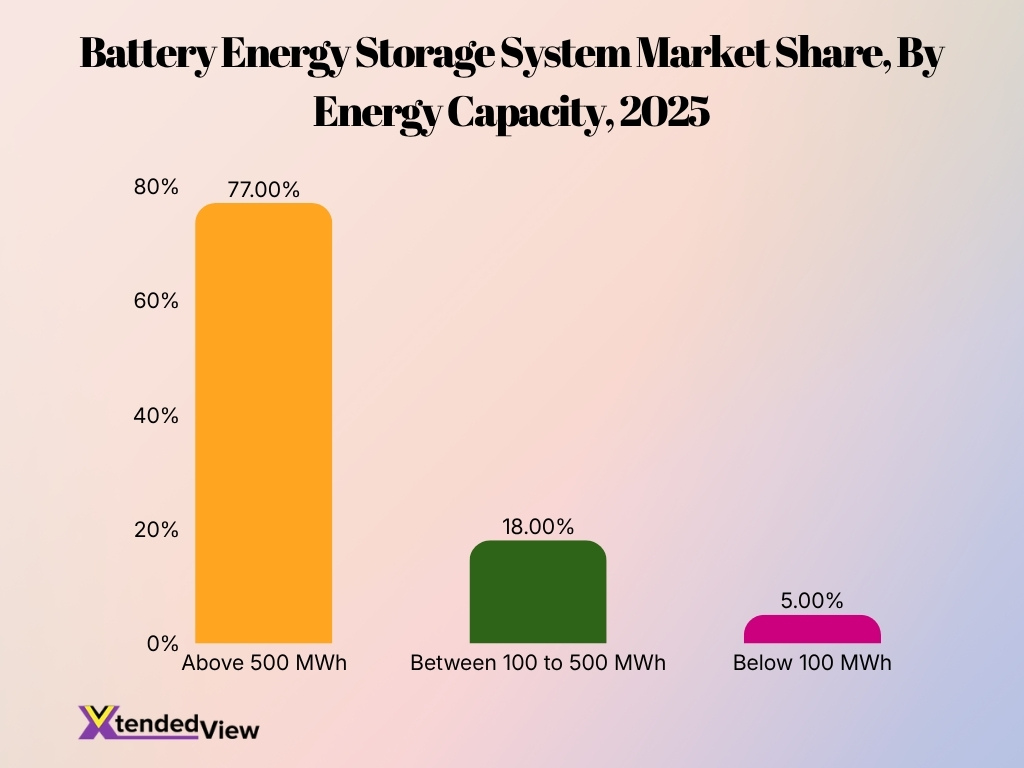
- Above 500 MWh systems dominate the market, accounting for a massive 77.00% share, highlighting strong industry preference for utility-scale energy storage.
- The 100 to 500 MWh segment holds 18.00%, indicating growing mid-scale deployments, often used for grid balancing and renewable integration.
- Small-scale systems (below 100 MWh) represent only 5.00%, showing limited adoption compared to larger installations.
- The data clearly reflects a shift toward high-capacity battery storage, driven by increasing demand for grid stability and large renewable energy projects.
- Large-scale battery systems (>500 MWh) are nearly 4x larger than mid-scale deployments and over 15x bigger than small-scale systems, emphasizing market concentration at the top end.
- This distribution suggests that investment and infrastructure development are heavily focused on high-capacity energy storage solutions to support energy transition goals.
Planned and Pipeline Battery Storage Capacity
- Global battery storage pipeline projects exceeded 1.2 TWh of planned capacity by 2026, signaling strong long-term growth.
- China leads with a pipeline of over 500 GWh of planned projects, reinforcing its global dominance.
- The United States has over 160 GWh of battery storage in development, driven by federal incentives.
- Europe’s pipeline is expected to surpass 200 GWh by 2027, fueled by policy targets.
- India plans to deploy 236 GWh of storage by 2032, with auctions accelerating project pipelines.
- Australia has over 40 GWh of large-scale battery projects under development, focusing on grid reliability.
- The Middle East pipeline is projected to grow 2.5x between 2025 and 2028, led by regional investments.
- Globally, over 70% of pipeline projects are utility-scale, indicating strong grid-focused investments.
Battery Storage Capacity Costs and Levelized Cost Trends
- The levelized cost of battery storage declined by ~80% between 2015 and 2025.
- Average lithium-ion battery pack prices fell to ~$139/kWh in 2023, with further reductions expected in 2026.
- Grid-scale battery system costs dropped to $300–$500 per kWh installed in 2025, depending on duration.
- Energy storage system costs declined by ~15% between 2023 and 2025, improving project economics.
- Long-duration storage technologies still cost 2–3x more than lithium-ion systems, limiting adoption.
- Battery recycling can reduce lifecycle costs by up to 20%, enhancing sustainability.
- The cost of four-hour battery systems fell below $1,000/kW in 2025, a key milestone for grid competitiveness.
- By 2030, costs are projected to decline an additional 30–40%, driven by scale and innovation.
Key Challenges Slowing Battery Storage Capacity Growth in 2026
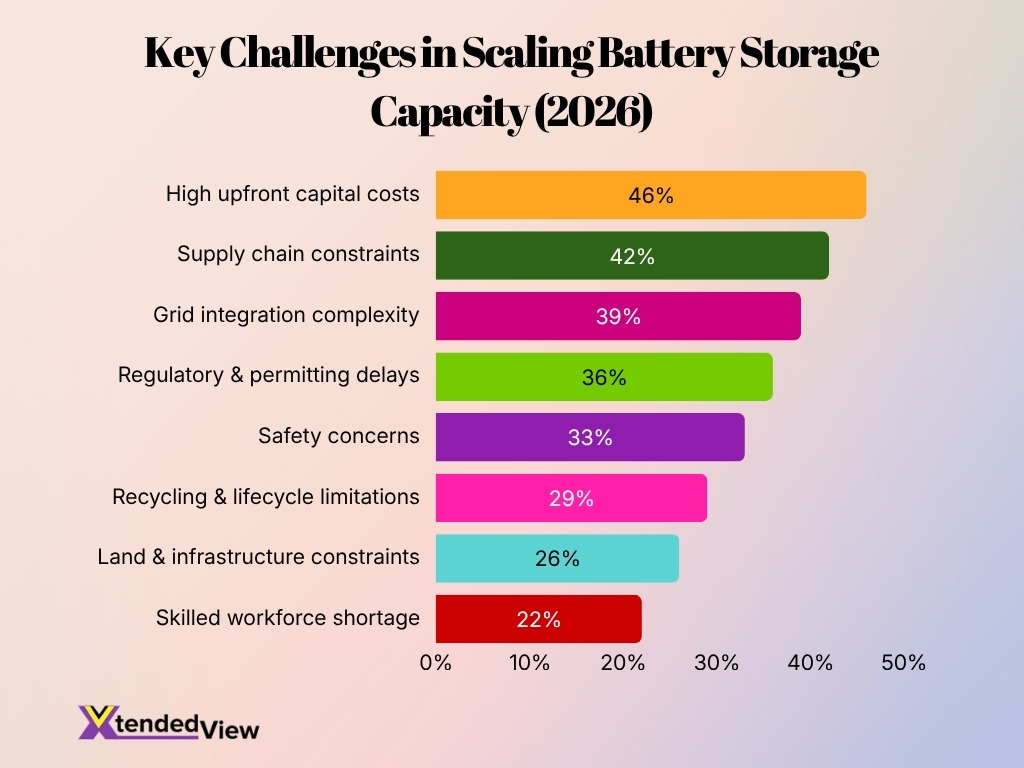
- High upfront capital costs are the biggest barrier to scaling battery storage capacity, with an impact score of 46%.
- Supply chain constraints rank second at 42%, showing that material availability, manufacturing capacity, and logistics remain major concerns.
- Grid integration complexity affects 39% of battery storage expansion challenges, as utilities need better infrastructure to connect large-scale storage systems.
- Regulatory and permitting delays account for 36%, indicating that approval timelines can slow down new battery storage projects.
- Safety concerns represent 33% of the challenge, especially around fire risks, thermal management, and operational reliability.
- Recycling and lifecycle limitations impact 29%, highlighting the need for stronger end-of-life battery management and circular supply chains.
- Land and infrastructure constraints contribute 26%, showing that site availability and grid-ready locations can limit deployment.
- Skilled workforce shortage has the lowest listed impact at 22%, but still creates barriers in installation, operation, and maintenance.
- Overall, the data shows that battery storage growth is not limited by one factor, but by a mix of cost, supply chain, grid, policy, and safety challenges.
Battery Storage Capacity and Emissions Reduction Impacts
- Battery storage can reduce power sector emissions by up to 20% globally by 2030.
- Integrating storage with renewables can cut curtailment losses by over 50%, improving efficiency.
- The U.S. grid avoided over 100 million metric tons of CO₂ emissions in 2025 due to storage-supported renewables.
- Battery storage enables higher penetration of solar and wind, which now supply over 30% of global electricity growth.
- Microgrids with storage can reduce diesel generator use by up to 70% in remote areas.
- EV charging supported by battery storage reduces peak emissions by 15–25%.
- Industrial battery storage systems can cut emissions by 10–15% through demand optimization.
- By 2050, battery storage could help avoid over 1 gigaton of CO₂ annually.
Battery Storage Capacity Forecasts to 2030
- Global battery storage capacity is projected to reach over 970 GW by 2030, up from under 300 GW in 2025.
- Annual installations are expected to exceed 400 GWh by 2030, reflecting sustained growth.
- The global energy storage market is forecast to grow at a CAGR of over 25% through 2030.
- The U.S. is expected to surpass 250 GW of installed storage capacity by 2030.
- Europe’s storage capacity is projected to exceed 200 GW by 2030, driven by renewable targets.
- China is forecast to maintain leadership with over 400 GW installed capacity by 2030.
- Long-duration storage capacity is expected to grow 10x by 2030, supporting renewable integration.
- AI-driven energy demand could increase storage requirements by 15–20% globally by 2030.
Frequently Asked Questions (FAQs)
Global battery storage capacity reached around 267 GW (610 GWh) in 2025.
Battery storage capacity grew by over 40% year-over-year in 2025, with some segments exceeding 60% growth.
Lithium-ion batteries account for approximately 90% of global battery storage capacity.
Global additions are projected to exceed 350 GWh of new battery storage capacity in 2026.
Global capacity is expected to surpass 970 GW by 2030, growing at a CAGR of over 25%.
Conclusion
Battery storage capacity continues to scale at a rapid pace, driven by the need for grid flexibility, renewable integration, and rising energy demand from sectors like AI and electrified transport. The data shows strong growth across utility-scale, residential, and industrial segments, supported by falling costs and policy momentum. However, supply chain risks, regulatory hurdles, and technology limitations still shape the pace of adoption. As investment accelerates and innovation advances, battery storage will remain a key pillar in building a resilient, low-carbon energy system.
