



Netflix enters the year with a larger revenue base, stronger profitability, and a rapidly expanding advertising business. The company now operates at a scale that affects several parts of the entertainment economy, from subscription streaming and digital advertising to film production, live sports, licensing and international content distribution. Advertisers use Netflix’s ad-supported tier to reach streaming households, while studios, producers and rights holders compete for access to its global audience and content budget.
At the same time, price increases, tighter password-sharing rules and new ad products are reshaping how Netflix monetizes viewers. The statistics in this article show how the company’s revenue, memberships, engagement, content spending and retention strategy continue to evolve.
Editor’s Choice
- $45.18 billion: Netflix’s 2025 revenue increased by roughly $6.18 billion from 2024, producing annual growth of 16%.
- $24.81 billion: Revenue for the first six months of 2026 increased 15% from $21.62 billion during the first half of 2025.
- $10.98 billion: Netflix’s 2025 net income rose by about $2.27 billion from the previous year.
- 33.4%: Netflix recorded this operating margin in Q2 2026, compared with 34.1% in Q2 2025.
- 301.63 million: Netflix finished 2024 with this many paid memberships, its final year-end subscriber count before ending routine membership reporting.
- 250 million+: The ad-supported service reached this number of global monthly active viewers by May 2026; more than 80% of ad-plan members watched during an average week.
- 97 billion+ hours: Members streamed this much content during H1 2026, 2% more than in the corresponding 2025 period.
Recent Developments
- Netflix’s ad-supported audience surpassed 250 million monthly active viewers worldwide in May 2026. The measurement counts members who watch at least one minute of advertising and adjusts for estimated viewers within the household.
- More than 80% of ad-plan members watch Netflix each week, indicating that the advertising audience extends beyond occasional monthly viewers.
- In May 2025, the ad-supported plan reached more than 94 million monthly active users, showing how quickly Netflix’s advertising reach expanded before it adopted its newer viewer-based metric.
- By November 2025, Netflix reported more than 190 million monthly active ad-supported viewers under its updated measurement methodology.
- Netflix plans to add the ad-supported tier in 15 additional countries in 2027, extending the model beyond its existing advertising markets.
- Members watched more than 97 billion hours in H1 2026, up 2% year over year, even as the service increased its mix of live programming and other formats.
- Live programming should account for just over 5% of 2026 content spending but only about 1% of total viewing hours, highlighting the different strategic role of live events.
- Despite representing a small portion of viewing time, live programming generated six of Netflix’s 10 largest new-member sign-up days during the five years through mid-2026.
- In Q1 2026, Netflix recorded a $2.8 billion termination fee related to the canceled WBD transaction, materially lifting first-half nonoperating income and net profit.
Netflix Revenue Statistics
- Netflix reported $12.56 billion in Q2 2026 revenue, an increase of $1.48 billion, or 13%, from Q2 2025.
- Q1 2026 revenue totaled $12.25 billion, up about 16% from $10.54 billion in Q1 2025.
- Combined revenue for H1 2026 reached $24.81 billion, compared with $21.62 billion in the first half of 2025, an increase of 15%.
- Netflix generated $45.18 billion in 2025 revenue, up 16% from $39.00 billion in 2024. Membership growth, higher prices, and advertising growth all contributed.
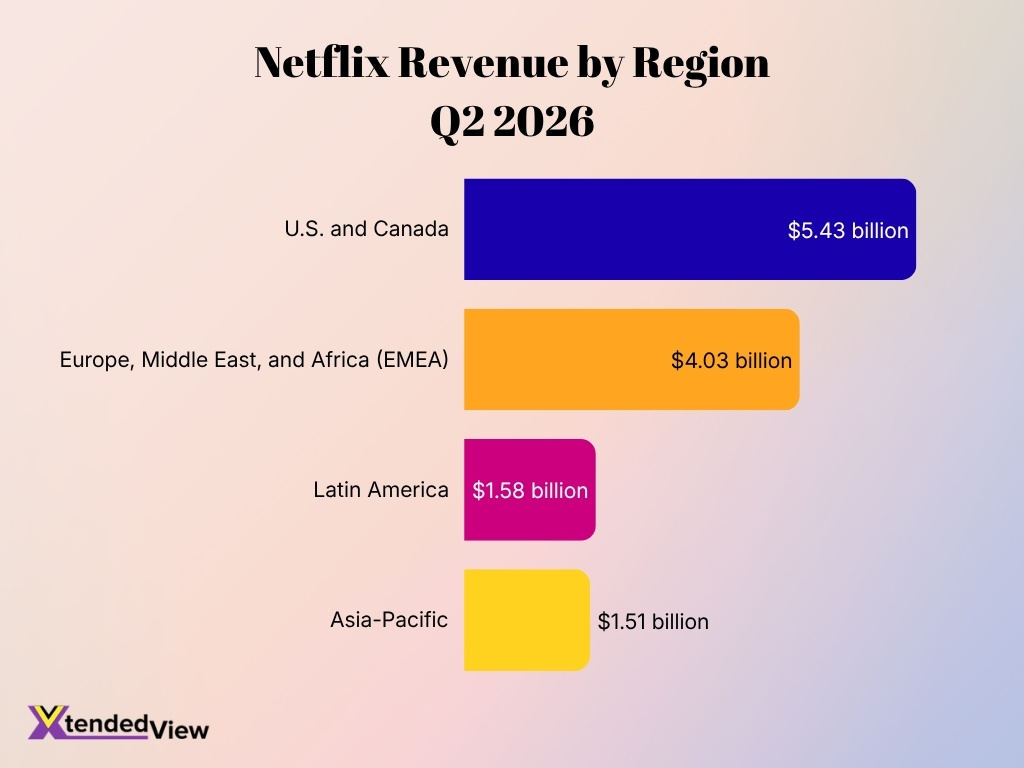
- U.S. and Canada revenue reached $5.43 billion in Q2 2026, up 10% from $4.93 billion in Q2 2025.
- Europe, the Middle East and Africa produced $4.03 billion in Q2 2026 revenue, representing 14% year-over-year growth.
- Latin American revenue increased 21% year over year to $1.58 billion in Q2 2026, the fastest reported regional percentage growth during the quarter.
- Asia-Pacific revenue reached $1.51 billion in Q2 2026, up 16% from $1.31 billion in Q2 2025.
- U.S. revenue alone totaled approximately $5.1 billion in Q2 2026 and $9.9 billion during the first six months of the year.
- In 2025, U.S. revenue reached $18.5 billion, compared with $16.1 billion in 2024 and $13.8 billion in 2023.
Netflix Profit and Net Income Statistics
- Netflix posted $4.19 billion in operating income in Q2 2026, an 11% increase from $3.77 billion in Q2 2025.
- The company’s Q2 2026 operating margin was 33.4%, down slightly from 34.1% one year earlier as technology, development and marketing expenses grew faster than revenue.
- Q2 2026 net income totaled $3.40 billion, up approximately $276 million, or 9%, from Q2 2025.
- Operating income reached $8.15 billion during H1 2026, compared with $7.12 billion during H1 2025.
- First-half 2026 net income reached $8.68 billion, compared with $6.02 billion in H1 2025; the 2026 figure includes the impact of a $2.8 billion transaction termination fee.
- Q1 2026 operating income totaled $3.96 billion, compared with $3.35 billion in Q1 2025.
- Full-year 2025 operating income climbed 28% to $13.33 billion, up from $10.42 billion in 2024.
- Netflix’s full-year operating margin improved from 26.7% in 2024 to 29.5% in 2025, an increase of 2.8 percentage points.
- Annual net income rose 26% to $10.98 billion in 2025, compared with $8.71 billion in 2024 and $5.41 billion in 2023.
- Netflix generated diluted earnings per share of $0.80 in Q2 2026, compared with $0.72 in Q2 2025 after adjusting historical figures for the 10-for-1 stock split completed in 2025.
Netflix Subscriber and Membership Statistics
- Netflix ended 2024 with 301.63 million paid streaming memberships worldwide, up from 260.28 million at the end of 2023.
- Paid memberships increased 16% year over year in 2024, adding approximately 41.35 million subscriptions to the year-end base.
- Netflix averaged 277.73 million paying memberships during 2024, 15% more than the 240.89 million average recorded in 2023.
- Average monthly revenue per paying membership reached $11.70 in 2024, compared with $11.64 in 2023.
- Starting with Q1 2025, Netflix stopped quarterly disclosure of paid net additions, ending memberships, average paying memberships and average monthly revenue per membership.
- The company also discontinued annual reporting of those membership metrics for 2025, shifting its primary performance emphasis toward revenue and operating margin.
- Despite no longer giving a total membership count, Netflix stated that membership growth contributed to its 16% revenue increase in 2025, alongside price increases and higher advertising revenue.
- The ad-supported tier reached more than 94 million monthly active users in May 2025, providing one of the clearest membership-related audience updates after routine subscriber reporting ended.
- By May 2026, Netflix with ads reached more than 250 million monthly active viewers, although this viewer metric should not be treated as equivalent to paid memberships because it can include multiple viewers within one household.
Netflix Global Paid Subscriber Growth Statistics
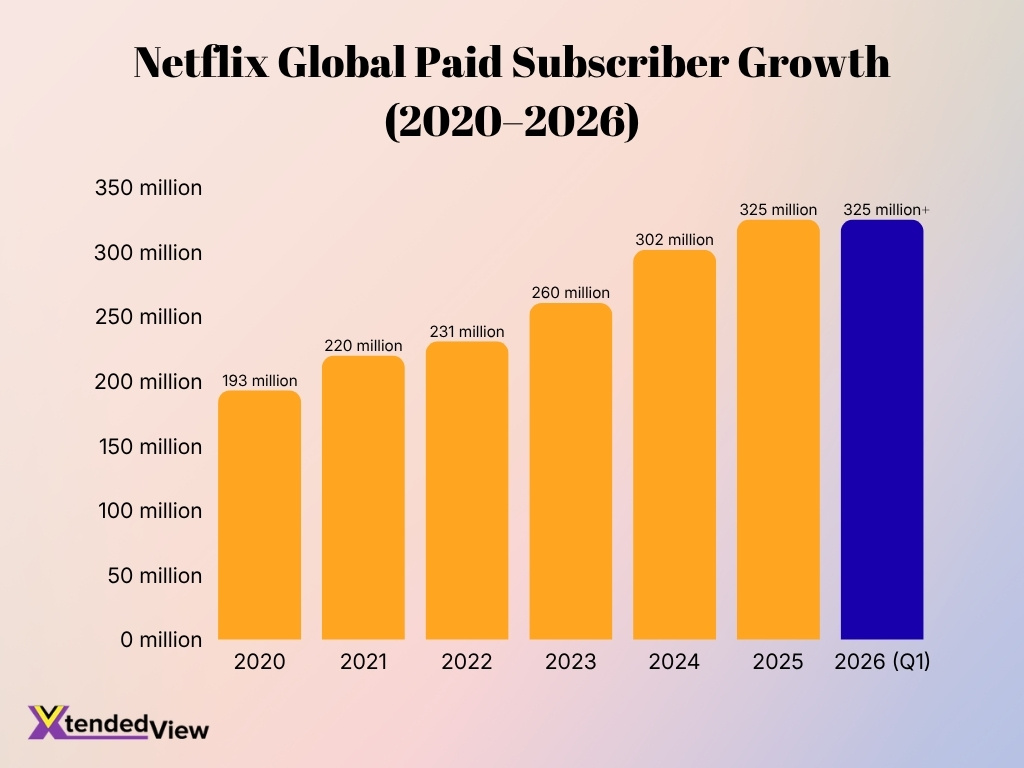
- Netflix’s global paid subscriber base increased from 192.9 million in 2020 to more than 325 million by Q1 2026, highlighting substantial long-term growth.
- In 2021, Netflix reached 219.7 million paid subscribers, adding approximately 26.8 million subscribers compared with 2020.
- Subscriber growth slowed in 2022, with the total reaching 230.7 million, an increase of about 11 million year over year.
- Netflix regained stronger momentum in 2023, when global paid subscribers climbed to 260.3 million, up 29.6 million from 2022.
- The platform recorded one of its strongest annual gains in 2024, adding 41.3 million subscribers to reach 301.6 million worldwide.
- By 2025, Netflix had expanded its global paid subscriber base to approximately 325 million, representing an increase of 23.4 million from 2024.
- In Q1 2026, Netflix maintained a global paid subscriber base of more than 325 million, according to the presented data.
- Overall, Netflix added more than 132 million paid subscribers between 2020 and Q1 2026, an increase of roughly 68% from its 2020 subscriber base.
Netflix Subscribers by Region and Country
- Netflix ended 2024 with 301.63 million paid memberships worldwide, compared with 260.28 million in 2023, a 16% increase.
- Europe, the Middle East and Africa was Netflix’s largest membership region at the end of 2024, with 101.13 million paid memberships, up 14% from 88.81 million in 2023.
- The U.S. and Canada finished 2024 with 89.63 million memberships, an increase of 9.50 million from the previous year.
- Asia-Pacific reached 57.54 million memberships at year-end 2024, up from 45.34 million in 2023. That represented roughly 27% year-over-year growth.
- Latin America ended 2024 with 53.33 million memberships, compared with 46.00 million in 2023, adding 7.33 million during the year.
- By Q4 2025, Netflix had crossed 325 million global paid memberships, although it did not provide a corresponding regional breakdown.
- Regional revenue offers a newer measure of geographic scale: in 2025, the U.S. and Canada generated $19.96 billion, EMEA $14.51 billion, Latin America $5.36 billion and Asia-Pacific $5.35 billion.
- Asia-Pacific recorded the fastest 2025 regional revenue growth at 21%, followed by EMEA at 17%, the U.S. and Canada at 15%, and Latin America at 11%.
- The advertising audience also shows significant country-level scale. By May 2026, Netflix with ads had more than 35 million monthly active viewers in Brazil and more than 28 million in Mexico.
Netflix User Demographics
- In an April 2025 survey of 9,397 U.S. adults, 72% said they watch Netflix, making it the most widely used individual streaming service measured in the survey.
- Netflix usage reached 80% among U.S. adults ages 18 to 29, placing the service well above its overall 72% adult penetration rate.
- Adults ages 30 to 49 posted the highest Netflix usage among the measured age groups at 81%.
- Netflix remained widely used among people ages 50 to 64, with 70% saying they watch programming on the service.
- Usage fell to 53% among Americans ages 65 and older, giving Netflix a 27-percentage-point gap between the youngest and oldest adult age groups.
- Streaming overall reaches 83% of U.S. adults, while only 36% say they currently subscribe to cable or satellite television at home.
- Among U.S. streaming users, 26% use a password belonging to someone outside their household, while 74% say they do not. This statistic covers streaming services generally rather than Netflix alone.
- Streaming audiences report relatively high content satisfaction: 40% are extremely or very satisfied, 50% are somewhat satisfied, and 9% are not too or not at all satisfied. These figures describe U.S. streaming users overall and provide context for Netflix’s addressable audience.
- Age also shapes device access: 27% of U.S. adults ages 18 to 29 were smartphone-dependent in 2025, compared with 11% of those ages 30 to 49, an important consideration for mobile streaming and product design.
Netflix Subscription Plans and Pricing Statistics
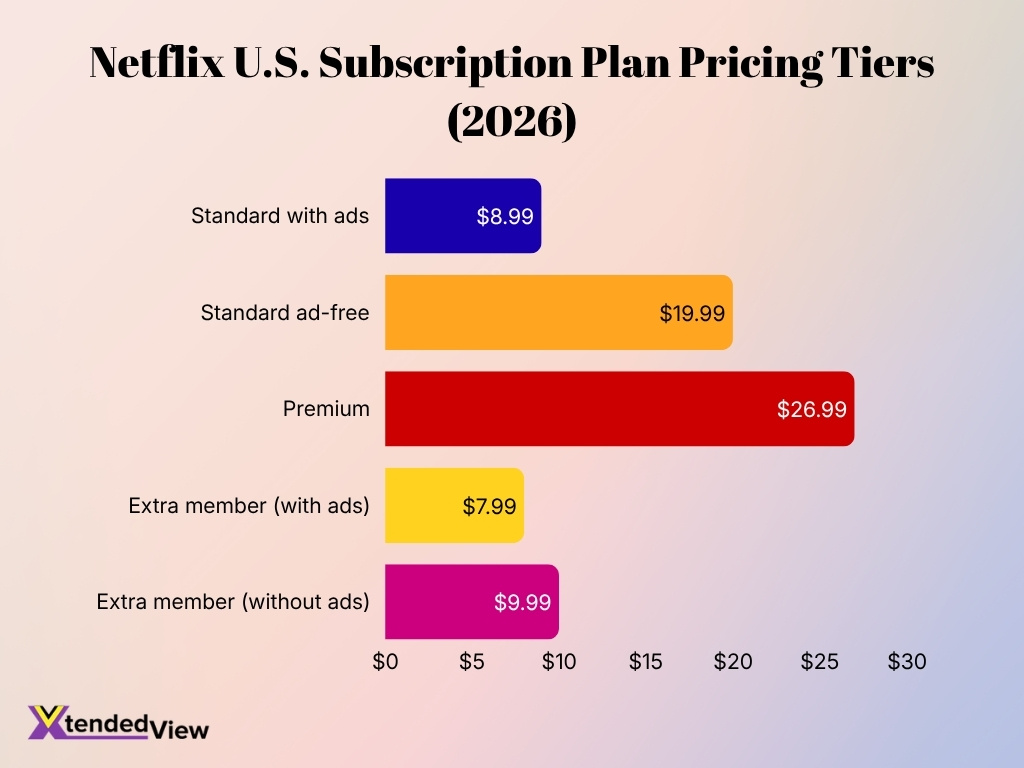
- The current U.S. Standard with ads plan costs $8.99 per month, making it the least expensive direct Netflix subscription.
- The U.S. Standard ad-free plan currently costs $19.99 per month and includes 1080p Full HD streaming.
- The Premium plan costs $26.99 per month and includes 4K Ultra HD, HDR and spatial audio where supported.
- Standard subscribers can watch on two supported devices simultaneously, while Premium subscribers can stream on four devices at the same time.
- Standard allows downloads on two supported devices, while Premium raises the allowance to six supported devices.
- Standard customers can add one extra member outside their household, while Premium customers can add as many as two.
- An extra member currently costs $7.99 per month with ads or $9.99 without ads in the U.S. Each extra member receives a separate account and password.
- In January 2025, the U.S. ad-supported price rose from $6.99 to $7.99, Standard increased from $15.49 to $17.99, and Premium rose from $22.99 to $24.99.
- Netflix implemented another round of price changes in markets including the U.S., Mexico and Spain during H1 2026 and said the customer response tracked its expectations.
- The Basic plan has been discontinued, leaving the ad-supported, Standard and Premium offerings as the principal direct U.S. plan choices.
Netflix Ad-Supported Plan and Advertising Statistics
- Netflix generated more than $1.5 billion in advertising revenue in 2025, more than 2.5 times its 2024 total.
- Netflix expects advertising revenue to reach approximately $3 billion in 2026, roughly double its 2025 result.
- Netflix with ads reached more than 250 million global monthly active viewers by May 2026.
- More than 80% of ad-plan members watch Netflix every week, indicating that the ad-supported audience regularly returns to the service.
- The ad-supported service had more than 94 million monthly active users in May 2025, before Netflix changed its audience-reporting methodology to monthly active viewers.
- By November 2025, the newer viewer-based measurement showed more than 190 million monthly active viewers, before reaching 250 million-plus in May 2026.
- U.S. upfront advertising commitments more than doubled year over year in 2025, with growth across retail, consumer packaged goods, telecommunications, health and wellness, entertainment and technology.
- Netflix had established sufficient advertising scale across 12 ad markets by Q3 2025, while its first-party advertising technology stack had become fully deployed across those markets.
- Starting in 2027, Netflix plans to bring its advertising tier to 15 additional countries, including Ireland, Denmark, Sweden, Switzerland, New Zealand, Indonesia and the Philippines.
- During Q2 2026, Netflix expanded AI-powered advertising tools across campaign planning, creative production, management, optimization and reporting, while extending programmatic access to Pause Ads and live inventory.
Netflix Average Revenue per User Statistics
- Netflix’s worldwide average monthly revenue per paying membership was $11.70 in 2024, compared with $11.64 in 2023.
- The U.S. and Canada generated the highest 2024 ARM at $17.20 per month, up 6% from $16.28 in 2023.
- EMEA’s average monthly revenue per membership reached $10.96 in 2024, compared with $10.87 in 2023.
- Latin America’s ARM was approximately $8.18 in 2024, reflecting the region’s lower subscription pricing relative to North America.
- Asia-Pacific recorded an ARM of approximately $7.17 in 2024, less than half the U.S. and Canada figure but alongside substantially faster membership growth.
- In Q3 2024, regional ARM stood at $17.06 in UCAN, $10.99 in EMEA, $8.40 in Latin America and $7.31 in Asia-Pacific.
- Netflix stopped reporting average monthly revenue per paying membership beginning with Q1 2025, along with routine quarterly subscriber totals.
- Even without a current ARM disclosure, monetization continued to rise: 2025 streaming revenue increased 16% to $45.18 billion, supported by membership growth, price increases, and advertising revenue.
- The same monetization drivers remained visible in Q2 2026, when revenue rose 13% year over year to $12.56 billion, primarily due to membership growth, pricing and increased advertising revenue.
Netflix Paid Subscribers vs. Major Streaming Platforms
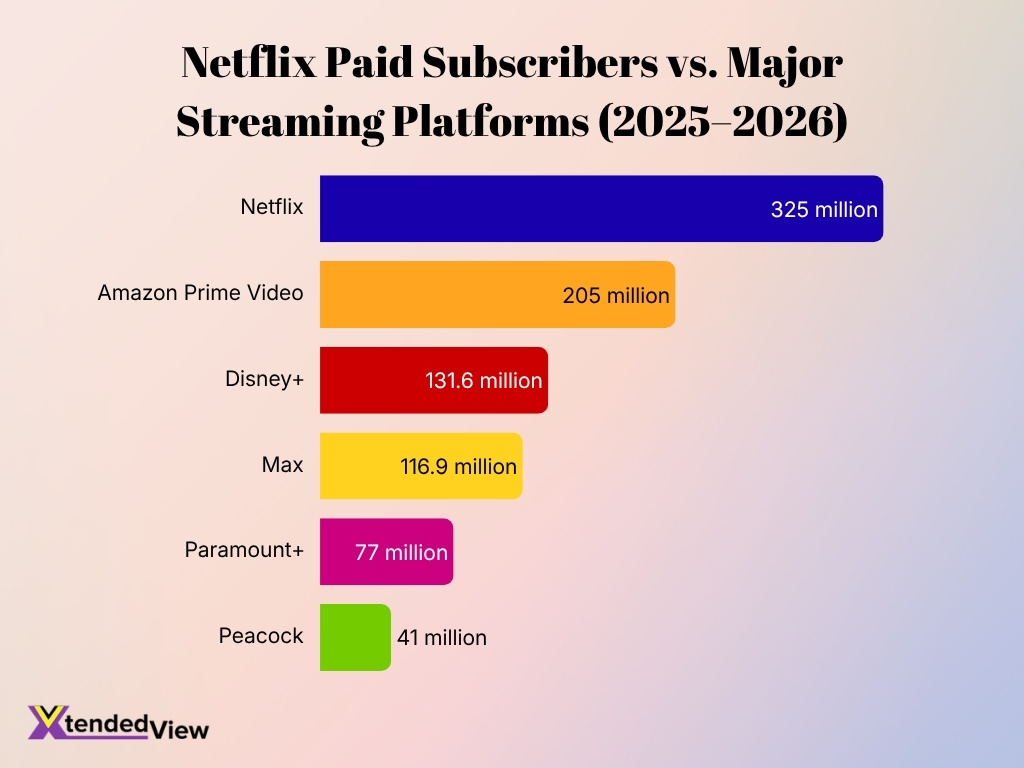
- Netflix leads the major streaming platforms with 325 million paid subscribers worldwide in 2025–2026.
- Amazon Prime Video ranks second with 205 million subscribers, about 120 million fewer than Netflix.
- Disney+ has 131.6 million paid subscribers, representing roughly 40% of Netflix’s subscriber total.
- Max reaches 116.9 million subscribers, putting Netflix at nearly 2.8 times its subscriber base.
- Paramount+ records 77 million paid subscribers, less than one-quarter of Netflix’s 325 million.
- Peacock has the smallest subscriber base in the comparison at 41 million, meaning Netflix has nearly 8 times as many subscribers.
- Overall, the figures show a substantial subscriber gap between Netflix and its major streaming competitors, reinforcing Netflix’s leading position by paid subscriber count.
Netflix Streaming Usage and Viewing Statistics
- Netflix members watched more than 97 billion hours during H1 2026, representing 2% year-over-year growth.
- Viewing hours increased 2% year over year during the second half of 2025, supported by stronger viewing of Netflix-branded originals.
- Viewing of branded original content increased 9% year over year in H2 2025, making originals a major contributor to engagement growth.
- Netflix represented 8.0% of total U.S. TV usage in May 2026, up 0.2 percentage points month over month.
- In June 2025, Netflix viewing increased 13.5% from May, accounting for 42% of streaming’s total monthly viewing gain.
- Netflix captured 8.3% of total U.S. TV time in June 2025, up 0.8 percentage points from May.
- Netflix’s U.S. TV share then climbed to a record 8.8% in July 2025, as viewing rose another 5% month over month.
- In July 2025, Netflix owned eight of the 10 most-watched streaming titles measured in the U.S., demonstrating how multiple releases can drive platform-level viewing at the same time.
- Live programming should account for just over 5% of Netflix’s 2026 content spending while generating about 1% of total viewing hours, showing that Netflix evaluates live events partly for acquisition and advertising rather than viewing volume alone.
- Despite accounting for a relatively small share of total viewing, live events generated six of Netflix’s 10 biggest new-member sign-up days during the five years through mid-2026.
Netflix Most-Watched Shows and Movies Statistics
- Netflix members watched more than 97 billion hours of content during H1 2026, the company’s highest viewing-hours total for any six-month reporting period.
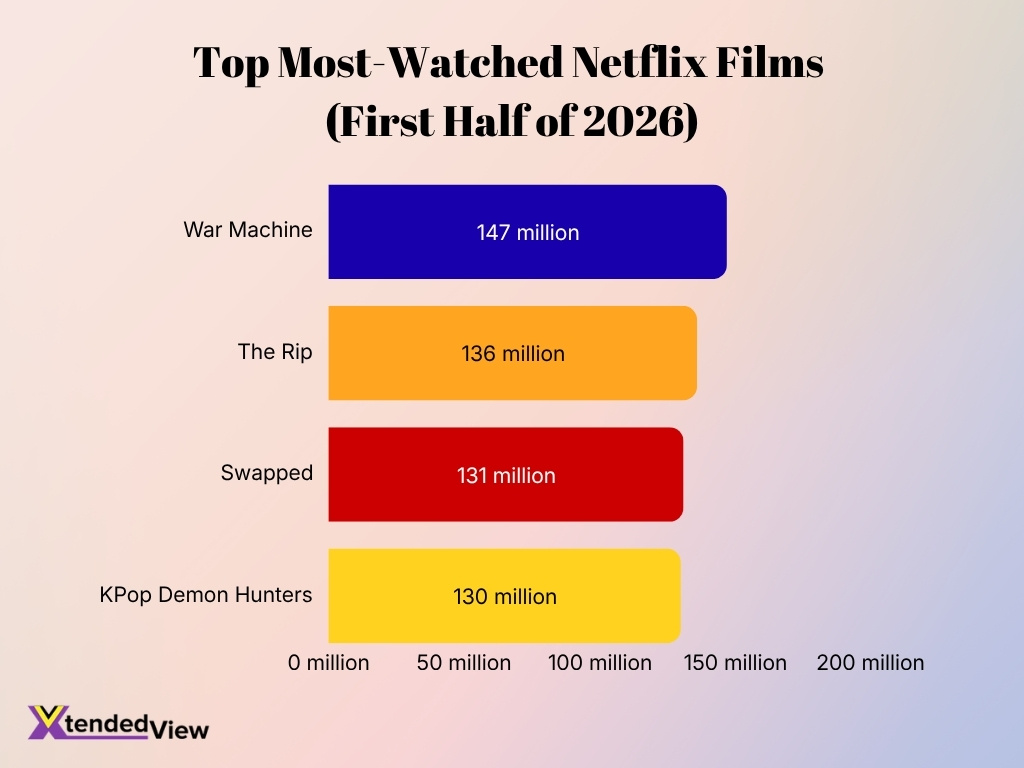
- War Machine ranked as the most-watched film in H1 2026 with 147 million views.
- The Rip generated 136 million views, making it the second-most-watched film during the first half of 2026.
- Swapped recorded 131 million views in H1 2026, while KPop Demon Hunters remained close behind with about 130 million despite premiering more than a year earlier.
- His & Hers became the most-watched series of H1 2026, collecting 104 million views.
- Bridgerton Season 4 generated 100 million views, while the full franchise accumulated about 180 million views during the half.
- In H2 2025, KPop Demon Hunters reached 482 million views, the highest six-month total recorded for any title in the engagement reports.
- Stranger Things Season 5 delivered 94 million views in H2 2025, making it the second-most-watched series during that reporting period.
- Frankenstein attracted 98 million views in H2 2025, while My Oxford Year reached 86 million and The Thursday Murder Club generated 69 million.
- Non-English programming accounted for more than one-third of all viewing in H1 2026, with strong titles from South Korea, India, Spain, Japan, Brazil and other markets.
Netflix Content Library and Original Content Statistics
- The U.S. catalog contained roughly 8,350 films and TV series in mid-2026, based on an active catalog tracker.
- A more recent catalog count placed the U.S. library at approximately 8,417 titles in August 2026, showing that the total changes continuously as titles enter and leave the service.
- Around 523 titles released in 2026 were already represented in the U.S. catalog by midyear, illustrating the pace of current-year additions.
- The U.S. catalog included approximately 991 titles released in 2025 when measured in 2026.
- One year-end analysis identified 597 new Netflix Originals released during 2025, contributing to a global original-programming catalog that continued to expand.
- More than half of Netflix members have watched at least one anime title, demonstrating how anime has moved from a niche category into a significant global programming segment.
- Netflix reported that non-English titles produced more than one-third of total viewing in H1 2026, reinforcing the importance of local-language productions to its global library.
- The full H1 2026 engagement dataset covered approximately 17,370 titles and individual seasons, representing about 96.8 billion hours of viewing in the underlying database.
- Kids and family programming remained substantial in H1 2026: Ms. Rachel generated 69 million views across two seasons, while Mark Rober’s CrunchLabs produced 36 million across four seasons.
- Netflix’s produced and released content carried an unamortized value of approximately $10.69 billion at the end of 2025, showing the scale of owned programming still being recognized as expense over future periods.
Netflix Content Spending and Production Statistics
- Netflix added approximately $17.10 billion to content assets in 2025, up from $16.22 billion in 2024.
- The increase in content-asset additions from 2024 to 2025 was approximately 5.4%, equal to about $873 million.
- Content amortization reached $16.42 billion in 2025, compared with $15.30 billion in 2024 and $14.20 billion in 2023.
- Licensed-content amortization totaled $8.71 billion in 2025, up about 13% from $7.69 billion in 2024.
- Produced-content amortization reached $7.71 billion in 2025, compared with $7.61 billion one year earlier.
- Netflix had approximately $24.1 billion in total content obligations at the end of 2025, including $5.7 billion recognized as current and noncurrent content liabilities and another $18.4 billion not yet recognized on the balance sheet.
- Of the $12.14 billion in unamortized licensed-content costs at year-end 2025, about $6.38 billion was expected to be amortized in 2026.
- Of the $10.69 billion in unamortized produced-content costs for released titles, approximately $4.31 billion was expected to be amortized during 2026.
- Live programming is expected to represent just over 5% of the 2026 content budget, even though it should generate only about 1% of total viewing hours.
- Netflix continues to emphasize original production because owned content requires more cash upfront than licensed programming but gives the company greater long-term control over intellectual property and distribution.
Netflix Website Traffic and App Usage Statistics
- Netflix’s website generated an estimated 1.46 billion monthly visits in a recent 2026 measurement.
- Another traffic estimate placed monthly visits at approximately 1.51 billion, showing the range produced by third-party measurement models.
- Estimated monthly unique website visitors reached approximately 337 million.
- Visitors viewed an average of 4.12 pages per visit and spent about 6 minutes and 9 seconds on the website per session.
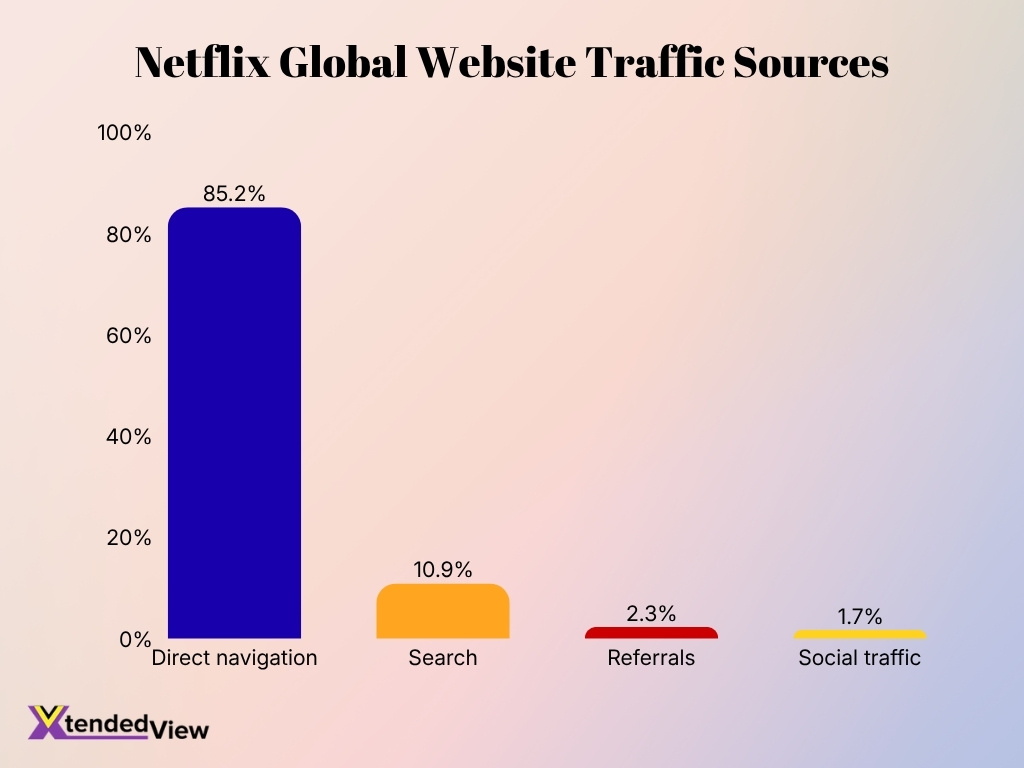
- Direct navigation accounted for approximately 85.2% of website traffic, while search contributed about 10.9%, referrals 2.3%, and social traffic 1.7%.
- The U.S. represented about 20.6% of website visitors, followed by India at 6.6%, Brazil at 4.6%, the U.K. at 4.4%, and Germany at 4.1%.
- AI platforms sent an estimated 5.9 million visits in July 2026, equal to about 0.37% of referral traffic measured in that dataset.
- The mobile Netflix app surpassed 1 billion downloads on the Android app marketplace and had accumulated roughly 15.2 million user reviews in a recent 2026 snapshot.
- One global mobile-app dataset estimated that Netflix generated approximately 158 million downloads during 2025, placing it among the 30 most-downloaded apps worldwide.
- Across the broader OTT app category, worldwide downloads declined 7.9% from 2.6 billion in 2024 to 2.4 billion in 2025, while estimated in-app revenue increased 4.6% to $7.6 billion.
Netflix Customer Retention and Churn Statistics
- Netflix’s estimated monthly U.S. churn rate stood at about 2% in May 2026, the lowest among the major premium streaming services measured.
- The service maintained roughly 2% monthly churn for 12 consecutive months through May 2026, indicating relatively stable customer retention.
- For comparison, Disney+ recorded about 3% churn, Hulu 4%, several other major services 5%, Peacock 7%, and Starz 8% in the same May 2026 analysis.
- The weighted monthly churn rate across nine major premium streaming services was approximately 4% in May 2026, roughly twice Netflix’s level.
- Following Netflix’s January 2025 U.S. price increase, estimated churn rose from 1.8% in December 2024 to 2.5% in January 2025.
- Churn then eased to 2.3% in February 2025 and returned to about 2.0% by May, suggesting the pricing change did not produce a prolonged cancellation spike.
- In the first five months of 2025, Netflix averaged approximately 1.3 million U.S. gross additions per month, 25.7% fewer than in the same period of 2024 but 47% more than in 2023.
- Netflix’s monthly resubscription rate rose back above 40% for four consecutive months during early 2025, indicating that former customers continued to represent a meaningful share of new sign-ups.
- The broader premium streaming market recorded an estimated 4.6% weighted average churn rate in 2025, while total subscriptions grew 7%, down from 12% growth in 2024.
- Live programming has also become a retention and acquisition tool: six of Netflix’s 10 largest new-member sign-up days over the five years through mid-2026 were associated with live events.
Frequently Asked Questions (FAQs)
Netflix generated $12.56 billion in Q2 2026 revenue, up 13% year over year from $11.08 billion.
Netflix forecasts full-year 2026 revenue of $51.0 billion to $51.4 billion, with an expected operating margin of 31.5%.
Netflix generated $45.18 billion in 2025 revenue, an increase of 16% from $39.00 billion in 2024.
Netflix with ads reached more than 250 million global monthly active viewers by May 2026, with over 80% of ad-plan members watching each week.
Netflix audiences watched more than 97 billion hours in H1 2026, the company’s highest six-month viewing total reported to date.
Conclusion
Netflix’s statistics show a company that increasingly measures success through revenue, engagement, advertising performance, and retention rather than subscriber totals alone. With more than 325 million paid memberships, over 97 billion hours watched in H1 2026 and an ad-supported audience exceeding 250 million monthly active viewers, Netflix continues to operate at substantial global scale. Its business now depends on several growth engines, including subscription pricing, advertising, international programming, original productions, live events and strong customer retention.
At the same time, competition across streaming, traditional TV and online video keeps pressure on content investment and audience engagement. Overall, Netflix’s position reflects a shift from pure subscriber growth toward deeper monetization of a large and increasingly diversified global audience.
