



Social media advertising is reshaping how brands connect with customers. Social advertising spend is projected to climb sharply, driven by more users, widespread mobile engagement, and smarter ad tools. In the U.S., brands are allocating larger portions of their budgets to paid social campaigns to reach engaged audiences. From small businesses leveraging targeted Instagram ads to global brands boosting sales via TikTok, social media advertising now drives measurable business outcomes. Let’s explore the latest data shaping this dynamic landscape.
Editor’s Choice
- Over $276 billion is expected to be spent on global social media advertising in 2025.
- American businesses alone may spend ~$88.3 billion on social ads by 2026.
- Social media now contributes roughly 33% of all digital ad spend worldwide.
- 5.17+ billion people use social media globally in 2026.
- Mobile social ads dominate growth, far outpacing desktop segments.
- TikTok’s ad revenue grew ~40% YoY in Q2 2025.
- Social media advertising delivers an average ROI of $5.2 per $1 spent in 2026.
Recent Developments
- Ad spend forecasts continue rising, with global advertising expected to exceed $1 trillion in 2026.
- Ad spending is projected to grow by 7%+ in 2025, emphasizing social media’s role.
- Reddit’s ad revenue topped $2.2 billion in 2025, up significantly year over year.
- Social platforms are integrating AI-driven ad targeting and analytics tools to optimize spend.
- Short-form video formats continue gaining traction, with significant investment forecasts.
- Influencer marketing spend is projected to surpass traditional social ad spend in certain categories.
- New ad formats such as shoppable ads and interactive posts are expanding engagement options.
Global Overview of Social Media Advertising
- By 2026, ~62% of the world’s population is estimated to be social media users.
- Over 5 billion people actively engage with social platforms daily in 2026.
- Social media user engagement averages 2 hours and 24 minutes per day.
- Social platforms now influence purchase decisions for over 70% of users, rising higher among Gen Z.
- YouTube ads reach ~2.5 billion people monthly, the highest advertising reach globally.
- Meta’s suite of platforms accounts for over 60% of social ad revenue share.
- TikTok remains among the fastest-growing platforms in ad revenue share.
Global Social Media Advertising Market Growth
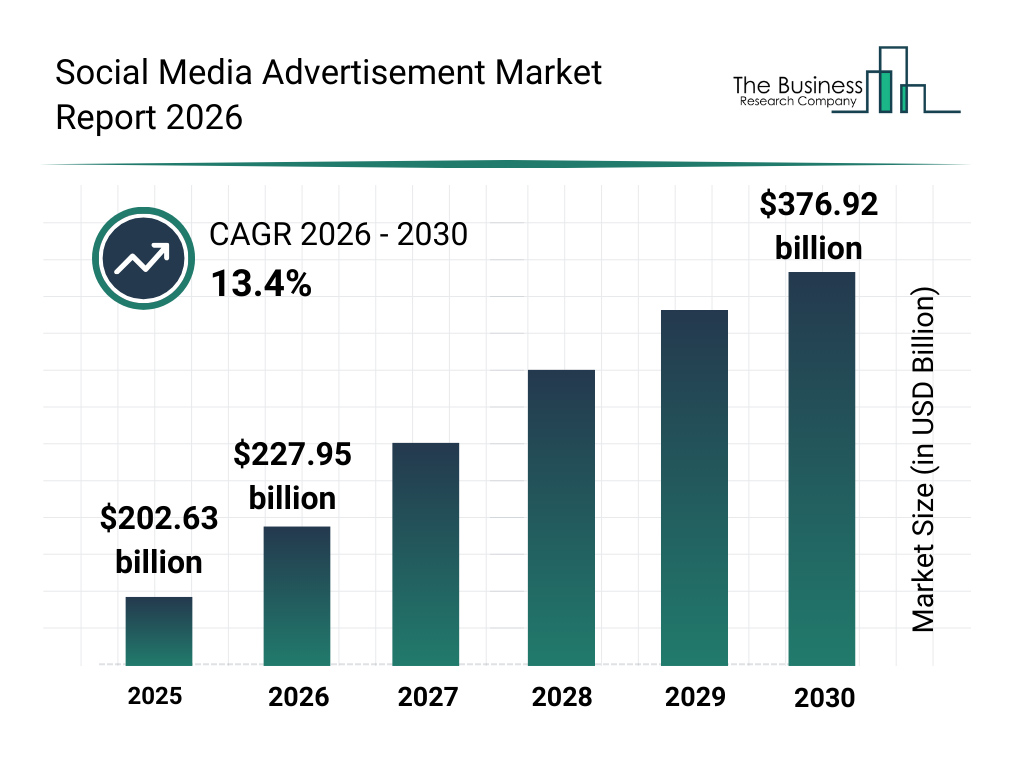
- The global social media advertising market is projected to grow from $202.63 billion in 2025 to $376.92 billion by 2030, reflecting strong industry expansion.
- Market value is expected to reach $227.95 billion in 2026, marking a significant year-over-year increase.
- Between 2026 and 2030, the industry is forecast to expand at a robust 13.4% CAGR, indicating sustained double-digit growth.
- The market is set to add over $174 billion in incremental value between 2025 and 2030, highlighting accelerating advertiser investment.
- The steady upward trajectory from 2025 through 2030 signals increasing reliance on digital and performance-driven advertising channels.
- By 2030, the market size will approach $377 billion, reinforcing social platforms as a dominant force in global advertising spend.
Global Ad Spend and Growth in Social Media Advertising
- Global social ad spend is forecast to exceed $276 billion in 2025.
- This figure represents roughly 30%+ of all digital ad budgets worldwide.
- Social advertising shows double-digit year-on-year growth in many markets.
- Mobile social advertising revenues outpace desktop by large margins year after year.
- The average global social ad segment growth rate is projected at ~18% through 2026.
- Brands are increasing spend on high-engagement formats like video and shoppable ads.
- Programmatic media buying constitutes a growing slice of digital and social ad budgets.
Share of Digital Advertising Budgets Allocated to Social Media
- Social media captured ~30% of global digital ad spend in 2024, nearing a quarter trillion dollars.
- Meta platforms dominated with 67.3% of social media ad spend in Q3 2025 at $51.24B.
- Paid social ad spend is projected to grow 8.7% in 2025, outpacing search‘s 6.7%.
- Marketers allocate 10-20% of total marketing budgets to social media advertising.
- 67% of social media ad budgets go to video content due to superior engagement rates.
- 73% of marketers use Facebook video ads, which are 50% cheaper per engagement.
- Social ad spend grew 15% year-over-year in 2024 despite economic challenges.
- Global social ad revenue hit $242B in 2025, up 11% YoY, showing resilience.
- AI-driven tools boost social ROI, with 42% of CMOs increasing influencer budgets.
Global Advertising Spend as a Percentage of GDP
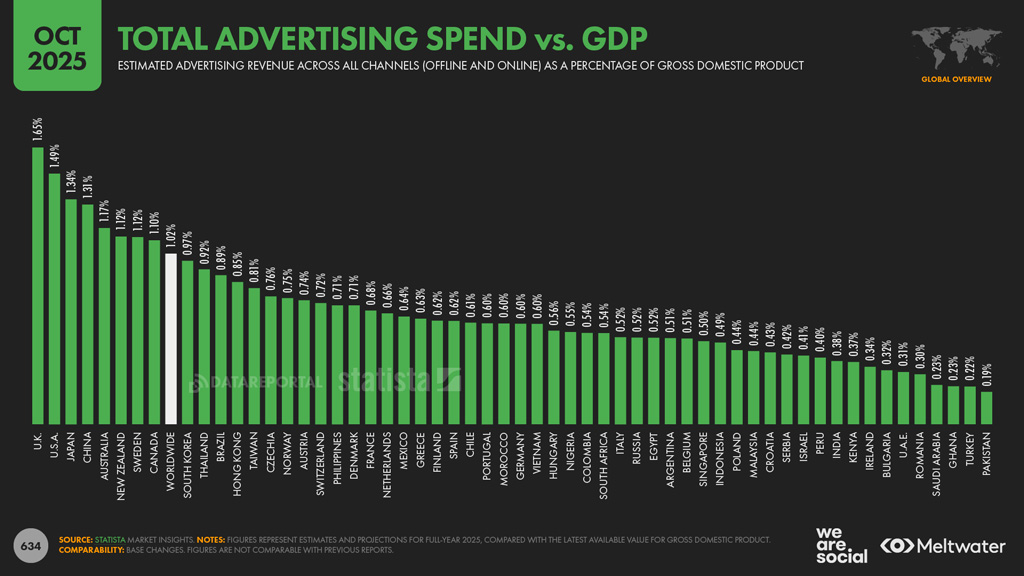
- The U.K. leads globally with advertising spend reaching 1.65% of GDP, the highest among all measured markets.
- The U.S.A. follows at 1.49%, reinforcing its position as one of the world’s most advertising-intensive economies.
- Japan (1.34%) and China (1.31%) rank next, highlighting strong ad investment across major Asian economies.
- The global average stands at 1.02% of GDP, meaning only a handful of markets exceed the worldwide benchmark.
- Among Oceania markets, Australia (1.17%) and New Zealand (1.12%) show above-average advertising intensity.
- Canada (1.10%) and Sweden (1.12%) also outperform the global average, reflecting mature media markets.
- Several developed European economies, such as France (0.68%), the Netherlands (0.66%), and Germany (0.60%), fall below the global average.
- Emerging Asian markets like India (0.52%), Vietnam (0.60%), and the Philippines (0.71%) demonstrate mid-range advertising investment relative to GDP.
- Nigeria (0.56%) and South Africa (0.54%) lead African markets but remain well below the global benchmark.
- Southeast Asia shows moderate performance, with Singapore (0.50%), Indonesia (0.49%), and Malaysia (0.44%) clustered below 0.50%.
- Eastern European markets such as Poland (0.44%), Romania (0.30%), and Bulgaria (0.32%) record comparatively lower ad-to-GDP ratios.
- Middle Eastern markets, including the U.A.E. (0.31%) and Saudi Arabia (0.23%), remain under the global average.
- Turkey (0.22%) and Pakistan (0.19%) rank among the lowest in advertising spend relative to GDP.
- The gap between the top market (1.65% in the U.K.) and the lowest (0.19% in Pakistan) represents a 1.46 percentage-point difference, underscoring major global disparities in advertising intensity.
Industry and Vertical Breakdown of Social Media Ad Spending
- Retail and eCommerce account for over 20% of global social ad spending, making it the largest vertical.
- The automotive industry invests heavily in social video ads, contributing nearly 10% of total social media ad budgets.
- Financial services increased social media ad spending by over 12% year over year in 2024, focusing on customer acquisition.
- Healthcare and pharma brands are expanding digital and social budgets by high single digits annually, especially for awareness campaigns.
- Travel and hospitality social ad budgets rebounded by 15%+ in 2024, following recovery trends.
- Technology companies dedicate 30% or more of their digital budgets to social channels, driven by product launches and SaaS acquisition models.
- Consumer packaged goods brands prioritize social commerce integrations, increasing paid social allocations by 10% annually.
- Entertainment and media companies allocate a growing share to short-form video ads, particularly on TikTok and Instagram.
Budget Allocation and Planning Trends in Social Media Advertising
- Over 60% of U.S. marketers plan to increase social media advertising budgets in 2025.
- Approximately 45% of marketers rank paid social as their top-performing digital channel.
- More than 50% of brands use data-driven attribution models to optimize social ad spending.
- Nearly 70% of marketers report reallocating budget from traditional media to digital and social platforms.
- Small and mid-sized businesses dedicate an average of 20%–30% of marketing budgets to social advertising.
- About 40% of brands test new social platforms annually to diversify ad risk.
- Programmatic buying accounts for over 85% of digital display and social transactions in the U.S.
- Cross-channel campaigns that integrate social and search show 15%–20% higher ROI compared to single-channel campaigns.
Reach and Audience Size Across Social Media Platforms
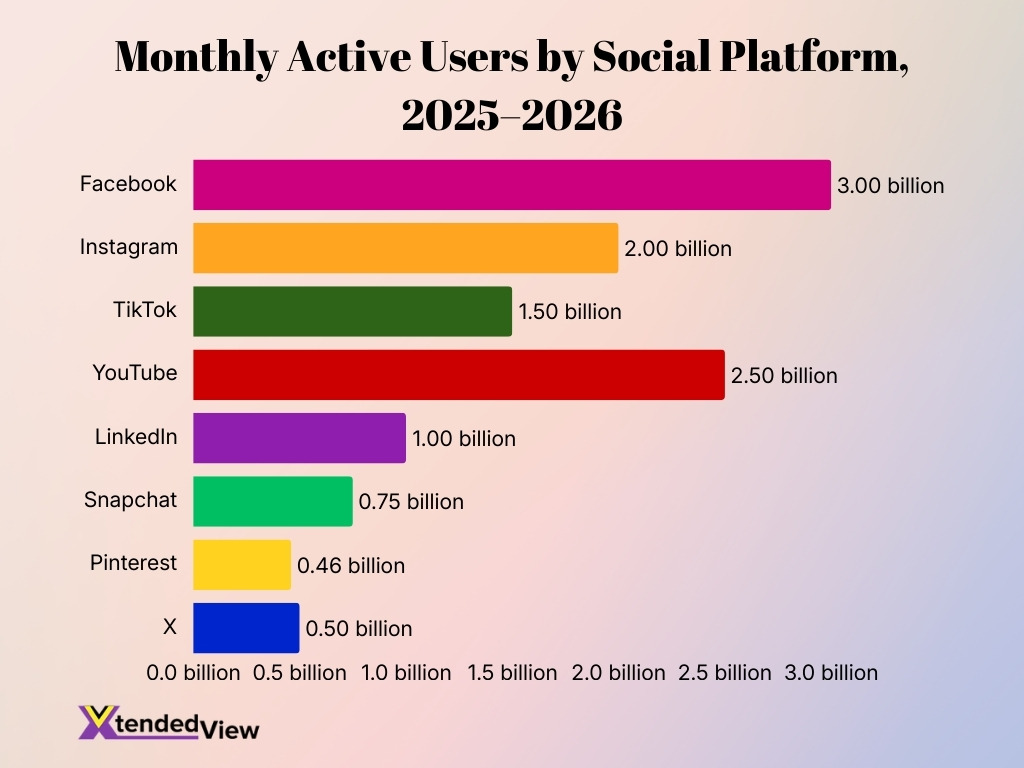
- Facebook maintains over 3 billion monthly active users globally in 2025.
- Instagram exceeds 2 billion monthly active users, making it one of the top advertising channels worldwide.
- TikTok surpasses 1.5 billion active users, with strong Gen Z and millennial reach.
- YouTube ads reach over 2.5 billion users monthly, providing the broadest global advertising reach.
- LinkedIn has 1 billion members globally, with millions of decision-makers on the platform.
- Snapchat reaches more than 750 million monthly active users, particularly strong among users aged 13–34.
- Pinterest reports over 460 million monthly active users, with high commercial intent among shoppers.
- X reaches roughly 500+ million monthly users, offering real-time engagement opportunities.
Adoption of Social Media Advertising Among Marketers and Brands
- Over 90% of U.S. businesses use social media for marketing purposes.
- Around 83% of marketers globally use paid social advertising campaigns.
- Nearly 70% of small businesses invest in Facebook ads specifically.
- About 60% of B2B marketers report LinkedIn as their primary paid social platform.
- More than 75% of marketers consider social ads effective for brand awareness.
- Approximately 48% of marketers say paid social drives measurable lead generation.
- Influencer partnerships integrated into paid social campaigns are used by over 65% of brands.
- Nearly 50% of marketers increased their paid social budgets between 2024 and 2025.
Objectives and Use Cases in Social Media Advertising
- Brand awareness remains the top objective for over 80% of advertisers using social media.
- Lead generation campaigns account for roughly 35%–40% of paid social objectives.
- Conversion-focused ads contribute significantly to retail sales, especially during peak seasons.
- Social ads influence purchase decisions for over 70% of consumers, especially younger demographics.
- Approximately 60% of marketers use social media advertising to drive website traffic.
- Retargeting campaigns on social platforms generate 2–3x higher conversion rates compared to cold audiences.
- App install campaigns represent a growing share, particularly in gaming and fintech sectors.
- Social commerce ads directly drive purchases, with over 50% of Gen Z shoppers discovering products via social platforms.
Perception of Accuracy in Social Media Ads
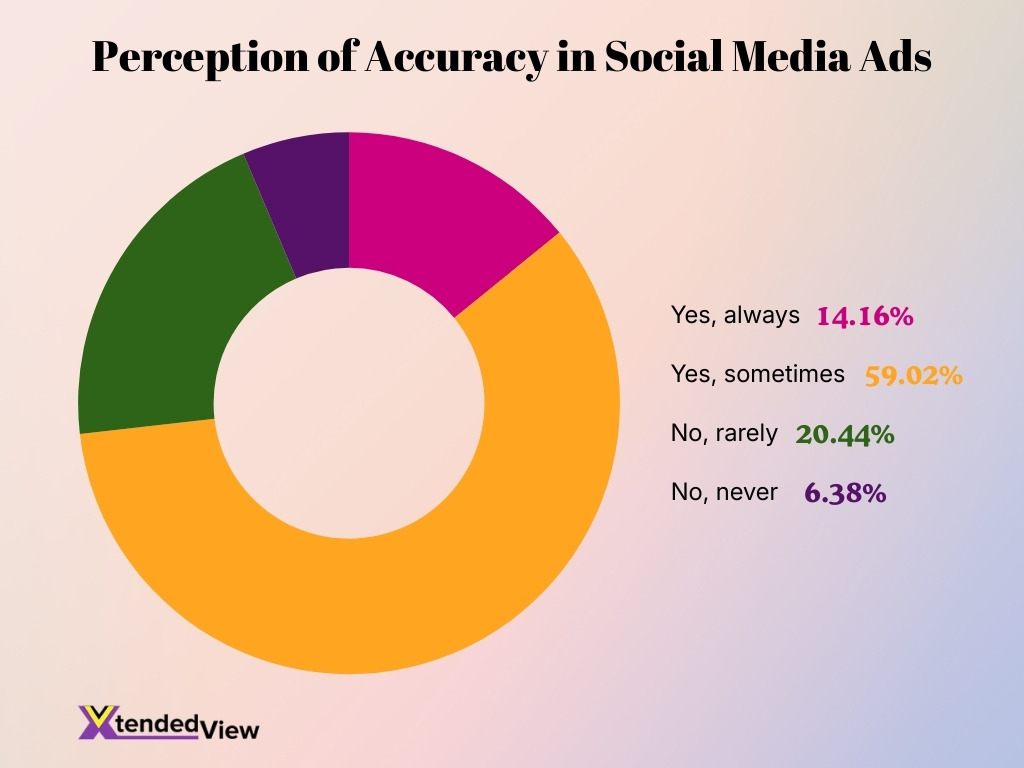
- A clear majority of users (59.02%) believe that social media ads are accurate only sometimes, indicating moderate trust but noticeable skepticism.
- Only 14.16% of respondents feel that ads are always accurate, showing limited full confidence in advertising claims.
- Around 20.44% of users report that ads are rarely accurate, highlighting ongoing concerns about misleading content.
- A smaller segment (6.38%) believes that social media ads are never accurate, reflecting strong distrust among a minority of users.
- Overall, nearly 26.82% of respondents (20.44% + 6.38%) express low trust in ad accuracy, emphasizing the need for greater transparency.
- The data suggests that improving fact-based messaging, credibility, and verification could help brands convert “sometimes” believers into loyal customers.
Ad Formats and Placements in Social Media Campaigns
- Image ads remain widely used, but video now accounts for over 50% of social media ad spend globally.
- Instagram Stories ads deliver completion rates of 70%+ for vertical video formats, making them a preferred placement for mobile-first campaigns.
- Carousel ads generate up to 30% lower cost per conversion compared to single-image ads in retail campaigns.
- TikTok in-feed ads report average engagement rates of 4%–5%, significantly higher than traditional display benchmarks.
- LinkedIn Sponsored Content drives engagement rates of approximately 2%–3% in B2B campaigns.
- Reels placements across Instagram and Facebook account for more than 20% of ad impressions growth in 2024–2025.
- Pinterest Shopping Ads increase purchase intent by up to 50% compared to standard promoted pins.
- Collection ads and instant experience formats reduce drop-off rates by up to 15%.
Mobile Trends in Social Media Advertising
- More than 95% of social media users access platforms via mobile devices.
- Mobile accounts for over 80% of total social ad impressions globally.
- U.S. mobile social ad spend exceeded $100 billion in 2024.
- Vertical video formats optimized for smartphones drive 30% higher engagement rates compared to horizontal formats.
- Mobile click-through rates average 1.5%–2%.
- In-app purchases influenced by social ads continue rising across industries.
- Over 70% of social commerce purchases now occur directly on mobile devices.
- Brands investing in mobile-first creative report 20% better return on ad spend.
How Product Videos Influence Shopper Decisions in Social Media Ads
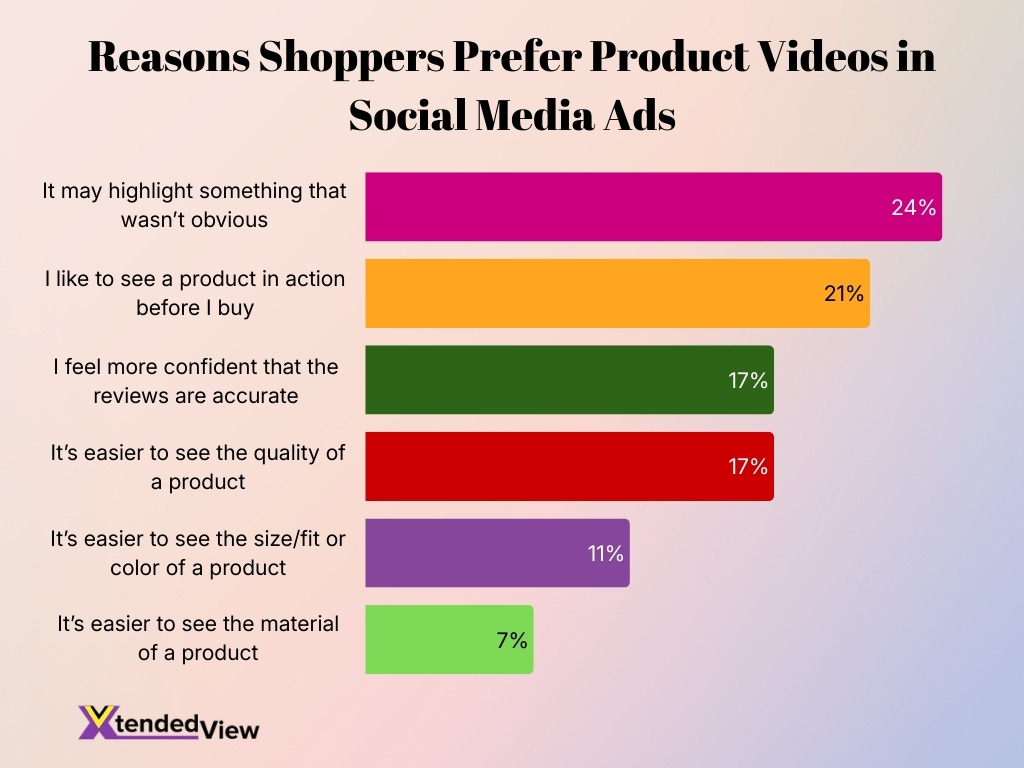
- 24% of shoppers watch product videos because they highlight hidden or non-obvious details, helping them make more informed buying decisions.
- 21% of consumers prefer videos to see products in action before purchasing, increasing trust in real-world performance.
- 17% of buyers feel more confident about review accuracy when ads include video demonstrations.
- Another 17% of users rely on videos to evaluate product quality, reducing uncertainty before checkout.
- 11% of shoppers use videos to better understand size, fit, and color, lowering the chances of post-purchase dissatisfaction.
- Only 7% of consumers focus on videos to assess product material, making it the least influential factor in purchase decisions.
Social Commerce and Shoppable Ads in Social Media
- Global social commerce sales are projected to surpass $1.2 trillion in 2025, up from approximately $992 billion in 2024.
- In the U.S., social commerce sales are expected to reach over $100 billion in 2025.
- More than 50% of Gen Z consumers discover new products via social media platforms.
- Platform-integrated shopping tools have increased direct in-app purchases by double-digit percentages year over year.
- Pinterest users are 7x more likely to say the platform influences purchase decisions compared to other social networks.
- Facebook Marketplace reaches 1 billion monthly users.
- Influencer-driven social commerce campaigns can generate up to 11x ROI compared to traditional banner ads.
- Livestream commerce adoption in North America grew by over 25% year over year between 2024 and 2025.
Performance Benchmarks for Social Media Advertising (CTR, CPC, CPM, CPA)
- The average Facebook ad CTR across industries is approximately 0.9%–1.3%.
- Instagram ads average a CTR of 1%+.
- The average cost per click for Facebook ads ranges between $0.50 and $2.00.
- LinkedIn ads often average $5–$8 per click in B2B campaigns.
- TikTok ad CPM averages $6–$10.
- The average cost per thousand impressions across social platforms in the U.S. sits between $5 and $15.
- Retargeting campaigns often reduce CPA by up to 50%.
- Video ads tend to deliver 20% lower CPA compared to static image campaigns.
Instagram Brand Content Engagement Trends
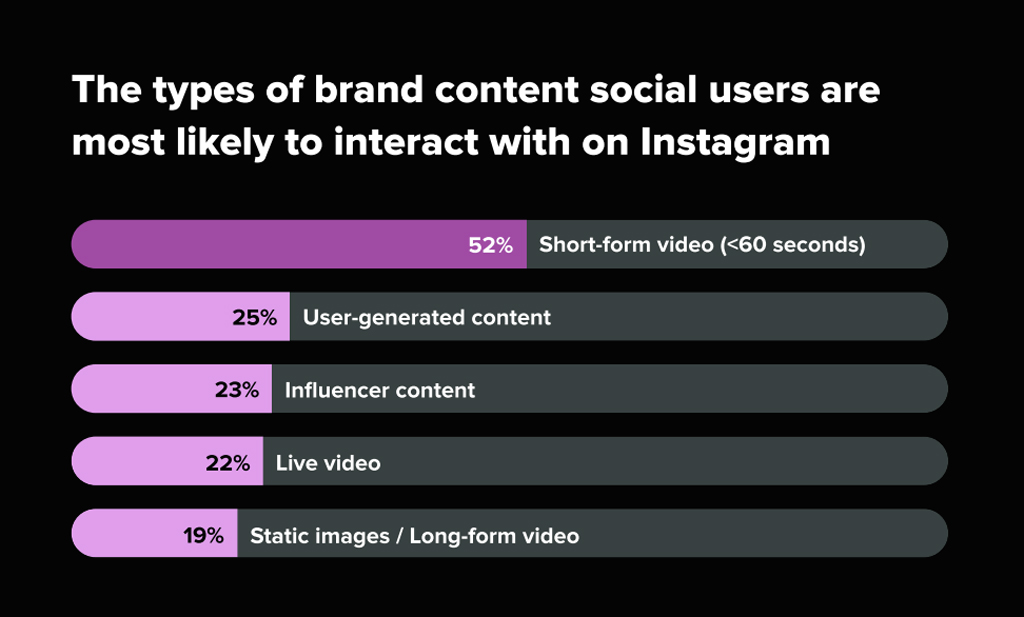
- Short-form videos (<60 seconds) dominate user interaction, with the highest engagement rate at 52%, making them the most effective content format on Instagram.
- User-generated content ranks second, attracting 25% engagement, highlighting strong audience trust in authentic, community-driven posts.
- Influencer content continues to perform well, generating 23% engagement, showing the ongoing impact of creator-led brand promotions.
- Live videos secure 22% engagement, indicating growing interest in real-time and interactive brand experiences.
- Static images and long-form videos receive the lowest interaction at 19%, suggesting declining user preference for traditional content formats.
Conversion, ROAS, and ROI in Social Media Advertising
- The average return on ad spend ranges between 2:1 and 5:1.
- Retail brands often achieve ROAS of 4x or higher during peak seasons.
- Social retargeting campaigns drive conversion rates that are 2–3 times higher than cold traffic campaigns.
- Over 60% of marketers report measurable ROI improvements after integrating social and search strategies.
- Brands that personalize social ads using first-party data see 20%+ lift in conversion rates.
- Shoppable ad formats can reduce the customer journey length by one to two steps.
- U.S. small businesses report social ads as their second-highest ROI digital channel.
- Cross-platform attribution modeling improves reported campaign ROI accuracy by up to 30%.
AI and Automation in Social Media Advertising
- Over 80% of digital display ads are now purchased programmatically.
- AI-powered campaign setups drive up to 32% higher ROAS compared to manual configurations.
- Automated optimization tools show 18% average lift in conversions for advertisers.
- Approximately 70% of marketers use AI tools for audience targeting and campaign optimization.
- AI-powered creative testing reduces campaign setup time by up to 50%.
- Predictive analytics improves ad budget allocation efficiency by 15%–20%.
- Chatbots integrated with paid social ads increase customer response rates by up to 25%.
- By 2026, a majority of large advertisers are expected to rely on AI-driven automation for bid management and creative optimization.
Frequently Asked Questions (FAQs)
Global social media advertising spend is projected to reach $317.33 billion in 2026.
The social media ad market is forecast to grow at a 12.5% CAGR from 2025 to 2026.
About 63.9% of the global population will be using social media in 2025.
Programmatic media buying accounted for 42% of total digital ad spend, up 19% year-on-year in 2025.
In the U.S., social media advertising revenues totaled $88.8 billion in 2024.
Conclusion
Social media advertising stands at the center of digital growth. Global ad spend continues climbing, mobile dominates engagement, and short-form video reshapes creative strategy. At the same time, social commerce and AI-powered optimization tools drive measurable returns for brands across industries. For U.S. businesses and global marketers alike, social platforms now serve as both discovery engines and direct sales channels.
As budgets expand and automation deepens, advertisers who prioritize data, creative agility, and mobile-first experiences will capture the strongest returns. The statistics throughout this report highlight one clear takeaway: social media advertising is no longer optional; it is a core performance channel shaping the future of digital marketing.
