


Remote work has become a permanent part of business operations, but it has also expanded the cyberattack surface for organizations worldwide. Companies now secure employees across home networks, personal devices, cloud platforms, and remote collaboration tools, making cybersecurity a top business priority. These trends directly affect industries such as health care, financial services, technology, and government, where a single security incident can disrupt operations and expose sensitive data. Explore the statistics below to understand how remote work continues to reshape the cybersecurity landscape.
Editor’s Choice
- The global remote work security market reached $68.94 billion in 2025 and is projected to grow to $83.73 billion in 2026, reflecting continued enterprise investment in securing hybrid workforces.
- Organizations are expected to spend more than $173 billion on remote work security by 2030, growing at a compound annual growth rate of 21.2% from 2025 onward.
- Data breaches involving remote work environments continue to cost organizations an average of $1.07 million more than breaches without a remote work factor.
- Around 52% of security incidents in 2025 involved a remote worker’s device, connection or endpoint, highlighting the expanded attack surface created by distributed workforces.
- Security systems process 100 trillion security signals every day, block 4.5 million malware files daily and screen 5 billion emails to detect cyberthreats affecting organizations worldwide.
- According to recent enterprise research, 91% of organizations now require multi-factor authentication for remote access to reduce credential-based attacks.
- 85% of organizations worldwide plan to increase cybersecurity spending as AI-powered cyberthreats continue to evolve in 2026.
Recent Developments
- AI-related cyber incidents now represent approximately 22% of reported security breaches, following a 56% increase in AI-enabled attacks over the past year.
- Deepfake impersonation has become the most common AI-enabled attack technique, affecting 45% of surveyed organizations.
- Global organizations process increasingly complex threat volumes, with security systems analyzing 38 million identity-risk detections every day.
- One major technology provider employs 34,000 cybersecurity engineers worldwide to defend against evolving cyberthreats targeting enterprise users.
- Cybercriminals increasingly target VPN infrastructure by combining stolen credentials with AI-assisted phishing and automated exploitation techniques.
- Browser-based attacks continue to rise, with 82% of IT professionals reporting at least one web-based security incident during the past year.
- Despite growing investments, 73% of organizations believe their browser security is adequate even though most have already experienced security incidents.
- Cybersecurity leaders report that 98% of IT professionals are concerned about increasing browser-based threats affecting remote and hybrid workforces.
- Researchers observed that attackers harvested approximately 1.8 million credentials and 68.8 billion browser cookies during 2025, increasing risks for remote employees.
Remote Work Cybersecurity Statistics Overview
- Remote and hybrid work continue to expand enterprise attack surfaces as employees connect through home networks, unmanaged devices, and cloud applications.
- 36% of confirmed data breaches continue to involve phishing as an initial attack vector, making it one of the leading threats against remote workers.
- Remote employees face approximately 46% higher exposure to voice-phishing attacks than traditional office-based employees.
- Human error remains a major cybersecurity challenge, contributing to 60% of security breaches according to recent industry assessments.
- Enterprise cybersecurity teams increasingly prioritize identity protection because attackers frequently exploit stolen credentials rather than software vulnerabilities alone.
- Security researchers continue to recommend Zero Trust architectures as organizations expand cloud-first and remote-work strategies.
- Academic studies show that many remote employees still receive limited cybersecurity awareness training despite growing cyber risks.
- Organizations increasingly combine endpoint detection, cloud security, identity management and continuous monitoring to protect distributed workforces.
- Researchers continue to identify employee behavior, awareness and compliance as critical factors influencing remote-work cybersecurity outcomes.
Remote Work Security Market Size and Growth
- The global remote work security market reached $68.94 billion in 2025.
- The market is forecast to grow to $83.73 billion in 2026, reflecting sustained enterprise demand.
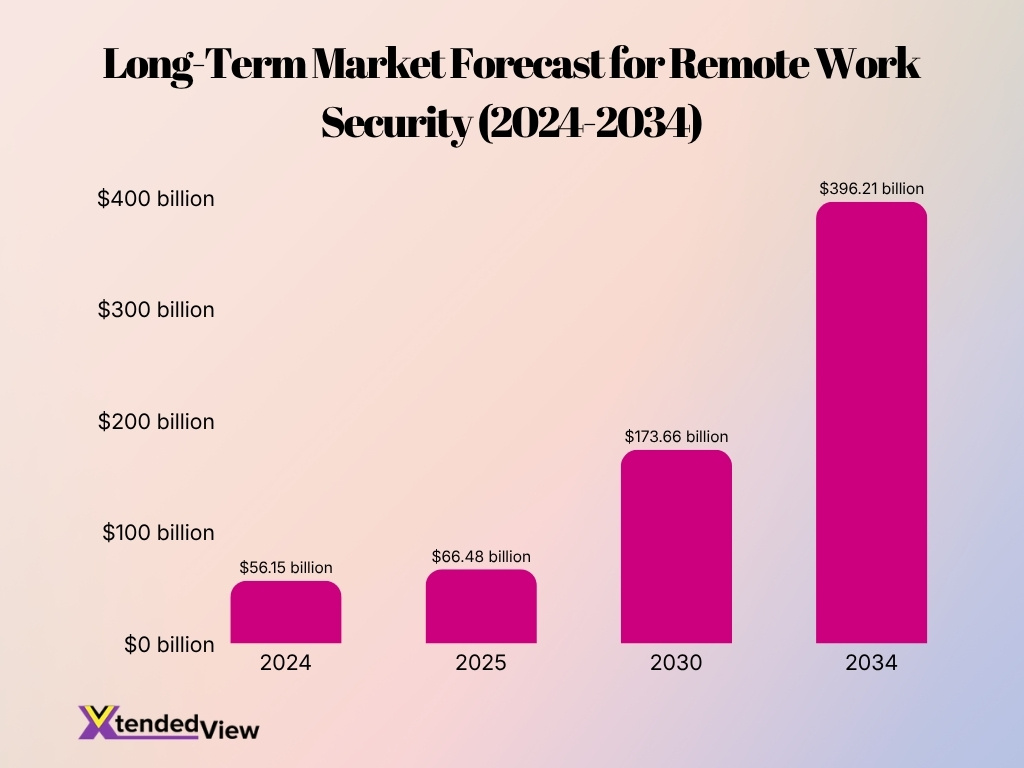
- Analysts project the market will reach $396.21 billion by 2034, representing rapid long-term expansion.
- The projected 2025-2034 compound annual growth rate is 21.45%, making remote-work security one of the fastest-growing cybersecurity segments.
- Another industry forecast estimates the market at $56.15 billion in 2024, rising to $66.48 billion in 2025 before reaching $173.66 billion by 2030.
- North America accounts for approximately 40% of the global remote work security market, maintaining the largest regional share.
- Endpoint protection, network security, cloud security and identity management remain the fastest-growing solution categories supporting remote work.
- Financial services, health care, IT, telecommunications and government organizations continue to lead enterprise spending on remote-work cybersecurity solutions.
- Rising ransomware activity, phishing campaigns, cloud adoption and stricter compliance requirements remain the primary drivers behind continued market growth.
Remote Work Security Incident Trends
- Approximately 52% of reported security incidents in 2025 involved remote-worker devices or remote connections.
- AI-assisted cyberattacks increased 56% year over year, accelerating threat activity against distributed workforces.
- Recent enterprise reports indicate that 82% of organizations experienced at least one web-based security incident during the previous year.
- Attackers increasingly rely on stolen credentials, browser sessions, and authentication cookies instead of direct malware deployment.
- Security systems block an average of 4.5 million malicious files every day, demonstrating the scale of modern enterprise cyberthreats.
- Organizations now analyze 100 trillion security signals daily to detect malicious behavior across cloud and remote environments.
- AI enables attackers to launch phishing, credential-stuffing, and vulnerability-exploitation campaigns at significantly greater speed than traditional manual attacks.
- Browser-based SaaS applications have become a major attack surface because nearly 79% of commonly used workplace applications are accessed exclusively through web browsers.
- Security experts increasingly recommend continuous monitoring, identity verification, and Zero Trust controls as core defenses against modern remote-work attacks.
Phishing Attacks on Remote Workers
- Phishing and pretexting appeared in 73% of social-engineering breaches analyzed in 2025. Remote employees face added exposure because they rely heavily on email, chat, cloud documents, and digital approval requests.
- Phishing served as the initial access method in roughly 15% of breaches covered by the 2025 breach dataset. The figure remained relatively stable from the previous reporting period.
- Phishing and spoofing ranked among the three most reported internet crimes in 2024, alongside extortion and personal-data breaches. Remote teams remain attractive targets because attackers can impersonate colleagues without entering a physical office.
- US victims submitted 859,532 internet-crime complaints during 2024. Reported losses reached $16.6 billion, a 33% increase from 2023.
- The number of complaints rose to 1,008,597 in 2025, up about 17% from 2024. Phishing and spoofing again ranked among the most frequently reported complaint categories.
- AI-connected fraud generated 22,364 complaints and $893.3 million in reported losses during 2025. AI can help criminals write convincing phishing messages, mimic business communication and personalize fraudulent requests.
- Business-email compromise schemes with a likely AI connection caused more than $30 million in reported business losses in 2025. These attacks often target employees who handle invoices, payroll or wire transfers from remote locations.
- About 12% of analyzed emails showed signs of AI-generated content, while credential harvesting remained the most commonly detected phishing subtype in a 2026 threat analysis.
- Only 30% of security leaders expressed high confidence in their phishing defenses, even though 87% considered phishing-resistant MFA critical to their strategies.
Top Remote Work Cybersecurity Threats
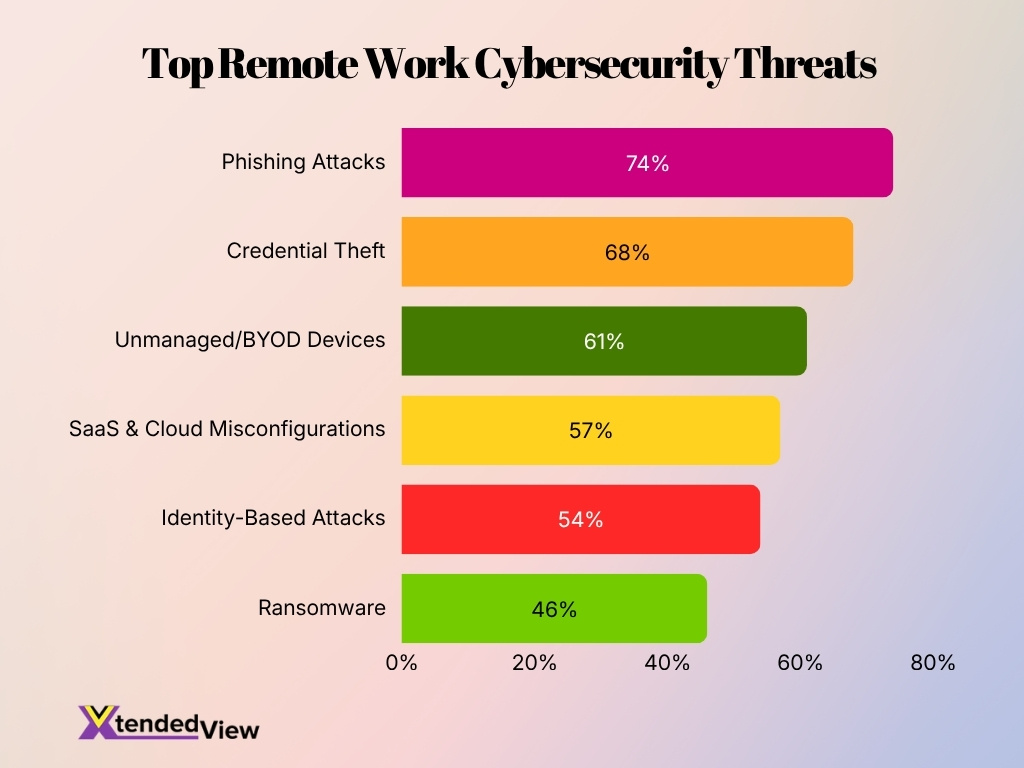
- Phishing attacks are the most widely reported remote work cybersecurity threat, with 74% of organizations identifying them as a major security challenge, highlighting the continued effectiveness of email and social engineering attacks.
- Credential theft affects 68% of organizations, making it the second most common threat, as compromised usernames and passwords remain a leading cause of unauthorized access.
- Unmanaged and BYOD (Bring Your Own Device) devices are reported by 61% of organizations, emphasizing the growing security risks associated with employees using personal devices for work.
- SaaS and cloud misconfigurations impact 57% of organizations, demonstrating that improperly configured cloud services continue to expose businesses to data breaches and unauthorized access.
- Identity-based attacks are experienced by 54% of organizations, reflecting the increasing focus of cybercriminals on exploiting user identities, credentials, and access privileges.
- Despite widespread security improvements, ransomware remains a significant concern, with 46% of organizations reporting ransomware-related threats in remote work environments.
- The data shows that identity and access-related threats, including phishing, credential theft, and identity-based attacks, account for the three most prominent cybersecurity risks, underscoring the importance of strong authentication and user awareness programs.
- Overall, the findings indicate that organizations must prioritize phishing prevention, identity security, endpoint management, and secure cloud configuration to reduce cybersecurity risks in increasingly distributed and remote work environments.
Credential Theft and Account Takeover Risks
- Compromised credentials provided initial access in 22% of breaches examined during 2025, making credential abuse one of the two leading entry methods.
- Identity-based attacks increased 32% during the first half of 2025. This rise matters for remote teams because cloud applications and remote-access systems treat a successful login as legitimate activity.
- More than 97% of identity attacks observed during the 2025 reporting period involved password-based techniques, including large-scale password spraying.
- Security systems analyzed an average of 38 million identity-risk detections per day during the 2025 reporting period. The volume illustrates how frequently organizations must assess potentially malicious sign-ins.
- Credential-theft activity increased by 160% in 2025, while compromised credentials accounted for an estimated 20% of breaches in the cited threat analysis.
- One month of 2025 produced approximately 14,000 recorded credential-compromise cases. AI-supported phishing and commercially available infostealer malware contributed to the increase.
- Exposed credentials found in public software repositories remained available for an average of 94 days before remediation, giving attackers an extended opportunity to access connected systems.
- Infostealer data showed that the median affected user maintained unique passwords for only 49% of services. Password reuse allows one stolen credential set to compromise several workplace accounts.
- Attackers harvested an estimated 1.8 million credentials and 68.8 billion browser cookies in 2025. Stolen session cookies can sometimes let criminals enter SaaS accounts without repeating the normal login process.
Endpoint Security Risks in Remote Work
- Vulnerability exploitation accounted for 20% of initial breach access in the 2025 dataset, up 34% from the preceding report. Remote endpoints and internet-facing appliances require timely patching to reduce this exposure.
- The 2025 breach analysis covered 22,052 security incidents, including a record 12,195 confirmed data breaches across 139 countries. The dataset shows the scale of threats facing endpoints and access systems worldwide.
- Unmanaged devices played a role in more than 90% of observed ransomware incidents, according to data cited in a 2025 workplace-device assessment. Personal computers and phones can lack the monitoring controls placed on company equipment.
- About 40% of edge devices remained unmanaged in the same 2025 analysis. These devices can include routers, remote-access appliances and other systems positioned between employees and corporate resources.
- 38% of IT professionals said they lacked adequate visibility into devices connected to their networks. Limited visibility can delay the detection of outdated software, malware and unauthorized endpoints.
- 82% of surveyed US IT and cybersecurity professionals reported at least one web-based security incident during the previous year, despite 73% expressing confidence in their protections.
- Almost 98% of IT professionals expressed concern about increasing browser threats, while 81% expected attacks to become more sophisticated. Browsers now act as primary work endpoints for many remote employees.
- Nearly 79% of the most widely used workplace applications could operate entirely through a web browser. As a result, endpoint protection must cover browser sessions, extensions, and downloaded content.
- Data-loss prevention tools reached only 53% adoption among surveyed organizations, leaving many remote endpoints without consistent controls over uploads, copying, and file transfers.
BYOD Security Risks
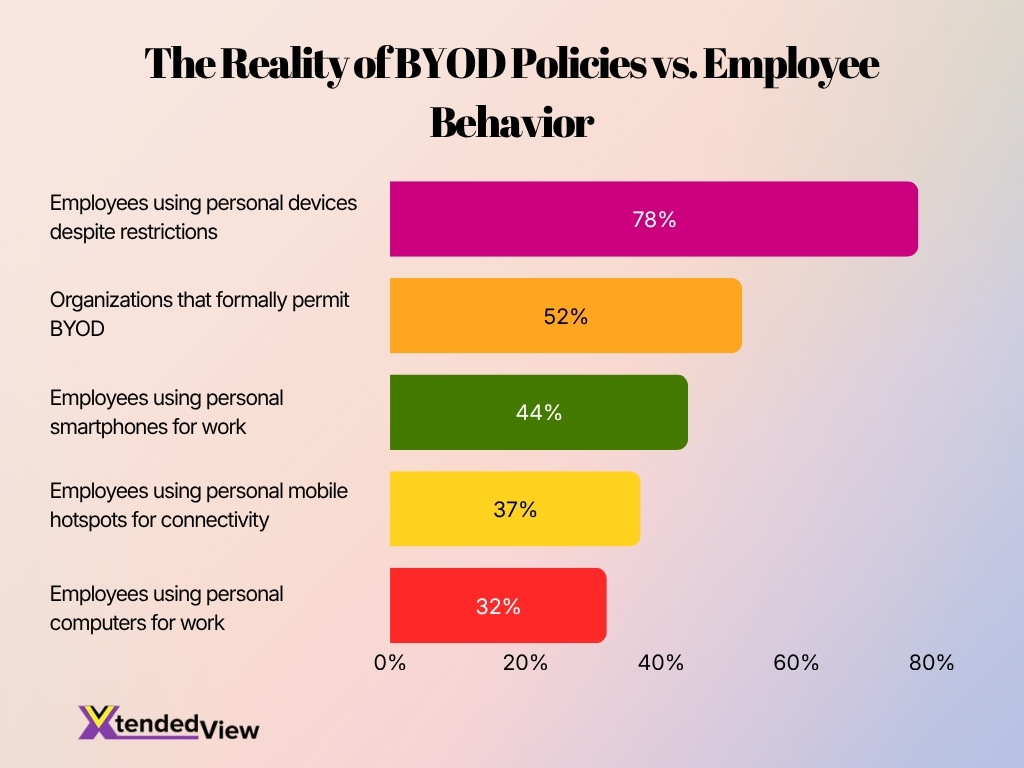
- 44% of employees reported using personal smartphones for work in a 2025 device-use study. Personal phones can store business messages, authentication prompts and downloaded files outside company-managed environments.
- Another 32% of employees used personal computers for work, increasing the number of endpoints that organizations must secure, patch and monitor.
- 37% of workers used personal mobile hotspots for business connectivity. Although hotspots can avoid unsafe public Wi-Fi, companies may lack visibility into their configuration and traffic.
- Only 52% of surveyed organizations formally permitted BYOD, showing a substantial gap between written policy and actual employee behavior.
- Among employees whose organizations restricted BYOD, 78% still used personal devices for work. This creates shadow IT because security teams cannot protect equipment they do not know exists.
- 52% of companies were considering banning BYOD in office settings, while 57% cited difficulty securing devices outside the company network.
- More than 90% of ransomware incidents in the cited enterprise data originated from unmanaged devices, highlighting the potential consequences of poorly controlled BYOD access.
- The BYOD security market reached an estimated $43.5 billion in 2025. Spending reflects growing demand for device management, secure access, application controls, and data protection.
- The market could reach $177.6 billion by 2035, representing an estimated compound annual growth rate of about 15.1% between 2026 and 2035.
VPN Security Risks
- Exploitation of vulnerabilities reached 20% of breach entry methods in the 2025 analysis, partly because attackers targeted internet-facing edge devices and VPN products.
- Vulnerability exploitation grew 34% year over year, placing it close to credential abuse as a leading initial-access vector. Unpatched VPN gateways contributed to this expansion.
- The share of breaches involving a third party doubled to 30% in 2025. Contractors and technology providers often use remote-access connections that can expose customer environments when compromised.
- Credential abuse accounted for 22% of breach entry methods, showing why a VPN password alone does not provide adequate protection for remote access.
- Only 34% of organizations in a 2025 workplace-technology study had adopted Zero Trust network access, despite growing concern about unmanaged devices and remote connectivity.
- Privileged-access management adoption stood at 30% in the same study. Weak control over administrative accounts can let a compromised VPN session reach high-value systems.
- 22% of organizations still used IP-based rules as their main access-control model in a 2025 survey. This approach can grant broad access after a user enters the network through a trusted address or VPN.
- Another 48% of organizations used an equal mixture of IP- and identity-based controls. The figure suggests many companies remain midway between traditional VPN access and identity-centered security.
- Only 29% of organizations primarily controlled access through identity-based policies. A fully identity-led approach can restrict remote users to specific resources instead of granting broad network access.
Zero Trust and Remote Access Security
- 63% of organizations worldwide had implemented a Zero Trust strategy by 2024, according to research referenced in a 2026 remote-access assessment.
- However, only 29% of organizations used identity-based access as their primary access-control model in 2025. This indicates that adoption labels do not always represent full implementation.
- Nearly half of organizations, 48%, combined identity controls with traditional IP-based rules. Hybrid models can help companies migrate gradually, but they may preserve legacy access weaknesses.
- 22% of organizations relied mainly on IP-based access rules, which provide less context about the user, device health, and sensitivity of the requested resource.
- Approximately 72% of organizations prioritized Zero Trust network-access adoption in 2025 as remote work and cyberthreats continued to expand.
- Survey research found that 72% of organizations planned to adopt Zero Trust, although implementation levels remained below stated intentions.
- Zero Trust network-access adoption reached only 34% in one 2025 workplace-device study, demonstrating wide variation in adoption depending on the surveyed population and definition.
- Modern Zero Trust models combine identity management, MFA, least-privilege access, continuous authentication and real-time risk analysis rather than trusting a user after one successful login.
- A review of Zero Trust research from 2016 through 2025 identified continuous authentication, conditional access and dynamic trust evaluation as core controls for cloud and remote environments.
Remote Access Security Controls
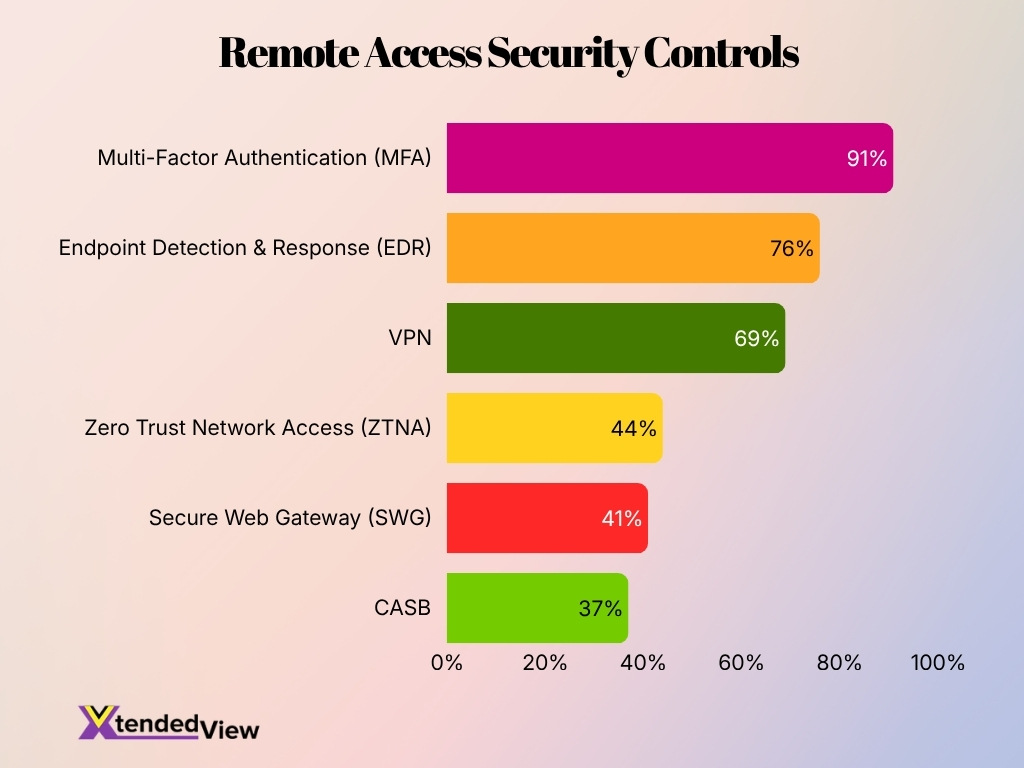
- Multi-Factor Authentication (MFA) is the most widely adopted remote access security control, with 91% of organizations implementing it to strengthen identity verification and reduce unauthorized access risks.
- Endpoint Detection & Response (EDR) is used by 76% of organizations, highlighting the growing importance of real-time endpoint monitoring and rapid threat detection for remote devices.
- VPN solutions remain a foundational security measure, with 69% adoption, as organizations continue to rely on encrypted remote connections for employees and distributed workforces.
- Zero Trust Network Access (ZTNA) has been adopted by 44% of organizations, reflecting the increasing shift toward identity-based, least-privilege access instead of traditional perimeter security.
- Secure Web Gateway (SWG) solutions are deployed by 41% of organizations, helping protect remote users from malicious websites, unsafe downloads, and web-based cyber threats.
- Cloud Access Security Broker (CASB) adoption stands at 37%, indicating that more than one third of organizations use dedicated tools to improve cloud application visibility, compliance, and data protection.
- The gap between MFA (91%) and CASB (37%) demonstrates that identity security technologies have achieved significantly broader adoption than advanced cloud security controls.
- Overall, the data shows that organizations prioritize identity protection, endpoint security, and secure connectivity, while Zero Trust and cloud security technologies continue to gain traction as remote work environments evolve.
MFA Adoption for Remote Work
- Workforce MFA adoption reached 70% in 2025, but nearly three in 10 users still lacked an additional authentication factor.
- The comparable adoption rate stood at 66% in January 2024, indicating continued progress in protecting workforce accounts.
- MFA adoption among administrators reached 91% in 2024. Administrative accounts require stronger protection because they can change configurations, create users, and access sensitive systems remotely.
- High-assurance MFA adoption rose from 41% to 58%, showing that more organizations moved beyond basic one-time codes toward stronger authentication methods.
- Adoption of phishing-resistant authenticators increased 63% in one year through 2025. These methods reduce reliance on passwords and codes that employees can enter into fraudulent login pages.
- Usage of one phishing-resistant authentication method increased 162% year over year, while SMS authentication usage declined by 14% in the 2025 workplace analysis.
- The total volume of passwordless authentications using that method grew 377% over 12 months, while authentications supported by fingerprints or facial recognition rose 288%.
- Modern MFA can reduce the risk of identity compromise by more than 99%, according to 2025 threat telemetry.
- More than 99.9% of compromised accounts in an identity-security analysis did not use MFA. This left them more vulnerable to phishing, password spraying, and reused credentials.
- Although 87% of security leaders considered phishing-resistant MFA critical, only 30% expressed strong confidence in their existing phishing defenses.
Cloud Security Challenges for Remote Teams
- The global average cost of a data breach reached a record $4.99 million in 2026, a 12% increase from the previous year. Cloud-based collaboration, remote identities, and distributed data stores can raise detection and recovery costs when organizations lack centralized oversight.
- Public-cloud breaches produced an average cost of $5.17 million in the latest available cloud-environment analysis. Remote teams often create, share, and download sensitive information across several cloud services, making access governance essential.
- Basic security errors contributed to 80% of cloud breaches analyzed in a 2026 report. Common weaknesses included misconfigurations, exposed credentials, and poor management of internet-facing resources.
- Cloud-infrastructure attacks increased 21% year over year, while misconfigurations appeared in nearly 38% of breaches covered by one 2026 assessment. Remote operations can amplify these risks when teams deploy services without consistent security reviews.
- Approximately 31% of cloud data breaches had an API connection. APIs support remote collaboration and application integrations, but weak authentication or excessive permissions can expose connected data.
- More than 70% of organizations used AI-enabled cloud services in production by late 2025. However, rapid deployment frequently outpaced identity, configuration, and data-protection controls.
- Identity-related weaknesses contributed to 80% of cloud security incidents in one 2025 cloud study. Stolen remote-worker credentials and overprivileged service accounts can give attackers broad access without requiring malware.
- Shadow AI appeared in 20% of breaches analyzed during 2025. Incidents involving unauthorized AI tools cost an average of $4.63 million, compared with $3.96 million for breaches without that factor.
- Security teams attributed 82% of breaches in hybrid environments to insufficient visibility in one industry assessment. Organizations cannot consistently protect remote cloud activity when they lack a complete inventory of users, applications, and data flows.
Top Remote Work Security Challenges
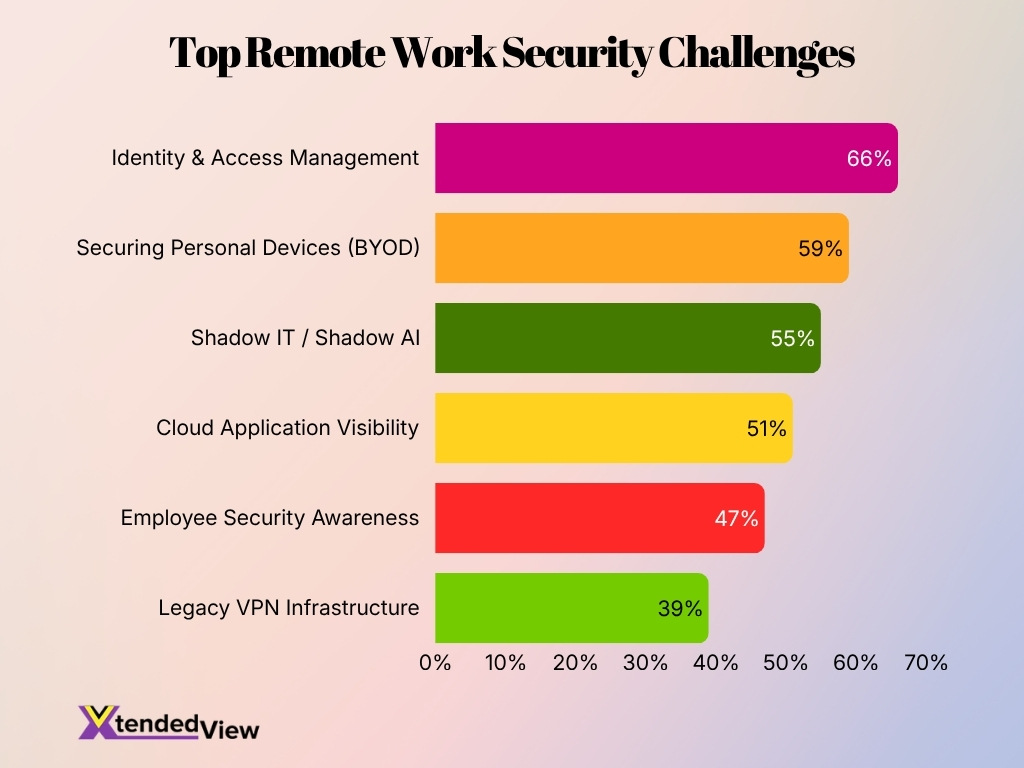
- Identity & Access Management (IAM) remains the biggest remote work security challenge, with 66% of organizations identifying it as their primary concern due to the growing complexity of managing user identities and permissions across distributed workforces.
- Securing personal devices (BYOD) is the second-largest challenge, reported by 59% of organizations, highlighting the increased cybersecurity risks associated with employees accessing corporate resources from unmanaged devices.
- Shadow IT and Shadow AI impact 55% of organizations, showing that unauthorized applications and AI tools continue to create significant visibility, compliance, and data security challenges for IT teams.
- Cloud application visibility is a concern for 51% of organizations, reflecting the difficulty of monitoring user activity, data access, and security risks across an expanding portfolio of cloud-based services.
- Employee security awareness remains a key issue, with 47% of organizations reporting that user behavior and insufficient cybersecurity training contribute to ongoing remote work vulnerabilities.
- Despite the rise of modern security frameworks, 39% of organizations still identify legacy VPN infrastructure as a major challenge, indicating that traditional remote access solutions continue to struggle with scalability, performance, and evolving cyber threats.
- The findings show that identity security, device protection, and cloud visibility are now the top three priorities for organizations looking to strengthen cybersecurity in remote and hybrid work environments.
- Overall, the data suggests that businesses are shifting away from perimeter-based security toward identity-centric and Zero Trust strategies to address the most pressing remote work security risks.
SaaS Security Risks in Remote Work
- SaaS security ranked as a high priority for 86% of organizations in 2025. Remote teams depend on browser-based productivity, customer management, and file-sharing applications, which makes SaaS accounts a central attack surface.
- 76% of organizations increased their SaaS security budgets during 2025. Spending focused on threat detection, posture management, identity controls, and improved visibility across connected applications.
- External data oversharing affected 63% of organizations. Public links, broad group permissions and unrestricted collaboration settings can expose files beyond their intended remote recipients.
- 56% of organizations reported that employees uploaded sensitive information to unauthorized SaaS applications. This behavior can place regulated or confidential data outside approved retention and monitoring systems.
- Employees adopted SaaS products without security-team involvement at 55% of organizations. Remote employees may turn to unapproved tools when authorized services do not meet immediate workflow needs.
- Fragmented SaaS administration affected 57% of organizations. Separate application owners and inconsistent settings can make it difficult to revoke access when remote workers change roles or leave a company.
- 58% of organizations struggled to enforce appropriate privilege levels across SaaS environments. Excessive access allows a compromised employee account to reach more data than the user needs for daily work.
- Another 54% lacked automated account-lifecycle management, increasing the risk that dormant, former-employee or contractor accounts remain active. These accounts can provide attackers with less-monitored entry points.
- Nearly 46% of organizations struggled to monitor nonhuman identities such as service accounts, integration tokens, and automated agents. In addition, 56% expressed concern about APIs receiving excessive privileges.
Remote Work Ransomware Statistics
- Ransomware appeared in 48% of breaches analyzed for the 2026 breach report, up from 44% in the prior reporting cycle. Remote-access systems, cloud identities, and unmanaged endpoints remain practical routes into distributed organizations.
- The 2025 reporting cycle recorded a 37% annual rise in ransomware, with ransomware present in 44% of reviewed breaches compared with 32% one year earlier.
- 69% of ransomware victims declined to pay in the 2026 dataset. This continued an upward trend in payment refusal as more organizations improved recovery planning and faced restrictions on funding criminal groups.
- The median reported ransomware payment reached $139,875 in 2026. Although fewer victims paid, successful attacks still created substantial financial pressure through downtime, investigation, and restoration costs.
- In the 2025 reporting cycle, the median payment declined to $115,000, from $150,000 in the preceding dataset. The decrease occurred while ransomware incidents continued to become more common.
- 64% of ransomware victims did not pay in the 2025 analysis, compared with 50% two reporting periods earlier. Maintaining offline backups and rehearsed recovery procedures can strengthen an organization’s ability to refuse demands.
- The success rate of ransomware encryption increased 11% to 56% in a 2026 organizational survey. Once attackers entered an environment, more than half successfully encrypted at least some data.
- Organizations reported average recovery costs of $1.7 million following ransomware incidents in 2026, excluding ransom payments. Recovery expenses can include system rebuilding, forensic analysis, lost productivity and customer notification.
- Backup-based recovery rose 12% year over year to 66% in 2026. Reliable backups remain particularly important for remote organizations because employees may store business data across laptops, cloud drives and local systems.
- Stolen credentials initiated 79% of ransomware breaches in one 2026 study. This figure reinforces the need for phishing-resistant MFA, device checks and conditional access across remote accounts.
U.S. Remote Work by Occupation
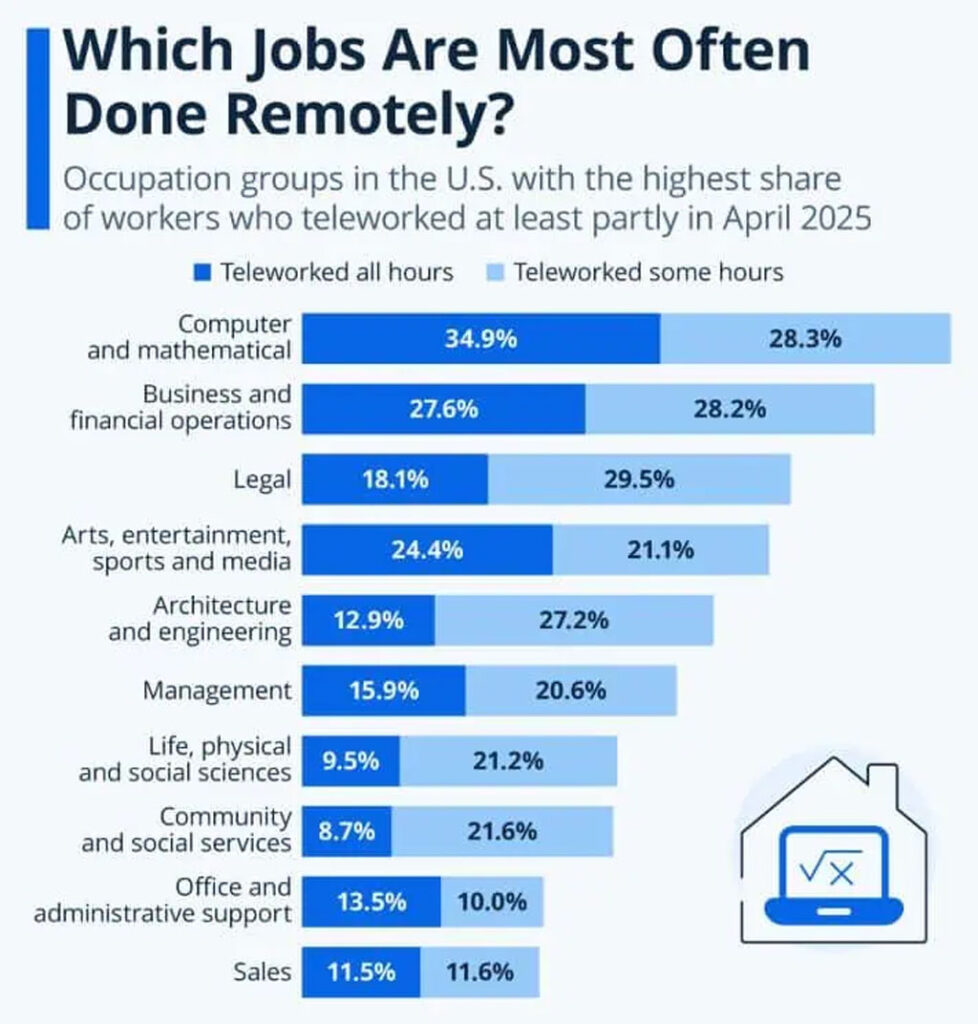
- Computer and mathematical occupations recorded the highest remote work participation, with 34.9% of employees working fully remotely and 28.3% working partially remotely, bringing the total telework share to 63.2%.
- Business and financial operations ranked second, with 55.8% of workers teleworking overall, including 27.6% working all hours remotely and 28.2% working some hours remotely.
- Legal professionals had the highest share of partial remote work among all occupations at 29.5%, while 18.1% worked fully remotely, resulting in a 47.6% overall telework rate.
- Arts, entertainment, sports, and media employees demonstrated strong workplace flexibility, with 24.4% teleworking full time and 21.1% working remotely part time, for a 45.5% total.
- Architecture and engineering occupations reported 40.1% total telework adoption, driven primarily by 27.2% of workers teleworking for some hours and 12.9% working entirely remotely.
- Management roles maintained a notable level of remote work, with 15.9% of managers working all hours remotely and 20.6% working some hours remotely, totaling 36.5%.
- Life, physical, and social sciences reached a 30.7% telework rate, including 9.5% of employees working fully remotely and 21.2% working partially remotely.
- Community and social services posted a similar 30.3% overall telework share, with 8.7% working all hours remotely and 21.6% teleworking for some hours.
- Office and administrative support roles showed a comparatively lower remote work rate of 23.5%, including 13.5% fully remote workers and 10.0% partial remote workers.
- Sales occupations had the lowest overall telework adoption among the listed professions at 23.1%, with 11.5% working all hours remotely and 11.6% teleworking for only some hours.
AI-Powered Threats Against Remote Workers
- AI-related incidents accounted for 22% of cyber breaches among surveyed organizations in a 2026 assessment. The number of AI-enabled attacks increased 56% over the previous year.
- Organizations affected by AI-related breaches reported an average financial impact of approximately $6 million. Attackers used AI both to target AI systems and to improve established tactics such as phishing and impersonation.
- Deepfake impersonation affected 45% of organizations that experienced AI-enabled attacks. Remote workers face specific exposure because they routinely approve requests through video calls, voice calls, and online messages.
- Controlled research found that 66% of participants failed to identify AI-generated audio as fake. Voice cloning can help attackers impersonate managers, support staff or vendors during remote conversations.
- In the same experiment, 43% of participants could not identify AI-generated video. A convincing synthetic video call can weaken the value of visual confirmation during a financial or account-recovery request.
- Security monitoring identified more than 200 cases of foreign adversaries using AI-generated deceptive content in July 2025 alone. That monthly total was more than twice the prior year’s volume and more than 10 times the 2023 level.
- The United States remained the most frequently targeted country in the 2025 AI-enabled threat analysis. Attackers used AI-generated messages, personas and media against government, technology and other high-value organizations.
- AI-linked fraud generated 22,364 US complaints and $893.3 million in reported losses during 2025. Fraudulent job offers, executive impersonation and business-email compromise can all target employees outside a supervised office setting.
- Global research found that 85% of organizations planned to increase security spending because of advanced AI threats. Investment priorities included incident response, data protection and AI governance.
Remote Work Security by Industry
- Manufacturing experienced an almost sixfold increase in espionage-motivated breaches during the 2025 reporting period. Espionage represented 20% of manufacturing breaches, up from 3% in the previous report.
- Ransomware appeared in 30% of public-sector breaches in the 2025 industry analysis. Government employees working remotely may access citizen records, payment systems and administrative platforms from distributed locations.
- Local governments represented about 43% of US public-sector ransomware victims in the same dataset. Smaller agencies can face resource limits, aging infrastructure and broad remote-access requirements.
- Health care organizations reported 772 large data breaches in 2025, setting a new annual record. The total rose roughly 4% from 2024, even as the number of affected individuals declined from the prior year’s exceptional level.
- Financial services recorded the highest average breach cost in one 2026 national analysis, at approximately £5.46 million per incident. Remote access to financial records, payment platforms and customer accounts gives attackers several high-value targets.
- System-intrusion breaches accounted for 53% of incidents in Europe, the Middle East and Africa during the 2025 analysis, nearly double the previous year’s 27%. Distributed employees and third parties can expand the number of systems attackers attempt to enter.
- Internal actors contributed to 29% of breaches in that regional dataset. Unintentional mistakes accounted for 19%, while deliberate misuse represented 8%.
- Phishing appeared in 19% of regional breaches, making social engineering the second-most common incident pattern. Employees in finance, education, health care and public services remain frequent impersonation targets.
- Across the United Kingdom, 20% of businesses and 14% of charities experienced at least one cybercrime during the 2025 survey period. The estimates represented about 283,000 businesses and 29,000 charities.
- Third-party involvement reached 30% of global breaches during the 2025 reporting cycle. Industries with outsourced IT, cloud services, payroll platforms, and contractors must secure remote access beyond their direct employees.
Frequently Asked Questions (FAQs)
The global remote work security market is estimated at $76.38 billion in 2026 and could reach $300.26 billion by 2033, growing at a 21.6% CAGR.
The global average cost of a data breach reached a record $4.99 million in 2026, representing a 12% year-over-year increase.
Ransomware appears in 48% of data breaches, up from 44% in the previous reporting period.
Around 69% of ransomware victims did not pay in the latest 2026 dataset, while the median payment among those who paid was $139,875.
68% of organizations reported an increase in browser-related security incidents over the previous two years, while 85% planned to increase investment in browser security.
Conclusion
Remote work increases the number of identities, devices, cloud services and external connections that organizations must protect. The findings show that stolen credentials, unpatched systems, excessive permissions and deceptive messages remain the most persistent risks. Organizations can reduce exposure by using phishing-resistant authentication, enforcing least-privilege access, monitoring unmanaged devices, securing cloud applications and testing recovery plans regularly.
