



Microsoft Teams has become a core collaboration platform for businesses, schools, healthcare providers, and government organizations. It supports everything from virtual meetings and project collaboration to enterprise telephony and AI-powered workplace productivity. As Microsoft continues to integrate Teams with Microsoft 365 and Copilot, the platform plays a larger role in hybrid work and digital transformation. This article explores the latest Microsoft Teams statistics to help you understand current adoption, user growth, and usage trends.
Editor’s Choice
- Microsoft Teams has approximately 320 million monthly active users worldwide, making it one of the largest workplace collaboration platforms.
- Microsoft continues to position Teams as the primary communication platform following the retirement of Skype in 2025.
- Teams usage reports now measure activity across meetings, chats, channels, guests, and external users, providing organizations with deeper workplace analytics.
- Microsoft expanded Teams throughout 2026 with AI-powered workflows, enhanced cross-organization collaboration, and stronger privacy protections.
- Teams analytics define an active user as someone performing an intentional action such as sending messages, editing files, joining meetings, or placing calls.
- Organizations can analyze Teams activity over 7-, 30-, 90-, and 180-day reporting periods through Microsoft 365 admin reports.
- Microsoft continues investing heavily in Teams as the collaboration hub connecting Microsoft 365, Copilot, Outlook, SharePoint, and OneDrive.
Recent Developments
- In May 2025, Microsoft officially retired Skype for consumers and encouraged users to migrate directly to Teams.
- Microsoft introduced AI-powered Workflows that allow Teams users to automate repetitive business processes using Copilot.
- Teams now supports multi-account notifications, allowing users to monitor activity across multiple organizations without switching tenants.
- Microsoft added automatic EXIF metadata removal from shared images to improve privacy by default.
- Teams on the web now requires browsers supporting ECMAScript 2022 (ES2022) beginning in 2026.
- Microsoft enhanced Teams presence detection so browser users can maintain accurate availability while working outside the Teams tab.
- Ignite 2025 introduced broader Copilot integration across chats, meetings, channels, and collaborative workflows.
- Microsoft continues expanding Teams as the central workspace for AI-assisted collaboration throughout Microsoft 365.
Global Microsoft Teams Overview
- Microsoft Teams serves approximately 320 million monthly active users globally.
- Teams operates across desktop, mobile, and web applications within the Microsoft 365 ecosystem.
- Organizations can monitor activity from internal users, guests, and external collaborators using built-in reporting tools.
- Teams supports collaboration through chats, meetings, shared channels, file sharing, and enterprise calling.
- Microsoft measures activity using intentional user actions rather than passive application launches, improving reporting accuracy.
- Usage analytics help organizations monitor adoption across departments, teams, channels, and collaboration patterns.
- Teams integrates with Microsoft 365 services including Outlook, SharePoint, OneDrive, Planner, and Copilot.
- Microsoft continues enhancing Teams with AI features aimed at improving enterprise productivity throughout 2026.
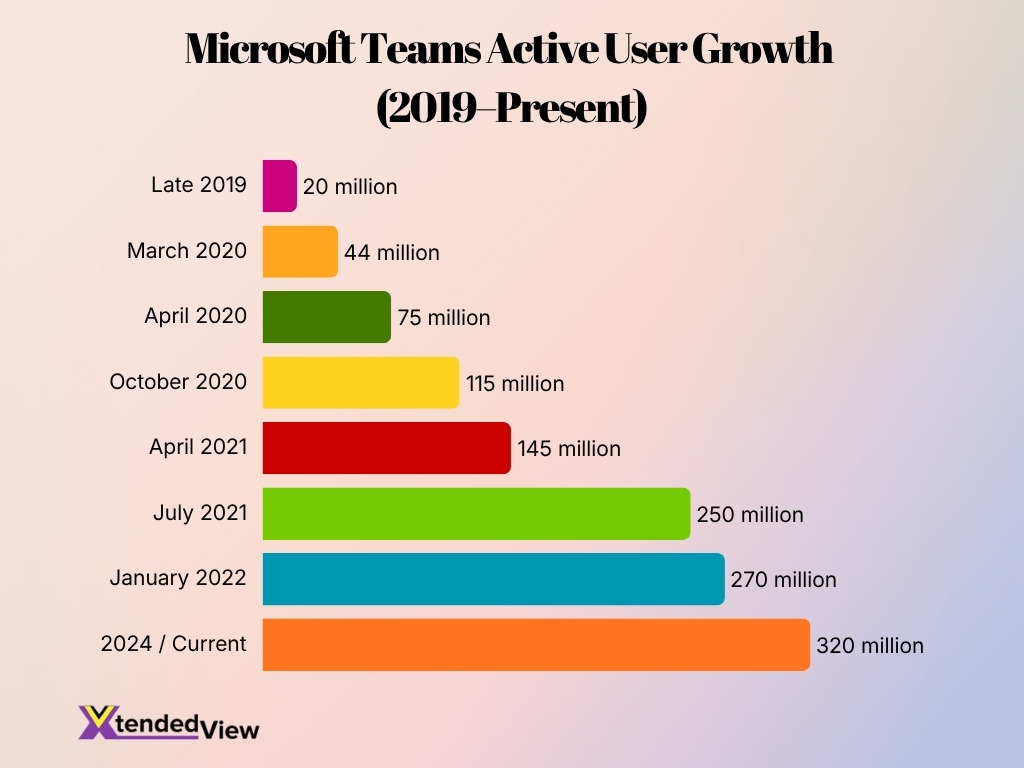
Microsoft Teams User Growth Over Time
- Microsoft Teams recorded 20 million daily active users during late 2019.
- The platform rapidly surged to 44 million daily active users by March 2020.
- Global user adoption expanded to 75 million daily active users in April 2020.
- The collaboration service surpassed 115 million daily active users by October 2020.
- Continued remote work pushed usage to 145 million daily active users in April 2021.
- The company reported a massive 250 million monthly active users by July 2021.
- Sustained enterprise adoption drove growth to 270 million monthly active users in January 2022.
- The platform ultimately achieved 320 million monthly active users fueled by AI-powered collaboration.
Daily Active Users Statistics
- Microsoft Teams supports over 320 million daily active users across the globe.
- The platform experienced a massive surge of 55 million new daily users in a single year.
- Users accumulate an estimated 2.7 billion meeting minutes every single day.
- More than 1 million companies worldwide have adopted the platform for daily communication.
- A staggering 93% of Fortune 100 companies rely on the service for their daily operations.
- The platform accounts for a 32.29% market share in the global video conferencing industry.
- Exactly 50% of Microsoft 365 commercial users actively utilize the Teams platform.
- Over 17 million active users engage with the dedicated phone feature every month.
- Around 61.21% of users are professional individuals aged between 35 and 54 years old.
- The application is widely utilized by 183,000 educational tenants in 175 different nations.
Monthly Active Users Statistics
- Microsoft Teams currently supports over 320 million monthly active users worldwide.
- The platform is projected to reach 360 million monthly active users by mid 2025.
- Around 93% of Fortune 100 companies actively use Microsoft Teams for enterprise communication.
- Microsoft Teams currently commands a 32.29% share of the global video conferencing market.
- Users globally generate over 5 billion meeting minutes on the platform in a single day.
- The Teams mobile application has successfully surpassed 75 million daily active users globally.
- More than 17 million monthly active users utilize the integrated Microsoft Teams phone feature.
- The average employee receives approximately 153 Teams messages every single workday.
- Professionals aged 35 and older account for roughly 82% of the total Teams user base.
- The collaboration platform generates an estimated $8 billion in annual revenue for Microsoft.
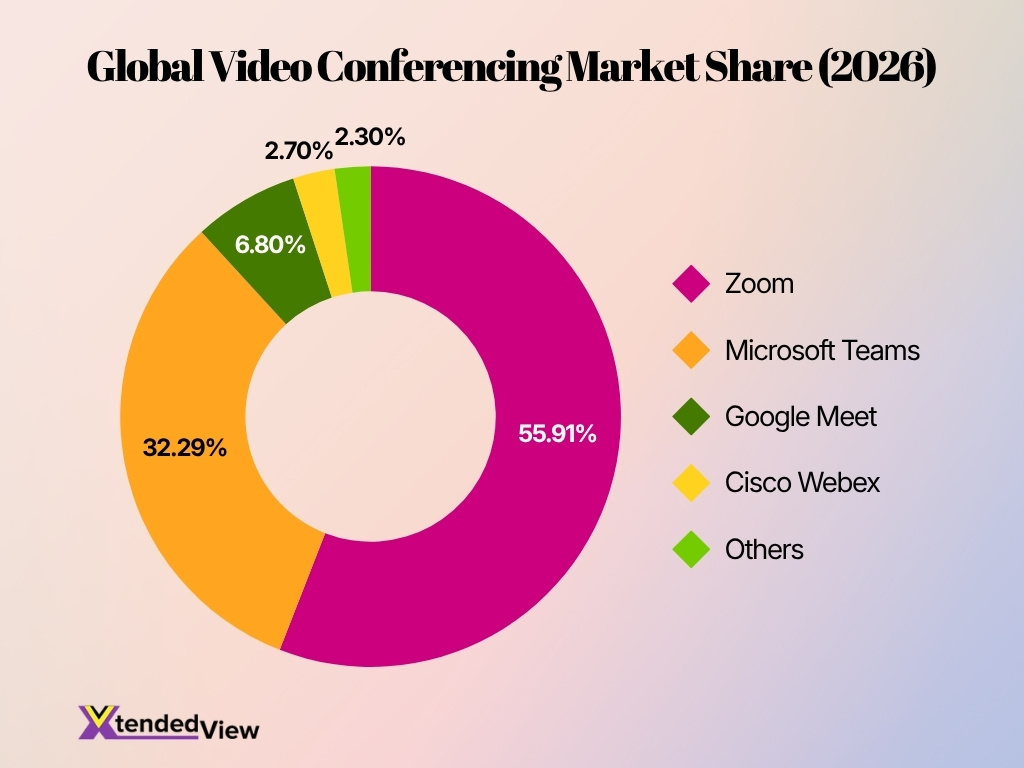
Global Video Conferencing Market Share
- Zoom leads the global video conferencing market with a commanding 55.91% share, accounting for more than half of the total market.
- Microsoft Teams ranks second with a substantial 32.29% market share, supported by strong adoption among businesses and Microsoft 365 users.
- Together, Zoom and Microsoft Teams control 88.20% of the market, highlighting the highly concentrated nature of the video conferencing industry.
- Google Meet holds 6.80% of the market, placing it a distant third despite its integration with Google Workspace.
- Cisco Webex accounts for 2.70%, reflecting its continued presence primarily within enterprise and corporate communication environments.
- Other video conferencing platforms collectively represent just 2.30%, leaving limited market share for smaller and emerging competitors.
- Zoom’s market share is approximately 23.62 percentage points higher than Microsoft Teams, demonstrating its clear leadership position.
- The data indicates that the global video conferencing market is dominated by a small number of major platforms, with Zoom maintaining the strongest competitive advantage.
Organizational Adoption of Microsoft Teams
- Microsoft Teams serves more than 350 million monthly active users, based on the latest publicly stated Microsoft figure from 2025. This total includes workplace, education, and personal accounts.
- Microsoft previously reported 320 million monthly active users in October 2023. Therefore, the latest disclosed figure indicates growth of at least 30 million users, or 9.4%, from that benchmark.
- Teams had reached 270 million daily active users in 2022, nearly double the 145 million recorded a year earlier. Microsoft has since shifted its public reporting toward monthly active users.
- A modeled 5,000-user organization generated an estimated $27.1 million net benefit from Teams over three years after accounting for implementation and operating costs.
- The same organizational model estimated $30.3 million in present-value benefits against approximately $3.2 million to $3.3 million in costs.
- The modeled implementation produced an estimated 832% return on investment and recovered its costs in less than six months. These results represent a composite organization rather than every Teams deployment.
- In a customer deployment reported in 2026, employee adoption reached 95.3%, with the highest engagement occurring in Teams and Outlook. Employees reported saving one to three hours a day on administrative work.
- Another 2026 deployment produced a 93% employee satisfaction rate, 91% meeting-room utilization, and a 50% reduction in meeting setup time.
- Teams Essentials supports organizations with up to 300 participants, while Teams Enterprise targets organizations that need to connect more than 300 people.
Enterprise and Fortune 100 Adoption
- Microsoft reported that 93 of the Fortune 100 companies used Teams by 2020. The company has not released a newer Teams-specific Fortune 100 percentage as of July 2026.
- Teams supported users across 181 markets and 53 languages when Microsoft published its Fortune 100 adoption benchmark.
- By March 2020, 20 enterprise customers each had more than 100,000 employees actively using Teams.
- One early enterprise rollout covered 440,000 active employees, showing that Teams could support nearly half a million workers within one organization.
- A 2026 enterprise AI rollout reached approximately 743,000 employees, with Teams forming part of the connected Microsoft 365 work environment. It represented the largest publicly identified enterprise Copilot rollout at that time.
- Data from 200,000 users in that rollout found that 97% completed routine tasks up to 15 times faster with Copilot-supported workflows.
- In the same study, 53% of participating employees reported significant improvements in productivity and efficiency.
- More than 85% of Fortune 500 companies used Microsoft AI solutions by July 2025. Although that percentage covers the broader AI portfolio, Teams serves as a major interface for enterprise Copilot collaboration.
- 90% of Fortune 100 companies used GitHub Copilot by 2026, illustrating how widely Microsoft’s collaboration and AI ecosystem has penetrated large enterprises. This figure should not be confused with Teams-specific adoption.
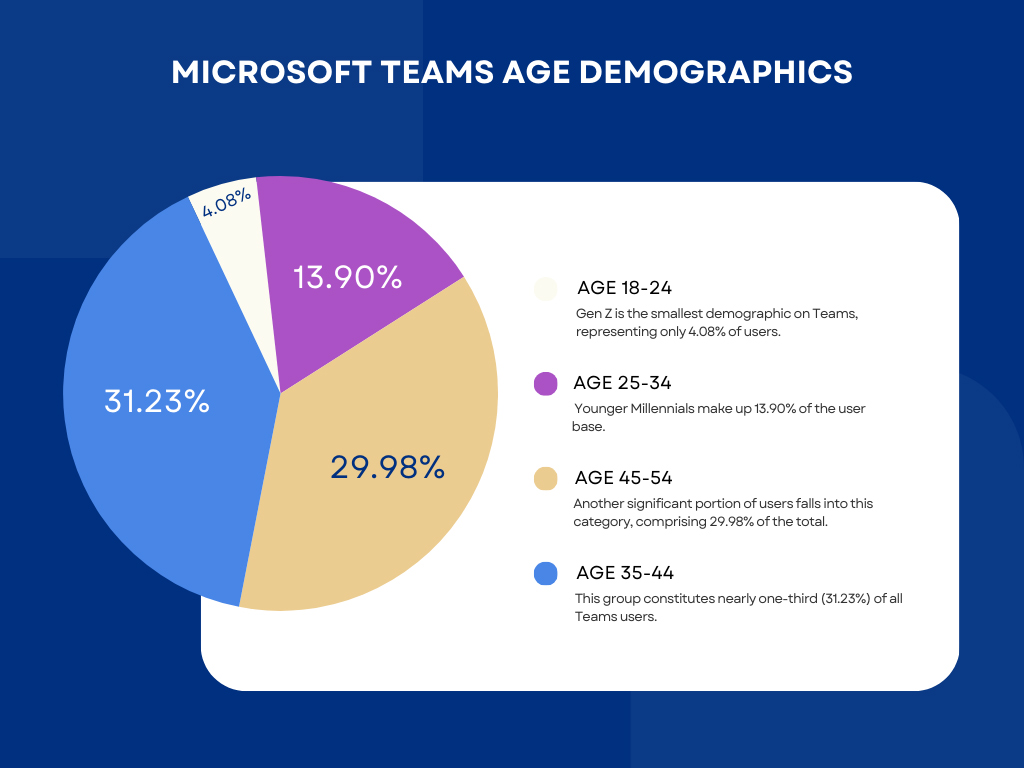
Microsoft Teams Age Demographics Insights
- Users aged 35–44 form the largest Microsoft Teams demographic, accounting for 31.23% of the user base.
- The 45–54 age group follows closely, representing 29.98% of Microsoft Teams users.
- Together, users aged 35–54 make up 61.21%, highlighting Teams’ strong adoption among experienced working professionals.
- The 25–34 age group accounts for 13.90% of users, showing comparatively lower adoption among younger professionals.
- Users aged 18–24 represent just 4.08%, making them the smallest demographic shown in the chart.
- The gap between the largest and smallest age groups is 27.15 percentage points, indicating a strong concentration among middle-aged users.
Industry-Wise Adoption and Usage of Microsoft Teams
- In 2025, 82% of business leaders prioritized rethinking operations by adopting AI-enabled tools in Teams.
- A professional services deployment achieved a 70% adoption rate among 30,000 employees within seven months.
- A construction and property group reported 91% meeting-room utilization after deploying Teams Rooms.
- The same construction organization successfully reduced its meeting setup time by 50%.
- Over 200 employees earned Copilot certifications while staff collectively completed 1,500 learning badges.
- A healthcare benchmark showed Teams reached 93 Fortune 100 companies and 115 million daily active users.
- A customer-service group of 350 employees effectively saved 24 minutes per worker per day using the platform.
- These daily time savings generated an estimated $759,493 in business value over three years for the group.
Education Sector Usage Statistics
- Teams for Education remains free for eligible students and educators who have a valid, active school email address. It combines video meetings, chat, assignments, notes, and class materials.
- One featured higher-education and healthcare deployment supports more than 70,000 users across its campus and clinical operations.
- Another education deployment rolled out Microsoft 365 across 20,000 devices at a time, illustrating the scale at which institutions can provision Teams-connected learning environments.
- In 2025, educational AI features linked to Teams, and Microsoft 365 began integrating learning standards from more than 36 countries.
- Microsoft 365 Copilot Chat became available to eligible students ages 13 to 17 in 2025, extending AI-assisted educational workflows to teenage learners.
- The Microsoft Innovative Educator Expert community approached 30,000 educators during the first half of 2025. Members receive professional development for tools that include Teams.
- A U.S. teacher-training partnership announced in 2025 aims to train 400,000 educators over five years in the responsible use of AI tools.
- Microsoft committed $12.5 million over five years to that teacher-training initiative, while the total funding announced by participating technology companies reached about $23 million.
- A separate program plans to offer online AI microcredentials to nearly 10,000 educators, expanding professional development for Microsoft-supported classroom technology.
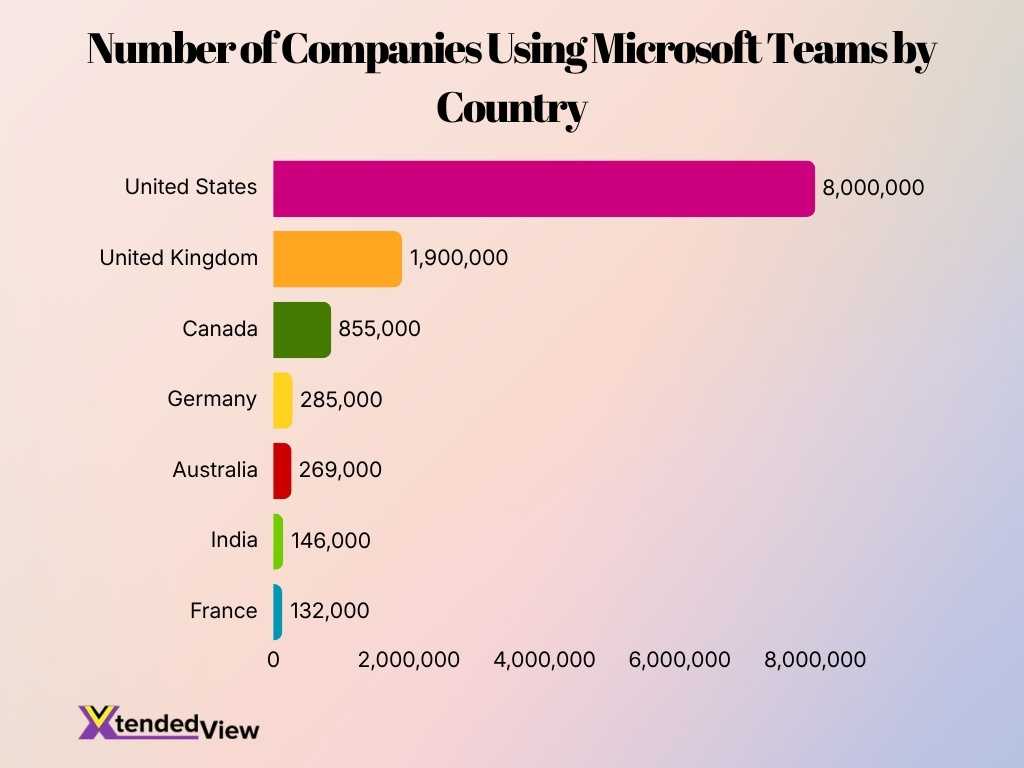
Microsoft Teams Adoption by Country
- The United States leads Microsoft Teams adoption, with approximately 8 million companies using the platform.
- The United Kingdom ranks second, recording nearly 1.9 million companies that have adopted Microsoft Teams.
- Canada has around 855,000 companies using Microsoft Teams, making it the third-largest market in the dataset.
- Microsoft Teams is used by approximately 285,000 companies in Germany, the highest figure among the listed continental European countries.
- Australia follows closely behind Germany, with nearly 269,000 companies adopting the collaboration platform.
- In India, approximately 146,000 companies use Microsoft Teams for workplace communication and collaboration.
- France records the lowest adoption figure among the listed countries, with around 132,000 companies using Microsoft Teams.
- The United States has over four times more Microsoft Teams companies than the United Kingdom, highlighting its dominant market position.
- Together, the seven listed countries account for approximately 11.59 million companies using Microsoft Teams.
Platform and Device Usage (Desktop vs Mobile)
- Weekly Teams mobile users experienced a growth of over 300% between early February and March 2020.
- Teams Essentials accommodates up to 300 participants with meetings lasting up to 30 hours across platforms.
- Teams Free supports cross-device group meetings with a strict time limit of 60 minutes.
- The platform reached approximately 320 million daily active users globally across all devices as of 2024.
- Mobile app downloads for Microsoft Teams in the EMEA region spiked by 750% during early 2020.
- The Asia-Pacific region alone generated 129 million mobile downloads in the second quarter of 2020.
- Professionals aged 35 to 44 represent the largest active user demographic on the platform at 31.23%.
- Microsoft Teams facilitates an average of 2.7 billion meeting minutes across devices every single day.
Meetings and Calling Activity Statistics
- Teams meeting minutes increased fourfold over the two years preceding February 2025.
- More than 20 million users enabled telephone network connectivity through Teams Phone by 2025.
- Teams Essentials supports extended continuous meetings for up to 30 hours.
- A standard Teams Essentials meeting accommodates up to 300 participants.
- Large-scale Teams events can support audiences of up to 100,000 attendees.
- Free group meetings limit collaborative sessions to a maximum of 60 minutes.
- At peak times around 11 a.m., 54% of measured users were highly active in messaging.
- Infrastructure analytics successfully traced over 10 million calls within a single 24-hour period.
- Optimized call-placement methods reduced overloaded media processor handling by 2.5 times.
Microsoft Teams Benefits Over Three Years
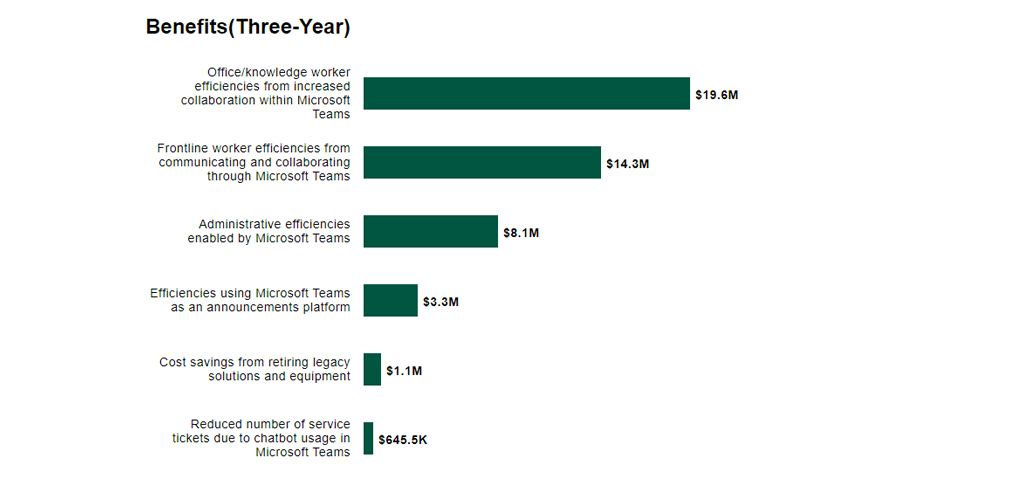
- Office and knowledge worker efficiencies deliver the highest three-year benefit at $19.6 million, driven by stronger collaboration in Microsoft Teams.
- Frontline worker communication and collaboration efficiencies generate $14.3 million, making them the second-largest financial benefit.
- Administrative efficiencies enabled by Microsoft Teams contribute approximately $8.1 million over three years.
- Using Microsoft Teams as an announcements platform creates an estimated $3.3 million in efficiency gains.
- Retiring legacy solutions and equipment produces around $1.1 million in cost savings.
- Microsoft Teams chatbot usage reduces service-ticket volumes and generates approximately $645,500 in benefits.
- Combined, the six measured benefits total approximately $47.05 million over the three-year period.
Chat and Messaging Volume Statistics
- The average employee received 153 Teams messages per weekday in Microsoft’s 2025 workplace telemetry study. The dataset covered trillions of productivity signals from Microsoft 365 users.
- Teams message volume per employee increased 6% year over year worldwide in 2025, showing that chat continued to replace some email and scheduled meeting activity.
- Message volume grew by more than 20% across Central and Eastern Europe, the Middle East, and Africa. These regions recorded more than three times the global growth rate.
- Teams messages per employee rose by more than 15% in the U.K. and South Korea, providing two country-level examples of above-average communication growth.
- By 8 a.m., Teams had overtaken email as the dominant communication channel during the typical workday. This pattern shows how quickly real-time collaboration begins after employees log on.
- At 11 a.m., 54% of measured users actively exchanged messages, making late morning one of the busiest periods for workplace communication.
- Tuesday accounted for 23% of weekly meetings in the 2025 study. High meeting concentration also increased surrounding chat activity as employees shared links, notes, and follow-up requests.
- Almost 29% of active employees returned to their inboxes by 10 p.m., reflecting how communication increasingly extends beyond traditional working hours.
- Teams Essentials provides unlimited workplace chat for organizations with up to 300 users, alongside meeting, file-sharing, and task-management functions.
File Sharing and Collaboration Activity
- Teams Essentials gives each licensed user 10 GB of cloud storage, allowing a 300-person organization to provision up to 3 TB of user-level storage under the plan.
- Microsoft 365 Business Basic provides 1 TB of cloud storage per user, or 100 times the per-user storage included with Teams Essentials.
- Microsoft 365 Business Standard also includes 1 TB per user, along with desktop, web, and mobile productivity applications connected to Teams.
- Teams Free provides 5 GB of cloud storage for an individual account and supports document sharing within chats, calls, and communities.
- Teams users can collaborate through shared files, task lists, polls, channels, and integrated applications rather than moving between separate communication tools.
- Microsoft 365 Business Basic includes more than 10 additional applications, including Planner, Forms, and Bookings, which extend collaboration beyond messaging and meetings.
- Microsoft 365 Business Standard adds more than 10 connected applications, including Microsoft Loop, Planner, Forms, Bookings, and Microsoft Clipchamp.
- Teams activity reports can measure active teams, channels, meetings, and users across 7-, 30-, 90-, and 180-day periods, helping administrators assess collaboration patterns.
- Microsoft encrypts meetings, chats, calls, and files in qualifying Teams plans, protecting content while users collaborate across supported devices.
Microsoft 365 Commercial Cloud Growth Accelerates
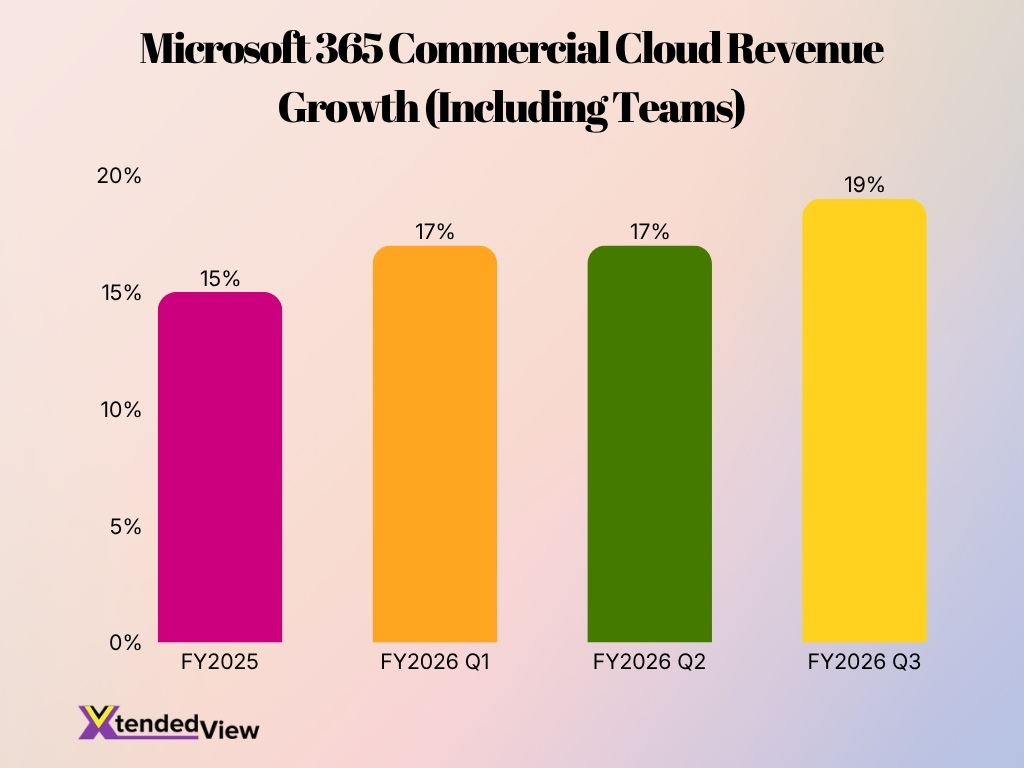
- Microsoft 365 Commercial Cloud revenue grew 15% year over year in FY2025, establishing a strong growth baseline.
- Growth increased to 17% in FY2026 Q1, marking a 2 percentage point rise from FY2025.
- Revenue growth remained steady at 17% in FY2026 Q2, indicating consistent commercial cloud demand.
- Growth accelerated further to 19% in FY2026 Q3, the highest rate recorded in the period.
- From FY2025 to FY2026 Q3, growth improved by 4 percentage points, highlighting stronger business momentum.
- The upward trend reflects continued adoption of Microsoft 365 cloud services, including collaboration tools such as Microsoft Teams.
Security, Compliance, and Premium License Adoption
- Microsoft processes more than 100 trillion security signals each day, creating a large threat-intelligence foundation for products across Microsoft 365 and Teams.
- Its security systems block approximately 4.5 million new malware attempts per day across the wider Microsoft ecosystem.
- Microsoft analyzes about 38 million identity-risk detections daily, which matters for Teams because compromised accounts can expose meetings, messages, and shared files.
- Security systems screen approximately 5 billion emails each day for malware and phishing. While this measure covers email, the same identities often connect to Microsoft 365 and Teams accounts.
- Identity-based attacks increased 32% during the first half of 2025, adding pressure on organizations to strengthen authentication and access controls.
- More than 97% of identity attacks involved passwords, including large-scale credential guessing and leaked-password attacks.
- Attackers attempted to steal or leak data in 80% of investigated cyber incidents between July 2024 and June 2025.
- Microsoft Incident Response observed data collection in 79.5% of reactive engagements, underscoring why Teams administrators need retention, access, and information-protection controls.
- Financial gain motivated at least 52% of cyberattacks with identifiable objectives, while espionage accounted for only 4%.
- Teams Premium adds advanced meeting protection and AI-powered capabilities, but Microsoft had not published a verified global Premium license count as of July 2026. Therefore, precise adoption percentages remain unavailable.
Frequently Asked Questions (FAQs)
Microsoft Teams has approximately 320 million monthly active users worldwide, making it one of the largest workplace collaboration platforms.
Microsoft reported more than 20 million Teams Phone PSTN users, highlighting strong enterprise adoption of its cloud calling solution.
Microsoft Teams usage reports allow administrators to analyze activity trends over 7, 30, 90, or 180 days.
Microsoft Teams usage data typically becomes available within 48 hours after user activity occurs.
Microsoft considers users active when they perform intentional actions such as starting chats, joining meetings, making calls, sharing files, or editing documents, while passive actions are excluded from the metrics.
Conclusion
Microsoft Teams continues to strengthen its position as one of the world’s leading workplace collaboration platforms. With more than 350 million monthly active users, continued investment in AI-powered capabilities, and deep integration across the Microsoft 365 ecosystem, Teams remains central to how organizations communicate, collaborate, and manage hybrid work.
The latest statistics also show that Teams is evolving beyond video meetings into a unified productivity hub. Growing chat volumes, enterprise adoption, cloud collaboration, and expanding AI functionality demonstrate how businesses increasingly rely on the platform for everyday operations. At the same time, Microsoft continues investing in security, compliance, and premium collaboration features to support organizations of every size.
As the collaboration software market continues to expand, Teams is well-positioned to maintain its leadership by combining communication, document collaboration, enterprise calling, and AI-assisted workflows into a single integrated experience.
