



Video collaboration platforms now power everything from hybrid work and virtual healthcare to online education and customer support. As organizations continue investing in AI-enabled collaboration, Zoom and Microsoft Teams remain two of the most influential platforms shaping how people communicate and work together. This article explores the latest statistics, market trends, user adoption, and business performance to help you understand how both platforms compare.
Editor’s Choice
- Microsoft Teams surpassed 320 million monthly active users, maintaining its position as one of the world’s largest workplace collaboration platforms.
- Zoom generated $4.87 billion in fiscal year 2026 revenue, representing 4.4% year-over-year growth.
- Zoom’s enterprise revenue reached $2.93 billion in FY2026, increasing 6.5% year over year and outpacing overall company growth.
- More than 4,500 Zoom enterprise customers each contributed over $100,000 in trailing 12-month revenue by April 2026.
- Microsoft Teams continues to benefit from deep integration with Microsoft 365, making it the default collaboration platform across millions of enterprise deployments.
- Zoom continues expanding beyond meetings through AI-powered collaboration, cloud telephony, contact center services, and employee engagement products, broadening its enterprise footprint.
- Both platforms increasingly compete on AI productivity features rather than video conferencing alone, reflecting the industry’s shift toward intelligent workplace collaboration.
Recent Developments
- During fiscal year 2026, Zoom introduced additional AI capabilities across meetings, chat, phone, and contact center products to strengthen its AI-first collaboration platform.
- Zoom announced the acquisition of Common Room in 2026 to enhance buyer intelligence and AI-powered revenue solutions.
- Zoom expanded its enterprise communications portfolio by introducing new AI agent capabilities for customer service and virtual receptionist solutions in 2026.
- Zoom reported Q4 FY2026 revenue of $1.247 billion, up 5.3% year over year.
- Enterprise revenue reached $757.3 million during Q4 FY2026, growing 7.1% compared with the previous year.
- Zoom’s remaining performance obligations increased to approximately $4.2 billion, indicating continued enterprise demand and long-term contracted revenue.
- Microsoft continues enhancing Teams through Microsoft Copilot integration, making AI-generated meeting summaries, chat assistance, and workflow automation standard productivity features.
- Competition among Zoom, Microsoft Teams, and Google Meet has intensified as vendors increasingly bundle AI collaboration features into broader productivity suites.
Zoom and Microsoft Teams Dominate the Video Conferencing Market
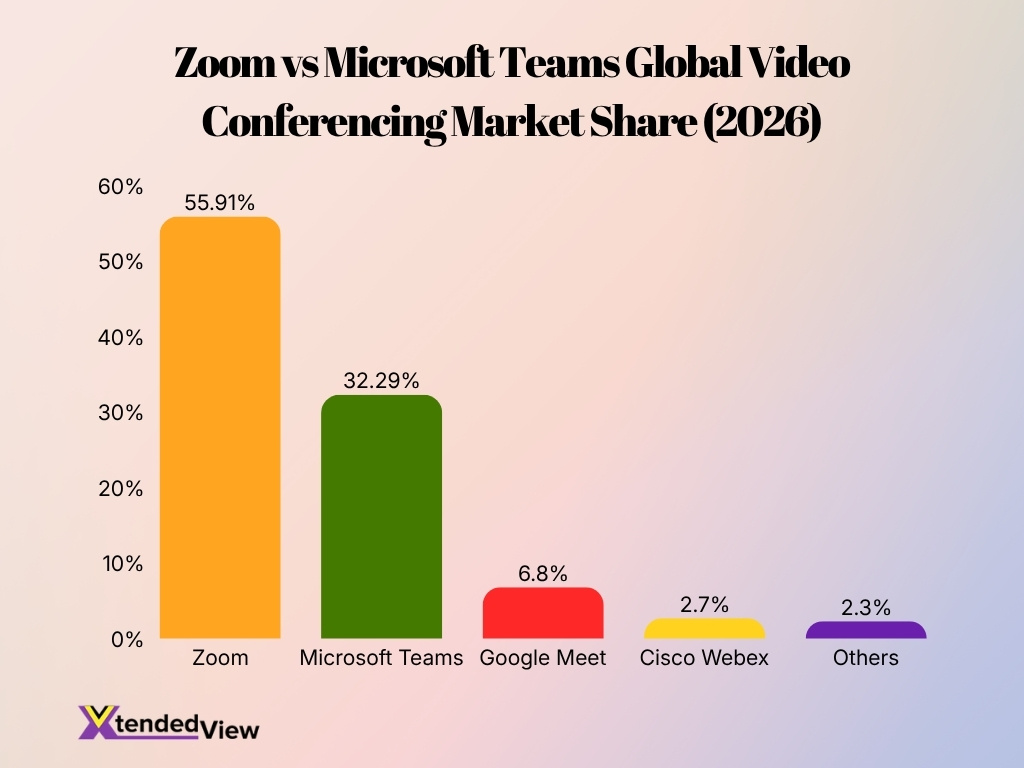
- Zoom leads the global video conferencing market with a 55.91% share, giving it a clear advantage over every competing platform in 2026.
- Microsoft Teams holds the second-largest market share at 32.29%, although it remains 23.62 percentage points behind Zoom.
- Together, Zoom and Microsoft Teams account for 88.20% of the market, highlighting the strong concentration of users among the two leading platforms.
- Google Meet ranks third with a 6.8% market share, but its presence is substantially smaller than both Zoom and Microsoft Teams.
- Cisco Webex captures only 2.7% of the global market, placing it well behind Google Meet and the two dominant industry leaders.
- Other video conferencing platforms collectively represent just 2.3% of the market, showing limited room for smaller competitors.
- Zoom’s market share is approximately 1.73 times larger than Microsoft Teams’ share, reinforcing its position as the market leader.
- The top three platforms, including Zoom, Microsoft Teams, and Google Meet, control 95% of the market, leaving only 5% for Cisco Webex and other providers.
- The figures suggest that the global video conferencing industry is highly consolidated, with nearly nine out of every 10 market-share points held by Zoom and Microsoft Teams.
- Despite strong competition from Microsoft Teams, Zoom remains the preferred platform by a wide margin, controlling more than half of the entire market.
Revenue and Growth Trends
- Zoom generated $4.87 billion in fiscal 2026 revenue, up 4.4% from $4.67 billion in fiscal 2025.
- Zoom’s fiscal 2026 enterprise revenue reached $2.93 billion, an increase of 6.5% year over year. Enterprise sales grew faster than the company’s overall revenue.
- Zoom’s online revenue totaled $1.93 billion in fiscal 2026, rising 1.2% from the previous fiscal year.
- In the fourth quarter of fiscal 2026, Zoom recorded $1.25 billion in revenue, representing 5.3% annual growth.
- Zoom’s fourth-quarter enterprise revenue increased 7.1% to $757.3 million, while online revenue rose 2.6% to $489.7 million.
- Zoom started fiscal 2027 with quarterly revenue of $1.24 billion, up 5.5% year over year. Enterprise revenue grew 7.2% to $755.7 million during the same quarter.
- Microsoft generated $281.7 billion in total revenue during fiscal 2025, an increase of 15% from fiscal 2024. However, the company does not disclose Microsoft Teams as a separate revenue line.
- Microsoft 365 Commercial products and cloud services revenue grew 14% in fiscal 2025, supported by seat growth and higher average revenue per user. Teams forms part of this broader commercial cloud portfolio.
- Microsoft reported fourth-quarter fiscal 2025 revenue of $76.4 billion, up 18% year over year, while Microsoft 365 Commercial cloud remained a major growth contributor.
User Base and Adoption Statistics
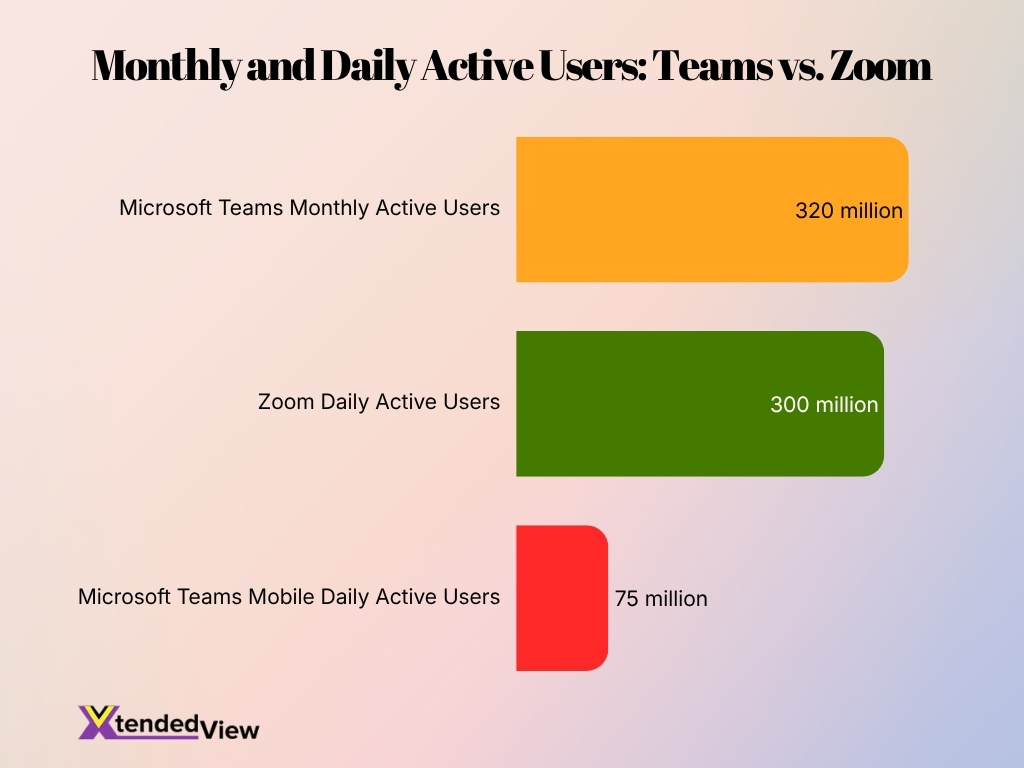
- Microsoft Teams recently surpassed 320 million monthly active users globally.
- A staggering 93% of Fortune 100 companies actively use Microsoft Teams for collaboration.
- The average employee receives 153 Microsoft Teams messages every standard workday.
- Zoom achieved a total annual revenue of $4.86 billion for fiscal year 2026.
- Zoom recorded 4,468 enterprise customers generating over $100,000 in trailing 12-month revenue.
- Zoom Phone reached a massive milestone by surpassing 10 million paid seats.
- Zoom consistently hosts over 300 million daily meeting participants worldwide.
- Users collectively spend 3.3 trillion minutes annually participating in Zoom meetings.
Daily and Monthly Active Users
- Microsoft Teams boasts over 320 million monthly active users globally.
- Zoom sustains high engagement with over 300 million daily active users.
- A remarkable 93% of Fortune 100 companies rely on Microsoft Teams.
- Zoom serves 504,900 business customers worldwide for critical enterprise communications.
- Microsoft Teams generates an estimated $8 billion in annual revenue.
- Zoom tracks over 2,278 enterprise clients contributing $100,000+ annually.
- The average worker processes 153 Microsoft Teams messages every workday.
- Global workflow collaboration drives 3.3 trillion annual meeting minutes on Zoom.
- Teams mobile adoption has expanded to over 75 million daily active users.
Business and Enterprise Customer Counts
- Zoom ended April 2026 with 4,534 customers contributing more than $100,000 in annual revenue.
- The same metric stood at 4,192 customers one year earlier, reflecting 8.2% annual growth.
- Zoom’s enterprise customers generated 61% of company revenue during Q1 FY2026.
- Customers spending over $100,000 annually represented 32.7% of quarterly revenue during Q1 FY2026.
- Zoom reported 9.3% year-over-year growth in customers contributing more than $100,000 during FY2026.
- Enterprise revenue reached $757.3 million during Q4 FY2026, increasing 7.1% year over year.
- Microsoft Teams remains deeply embedded across enterprise organizations through Microsoft 365 commercial licensing, making it one of the most widely deployed workplace collaboration platforms.
- Enterprise competition increasingly centers on AI capabilities, workflow integration, security, and platform breadth rather than video meetings alone.
Industry and Segment Usage Breakdown
- Zoom’s enterprise sales generated 60.3% of its $4.87 billion total fiscal 2026 revenue.
- The online segment produced the remaining 39.7% of Zoom’s fiscal 2026 revenue.
- Zoom saw a 9.3% year-over-year growth in customers contributing over $100,000 in trailing revenue.
- Microsoft Teams Essentials targets organizations with up to 300 users, while Teams Enterprise targets over 300 seats.
- A 2025 workplace study revealed that 53% of business leaders required a productivity increase.
- In the same study, 80% of workers reported lacking the time or energy to finish their work.
- Expanding capacity through digital labor was a leading priority for 45% of leaders over the next 12 to 18 months.
- A 2026 analysis of over 100,000 AI conversations found that 49% supported cognitive work.
Video Conferencing Platform Usage by Country
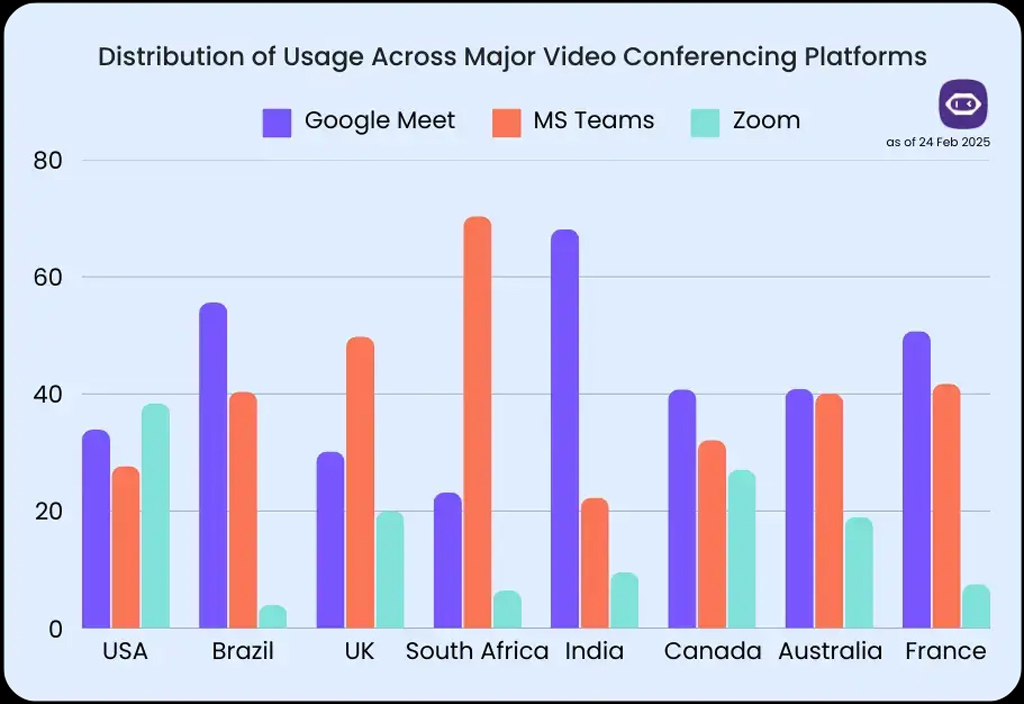
- Google Meet leads in India at 68%, its highest usage share among the eight countries.
- MS Teams dominates South Africa with 70%, the strongest platform share shown in the chart.
- Zoom performs best in the USA at 38%, narrowly ahead of Google Meet at 34%.
- Google Meet leads Brazil with 56%, while Zoom records only 4% usage.
- In the UK, MS Teams holds a 50% share, compared with 30% for Google Meet and 20% for Zoom.
- Canada has a more balanced market, with Google Meet at 40%, MS Teams at 32%, and Zoom at 27%.
- Australia is almost evenly split between Google Meet at 40% and MS Teams at 40%, while Zoom trails at 19%.
- In France, Google Meet ranks first at 50%, followed by MS Teams at 42% and Zoom at 8%.
- Google Meet is the leading platform in five countries, including Brazil, India, Canada, Australia, and France.
- MS Teams leads in the UK and South Africa, while Zoom leads only in the USA.
SMB vs. Enterprise Deployment Statistics
- Zoom’s fiscal 2026 enterprise revenue grew 6.5%, compared with only 1.2% growth in online revenue, showing stronger momentum among managed business accounts.
- Enterprise customers generated $2.93 billion for Zoom in fiscal 2026, compared with $1.93 billion from its online customer segment.
- Zoom’s enterprise segment produced roughly $1 billion more revenue than its online segment during fiscal 2026.
- Customers contributing more than $100,000 in annual revenue grew 9.3% year over year, exceeding Zoom’s 4.4% total revenue growth rate.
- Zoom’s enterprise net dollar expansion rate reached 99% in the first quarter of fiscal 2027, up from 98% one year earlier.
- Microsoft Teams Essentials supports meetings for as many as 300 participants, making the package suitable for small and midsize organizations.
- Teams Essentials allows meetings lasting up to 30 hours and provides 10 GB of cloud storage per user.
- Microsoft separates its offering into plans for organizations with up to 300 users and enterprise packages for deployments above that threshold.
- Microsoft 365 Commercial products and cloud services revenue increased 14% in fiscal 2025, reflecting continued business demand for the productivity ecosystem that includes Teams.
Device and Platform Usage Statistics
- Microsoft Teams Essentials permits meetings lasting up to 30 hours, compared to a 60-minute limit on free group calls.
- Zoom’s free plan limits group meetings to 40 minutes for up to 100 participants.
- Teams Essentials provides 10 GB of cloud storage per user to support file sharing alongside chat and meetings.
- Microsoft Teams includes live captions in more than 40 languages on its free service.
- Major videoconferencing applications use an average of 0.8 Mbps to 1.9 Mbps on an unconstrained connection.
- Some video applications require as long as 50 seconds to recover after a temporary drop in available network capacity.
- Select paid plans on Zoom and Microsoft Teams allow continuous session durations of up to 30 hours.
- Microsoft Teams supports 4 major operating systems natively, while Linux users access the app via a progressive web application.
- Zoom supports 6 distinct platform and browser ecosystems, including Windows, macOS, Android, iOS, Chrome, and web browsers.
Adoption in Education and Public Sector
- Microsoft’s free Teams plan supports group meetings lasting up to 60 minutes.
- Zoom’s free meeting tier supports 100 participants, expanding up to 1,000 participants on paid plans.
- Microsoft reported fiscal 2025 cloud revenue of $168.9 billion, supporting massive public-sector infrastructure.
- Microsoft’s Intelligent Cloud revenue reached $29.9 billion in Q4 2025, marking a 26% increase.
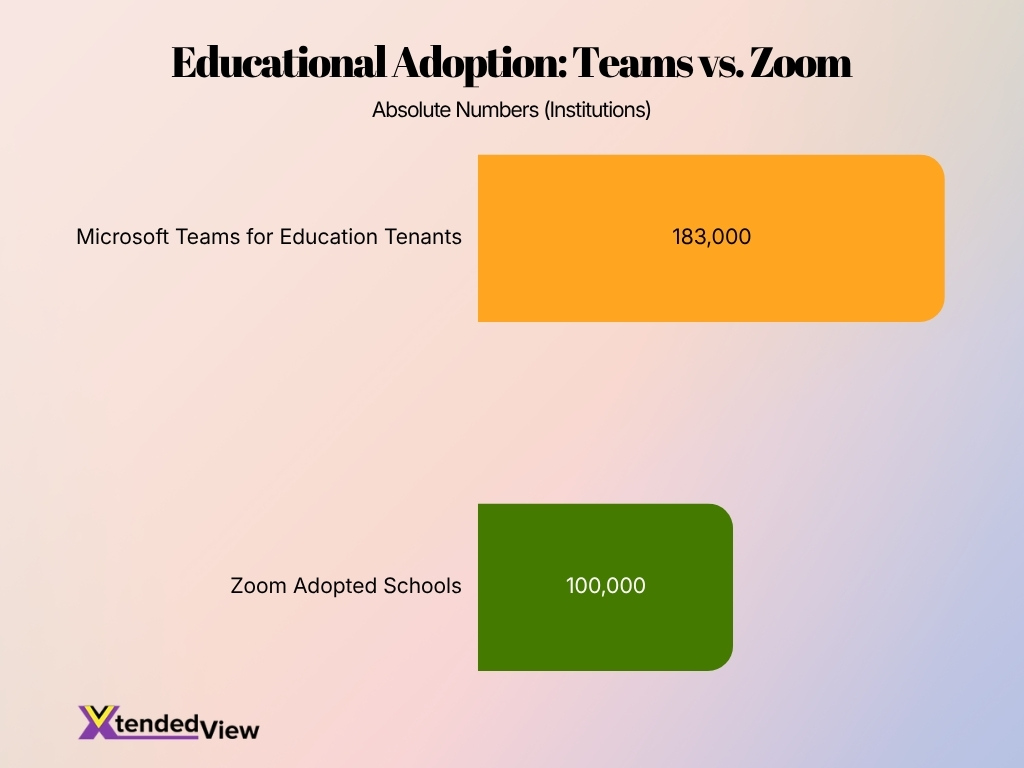
- Microsoft Teams for Education is utilized by 183,000 tenants in 175 nations.
- Zoom holds a commanding 55.9% market share in the global video conferencing space.
- Over 100,000 schools across 25 countries have adopted Zoom for remote educational learning.
- Around 87% of teachers worldwide plan to use technology like Microsoft Teams for hybrid education.
- Usage of Microsoft Teams video calls surged with a massive 1000% increase since the pandemic began.
- Zoom consistently hosts over 300 million daily meeting participants across business and education sectors.
Meeting Volume and Minutes Hosted
- The average employee received 153 Teams messages per weekday in 2025, illustrating how much Teams usage now occurs outside formal video meetings.
- Teams messages per worker increased 6% globally from the previous year.
- By 8 a.m., Teams overtook email as the dominant workplace communication channel in the 2025 activity data.
- Employees faced an estimated 275 meetings, emails, or chat interruptions per day, equal to one interruption about every two minutes during core work hours.
- Approximately 60% of workplace meetings occurred on an ad hoc basis rather than through advance scheduling.
- Employees received an average of 58 chat messages outside regular working hours, while after-hours chat volume rose 15% year over year.
- Tuesday accounted for 23% of weekly meetings, making it the busiest meeting day in the 2025 activity sample.
- Nearly 29% of active employees returned to their inboxes by 10 p.m., showing how digital collaboration increasingly extends beyond the traditional workday.
- A 2025 meeting survey found that 46% of leaders believed they spent more time than they wanted in virtual meetings, compared with 37% of employees.
- Another workforce survey found that 46% of employees attended at least three meetings per day, while 41.8% said a typical meeting lasted between 30 minutes and one hour.
Webinar and Large Event Usage Statistics
- Zoom customers hosted more than 9 million webinars during calendar year 2025, equal to roughly 24,700 webinars per day.
- Those Zoom webinars attracted more than 692 million attendees in 2025, demonstrating demand for virtual training, product launches, investor events and customer education.
- Attendees collectively spent approximately 616 million hours watching Zoom webinars during 2025.
- Based on those totals, an average Zoom webinar attracted about 77 attendees and generated nearly 68 attendee-hours in 2025. This calculation uses reported annual event and attendance figures.
- Microsoft Teams supports fully interactive webinars for up to 1,000 attendees, including camera, microphone, and registration capabilities.
- Standard Teams town halls can accommodate as many as 10,000 view-only attendees, while enhanced event packages can extend capacity substantially.
- Teams can support interactive events for up to 3,000 attendees under eligible configurations and large-scale events for as many as 100,000 attendees with capacity packs and event services.
- Microsoft Teams meetings, webinars and town halls can each run for up to 30 hours, giving organizations enough time for conferences, training programs and multiregion broadcasts.
- In 2025, 98% of surveyed marketers planned to strengthen their webinars with artificial intelligence, showing that automation, content repurposing and audience analysis now shape virtual event strategies.
- More than 30% of organizations had produced webinars for at least four years by 2025, indicating that webinars have become an established business channel rather than a temporary remote-work substitute.
Zoom vs Microsoft Teams Business Use Statistics
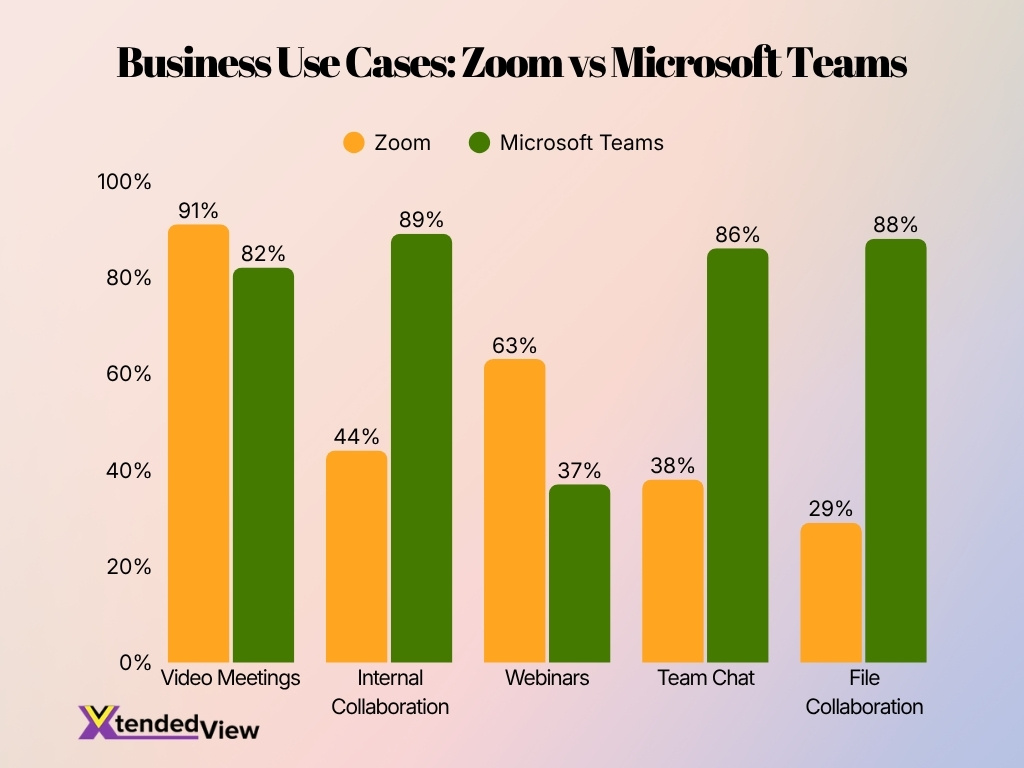
- Zoom leads in video meetings, with 91% usage compared with 82% for Microsoft Teams, highlighting Zoom’s continued strength as a dedicated video conferencing platform.
- Microsoft Teams dominates internal collaboration, recording 89% usage versus only 44% for Zoom, as businesses rely on Teams for broader workplace communication.
- For webinars, Zoom holds a significant advantage at 63%, while Microsoft Teams accounts for 37%, showing Zoom’s popularity for virtual events and presentations.
- Microsoft Teams is the preferred platform for team chat, with an adoption rate of 86%, more than double Zoom’s 38% share.
- In file collaboration, Microsoft Teams reaches 88% usage compared with just 29% for Zoom, reflecting its close integration with Microsoft 365 tools.
- Overall, Zoom performs best for video-focused activities, while Microsoft Teams leads in collaboration, messaging, and file-sharing use cases.
Collaboration and Productivity Usage Metrics
- Employees received an average of 153 Teams messages per weekday in 2025, illustrating how workplace collaboration extends well beyond scheduled video calls.
- The average employee faced approximately 275 meetings, emails, or chat notifications per day, creating an interruption about once every two minutes during core working hours.
- Nearly 48% of employees said their work felt chaotic and fragmented, compared with 52% of organizational leaders.
- About 60% of meetings occurred without advance scheduling, increasing the pressure created by spontaneous calls and chat-driven collaboration.
- After-hours chat activity increased 15% year over year in 2025, showing that digital collaboration increasingly extends beyond traditional office schedules.
- Employees received an average of 58 messages outside regular working hours, adding to the risk of communication overload.
- A 2025 survey found that 80% of employees and leaders lacked enough time or energy to complete their work, even as organizations sought higher productivity.
- Meanwhile, 53% of leaders said productivity needed to increase, highlighting the gap between organizational targets and available employee capacity.
- Approximately 82% of leaders expected to use digital labor to expand workforce capacity within the following 12 to 18 months. This shift supports greater use of AI assistants inside Teams and Zoom.
- Research highlighted by Zoom found that meeting friction costs employees approximately 1.6 hours each week and affects 94% of workers.
User Preference and Satisfaction Ratings
- 71% of business leaders said hybrid and remote working options had a positive effect on employee happiness and satisfaction.
- However, 36% of employees said remote work negatively affected workplace collaboration, suggesting that flexibility does not automatically produce stronger teamwork.
- Another 28% of workers said they carried a heavier workload while working remotely than they did in the office.
- 46% of leaders believed they spent more time than they wanted in virtual meetings, compared with 37% of employees.
- The nine-percentage-point difference suggests that meeting overload may affect managers more heavily because they participate in more cross-functional discussions. This is an inference from the survey results.
- Approximately 88% of employees considered in-person contact essential for developing strong and lasting workplace relationships, even as Zoom and Teams supported flexible work.
- 46% of surveyed employees attended at least three meetings per day, showing why meeting quality and ease of use strongly influence platform satisfaction.
- About 41.8% of employees said a typical meeting lasted from 30 minutes to one hour, making reliability, audio quality, and simple controls important user-experience factors.
- Independent network testing found that leading video platforms consumed an average of 0.8 Mbps to 1.9 Mbps on unconstrained connections. These variations can affect satisfaction for users with limited bandwidth.
- Under temporary bandwidth reductions, some conferencing applications required up to 50 seconds to recover, which can cause frozen video, delayed audio, and lower meeting satisfaction.
Zoom vs Microsoft Teams Pricing Insights
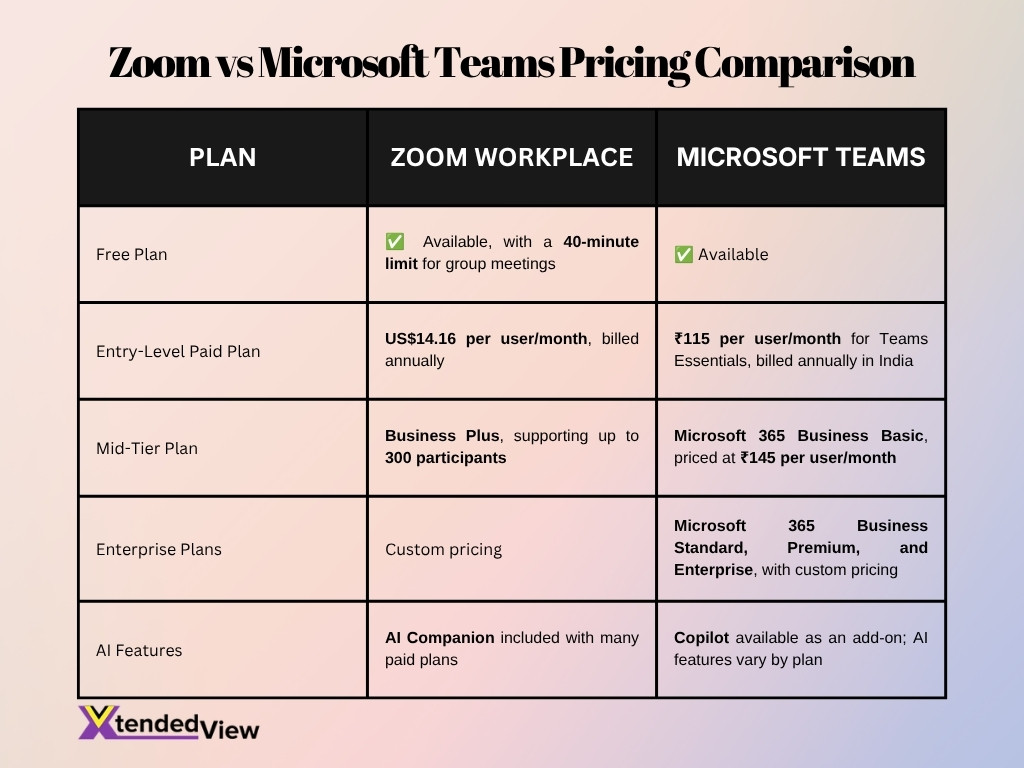
- Both Zoom Workplace and Microsoft Teams offer free plans, although Zoom limits group meetings to 40 minutes.
- Zoom’s entry-level paid plan costs $14.16 per user per month with annual billing, while Teams Essentials starts at ₹115 per user per month in India.
- For growing organizations, Zoom’s Business Plus plan supports meetings with up to 300 participants.
- Microsoft offers Microsoft 365 Business Basic as a mid-tier option at ₹145 per user per month.
- Both platforms provide enterprise-level plans, but pricing generally depends on company size, features, security requirements, and contract terms.
- Zoom includes AI Companion with many paid subscriptions, potentially reducing the need for a separate AI add-on.
- Microsoft’s Copilot is typically offered as an additional paid feature, while the availability of other AI tools varies by plan.
- Overall, Microsoft Teams may provide a more affordable entry point, while Zoom emphasizes meeting capacity, video conferencing, and bundled AI capabilities.
Security and Compliance Adoption Metrics
- Zoom maintains 4 core enterprise certifications including SOC 2, ISO 27001, HIPAA, and FedRAMP.
- FedRAMP delivers 1 standardized security framework for public-sector cloud products.
- Microsoft Teams supports live captions in more than 40 languages to meet accessibility requirements.
- A 2025 privacy study exposed excessive data collection concerns within third-party Zoom applications.
- Researchers tracked changes in the Zoom application marketplace over a period of exactly 1 year.
- A 2025 systematic review analyzed 10 years of Zero Trust adoption and research.
- The comprehensive Zero Trust review evaluated published academic work from 2016 through 2025.
- Microsoft Teams strengthened its default messaging security controls starting in January 2026.
Future Growth and Forecast Statistics
- The global web conferencing market reached an estimated $24.9 billion in 2026, up from $22.5 billion in 2025.
- That market could reach $69.52 billion by 2036, representing a projected compound annual growth rate of 10.8% from 2026 through 2036.
- The forecast implies an additional $44.59 billion in web conferencing market value over the 10-year period.
- A separate forecast valued the broader video conferencing market at $41.62 billion in 2026 and projected it to reach $65.72 billion by 2034.
- That video conferencing projection represents a 5.9% annual growth rate, indicating steady expansion as hybrid meetings become part of standard business infrastructure.
- The unified communications market could grow from $229.4 billion in 2026 to $417.9 billion by 2030, reflecting a projected 17.4% compound annual growth rate.
- The cloud-based unified communications market could expand from $66.42 billion in 2025 to $276.9 billion by 2034, producing a forecast annual growth rate of 17.1%.
- Another market estimate placed unified communications and collaboration spending at $236.21 billion in 2026, with a potential increase to $779.47 billion by 2031.
- The professional audiovisual market could rise from $332 billion in 2025 to $402 billion in 2030, with conferencing and collaboration technology remaining its largest solution category.
- Zoom entered fiscal 2027 with quarterly revenue growth of 5.5%, while continued investment in AI tools, contact centers and workplace products indicates that its future growth depends on services beyond conventional video meetings.
Frequently Asked Questions (FAQs)
Microsoft Teams has more than 320 million monthly active users worldwide.
Zoom generated $4.87 billion in total revenue during fiscal year 2026, representing 4.4% year-over-year growth.
Zoom reported that more than 4,500 enterprise customers each contributed over $100,000 in trailing 12-month revenue by the end of fiscal 2026.
Enterprise customers generated approximately 60.3% of Zoom’s fiscal 2026 revenue, contributing $2.93 billion out of $4.87 billion in total revenue.
Microsoft Teams supports up to 10,000 view-only attendees in a standard town hall event, with higher capacities available through enhanced event options.
Conclusion
Zoom and Microsoft Teams remain two of the most important collaboration platforms, but they serve different organizational priorities. Microsoft Teams offers a strong fit for companies already using Microsoft 365, especially those that need integrated chat, file sharing, meetings and enterprise administration in one environment. Zoom continues to stand out for external meetings, webinars, large virtual events and flexible communication across different organizations. As both platforms expand their AI, automation, security and workflow features, the best choice will depend less on basic video quality and more on ecosystem fit, event scale, compliance needs and long-term collaboration goals.