


Social media has become one of the most influential channels for businesses worldwide. Companies of all sizes rely on social platforms not just for brand visibility, but also for customer engagement, lead generation, and revenue growth. From small local shops driving in‑store traffic to global brands targeting millions with paid ads, social media shapes how businesses connect with audiences today. Explore the latest data below to understand how social platforms impact business strategy and outcomes this year.
Editor’s Choice
- 5.66 billion people globally are active on social media platforms in 2026, representing roughly 69% of the world’s population.
- About 93% of all internet users use social media monthly.
- The U.S. now has approximately 253 million social media users, covering nearly four‑fifths of its internet population.
- Social media advertising spend is forecast to exceed $300 billion in 2025 and 2026.
- Businesses report that 96% of small companies use social media to market their business.
- On average, people use 6.75 social platforms per month.
- Social media ads account for roughly 3 in every 10 dollars of digital ad spend.
Recent Developments
- Reddit’s ad revenue rose 75% year‑over‑year in Q4 2025, showing strong advertiser demand.
- Snap reports a 28% increase in active advertisers by the end of 2025.
- AI is becoming central to social advertising, with major platforms aiming to fully automate ad targeting by 2026.
- Creator‑focused ads are rapidly growing; creator economy ad spend in the U.S. more than doubled since 2021.
- Social video formats remain a key focus, with brands prioritising short‑form content across networks.
- Platform competition intensifies as networks innovate features to help businesses reach audiences.
- Social media continues to absorb ad dollars traditionally spent on legacy media.
What Is Social Media for Business?
- Social media for business refers to using platforms like Facebook, Instagram, TikTok, LinkedIn, and X to reach audiences, engage customers, build brand awareness, and drive sales.
- It includes content creation, community engagement, and paid advertising.
- Businesses use these channels for direct dialogue with customers.
- Social platforms act as search engines for product discovery.
- They enable targeted advertising based on demographic and behavioural data.
- Engagement metrics inform product and marketing decisions.
- Small and mid‑sized enterprises leverage platforms to level the competitive field.
- Paid social ads allow precise audience targeting vs. broad traditional media buys.
Key Social Media for Business Statistics
- 5.66 billion people use social media globally in 2026.
- Social media usage grew about 4.8% year‑on‑year.
- 93% of internet users now engage with social platforms.
- Average daily social media engagement is around 2 h 21 m per user.
- U.S. social media users number ~253 million as of early 2025.
- Users access roughly 6.75 platforms monthly.
- Video content constitutes 61%+ of social time in the U.S. in 2025.
- Social networking penetration is nearing 70% worldwide.
Social Media Adoption by Businesses
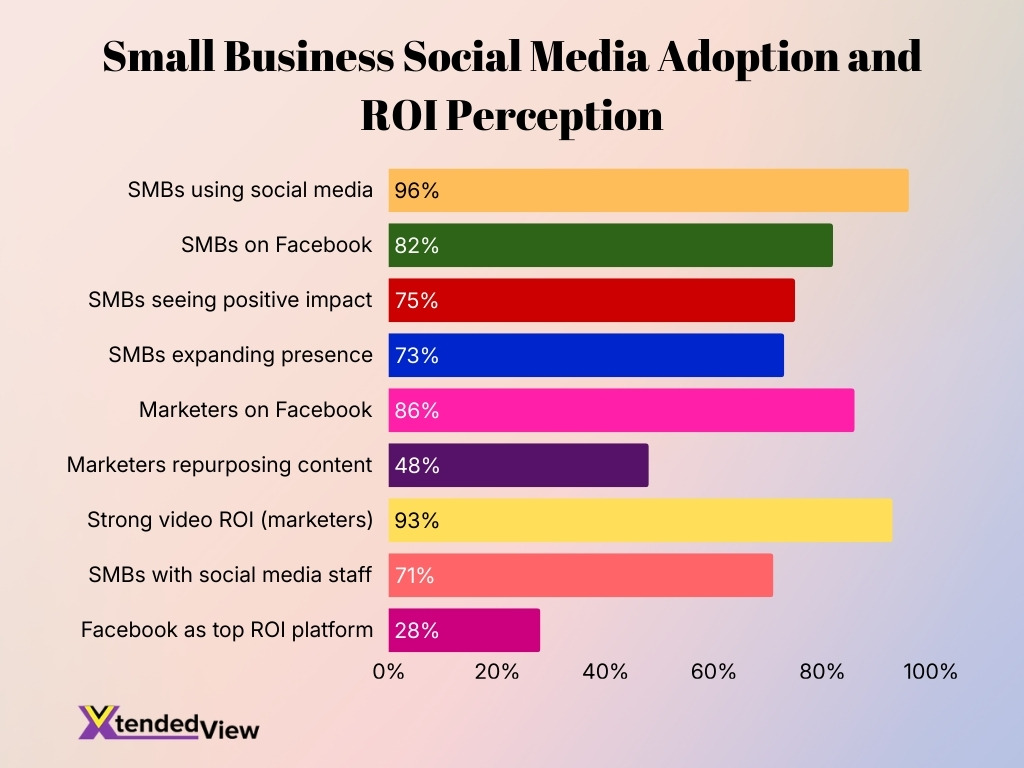
- 96% of small businesses use social media in their marketing strategy.
- 82% of small businesses use Facebook for promotion and customer connection.
- Over 75% of small- and medium-sized businesses agree that social media positively impacts performance.
- 73% of small businesses plan to expand their social media presence next year.
- 86% of marketers report using Facebook for brand marketing worldwide.
- 48% of social media marketers repurpose content across platforms.
- 93% of marketers report strong ROI from video marketing.
- 71% of small businesses have dedicated staff for social media content creation.
- 28% of marketers cite Facebook as delivering the highest ROI.
Global Social Media Usage and Growth
- Global social media users reached 5.52 billion, or 67.8% of the world population.
- 259 million new social media user identities were added from early 2025 to 2026.
- 93.4% of global internet users actively use social platforms.
- Average weekly social media engagement hit 18 hours 47 minutes worldwide.
- Annual growth rate for social media users stayed steady at 4.8%.
- Adults 25-34 years form the largest user group at 31.2% globally.
- Asia drives growth with 2.46 billion users, 50%+ of total.
- Africa‘s social penetration surged to 43.9%, adding 72 million users.
- Latin America boasts 90.6% penetration among internet users.
- 98.5% of social media access occurs via mobile devices globally.
Social Media Usage by Business Size
- About 96% of small businesses use social media as a core marketing tool in 2026, with nearly universal adoption among smaller firms.
- Small businesses typically invest less than 6% of total marketing spend on paid social but see outsized engagement compared with traditional channels.
- Mid‑sized businesses report allocating roughly 12–18% of their marketing budget to social media channels in 2026.
- Large enterprises now dedicate 20%+ of marketing budgets to social platforms, reflecting strategic prioritisation.
- Small businesses are 23% more likely than average to see social media ROI from content marketing efforts.
- Adoption of AI content tools for social campaigns is reported by about 75% of medium and large businesses in 2026.
- Around 60% of small businesses consistently use analytics dashboards to measure social performance, up from ~45% in 2024.
- Larger brands are 2× more likely to run cross‑platform paid campaigns than smaller firms.
- Small firms increasingly tap into social commerce features, such as in‑app shops, to compete with larger competitors.
Social Media Impact Measurement Statistics
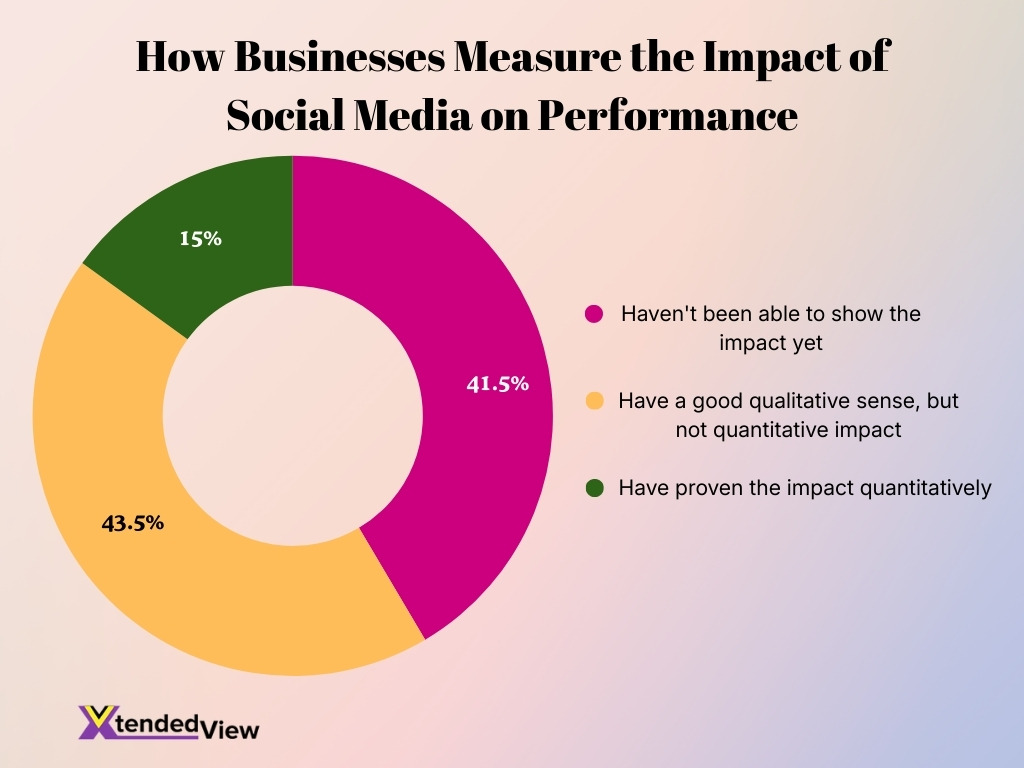
- 43.5% of businesses have a strong qualitative understanding of social media’s impact, but lack clear quantitative metrics to prove ROI.
- 41.5% of companies have not yet been able to demonstrate the business impact of social media through measurable data.
- Only 15.0% of organisations have successfully proven social media impact quantitatively, highlighting limited analytics maturity.
- Nearly 85% of businesses rely on estimates, assumptions, or indirect indicators instead of verified performance metrics.
- The data reveals a major measurement and attribution gap, preventing most brands from accurately linking social media to revenue, leads, and growth.
- These findings emphasise the urgent need for advanced analytics tools, better tracking systems, and ROI-focused strategies in social media marketing.
B2B vs B2C Social Media Statistics
- LinkedIn remains the top platform for B2B marketers, with an estimated 89% using it for lead generation and 62% confirming it produces tangible leads.
- Among B2C marketers, 51% say Facebook is the most important social platform for their business.
- Roughly 44% of B2B marketers also include Facebook in their strategy portfolio despite LinkedIn’s dominance.
- Instagram leads ROI for B2C campaigns, with 78% of B2C marketers reporting positive returns there.
- TikTok is cited as delivering the highest ROI for 32% of marketers, particularly in B2C campaigns focused on brand awareness.
- B2B social media budgets now frequently exceed 20% of total marketing spend, up from mid‑teens a few years earlier.
- Video content drives 34% higher conversion rates across platforms, relevant for both B2B and B2C strategies.
- Pinterest shopping ads show ~30% lower cost per conversion, a top tactic for B2C brands.
- Snapchat AR ads deliver 2.5× higher engagement, appealing more to B2C than B2B audiences.
Most Used Social Media Platforms by Businesses
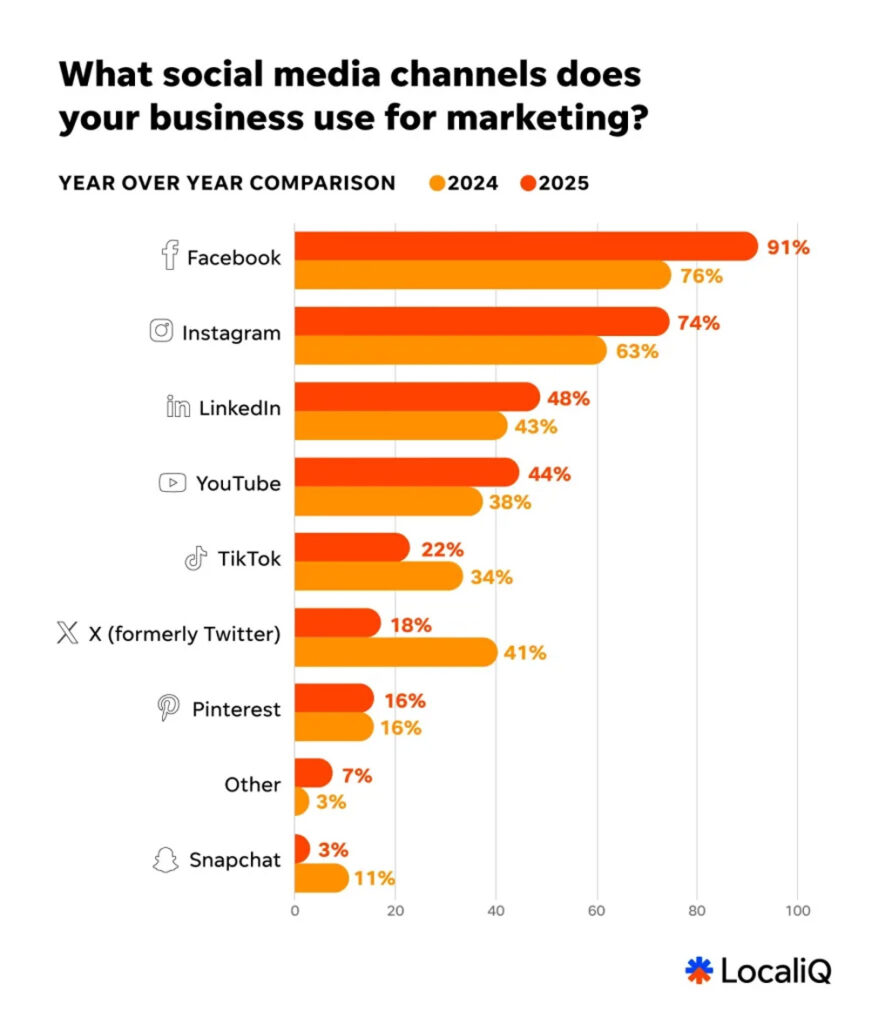
- Facebook remained the most dominant platform, rising sharply from 76% in 2024 to 91% in 2025, showing its continued leadership in business marketing.
- Instagram saw strong growth, increasing from 63% to 74%, reinforcing its role as a key channel for visual and engagement-driven campaigns.
- LinkedIn usage grew steadily from 43% to 48%, highlighting its expanding importance for B2B marketing and professional outreach.
- YouTube adoption improved from 38% to 44%, reflecting rising demand for video-based marketing strategies.
- TikTok experienced a notable decline, dropping from 34% in 2024 to 22% in 2025, suggesting reduced reliance by businesses.
- X (formerly Twitter) saw the steepest fall, decreasing dramatically from 41% to 18%, indicating shifting priorities away from real-time text-based platforms.
- Pinterest remained stable at 16% in both 2024 and 2025, showing consistent but limited usage among marketers.
- Usage of Other platforms increased from 3% to 7%, pointing to growing experimentation with emerging or niche social networks.
- Snapchat adoption declined significantly from 11% to 3%, reflecting reduced business interest in ephemeral content marketing.
- Overall, businesses in 2025 showed a strong preference for established, high-reach platforms like Facebook (91%), Instagram (74%), and YouTube (44%), while moving away from less predictable channels.
Platform‑Specific Business Stats
- Instagram delivers an average 420% ROI for marketing campaigns, leading platforms.
- 29% of B2B and B2C companies report Instagram as their highest-ROI platform.
- TikTok ads deliver 2.4x ROAS over benchmarks for marketers.
- TikTok converts 43.8% of users into buyers, outperforming others.
- Facebook accounts for 24.8% of all social media referral traffic.
- LinkedIn boasts over 1.3 billion members worldwide in 2026.
- 84% of Instagram users are under age 45, ideal for targeting.
- X has 237.8 million daily active users with 28-34 minutes.
- 78% discover new brands via TikTok’s short-form videos.
- 85% of weekly Pinterest users purchase from brand pins.
Cost and ROI of Social Media Advertising
- Average social media ads generate ~$5.20 back for every $1 spent in 2026.
- Social campaigns typically enjoy ~2× higher ROI compared with traditional display banners.
- TikTok delivers the highest ROI for 32% of marketers in 2026.
- Pinterest ads show ~30% lower conversion costs compared with broader social ads.
- Video ads outperform static ads by ~34% in conversion rates.
- LinkedIn’s average lead generation conversion rate is strong by industry standards.
- CTR for social media ads averages around 1.21% across platforms.
- Visual and AI‑assisted creative workflows are boosting ad performance metrics.
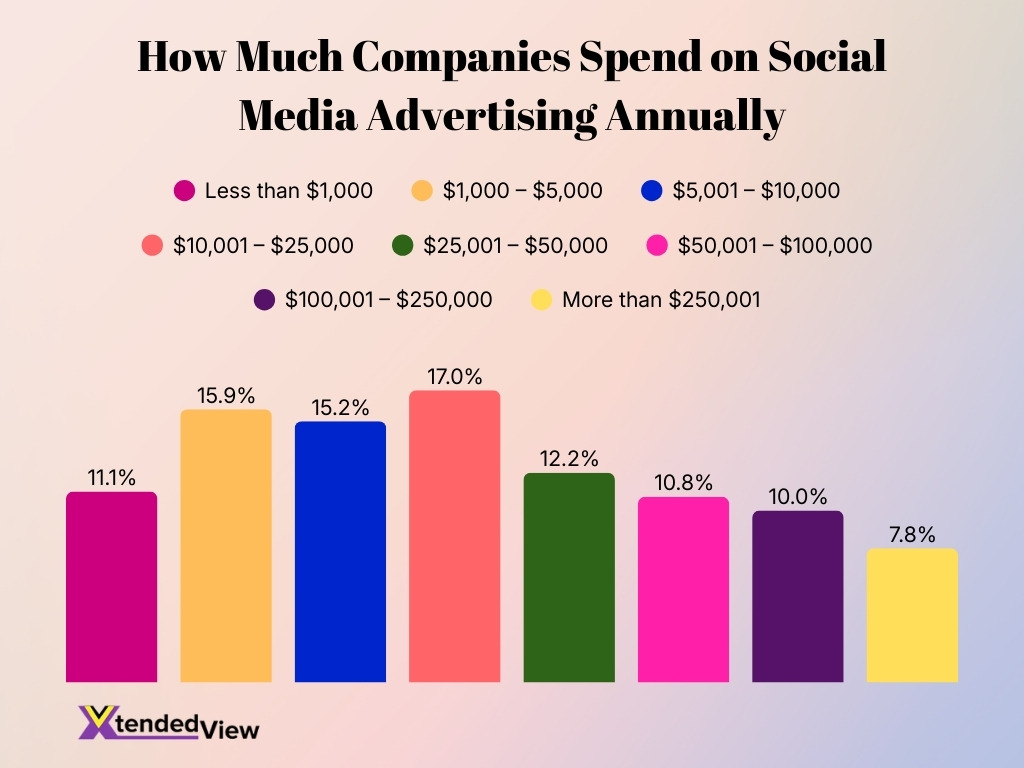
How Much Do Companies Spend on Social Media Advertising Annually
- 17% of companies allocate $10,001–$25,000 per year, making this the most common social media ad budget range.
- 15.9% of businesses spend $1,000–$5,000 annually, showing strong adoption among small and growing brands.
- 15.2% of companies invest $5,001–$10,000 per year, reflecting moderate but consistent marketing activity.
- 12.2% of firms allocate $25,001–$50,000 annually, highlighting mid-sized business investment levels.
- 11.1% of organisations spend less than $1,000 per year, indicating limited or experimental ad strategies.
- 10.8% of companies invest $50,001–$100,000 annually, showing a serious commitment to paid social growth.
- 10% of businesses allocate $100,001–$250,000 per year, reflecting aggressive digital marketing strategies.
- Only 7.8% of companies spend more than $250,001 annually, suggesting that very high ad budgets remain rare.
Social Media as a Lead Generation Channel
- 66% of marketers report successfully generating leads through social media with just a few hours of weekly effort.
- 47% of lead generation professionals are actively increasing TikTok expertise to improve results.
- The average cost per lead on Facebook remains around $23.10 across industries.
- About 21% of businesses use lead generation results to demonstrate the ROI of social activity.
- Social media lead quality is ranked high or very high by 77% of marketers.
- Roughly 30% of marketers still find lead generation one of their top challenges.
- 37% of marketers say leads have become more informed thanks to generative AI tools.
- Top KPIs for lead gen include lead quality, conversion rates, and ROI, cited by nearly 39%, 34%, and 31%, respectively.
Social Media’s Impact on Sales and Revenue
- Online stores with a social media presence see an average 32% increase in sales vs those without.
- Social commerce is projected to drive $1.3 trillion in global sales in 2026.
- In the U.S., social commerce reached about $87 billion and is still growing year‑on‑year.
- Gen Z and millennial shoppers now account for the majority of social commerce purchasers.
- TikTok Shop alone crossed $500 million in U.S. sales during the 2025 Black Friday and Cyber Monday week.
- Diversified social media strategies can help retailers increase total online sales by 2–5 % due to repeated user exposure.
- Paid social campaigns tied to shopping features tend to deliver measurable revenue gains over awareness‑only efforts.
- Active social media engagement correlates with stronger sales performance across sectors.
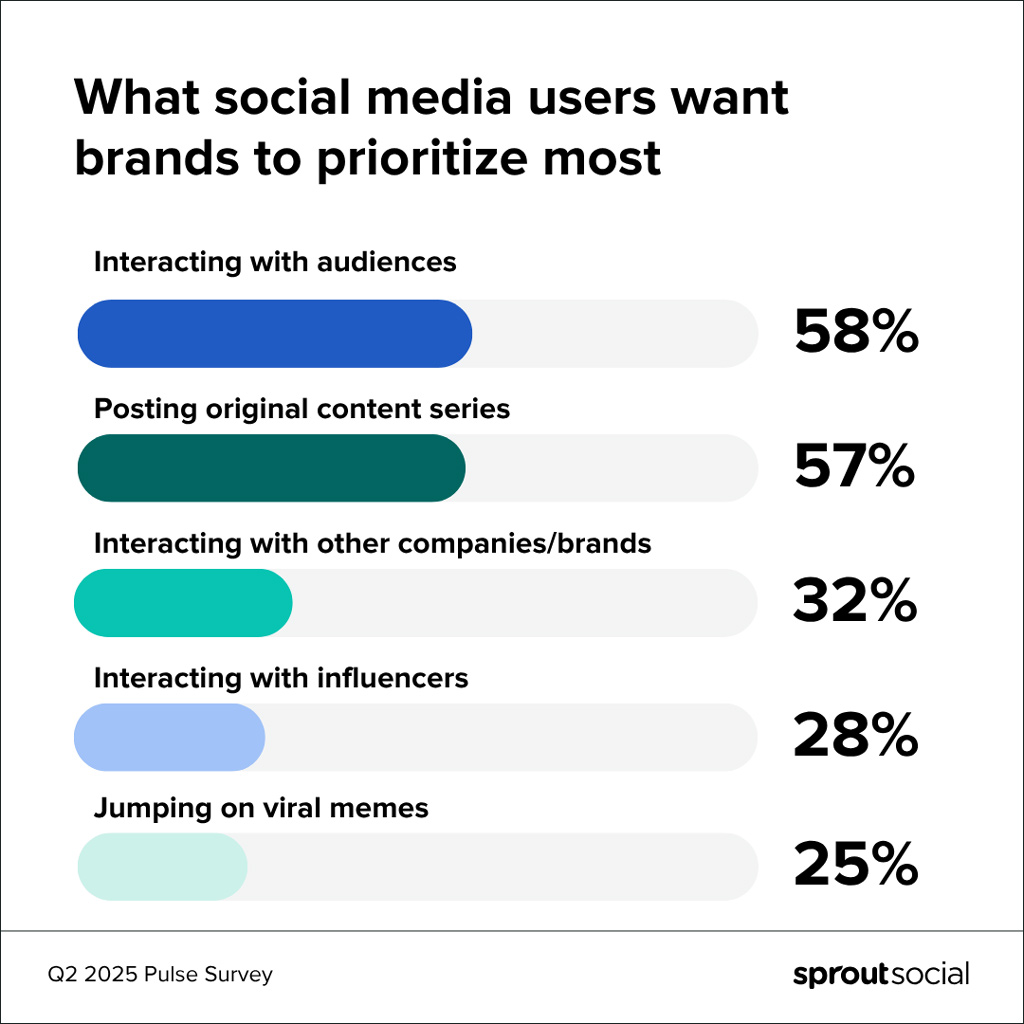
What Social Media Users Expect From Brands
- 58% of users say brands should focus most on interacting directly with audiences, highlighting the importance of two-way communication and engagement.
- 57% of respondents prioritise posting original content series, showing strong demand for consistent, high-quality, and unique content.
- 32% of users prefer brands interacting with other companies and brands, indicating interest in collaborations and partnerships.
- 28% of users value interacting with influencers, suggesting that influencer marketing is useful but not a top priority.
- Only 25% of users want brands to focus on jumping on viral memes, making it the least important strategy among surveyed options.
Customer Engagement and Interaction Statistics
- Average engagement rates for business posts range between 1.4% and 2.8% across platforms.
- Engagement is higher on video‑first networks like TikTok and Instagram Reels.
- Community building is reported as critical by more than 90% of social media marketers.
- Consumers use social media to research brands and products, about 73% globally.
- Emotional and interactive content tends to elicit higher engagement than purely promotional posts.
- Engagement actions such as shares and comments can directly influence algorithmic reach.
- Customers increasingly expect two‑way conversational interaction with brands on social channels.
- Engagement metrics are now tied to conversion indicators, with firms tracking actions that lead further down the purchase funnel.
Social Media and Customer Service Statistics
- Customers expect real-time responses, with 76% anticipating replies within 24 hours on social platforms.
- 70% of customers have used social media for customer service at least once.
- 40% of consumers expect brands to respond within the first hour on social media.
- 73% of social users will switch to competitors if brands fail to respond.
- 80% of consumers engage brands via social media for support and feedback.
- Quick responses boost satisfaction, with 71% of customers likely to recommend the brand.
- AI chatbots achieve 87.58% satisfaction rate, surpassing phone support at 44%.
- Social support costs 1/6th of phone calls, significantly lowering service expenses.
- 34.5% of consumers prefer social media as their top customer service channel.
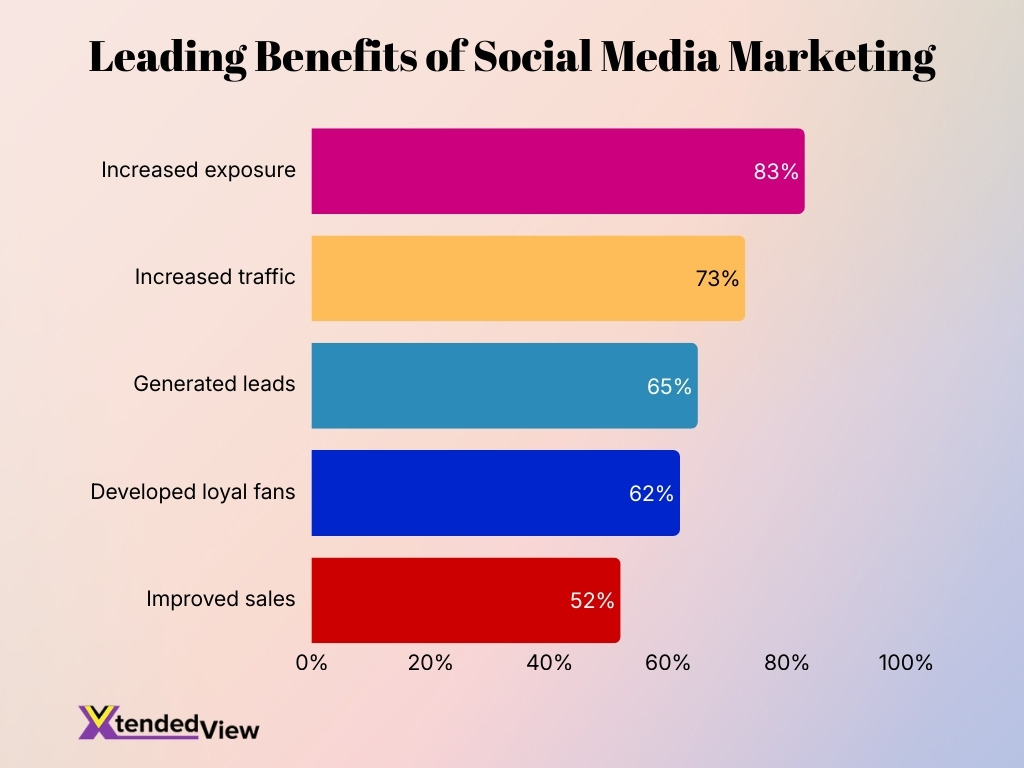
Leading Benefits of Social Media Marketing
- Increased exposure is the top benefit of social media marketing, cited by 83% of marketers worldwide, highlighting its strong impact on brand visibility.
- Increased traffic ranks second, with 73% of marketers reporting higher website visits driven by social platforms.
- Generated leads remain a key advantage, as 65% of marketers use social media to capture and nurture potential customers.
- Developed loyal fans is noted by 62% of marketers, showing social media’s role in building long-term audience relationships.
- Improved sales are achieved by 52% of marketers, demonstrating social media’s direct contribution to revenue growth.
Social Commerce and In‑App Shopping Statistics
- The global social commerce market is valued at roughly $1.63 trillion and expected to grow strongly.
- Social commerce penetration could reach ~24% worldwide by the end of 2026.
- The U.S. social commerce segment jumped past the $87 billion mark with healthy annual growth.
- Millennials represent about 33% of social commerce spend, the largest demographic share.
- Younger generations make social purchases more frequently than older cohorts.
- Live shopping features and AR‑enabled try‑ons boost purchase intent and conversion.
- Social checkout options reduce friction, shortening the path from discovery to purchase.
- In‑app shopping continues to attract major brands integrating direct selling within feeds.
Future Outlook for Social Media in Business
- AI in the social media market to reach $24.2 billion by 2034 at 28% CAGR.
- The social commerce market is projected at $2.21 billion in 2026, growing to $27.52 billion by 2034.
- Short-form videos under 60 seconds retain 50% viewers through completion.
- YouTube Shorts achieved 200 billion daily views in early 2026.
- The social media analytics market is expected to expand from $20.3 billion in 2026 to $77.71 billion by 2034.
- TikTok US ad revenue forecasted at $14.5 billion in 2026, 38% of the global total.
- Evergreen blog posts generate 38% of total website traffic consistently.
- Live shopping in the US is expected to reach $55 billion by 2026.
- The social media management tools market is expected to hit $171.62 billion by 2033 at 24.8% CAGR.
Frequently Asked Questions (FAQs)
About 5.66 billion people, roughly 69% of the world’s population, are active on social media in 2026.
An estimated 93% of all internet users engage with social media on a monthly basis as of 2026.
About 26% of marketers plan to explore selling products directly on social media, including Instagram shops, in 2026.
Social media usage grew by approximately 4.87% year‑over‑year in the most recent period.
The average global social media user engages with about 6.75 different platforms each month.
Conclusion
Social media is more than a promotional channel; it’s a revenue driver, engagement engine, and customer touchpoint that shapes how brands grow and connect. Data shows measurable increases in sales, leads, and brand awareness when social media strategies are thoughtfully executed. With evolving tools, AI enhancements, and social commerce expanding rapidly, businesses that harness these trends will gain significant competitive advantages in the years ahead. As you plan your next strategy, let these insights guide informed decisions and outcomes that matter.
