



Small businesses play a central role in shaping both local economies and the broader global market. From neighborhood retail shops and family-run restaurants to digital-first startups and freelance-driven service firms, they create jobs, drive innovation, and keep supply chains moving across industries like e-commerce, healthcare, and professional services. In the United States, small businesses account for nearly half of private sector employment and contribute a substantial share of GDP, making them a critical force behind economic resilience and consumer activity.
Globally, their impact is even more pronounced, with small and medium enterprises forming the backbone of entrepreneurship in both developed and emerging markets. As economic conditions evolve and technology reshapes how businesses operate, understanding the latest small business statistics provides valuable insight into where opportunities and challenges lie. Let’s explore the key data defining small businesses.
Editor’s Choice
- The U.S. has 36.2 million small businesses, representing 99.9% of all businesses.
- Small businesses employ 62.3 million workers, accounting for 45.9% of private sector jobs.
- They contribute approximately 43.5% of U.S. GDP, highlighting their economic weight.
- Over 80% of small businesses are solo-owned, reflecting a rise in independent entrepreneurship.
- Small businesses generated 88.9% of net job growth between 2023–2024.
- Around 87.8% of small businesses report stable or increasing revenue entering 2026.
- A 1% increase in business formation links to 0.18% GDP growth, showing direct economic impact.
Recent Developments
- The SBA supported $45 billion in small business loans in FY2025.
- Small firms accounted for 52.8% of net job creation between 2021–2024.
- About 74% of small business owners expect revenue growth in 2026.
- Nearly 60% plan to expand operations despite economic uncertainty.
- 43% of small businesses report a healthy local economy, indicating moderate confidence.
- Around 77% of businesses have adopted AI in the past five years, signaling rapid digital transformation.
- Small business optimism rose in late 2025, with 79% expecting revenue growth.
- 1.2 million net jobs were added by small businesses in recent annual data.
- Global trends show MSMEs account for 90% of businesses worldwide.
Overview of Small Businesses
- Small businesses make up 99.9% of all U.S. companies, dominating the business landscape.
- There are between 33.3 million and 36.2 million small businesses, depending on methodology.
- Over 27 million businesses operate without employees, showing solo entrepreneurship dominance.
- Only 16% of small businesses employ 1–19 workers, indicating limited scaling.
- Firms with 20–499 employees total fewer than 650,000, forming the upper tier of SMBs.
- Small businesses contribute 38.7% of private payroll, showing wage impact.
- Around 81.9% are nonemployer firms, reflecting gig and freelance growth.
- The number of small businesses grew by over 9.7% since 2019, showing steady expansion.
- Small firms account for nearly half of workforce participation, reinforcing economic reliance.
Distribution of Small Businesses by Country
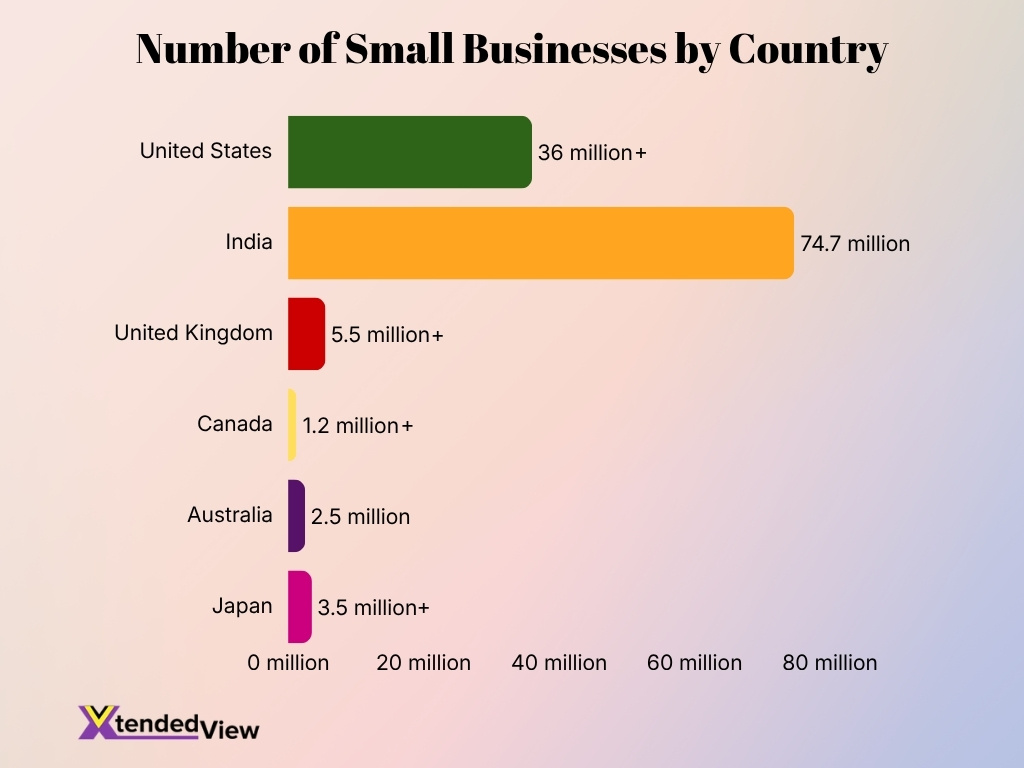
- The United States leads with 36+ million small businesses.
- India follows with 74.7 million MSMEs, one of the largest ecosystems globally.
- The UK reports over 5.5 million small businesses, forming 99% of firms.
- Canada has over 1.2 million small businesses, accounting for 98% of employer firms.
- Australia hosts 2.5 million small businesses, making up 97% of enterprises.
- In the EU, SMEs represent 99.8% of all enterprises, showing regional consistency.
- China’s SME sector dominates employment, contributing over 60% of GDP.
- Japan reports over 3.5 million SMEs, forming the backbone of its economy.
- Emerging markets like Brazil show SMEs accounting for ~30% of GDP, with rapid growth potential.
Global Number of Small Businesses
- Globally, small and medium enterprises represent around 90% of all businesses.
- SMEs contribute over 50% of global employment, highlighting labor dependence.
- India alone has 74.7 million MSMEs, showcasing an emerging market scale.
- The U.S. contributes over 36 million small businesses to the global total.
- Europe’s SME sector accounts for over 99% of enterprises.
- China hosts over 140 million market entities, most classified as SMEs.
- Global small business density averages 1 business per 10–12 people in developed economies.
- In developing economies, SMEs contribute up to 40% of GDP, depending on formalization levels.
- The global MSME sector drives innovation in supply chains and exports, especially in Asia.
Definition and Size Thresholds of Small Businesses
- In the U.S., a small business typically has fewer than 500 employees.
- The SBA uses industry-specific size standards, often based on revenue or employee count.
- Many service-based firms qualify as small with under $7.5 million in annual revenue.
- Manufacturing businesses may qualify with up to 1,500 employees, depending on classification.
- The EU defines SMEs as businesses with fewer than 250 employees.
- Micro-enterprises in the EU employ fewer than 10 people, forming the largest segment.
- In India, MSMEs are classified based on investment and turnover thresholds, not just employee count.
- Globally, small businesses are often defined as firms with fewer than 50 employees in many countries.
- Nonemployer firms, those with zero employees, still qualify as small businesses in U.S. data.
Small Business Employee Size Distribution Insights
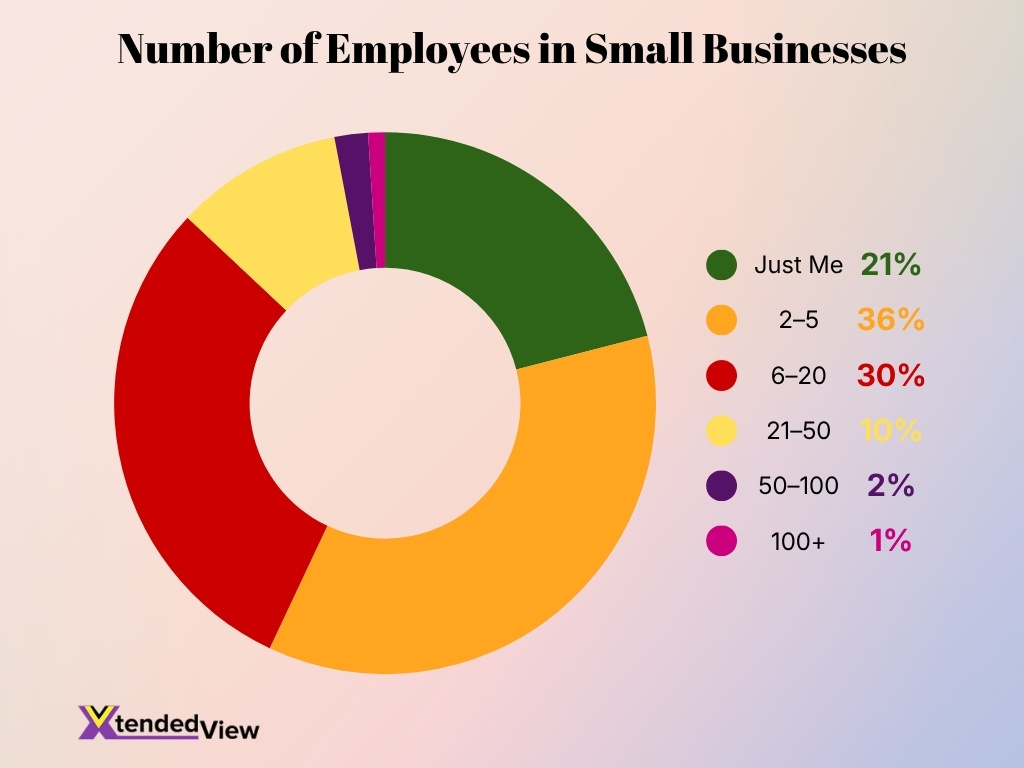
- The largest share of small businesses operates with 2–5 employees (36%), making it the most common team size.
- A significant portion, 30%, employs 6–20 employees, highlighting a strong presence of slightly scaled operations.
- Solo entrepreneurs represent 21% of small businesses, indicating a substantial number of self-employed or single-owner businesses.
- Only 10% of businesses have 21–50 employees, showing a drop as companies grow beyond early stages.
- Medium-sized small businesses with 50–100 employees account for just 2%, reflecting limited scaling to this level.
- Businesses with 100+ employees are extremely rare (1%), emphasizing that most small businesses remain lean and compact.
- Overall, nearly 87% of small businesses have fewer than 20 employees, reinforcing the dominance of micro and small-scale enterprises.
Share of Small Businesses in Total Enterprises
- Small businesses account for 99.9% of all U.S. firms, making them the dominant business category.
- In the European Union, SMEs represent 99.8% of all enterprises, showing similar dominance.
- Canada reports 98% of employer businesses as small businesses.
- In Australia, small businesses make up 97.3% of all businesses.
- Japan’s SME sector accounts for 99.7% of all companies, reinforcing global trends.
- In India, MSMEs represent over 95% of industrial units, highlighting their widespread presence.
- Globally, small businesses contribute to 90%+ of all enterprises, especially in developing markets.
- Even in highly industrialized economies, large corporations represent less than 1% of total businesses, emphasizing SMB dominance.
- The share of small businesses has remained stable, with minimal fluctuation since 2020, indicating structural consistency.
Industry Distribution of Small Businesses
- The service sector hosts over 70% of small businesses in the U.S., including consulting and healthcare.
- Retail trade accounts for approximately 12% of small businesses, driven by local demand.
- Construction represents about 10% of SMBs, with strong regional demand.
- Professional and business services make up 15%+ of small firms, especially in consulting and IT services.
- Food services and hospitality contribute 8–10% of small businesses, with high turnover rates.
- E-commerce-based small businesses grew by over 25% between 2020–2025, reflecting digital shifts.
- Manufacturing small businesses represent less than 5%, but contribute disproportionately to exports.
- Healthcare-related small businesses saw 12% growth post-2022, driven by aging populations.
- Creative industries, media, and design account for over 6% of SMBs, fueled by freelance platforms.
Weekly Marketing Time Spent by Businesses
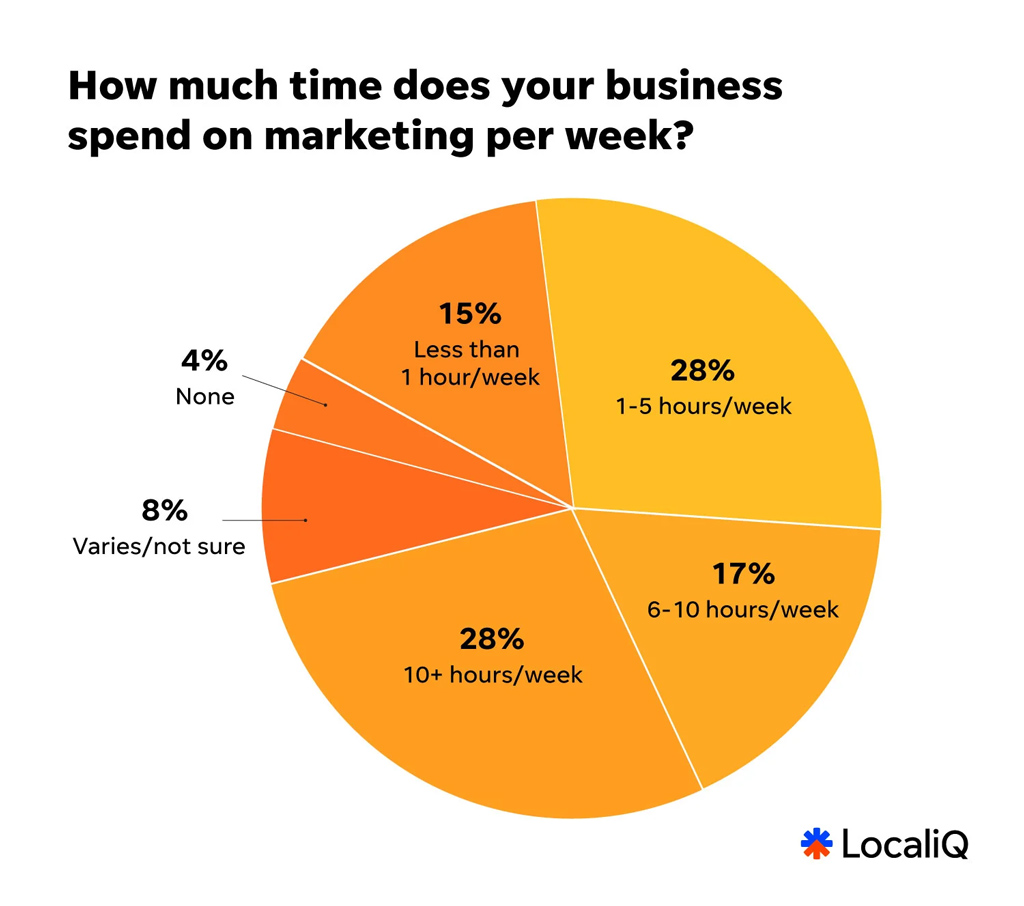
- The largest share of businesses (28%) spend 1–5 hours per week on marketing, showing a preference for moderate time investment.
- An equal proportion (28%) dedicate 10+ hours per week, indicating a strong segment that prioritizes high marketing effort.
- Around 17% of businesses allocate 6–10 hours weekly, reflecting a mid-to-high commitment level to marketing activities.
- A notable 15% spend less than 1 hour per week, suggesting minimal engagement with marketing.
- Only 4% report spending no time at all, highlighting that most businesses recognize the importance of marketing.
- About 8% of respondents are unsure or have varying schedules, indicating inconsistent or unstructured marketing strategies.
- Overall, nearly 73% of businesses spend at least 1 hour per week on marketing, emphasizing its role as a core business function.
- The distribution shows a split between low-effort and high-effort strategies, with many businesses either keeping marketing lean or heavily investing in it.
Contribution of Small Businesses to GDP
- Small businesses contribute approximately 43.5% of U.S. GDP, highlighting their economic significance.
- In developing countries, SMEs contribute up to 40% of GDP, depending on formalization.
- In the EU, SMEs generate over 50% of total GDP, reflecting strong regional integration.
- Small firms contribute over 60% of China’s GDP, despite large enterprise dominance.
- Canada’s SMEs contribute over 52% of GDP, driven by services and trade.
- The UK’s small businesses contribute over 52% of private sector turnover, a key GDP component.
- U.S. small business GDP contribution has increased by 2–3% since 2020, showing steady growth.
- Micro-businesses, fewer than 10 employees, contribute over 20% of GDP in some economies, especially in emerging markets.
- Small firms drive over 65% of net new economic value creation globally, according to SME studies.
Revenue and Sales Trends of Small Businesses
- Around 87% of small businesses report stable or growing revenue entering 2026.
- The average small business generates $1–$5 million in annual revenue, depending on industry.
- E-commerce SMBs saw revenue growth of 20%+ annually post-2022.
- Nearly 40% of SMBs report increased sales due to digital channels, including marketplaces.
- Inflation impacted over 60% of small businesses, affecting pricing strategies.
- About 55% of SMBs increased prices in 2025 to offset costs.
- Subscription-based revenue models grew by 18% among SMBs, especially in SaaS and services.
- Small retailers reported average sales growth of 6–8% in 2024, despite supply chain challenges.
- Seasonal businesses generate up to 30% of annual revenue during peak periods, especially in retail and tourism.
Small Business Job Creation by Employee Size
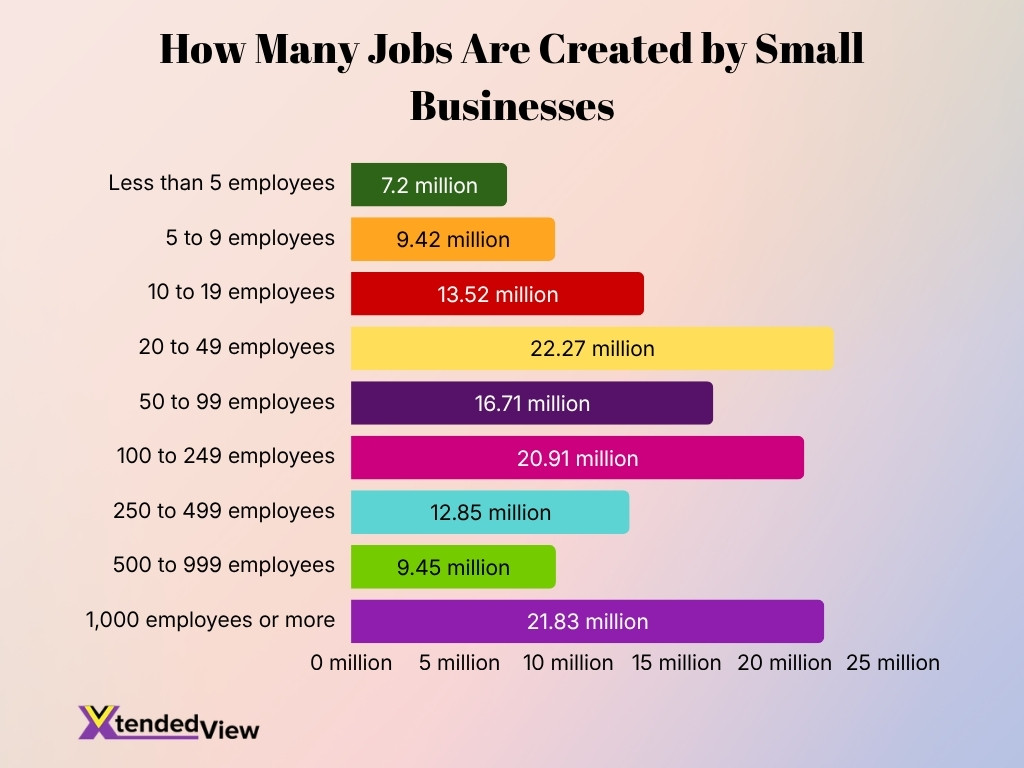
- Mid-sized small businesses (20–49 employees) generate the highest number of jobs at 22.27 million, making them the largest contributors to employment.
- Businesses with 1,000+ employees follow closely, contributing 21.83 million jobs, highlighting the continued impact of large enterprises.
- Firms with 100–249 employees also play a major role, creating 20.91 million jobs, reinforcing the importance of upper mid-sized businesses.
- Companies employing 50–99 workers contribute 16.71 million jobs, showing consistent job creation across growing businesses.
- Smaller firms with 10–19 employees generate 13.52 million jobs, indicating strong employment contribution even at early growth stages.
- Businesses with 250–499 employees account for 12.85 million jobs, maintaining a steady share in job creation.
- Enterprises with 5–9 employees contribute 9.42 million jobs, while those with 500–999 employees create 9.45 million jobs, showing similar employment impact across these segments.
- The smallest firms, with fewer than 5 employees, still generate a notable 7.20 million jobs, emphasizing the collective strength of micro-businesses.
- Overall, job creation increases with business size up to a point, peaking in the 20–49 employee range, before showing variation across larger categories.
Startup and New Registration Trends of Small Businesses
- The U.S. recorded over 5.5 million new business applications in 2023, maintaining high startup momentum.
- Business applications remained above 5 million annually in 2024–2025, showing sustained entrepreneurial activity.
- High-propensity business applications, likely to hire employees, account for over 30% of total filings.
- Digital-first startups have increased by over 40% since 2020, driven by low entry barriers.
- Minority entrepreneurs accounted for over 50% of new business applications in 2024, indicating diversification.
- Women-led startups grew by nearly 20% year-over-year, outpacing overall growth.
- The average startup cost in the U.S. ranges between $3,000 and $10,000, depending on the industry.
- About 70% of startups begin from home, reflecting cost-conscious entrepreneurship.
- Online registration platforms reduced business formation time by up to 80%, accelerating growth.
Survival and Failure Rates of Small Businesses
- Approximately 20% of small businesses fail within the first year.
- Around 50% survive beyond five years, highlighting long-term challenges.
- Only one-third of businesses survive beyond 10 years, indicating sustainability hurdles.
- The most common failure reason is a lack of market demand, 42%, followed by cash flow issues.
- Businesses with strong planning are 30% more likely to survive five years, emphasizing the importance.
- Startups with mentorship programs show improved survival rates by up to 70%, according to SBA studies.
- Economic downturns increase failure rates by 5–10%, depending on industry.
- Small businesses with digital presence are twice as likely to survive compared to offline-only firms.
- Access to funding improves survival chances by over 25%, especially in the early stages.
Demographics of Small Business Owners
- In 2025, the Census Bureau reported 36.4 million U.S. employer and nonemployer businesses, giving the latest broad base for owner demographic analysis.
- Women owned 14.2 million U.S. businesses in 2023, while veterans owned 1.6 million, showing how ownership continues to widen beyond the traditional founder profile.
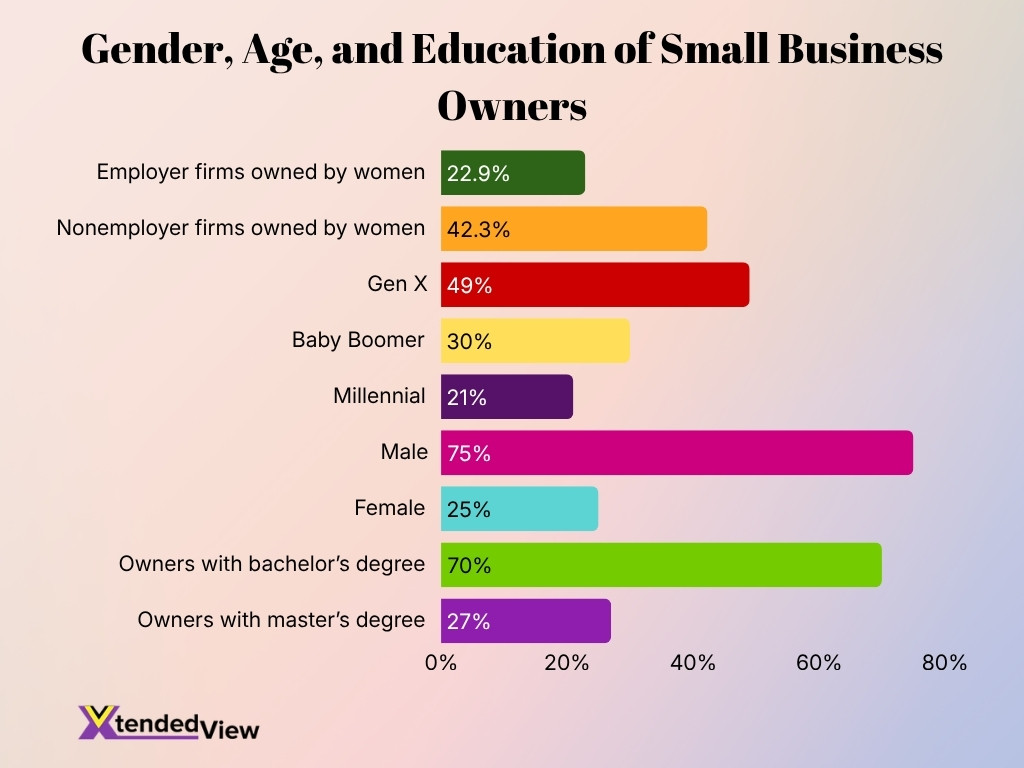
- Among employer firms, women owned 1.4 million, or 22.9%, of the nation’s roughly 5.9 million employer businesses in 2023.
- Among nonemployer firms, women owned 12.9 million, or 42.3%, of the nation’s 30.4 million firms in 2023.
- According to Guidant’s 2025 small business survey, Gen X owns 49% of small businesses, compared with 30% for Baby Boomers and 21% for Millennials.
- The same Guidant survey found that 75% of small business owners are male and 25% are female, which shows that ownership is diversifying but still uneven.
- Education levels remain high among owners, 70% hold a bachelor’s degree, and 27% hold a master’s degree.
- SBA’s 2025 U.S. profile found that women owned 44.6% of businesses, while veterans owned 5.3% of businesses and Hispanics owned 16.5%.
- Veteran ownership still carries scale as well as share, employing nearly 3.2 million workers.
Women-Owned Small Businesses Statistics
- Women owned 14.2 million U.S. businesses in 2023, and those firms generated $2.8 trillion in receipts.
- Women-owned employer businesses totaled 1.4 million in 2023, equal to 22.9% of all employer firms.
- Women-owned nonemployer firms reached 12.9 million in 2023 and produced $423.1 billion in receipts.
- Census data for 2022 showed women-owned employer businesses generated $2.1 trillion in receipts, supported 11.4 million employees, and paid $508.5 billion in annual payroll.
- SBA’s 2025 profile estimated that women own 44.6% of all U.S. businesses, up from 44.1% previously.
- Women own 13.3 million businesses and represent 45% of all entrepreneurs in the U.S.
- Women-owned businesses provide more than 10.5 million W-2 jobs.
- Women started 49% of new businesses in 2024, a 69% increase from 2019.
- Women-owned businesses represent 39.2% of all businesses, but only 9.6% of employment and 6.2% of revenues, showing scaling gaps.
Minority-Owned Small Businesses Statistics
- Asian-owned employer businesses account for 11.5%, Hispanic-owned 8.4%, and Black-owned 3.4% of employer firms.
- That equals 685,000 Asian-owned, 496,000 Hispanic-owned, and 201,000 Black-owned employer businesses.
- Asian-owned employer firms generated $1.2 trillion in receipts in 2023.
- Hispanic-owned firms produced $730.3 billion, while Black-owned firms produced $249.0 billion.
- Hispanic-owned nonemployer firms reached 5.3 million, Black-owned 4.4 million, and Asian-owned 2.8 million.
- These firms generated $244.2 billion, $128.7 billion, and $163.6 billion in receipts, respectively.
- Hispanic-owned employer businesses grew 14.6% year over year.
- Black-owned employer firms increased significantly, with revenue growth of 66% over several years.
- Minority-owned businesses continue to drive job creation and economic inclusion across sectors.
How Small Businesses Are Using AI in Marketing
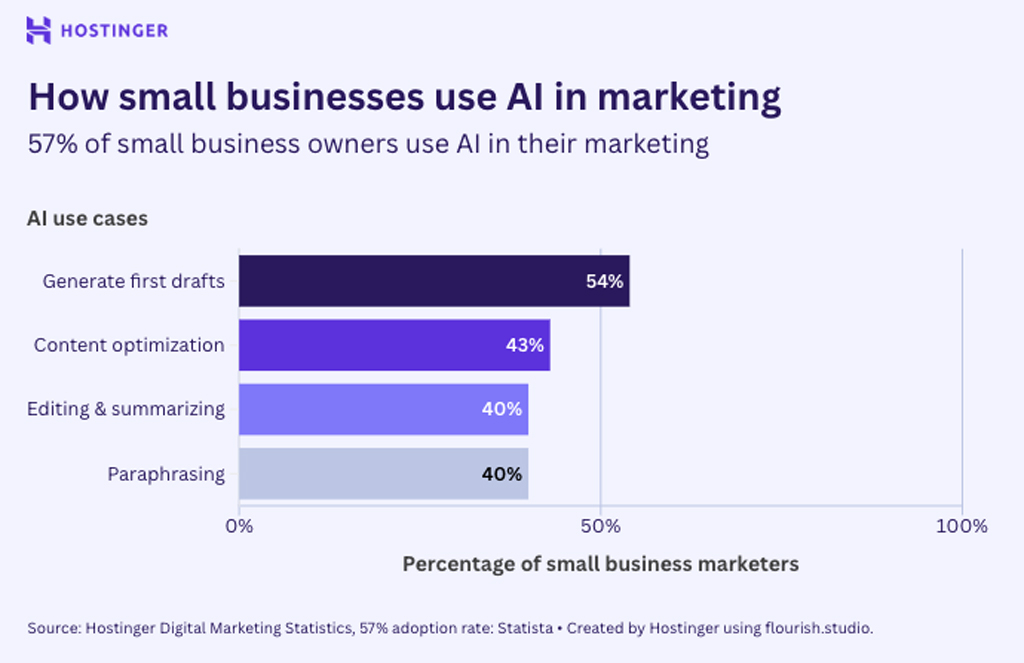
- 57% of small business owners are already using AI in their marketing, highlighting rapid adoption across the sector.
- The most common use case is generating first drafts, used by 54% of small business marketers.
- Content optimization is another key application, with 43% of marketers leveraging AI to improve performance and SEO.
- Around 40% of businesses use AI for editing and summarizing content, streamlining workflows, and saving time.
- Similarly, 40% rely on AI for paraphrasing, helping repurpose and refine existing content.
- Overall, AI is primarily used for content creation and enhancement, indicating its strong role in improving marketing efficiency and productivity.
Access to Financing for Small Businesses
- 60% of small firms applied for financing in the prior 12 months.
- 42% received full funding, 36% partial, and 22% none.
- 38% applied specifically for loans, credit lines, or cash advances.
- The most common financing uses were operating expenses, 56%, and expansion, 46%.
- Small banks approved 57% of applicants fully, outperforming other lenders.
- Online lender usage increased from 17% in 2020 to 29% in 2025.
- 60% of online borrowers reported higher-than-expected costs.
- 86% of small firms use financing regularly, while 31% carry no debt.
- Financing data is now tracked by demographics, improving visibility into access gaps.
E-commerce Adoption in Small Businesses
- U.S. retail e-commerce sales reached $1.2337 trillion in 2025, up 5.4% year over year.
- E-commerce represented 16.4% of total retail sales in 2025.
- In Q4 2025, e-commerce sales totaled $365.2 billion, up 5.6% from the previous year.
- E-commerce share reached 18.3% in Q4 2025, reflecting peak seasonal activity.
- Microbusiness website activity reached record levels, signaling strong online engagement.
- Over 20 million online businesses operate with active websites and domains.
- 65% of small businesses primarily serve local customers, even when operating online.
- 72% expect revenue growth or stability, supported by digital channels.
- Global e-commerce is projected to reach $5.5 trillion by 2027, expanding opportunities for SMBs.
Frequently Asked Questions (FAQs)
There are approximately 36.2 million small businesses in the U.S., making up 99.9% of all businesses.
Small businesses employ about 62.3 million people, which equals 45.9% of the private-sector workforce.
The average small business generates around $1,221,884 in annual revenue in the U.S.
Over 70% to 80% of small businesses in the U.S. operate with no employees, meaning they are solo-run ventures.
In early 2026, the U.S. recorded about 532,319 business applications in January alone, showing strong startup activity.
Conclusion
Small business data highlights a sector that continues to expand while adapting to rapid economic and technological change. Ownership patterns are becoming more diverse, with women, minority, and younger entrepreneurs steadily increasing their presence, even as challenges around scaling and access to capital remain. At the same time, digital transformation is reshaping how small businesses operate, with e-commerce, AI tools, and automation helping firms reach customers, improve efficiency, and compete in crowded markets. However, gaps in funding access, revenue growth, and long-term sustainability still create uneven outcomes across different segments of the small business landscape.
For U.S. readers, these trends matter because small businesses remain a key driver of employment, innovation, and community development. For a global audience, they signal a broader shift toward leaner, tech-enabled, and more inclusive entrepreneurship models. Looking ahead, the ability of small businesses to adapt, scale, and leverage new technologies will play a defining role in shaping economic growth in the years to come.
