


Robotics is entering a new phase as automation expands beyond traditional automotive and heavy manufacturing into electronics, logistics, healthcare, agriculture, food production, and consumer applications. Industrial robots continue to handle welding, assembly, material movement, and quality inspection, while collaborative robots increasingly work alongside employees in more flexible production environments. At the same time, warehouses are deploying autonomous mobile systems for inventory and order fulfillment, hospitals are increasing their use of robot-assisted surgery, and farms are adopting autonomous equipment and precision technologies.
Artificial intelligence is also reshaping what robots can do by improving perception, navigation, decision-making, and adaptability. Humanoid robots and other general-purpose systems are moving from experimental projects toward early commercial deployment, while falling component costs and rising investment could broaden adoption further. Together, these developments show that robotics is becoming an increasingly important part of productivity, labor strategy and technological competition worldwide. The following Robot Statistics provide a detailed look at installations, sales, market growth, regional adoption and emerging applications.
Editor’s Choice
- Global factories installed 542,076 industrial robots in 2024, keeping annual installations above 500,000 for a fourth consecutive year.
- The worldwide operational stock climbed to 4,663,773 industrial robots, an 8.9% increase from the previous year.
- China installed approximately 295,000 industrial robots in 2024, accounting for 54% of worldwide deployments and setting a national record.
- Asia captured 74% of global industrial robot installations in 2024. Europe accounted for 16%, while the Americas represented 9%.
- North American companies ordered 36,766 robots worth $2.25 billion in 2025. Unit orders increased 6.6%, while order revenue climbed 10.1% from 2024 on a comparable reporting basis.
- Collaborative robots represented 19.6% of North American robot units ordered in 2025. Buyers ordered 7,212 cobots valued at $241 million.
- In Q1 2026, North American cobot orders increased 55.6% in units and 78.2% in revenue from Q1 2025.
- Transportation and logistics companies purchased about 102,900 professional service robots in 2024, 14% more than a year earlier. This category represented more than half of reported professional service robot sales.
- Electronics became the largest industrial robot customer sector in 2024, with 128,899 installations, compared with 126,088 in automotive manufacturing.
Recent Developments
- North American robot orders reached 36,766 units in 2025, a 6.6% annual increase, while associated revenue grew 10.1% to $2.25 billion.
- Q1 2026 generated 9,055 North American robot orders worth $543 million. Unit volume remained almost flat year over year, while revenue declined 6.4%.
- Automotive OEM robot orders fell 35.1% by units in Q1 2026 compared with Q1 2025, showing that overall robotics demand increasingly depends on industries beyond vehicle manufacturing.
- By the end of Q2, first-half 2026 North American robot orders had risen to 17,995 units, despite continued weakness among automotive OEM buyers.
- Automotive OEM robot orders were down approximately 25% in the first half of 2026, while the overall North American market still expanded.
- Cobots made a particularly strong start to 2026: Q1 unit orders rose 55.6% year over year, while cobot revenue increased 78.2%.
- In 2025, North American buyers ordered 7,212 cobots, giving collaborative systems nearly one-fifth of total robot unit orders for the year.
- AI has become a central robotics development in 2026. Current commercial applications include computer vision for object recognition, sorting and inspection, alongside machine learning for predictive maintenance and process optimization.
- The major robotics trends identified for 2026 include AI-driven autonomy, convergence between information and operational technologies, real-world humanoid testing, responses to labor shortages, and stronger attention to safety and cybersecurity.
Global Robot Market Overview
- Worldwide industrial robot installations totaled 542,076 units in 2024, only about 0.1% above the 541,302 installations recorded in 2023.
- The 2024 result ranked as the second-highest installation total in history, behind the record 552,946 units installed in 2022.
- Annual installations have remained above 500,000 units for four consecutive years, showing that industrial robotics has maintained a much larger deployment base than it had a decade earlier.
- The 542,000 robots installed during 2024 represented more than twice the roughly 221,000 units installed 10 years earlier.
- The operational industrial robot stock reached approximately 4.66 million units worldwide in 2024, increasing 8.9% year over year.
- China held about 43.5% of the world’s operational industrial robot stock in 2024. Japan held 9.7%, while the U.S. and South Korea each accounted for about 8.4%.
- Asia increased industrial robot installations by 5% in 2024 and captured nearly three-quarters of global installations.
- Europe accounted for 16% of global industrial robot deployments in 2024 after installations fell 8% from the previous year.
- The Americas represented 9% of worldwide installations in 2024 after regional demand fell about 10% year over year.
- China alone represented 54% of global new industrial robot deployments in 2024, demonstrating how strongly one national market influences worldwide installation totals.
Robotics Market Revenue Growth and Forecast
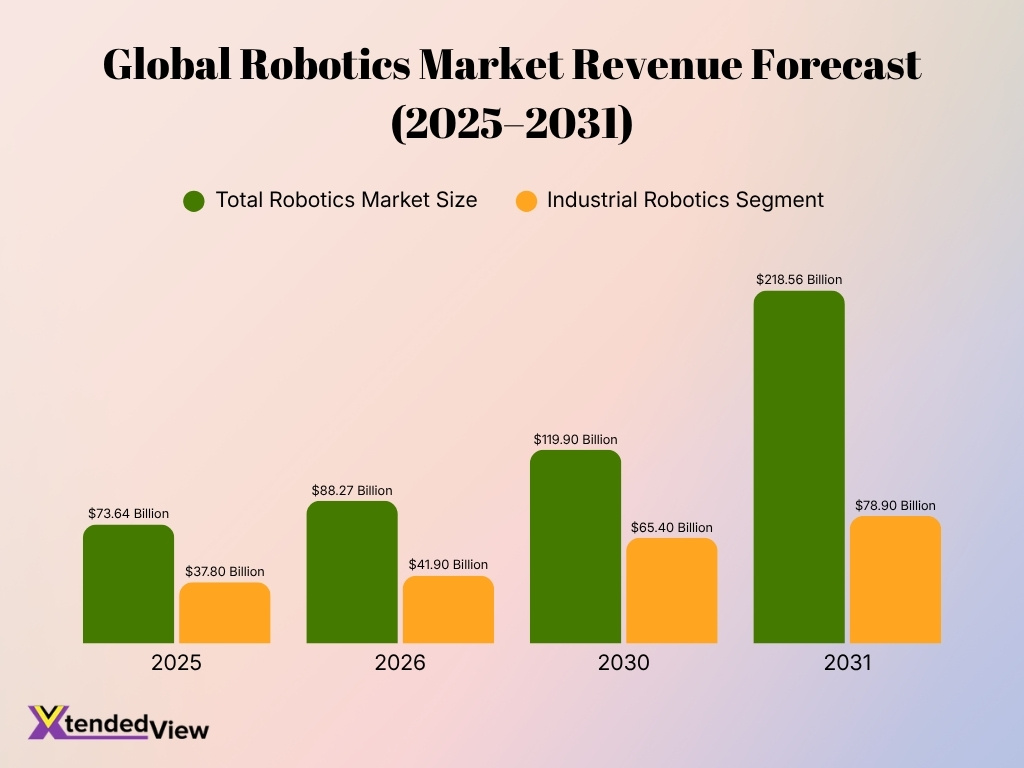
- The global robotics market is projected to grow from $73.64 billion in 2025 to $88.27 billion in 2026, indicating strong near-term expansion.
- By 2030, the total robotics market is expected to reach $119.90 billion, up roughly 63% from 2025.
- The market is forecast to climb to $218.56 billion by 2031, nearly 3 times its 2025 size.
- Industrial robotics is estimated at $37.8 billion in 2025, accounting for roughly 51% of the total robotics market that year.
- The industrial robotics segment is projected to increase to $41.9 billion in 2026 and $65.4 billion by 2030.
- Longer-term projections put the industrial robotics segment at $78.9 billion by 2033, more than double its 2025 value.
Industrial Robots Statistics
- Global factories added 542,076 industrial robots in 2024, compared with 541,302 units in 2023.
- Electronics companies installed 128,899 industrial robots in 2024, an increase of 2.5% and the highest total among major industrial sectors.
- Electronics represented approximately 24% of global industrial robot installations in 2024, one percentage point higher than in the previous year.
- Automotive manufacturers installed 126,088 industrial robots in 2024, down 6.9% year over year.
- Automotive manufacturing accounted for about 23% of global installations, two percentage points less than the previous year.
- Metal and machinery manufacturing increased its share to 16% of worldwide industrial robot installations in 2024, retaining third place among the major customer industries.
- Plastic and chemical products accounted for roughly 5% of global installations, while food and beverage manufacturing represented about 4%.
- China installed 295,000 industrial robots in 2024, 7% more than the prior year and the highest annual number recorded in the country.
- Japan installed approximately 44,500 industrial robots in 2024, a 4% decline, while its operational robot stock increased 3% to about 450,500 units.
- Global robot density reached 177 industrial robots per 10,000 manufacturing employees in 2024, up from 163, illustrating the continued increase in automation intensity.
Service Robots Market Data
- Worldwide professional service robot sales surpassed 199,000 units in 2024, representing 9% growth from the previous year.
- Transportation and logistics led professional service robot demand with approximately 102,900 units sold, an increase of 14%.
- More than one in every two professional service robots sold in 2024 served transportation or cargo-moving applications.
- Hospitality remained the second-largest professional service robot application, recording more than 42,000 units sold despite an 11% annual decline.
- Professional cleaning robot sales grew 34%, reaching more than 25,000 units during 2024.
- Agricultural service robot sales came to nearly 19,500 units, representing a 6% year-over-year decline.
- Search, rescue and security applications generated approximately 3,100 robot sales in 2024, up 19% from the previous year. Three-quarters of these units supported security services.
- Inspection and maintenance robot sales approached 2,800 units, representing an unusually large 2,476% increase as deployments expanded from a small base.
- Robot-as-a-service fleets grew 31% to more than 24,500 units in 2024, reflecting growing use of subscription and rental models rather than outright purchases.
- The worldwide service robotics supplier base included 944 identified producers, and 80% were small or midsize companies with no more than 500 employees.
Collaborative Robots (Cobots) Adoption
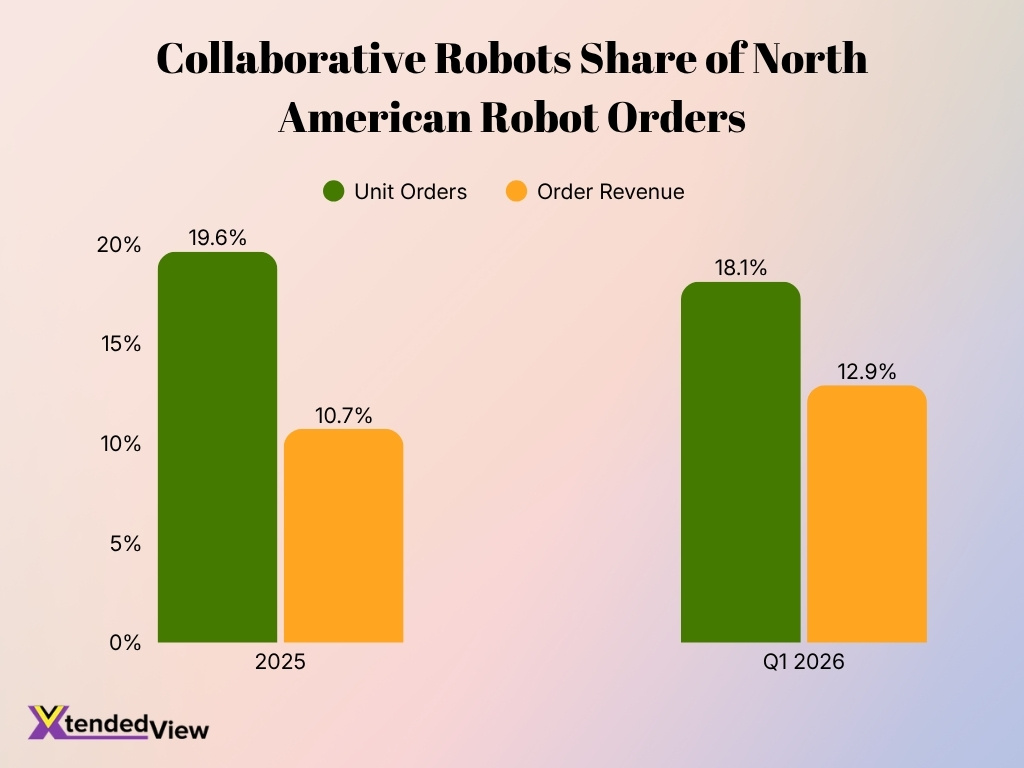
- Cobots represented 19.6% of all North American robot units ordered in 2025, making collaborative systems a substantial part of regional automation demand.
- North American companies ordered 7,212 collaborative robots in 2025, with a combined order value of approximately $241 million.
- Cobots accounted for 10.7% of North American robot order revenue in 2025, lower than their 19.6% unit share and indicative of the different system mix within the segment.
- In Q1 2026, cobot unit orders increased 55.6% from Q1 2025, significantly outpacing the essentially flat overall robot unit market during the quarter.
- Cobot order revenue increased 78.2% year over year in Q1 2026, compared with a 6.4% decline in overall robot order revenue.
- Collaborative robots accounted for 18.1% of all North American robot units ordered in Q1 2026 and 12.9% of order revenue.
- For comparison, Q1 2025 generated 1,052 cobot orders worth $39.2 million, representing 11.6% of all robot units ordered and 6.8% of revenue.
- Life sciences, pharmaceuticals and biomedical customers ordered 127 cobots in Q1 2025, while food and consumer goods companies ordered 114. Other industries collectively accounted for another 419 units.
- Globally, cobots represented 10.5% of industrial robots installed in 2023, providing a useful benchmark for measuring the segment’s subsequent expansion.
- Cobots exceeded 20% of robot demand in several North American Q1 2025 customer segments, including life sciences/pharma/biomed and food and consumer goods, indicating that collaborative automation has gained particular traction outside traditional automotive manufacturing.
Humanoid Robots Market Growth
- China shipped more than 40,000 humanoid robots in the first half of 2026, representing a reported 97% share of global shipments during the period.
- China’s humanoid robot output is expected to exceed 100,000 units in 2026, according to a July 2026 government briefing on the country’s AI and robotics sector.
- Global humanoid robot shipments exceeded 13,000 units in 2025, with Chinese manufacturers producing nearly 80% of the total.
- One current industry forecast expects global humanoid shipments to reach approximately 100,000 units in 2026, showing how quickly production could rise from the 2025 base.
- A long-term forecast estimates that nearly 1 billion humanoid robots could operate worldwide by 2050, although adoption is expected to remain comparatively slow until the mid-2030s.
- About 930 million humanoids, or roughly 90% of the projected 2050 installed base, could serve industrial and commercial applications rather than households.
- China could have about 302.3 million humanoid robots in use by 2050, compared with approximately 77.7 million in the U.S., under one long-term adoption scenario.
- The estimated manufacturing cost of a humanoid robot in high-income markets stood near $200,000 in 2024 and could decline to about $150,000 by 2028 as component costs and production volumes improve.
- Another market forecast places the humanoid opportunity at $38 billion by 2035, with approximately 1.4 million unit shipments projected for that year.
- Beijing’s current embodied-AI manufacturing plan targets mass-production capability of 100,000 robot units and production capacity for 1 million sets of core components as the regional ecosystem scales.
Robot Density by Country
- South Korea ranked first worldwide in the latest dataset with 1,220 industrial robots per 10,000 manufacturing employees. Its density has grown by an average of 7% annually since 2019.
- Singapore ranked second with 818 robots per 10,000 manufacturing employees, supported by a small manufacturing workforce and a highly automated production base.
- China reached 567 robots per 10,000 manufacturing workers in the 2024 dataset, placing it among the world’s most automation-intensive manufacturing economies.
- Germany recorded a density of 449 robots per 10,000 manufacturing employees, maintaining its position as Europe’s leading major manufacturing economy for robot penetration.
- Japan followed closely at 446 robots per 10,000 employees, reflecting its large automotive, electronics, and robot-manufacturing sectors.
- Sweden recorded 377 robots per 10,000 manufacturing employees, while Denmark reached 329 and Slovenia reached 315.
- The U.S. reached 307 industrial robots per 10,000 manufacturing employees, placing it eighth globally in the latest ranking.
- Chinese Taipei recorded 302 robots per 10,000 workers, while Switzerland registered 294, completing the latest global top 10.
- Western Europe averaged a record 267 robots per 10,000 manufacturing employees in 2024, compared with 204 in North America and 131 in Asia under the regional density measure.
- Global robot density increased from 163 to 177 robots per 10,000 manufacturing employees in the latest worldwide dataset, showing that automation intensity continues to rise even as installation growth varies by region.
Industrial Robotics Revenue Trends by Region
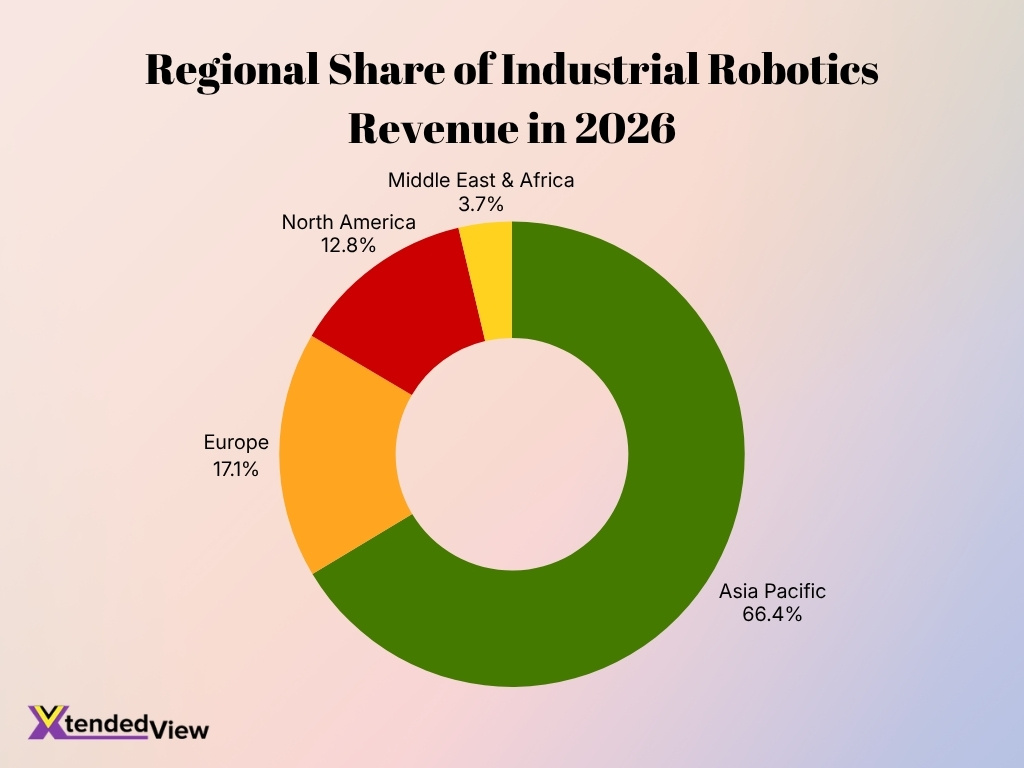
- Asia Pacific dominates the industrial robotics market, accounting for 66.4% of global revenue share in 2026, led by strong demand from the electronics and automotive industries.
- Europe holds a 17.1% revenue share, with precision manufacturing emerging as a key growth segment for industrial robotics adoption.
- North America represents 12.8% of the market, supported by accelerating automation across logistics and warehousing operations.
- The Middle East and Africa account for 3.7% of industrial robotics revenue, the smallest regional share among the markets analyzed.
- Despite its smaller base, the Middle East and Africa show high growth potential, with robotics adoption expanding from a relatively low starting point.
- Combined, Asia Pacific and Europe control 83.5% of industrial robotics revenue, highlighting the strong concentration of the global market in these two regions.
Robots by Industry Application
- Electronics companies installed 128,899 industrial robots in 2024, up 2.5% year over year and enough to regain the position as the largest robot customer industry worldwide.
- Automotive manufacturers installed 126,088 robots in 2024, a 6.9% decline that left the industry narrowly behind electronics.
- Electronics accounted for about 24% of global industrial robot installations, compared with approximately 23% for automotive manufacturing.
- Metal and machinery manufacturing represented about 16% of worldwide industrial robot installations in 2024, making it the third-largest customer group.
- China’s industrial robot market alone represented 54% of global installations in 2024, so electronics, automotive and metal-industry investment in the country has an outsized effect on worldwide application trends.
- In India, automotive manufacturing generated 45% of industrial robot installations in 2024, helping the country reach a record 9,100 annual deployments.
- In Mexico, automotive companies accounted for 63% of robot installations in 2024, showing that vehicle manufacturing remains the country’s dominant robotics application.
- Canada’s automotive industry represented 47% of its 2024 robot installations, making national deployment particularly sensitive to vehicle-production investment cycles.
- U.S. food-industry robot installations increased 30% in 2025, bringing the sector to roughly 3,000 installations, close to the levels recorded by metal and machinery and electrical-electronics manufacturing.
- Handling has historically represented the largest industrial robot application: global installations for handling operations reached about 280,000 units in 2023, compared with 92,000 for welding and 47,000 for assembly.
Automotive Sector Robot Usage
- Global automotive manufacturers installed 126,088 industrial robots in 2024, down 6.9% from the previous year.
- Automotive manufacturing represented about 23% of worldwide industrial robot installations in 2024, keeping it only slightly behind the electronics industry.
- U.S. automakers installed around 13,700 robots in 2024, a 10.7% increase from 2023.
- Preliminary 2025 figures show U.S. automotive installations at approximately 13,500 robots, just 1% below the prior year and the industry’s third-best annual result in seven years.
- European automotive manufacturers installed roughly 23,000 industrial robots in 2024, the second-highest annual total recorded during the previous five years.
- Europe’s automotive installations exceeded North America’s 19,200-unit total in 2024, highlighting the region’s continued emphasis on automated vehicle manufacturing.
- Japan’s automotive industry installed about 13,000 industrial robots in 2024, up 11% year over year and its highest level since 2020.
- Japan recorded an automotive robot density of 1,531 robots per 10,000 automotive employees in the 2023 sector-specific dataset.
- Mexico’s automotive industry accounted for 63% of the country’s 5,600 robot installations in 2024, equivalent to roughly 3,500 units when applying the reported share.
- India’s automotive industry generated 45% of its record 9,100 robot installations in 2024, or roughly 4,100 deployments based on the reported national share.
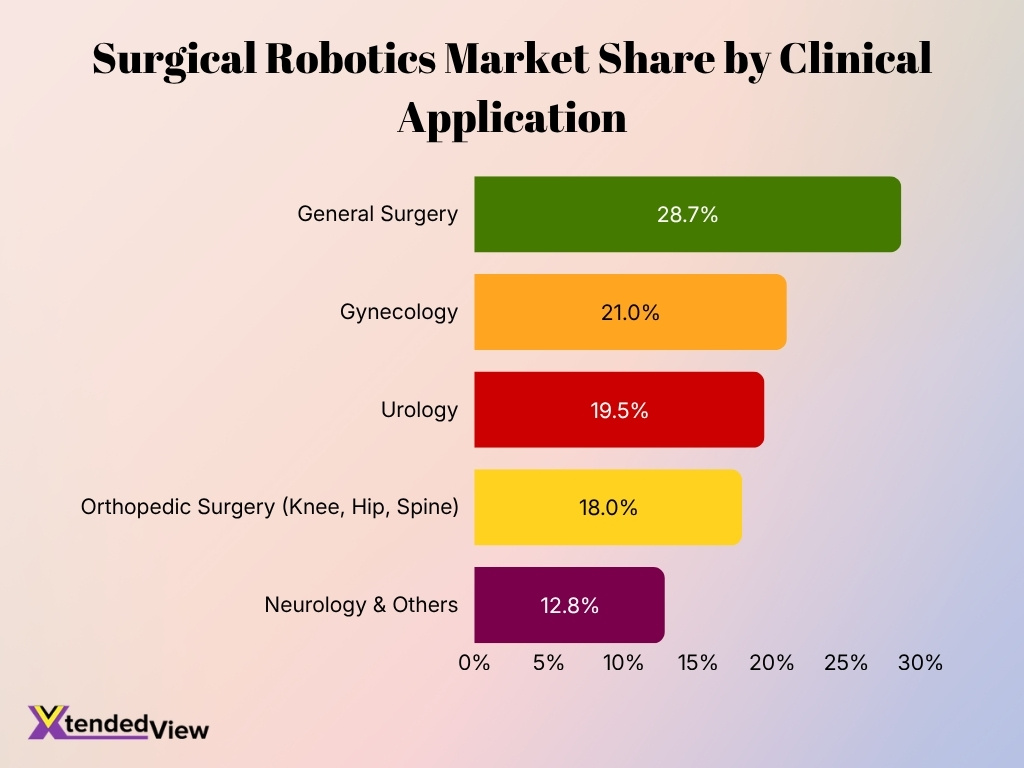
Surgical Robotics Market Share by Clinical Application
- General surgery leads the surgical robotics market with an estimated 28.7% share in 2026, making it the largest clinical application.
- Gynecology accounts for approximately 21.0% of the market, representing the second-largest surgical robotics segment.
- Urology holds an estimated 19.5% market share, highlighting the continued importance of robotic systems in urological procedures.
- Orthopedic surgery, including knee, hip, and spine procedures, represents approximately 18.0% of the surgical robotics market.
- Neurology and other surgical applications collectively account for the remaining 12.8% of the market.
- Combined, general surgery, gynecology, and urology represent approximately 69.2% of the surgical robotics market in 2026.
Warehouse and Logistics Automation
- Transportation and logistics companies purchased approximately 102,900 professional service robots in 2024, up 14% from the previous year.
- Logistics accounted for more than half of all professional service robots sold in 2024, making it the largest professional service robotics application by unit volume.
- Worldwide professional service robot sales approached 200,000 units in 2024, meaning logistics alone represented more than 100,000 annual deployments.
- Indoor transportation without public traffic remained the largest logistics robot application, covering mobile systems used to transport and handle goods inside warehouses and factories.
- Robot-as-a-service adoption in transportation and logistics grew 42% in 2024, allowing warehouse operators to add automation without purchasing every robot outright.
- Across professional service robotics, the overall robot-as-a-service fleet expanded 31% in 2024, supporting subscription-based deployment in logistics and other commercial environments.
- In 2026, an autonomous indoor drone warehouse system received recognition for commercial deployment after demonstrating automated inventory-monitoring capabilities, showing that warehouse robotics now extends beyond ground-based mobile platforms.
- Warehousing and logistics are also among the priority environments in China’s 2026 humanoid and embodied-intelligence deployment program, which targets more than 100 high-value application scenarios and deployment capacity at the 10,000-unit scale.
- The same 2026 program requires participating Chinese provincial regions to identify at least 20 priority real-world scenarios, while participating central enterprises must select at least 10, creating a formal pathway for warehouse, manufacturing and service robot testing.
- The combination of 102,900 logistics robots sold in 2024 and rapidly expanding rental models shows why material transport remains one of the clearest commercial applications for mobile robotics heading through 2026.
Agricultural Robots Statistics
- Professional agricultural robot sales totaled nearly 19,500 units in 2024, down 6% from the prior year as cultivation and robotic milking sales softened.
- In the U.S., 22% of farms and ranches reported using precision agriculture practices in 2025, including GPS guidance, drones, robotic milking, variable-rate applications, and related technologies.
- North Dakota recorded one of the highest U.S. adoption levels in 2025, with 50% of farms reporting precision agriculture use.
- In 2023, guidance and autosteering systems were already used by 70% of large-scale U.S. crop farms and 52% of midsize crop farms.
- Yield monitors, yield maps, and soil maps were used by 68% of large-scale U.S. crop-producing farms in 2023, indicating strong readiness for increasingly autonomous machinery.
- About 7% of European Union farms used robotics capable of autonomous operation in 2023, according to agricultural digitalization statistics released in 2026.
- Approximately 18% of EU farms used at least one precision-farming technology or practice in 2023, including robotic plant-protection equipment and automated variable-rate systems.
- Around half of dairy production in northwest Europe was projected to use robotic milking by 2025, highlighting dairy farming as one of agriculture’s most mature robot applications.
- A 2026 systematic review assessed 443 agricultural digital-twin studies, but fewer than 10% reported rigorous field-level numerical validation, illustrating the gap between agricultural robotics research and large-scale field deployment.
- U.S. agricultural technology investment remained selective in 2025: first-quarter funding totaled $1.6 billion across 137 deals, while precision agriculture and robotic field equipment showed stronger momentum than several other agricultural technology categories.
Consumer and Domestic Robots
- Consumer service robot sales totaled approximately 20.1 million units in 2024, representing 11% annual growth.
- Robots for domestic tasks such as vacuuming and lawn mowing accounted for about 97% of reported consumer robot sales in 2024.
- By contrast, only 536 home-care robots were registered in the same dataset, showing how small direct personal-assistance robotics remains compared with cleaning products.
- Consumer robot sales reported by suppliers in Europe increased 16% in 2024, matching the growth rate recorded among Asia-Pacific suppliers.
- Sales reported by suppliers in the Americas declined 1% in 2024, partly because of lower market share in robotic vacuum cleaners.
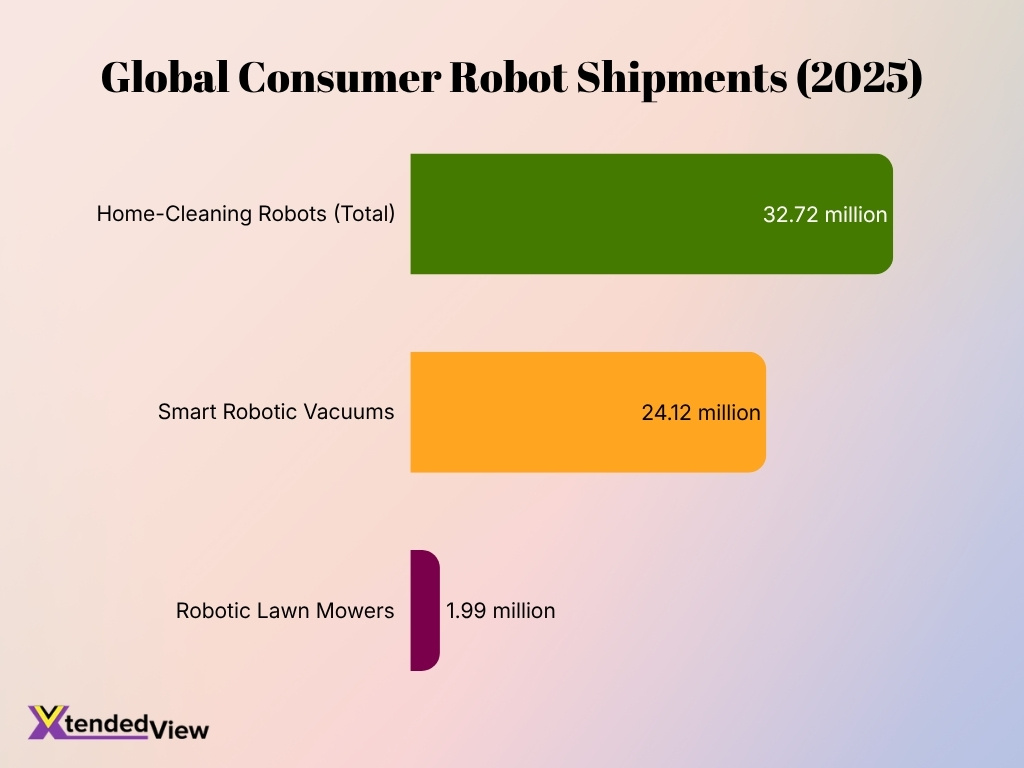
- Global home-cleaning robot shipments climbed to 32.72 million units in 2025, an increase of 20.1% from the previous year.
- Smart robotic vacuum shipments reached 24.12 million units in 2025, rising 17.1% year over year and remaining the largest household cleaning robot category.
- Robotic lawn mower shipments reached 1.99 million units in 2025, soaring 63.8% and making lawn automation one of the fastest-growing home robot applications.
- One 2026 forecast values the worldwide consumer robotics market at about $16 billion in 2026 and projects it to reach $40.2 billion by 2030.
- North America represented approximately 35% of global consumer robotics revenue in one recent market estimate, reflecting high adoption of smart-home and autonomous cleaning devices.
Robot Shipments and Sales Trends
- North American companies ordered 36,766 robots in 2025, up 6.6% from 2024 on a comparable reporting basis.
- Those 2025 orders were worth $2.25 billion, a 10.1% annual increase and the region’s highest annual robot-order volume since 2022.
- Q4 2025 accounted for 10,325 robot orders, 6.6% more than Q4 2024 and the sixth consecutive quarter of year-over-year unit growth.
- Companies ordered 9,055 robots in Q1 2026, only 0.1% fewer than a year earlier, even as automotive OEM demand weakened sharply.
- Q1 2026 robot-order revenue totaled $543 million, down 6.4% year over year.
- Q2 2026 orders increased to 8,940 robots worth $622 million, with unit demand rising 4.3% and dollar value increasing 21.3% from Q2 2025.
- First-half 2026 North American orders reached 17,995 units, 2% higher than in the first half of 2025.
- First-half robot-order value reached approximately $1.166 billion, representing 6.6% year-over-year growth.
- Professional service robot sales exceeded 199,000 units in 2024, growing 9% year over year and providing another major source of robotics volume outside factories.
- The operational industrial robot population reached approximately 4.664 million units worldwide in 2024, up 9%, showing how several years of high shipment volumes continue to enlarge the installed base.
AI and Machine Learning in Robotics
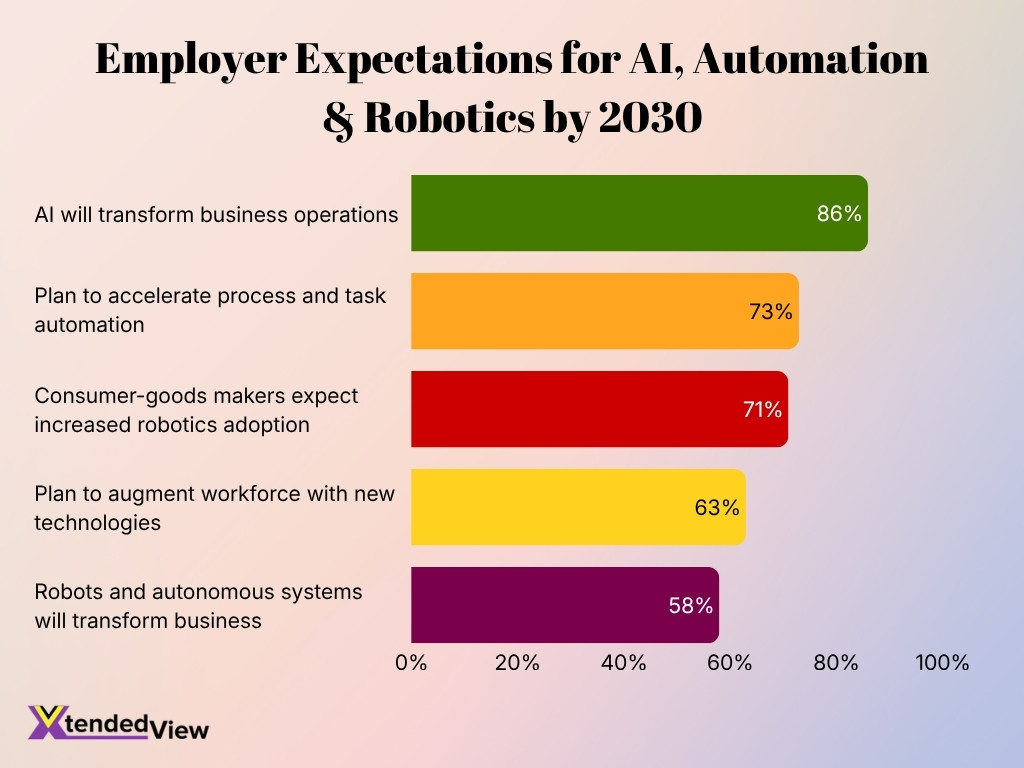
- 86% of surveyed employers expect AI and information-processing technologies to transform their businesses by 2030.
- Robots and autonomous systems are expected to transform 58% of employers’ businesses by 2030, making robotics the second-most-cited technology category after AI.
- About 73% of employers plan to accelerate process and task automation between 2025 and 2030.
- Another 63% of employers plan to augment their workforce with new technologies, indicating that many companies expect automation to complement workers rather than operate solely as a replacement strategy.
- In the U.S., 94% of surveyed employers expect AI and information-processing technologies to transform their operations during the five years through 2030.
- In Mexico, 63% of employers expect greater use of robotics, while 82% anticipate accelerating task automation by 2030.
- Consumer-goods manufacturers report particularly strong robotics expectations, with 71% anticipating increased adoption of robots and autonomous systems, compared with 58% across all industries.
- A May 2026 technology survey ranked physical AI as the No. 2 AI investment priority for organizations over the following 24 months.
- About 80% of physical-AI edge deployments could rely on cloud infrastructure by 2028, reflecting the growing connection between robots, AI models and remote computing resources.
- Employers expect robotics and autonomous systems to create a net displacement of about 5 million jobs by 2030, although the broader set of economic and technological trends is projected to generate a net gain in employment overall.
Frequently Asked Questions (FAQs)
Approximately 38,000 industrial robots were installed in 2025, up 11% year over year.
Companies ordered 17,995 robots worth about $1.166 billion, with unit orders rising 2% year over year.
Factories installed approximately 542,000 industrial robots, with Asia accounting for 74% of global deployments.
More than 199,000 professional service robots were sold, representing 9% annual growth.
Medical robot sales increased 91% to about 16,700 units in 2024, while surgical robot demand grew 41%.
Conclusion
Robots Statistics show that robotics has developed into a much broader technology market than conventional factory automation alone. Industrial robots remain the foundation of global deployment, but collaborative systems, service robots, medical platforms, warehouse automation, agricultural equipment, and consumer robots are creating additional sources of demand. Asia continues to dominate industrial installations, while the U.S. and other major manufacturing economies are increasing automation in industries ranging from electronics and food production to life sciences.
AI is likely to accelerate this shift by giving robots greater autonomy, perception, and flexibility in environments that previously required extensive programming or human supervision. Humanoid and general-purpose robots remain at an earlier stage of commercialization, but growing investment and production targets suggest they could become a more important part of the market over the next decade. Overall, the data point toward a robotics industry that is becoming more intelligent, diversified, and commercially relevant, with automation increasingly influencing productivity, workforce planning, and competition across both industrial and service sectors.