


PayZapp has evolved from a standalone digital wallet into a broader mobile payments platform that combines UPI, cards, a prepaid wallet, bill payments, shopping features, and digital credit products. Consumers can use the app for everyday activities such as scanning merchant QR codes, transferring money, paying utility bills, recharging mobile services, booking travel, and purchasing brand vouchers.
Its integration with HDFC Bank cards and PIXEL credit products also gives the platform a stronger banking connection than many pure UPI apps. With registrations, monthly active users, and transaction activity rising sharply, PayZapp offers a useful view of how bank-backed payment platforms are expanding within India’s fast-growing digital payments market.
Editor’s Choice
- PayZapp reached roughly 20.8 million registered users during FY 2025-26, compared with more than 16 million in FY 2024-25.
- That change represents approximately 30% year-over-year registration growth, based on the two reported year-end figures.
- Relative to the 7.5 million registrations reported at March 31, 2024, the FY 2025-26 base was approximately 177% larger.
- PayZapp served more than 5.2 million monthly active users in FY 2025-26.
- More than 4 million users were onboarded from April through September 2025 during a focused adoption campaign.
- The same campaign produced a 125% increase in transactions and a 200%+ rise in transaction value.
- PayZapp’s Android app has exceeded 10 million downloads, carries roughly 1.31 million reviews, and was rated about 4.5/5 in early September 2026.
Recent Developments
- From April through September 2025, a PayZapp marketing and engagement initiative attracted 40+ lakh new users.
- Daily transacting users increased 15% during that campaign period, indicating that growth included repeat payment activity rather than registrations alone.
- The number of wallet customers increased 61% over the campaign period.
- Overall transaction count surged 125%, more than doubling from the campaign’s comparison base.
- Transaction value rose by more than 200%, meaning value at least tripled relative to the comparison level.
- By FY 2025-26, PayZapp had scaled beyond 2.1 crore registrations and 52 lakh monthly active users, extending the gains generated during 2025.
- A September 2026 Android update introduced stronger card validation designed to prevent unsupported cards from being saved or used for payments. The app listing showed an update date of Sept. 1, 2026.
- PIXEL has also become a larger part of the PayZapp ecosystem, with two digital-card propositions, PIXEL Play and PIXEL Go, available through the app.
What Is PayZapp?
- PayZapp 2.0 launched in March 2023, replacing the earlier generation with a broader payments and commerce proposition.
- The platform combines four major funding options: UPI, credit cards, debit cards and the PayZapp prepaid wallet.
- Users can complete merchant payments through three main interaction formats: Scan, Tap and Swipe.
- The shopping area supports purchases from 200+ brand vouchers, expanding PayZapp beyond person-to-person transfers and QR payments.
- PayZapp’s registered population exceeded 2.1 crore, or 21 million, in FY 2025-26.
- More than 52 lakh, or 5.2 million, users were active on the platform each month in FY 2025-26.
- Its Android footprint exceeds 10 million installations, while more than 1.3 million Android users have submitted reviews.
- PayZapp also integrates the PIXEL digital credit-card experience, letting eligible users apply for and manage the card within the same app.
PayZapp Android Install Growth
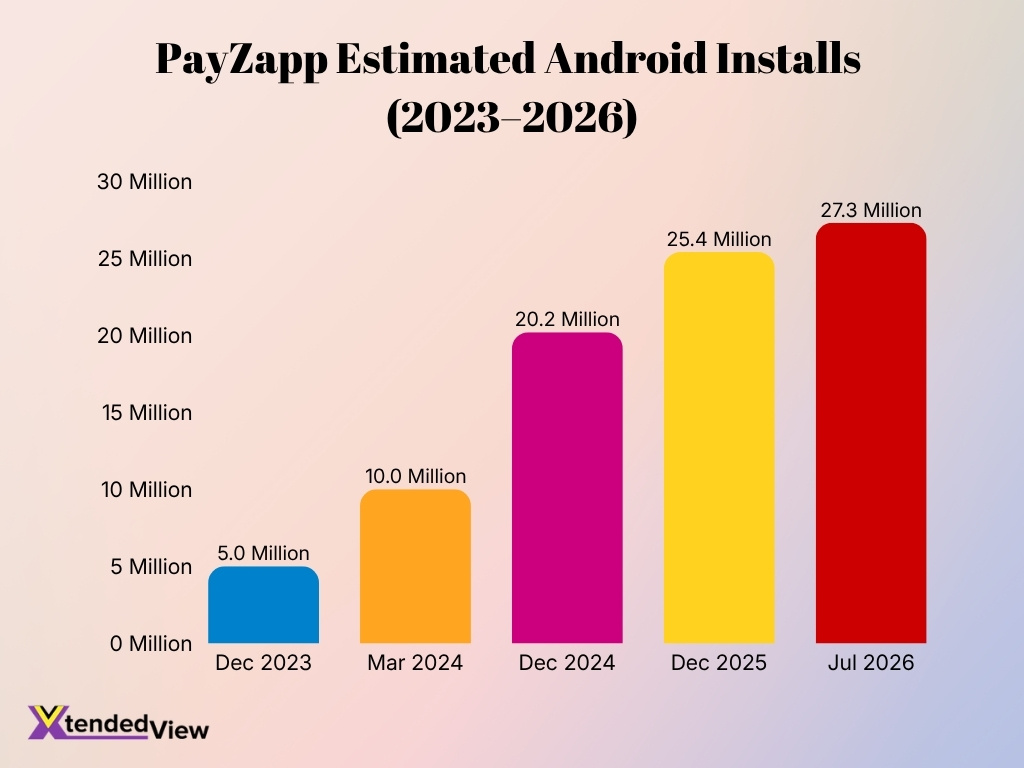
- PayZapp’s estimated Android installs increased from 5 million in December 2023 to 27.3 million by July 2026, representing more than a 5x increase.
- The app reached the 10 million+ Play Store milestone by March 2024, doubling its estimated installs from December 2023.
- PayZapp’s estimated Android installs climbed to 20.2 million by December 2024, adding more than 10 million installs in roughly nine months.
- By December 2025, estimated installs had risen to 25.4 million, an increase of about 25.7% from December 2024.
- PayZapp added another 1.9 million estimated installs between December 2025 and July 2026, reaching its latest peak of 27.3 million.
- Overall, PayZapp gained approximately 22.3 million Android installs between December 2023 and July 2026, highlighting substantial expansion in its Android user reach.
PayZapp Registration, KYC, and User Adoption
- PayZapp recorded 7.5 million registrations as of March 31, 2024.
- By March 2025, registrations had climbed beyond 16 million.
- The increase from 7.5 million to 16 million equals approximately 8.5 million additional registrations in about one year.
- That translates to roughly 113% year-over-year growth between the FY 2024 and FY 2025 reported registration totals.
- During FY 2025-26, the registered base reached approximately 20.8 million, extending the growth trend.
- Consequently, PayZapp added roughly 4.8 million registrations between the FY 2025 and FY 2026 reported levels, or about 30% growth.
- A single April-September 2025 initiative accounted for more than 4 million newly onboarded users, equivalent to roughly one-fifth of the eventual FY 2025-26 registered base.
- Monthly active usage exceeded 5 million users in FY 2024-25 and subsequently topped 5.2 million in FY 2025-26.
- Using 20.8 million registrations and 5.2 million monthly active users as reference points, monthly active users equaled approximately 25% of registered accounts. This ratio is an indicative calculation rather than a disclosed engagement rate.
PayZapp Transaction Volume and Growth
- PayZapp transaction count increased 125% during the April-September 2025 growth initiative.
- A 125% increase means transaction activity reached approximately 2.25 times its comparison-period level. This figure derives directly from the reported growth rate.
- Transaction value jumped by more than 200% over the same period, meaning payment value grew to more than three times its comparison-period level.
- Because transaction value rose more than 200% while transaction count rose 125%, the reported data indicates that average value per transaction also increased during the period.
- Daily transacting users grew 15%, showing that the increase in volume coincided with growth in the number of people making payments each day.
- PayZapp’s Zapp account recorded approximately 30 lakh transactions per month by FY 2025-26.
- About 5 lakh Zapp customers transacted monthly, which works out to roughly six transactions per monthly transacting customer based on the disclosed totals.
- At a constant pace of 30 lakh transactions a month, Zapp would represent an annualized run rate of about 3.6 crore transactions. This is a calculated run rate, not a reported full-year transaction total.
- More broadly, PayZapp’s monthly active user base exceeded 52 lakh in FY 2025-26, providing a larger recurring audience for UPI, wallet, card, and merchant-payment transactions.
PayZapp & UPI Transaction Limit
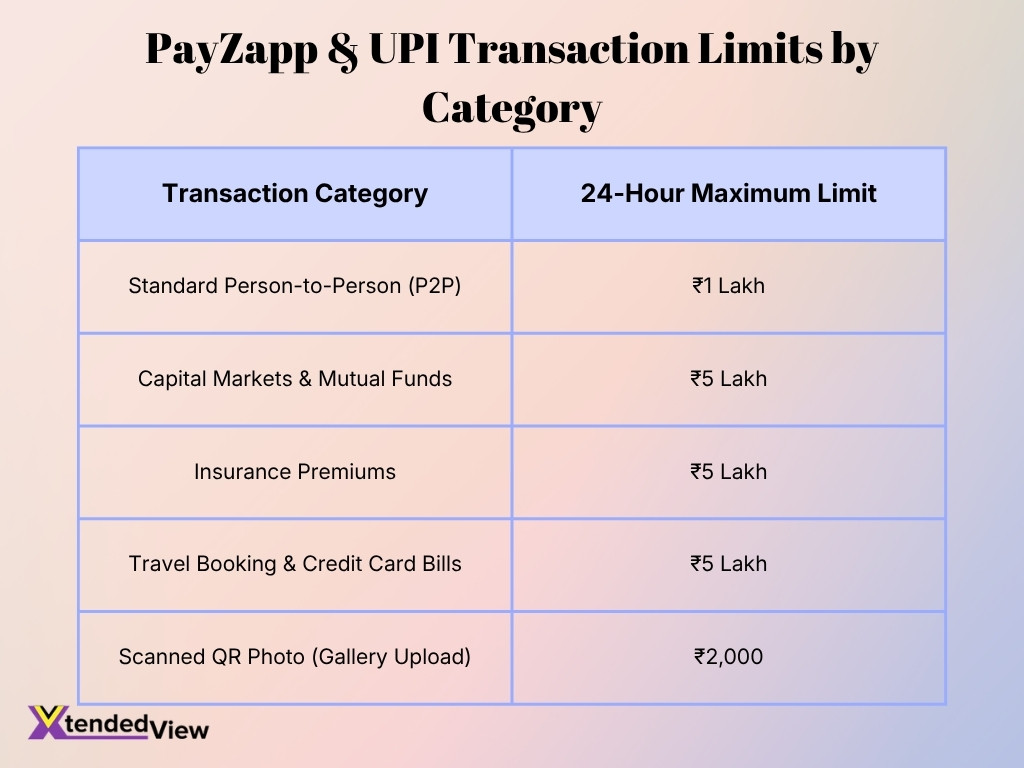
- Standard person-to-person (P2P) transactions have a maximum 24-hour limit of ₹1 lakh.
- Payments related to capital markets and mutual funds have a significantly higher daily limit of ₹5 lakh.
- Insurance premium payments are also permitted up to ₹5 lakh within 24 hours.
- Users can make travel bookings and credit card bill payments of up to ₹5 lakh per day.
- Transactions made using a scanned QR photo uploaded from the gallery are capped at just ₹2,000, the lowest limit among the listed categories.
- The highest transaction ceiling is ₹5 lakh, which is 5 times higher than the standard P2P limit of ₹1 lakh.
- Overall, the limits indicate that higher-value financial and bill-payment categories receive substantially larger transaction allowances than standard transfers and gallery-uploaded QR payments.
PayZapp UPI Payments and Transfers
- India’s UPI network processed 24,162 crore transactions in FY 2025-26, highlighting the payment ecosystem in which PayZapp competes. The network had 55.49 crore onboarded users by June 2026.
- In August 2026 alone, UPI processed 24.51 billion transactions worth ₹29.82 trillion, showing the scale of India’s instant-payment market.
- PayZapp’s Zapp account had approximately 5 lakh monthly transacting customers by FY 2025-26, generating around 30 lakh transactions per month. The account targets customers who want a separate balance for payments and UPI activity.
- Those figures imply roughly six monthly transactions per transacting Zapp customer, based on the reported 30 lakh transactions and 5 lakh customers.
- The standard UPI person-to-person ceiling can reach ₹1 lakh in 24 hours, although individual bank and transaction-category restrictions can affect the amount available to a PayZapp user.
- Higher-value UPI merchant categories can support transactions of up to ₹5 lakh, including eligible payments in areas such as capital markets, insurance, travel and credit-card bills.
- PayZapp users can scan any UPI QR, rather than relying only on a PayZapp-specific merchant acceptance network.
- Standard customer UPI transfers generally carry no transaction charge. For eligible PPI-funded merchant transactions above ₹2,000, a 1.1% interchange mechanism can apply, but the customer does not directly pay that interchange fee.
- PayZapp’s UPI terms also support mandates, while transaction ceilings for IPO and non-IPO mandates follow applicable payment-network limits.
PayZapp Wallet and Zapp Account Statistics
- The Zapp account was introduced during FY 2024-25 to meet demand for a secondary account dedicated to payments and UPI transactions.
- By FY 2025-26, approximately 5 lakh Zapp customers were transacting each month.
- These customers generated about 30 lakh monthly transactions, equivalent to an annualized run rate of approximately 3.6 crore transactions if that monthly pace remained constant.
- During the April-September 2025 PayZapp growth campaign, the number of wallet customers increased by 61%.
- A full-KYC Zapp account can hold up to ₹2 lakh, compared with ₹10,000 under the PAN-based KYC tier.
- Full-KYC users can load up to ₹2 lakh per transaction, ₹4 lakh per month and ₹24 lakh per year under the currently published Zapp limits.
- Full-KYC Zapp spending limits reach ₹2 lakh per transaction, ₹6 lakh per month and ₹24 lakh per year.
- PAN-based KYC accounts carry a lower ₹10,000 transaction and monthly spending limit, with annual loading and spending capped at ₹1.2 lakh.
- Loading a Zapp account through a debit card or UPI carries 0% loading fees, while credit-card loading currently costs 2.5% plus applicable GST.
PayZapp PIXEL Credit Card Statistics
- PIXEL currently centers on two core card propositions, PIXEL Play and PIXEL Go, with application and card-management journeys available through PayZapp.
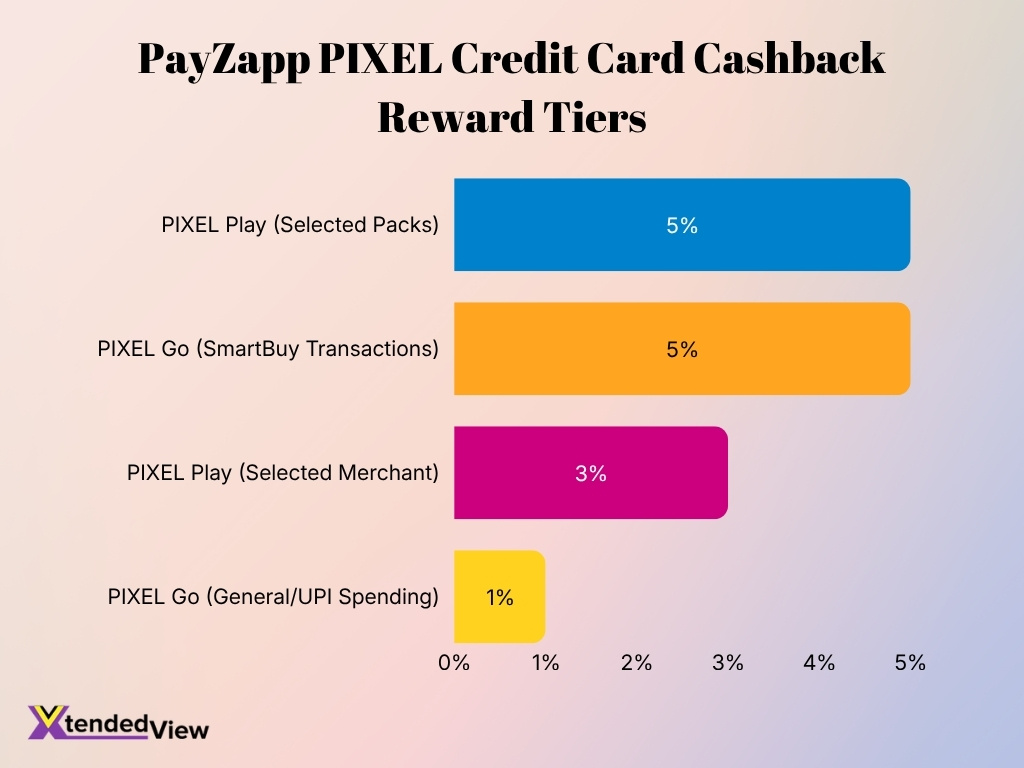
- PIXEL Play can return up to 5% cashback on selected spending packs, 3% on a selected merchant, and 1% on eligible other spending.
- PIXEL Play caps the 5% selected-pack reward at 500 CashPoints per month, while its selected 3% merchant reward also carries a 500-CashPoint monthly cap.
- PIXEL Go provides 1% cashback on eligible spending, plus 5% cashback through eligible SmartBuy transactions and 1% on eligible UPI spending with its RuPay version.
- Under the fair-use policy effective from October 2025, the maximum cashback under the cards’ 1% other-spend feature is ₹15,000 per calendar month.
- PIXEL cards can provide up to 50 days of interest-free credit from the purchase date, subject to applicable billing and merchant-submission conditions.
- PIXEL Play provides a 1% fuel surcharge waiver on eligible fuel transactions from ₹400 to ₹5,000, capped at ₹250 per statement cycle.
- PIXEL Go’s renewal fee can be waived after ₹50,000 in eligible annual spending, while PIXEL Play’s standard renewal-waiver threshold is ₹1 lakh.
- FD-backed PIXEL cards can offer a credit limit of up to 90% of the underlying fixed deposit, opening a secured-credit route for customers who may not qualify through a conventional unsecured application.
- A credit-card app market study covering November 2023 through October 2024 estimated 21.5 million PayZapp downloads, up 414.35% from 4.18 million in the preceding comparable period. PayZapp accounted for 34.45% of downloads within that study’s 25-app credit-card sample.
PayZapp Bill Payments and Recharge Statistics
- PayZapp advertises cashback of up to 5% on eligible online bill payments, subject to the terms of the active offer.
- Eligible recharge transactions can also earn up to 5% cashback, extending rewards to recurring prepaid expenses.
- Credit-card bill payments currently advertise a flat ₹11 cashback under the applicable promotional terms.
- The app supports at least four explicitly promoted recharge types: prepaid mobile, postpaid mobile, DTH and FASTag, alongside bill-payment categories.
- A FY 2025-26 customer offer booklet estimated potential PayZapp savings of up to ₹12,000 per year across bill payments, recharge, FASTag, shopping, travel and related use cases.
- From Aug. 1, 2025, government, education and FASTag payments made through UPI, the PayZapp wallet, eligible debit cards or an HDFC Bank credit card carried no PayZapp convenience charge.
- The same zero-charge structure applies to insurance payments made through UPI, the PayZapp wallet, eligible debit cards or an HDFC Bank credit card. A non-HDFC credit card incurs a 1.10% charge for insurance payments.
- Mobile prepaid, electricity, LPG cylinder and other permitted bill categories carry no PayZapp charge with UPI, wallet, eligible debit cards or HDFC Bank credit cards, while eligible non-HDFC credit-card payments carry a 2.50% charge.
- Most bill payments complete instantly, but an unresolved provider confirmation can take up to four days to process. Failed payments in these cases should also return to the source account within four days.
PayZapp Shopping and Merchant Payment Statistics
- Shoppers have access to instant e-vouchers from over 200+ partner brands for online and offline shopping.
- Promotional shopping campaigns deliver cashback of up to ₹1,000 on eligible e-voucher purchases.
- The FY 2025–26 loyalty framework provides potential savings of up to ₹1,000 per month across participating merchants.
- The booking marketplace integrates 4 major travel categories: flights, hotels, buses, and trains.
- Customers can redeem accumulated reward points across 2 travel categories for flights and hotel stays.
- Merchant checkout features support seamless interoperability with any UPI QR code.
- Users can complete transactions using 3 payment methods: Scan, Tap, and Swipe.
- Issued promotional shopping e-vouchers carry a strict expiration term of 30 days from issuance.
- Unavailable voucher denominations are dynamically restocked within 48 hours.
PayZapp User Demographics Statistics
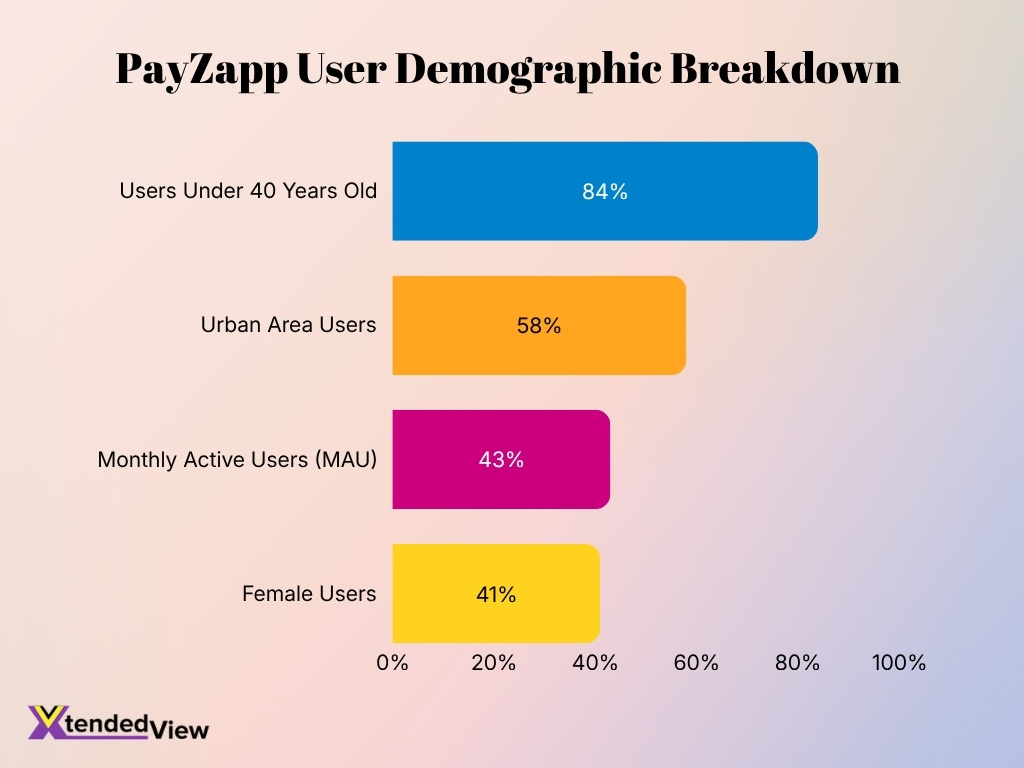
- 84% of PayZapp users are under 40 years old, indicating that the platform has a predominantly younger user base.
- Urban users account for 58% of PayZapp’s user base, showing stronger adoption across cities and urban markets.
- Monthly active users (MAU) represent 43% of the user base, highlighting the proportion of users who actively engage with PayZapp each month.
- Female users make up 41% of PayZapp’s total user base, indicating substantial participation among women.
- The demographic data suggests that PayZapp’s strongest audience consists of younger, urban, and digitally active consumers.
PayZapp Cashback, Rewards, and Offers
- PayZapp currently advertises up to 5% cashback on qualifying online bill payments.
- Eligible mobile and service recharges can generate up to 5% cashback under current promotional positioning.
- Eligible shopping and e-voucher purchases can return as much as ₹1,000 cashback.
- Credit-card bill-payment promotions advertise a flat ₹11 cashback on qualifying transactions.
- PIXEL Play offers cashback of up to 5% on two selected spending packs, allowing customers to tailor rewards around their spending behavior.
- The same card can return 3% cashback on one selected merchant, with the reward capped at 500 CashPoints per month for that benefit.
- PIXEL Go offers 1% cashback on eligible general spending, while eligible SmartBuy spending can earn 5%.
- One PIXEL CashPoint has a redemption value of ₹1, making the reward conversion straightforward for eligible card cashback.
- Eligible PayZapp CashPoints can take up to seven days to reach an account after a successful qualifying transaction is fulfilled.
- Customers need completed KYC before transferring eligible PayZapp CashPoints to the PayZapp wallet, linking reward redemption with identity-verification requirements.
PayZapp Fees, Charges, and Transaction Limits
- Effective Jan. 6, 2025, PayZapp reduced its wallet-to-account transfer charge to zero, compared with the previous 1% plus GST charge.
- Loading the wallet through UPI carries no PayZapp loading fee under the published schedule.
- HDFC Bank and non-HDFC debit-card wallet loads also carry no loading fee.
- Credit-card wallet loading costs 2.5% plus GST, up from 1.5% plus GST before the January 2025 revision.
- Full-KYC wallet spending can reach ₹2 lakh per transaction, with a published annual spending ceiling of ₹10 lakh in the general PayZapp FAQ.
- Wallet-to-bank transfers carry a limit of ₹50,000 per beneficiary per month, while total monthly wallet-to-account transfers can reach ₹1.5 lakh.
- The published yearly wallet-to-account transfer ceiling is ₹10 lakh.
- From Aug. 1, 2025, eligible non-HDFC credit cards incur a 1% charge for government, education and FASTag payments, while the corresponding UPI, wallet, debit-card and HDFC Bank credit-card routes carry no PayZapp charge.
- Eligible non-HDFC credit-card insurance payments carry a 1.10% charge, while certain other categories, including mobile prepaid, electricity and LPG cylinder payments, can carry a 2.50% charge when funded by a non-HDFC credit card.
- Refund timing depends on the original payment method: PayZapp lists approximately one working day for wallet refunds, three to four working days for UPI and four to seven working days for cards after failed transactions.
PayZapp Feature Usage Statistics
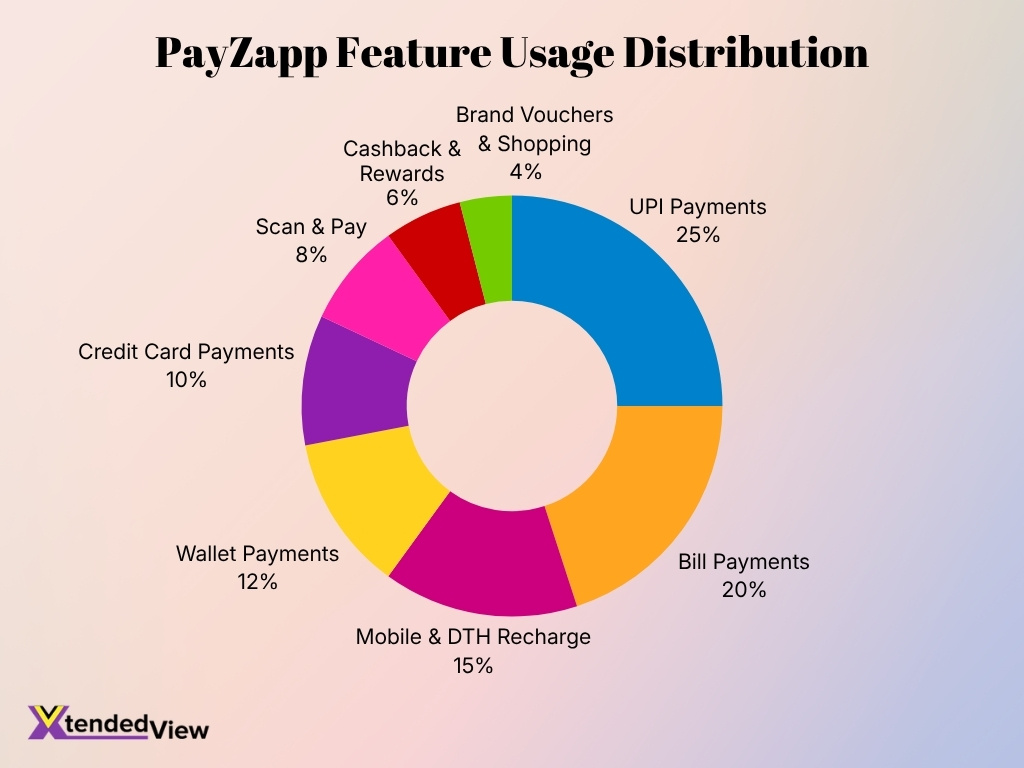
- UPI Payments are the most-used PayZapp feature, accounting for 25% of total feature usage.
- Bill Payments rank second with a 20% share, highlighting strong demand for recurring payment services.
- Mobile & DTH Recharge represents 15% of PayZapp feature usage, making it the third-largest category.
- Wallet Payments account for 12% of usage, while Credit Card Payments contribute another 10%.
- Scan & Pay represents 8% of total feature usage, reflecting the role of QR-based payments on the platform.
- Cashback & Rewards make up 6% of usage, indicating a smaller but notable role for incentive-based features.
- Brand Vouchers & Shopping have the lowest share at 4% of total PayZapp feature usage.
- The top three features, UPI Payments, Bill Payments, and Mobile & DTH Recharge, collectively account for 60% of overall usage.
PayZapp Security and Fraud Prevention
- PayZapp uses a 4-digit numeric passcode for app access, and users must keep at least one device or app lock enabled at all times.
- Entering the wrong PayZapp passcode three times temporarily blocks the account for 24 hours. The same 24-hour block can apply after three incorrect card-detail attempts.
- Swipe to Pay works as a two-factor authentication method and operates only on the device registered to the PayZapp account.
- Swipe to Pay supports five card-network or card-type combinations listed for eligible HDFC Bank and prepaid cards: RuPay, Diners Club, Mastercard, Visa, and prepaid cards.
- The Swipe to Pay feature requires PayZapp version 1.78 or later under the published compatibility guidance for previously linked cards.
- HDFC Bank credit-card users can control at least three transaction settings through the PayZapp-linked card-control interface: online transactions, contactless transactions and international usage. Changes take effect immediately.
- PayZapp limits cashback-linked account proliferation to two registered PayZapp mobile numbers per PAN under applicable program conditions. Additional accounts tied to the same PAN can lose KYC status and cashback eligibility.
- One device ID can have a maximum of three registered PayZapp mobile numbers before additional accounts face restrictions under the applicable cashback rules.
- Eligible customers can receive cashback for no more than five transactions per device per day under the stated anti-abuse conditions.
- The broader banking platform reported that 98% of financial transactions were digital in FY 2025-26, increasing the importance of authentication, cyber controls, and secure payment architecture across services connected with PayZapp.
UPI App Market Share and Transaction Volume in India
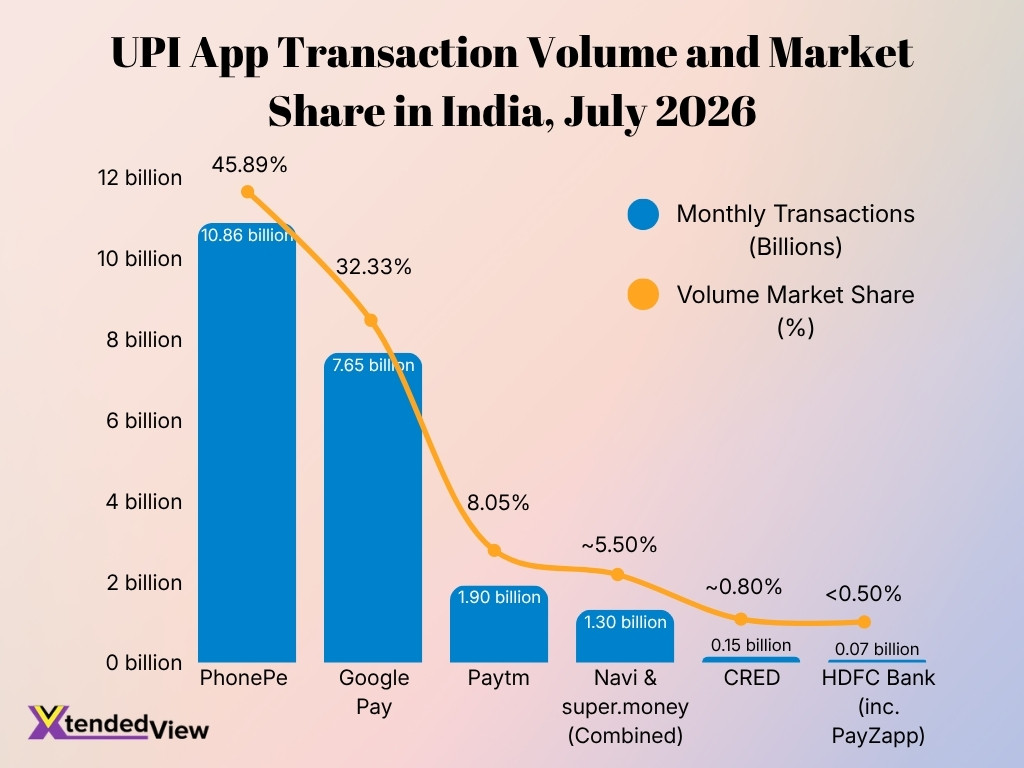
- PhonePe dominated India’s UPI market in July 2026 with 10.86 billion monthly transactions, accounting for 45.89% of transaction volume.
- Google Pay ranked second with 7.65 billion transactions and a substantial 32.33% market share.
- Together, PhonePe and Google Pay controlled 78.22% of India’s UPI transaction volume, highlighting the market’s strong concentration among the top two apps.
- Paytm held the third position, processing 1.90 billion monthly transactions and capturing 8.05% of UPI volume.
- Navi and super.money combined processed approximately 1.30 billion transactions, representing around 5.50% of the market.
- CRED accounted for roughly 0.80% of UPI transaction volume, with about 150 million monthly transactions.
- HDFC Bank, including PayZapp, processed around 70 million transactions, giving it a comparatively small market share of less than 0.50%.
- The figures show a significant gap between the market leaders and smaller UPI platforms, with PhonePe alone handling nearly 46% of total transaction volume.
PayZapp for HDFC Bank Customers
- Existing HDFC Bank customers can complete bank-based full KYC using account or card information instead of starting the same identity-verification journey required of many non-bank users.
- PayZapp can automatically fetch and link eligible HDFC Bank debit and credit cards during onboarding, reducing the need to enter complete card details manually.
- For credit-card bill payments, an HDFC Bank card should appear automatically. If it does not, customers can add it using the card’s 16-digit number.
- HDFC Bank credit-card payments initiated through PayZapp generally settle on T-Day, while payments to cards from other banks typically take two to four days.
- Customers can set up a RuPay credit card for UPI using the last six digits of the card, expiry date, OTP, credit-card PIN, and a newly created UPI PIN.
- HDFC Bank held approximately 26.98 million credit cards in circulation in July 2026, giving PayZapp access to India’s largest individual bank credit-card base.
- The bank added about 230,067 net credit cards in July 2026 alone, the largest monthly increase among reporting banks in that month’s data.
- Across the wider digital ecosystem, the HDFC Bank ONE platform recorded more than 4.9 crore monthly engagements in FY 2025-26.
- About 99% of personal loans originated digitally during FY 2025-26, illustrating the broader digital-first customer base into which PayZapp fits.
- The bank’s digital adoption increased from 97% of financial transactions in FY 2024-25 to 98% in FY 2025-26, reinforcing PayZapp’s role within an increasingly digital customer relationship.
Frequently Asked Questions (FAQs)
PayZapp reached approximately 2.08 crore, or 20.8 million, registered users in FY 2025-26.
PayZapp has more than 50 lakh, or 5 million, monthly active users in FY 2025-26.
During its April-September 2025 campaign, PayZapp recorded a 125% increase in transactions and a 200%+ rise in transaction value.
PayZapp has surpassed 10 million Android downloads and has accumulated about 1.31 million reviews with a 4.5-star rating as of September 2026.
The Zapp Account generates around 30 lakh transactions per month from approximately 5 lakh monthly transacting customers, equal to about six transactions per customer.
Conclusion
PayZapp enters the rest of the year with a larger registered-user base, stronger transaction activity and a broader mix of UPI, wallet, card, shopping and digital-credit services. Its 2025 growth campaign increased transactions by 125%, transaction value by more than 200% and wallet customers by 61%, while monthly active usage moved above 5 million users. At the same time, the platform benefits from wider UPI adoption, a large HDFC Bank card customer base, and increasing demand for integrated payment experiences.
PayZapp still operates in a market where the largest UPI apps control most transaction volume, so its competitive strength does not depend on UPI scale alone. Instead, its position comes from combining everyday payments with wallet balances, card management, rewards, bill payments, merchant transactions, and PIXEL credit products in one app. As India’s digital payment ecosystem continues to expand, PayZapp’s ability to increase active usage and deepen engagement among both HDFC Bank and non-bank customers will be an important measure of its future growth.
